
Trans-Siberian Rail Freight Transport Market Size and Share
Market Overview
| Study Period | 2021 - 2032 |
|---|---|
| Forecast Data Period | 2027 - 2032 |
| Base Year Market Size (2026) | USD 7.22 Billion |
| Market Size (2027) | USD 7.5 Billion |
| Market Size (2032) | USD 8.93 Billion |
| Growth Rate (2027 - 2032) | 3.55 % |
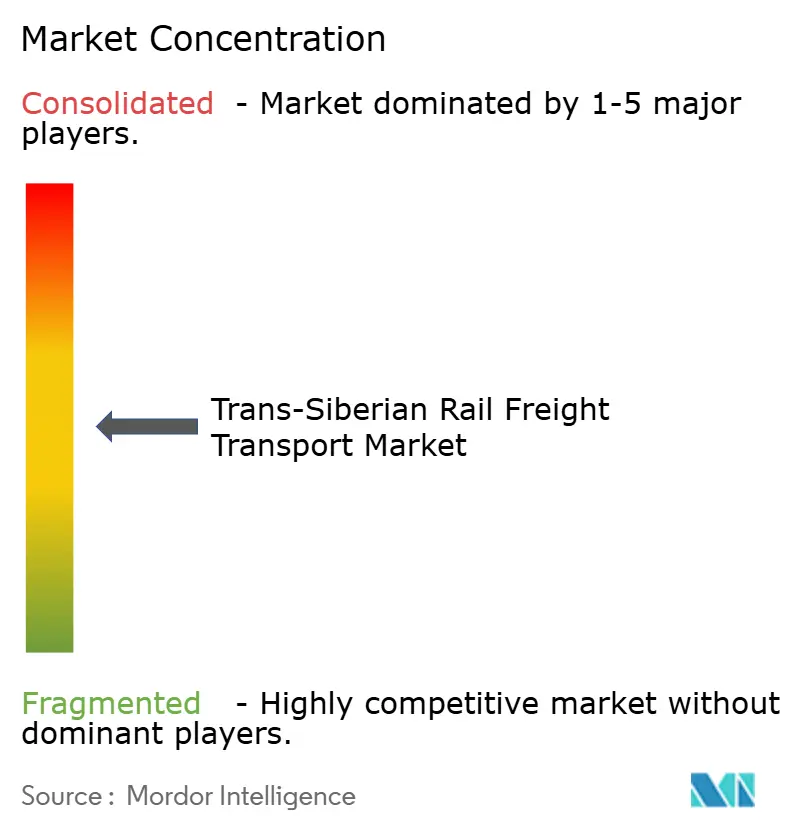
| Market Concentration | Medium |
Major Players *Disclaimer: Major Players sorted in no particular order Image © Mordor Intelligence. Reuse requires attribution under CC BY 4.0. | |
Trans-Siberian Rail Freight Transport Market Analysis by Mordor Intelligence
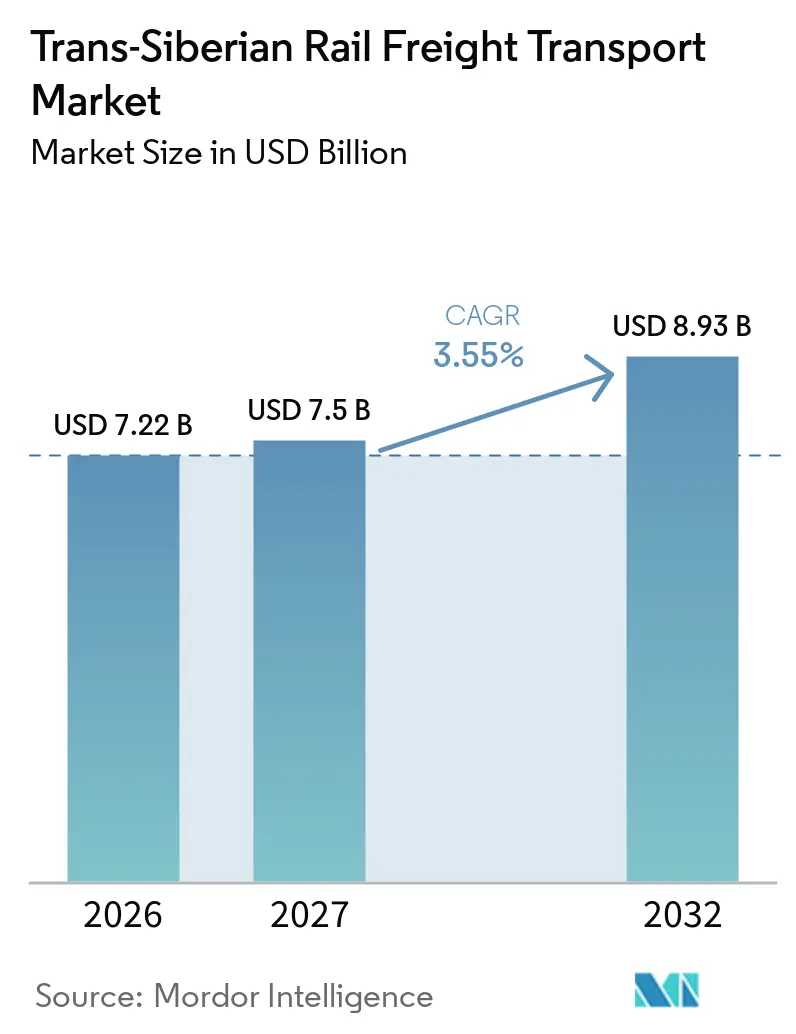
The Trans-Siberian rail freight transport market size is valued at USD 7.22 billion in 2026 and is estimated to grow from USD 7.50 billion in 2027 to reach USD 8.93 billion by 2032, at a CAGR of 3.55% during the forecast period (2027-2032).
The Trans-Siberian rail freight transport market remains anchored in domestic resource movements, while China-linked manufactured cargo is changing the mix of traffic on the corridor. Russia-China rail freight reached 186.8 million tons in 2025, and rail traffic in manufactured goods and vehicles from China continued to rise during the first 7 months of 2026. Investment priorities, port additions, and border capacity improvements support activity in the east, although lower rail investment and equipment constraints restrict available capacity.[1] The China-Europe transit business remains sensitive to relative sea and rail freight costs, which makes it less stable than domestic freight. Private operators are competing on wagon availability, service reliability, and digital processes, while RZD retains control of the network and access conditions.
Key Report Takeaways
- By cargo type, bulk commodities held 48.43% of the Trans-Siberian rail freight transport market share in 2026, while project and oversized cargo recorded the highest projected CAGR at 4.97% through 2032.
- By shipment configuration, wagonload and single-wagon services held 45.21% of the Trans-Siberian rail freight transport market size in 2026, while dedicated and block-train services recorded the highest projected CAGR at 5.24% through 2032.
- By commodity, coal and coke held a 30.54% share of the Trans-Siberian rail freight transport market size in 2026, while machinery, automotive, and other manufactured goods recorded the highest projected CAGR at 4.46% through 2032.
- By destination, domestic freight held 62.05% of the Trans-Siberian rail freight transport market share in 2026, while international and cross-border freight recorded the highest projected CAGR at 3.82% through 2032.
- By geography, Central and European Russia, including the Moscow Origin Area, held 25.83% of the Trans-Siberian rail freight transport market size in 2026, while the Russian Far East recorded the highest projected CAGR at 4.28% through 2032.
Note: Market numbers in this report are based on Mordor Intelligence's proprietary estimation framework, which combines nine months of actuals with Q4 projections for base year 2026.
Market Trends and Insights
Drivers Impact Analysis of Trans-Siberian Rail Freight Transport Market*
| Driver | (~) % Impact on CAGR Forecast | Geographic Relevance | Impact Timeline |
|---|---|---|---|
| Asia-Europe Supply-Chain Diversification | +0.7% | Global, with primary gains along the Trans-Siberian mainline and Russian Far East | Medium term (2-4 years) |
| Government Investment in the Eastern Polygon | +0.5% | Eastern Siberia and Russian Far East | Long term (≥ 4 years) |
| Rising China-Russia and Central Asia Trade | +0.8% | Russian Far East, Eastern Siberia, Ural Region, and Central Asian border crossings | Short term (≤ 2 years) |
| Digital Slot Booking and Electronic Customs Documentation | +0.4% | Russia-China and Russia-Kazakhstan border crossings and the EAEU network | Short term (≤ 2 years) |
| Shorter Delivery Windows for High-Value and Time-Sensitive Cargo | +0.3% | China-Europe transit, Ural Region, and Western Siberia origin points | Medium term (2-4 years) |
| Underused Return-Leg Capacity for Westbound Services | +0.2% | Central and European Russia, including the Moscow Origin Area | Medium term (2-4 years) |
| Source: Mordor Intelligence | |||
Rising China-Russia and Central Asia Trade Reshapes Commodity Mix
Russia-China bilateral rail freight reached 186.8 million tons in 2025, the highest annual volume on record. The January-July 2026 pattern indicated a further 6% increase, and container traffic reached 2.1 million TEU. Vehicles and components from China rose 51.6%, manufactured goods increased 24.3%, and fertilizers moving from Russia to China increased 15.1% over the same period.[2] This traffic broadens the cargo base beyond traditional bulk flows and supports demand for reliable container services in the Trans-Siberian rail freight transport market. Zabaikalsk processed 197,400 TEU from January through April 2026, up 32% year-over-year. The May 2026 Russia-China agreement for a second standard-gauge track at Zabaikalsk-Manzhouli targets 11 million tons of added annual capacity by 2030, though other gauge-change crossings still face limits.
Government Investment in the Eastern Polygon Enables Long-Run Capacity
The third stage of Eastern Polygon modernization began in early 2026 and targeted 270 million tons of combined Trans-Siberian and Baikal-Amur Mainline throughput by 2035. The program carries an estimated value of RUB 3.7 trillion (USD 46.87 billion). In 2025, the construction cycle delivered 249.8 km of additional track and began work in the Severomuisky and Kodarsky tunnels, with confirmed participation of up to RUB 500 billion (USD 6.33 billion), alongside syndicated credit exceeding RUB 1 trillion (USD 12.66 billion) for Eastern Polygon work. These projects can ease capacity pressure across Eastern Siberia and the Russian Far East over a longer period.[3] However, lower capital allocations and reported project delays mean that capacity additions may arrive later than commercial demand across the Trans-Siberian rail freight transport market.
Asia-Europe Supply-Chain Diversification Creates Durable Transit Demand
The Trans-Siberian corridor remains a routing option for shippers who need an alternative to maritime services. A 2025 study in the Journal of Shipping and Trade found that generalized rail chain costs averaged 1.5-2 times maritime equivalents, while the difference narrowed for inland Chinese origins. This position favors rail services for cargo originating far from Chinese seaports. China-Europe rail volumes rose 25% in January-February 2026 after declining 23.3% in 2025, showing the effect of shifting modal prices and contracted capacity. Central Asian container rail flows rose 27.7% to 1.13 million TEU in 2025, providing another source of corridor demand. The Trans-Siberian rail freight transport market, therefore, benefits from more diversified routing needs, but transit volumes can still move sharply when maritime conditions change.
Digital Slot Booking and Electronic Customs Documentation Compress Dwell Times
Russia, Belarus, and Kazakhstan completed their transition to digital transport documents by August 2025. Russia's Federal Customs Service also introduced automated inter-post declaration routing in December 2025. KTZ and RZD signed a joint digitalization plan in May 2026 for a unified digital space across 9 Russia-Kazakhstan interchange points. Faster document handling supports container traffic and reduces delays at border locations. This is particularly relevant because container throughput at Zabaikalsk rose 32% in January-April 2026, while total tonnage rose 4.3%. Better slot booking and electronic documentation can improve asset utilization, although they cannot resolve physical gauge and inspection constraints on their own.
Restraints Impact Analysis of Trans-Siberian Rail Freight Transport Market*
| Restraint | (~) % Impact on CAGR Forecast | Geographic Relevance | Impact Timeline |
|---|---|---|---|
| Sanctions-Led Locomotive and Spare-Parts Constraints | -0.7% | Eastern Siberia and Russian Far East, particularly Eastern Polygon bottleneck zones | Long term (≥ 4 years) |
| Border-Crossing, Gauge-Change and Inspection Bottlenecks | -0.5% | Russia-China crossings and Russia-Kazakhstan interchange points | Medium term (2-4 years) |
| Maritime Rate Normalization and Canal Reopening Risk | -0.4% | China-Europe transit and cross-border freight linked to EU destinations | Short term (≤ 2 years) |
| Uneven Eastbound-Westbound Cargo Balance | -0.2% | Pan-corridor, with the strongest effect at Central European terminus points | Medium term (2-4 years) |
| Source: Mordor Intelligence | |||
Sanctions-Led Locomotive and Spare-Parts Constraints Cap Throughput
Restrictions on imported locomotive components and rail-engineering services continue to affect fleet renewal and maintenance. EU Council Regulation No. 833/2014, as amended through 2025, restricts relevant supplies and services connected with Russian rail operations. RZD's rolling-stock procurement declined from RUB 257.2 billion (USD 3.25 billion) in 2025 to RUB 161.7 billion (USD 2.04 billion) in 2026. This reduction limits the scope for rapid fleet replacement. Constraints are most acute where the Eastern Polygon requires dependable traction for heavy commodity and container services. The operational effect is lower flexibility during periods of high demand, which can shift cargo among operators and reduce effective network throughput. The Trans-Siberian rail freight transport market can, therefore, expand in revenue while physical capacity remains constrained.
Border-Crossing, Gauge-Change and Inspection Bottlenecks
Russia's 1,520 mm gauge and China's 1,435 mm gauge require container transshipment or axle exchange at locations such as Zabaikalsk-Manzhouli. These processes add time and make border capacity critical for rail services. A May 2025 UN ESCAP review found that electronic document exchange at the Russia-Mongolia-China junction was not legally binding, which left paper procedures in place. Construction work on the Dostyk-Moynty line also created operating disruptions during 2025. The second-track agreement at Zabaikalsk-Manzhouli addresses a significant crossing, but it does not resolve all interchange points.[4] These conditions sustain a capacity drag on the Trans-Siberian rail freight transport market through the forecast period.
*Our forecasts treat driver/restraint impacts as directional, not additive. The impact forecasts reflect baseline growth, mix effects, and variable interactions.
Trans-Siberian Rail Freight Transport Market Segment Analysis
By Cargo Type:
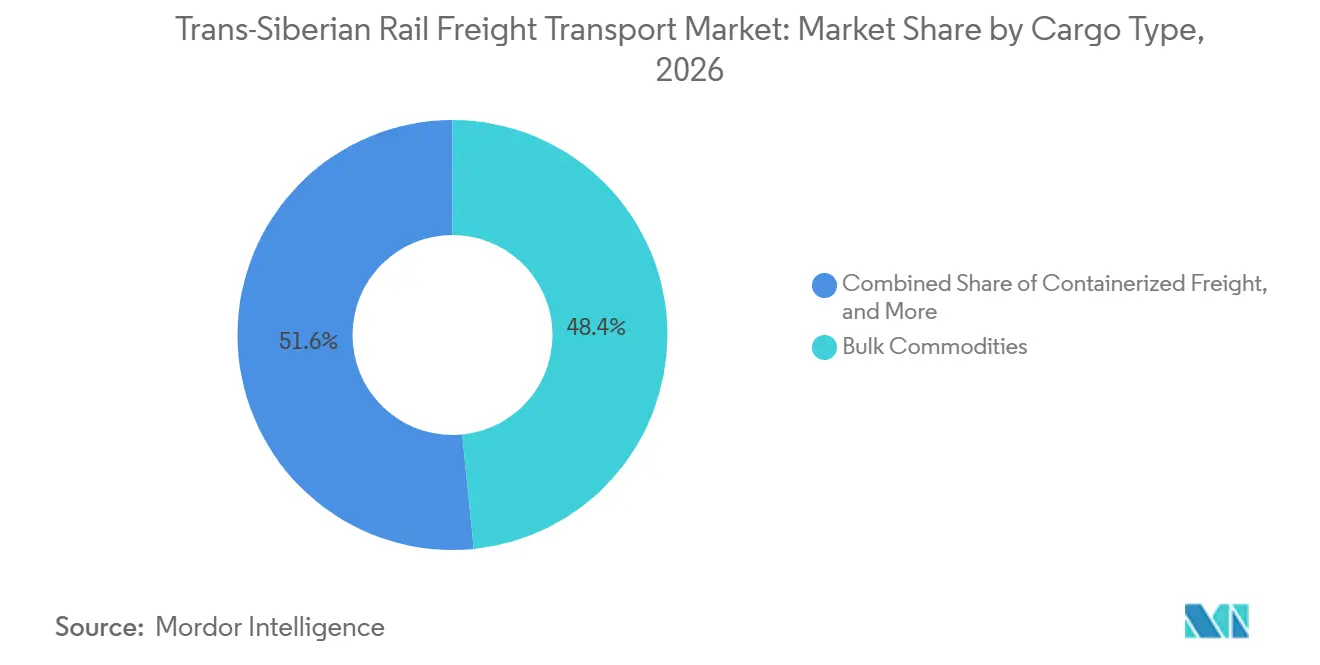
Bulk Anchors Revenue While Project Cargo Leads GrowthBulk commodities held 48.43% of the Trans-Siberian rail freight transport market size in 2026, reflecting the route's role in moving high-volume materials. Bulk traffic is tied to the geography of mines, production sites, ports, and industrial consumers. Rail coal exports fell for the fifth consecutive year in 2025, even as eastbound coal volumes remained near 119 million tons. This contrast shows that eastbound activity has stayed important despite weaker aggregate coal loading. Eastern Polygon construction activity and deliveries of Chinese industrial machinery to Russian Far East projects support this rate.
Project and oversized cargo records a 4.97% CAGR for 2027-2032. Containerized freight is expanding as terminal capacity develops in Vladivostok, Novosibirsk, and Khabarovsk. General cargo and breakbulk support domestic food distribution and other routine industrial flows. Other specialized cargo faces limits from the restricted availability of temperature-controlled wagons. International rail services use SMGS procedures administered by the Organisation for Cooperation of Railways. Bulk traffic may remain central to the revenue base, even as specialized movements become more visible in the Trans-Siberian rail freight market. The Trans-Siberian rail freight industry, therefore, continues to rely on the capacity to handle heavy cargo consistently, even where container movements gain importance. The mix creates an opening for operators that can manage complex cargo without losing the scale advantages of bulk transport.

By Shipment Configuration:
Block-Train Scheduling Commands a Growing PremiumWagonload and single-wagon services held 45.21% of the Trans-Siberian rail freight transport market in 2026 because coal, oil, and timber originate from dispersed locations. FCL movements serve manufactured imports through Vladivostok and Zabaikalsk. LCL consolidation gives smaller e-commerce importers access to container services without full-container commitments. Specialized rail freight services include refrigerated circuits for pharmaceutical and cold-chain agricultural shipments to Central Asia. UTLC ERA and KTZ used gondola-car container arrangements during 2025 infrastructure work, combining elements of wagonload and block-train operations. The configuration mix allows established commodity movements and higher-value traffic to use the same corridor. This structure gives the Trans-Siberian rail freight industry a way to serve dispersed origins while developing more scheduled services for importers.
Dedicated and block-train services record the highest forecast CAGR at 5.24% for 2027-2032. Automotive, electronics, and e-commerce importers use these services when fixed departure times and predictable handoffs matter. Vehicle and component traffic from China increased 51.6% in January-July 2026. This growth supports the value of scheduled rail capacity for time-sensitive freight. FESCO and UTLC ERA offer services that use planned train paths and coordinated terminal operations. The Trans-Siberian rail freight market size for block-train services benefits from demand for more reliable schedules rather than from tonnage alone.
By Commodity:
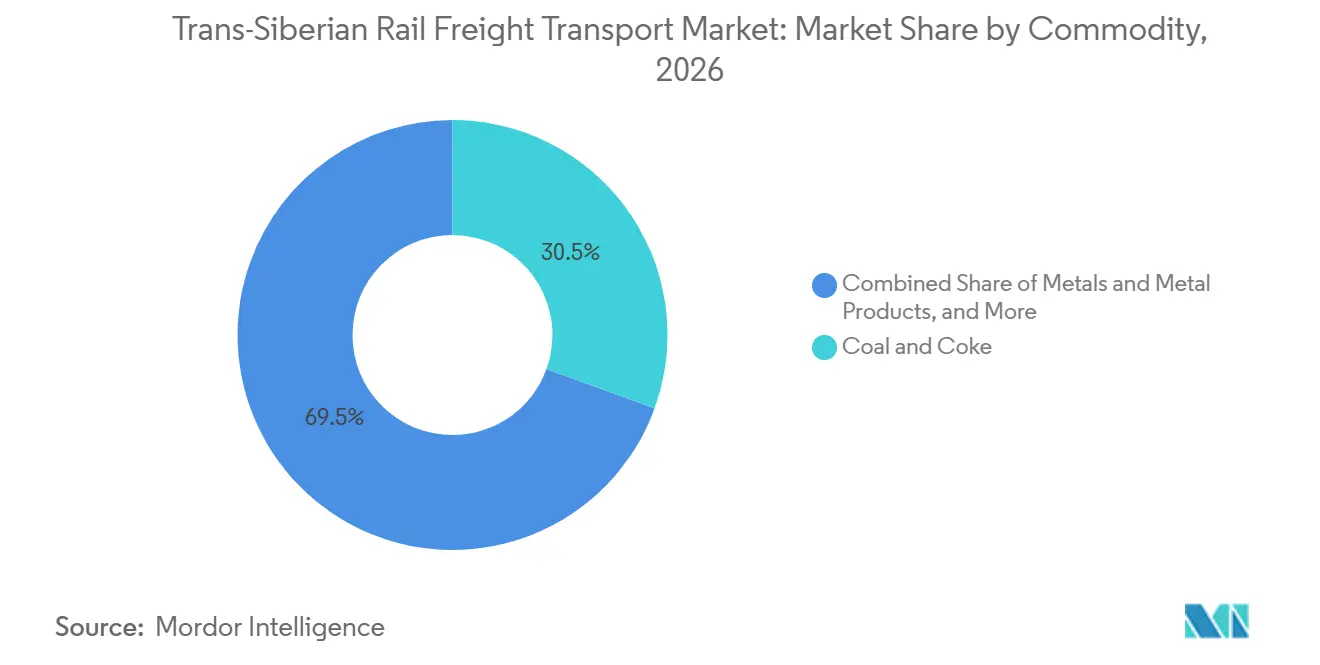
Coal Leads Share but Manufactured Goods Drive Growth NarrativeCoal and coke held 30.54% of the Trans-Siberian rail freight transport market share in 2026, making it the largest commodity category. Coal traffic remains significant for eastern ports and Chinese destinations. Cross-border coal deliveries to China through land crossings declined 22.6% year-over-year in the first quarter of 2026. Traction availability and border capacity can, therefore, affect coal movements even when demand at destination remains present. The category gains from higher Russian reliance on Chinese manufactured goods after the withdrawal of many Western suppliers.
Machinery, automotive and other manufactured goods lead commodity growth at a 4.46% CAGR for 2027-2032. Oil and petroleum products loading on the East Siberian Railway grew 10.6% in 2025 as flows were redirected toward China. Agricultural Products and Foodstuffs nearly doubled in Western Siberian dispatch volume in 2025. Fertilizer shipments from Russia to China increased 15.1% in January-July 2026. Metals and timber faced weaker demand, and timber loading on the East Siberian Railway declined 10% in 2025. This combination reduces the Trans-Siberian rail freight market's dependence on one commodity, although coal continues to define its current revenue profile. Operators that have flexible wagons and container capacity can serve the changing cargo mix more effectively.
By Destination:
Domestic Revenues Anchor as Cross-Border Routes DiversifyDomestic freight held 62.05% of the Trans-Siberian rail freight transport market share in 2026. Coal, oil, grain, and construction materials move across the 9,289-kilometer domestic corridor, creating its commercial base. Domestic operations are less exposed to international border procedures than cross-border services. They also make revenue less dependent on China-Europe transit conditions. Freight movements inside Russia still require reliable traction, track access, and terminal capacity. This domestic foundation gives the Trans-Siberian rail freight market a stable core even when international flows fluctuate.
International and cross-border freight records the highest destination CAGR at 3.82% for 2027-2032. The China-Russia route moved 186.8 million tons in 2025. China-Europe transit declined 23.3% in 2025 before rising 25% in January-February 2026, reflecting changes in relative modal costs. Russia-Central Asia freight provides a steadier additional route. Russia-Mongolia traffic is constrained by the lack of legally binding electronic customs exchange at the tripartite border. Cross-border growth, therefore, rests on infrastructure, documentation, and trade patterns rather than on a single transit route.
Geography Analysis
Central and European Russia, including the Moscow Origin Area, held a 25.83% share of the Trans-Siberian rail freight transport market size in 2026. The area is the principal terminus for China-origin container trains and a major dispatch hub for domestic westbound freight. Yanino Logistics Park near St. Petersburg is developing as a secondary distribution node. In April 2026, Global Ports, Oktyabrskaya Railway, and Post Logistics Company agreed to develop a direct China-to-St. Petersburg service with a 15-day transit target. The Ural Region provides traction and cargo sorting between western demand centers and eastern origins. Its freight-yard improvements through 2028 can support more consistent network operations.
Western Siberia and Eastern Siberia form the main high-volume origination zone for the Trans-Siberian rail freight market. Western Siberia loaded 244 million tons in 2025, including 180 million tons of coal and 19.7 million tons of oil products. Total loading declined 2.6%, although grain dispatches nearly doubled and offered some offset to lower coal activity. Eastern Siberia's oil loading grew 10.6% to 9.5 million tons in 2025. Non-ferrous ore increased 80%, while container throughput rose 5.4% to 472,000 TEU in the first 9 months of 2025. This broader cargo base reduces dependence on a single export category.
The Russian Far East is the fastest-growing geography at a 4.28% CAGR for 2027-2032. Vladivostok Commercial Sea Port led Russia in container handling for the sixth consecutive year in 2025. Russia added 25 million tons of port capacity in 2025. The May 2026 Zabaikalsk-Manzhouli agreement targets 11 million tons of annual crossing capacity by 2030. VEB.RF support of up to RUB 500 billion (USD 6.33 billion) and syndicated credit exceeding RUB 1 trillion (USD 12.66 billion) support 4 Eastern Polygon Phase 3 projects. Tunnel and Amur bridge delivery is scheduled by 2032, supporting the Far East's longer-term logistics role.
Competitive Landscape
The Trans-Siberian rail freight transport market is concentrated at the infrastructure level and moderately fragmented at the commercial-service level. RZD controls track access and infrastructure pricing. Private wagon operators compete through fleet availability, maintenance, tariffs, and digital service quality. International container operators compete through schedule reliability and customs coordination. Globaltrans transferred 5 Russian and Kazakhstani operating subsidiaries to a purchaser in April 2025 for USD 767 million. The transaction placed a large rolling-stock pool under domestic ownership and changed the competitive field for private wagon services.
RZD signed a joint venture agreement with IT Holding T1 at the 2025 St. Petersburg Economic Forum to develop data-based scheduling tools. This move places greater value on digital network management and scheduled capacity. FESCO, UTLC ERA, Far East Land Bridge, and InterRail Group focus on service reliability for China-Europe block trains. UTLC ERA's November 2025 shareholder meeting with RZD and Belarusian Railway confirmed a 2026-2035 plan covering North-South and East-West corridor integration. KTZ also signed a joint freight digitalization action plan with RZD in May 2026 for 9 interchange points. These moves show that control of information, paths, and border processes matters alongside ownership of wagons.
Kazakhstan Temir Zholy's USD 4.2 billion locomotive agreement with Wabtec, signed in September 2025, and financing for the Mointy-Kyzylzhar section support competing Middle Corridor capacity. Return-leg consolidation, cold-chain agricultural logistics, and integrated digital booking remain areas with room for additional service development. International operators on cross-border routes operate under SMGS procedures and bilateral railway coordination arrangements. Sanctions-related supply constraints can create schedule volatility across the Trans-Siberian rail freight market.
Trans-Siberian Rail Freight Transport Industry Leaders
-
Russian Railways (RZD)
-
FESCO Transportation Group
-
Freight One
-
Delo Group
-
TransContainer
- *Disclaimer: Major Players sorted in no particular order
Trans-Siberian Rail Freight Transport Market Companies Covered in this Report
- Russian Railways (RZD)
- FESCO Transportation Group
- Delo Group (Rosatom)
- BaltTransServis (BTS)
- Freight One
- PCC Intermodal
- UTLC ERA
- Far East Land Bridge
- Belarusian Railway
- Kazakhstan Temir Zholy (KTZ)
- China State Railway Group Co., Ltd.
- Deutsche Bahn AG (DB Group)
- DSV A/S
- Hamburger Hafen und Logistik AG (HHLA)
- InterRail Group
- NefteTransService
- Rail Cargo Group (OBB)
- PKP Cargo S.A.
- Nurminen Logistics Oyj
- CargoBeamer AG
Recent Industry Developments in Trans-Siberian Rail Freight Transport Market
- September 2026: FESCO Transportation Group and Vietnam Maritime Corporation (VIMC) signed a logistics partnership agreement between Vladivostok Commercial Sea Port and Port Saigon, covering digitalization and the development of a Ho Chi Minh City transit hub for Southeast Asian cargo.
- July 2026: FESCO Transportation Group and China's Huayuan International Land Port (Datong) Group signed a cooperation agreement to expand railway container transport between Russia and China through land border crossings, targeting new logistics solutions via Shanxi Province.
- May 2026: Kazakhstan Temir Zholy (KTZ) and Russian Railways signed a Joint Digitalization Action Plan for freight, targeting a unified digital space across nine Russia-Kazakhstan interchange points, signed in the presence of both countries' heads of state during Putin's state visit to Kazakhstan.
- April 2026: Delo Group's Global Ports, Russian Railways' Oktyabrskaya Railway, and Post Logistics Company signed a tripartite cooperation agreement to launch a direct China-to-St. Petersburg container rail service targeting a 15-day transit time.
Trans-Siberian Rail Freight Transport Market Report Scope
Segmentation Overview
| Containerized Freight |
| Bulk Commodities |
| General Cargo and Breakbulk |
| Project and Oversized Cargo |
| Other Specialized Cargo |
| Full-Container-Load (FCL) Shipments |
| Less-Than-Container-Load (LCL) Shipments |
| Dedicated and Block-Train Services |
| Wagonload and Single-Wagon Services |
| Specialized Rail Freight Services |
| Agricultural Products and Foodstuffs |
| Coal and Coke |
| Oil and Petroleum Products |
| Chemicals and Fertilizers |
| Metals and Metal Products |
| Minerals, Ores and Construction Materials |
| Timber, Wood and Paper Products |
| Machinery, Automotive and Other Manufactured Goods |
| Other Commodities |
| Domestic Freight | |
| International and Cross-border Freight | China-Russia Freight |
| Russia-Mongolia Freight | |
| Russia-Central Asia Freight | |
| China-Europe Transit Freight | |
| Other International Freight |
| Central and European Russia, including the Moscow Origin Area |
| Ural Region |
| Western Siberia |
| Eastern Siberia |
| Russian Far East |
| By Cargo Type | Containerized Freight | |
| Bulk Commodities | ||
| General Cargo and Breakbulk | ||
| Project and Oversized Cargo | ||
| Other Specialized Cargo | ||
| By Shipment Configuration | Full-Container-Load (FCL) Shipments | |
| Less-Than-Container-Load (LCL) Shipments | ||
| Dedicated and Block-Train Services | ||
| Wagonload and Single-Wagon Services | ||
| Specialized Rail Freight Services | ||
| By Commodity | Agricultural Products and Foodstuffs | |
| Coal and Coke | ||
| Oil and Petroleum Products | ||
| Chemicals and Fertilizers | ||
| Metals and Metal Products | ||
| Minerals, Ores and Construction Materials | ||
| Timber, Wood and Paper Products | ||
| Machinery, Automotive and Other Manufactured Goods | ||
| Other Commodities | ||
| By Destination | Domestic Freight | |
| International and Cross-border Freight | China-Russia Freight | |
| Russia-Mongolia Freight | ||
| Russia-Central Asia Freight | ||
| China-Europe Transit Freight | ||
| Other International Freight | ||
| By Geography | Central and European Russia, including the Moscow Origin Area | |
| Ural Region | ||
| Western Siberia | ||
| Eastern Siberia | ||
| Russian Far East | ||
Key Questions Answered in the Report
What is the 2026 value of Trans-Siberian rail freight?
The sector was valued at USD 7.22 billion in 2026 and is projected to reach USD 8.93 billion by 2032.
What is driving freight growth on the Trans-Siberian route?
Rising Russia-China trade, higher manufactured-goods flows, digital documentation, and Eastern Polygon investment support growth.
Which cargo type has the largest share of Trans-Siberian rail freight?
Bulk commodities held 48.43% in 2026, supported by the corridor's role in large-scale commodity movements.
Which shipment service is growing fastest on the Trans-Siberian corridor?
Dedicated and block-train services lead growth with a 5.24% CAGR through 2032.
Why is the Russian Far East important for rail freight?
The Russian Far East has the highest projected regional CAGR of 4.28% through 2032, aided by port capacity and border infrastructure projects.
What constraints affect Trans-Siberian rail freight operations?
Locomotive and spare-parts constraints, gauge changes, border inspections, and uneven return-leg cargo remain important constraints.