
Train Collision Avoidance System Market Size and Share
Market Overview
| Study Period | 2020 - 2032 |
|---|---|
| Market Size (2027) | USD 14.21 Billion |
| Market Size (2032) | USD 18.99 Billion |
| Growth Rate (2027 - 2032) | 5.97 % |
| Fastest Growing Market | Asia-Pacific |
| Largest Market | Asia-Pacific |
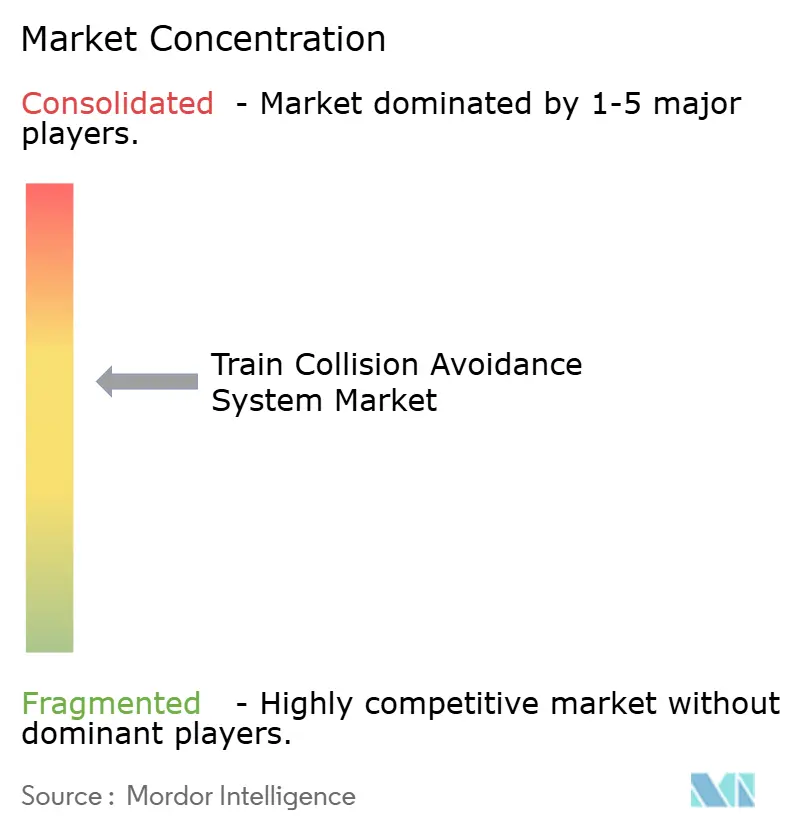
| Market Concentration | Medium |
Major Players *Disclaimer: Major Players sorted in no particular order Image © Mordor Intelligence. Reuse requires attribution under CC BY 4.0. | |
Train Collision Avoidance System Market Analysis by Mordor Intelligence
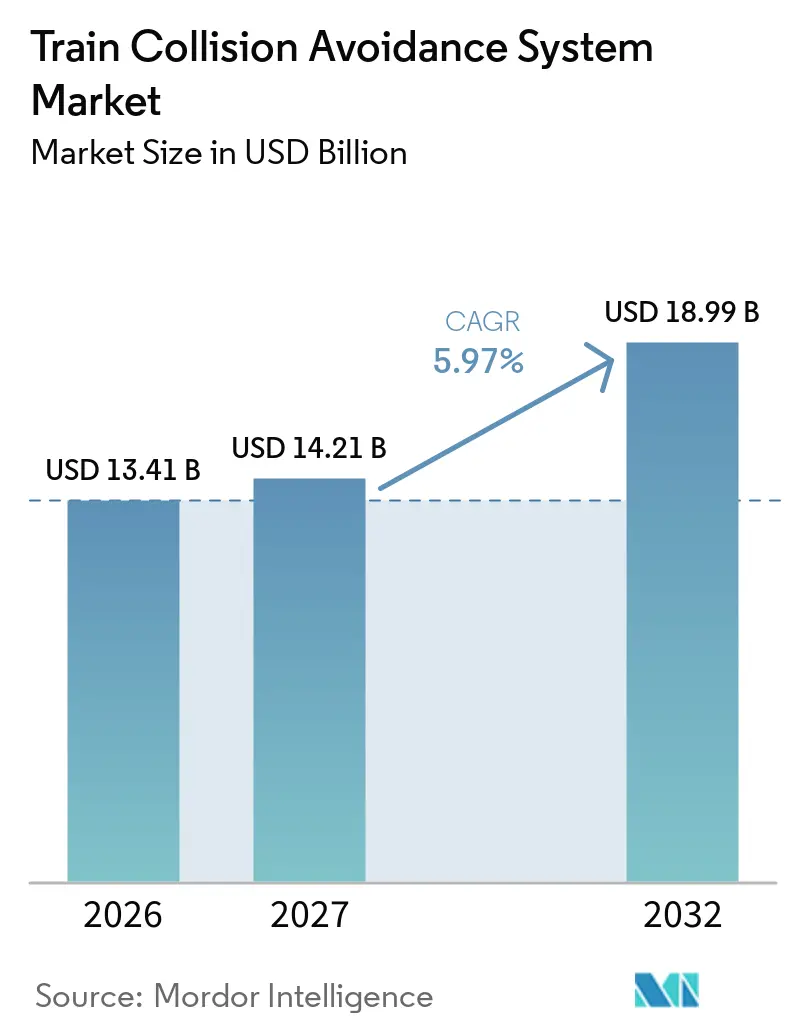
The train collision avoidance system market size was valued at USD 13.41 billion in 2026 and is projected to expand from USD 14.21 billion in 2027 to reach USD 18.99 billion by 2032, registering a CAGR of 5.97% between 2027 and 2032. Mandatory safety programs turn accident prevention into funded procurement, which gives suppliers longer visibility than discretionary transport spending. Metro construction, high-speed rail expansion, and the replacement of aging signaling equipment create demand in both new lines and existing networks. The train collision avoidance system market also benefits from projects that combine rolling-stock upgrades, trackside equipment, and communications systems within one program. Long approval cycles, limited engineering capacity, and difficult work on operating railways can delay installations, but they do not remove the underlying safety requirement. Suppliers with certified platforms and experience in complex migration programs are positioned to compete for larger framework contracts.
Key Report Takeaways
- By system, ETCS/ATP Levels 1 to 3 held 38.14% of the train collision avoidance system market share in 2026, while Kavach/TCAS is forecast to grow at a CAGR of 10.12% through 2032.
- By application, passenger rail held 43.25% of the train collision avoidance system market share in 2026, while metro and light rail are forecast to grow at a CAGR of 7.15% through 2032.
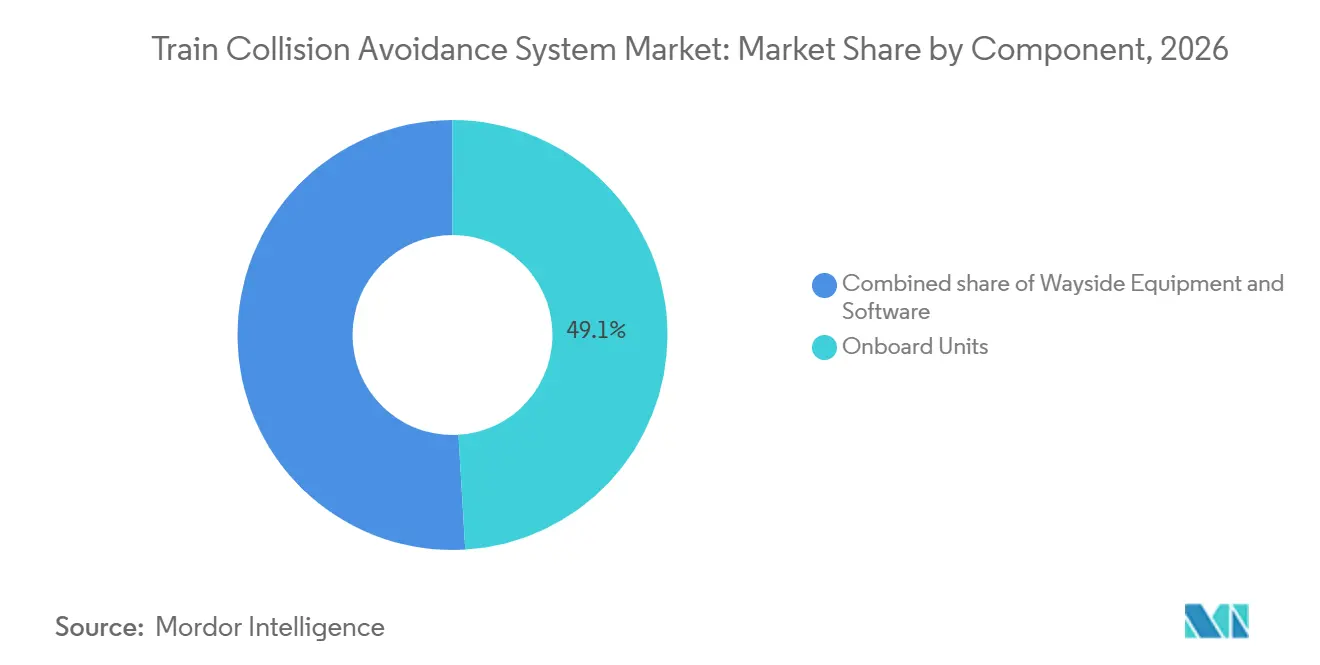
- By component, onboard units held 49.05% of the train collision avoidance system market share in 2026, while software is forecast to grow at a CAGR of 8.22% through 2032.
- By deployment, retrofit held 54.12% of the train collision avoidance system market share in 2026, while new installation is forecast to grow at a CAGR of 6.72% through 2032.
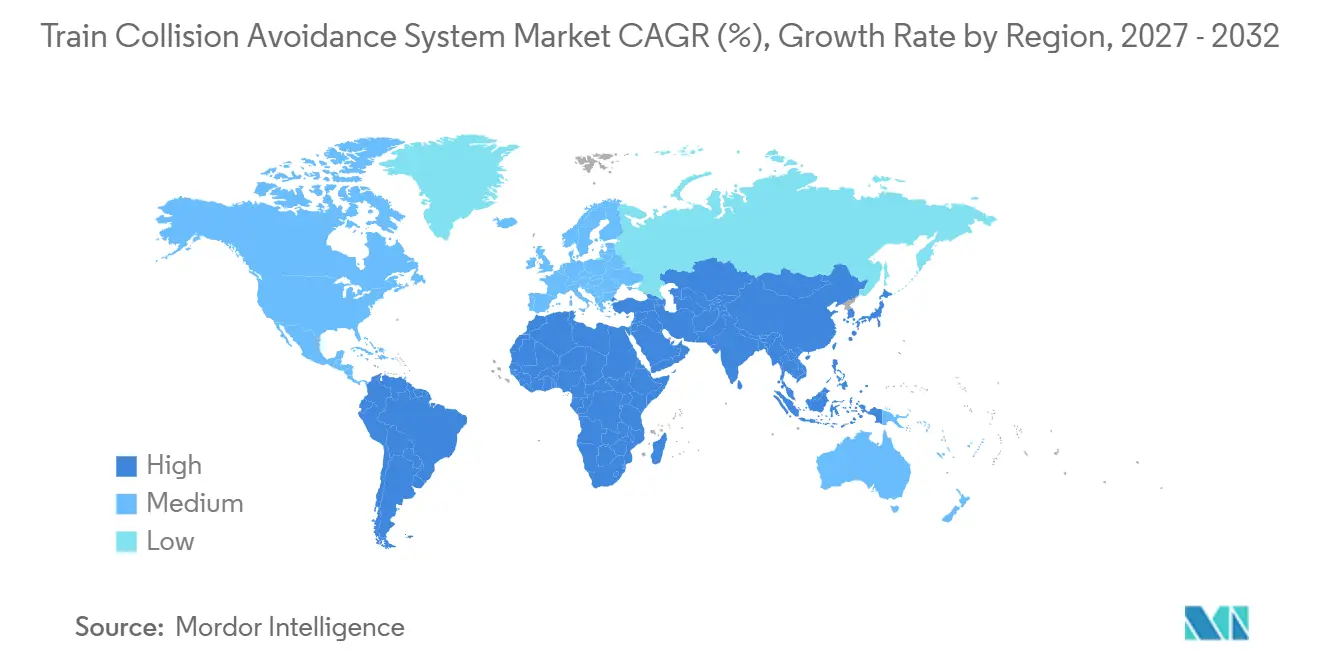
- By geography, Asia-Pacific held 37.18% of the train collision avoidance system market share in 2026 and is forecast to grow at a CAGR of 7.84% through 2032.
Note: Market numbers in this report are based on Mordor Intelligence's proprietary estimation framework, which combines nine months of actuals with Q4 projections for base year 2026.
Market Trends and Insights
Drivers Impact Analysis of Train Collision Avoidance System Market*
| Driver | (~) % Impact on CAGR Forecast | Geographic Relevance | Impact Timeline |
|---|---|---|---|
| Mandatory Rail Safety and Train Protection Upgrades | +1.0% | Global, concentrated in India and Europe | Short term (≤ 2 years) |
| Urban Rail Capacity Expansion Through CBTC | +0.7% | Asia-Pacific core, with effects in the Middle East, Africa, and South America | Medium term (2–4 years) |
| High-Speed Rail and Cross-Border Interoperability Investment | +0.6% | Europe, East Asia, and Turkey | Medium term (2–4 years) |
| Retrofit Demand from Aging Signaling and Rolling Stock | +0.5% | North America and Western Europe | Short term (≤ 2 years) |
| Real-Time Train Localization and Automated Braking Adoption | +0.4% | Global | Medium term (2–4 years) |
| Migration to FRMCS, 5G, and Resilient Train-to-Ground Communications | +0.4% | Europe primary, Asia-Pacific and North America secondary | Long term (≥ 4 years) |
| Source: Mordor Intelligence | |||
Mandatory Rail Safety and Train Protection Upgrades
Government safety mandates are the most dependable source of demand for the train collision avoidance system market because they convert accident risk into formal procurement commitments. India had commissioned Kavach Version 4.0 on 2,633 route kilometers of the Delhi-Mumbai and Delhi-Howrah corridors by July 31, 2026 [1]. Trackside work had also been taken up across 21,794 route kilometers, which provides a large implementation pipeline. The Rail Safety and Standards Board launched an industry-wide Train Protection Strategy in November 2025 to set interim safety improvements while ETCS is progressively fitted across the United Kingdom network. European and Indian safety rules establish compliance gates that favor suppliers able to demonstrate system assurance and certification capability. This structure limits the scope for operators to postpone safety spending once obligations are in place.
Urban Rail Capacity Expansion Through CBTC
CBTC is becoming a standard requirement in new metro programs because it supports shorter headways and more responsive service control. The International Trade Administration estimates USD 40 billion for Ho Chi Minh City and USD 21 billion for Hanoi urban rail through 2035, with signaling and train control identified as key opportunity areas[2]. These programs expand the train collision avoidance system market beyond conventional mainline rail into city transport networks. Hitachi reported that its CBTC system on Tokyo Metro’s Marunouchi Line achieved 0.1-meter train-position resolution, compared with a 50-meter minimum under conventional track circuits. Such performance supports capacity improvements without relying on the fixed-block logic used in older systems. Metro projects also give suppliers opportunities to sell signaling, telecommunications, supervision software, and maintenance support together.
High-Speed Rail and Cross-Border Interoperability Investment
High-speed rail investment increases demand for interoperable train protection because services often cross national networks and operate at higher speeds. The European Commission’s 2025 High-Speed Rail Action Plan seeks faster links on major corridors and identifies EUR 345 billion (USD 373.9 billion) TEN-T network investment through 2040 [3]. The plan aligns with continued ETCS deployment and supports an expanded addressable base for the train collision avoidance system market. Finland received an EU derogation in September 2026 from GSM-R requirements, allowing it to use a national pre-FRMCS radio system until 2035. The World Bank approved USD 2 billion in March 2026 for Turkey’s Istanbul North Rail Crossing Project, a high-capacity electrified link requiring modern railway systems. These projects increase the importance of common specifications, data links, and cross-border approval processes.
Retrofit Demand from Aging Signaling and Rolling Stock
A large installed base of relay interlockings and analog train protection equipment makes retrofit work central to the train collision avoidance system market. Deutsche Bahn concluded a digital-signaling volume contract in 2025 to secure industrial capacity for its network modernization program. The contract includes suppliers such as Siemens Mobility, Alstom, Hitachi Rail, and MerMec Deutschland, which indicates the scale of work needed in established networks. Swiss Federal Railways also awarded digital interlocking frameworks intended to renew a substantial share of signaling assets over the longer term. Retrofit programs require testing, staged commissioning, and close coordination with operations, increasing the value of integration skills. They also extend revenue across engineering, hardware replacement, software configuration, and long-term service support.
Restraints Impact Analysis of Train Collision Avoidance System Market*
| Restraint | (~) % Impact on CAGR Forecast | Geographic Relevance | Impact Timeline |
|---|---|---|---|
| High Brownfield Migration, Testing, and Possession Costs | -0.8% | North America and Western Europe | Short term (≤ 2 years) |
| Interoperability and Safety-Certification Complexity | -0.7% | Global, acute in cross-border European corridors | Medium term (2–4 years) |
| Cybersecurity Exposure Across Connected Train Control Architectures | -0.6% | Global | Medium term (2–4 years) |
| Shortage of Signaling Engineering and Safety-Assurance Talent | -0.4% | Global, concentrated in developed markets | Long term (≥ 4 years) |
| Source: Mordor Intelligence | |||
High Brownfield Migration, Testing, and Possession Costs
Modernizing an operating railway costs more and takes longer than fitting equipment on a new line. Operators have limited possession windows, which restrict the time available for installation, testing, and commissioning. Deutsche Bahn’s 2025 volume contract was designed to shorten an implementation cycle that had averaged 8 years by securing supplier capacity. India’s Kavach program also required SIL-4 assessment and validation before full deployment could proceed. These practical constraints can defer projects until regulatory deadlines are closer. They may also concentrate orders in a narrow period, putting pressure on specialist labor and certified supplier capacity.
Interoperability and Safety-Certification Complexity
Different legacy systems and national approval processes remain barriers when rail operators deploy protection systems across borders. The European Commission stated in February 2026 that ERTMS deployment is progressing but needs further work, with overall rollout behind the required pace. Alstom received ERA approval in September 2025 for an ETCS onboard system on TRAXX Universal locomotives, enabling cross-border freight operations for Czech carriers [4]. The example shows that approvals remain specific to equipment and operating conditions. Connected architectures also require stronger cybersecurity controls, while shortages of signaling and safety-assurance specialists add scheduling pressure. CISA documented a weak-authentication vulnerability in end-of-train and head-of-train remote linking devices in July 2025, showing why cyber risk must be addressed alongside functional safety.
*Our forecasts treat driver/restraint impacts as directional, not additive. The impact forecasts reflect baseline growth, mix effects, and variable interactions.
Train Collision Avoidance System Market Segment Analysis
By System:
Kavach Gains Scale While ETCS/ATP Remains the Largest System BaseETCS/ATP Levels 1 to 3 accounted for 38.14% of the train collision avoidance system market share in 2026, making it the largest system category. Its position reflects European interoperability requirements and the depth of existing ERTMS programs. The European Commission continues to treat ERTMS as a core requirement for rail network modernization and cross-border services. Kavach/TCAS is forecast to record the highest growth rate, at 10.12% through 2032, driven by the phased rollout on Indian Railways. Kavach 4.0 was operating on 2,633 route kilometers in July 2026, while trackside work had been taken up on a further 21,794 route kilometers. The scale of these corridors supports demand for onboard units, trackside equipment, radio links, and integration services. It also allows domestic suppliers to build capability in a large national program.
Positive Train Control retains an established role in North America, where it provides a regulatory and operational foundation for mainline safety systems. CBTC is more prominent in urban networks because it supports closer train spacing and continuous supervision. The train collision avoidance system industry therefore rewards vendors that can manage several standards rather than suppliers limited to one architecture. Software is becoming more important within each system as features move from fixed equipment toward digital control logic. Communications upgrades, including future FRMCS deployments, can further expand the role of resilient train-to-ground data exchange. Certification remains the key market-entry filter, particularly where systems must meet high safety-integrity requirements.
By Application:
Passenger Rail Supports Revenue While Metro and Light Rail AcceleratePassenger rail held 43.25% of the train collision avoidance system market share in 2026, supported by the high value of conventional and high-speed resignaling projects. Mainline operators require protection systems to manage speed, authority, signaling interfaces, and safe braking on complex routes. East Japan Railway Company (JR East) identifies ATACS and automatic train operation in its DX agenda, showing continued investment in digital railway control. Passenger services also receive direct attention from policymakers because reliability and accident prevention affect a large number of travelers. High-speed projects add technical requirements because the system must maintain dependable supervision at sustained high speeds. These features make passenger rail a stable revenue base for the train collision avoidance system market. Long asset lives also create recurring opportunities for equipment refreshes and software upgrades.
Metro and light rail are forecast to be the fastest-growing application, with a 7.15% CAGR through 2032. New urban networks use CBTC to increase train frequency and manage capacity as cities expand. Freight rail remains more exposed to traffic and commodity conditions than passenger and metro applications. Yet hazard detection and automated braking can create additional safety demand in yards and on freight routes. The large combined role of passenger and urban rail helps reduce the effect of freight cycles on overall demand.
By Component:
Onboard Units Lead Revenue While Software Expands FasterOnboard units held 49.05% of the train collision avoidance system market share in 2026 because certified vehicle hardware carries high unit values. These units link the locomotive or train to movement authority, braking functions, driver displays, and communications systems. They also require extensive testing to demonstrate compatibility with the relevant trackside system and rolling stock. This certification burden raises the cost and importance of the equipment. Kavach deployment includes both onboard and trackside elements, which increases the number of required hardware installations across the railway fleet. Onboard equipment will remain essential even as more functions move into software. The installed base also creates a service need for maintenance, replacement, and upgrades.
Software is forecast to grow at 8.22% through 2032, the fastest rate among components in the train collision avoidance system market. The increase reflects wider use of software-defined signaling, configuration tools, diagnostics, and digital updates. Wayside equipment still matters in existing networks, especially where operators replace analog relays with digital interlockings. Moving-block approaches may reduce dependence on fixed trackside devices over time, but they increase the need for reliable communications and secure data handling. Suppliers are adapting by offering modular products that combine interlocking, object control, level crossing functions, and analytics. This shift can increase recurring revenue from licensing, configuration, cybersecurity updates, and support.

By Deployment:
Retrofit Remains the Larger Base While New Installation Builds MomentumRetrofit held 54.12% of the train collision avoidance system market share in 2026 because much of the global rail network operates with equipment installed between 1960 and 2000. These systems must be renewed before operators can introduce more advanced ETCS, CBTC, or Kavach capabilities. Brownfield projects require integration with legacy assets and execution during restricted possession periods. They often carry more engineering risk than greenfield work because operational service must continue during migration. The train collision avoidance system industry benefits from this installed base because modernization programs can cover full networks rather than isolated routes. Retrofit work favors suppliers that combine certified products with strong systems engineering and program-delivery resources.
New installation is projected to grow at a CAGR of 6.72% through 2032. Greenfield metro lines, high-speed corridors, and previously unsignaled routes require protection systems from the start of operations. These projects generally offer cleaner installation conditions because signaling can be designed with the wider rail system. New work in India can include routes that were not previously equipped with comparable safety systems, making the boundary between new installation and retrofit less distinct. New installations may have lower variation in execution cost than retrofit programs, although they still require certification and testing. A balanced portfolio across both deployments helps suppliers manage the different risk and margin profiles.
Geography Analysis
Asia-Pacific held 37.18% of the train collision avoidance system market share in 2026 and is forecast to grow at 7.84% through 2032. India is a major source of regional demand because its Kavach rollout covers high-density corridors and a large pipeline of sanctioned route kilometers. China maintains continued investment across its extensive high-speed and urban rail networks. Japan continues to advance digital rail control and automatic-operation capability through established operators and suppliers. Australia also provides project demand, as Alstom secured a June 2026 contract for ETCS Level 2 on Queensland’s Sunshine Coast line.
Europe has a mature installed base but remains an important source of modernization spending for the train collision avoidance system market. ERTMS obligations, cross-border freight and passenger operations, and high-speed investment keep ETCS at the center of procurement. The European Commission recognizes that ERTMS rollout is behind schedule, which highlights the difficulty of standardizing complex networks. Germany and Switzerland show how long-term framework agreements can secure industrial capacity for digital signaling. North America has a mature Positive Train Control base and has further opportunity in metro CBTC upgrades and software validation.
The Middle East, Africa, and South America represent smaller pools of current demand, but projects in these regions can be significant for suppliers with international delivery capability. African and Middle Eastern metro programs also increase interest in CBTC and integrated control systems. South American contracts can attract leading global suppliers when projects have clear financing and technical specifications. Across these markets, procurement timing depends heavily on public funding, project preparation, and the ability to manage imported technology within local operating conditions.
Competitive Landscape
The train collision avoidance system market is moderately concentrated in system integration and certified hardware. Siemens Mobility, Alstom, Hitachi Rail, and Wabtec Corporation have broad portfolios across key system types and geographies. The scale of required certification and the cost of demonstrating safe operation create high barriers for new full-system suppliers. Deutsche Bahn’s 2025 contract shows how long-term commitments can strengthen incumbent positions by reserving delivery capacity. Hitachi Rail also secured a framework contract connected to the digitalization of the Swiss rail network in December 2025. These agreements give major suppliers a more stable order base, but they also require sustained execution quality over many years.
Competition remains active in adjacent areas such as diagnostics, obstacle detection, software validation, and cybersecurity. Siemens issued a product security bulletin in September 2025 on the end-of-train and head-of-train remote-linking vulnerability flagged by CISA, affecting its Trainguard devices. Knorr-Bremse introduced its RailEye Front Collision Warning system with digital partner EYYES at InnoTrans 2026, using vehicle-mounted cameras to identify hazards and pedestrians. Knorr-Bremse also signed a five-year framework agreement with AtkinsRéalis in June 2026 to deploy its ElectroLogIXS signaling platform in the United Kingdom. Such moves illustrate how suppliers are extending their offering from isolated components to interoperable product sets.
Domestic companies remain important where procurement supports local technology development. India’s Kavach program gives companies such as Medha Servo Drives, HBL Engineering, and Kernex Microsystems an opportunity to participate within an indigenous ecosystem. The approach can reduce reliance on imported systems while increasing the domestic base of certified capability. Large global vendors retain advantages in multinational programs because they can provide trackside, onboard, software, and maintenance services together. Smaller specialists can compete where they offer focused sensor, communications, software, or assurance capabilities. The train collision avoidance system market therefore combines concentrated leadership in safety-critical integration with room for specialized technology providers.
Train Collision Avoidance System Industry Leaders
-
Siemens Mobility GmbH
-
Alstom SA
-
Hitachi Rail
-
Wabtec Corporation
-
China Railway Signal and Communication Corporation Limited
- *Disclaimer: Major Players sorted in no particular order
Train Collision Avoidance System Market Companies Covered in this Report
- Siemens Mobility GmbH
- Alstom SA
- Hitachi Rail
- Wabtec Corporation
- Medha Servo Drives Pvt. Ltd.
- HBL Engineering Limited
- Kernex Microsystems (India) Limited
- Knorr-Bremse AG
- Mitsubishi Electric Corporation
- Toshiba Corporation
- CAF S.A.
- Indra Sistemas, S.A.
- Kyosan Electric Manufacturing Co., Ltd.
- Nippon Signal Co., Ltd.
- China Railway Signal and Communication Corporation Limited
- AŽD Praha s.r.o.
- Rail Vision Ltd.
- G.G. Tronics India Private Limited (GGT)
Recent Industry Developments in Train Collision Avoidance System Market
- October 2026: Central Railway completed the Independent Safety Assessment of Kavach 4.0 on the 104-km Amla–Chhindwara section of its Nagpur division, the first section in the division to be assessed.
- September 2026: Indian Railways approved INR 170 crore for Kavach 4.0 deployment on 712 route kilometers of Northern Railway’s Moradabad Division.
- September 2026: Knorr-Bremse and its digital partner EYYES presented the RailEye Front Collision Warning system, a camera-based obstacle-detection and driver-assistance system for metro, tram, and light rail, at InnoTrans 2026.
- August 2026: Wabtec won a contract of about BRL 1 billion (USD 195 million) from Vale to install its I-ETMS positive train control system on the Carajás and Vitória a Minas railways through 2031.
- June 2026: Indian Railways approved Kavach deployment across 631 route kilometers of East Coast Railway at a cost of INR 270 crore (USD 32.5 million).
- June 2026: Alstom secured a EUR 214 million frame contract to deliver ETCS Level 2 for Sector 1 North of Queensland’s new Sunshine Coast line.
Global Train Collision Avoidance System Market Report Scope
The scope includes segmentation by system (ETCS/ATP (levels 1–3), positive train control (PTC), communications-based train control (CBTC), Kavach/TCAS, and others), application (freight rail, passenger rail (conventional and high-speed), and metro and light rail), component (onboard units, wayside equipment, and software), and deployment (new installation and retrofit). The analysis also covers regional-level segmentation, including North America, Europe, Asia-Pacific, South America, and the Middle East and Africa. Market size and growth forecasts are presented by value in USD.
Segmentation Overview
| ETCS/ATP (Levels 1–3) |
| Positive Train Control (PTC) |
| Communications-Based Train Control (CBTC) |
| Kavach/TCAS |
| Others |
| Freight Rail |
| Passenger Rail (Conventional and High-Speed) |
| Metro and Light Rail |
| Onboard Units |
| Wayside Equipment |
| Software |
| New Installation |
| Retrofit |
| North America | United States |
| Canada | |
| Rest of North America | |
| Europe | Germany |
| France | |
| United Kingdom | |
| Italy | |
| Spain | |
| Russia | |
| Rest of Europe | |
| Asia-Pacific | China |
| Japan | |
| India | |
| South Korea | |
| Australia | |
| Southeast Asia | |
| Rest of Asia-Pacific | |
| South America | Brazil |
| Argentina | |
| Chile | |
| Rest of South America | |
| Middle East and Africa | Saudi Arabia |
| United Arab Emirates | |
| Turkey | |
| South Africa | |
| Egypt | |
| Rest of Middle East and Africa |
| By System | ETCS/ATP (Levels 1–3) | |
| Positive Train Control (PTC) | ||
| Communications-Based Train Control (CBTC) | ||
| Kavach/TCAS | ||
| Others | ||
| By Application | Freight Rail | |
| Passenger Rail (Conventional and High-Speed) | ||
| Metro and Light Rail | ||
| By Component | Onboard Units | |
| Wayside Equipment | ||
| Software | ||
| By Deployment | New Installation | |
| Retrofit | ||
| By Geography | North America | United States |
| Canada | ||
| Rest of North America | ||
| Europe | Germany | |
| France | ||
| United Kingdom | ||
| Italy | ||
| Spain | ||
| Russia | ||
| Rest of Europe | ||
| Asia-Pacific | China | |
| Japan | ||
| India | ||
| South Korea | ||
| Australia | ||
| Southeast Asia | ||
| Rest of Asia-Pacific | ||
| South America | Brazil | |
| Argentina | ||
| Chile | ||
| Rest of South America | ||
| Middle East and Africa | Saudi Arabia | |
| United Arab Emirates | ||
| Turkey | ||
| South Africa | ||
| Egypt | ||
| Rest of Middle East and Africa | ||
Key Questions Answered in the Report
What is the projected size of the train collision avoidance system market by 2032?
The train collision avoidance system market is projected to reach USD 18.99 billion by 2032, growing at a 5.97% CAGR from 2027 to 2032.
Which application has the highest demand for these systems?
Passenger rail held 43.25% of revenue in 2026, while metro and light rail are forecast to be the fastest-growing application at a 7.15% CAGR.
What component is expanding fastest in railway protection systems?
Software is forecast to grow at an 8.22% CAGR through 2032 as signaling increasingly uses digital configuration, diagnostics, and updates.
Which region leads demand for train collision avoidance systems?
Asia-Pacific held 37.18% of revenue in 2026 and is forecast to grow at a 7.84% CAGR through 2032.