
Traditional Wound Management Market Size and Share
Market Overview
| Study Period | 2021 - 2032 |
|---|---|
| Market Size (2027) | USD 8.09 Billion |
| Market Size (2032) | USD 10.06 Billion |
| Growth Rate (2027 - 2032) | 4.47 % |
| Fastest Growing Market | Asia-Pacific |
| Largest Market | North America |
| Market Concentration | Medium |
Major Players *Disclaimer: Major Players sorted in no particular order Image © Mordor Intelligence. Reuse requires attribution under CC BY 4.0. | |
Traditional Wound Management Market Analysis by Mordor Intelligence
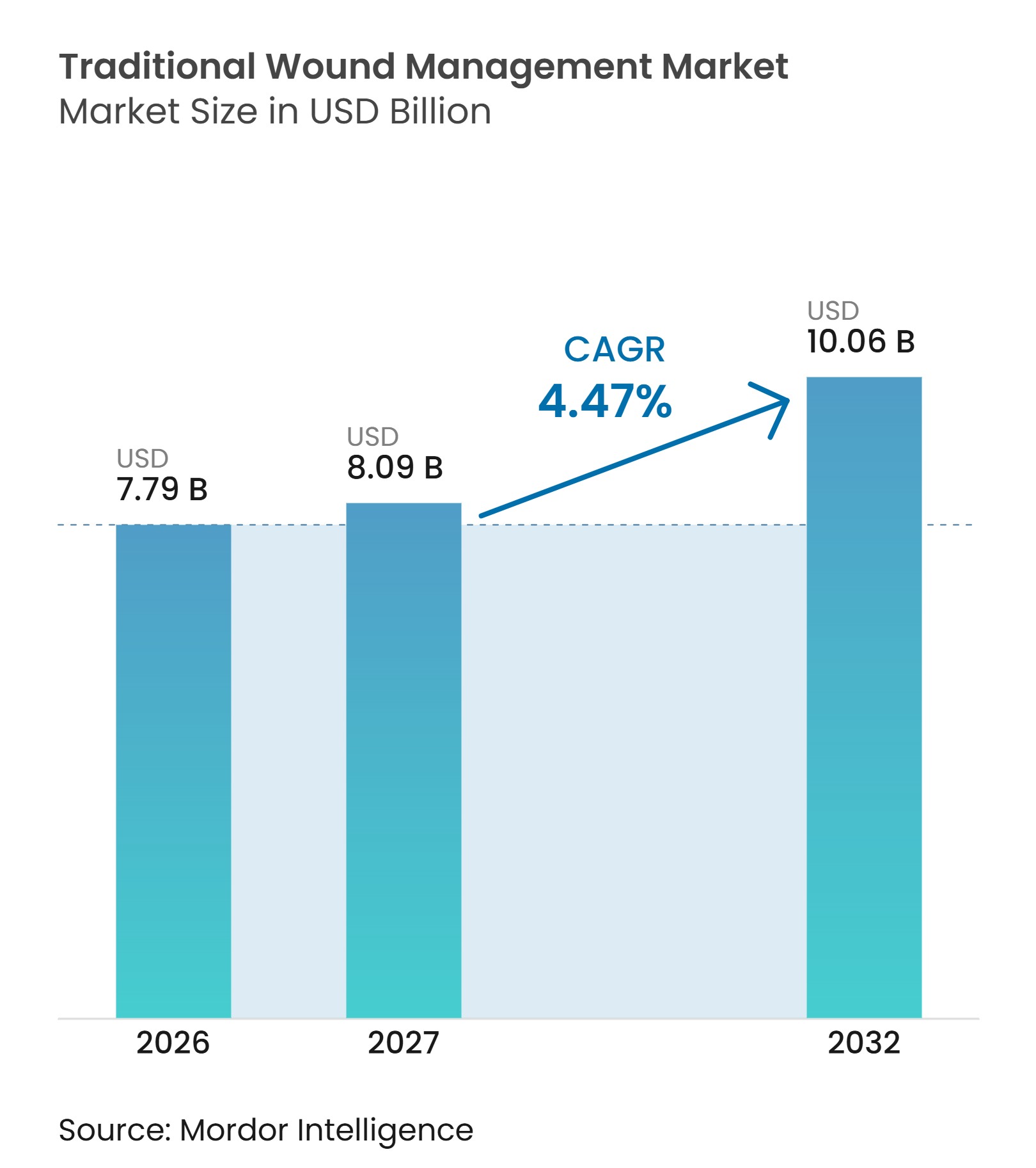
The Traditional Wound Management Market size is projected to be USD 7.79 billion in 2026, USD 8.09 billion in 2027, and reach USD 10.06 billion by 2032, growing at a CAGR of 4.47% from 2027 to 2032.
Demand remains tied to surgical care, chronic wound treatment, and the wider use of home-based services. Gauze, bandages, and medical tapes retain a cost advantage in settings with limited budgets or limited access to specialist care. Traditional products also remain relevant when advanced therapies require a fixation layer or clinical supervision. Companies are balancing commodity pricing pressure with investments in skin-safe adhesives, reliable supply, and sterile packaging. The traditional wound management market continues to offer opportunities in care settings where practical, standardized products are needed across high patient volumes.
Key Report Takeaways
- By product type, gauze held 42.16% of the traditional wound management market share in 2026, while medical tapes are projected to grow at a 6.83% CAGR through 2032.
- By wound type, acute wounds held a 58.14% share in 2026, while chronic wounds are projected to grow at a 6.23% CAGR through 2032.
- By application, primary wound dressing accounted for 39.20% of total value in 2026 and is projected to grow at a 7.54% CAGR through 2032.
- By end user, hospitals held a 48.23% share in 2026, while home healthcare is projected to grow at a 7.13% CAGR through 2032.
- By distribution channel, hospital pharmacies held 39.45% of total value in 2026, while online channels are projected to grow at an 8.64% CAGR through 2032.
- By geography, North America held a 45.14% share in 2026, while Asia-Pacific is projected to grow at a 7.45% CAGR through 2032.
Note: Market numbers in this report are based on Mordor Intelligence's proprietary estimation framework, which combines nine months of actuals with Q4 projections for base year 2026.
Market Trends and Insights
Drivers Impact Analysis of Traditional Wound Management Market*
| Driver | (~) % Impact on CAGR Forecast | Geographic Relevance | Impact Timeline |
|---|---|---|---|
| Rising Surgical Procedure Volumes | +1.1% | Global, with concentrated gains in North America and Asia-Pacific | Medium term (2-4 years) |
| Increasing Chronic Wound Prevalence | +0.9% | Global, with the highest clinical burden in North America and Southeast Asia | Long term (≥ 4 years) |
| Growth of Home-Based Wound Care | +0.7% | North America and Europe, with early development in Asia-Pacific | Medium term (2-4 years) |
| Cost Advantage in Resource-Constrained Care Settings | +0.6% | Middle East and Africa, South Asia, Southeast Asia, and Latin America | Long term (≥ 4 years) |
| Use of Conventional Dressings as Secondary Fixation Layers | +0.5% | Global | Short term (≤ 2 years) |
| Expansion of Pre-Packed Kits for EMS and Institutional Preparedness | +0.3% | North America and GCC procurement channels | Short term (≤ 2 years) |
| Source: Mordor Intelligence | |||
Rising Surgical Procedure Volumes
Surgical activity creates recurring demand for standardized dressings, gauze, bandages, and tape. The International Society of Aesthetic Plastic Surgery recorded 17.88 million cosmetic surgical procedures worldwide in 2025, which was 25.3% higher than in 2021. Procedures such as facelifts, abdominoplasties, and scar revisions require postoperative dressing care[1]. General surgery, orthopedic procedures, and trauma care add a larger base of wound management use. The traditional wound management market benefits where surgical capacity rises faster than specialist wound care infrastructure. This pattern supports continued use of basic dressings in emerging care systems.
Increasing Chronic Wound Prevalence
Chronic wounds create regular product use because initial treatment commonly involves standard wound care. A 2026 review covering 89 studies found 54.57 active diabetic foot ulcer cases per 1,000 people with diabetes worldwide, with the Americas reporting 199.51 cases per 1,000. The European Wound Management Association reported 2.21 chronic wound cases per 1,000 people in Europe and identified 16 million people in the WHO European Region as being at lifetime risk of diabetic foot ulceration. Standard care remains the starting point before advanced biologic therapies are considered for eligible patients. This clinical pathway sustains demand for conventional products alongside more specialized treatment options. The traditional wound management market therefore remains connected to the rising burden of diabetes, venous disease, and pressure injury.
Growth of Home-Based Wound Care
Home care favors products that patients and caregivers can obtain and apply with limited specialist support. Gauze, bandages, and tapes are familiar products for follow-up care after surgery and for chronic wounds. Many advanced wound technologies require supervision, trained application, or defined storage conditions. This limits their use across routine home episodes. The traditional wound management market gains volume when dressing changes move from inpatient settings to households. Home services also support repeat purchase through retail pharmacies, digital pharmacies, and direct delivery channels.
Cost Advantage in Resource-Constrained Care Settings
Traditional dressings remain a practical option when providers must manage high patient volumes with constrained budgets. Their low unit cost supports use in primary health centers, community nursing, and public procurement programs. A 2025 study in southwest Nigeria found that traditional dressings remained the dominant approach among hospitalized patients, while families paid USD 3.49 to USD 8.42 per week depending on wound type. This reliance reflects both affordability and product availability. Conventional products also serve as secondary fixation layers for negative pressure wound therapy, skin substitutes, and catheter care. Emergency preparedness programs create an additional demand base because their kits specify gauze, trauma dressings, and related products.
Restraints Impact Analysis of Traditional Wound Management Market*
| Restraint | (~) % Impact on CAGR Forecast | Geographic Relevance | Impact Timeline |
|---|---|---|---|
| Substitution by Advanced Wound Care Products | -0.9% | North America and Europe, where advanced care reimbursement is established | Medium term (2-4 years) |
| Low Product Differentiation and Pricing Pressure | -0.6% | Global, with the strongest pressure in North America and Asia-Pacific OTC channels | Short term (≤ 2 years) |
| Medical Adhesive-Related Skin Injury and Product-Removal Risk | -0.4% | Global, with high regulatory sensitivity in the European Union and North America | Medium term (2-4 years) |
| Sterile Packaging Waste and Disposal Burden | -0.3% | European Union, with effects in North America and high-income Asia-Pacific markets | Long term (≥ 4 years) |
| Source: Mordor Intelligence | |||
Substitution by Advanced Wound Care Products
Advanced therapies can replace basic dressings in selected complex and chronic wound cases. Hydrogel dressings, negative pressure wound therapy, bioactive matrices, and cellular products are most relevant in well-resourced facilities. A 2025 review found that advanced therapies can benefit diabetic foot ulcers and venous leg ulcers, although cost, access, storage requirements, and shelf life can limit adoption. The effect is therefore strongest where reimbursement and experienced wound care teams are established. The traditional wound management market remains important for initial treatment, routine follow-up, and locations that cannot support advanced therapies at scale. Regulatory review by the US Food and Drug Administration and European Medicines Agency also shapes the evidence and approval path for specialized products.
Low Product Differentiation and Pricing Pressure
Gauze, standard bandages, and basic medical tapes compete largely on price because product differences are limited. Group purchasing organizations and centralized hospital buyers often use price, supply reliability, and compliance status as their main selection criteria. Medical adhesive-related skin injury adds a clinical consideration for tape suppliers, especially among vulnerable patients. Recent systematic reviews have examined the incidence and risk factors for this injury in critically ill and cancer populations. Sterile packaging also presents a longer-term compliance issue because recycled materials must meet defined performance requirements. The Sterile Barrier Association stated in 2025 that mechanically recycled post-consumer materials are currently unsuitable for sterile barrier systems because quality is inconsistent.
*Our forecasts treat driver/restraint impacts as directional, not additive. The impact forecasts reflect baseline growth, mix effects, and variable interactions.
Traditional Wound Management Market Segment Analysis
By Product Type:
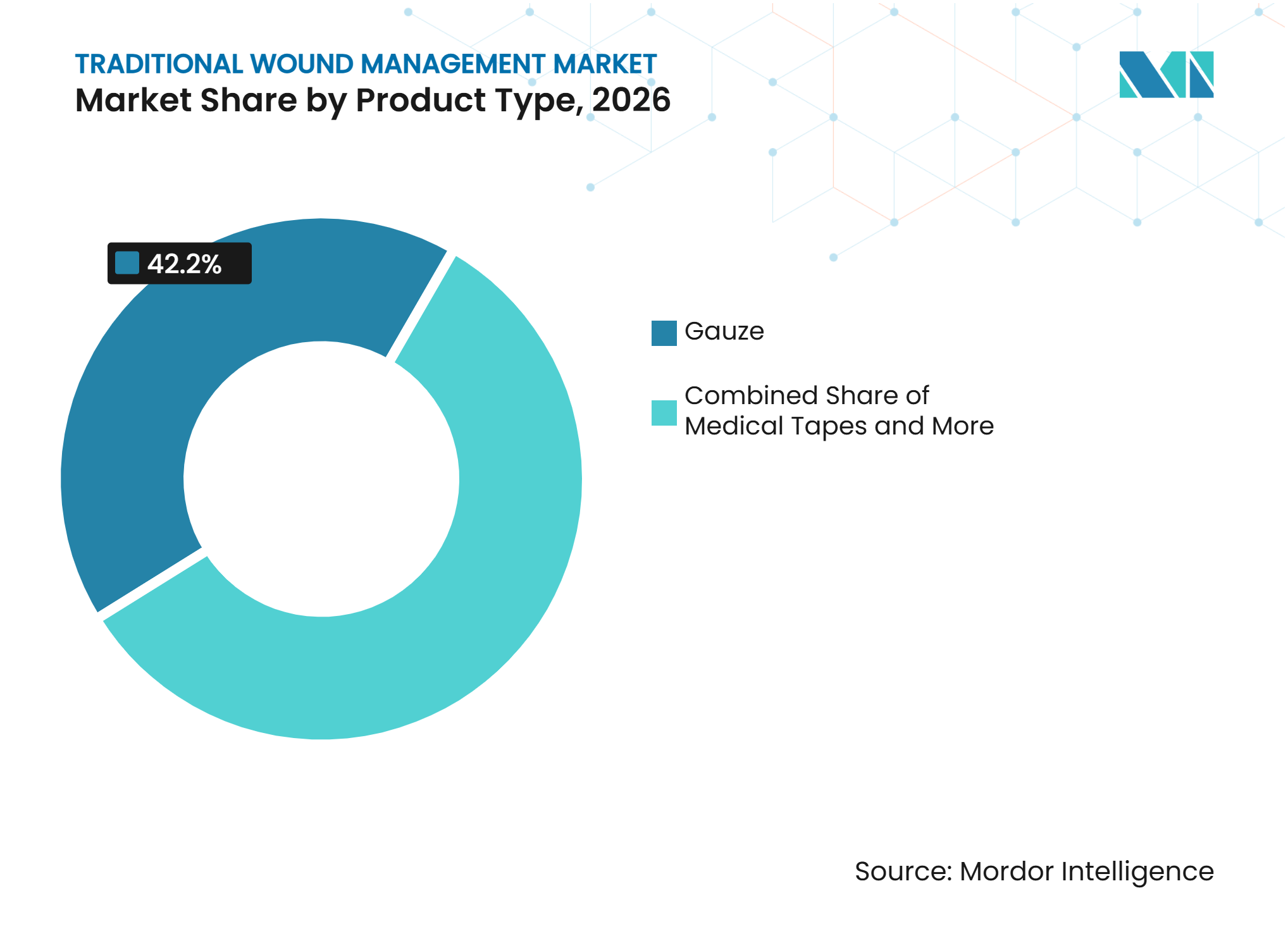
Gauze Leads While Medical Tapes Gain Clinical RelevanceGauze held 42.16% of the traditional wound management market share in 2026. Its use spans acute surgery, emergency trauma, and first-line management of chronic wounds. Hospital specifications and established supply contracts support steady procurement. Providers continue to select gauze because it is standardized, widely understood, and available in multiple care settings. Bandages, wound swabs, cotton wool, and absorbent pads add recurring demand across orthopedic, sports medicine, compression, and routine wound care.
Medical tapes are projected to grow at a 6.83% CAGR from 2027 to 2032. They secure dressings, catheters, drainage systems, and negative pressure wound therapy tubing in hospital and home settings. This function makes tapes complementary to specialized therapies, rather than only a basic consumer product. Suppliers are developing silicone and acrylate adhesives that seek to reduce medical adhesive-related skin injury. ISO 10993 biocompatibility requirements guide the assessment of these materials and support a clearer innovation path than commodity gauze.



By Wound Type:
Acute Care Provides the Larger Base While Chronic Care Grows FasterAcute wounds held a 58.14% share in 2026. The segment includes postoperative wounds, traumatic injuries, lacerations, and abrasions. Operating rooms and emergency departments use sterile gauze, dressings, and fixation products across the care pathway. Each procedure requires primary or secondary dressing materials at defined stages. This broad clinical reach provides a stable volume base across hospitals, clinics, ambulatory facilities, and emergency settings.
Chronic wounds are projected to grow at a 6.23% CAGR from 2027 to 2032. A 2025 review of 46 studies across Asian populations reported a pooled hospital-based chronic wound prevalence of 32.1%, including 50.8% in Southeast Asia. Diabetes, venous insufficiency, and pressure injuries sustain treatment needs over longer periods. Guidelines that begin with conventional care keep gauze and bandages relevant before treatment escalation. The traditional wound management market benefits from this first-line role in both higher-resource and lower-resource care settings.
By Application:
Primary Dressing Holds Both the Largest Position and the Highest Growth RatePrimary wound dressing accounted for 39.20% of the traditional wound management market size in 2026. It is also projected to grow at a 7.54% CAGR from 2027 to 2032. Postoperative protocols in general surgery, orthopedics, and dermatology support this role during the first 24 to 72 hours after an incision. Standard care is used before advanced cellular therapies are considered for appropriate wounds[2]. This clinical sequence supports a stable base of use for conventional primary dressings.
Secondary wound dressings provide retention and protection over primary materials. Hospitals and long-term care providers purchase these products in steady volumes for diverse wound episodes. Wound fixation and securement grow with the use of devices that need tape or bandage support. Hemostasis and exudate absorption products serve trauma surgery, emergency care, and institutional preparedness requirements. The traditional wound management market covers several points in the care pathway, which reduces dependence on a single clinical use case.
By End User:
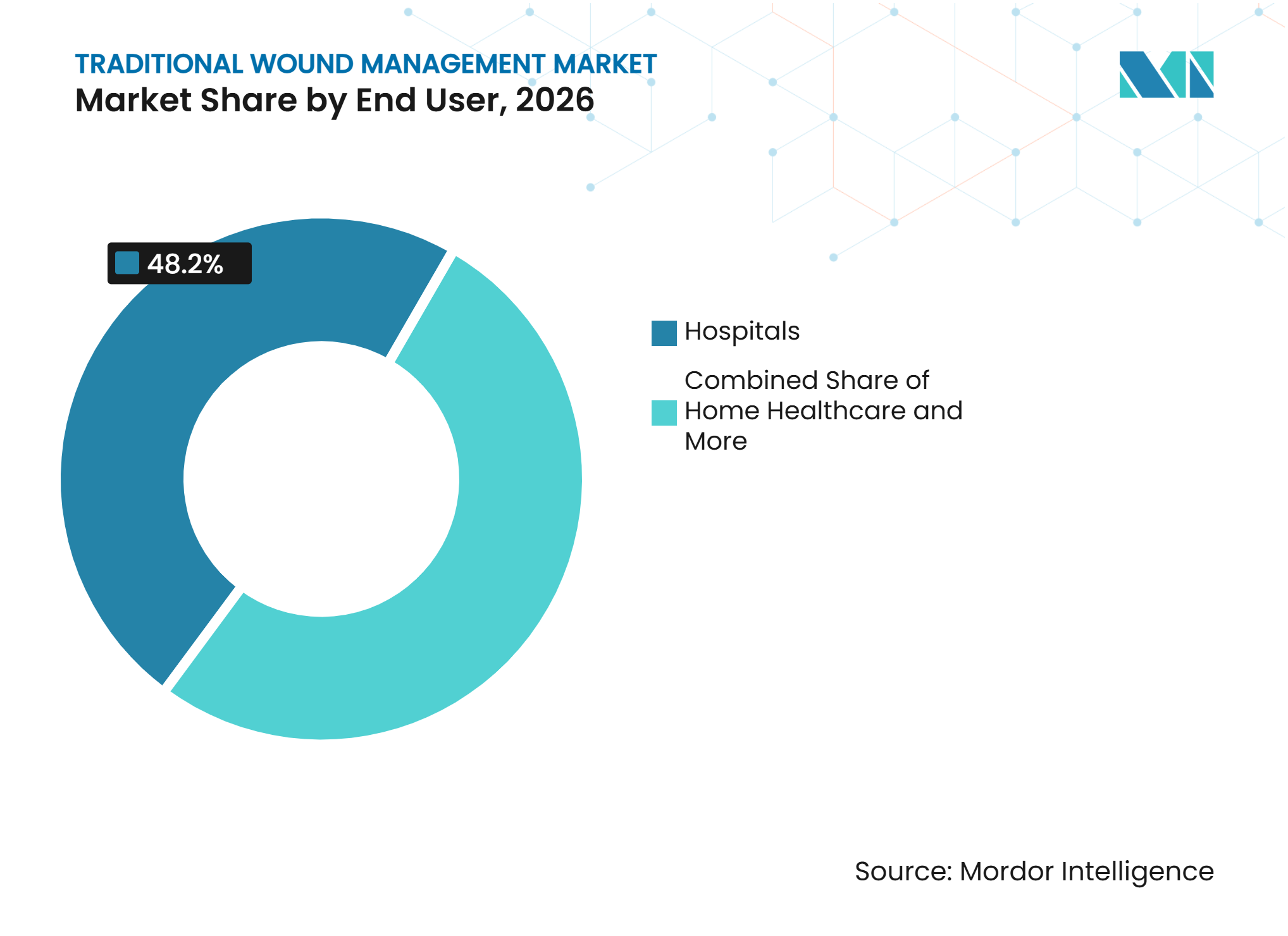
Hospitals Remain Central While Home Healthcare Expands Product UseHospitals held a 48.23% share in 2026. Bulk purchasing, infection-control procedures, and the range of wounds treated in acute care support their position. Hospitals require wound products for surgery, emergency departments, inpatient units, and outpatient services. Institutional contracts concentrate substantial volumes through a limited number of buyers. Reliable supply and compliance remain important for gauze, surgical dressings, and fixation products.
Home healthcare is projected to grow at a 7.13% CAGR from 2027 to 2032. Patients and informal caregivers often rely on accessible products that are easy to apply during routine dressing changes. Pharmacies, online channels, and home delivery services make traditional materials widely available. Advanced devices can require clinician supervision or specialized application. The traditional wound management market benefits as more postoperative and chronic care moves beyond hospital walls.

By Distribution Channel:
Online Sales Expand Access While Hospital Pharmacies Retain Institutional VolumeHospital pharmacies held 39.45% of the traditional wound management market size in 2026. Institutional contracts and formulary selection route significant product volumes through this channel. Hospitals need reliable fulfillment for commonly used gauze pads, dressings, and tape. Retail pharmacies support immediate self-care purchases of bandages and basic wound products. Together, these channels serve clinical procurement and everyday household needs.
Online channels are projected to grow at an 8.64% CAGR from 2027 to 2032. Traditional wound products suit digital commerce because they use standardized stock-keeping units and are familiar to consumers. Digital pharmacies and e-commerce platforms support replenishment orders and direct delivery. Online competition increases private-label visibility and price pressure on branded lines. Waterproof products, skin-tone adhesives, and pre-cut sizes may help suppliers retain value while the traditional wound management market gains digital reach.
Geography Analysis
North America
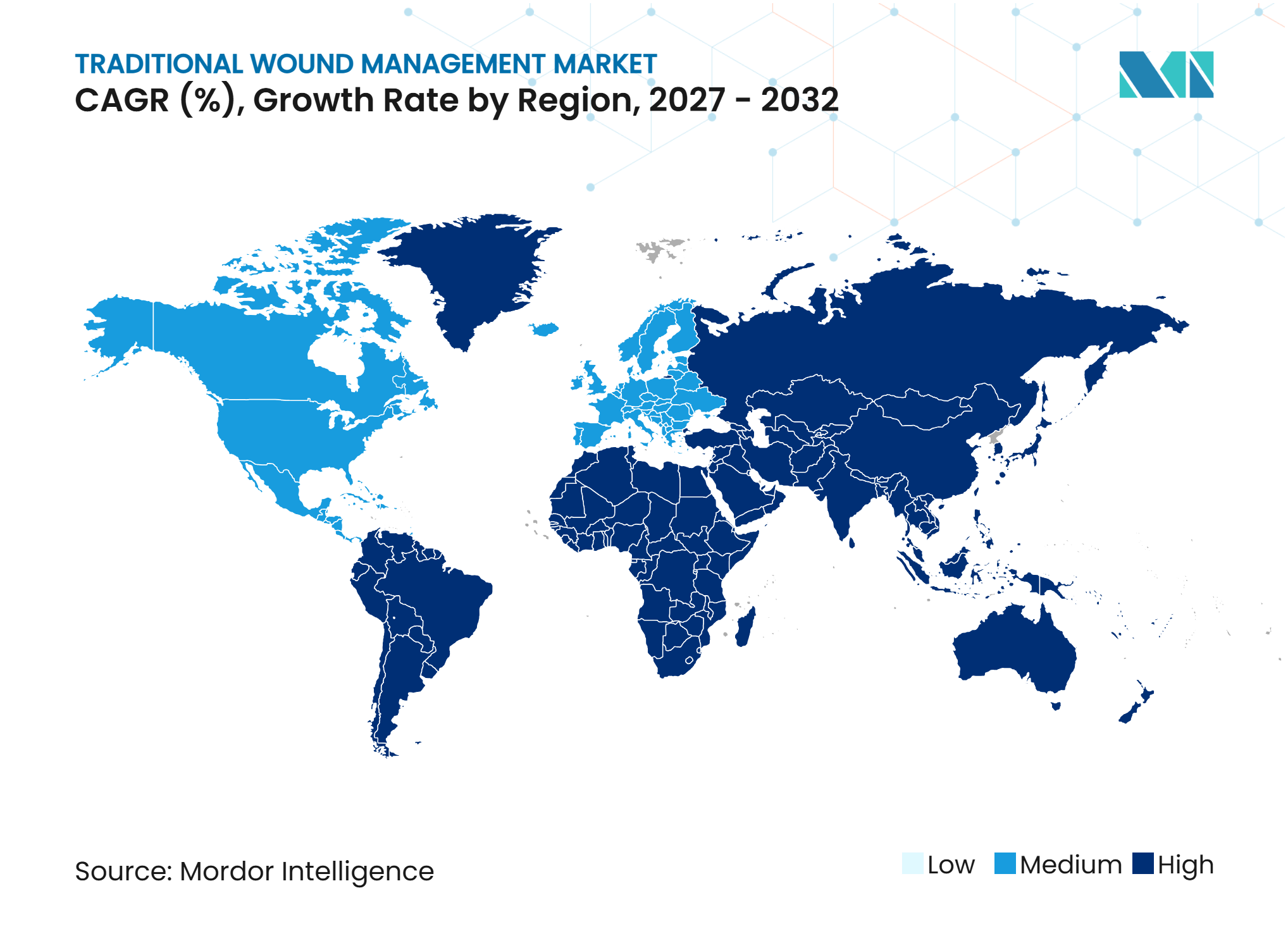
North America held a 45.14% share in 2026. High healthcare spending, aging populations, diabetes and obesity comorbidities, and established institutional purchasing support demand. In January 2026, the Centers for Medicare & Medicaid Services reclassified skin substitutes as incident-to supplies and applied a flat payment of USD 127.14 per cm². This change may preserve a role for conventional protocols in outpatient chronic wound episodes, while Canada’s nursing constraints and Mexico’s expanding access also support standardized product demand.
Asia-Pacific
Asia-Pacific is projected to grow at a 7.45% CAGR from 2027 to 2032. Surgical activity, a large diabetes burden, home-based care, e-pharmacy access, and rapid delivery services support demand for over-the-counter products. China faces online price competition and pressure on reimbursement for basic dressings, which favors suppliers that combine cost control with differentiated formats. The traditional wound management market also benefits from local manufacturing and hospital procurement capacity. Suppliers must manage national requirements for registration, quality, and reimbursement.
Europe, Middle East and Africa, and South America
Europe reported 2.21 chronic wound cases per 1,000 people across its populations. Hospital purchasing structures in Germany, the United Kingdom, France, Italy, and Spain favor cost-consistent products, while evidence-based funding can favor advanced alternatives for eligible cases. European sterile packaging requirements increase attention to barrier design and compliance. Healthcare investment in GCC countries supports institutional demand, while affordable products remain important in sub-Saharan settings with trauma and chronic wound needs. Brazil’s public health system supports stable institutional purchasing, while Argentina and smaller South American markets add volume as budgets allow. The traditional wound management market serves these varied settings through products that can be used across formal and community care.
Competitive Landscape
Market Concentration
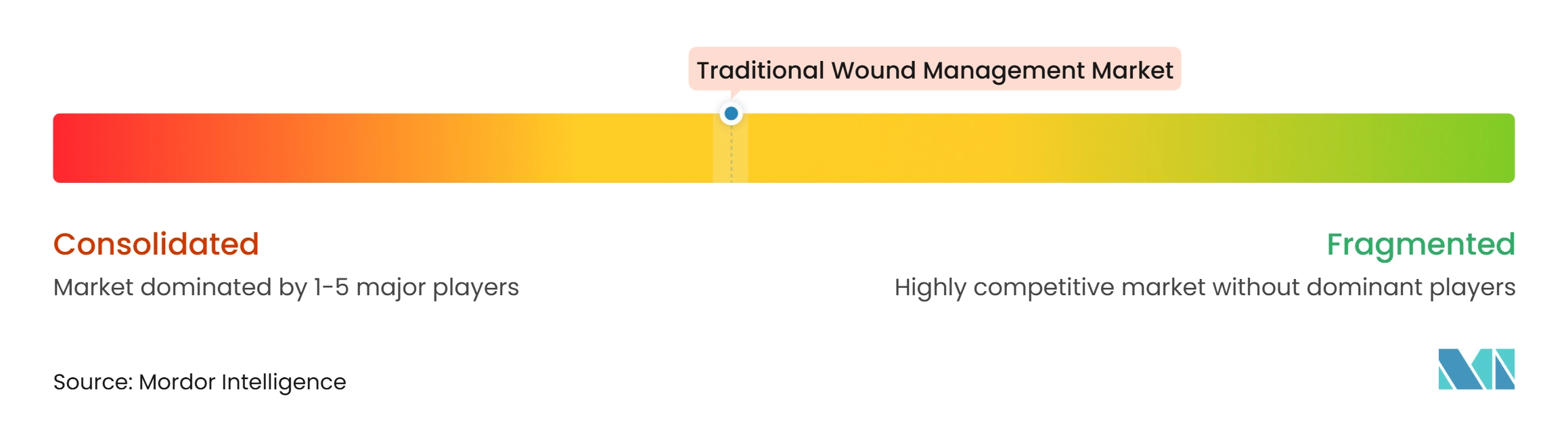
The traditional wound management market has moderate concentration. Large medical technology and healthcare suppliers hold institutional volumes through hospital contracts and established distribution networks. Regional producers, generic suppliers, and private-label brands compete actively in retail, over-the-counter, and emerging-market channels. Product differentiation is limited in core gauze and bandage categories, so supply reliability, compliant production, and purchasing relationships remain important. Smaller Asian suppliers can pressure mid-market pricing where hospitals and consumers favor lower-cost basic products.
Companies are seeking growth beyond conventional dressings while protecting their positions in core products. Solventum announced an agreement in November 2025 to acquire Acera Surgical for USD 725 million in cash, with up to USD 125 million in contingent milestone payments. The transaction targeted synthetic tissue matrices for complex wound management. Mölnlycke entered an exclusive co-promotion agreement with AROA Biosurgery in October 2026 to market Endoform in US post-acute settings. Smith+Nephew launched the CENTRIO Platelet-Rich-Plasma System in the United States in September 2025 for chronic wounds including diabetic foot ulcers and venous leg ulcers. These actions show that companies in the traditional wound management market are adding advanced capabilities besides traditional product portfolios.
Packaging and product safety create further areas of competition in the traditional wound management market. The Sterile Barrier Association stated that mechanically recycled post-consumer materials are not currently suitable for sterile barrier systems because material quality can vary. This requirement favors firms with established sterile packaging systems and the resources to validate new materials. Suppliers are also pursuing skin-safe adhesive formulations to address product-removal risk. Sustainable sterile packaging and antimicrobial-enhanced conventional dressings remain relevant development areas. This traditional wound management market depends on safety, packaging, quality, and supply requirements as well as price competitiveness.
Traditional Wound Management Industry Leaders
-
Cardinal Health, Inc.
-
ConvaTec Group Plc
-
Medline Industries, LP
-
Smith & Nephew plc
-
Solventum
- *Disclaimer: Major Players sorted in no particular order
Traditional Wound Management Market Companies Covered in this Report
- B. Braun
- Cardinal Health
- Coloplast
- Convatec
- DermaRite Industries, LLC
- DeRoyal Industries
- Dynarex
- Essity
- Integra LifeSciences
- Johnson & Johnson
- Kenvue Inc.
- Medline Industries
- Medtronic
- Molnlycke Health Care
- Hartmann Group
- Smiths Group
- Solventum
- URGO Medical
Recent Industry Developments in Traditional Wound Management Market
- October 2026: Mölnlycke Health Care entered an exclusive co-promotion agreement with AROA Biosurgery to market Endoform, a regenerative wound care product using AROA's proprietary ECM technology, in US post-acute settings, strengthening its advanced wound dressing portfolio and broadening its clinical reach beyond conventional product categories into regenerative wound care.
- November 2025: Solventum announced a definitive agreement to acquire Acera Surgical, a US-based regenerative wound care company, for USD 725 million in cash plus up to USD 125 million in contingent milestone payments, targeting the acute care synthetic tissue matrices market and leveraging Acera's proprietary electrospinning technology platform for complex wound management.
Global Traditional Wound Management Market Report Scope
As per the report's scope, the traditional wound management market covers conventional wound care products used to protect, cover, secure, and manage acute and chronic wounds, including gauze, bandages, medical tapes, primary and secondary wound dressings, wound fixation and securement products, and products used for hemostasis and exudate absorption across hospital, outpatient, home healthcare, and pharmacy settings.
The market is segmented by product type, wound type, application, end user, and distribution channel. By product type, the market is segmented into gauze, bandages, medical tapes, and other products. By wound type, the market is segmented into acute wounds and chronic wounds. By application, the market is segmented into primary wound dressing, secondary wound dressing, wound fixation and securement, and hemostasis and exudate absorption. By end user, the market is segmented into hospitals, clinics and physician offices, home healthcare, ambulatory surgical centers, and other end users. By distribution channel, the market is segmented into hospital pharmacies, retail pharmacies, and online channels.
By geography, the market is segmented into North America, Europe, Asia-Pacific, the Middle East and Africa, and South America. The market report also covers estimated market sizes and trends for 17 countries across major regions worldwide. The report offers market size and forecasts in value (USD) for the above segments.
Segmentation Overview
| Gauze |
| Bandages |
| Medical Tapes |
| Other Products |
| Acute Wounds |
| Chronic Wounds |
| Primary Wound Dressing |
| Secondary Wound Dressing |
| Wound Fixation and Securement |
| Hemostasis and Exudate Absorption |
| Hospitals |
| Clinics and Physician Offices |
| Home Healthcare |
| Ambulatory Surgical Centers |
| Other End Users |
| Hospital Pharmacies |
| Retail Pharmacies |
| Online Channels |
| North America | United States |
| Canada | |
| Mexico | |
| Europe | Germany |
| United Kingdom | |
| France | |
| Italy | |
| Spain | |
| Rest of Europe | |
| Asia-Pacific | China |
| Japan | |
| India | |
| Australia | |
| South Korea | |
| Rest of Asia-Pacific | |
| Middle East and Africa | GCC |
| South Africa | |
| Rest of Middle East and Africa | |
| South America | Brazil |
| Argentina | |
| Rest of South America |
| By Product Type | Gauze | |
| Bandages | ||
| Medical Tapes | ||
| Other Products | ||
| By Wound Type | Acute Wounds | |
| Chronic Wounds | ||
| By Application | Primary Wound Dressing | |
| Secondary Wound Dressing | ||
| Wound Fixation and Securement | ||
| Hemostasis and Exudate Absorption | ||
| By End User | Hospitals | |
| Clinics and Physician Offices | ||
| Home Healthcare | ||
| Ambulatory Surgical Centers | ||
| Other End Users | ||
| By Distribution Channel | Hospital Pharmacies | |
| Retail Pharmacies | ||
| Online Channels | ||
| By Geography | North America | United States |
| Canada | ||
| Mexico | ||
| Europe | Germany | |
| United Kingdom | ||
| France | ||
| Italy | ||
| Spain | ||
| Rest of Europe | ||
| Asia-Pacific | China | |
| Japan | ||
| India | ||
| Australia | ||
| South Korea | ||
| Rest of Asia-Pacific | ||
| Middle East and Africa | GCC | |
| South Africa | ||
| Rest of Middle East and Africa | ||
| South America | Brazil | |
| Argentina | ||
| Rest of South America | ||
Key Questions Answered in the Report
What is the projected value of traditional wound management by 2032?
The category is forecast to reach USD 10.06 billion by 2032, growing at a 4.47% CAGR from 2027 to 2032.
Which traditional wound product has the largest share?
Gauze leads product demand with a 42.16% share in 2026 because it is used across surgery, emergency care, and first-line chronic wound treatment.
Which product category is growing fastest?
Medical tapes are projected to grow at a 6.83% CAGR through 2032, supported by wound and device fixation needs.
Why are conventional dressings still used with advanced therapies?
Gauze, bandages, and tapes remain necessary for primary care, secondary fixation, and routine treatment settings where advanced products need clinical oversight.
Which end user is expanding fastest?
Home healthcare is projected to grow at a 7.13% CAGR through 2032 as wound treatment shifts toward settings that use accessible and easy-to-apply products.
Which regional segment is growing fastest?
Asia-Pacific is projected to grow at a 7.45% CAGR through 2032, supported by surgical volumes, home care development, and broader access to over-the-counter products.