
Traction Transformer Market Size and Share
Market Overview
| Study Period | 2022 - 2032 |
|---|---|
| Market Size (2027) | USD 1.85 Billion |
| Market Size (2032) | USD 2.52 Billion |
| Growth Rate (2027 - 2032) | 6.39 % |
| Fastest Growing Market | Asia-Pacific |
| Largest Market | Asia-Pacific |
| Market Concentration | Low |
Major Players *Disclaimer: Major Players sorted in no particular order Image © Mordor Intelligence. Reuse requires attribution under CC BY 4.0. | |
Traction Transformer Market Analysis by Mordor Intelligence
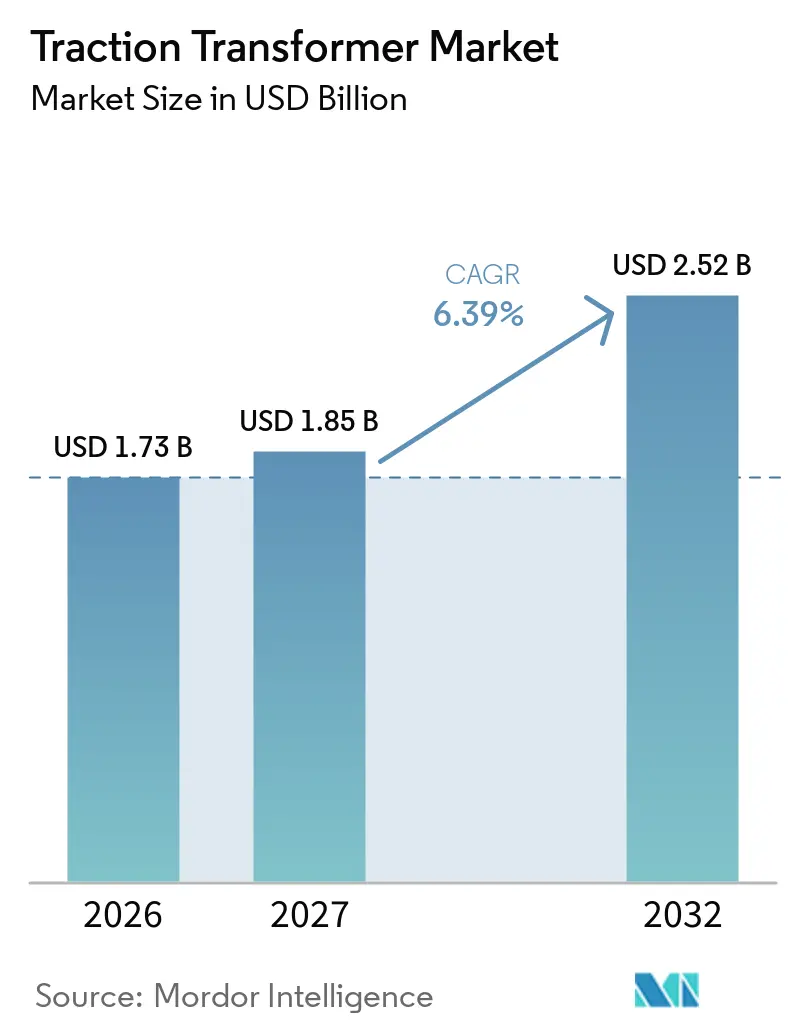
The Traction Transformer Market size is projected to be USD 1.73 billion in 2026, USD 1.85 billion in 2027, and reach USD 2.52 billion by 2032, growing at a CAGR of 6.39% from 2027 to 2032. Rail electrification, high-speed corridor construction, and replacement of aging rolling stock support demand for onboard power-conversion equipment. The World Bank reported in 2025 that it supported 15 railway investment projects with total commitments of USD 4.5 billion in more than 20 countries.[1] The Global Traction Transformer Market is also shaped by the need for equipment that can operate across different voltage systems and meet revised rail safety requirements. Large suppliers are using integrated rolling-stock contracts, certified product portfolios, and service capabilities to secure high-value orders. Higher material costs and longer approval cycles remain important limits on delivery schedules and supplier margins.
Key Report Takeaways
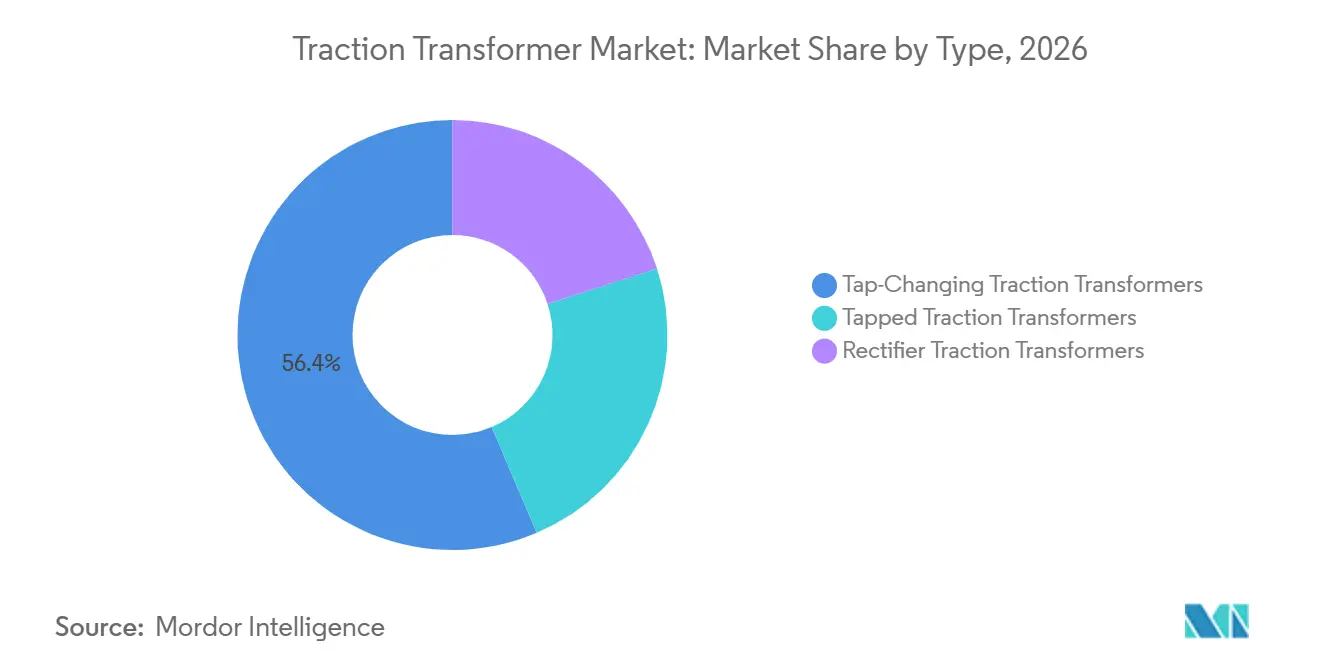
- By type, Tap-Changing Traction Transformers held 56.4% of the Global Traction Transformer Market share in 2026, while Rectifier Traction Transformers are forecast to grow at a 6.7% CAGR through 2032.
- By rolling stock, Electric Locomotives held 32.5% of the Global Traction Transformer Market share in 2026, while High-Speed Trains are forecast to grow at a 7.1% CAGR through 2032.
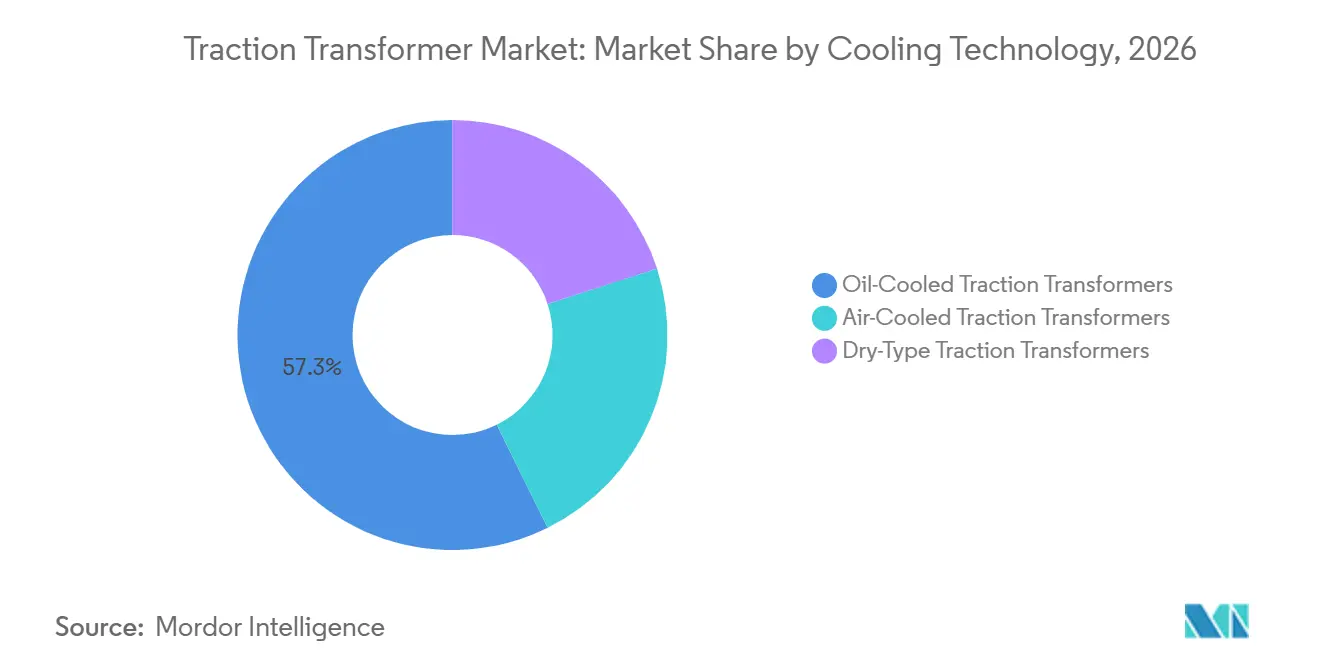
- By cooling technology, Oil-Cooled Traction Transformers held 57.3% of the Global Traction Transformer Market share in 2026, while Dry-Type Traction Transformers are forecast to grow at a 6.9% CAGR through 2032.
- By geography, Asia-Pacific held 48.7% of the Global Traction Transformer Market share in 2026 and is forecast to grow at a 6.8% CAGR through 2032.
Note: Market numbers in this report are based on Mordor Intelligence's proprietary estimation framework, which combines nine months of actuals with Q4 projections for base year 2026.
Market Trends and Insights
Drivers Impact Analysis of Traction Transformer Market*
| Driver | (~) % Impact on CAGR Forecast | Geographic Relevance | Impact Timeline |
|---|---|---|---|
| Rail Electrification and Diesel Fleet Replacement | +1.8% | Global, with primary intensity in South Asia, Sub-Saharan Africa, and Central Europe | Short term (≤ 2 years) |
| High-Speed Rail and Intercity Fleet Expansion | +1.5% | Asia-Pacific, Europe, and Middle East and Africa | Medium term (2-4 years) |
| Urban Metro and Suburban Rail Capacity Additions | +1.2% | Asia-Pacific, Middle East and Africa, and South America | Medium term (2-4 years) |
| Multi-System Interoperability Requirements | +0.8% | Europe, EU-adjacent corridors, and Northeast Asia | Medium term (2-4 years) |
| Digital Condition Monitoring and Predictive Maintenance | +0.7% | Global, led by Europe and Asia-Pacific | Long term (≥ 4 years) |
| Low-Weight, High-Power-Density Transformer Design | +0.5% | Asia-Pacific and Europe | Long term (≥ 4 years) |
| Source: Mordor Intelligence | |||
Rail Electrification and Diesel Fleet Replacement
Rail electrification provides the broadest demand base for the Global Traction Transformer Market because every electric locomotive, trainset, and electric multiple unit requires onboard power equipment. Indian Railways reached 99.2% broad-gauge electrification by December 2025 after adding 46,900 route km between 2014 and 2025.[2] This expansion has moved procurement toward Vande Bharat trainsets, freight locomotives, and metro units. These programs require both medium-power passenger equipment and higher-power freight locomotive equipment. Rail Baltica signed a EUR 1.77 billion electrification contract in September 2025 for 870 km across Estonia, Latvia, and Lithuania under a 2×25 kV system with 10 traction substations.[3] Lower electrification levels in the United Kingdom and Russia leave a further conversion pipeline for the Global Traction Transformer Market.
High-Speed Rail and Intercity Fleet Expansion
High-speed rail requires compact transformers that can operate under continuous thermal loads while meeting strict weight and vibration requirements. This need supports the 7.1% CAGR forecast for high-speed trains in the Global Traction Transformer Market. The European Commission’s high-speed rail plan published in November 2025 targets a Berlin-Copenhagen journey time of 4 hours by 2030 and a Paris-Lisbon connection via Madrid by 2035.[4] New corridors create demand for rolling stock as well as related traction equipment. India’s Mumbai-Ahmedabad project advanced with a USD 510 million track installation contract in September 2025, while power supply and signaling procurement progressed in parallel. Morocco’s Kenitra-Marrakech extension adds a 200 km, 320 km/h line under a 2×25 kV AC system and broadens high-speed demand in Africa.
Urban Metro and Suburban Rail Capacity Additions
Metro investment supports the Global Traction Transformer Market because commuter capacity needs are less dependent on commodity cycles. China planned more than 1,500 km of metro openings in 2025, including expansions above 100 km in Chengdu, Nanjing, and Tianjin. India received several funding commitments for metro development in 2025. The Asian Development Bank approved USD 240 million for the Chennai Metro Rail Investment Project in December 2025. The European Investment Bank committed EUR 289.5 million to metro development in Nagpur and Pune. Enclosed passenger settings encourage metro operators to favor dry-type and air-cooled equipment that can meet fire-safety requirements.
Multi-System Interoperability Requirements
Cross-border operation is creating demand for transformer assemblies that can manage several voltage systems within one locomotive. Europe uses 1.5 kV DC, 3 kV DC, 15 kV AC, and 25 kV AC systems, and these systems coexist on freight and passenger corridors. The Global Traction Transformer Market benefits when operators specify multi-voltage capability rather than single-system designs. Nexrail ordered up to 200 Stadler Euro9000 locomotives in November 2025 for operation across all 4 European voltage systems. A 2025 journal study found that switches between 25 kV AC and 3 kV DC can generate electromagnetic interference in the 500 to 3,000 Hz range. These operating conditions increase the engineering requirements for filters, rectifier assemblies, and onboard transformer integration.
Restraints Impact Analysis of Traction Transformer Market*
| Restraint | (~) % Impact on CAGR Forecast | Geographic Relevance | Impact Timeline |
|---|---|---|---|
| Long Qualification Cycles and Rail Safety Certification | -0.6% | Global; amplified for new entrants in Europe where TSI and ERA authorisation add compliance stages | Short to medium term (≤ 4 years) |
| Weight, Space, and Thermal-Management Trade-Offs | -0.4% | APAC (high-speed EMU weight constraints); Europe (lightweight regional trainset packaging) | Medium term (2–4 years) |
| Volatile Copper, Electrical Steel, and Insulating-Fluid Costs | -0.5% | Global; acute in North America and EU where GOES import costs are elevated vs. Chinese domestic pricing | Short term (≤ 2 years) |
| Limited Retrofit Windows on Operating Railways | -0.3% | North America and mature European networks with high traffic density and limited maintenance downtime | Long term (≥ 4 |
| Source: Mordor Intelligence | |||
Volatile Copper, Electrical Steel, and Insulating-Fluid Costs
Material costs remain a direct commercial constraint for the Global Traction Transformer Market. Copper and grain-oriented electrical steel together represent 40% to 50% of a unit’s bill of materials. Fixed-price rail contracts can expose suppliers when commodity prices change between contract award and delivery. These cycles can span 2 to 3 years. Longer lead times for premium electrical steel also require manufacturers to hold more inventory. Manufacturers are responding through lower-loss core designs and treated windings that can improve energy performance and reduce operating cost pressure.
Long Qualification Cycles and Rail Safety Certification
Qualification requirements can delay commercial entry even when fleet demand is strong. International Electrotechnical Commission (IEC) 60310:2026 was published in April 2026 and revised shock and vibration testing requirements for onboard transformers. The revised standard also separates dry-type temperature testing requirements. EN 50155:2026 took effect in May 2026 and replaced the 2021 edition, requiring suppliers to update technical documentation. New suppliers may need accredited test reports and authorization under European interoperability rules before revenue begins. This process favors established suppliers that already have certified product families and installed rail references.
*Our forecasts treat driver/restraint impacts as directional, not additive. The impact forecasts reflect baseline growth, mix effects, and variable interactions.
Traction Transformer Market Segment Analysis
By Type:
Tap-Changing Designs Support Multi-System Rail NetworksTap-Changing Traction Transformers held 56.4% of the Global Traction Transformer Market share in 2026. Their on-load tap-changing mechanism maintains secondary voltage across the changing input conditions found on 25 kV and 15 kV AC rail systems. This makes the design a common choice for electric locomotives and electric multiple units on electrified mainlines. The Global Traction Transformer Market size for this type benefits from mixed-traffic corridors, suburban networks, and cross-border services. Nexrail’s 2025 order for up to 200 four-system Euro 9000 locomotives illustrates demand for equipment that can manage several European voltage systems in one assembly.
Tapped transformers remain relevant for single-voltage metro and light-rail services where a fixed ratio can meet operating requirements. Their role is more limited when transit operators want a platform that can serve mixed routes. Rectifier Traction Transformers are forecast to expand at a 6.7% CAGR through 2032. DC metro expansion in China, India, and Southeast Asia supports this outlook. A 2025 study of large-capacity dry-type onboard traction transformers reported a 43% improvement in insulation tensile strength after structural optimization. This development supports higher-capacity rectifier designs where insulation performance and packaging are important.

By Rolling Stock:
Locomotive Demand Leads While High-Speed Trains Grow FasterElectric Locomotives accounted for 32.5% of the Global Traction Transformer Market share in 2026. Mainline freight and passenger locomotives operating under 25 kV AC systems often require transformer ratings of 3 to 6 MVA. Their unit revenue is therefore higher than that of many metro and light-rail applications. Alstom’s 2025 contract for traction components for 17 Vande Bharat Sleeper trainsets had a value of EUR 144 million and included 5 years of maintenance. Large fleet programs can concentrate revenue in a limited number of rolling-stock contracts.
High-Speed Trains are forecast to grow at a 7.1% CAGR through 2032, the fastest rate among rolling-stock segments. New corridors in India, Morocco, Europe, and the United Arab Emirates require equipment that can work within strict axle-load and thermal limits. Metro trains and electric multiple units create a separate demand base for compact and low-maintenance equipment. Metro operators often choose dry-type units to address fire-safety requirements in enclosed stations. Light rail vehicles and trams remain more price-sensitive because their lower unit values limit design complexity. Battery-electric and hydrogen-electric rolling stock may require auxiliary-circuit transformers as pilot fleets move into larger orders.
By Cooling Technology:
Oil-Cooled Units Lead While Dry-Type Designs Gain GroundOil-Cooled Traction Transformers commanded 57.3% of the Global Traction Transformer Market share in 2026. They retain a strong position in high-capacity mainline and freight service because they offer favorable power density and unit cost. Synthetic ester fluids with flash points above 300°C have addressed part of the concern around mineral-oil leakage. This allows oil-cooled equipment to remain relevant as fire-safety requirements become stricter. Mainline and freight rail programs continue to require high-capacity units where this cooling approach is established.
Dry-Type Traction Transformers are forecast to grow at a 6.9% CAGR through 2032. Urban rail operators favor oil-free equipment where passengers, enclosed spaces, and limited vehicle space raise the value of fire safety and low maintenance. Hitachi Energy secured an order in January 2025 for 360 RESIBLOC Rail dry-type transformers for 90 Munich S-Bahn XXL trains. The trains are part of Bavaria’s EUR 2 billion-plus S-Bahn upgrade, and deliveries are scheduled from the end of 2028. Air-cooled transformers serve applications where neither the capacity of oil-cooled units nor the safety premium of dry-type equipment is decisive. IEC 60310:2026 may require product updates across dry-type and air-cooled portfolios.
Geography Analysis
APAC Traction Transformer Market
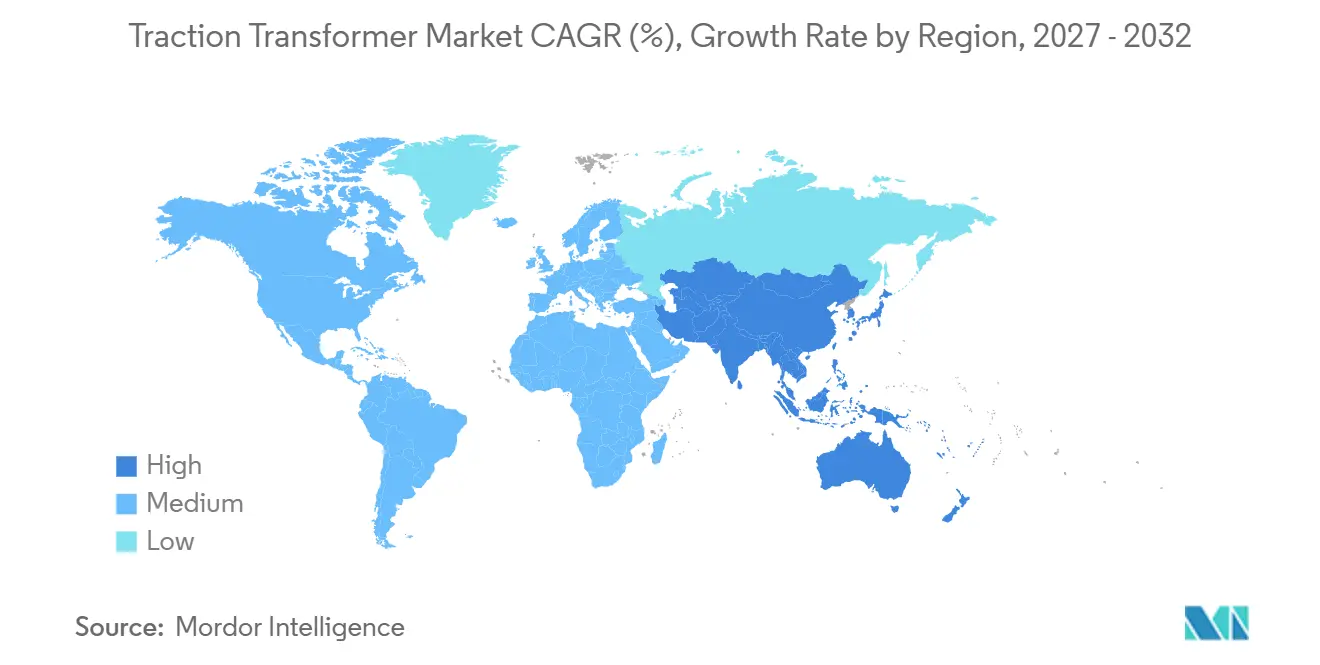
Asia-Pacific held 48.7% of the Global Traction Transformer Market share in 2026 and is forecast to expand at a 6.8% CAGR through 2032. China’s metro and high-speed construction, together with India’s rolling-stock procurement, underpins the region’s leading position. India electrified 46,900 route km between 2014 and 2025, supporting demand for Vande Bharat trainsets, freight locomotives, and metro electric multiple units. The Asian Development Bank approved a USD 299 million fourth-tranche loan for the Delhi-Meerut Regional Rapid Transit System in October 2025, bringing its total financing for the corridor to USD 1.05 billion. Jakarta’s proposed east-west metro tender and other Southeast Asian systems add to the procurement pipeline. Japan and South Korea provide replacement demand as equipment on established high-speed networks reaches end of service life.
Europe Traction Transformer Market
Europe is a technically demanding region for the Global Traction Transformer Market because operators must meet certification requirements and work across several electrification systems. The European Commission’s 2025 plan identifies major high-speed rail connections that would require rolling stock and related power equipment. Rail Baltica’s EUR 1.77 billion electrification project covers 870 km in Estonia, Latvia, and Lithuania under a 2×25 kV system. Operators in Romania, Poland, and the Czech Republic are replacing diesel fleets through publicly supported infrastructure plans. Siemens announced a EUR 220 million investment in its Nuremberg transformer facility in 2025. Hitachi Energy also announced a EUR 30 million investment in its Zaragoza dry-type transformer site.
The Americas and MEA Traction Transformer Market
North America has a fragmented demand base across commuter rail, light rail, and urban metro systems. Replacement and refurbishment of aging rolling stock in northeastern United States corridors support baseline orders. New light-rail projects in Canada and selected United States cities add further volume. European Investment Bank (EIB) Global signed a USD 250 million loan in October 2025 for Costa Rica’s first electric train system, comprising 51 km of double-track lines and 28 new electric train units. South America, the Middle East, and Africa present additional opportunities where modernization programs proceed despite longer procurement cycles. Morocco’s high-speed extension, Saudi intercity programs, and South African rail modernization could broaden demand for suppliers that can satisfy local-content requirements. The Global Traction Transformer Market is less exposed to high-speed rail in North America than it is in Asia-Pacific or Europe.
Competitive Landscape
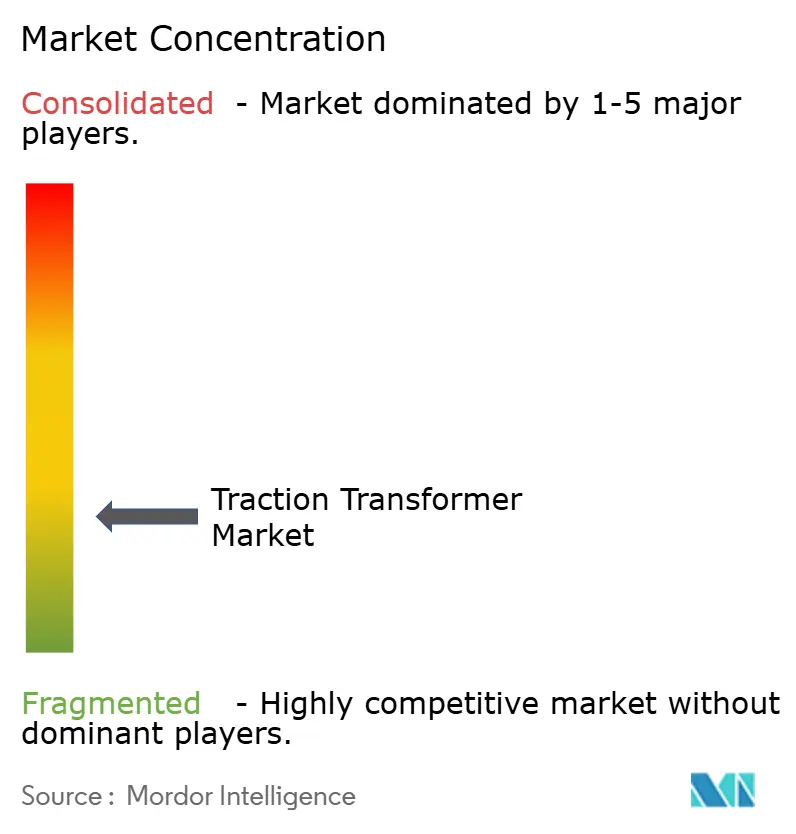
The Global Traction Transformer Market is fragmented among large rail-electrification groups. Hitachi Energy, Siemens, ABB, Alstom, CRRC, and Mitsubishi Electric can supply traction equipment through broader rolling-stock or rail electrification contracts. This model gives large suppliers access to high-value vehicle packages and long-term service arrangements. Hitachi Energy states that more than 5,000 of its traction transformers are installed in rail and metro infrastructure worldwide and that more than 30,000 rolling-stock units use its products. Regional specialists, including Končar, JST Transformateurs, Meidensha, and BHEL, maintain positions where national procurement rules and local manufacturing matter. The Global Traction Transformer Market also includes suppliers that compete on specific transformer types, certification coverage, and local rail references.
Large suppliers are expanding their dry-type portfolios as fire-safety requirements become more important in metro procurement. Hitachi Energy’s January 2025 order for 360 dry-type transformers for Munich’s S-Bahn program is one example of this strategy. The company also announced USD 250 million in additional global transformer manufacturing investment in March 2025. Siemens Energy announced construction of a USD 150 million transformer factory in Charlotte, North Carolina, and investment in its Nuremberg facility in 2025. These investments address capacity needs and strengthen access to component supply. Suppliers are also adding condition-monitoring and maintenance services to generate recurring revenue from installed fleets.
Certification remains an important competitive barrier because rail operators require qualified equipment with documented safety performance. IEC 60310:2026 and EN 50155:2026 increase the value of established testing and compliance capabilities. This favors manufacturers with broad certified product portfolios. Smaller entrants face greater cost and time requirements when they seek approval for new products. White space remains in dry-type rectifier transformer supply for DC metro systems in Southeast Asia and Sub-Saharan Africa. Chinese suppliers are gaining traction in export markets, while European suppliers face higher certification costs. The Global Traction Transformer Market concentration score is 6 out of 10 because large integrated suppliers hold strong positions in high-value contracts, while regional specialists continue to hold meaningful national and application-specific business.
Traction Transformer Industry Leaders
-
ABB Ltd.
-
Siemens AG
-
Alstom SA
-
Hitachi Energy Ltd.
-
Mitsubishi Electric Corporation
- *Disclaimer: Major Players sorted in no particular order
Traction Transformer Market Companies Covered in this Report
- ABB Ltd.
- Alstom SA
- Bharat Heavy Electricals Limited (BHEL)
- CG Power and Industrial Solutions Limited
- CRRC Corporation Limited
- EMCO Limited
- GE Vernova Inc.
- Hind Rectifiers Limited
- Hitachi Energy Ltd.
- JST Transformateurs
- Končar - Elektroindustrija d.d.
- Meidensha Corporation
- MGM Transformer Company
- Mitsubishi Electric Corporation
- Schneider Electric SE
- SGB-SMIT Group
- Siemens AG
- TBEA Co., Ltd.
- Toshiba Corporation
- Wabtec Corporation
- Wilson Transformer Company
Recent Industry Developments in Traction Transformer Market
- October 2026: Siemens Mobility won the world's largest order for battery-powered trains: 113 three-car Mireo Plus B trains (plus option for 132 additional units) from LNVG and RGB in Lower Saxony, valued at over EUR 2 billion, entering service from end-2031.
- October 2025: EIB Global signed a USD 250 million loan for Costa Rica's first electric train system, 51 km of double-track lines in the San José metro area and 28 new electric train units, the first electrification project of this scale in Central America.
- September 2025: Rail Baltica signed a EUR 1.77 billion electrification contract with COBELEC Rail Baltica covering 870 km across Estonia, Latvia, and Lithuania under a 2×25 kV, 50 Hz system with 10 traction substations. This is Europe's largest rail electrification project in active execution, with the first phase (EUR 949 million) due by 2030.
- March 2025: Hitachi Energy announced USD 250 million in additional global transformer production investment at CERAWeek, building on its USD 6 billion programme announced in 2024. Over 40% of the new capital targets US manufacturing, expanding component supply chains including for rail transformer variants.
Global Traction Transformer Market Report Scope
A traction transformer is a specialized electrical transformer that converts high-voltage power from overhead catenary wires or substations, typically ranging from 15 kV to 27.5 kV AC, into lower voltages required for train propulsion motors and auxiliary onboard systems.
The global traction transformer market is segmented by type, rolling stock, cooling technology, and geography. By type, the market is segmented into tap-changing traction transformers, tapped traction transformers, and rectifier traction transformers. By rolling stock, the market is segmented into electric locomotives, high-speed trains, metro trains, electric multiple units (EMUs), light rail vehicles and trams, and other electric rolling stock. By cooling technology, the market is segmented into oil-cooled, air-cooled, and dry-type traction transformers. The report also covers the market size and forecasts for the global Traction Transformer market across 22 countries in key regions. For each segment, the market sizing and forecasts have been provided on the basis of value (USD).
Segmentation Overview
| Tap-Changing Traction Transformers |
| Tapped Traction Transformers |
| Rectifier Traction Transformers |
| Electric Locomotives |
| High-Speed Trains |
| Metro Trains |
| Electric Multiple Units (EMUs) |
| Light Rail Vehicles and Trams |
| Other Electric Rolling Stock |
| Oil-Cooled Traction Transformers |
| Air-Cooled Traction Transformers |
| Dry-Type Traction Transformers |
| North America | United States |
| Canada | |
| Mexico | |
| Europe | Germany |
| France | |
| Italy | |
| Spain | |
| United Kingdom | |
| Poland | |
| Netherlands | |
| Russia | |
| Rest of Europe | |
| Asia-Pacific | China |
| India | |
| Japan | |
| South Korea | |
| Australia | |
| Rest of Asia-Pacific | |
| South America | Brazil |
| Argentina | |
| Rest of South America | |
| Middle East and Africa | Saudi Arabia |
| United Arab Emirates | |
| Israel | |
| South Africa | |
| Rest of Middle East and Africa |
| By Type | Tap-Changing Traction Transformers | |
| Tapped Traction Transformers | ||
| Rectifier Traction Transformers | ||
| By Rolling Stock | Electric Locomotives | |
| High-Speed Trains | ||
| Metro Trains | ||
| Electric Multiple Units (EMUs) | ||
| Light Rail Vehicles and Trams | ||
| Other Electric Rolling Stock | ||
| BY Cooling Technology | Oil-Cooled Traction Transformers | |
| Air-Cooled Traction Transformers | ||
| Dry-Type Traction Transformers | ||
| By Geography | North America | United States |
| Canada | ||
| Mexico | ||
| Europe | Germany | |
| France | ||
| Italy | ||
| Spain | ||
| United Kingdom | ||
| Poland | ||
| Netherlands | ||
| Russia | ||
| Rest of Europe | ||
| Asia-Pacific | China | |
| India | ||
| Japan | ||
| South Korea | ||
| Australia | ||
| Rest of Asia-Pacific | ||
| South America | Brazil | |
| Argentina | ||
| Rest of South America | ||
| Middle East and Africa | Saudi Arabia | |
| United Arab Emirates | ||
| Israel | ||
| South Africa | ||
| Rest of Middle East and Africa | ||
Key Questions Answered in the Report
Which traction transformer type holds the largest share?
The Global Traction Transformer Market is projected to reach USD 2.52 billion by 2032, from USD 1.84 billion in 2027, at a 6.39% CAGR.
Which traction transformer type holds the largest share?
Tap-Changing Traction Transformers hold the largest share at 56.4% in 2026 because they can manage voltage variation across electrified rail networks.
Which rolling-stock application is growing fastest?
High-Speed Trains are forecast to grow at a 7.1% CAGR through 2032 as new corridors require compact equipment with strict thermal and weight performance.
Why are dry-type traction transformers gaining adoption?
Dry-Type Traction Transformers are forecast to grow at a 6.9% CAGR through 2032 because urban operators prioritize fire safety, oil-free designs, and lower maintenance.
Which region leads demand for traction transformers?
Asia-Pacific leads with 48.7% share in 2026 and is forecast to grow at a 6.8% CAGR through 2032, supported by rail investment in China and India.
What limits supplier growth in this sector?
Qualification cycles, revised safety standards, and material-cost exposure can delay deliveries and pressure margins under long-term fixed-price contracts. These constraints are most relevant when projects have tight delivery schedules and suppliers must reserve materials before final equipment acceptance across global rolling-stock supply chains.