
Tow Truck Market Size and Share
Market Overview
| Study Period | 2020 - 2032 |
|---|---|
| Market Size (2027) | USD 2.27 Billion |
| Market Size (2032) | USD 2.81 Billion |
| Growth Rate (2027 - 2032) | 4.36 % |
| Fastest Growing Market | Asia-Pacific |
| Largest Market | North America |
| Market Concentration | Medium |
Major Players *Disclaimer: Major Players sorted in no particular order Image © Mordor Intelligence. Reuse requires attribution under CC BY 4.0. | |
Tow Truck Market Analysis by Mordor Intelligence
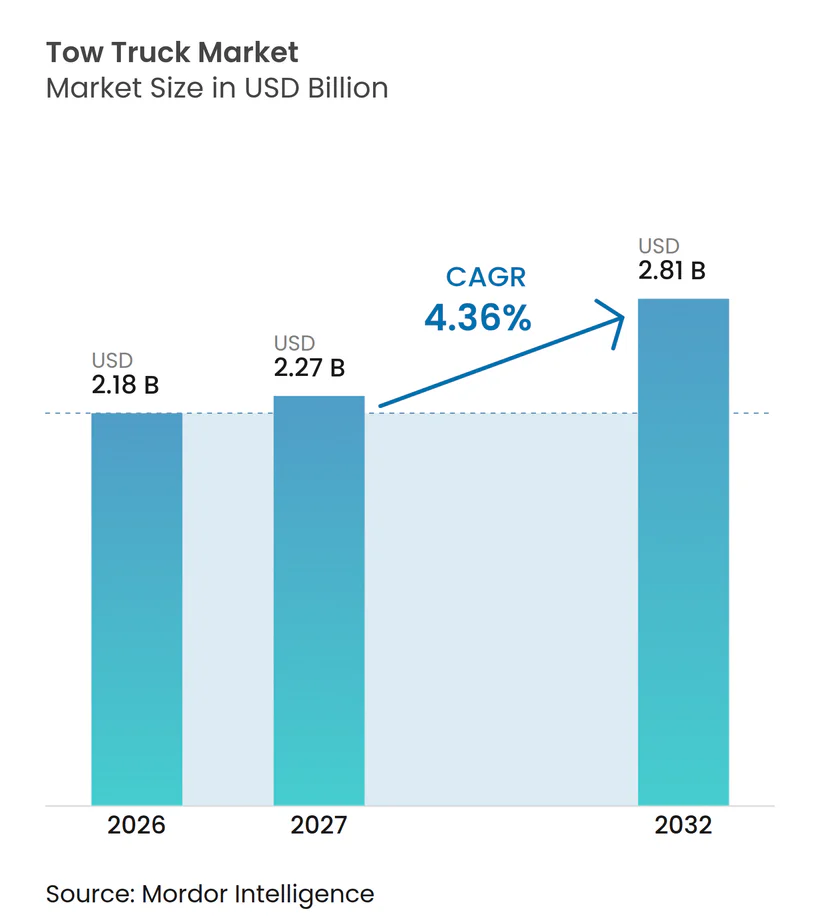
The tow truck market size was valued at USD 2.18 billion in 2026 and is projected to expand from USD 2.27 billion in 2027 to USD 2.81 billion by 2032, registering a CAGR of 4.36% between 2027 and 2032. The tow truck market is supported by a larger installed vehicle base, older vehicles, and more frequent roadside events that require professional recovery. In Germany, ADAC recorded 3,691,813 roadside deployments in 2025, equal to one deployment every nine seconds and 1.6% above 2024, which indicates a durable service base for recovery operators. Equipment demand is also changing as operators need to recover heavier vehicles while protecting complex drivetrains and electronic systems. Digital dispatch requirements are becoming part of commercial fleet contracts, which favors providers that can document service delivery and respond quickly. The tow truck market therefore has a measured expansion path, with replacement demand and operating requirements shaping purchasing decisions alongside new vehicle growth.
Key Report Takeaways
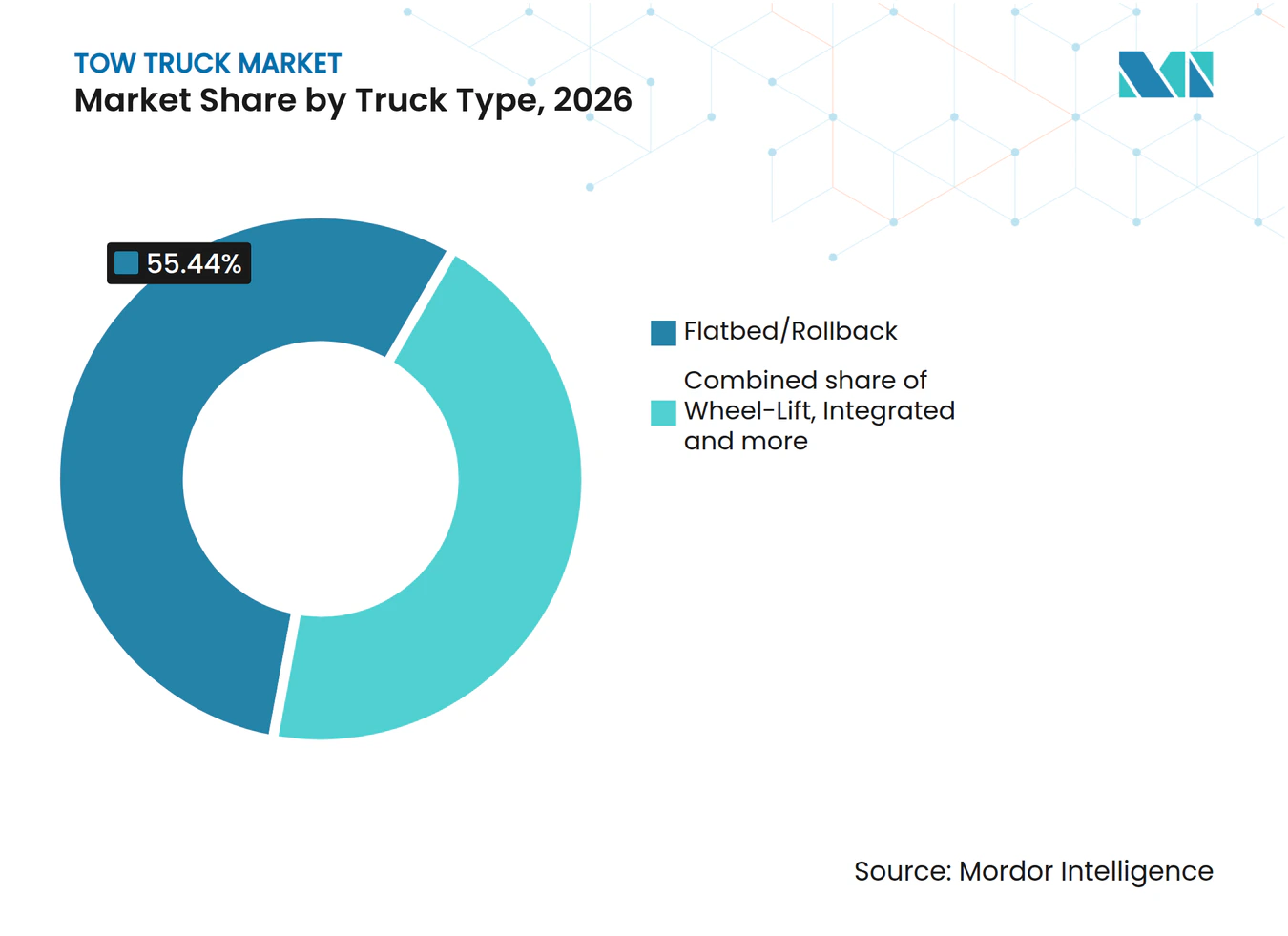
- By truck type, flatbed/rollback held a 55.44% share in 2026, while integrated (self-loader) units are projected to grow at the highest CAGR of 7.23% through 2032.
- By duty class, medium-duty held a 43.12% share in 2026, while heavy-duty units are projected to grow at the highest CAGR of 6.34% through 2032.
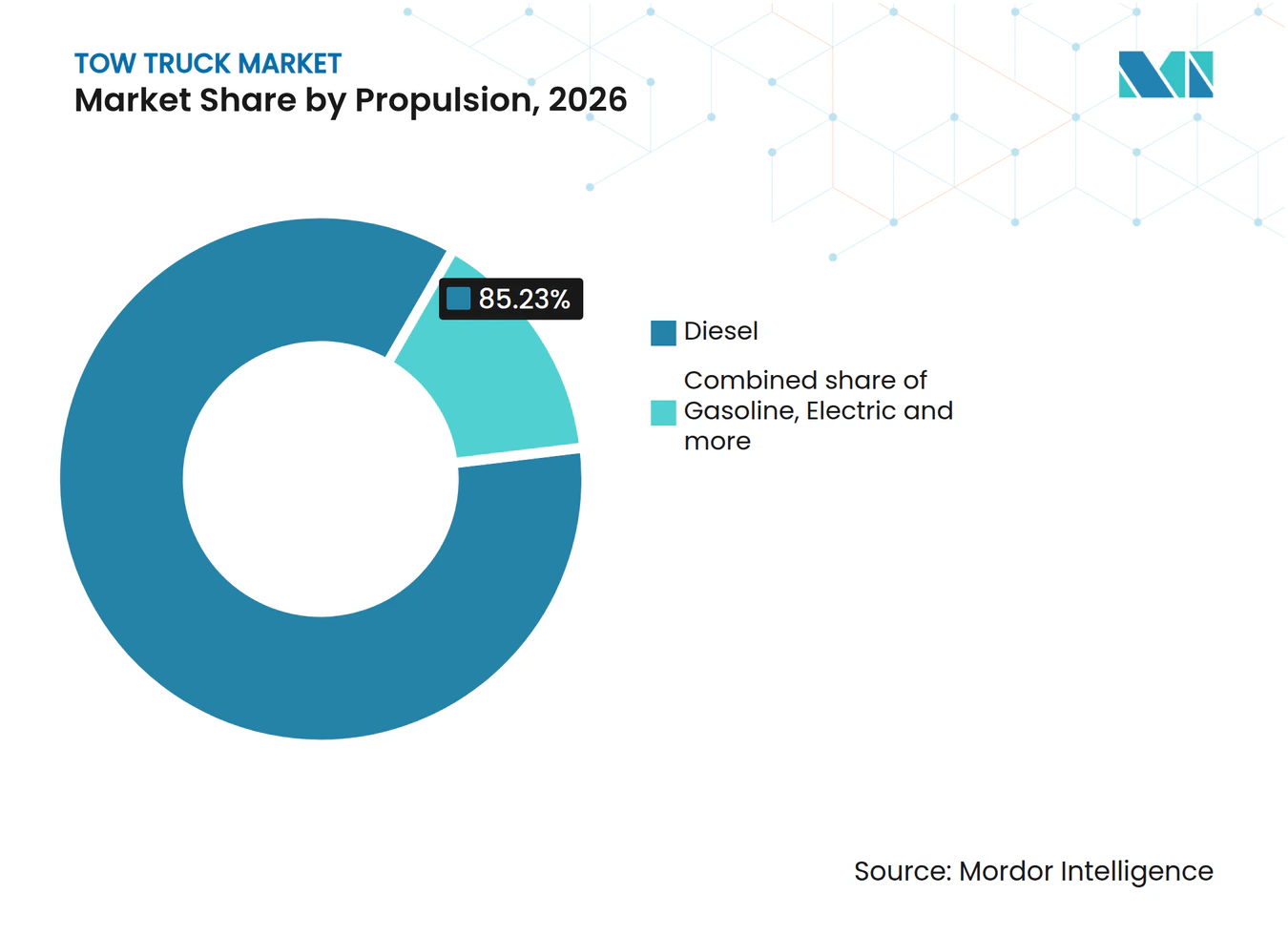
- By propulsion, diesel held an 85.23% share in 2026, while electric tow trucks are projected to grow at the highest CAGR of 10.17% through 2032.
- By end user, towing and roadside assistance companies held a 56.18% share in 2026, while fleet operators are projected to grow at the highest CAGR of 6.82% through 2032.
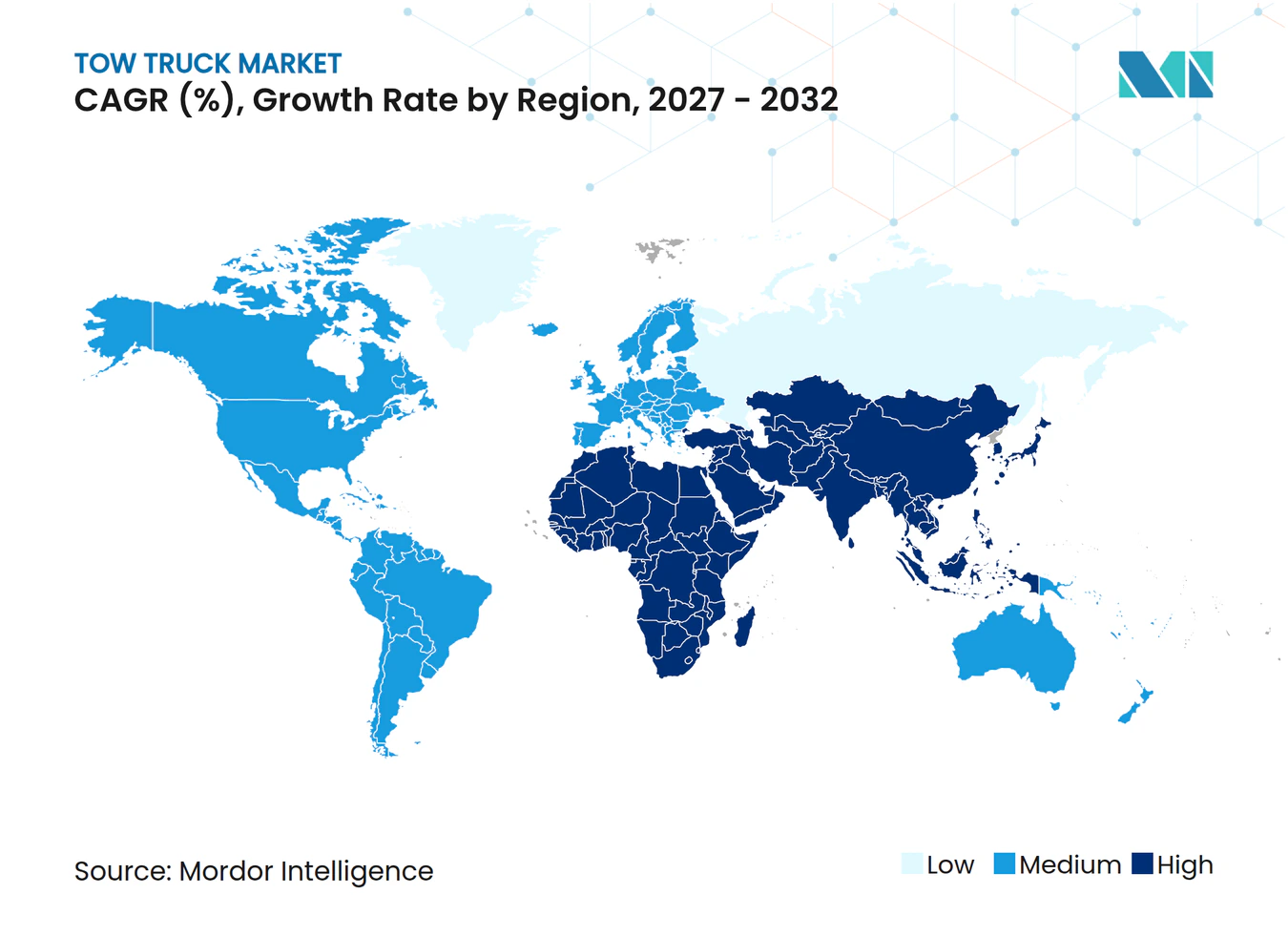
- By geography, North America held a 41.89% share in 2026, while Asia-Pacific is projected to grow at the highest CAGR of 6.45% through 2032.
Note: Market numbers in this report are based on Mordor Intelligence's proprietary estimation framework, which combines nine months of actuals with Q4 projections for base year 2026.
Market Trends and Insights
Drivers Impact Analysis of Tow Truck Market*
| Driver | (~) % Impact on CAGR Forecast | Geographic Relevance | Impact Timeline |
|---|---|---|---|
| Rising Vehicle Parc and Breakdown Exposure | +1.2% | Global; North America and Europe most acute | Medium term (2–4 years) |
| Expansion of Roadside-Assistance and Motor-Club Coverage | +0.8% | North America and Europe core; spillover to Asia-Pacific | Medium term (2–4 years) |
| Preference for Damage-Minimizing Flatbed Recovery | +0.6% | Global | Short term (≤ 2 years) |
| Heavier EVs Increasing Recovery Payload Requirements | +0.5% | North America and Europe; early-stage Asia-Pacific | Long term (≥ 4 years) |
| Digital Dispatch and Telematics Improving Fleet Utilization | +0.5% | North America core; Asia-Pacific and Europe growing | Medium term (2–4 years) |
| Road-Safety and Incident-Clearance Investment | +0.4% | Global; developed economies leading | Medium term (2–4 years) |
| Source: Mordor Intelligence | |||
Rising Vehicle Parc and Breakdown Exposure
A larger and older vehicle base supports recurring demand in the tow truck market because roadside events require an immediate physical response. ADAC recorded 3,691,813 roadside deployments in 2025, up 1.6% from 2024, and the pace of one deployment every nine seconds demonstrates the scale of the service requirement in Germany[1]. Roadside assistance activity also increased in other European markets during 2025, with battery and tire failures among the most common call-out causes. These patterns matter because equipment use is linked to the frequency, location, and complexity of breakdowns rather than to vehicle sales alone. Aging fleets can extend the period in which operators need dependable carriers, wreckers, and support vehicles. Road conditions and deferred maintenance can further increase dispatch volumes even where fleet growth is modest.
The tow truck market benefits when service operators need a dependable response fleet across urban, highway, and regional routes. Higher dispatch volume can raise vehicle utilization, which shortens the practical replacement cycle for heavily used recovery units. It also gives operators a stronger reason to choose equipment that reduces loading time and limits damage claims. This favors established recovery designs that can address a broad set of passenger and commercial vehicle events. The same operating conditions create opportunities for maintenance, parts, and body integration services around the towing fleet. For equipment suppliers, the relevant requirement is not only a larger vehicle population but a recovery fleet that can remain available during periods of high call volume.
Heavier EVs Increasing Recovery Payload Requirements
The shift toward heavier electric vehicles is changing payload needs in the tow truck market. Battery packs can add 400 kg to 700 kg compared with equivalent internal-combustion vehicles, which raises the mass that recovery equipment must safely carry. This requirement is especially important for operators serving larger passenger vehicles, buses, and commercial vehicles. The towing equipment must also handle vehicles with high-voltage systems and drivetrains that require careful loading and securing. The result is a stronger case for purpose-configured carriers and higher-capacity recovery equipment. It also makes duty-class selection more important when operators renew fleets.
The operational limits of electric recovery vehicles remain important. Electric recovery configurations require operators to assess payload, range, charging access, and the duty cycle before deployment. This requirement shows why fleet transition decisions remain tied to the work performed on each route. The tow truck market can gain from equipment upgrades even when the recovery vehicle itself remains diesel or hybrid. Manufacturers that support EV-safe procedures, flexible body configurations, and higher lifting capability can address a clear operator requirement. The need is most evident where recovery firms handle a growing mix of large electric passenger vehicles and commercial fleets.
Digital Dispatch and Telematics Improving Fleet Utilization
Digital dispatch is becoming a practical requirement for providers that serve commercial fleet accounts. Autura documented how Petroff Towing moved from manual processing to a digital dispatch system after a fleet customer required certified platform-based job acceptance. This change affects the tow truck market because equipment investment is increasingly assessed alongside dispatch capability, service records, and response management. A carrier that is physically capable but unavailable in a customer’s digital workflow may not qualify for work. Dispatch platforms can also improve visibility over driver location, vehicle status, and job completion. These functions help operators use existing assets more efficiently. They can therefore support purchasing decisions for equipment with connected systems and clearer maintenance records.
Telematics raises the service standard for both independent operators and larger fleets. Operators can use service data to schedule maintenance, review route performance, and provide proof of service to contracted customers. This is relevant to recovery fleets because a missed or poorly documented call can affect future work. The resulting competitive effect is gradual rather than immediate, since many smaller operators retain manual processes. However, fleet customers can make digital integration a condition of contract renewal. The tow truck market gains where operators invest in newer vehicles that can support more reliable dispatch, communication, and reporting practices.
Road-Safety and Incident-Clearance Investment
Public road-safety programs support equipment demand when they require quicker and more dependable incident response. California announced a USD 191 million package for operational and safety improvements along State Route 91 in October 2025 and set a framework to reduce fatal and serious-injury crashes by 30% by 2035[2]. Such programs can increase the importance of qualified recovery providers within highway operations. Rapid clearance reduces the risk of secondary incidents and helps restore traffic flow. This creates a clear role for appropriately specified carriers, wreckers, and support vehicles. The purchasing effect can extend beyond government-owned fleets because contracts often require private operators to meet equipment and service standards.
Australia’s 2025–26 Black Spot Program committed more than AUD 85 million (~USD 55 million) to 162 dangerous sites across three states[3]. These investments are not solely towing procurements, but they strengthen the broader operating environment for incident management. Tow providers that can meet clearance and safety requirements have a stronger role in the road-response chain. Equipment suppliers can benefit where contracts reward reliable access, heavy-duty capability, and documented compliance. The tow truck market also gains from standardization because operators must specify vehicles around defined service needs. This supports replacement demand even when general economic conditions are uneven.
Restraints Impact Analysis of Tow Truck Market*
| Restraint | (~) % Impact on CAGR Forecast | Geographic Relevance | Impact Timeline |
|---|---|---|---|
| High Upfront Cost and Long Replacement Cycles | -1.6% | Global; most severe in emerging markets and for independent operators | Long term (≥ 4 years) |
| Operator Shortage and Specialized Recovery Training Burden | -1.0% | North America and Europe; emerging in Asia-Pacific | Medium term (2–4 years) |
| Payload, Range, and Charging Constraints for Electric Tow Trucks | -0.5% | North America, Europe | Long term (≥ 4 years) |
| Steel, Aluminum, Chassis, and Hydraulic Component Cost Volatility | -0.5% | Global | Short term (≤ 2 years) |
| Source: Mordor Intelligence | |||
High Upfront Cost and Long Replacement Cycles
High purchase costs can delay replacement decisions across the tow truck market, especially among independent operators. Recovery vehicles are specialized assets that are often financed over several years. Operators may therefore keep older equipment in service when cash flow is uncertain or when interest and input costs rise. This limits the pace at which new product features can reach smaller fleets. It also gives used equipment a meaningful role in the purchasing cycle. The effect is strongest where operators lack steady contract income or large fleet purchasing power.
Long replacement cycles do not remove demand, but they can shift it toward repair, refurbishment, and incremental upgrades. Operators may prioritize changes that improve reliability, loading safety, or compliance instead of replacing an entire unit. This can moderate unit shipments while sustaining demand for components and service support. For manufacturers, flexible configurations and finance-supported distribution can reduce the entry barrier. The tow truck industry also depends on chassis availability and body-integration capacity, which can extend delivery schedules. Suppliers that maintain parts availability and dealer support can be better positioned when fleet owners eventually replace aging equipment.
Operator Shortage and Specialized Recovery Training Burden
The recovery workforce requires driving skill, equipment knowledge, and judgment during complex roadside events. The Garden State Towing Association promoted a three-day heavy-duty towing and recovery course in 2025, illustrating the specialized preparation required for this work. Training becomes more demanding when operators must handle high-voltage vehicles, all-wheel-drive systems, and heavier commercial equipment. A shortage of qualified workers can limit the number of units a company can place into active service. It can also delay expansion into heavy-duty work where the technical and safety requirements are higher. These constraints are relevant even when local breakdown demand remains strong.
The training burden affects fleet economics as well as service capacity. Businesses need to pay for instruction, manage time away from active work, and retain staff once they are trained. Smaller firms can find these conditions difficult because each trained worker represents a larger share of total capacity. Equipment that simplifies safe loading, reduces manual steps, or provides clearer operating guidance can partly address this issue. Still, the need for qualified judgment remains central to vehicle recovery. The tow truck market will continue to depend on manufacturers, training groups, and operators working together on practical recovery procedures.
*Our forecasts treat driver/restraint impacts as directional, not additive. The impact forecasts reflect baseline growth, mix effects, and variable interactions.
Tow Truck Market Segment Analysis
By Truck Type:
Flatbed Recovery Remains the Broadest Operating FormatFlatbed/rollback equipment held 55.44% of the tow truck market share in 2026, making it the largest truck type. This format places the recovered vehicle on the deck, which can reduce drivetrain and wheel contact concerns during transport. Electronic parking brakes and all-wheel-drive configurations are major reasons that operators prefer full-load recovery. That need can become more important as vehicles include more electronic systems and higher repair costs. Flatbeds also give operators flexibility across passenger vehicles, specialty vehicles, and selected light-commercial loads. Their broad utility makes them a common choice for mixed roadside fleets.
Integrated (self-loader) units are forecast to grow at a 7.23% CAGR through 2032, the highest rate within truck types. These units support applications where fast pickup, compact operation, and repeated vehicle movement are central requirements. Parking enforcement, repossession, and light commercial recovery can favor this format because the workflow emphasizes speed and frequent dispatches. Wheel-lift products remain relevant for operators that need a lower-cost entry point or work with suitable vehicle types. Rotators serve a narrower heavy-recovery role where lifting reach and controlled positioning are essential. NRC Industries upgraded its QuickSwap detachable unit with an integrated recovery boom in November 2025, adding a product example of a platform designed for flexible recovery work.



By Duty Class:
Medium-Duty Leads While Heavier Recovery Needs IncreaseMedium-duty units accounted for 43.12% of the tow truck market share in 2026. They offer a practical middle ground for companies that handle passenger vehicles, light commercial vehicles, and urban incident work. This class can fit the operating needs of regional companies that do not require a dedicated heavy wrecker for every call. A wider range of chassis choices can also support purchasing flexibility. Medium-duty equipment is useful where operators need a single vehicle to complete varied assignments. Its role is reinforced by the need to balance acquisition cost with operational range.
Heavy-duty units are projected to expand at a 6.34% CAGR through 2032 as recovery needs move toward larger and heavier vehicles. The move toward electric buses and battery-electric commercial trucks can increase the importance of higher-capacity equipment on logistics routes. Jerr-Dan introduced the JD35/40 Ton Rotator in October 2025 with a 37-foot continuous-rotation boom, dual 35,000-pound planetary winches, and a 50,000-pound drag winch. This product illustrates supplier attention to the space between standard heavy wreckers and the largest rotators. Light-duty products remain relevant for municipal work, vehicle seizures, and routine passenger-vehicle recovery. The tow truck market size for heavy-duty equipment can rise as fleets upgrade capacity to manage these more demanding assignments.
By Propulsion:
Diesel Retains a Large Installed Base as Electric Products Enter ServiceDiesel represented 85.23% of the tow truck market share in 2026. The segment is supported by established fueling and service networks and the torque characteristics needed for demanding recovery work. Diesel equipment also remains familiar to operators and technicians who manage long shifts across broad service territories. Replacement cycles are gradual, which reinforces the installed base. Gasoline models continue to serve parts of the light-duty category where lower acquisition cost can be important. Propulsion selection still depends on payload, distance, and the availability of service infrastructure.
Electric tow trucks are forecast to grow at a 10.17% CAGR through 2032, the strongest rate by propulsion. NRC Industries unveiled the E-20TB electric-powered carrier in June 2025 on a Mack MD Electric chassis, with an ePTO integrated into the body and a power pack that recharges while the vehicle is in transit. Fiault Industrie also produced a tow truck on a Volvo FM Electric 19-ton chassis in 2025 and adapted its workshop processes and staff training for electric-vehicle handling. These launches show that electric recovery equipment has moved into commercial product development. The commercial case will remain dependent on range, payload, charging access, and the specific recovery cycle. Diesel will therefore remain central while electric and hybrid options gain defined urban and regional applications.

By End User:
Roadside Specialists Lead Equipment PurchasingTowing and roadside assistance companies held 56.18% of the tow truck market share in 2026. These organizations are direct users of recovery equipment and typically have the highest dispatch frequency. Their need to cover varied calls can support investment across flatbeds, wheel-lifts, integrated units, and heavy-duty vehicles. Motor-club and assistance contracts can provide more predictable utilization than occasional towing work. This allows some companies to plan equipment renewal around utilization and service-level commitments. Their buying decisions often combine vehicle capability, parts support, and operating reliability.
Fleet operators are projected to grow at a 6.82% CAGR through 2032. Logistics, rental, utility, and large commercial fleets can bring selected recovery work in-house or contract it through structured provider networks. Digital acceptance, location data, and completed-service documentation are becoming more important in this setting. Autura’s Petroff Towing case study shows that platform integration can become a customer requirement rather than an optional tool. Municipalities, police departments, and dealerships continue to represent distinct demand pools with different vehicle and procurement requirements. These buyers can favor standardized configurations that fit routine enforcement, storage, transport, or assistance work.
Geography Analysis
North America
North America held 41.89% of the tow truck market share in 2026. The region benefits from a large commercial fleet base, extensive roadside-assistance activity, and established procurement channels for specialist recovery equipment. Highway incident-clearance programs can require private providers to maintain certified assets and defined response capability. This links equipment choices to operational standards as well as to ordinary fleet replacement. California’s 2025 safety initiative for State Route 91 shows how public agencies are using data and operational investment to improve road safety. These conditions support demand for equipment that can handle fast clearance, diverse vehicle weights, and documented service delivery.
The region also has a strong base of equipment manufacturers, distributors, and body integrators. Miller Industries reported 2025 net sales of USD 790.3 million and issued 2026 guidance of USD 850 million to USD 900 million, while pointing to inventory normalization ahead of later production activity. The scale of this supply network helps operators obtain parts, service, and specialized equipment. DOT requirements influence product specifications in the United States, while fleet contracts can add their own equipment and reporting requirements. The tow truck market size in North America is also supported by a broad set of end users, including dedicated roadside operators, fleet providers, municipal customers, and commercial recovery firms. These structural factors make the region significant for both routine replacement demand and specialized heavy-duty products.
Asia-Pacific
Asia-Pacific is forecast to grow at a 6.45% CAGR through 2032, the fastest regional rate. Vehicle ownership, urban growth, and highway expansion are increasing the need for managed roadside response across several countries. The region includes mature service networks as well as markets where formal recovery capacity is still developing. This mix gives suppliers opportunities across basic towing platforms, purpose-configured carriers, and heavy-duty equipment. Public policy can have an important role where road agencies define response obligations or include recovery capability in incident-management systems. The tow truck market share of the region can rise as these networks become more structured.
A regional pattern is the increasing attention to road-safety infrastructure and the integration of roadside services into broader mobility systems. Japan has an established recovery ecosystem, while other markets are building highway response capability as vehicle use expands. Suppliers must account for local chassis preferences, urban operating conditions, and differences in service procurement. Compact footprints can matter in dense cities, while higher-capacity units can be required on freight corridors. Digital scheduling and location systems can help operators manage greater call volumes across diverse geographies. This combination of infrastructure development and fleet growth supports a broad demand base for the tow truck market.
Europe, South America, and the Middle East and Africa
Europe is supported by older vehicles, mature roadside-assistance systems, and tightening interest in lower-emission commercial equipment. ADAC’s 2025 deployment figures show that demand for roadside response remains substantial in a major European market. Product development is beginning to reflect electrification needs. Fiault Industrie’s electric tow truck program demonstrates how body builders are adapting manufacturing processes and workforce practices for electric chassis. CE marking and applicable vehicle rules influence cross-border equipment sales. These compliance factors can strengthen the position of suppliers with established engineering, training, and distribution support.
South America is shaped by commercial fleet activity and the practical need for highway and urban recovery equipment. Operators in cost-sensitive markets may place greater emphasis on durable equipment, local service support, and suitable chassis integration. The Middle East and Africa combine infrastructure investment in some countries with established insurance-linked towing activity in others. These markets are not uniform, so product availability, financing, and service networks can have a strong effect on adoption. Equipment providers can address these conditions through regional distributors and configurations that match local road conditions. Across these mixed geographies, the tow truck market is supported by the same core need for safe, reliable vehicle recovery, although the purchasing route and equipment specification vary considerably.
Competitive Landscape
Market Concentration
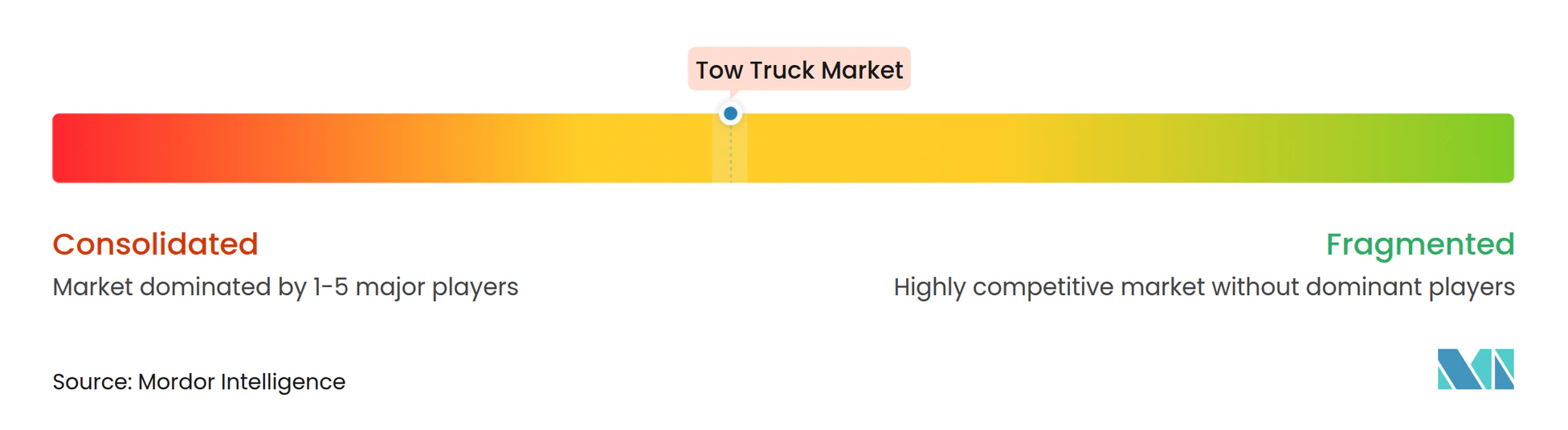
The tow truck market is moderately concentrated at the global level. Miller Industries and Jerr-Dan, part of Oshkosh Corporation, are prominent suppliers in North American heavy-duty and rotator equipment, while regional manufacturers compete through local specifications and dealer support. Miller Industries completed the acquisition of Omars S.p.A. in the fourth quarter of 2025, adding an Italian towing-equipment manufacturer to its European operations. The transaction supports a broader manufacturing and distribution footprint across Europe. It also shows that larger suppliers are using acquisitions to strengthen local market access. For buyers, scale can matter because recovery equipment requires parts availability, body integration, service knowledge, and distributor capability.
Product development is another important form of competition. Jerr-Dan introduced the JD35/40 Ton Rotator in October 2025 to serve recovery work between standard heavy wreckers and the largest rotators. NRC Industries introduced the E-20TB electric-powered carrier in June 2025, providing a commercial example of an electric carrier body developed for an electric chassis. These moves reflect a market where suppliers compete on capacity, flexibility, and compatibility with new chassis technologies. The field remains open for specialist products that address EV-safe recovery and connected fleet operations. Digital tools can help equipment brands differentiate, although reliable hardware and service support remain the central purchase considerations.
Smaller and regional companies remain important because towing applications vary by vehicle fleet, regulatory requirements, and operator budgets. European sales are influenced by CE marking, while United States equipment must meet applicable DOT expectations. These requirements can raise the cost and complexity of cross-border expansion. Local manufacturers may compete effectively where they understand chassis preferences and provide fast service. Larger suppliers retain an advantage in distribution scale, technical resources, and access to broad product ranges.
Tow Truck Industry Leaders
-
Miller Industries, Inc.
-
Oshkosh Corporation
-
NRC Industries
-
Dynamic Towing Equipment and Manufacturing
-
Stellar Industries, Inc.
- *Disclaimer: Major Players sorted in no particular order
Tow Truck Market Companies Covered in this Report
- Miller Industries, Inc.
- Oshkosh Corporation
- NRC Industries
- Dynamic Towing Equipment and Manufacturing
- Stellar Industries, Inc.
- B&B Industries, Inc.
- Dual-Tech, Inc.
- Carlinville Truck Equipment, Inc.
- Ledwell and Son Enterprises, Inc.
- Hubei Chengli Special Automobile Co., Ltd.
- Changsha Zoomlion Special Vehicle Co., Ltd.
- Fiault Industrie
- Miles Tow Trucks
- PolyBilt, Inc.
- Danco Products
- Isoli S.p.A.
- TEVOR Sp. z o.o.
- Global Towing Systems Kft.
- EMPL Fahrzeugwerk GmbH
- Roger Dyson Group
Recent Industry Developments in Tow Truck Market
- October 2026: NRC Industries introduced an evolved CSR50 heavy-duty recovery unit and the X-Deck high-traction carrier deck surface.
- March 2026: Miller Industries announced a USD 100 million, 200,000-plus sq ft facility addition at its Ooltewah, Tennessee headquarters to raise heavy-duty capacity, including military recovery-vehicle production starting in 2027; construction begins in late summer 2026.
- March 2026: NRC Industries released the next evolution of its QuickSwap detachable underlift unit.
- February 2026: Miller Industries launched the updated Century 9055XL 50-ton heavy-duty wrecker, with redesigned underlift pivot geometry, a new low 5x5 crossbar, and four-plate jack legs, available through its authorized global distributor network.
Global Tow Truck Market Report Scope
The tow truck market is segmented by truck type, duty class, propulsion, end user, and geography. By truck type, the market is segmented into Flatbed/Rollback, Wheel-Lift, Integrated (Self-Loader), Rotator, and Others. By duty class, the market is segmented into Light-Duty, Medium-Duty, and Heavy-Duty. By propulsion, the market is segmented into Diesel, Gasoline, Electric, and Others. By end user, the market is segmented into Towing and Roadside Assistance Companies, Municipalities and Police, Automotive Dealerships, Fleet Operators, and Others. By geography, the market is segmented into North America (United States, Canada, and Mexico), Europe (Germany, United Kingdom, France, Italy, Spain, Russia, and Rest of Europe), Asia-Pacific (China, India, Japan, South Korea, Australia, Indonesia, and Rest of Asia-Pacific), South America (Brazil, Argentina, Colombia, Chile, and Rest of South America), and Middle East and Africa (Saudi Arabia, United Arab Emirates, Turkey, South Africa, Egypt, Nigeria, and Rest of Middle East and Africa). The market forecasts are provided in terms of value (USD) and volume (units).
Segmentation Overview
| Flatbed/Rollback |
| Wheel-Lift |
| Integrated (Self-Loader) |
| Rotator |
| Others |
| Light-Duty |
| Medium-Duty |
| Heavy-Duty |
| Diesel |
| Gasoline |
| Electric |
| Others |
| Towing and Roadside Assistance Companies |
| Municipalities and Police |
| Automotive Dealerships |
| Fleet Operators |
| Others |
| North America | United States |
| Canada | |
| Mexico | |
| Europe | Germany |
| United Kingdom | |
| France | |
| Italy | |
| Spain | |
| Russia | |
| Rest of Europe | |
| Asia-Pacific | China |
| India | |
| Japan | |
| South Korea | |
| Australia | |
| Indonesia | |
| Rest of Asia-Pacific | |
| South America | Brazil |
| Argentina | |
| Colombia | |
| Chile | |
| Rest of South America | |
| Middle East and Africa | Saudi Arabia |
| United Arab Emirates | |
| Turkey | |
| South Africa | |
| Egypt | |
| Nigeria | |
| Rest of Middle East and Africa |
| By Truck Type | Flatbed/Rollback | |
| Wheel-Lift | ||
| Integrated (Self-Loader) | ||
| Rotator | ||
| Others | ||
| By Duty Class | Light-Duty | |
| Medium-Duty | ||
| Heavy-Duty | ||
| By Propulsion | Diesel | |
| Gasoline | ||
| Electric | ||
| Others | ||
| By End User | Towing and Roadside Assistance Companies | |
| Municipalities and Police | ||
| Automotive Dealerships | ||
| Fleet Operators | ||
| Others | ||
| By Geography | North America | United States |
| Canada | ||
| Mexico | ||
| Europe | Germany | |
| United Kingdom | ||
| France | ||
| Italy | ||
| Spain | ||
| Russia | ||
| Rest of Europe | ||
| Asia-Pacific | China | |
| India | ||
| Japan | ||
| South Korea | ||
| Australia | ||
| Indonesia | ||
| Rest of Asia-Pacific | ||
| South America | Brazil | |
| Argentina | ||
| Colombia | ||
| Chile | ||
| Rest of South America | ||
| Middle East and Africa | Saudi Arabia | |
| United Arab Emirates | ||
| Turkey | ||
| South Africa | ||
| Egypt | ||
| Nigeria | ||
| Rest of Middle East and Africa | ||
Key Questions Answered in the Report
What is the forecast for the tow truck market through 2032?
The tow truck market is projected to reach USD 2.81 billion by 2032, growing at a 4.36% CAGR from 2027 to 2032.
Which tow truck type has the largest share?
Flatbed/Rollback units led with 55.44% share in 2026 because they suit damage-sensitive recovery across a wide range of vehicles.
Which propulsion type is growing fastest for tow trucks?
Electric tow trucks are forecast to grow at a 10.17% CAGR through 2032, although diesel retained 85.23% share in 2026.
Which region has the largest demand for tow trucks?
North America held 41.89% share in 2026, supported by commercial fleets, roadside-assistance networks, and incident-clearance operations.