
Tourism Loyalty Programs Market Size and Share
Market Overview
| Study Period | 2022 - 2031 |
|---|---|
| Market Size (2026) | USD 8.97 Billion |
| Market Size (2031) | USD 10.43 Billion |
| Growth Rate (2026 - 2031) | 10.43 % |
| Fastest Growing Market | Asia-Pacific |
| Largest Market | North America |
| Market Concentration | Medium |
Major Players *Disclaimer: Major Players sorted in no particular order Image © Mordor Intelligence. Reuse requires attribution under CC BY 4.0. | |
Tourism Loyalty Programs Market Analysis by Mordor Intelligence
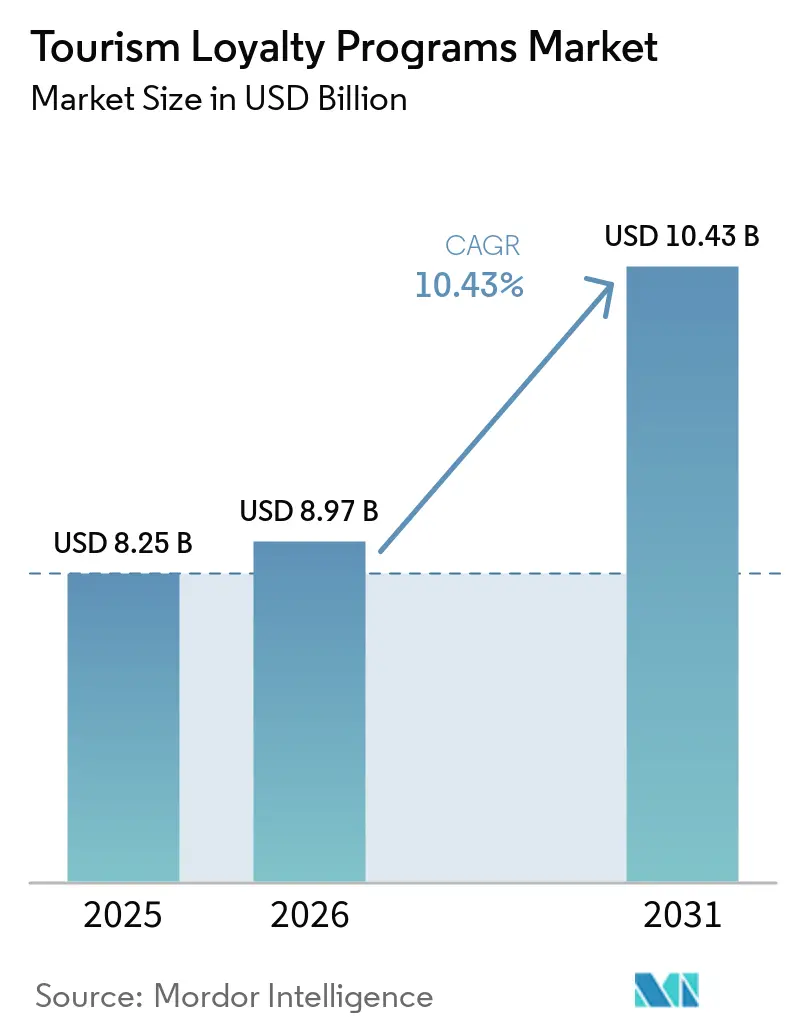
The Tourism Loyalty Programs Market size is expected to grow from USD 8.25 billion in 2025 to USD 8.97 billion in 2026 and is forecast to reach USD 10.43 billion by 2031 at 10.43% CAGR over 2026-2031.
Travel operators are increasingly turning to loyalty programs, not just for repeat bookings, but also for generating direct revenue through co-branded credit card royalties, subscription fees, and ancillary sales linked to member activities. Highlighting this shift, Marriott International, after renegotiating terms with JPMorgan Chase and American Express, forecast co-branded credit card royalty fees to soar to USD 966 million in 2026, up from USD 716 million in 2025. This underscores a trend in which the economics of tourism loyalty programs are leaning more towards financial metrics than solely on room occupancy. Operators are evolving their strategies, employing personalization, forming coalition partnerships, and adopting subscription-style memberships to keep members engaged. However, as they aim to expand across markets, they're grappling with challenges: high outstanding redemption obligations and stringent consent requirements are inflating execution costs. Furthermore, with digital comparison tools now influencing booking decisions by evaluating reward value, there's a push for loyalty programs to adopt simpler and more transparent designs. This shift presents an opportunity for operators to seamlessly blend immediate member value, enhanced data utilization, and expansive partner ecosystems, while ensuring the program remains user-friendly.[1]
Key Report Takeaways
- By tourism segment, Airlines held 42.53% of the tourism loyalty programs market share in 2025, while Online Travel Agencies are projected to record the fastest growth at an 11.94% CAGR through 2031.
- By end user, Individual Members accounted for 82.81% of the tourism loyalty programs market in 2025, while Corporate & Business Travelers are forecast to expand at a 10.67% CAGR through 2031.
- By program type, Points-Based Loyalty Programs represented 45.52% of the tourism loyalty programs market in 2025, while Subscription-Based Loyalty Programs are expected to grow fastest at a 10.95% CAGR through 2031.
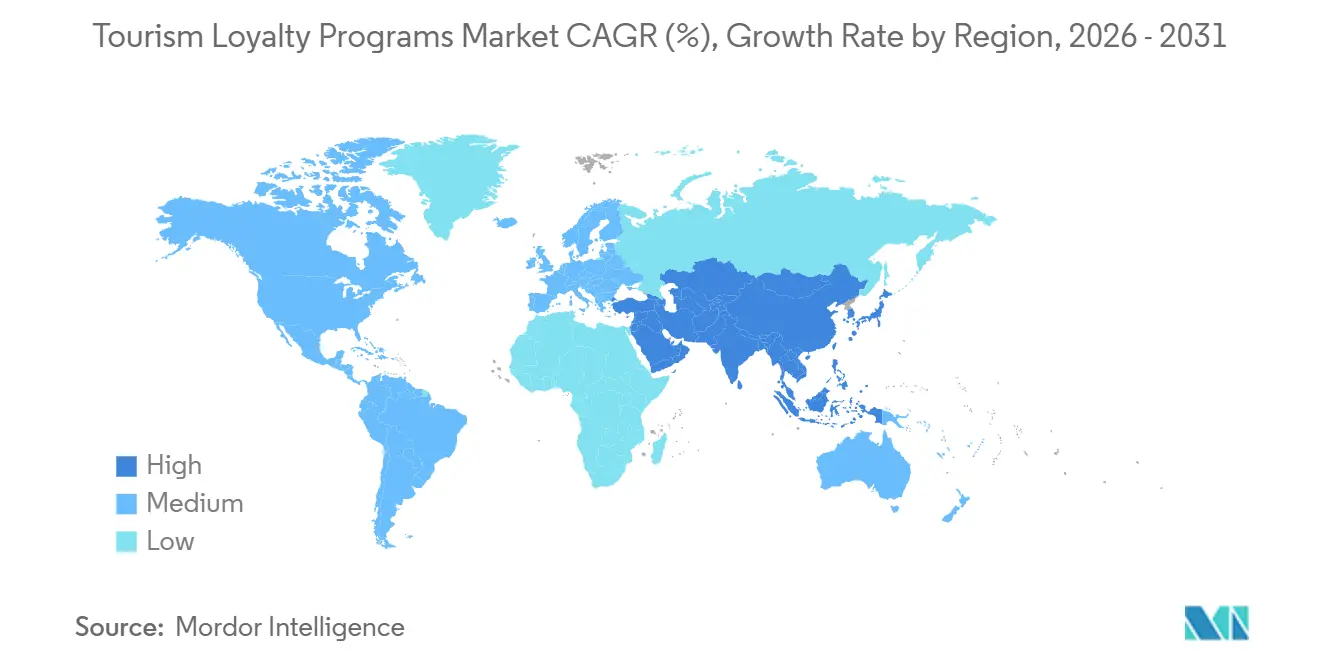
- By geography, North America captured 38.41% of the tourism loyalty programs market in 2025, while Asia-Pacific is projected to advance at an 11.65% CAGR through 2031.
Note: Market size and forecast figures in this report are generated using Mordor Intelligence’s proprietary estimation framework, updated with the latest available data and insights as of January 2026.
Global Tourism Loyalty Programs Market Trends and Insights
Drivers Impact Analysis*
| Drivers | (~) % Impact on CAGR Forecast | Geographic Relevance | Impact Timeline |
|---|---|---|---|
| Rising Demand for Personalized Travel Rewards | +2.4% | Global | Medium term (2-4 years) |
| Expansion of Cross-Brand Travel Partnerships | +1.7% | North America & APAC core, spill-over to MEA | Medium term (2-4 years) |
| Higher Mobile and App-Based Engagement | +1.5% | APAC core, spill-over to MEA | Short term (≤ 2 years) |
| Increased Use of First-Party Traveler Data | +1.2% | North America & EU | Medium term (2-4 years) |
| Growth in Subscription-Style Loyalty Memberships | +1.6% | Europe & North America | Short term (≤ 2 years) |
| Airline and Hotel Loyalty Monetization Through Ancillary Sales | +1.5% | North America & Europe | Short term (≤ 2 years) |
| Source: Mordor Intelligence | |||
Rising Demand for Personalized Travel Rewards
Personalization has become a core operating need in the tourism loyalty programs market, as travelers now expect rewards that match how and why they travel. Marriott Bonvoy’s Loyalty Trends Report 2026, based on a survey of 1,731 travelers across 8 Asia-Pacific markets, found that food and dining, nature and sightseeing, and shopping were strong motivators shaping reward engagement, indicating that redemption design needs to reflect travel intent rather than just point accumulation. This matters because travelers are comparing programs on perceived relevance, not simply on how many points they can collect over time. The tourism loyalty programs market is therefore moving toward more granular earn-and-redeem models that recognize dining, retail, leisure, and everyday spend alongside core travel transactions. Programs that fail to map benefits to real travel behavior are more exposed to disengagement, especially when digital tools make value comparisons easier at the time of booking. In practical terms, personalization is becoming part of program economics because it supports retention, wider partner usage, and more frequent member interaction across categories.
Expansion of Cross-Brand Travel Partnerships
Cross-brand partnership activity is expanding the scope of the tourism loyalty programs market by extending value beyond a single airline, hotel chain, or booking platform. Singapore Airlines and ANA deepened their cooperation in 2025 through revenue-sharing flights between Singapore and Japan and broader reciprocal earnings across additional booking classes, which illustrates how operators are linking loyalty value more closely with network strategy. When partnerships expand, members see more places to earn and redeem, and operators see stronger daily engagement. This is particularly important in the tourism loyalty programs market because many travelers split spend across multiple brands and categories during the same trip. Broader partner ecosystems also help programs stay relevant between trips, since dining, retail, and payment partners create additional transaction touchpoints. Over time, coalition-style architectures can improve switching costs for members because the program becomes tied to a wider share of the traveler’s spending behavior.[2]
Higher Mobile and App-Based Engagement
Mobile engagement is driving short-term growth in the tourism loyalty programs market, as smartphones are becoming the primary interface for discovery, booking, check-in, and redemption. This shift is especially visible in Asia-Pacific, where the user-supplied material already links regional growth to high smartphone penetration and strong loyalty participation. Accor reported that its ALL app recorded a 45% year-on-year increase in business volume in 2024, indicating that member activity is increasingly moving into app-based environments. Mobile-first engagement enhances the commercial value of the tourism loyalty programs market by enabling operators to surface targeted offers, real-time upgrades, and partner rewards at moments of high purchase intent. It also shortens the distance between earning and redemption, which makes the program feel more useful to the traveler. As more loyalty activity shifts into apps, programs with stronger mobile usability are likely to see better repeat engagement and stronger cross-sell performance.
Increased Use of First-Party Traveler Data
First-party data is becoming more important in the tourism loyalty programs market because operators need a direct view of traveler behavior across booking, stay, flight, and ancillary activity. That need becomes stronger when loyalty partnerships expand, since broader ecosystems create more member touchpoints that can be used to refine offers and improve redemption targeting. Expedia Group’s One Key structure links activity across Expedia, Hotels.com, and Vrbo into a single loyalty currency, reflecting a move toward more unified member data and a broader view of cross-brand behavior. In parallel, app-led member engagement at large hotel groups is giving operators a better foundation for understanding repeat behavior, preferred channels, and category-level purchase patterns. The tourism loyalty programs market increasingly rewards operators that can convert these first-party signals into clearer offers and more relevant benefits. At the same time, the benefit only materializes when data systems are well integrated, because fragmented systems weaken the quality and speed of personalization.
Restraints Impact Analysis*
| Restraints | (~) % Impact on CAGR Forecast | Geographic Relevance | Impact Timeline |
|---|---|---|---|
| Loyalty Fatigue Among Frequent Travelers | -1.5% | Global | Medium term (2-4 years) |
| High Program Redemption Liability | -1.2% | North America & Europe | Long term (≥ 4 years) |
| Data Privacy and Consent Complexity | -0.9% | EU core, spill-over to North America | Medium term (2-4 years) |
| Weak Differentiation Across Competing Programs | -0.8% | Global | Long term (≥ 4 years) |
| Source: Mordor Intelligence | |||
Loyalty Fatigue Among Frequent Travelers
Loyalty fatigue is becoming more visible in the tourism loyalty programs market as members join more programs but feel less attached to any single one. The user-supplied material shows that travelers increasingly want everyday usefulness, broader partner access, and clearer value rather than a narrow travel-only reward structure. At the same time, several large hotel groups revised their reward mechanics in 2026, indicating that operators are trying to protect economics while members are becoming more sensitive to program changes. This creates tension because the program may still attract sign-ups even as it loses emotional relevance. In the tourism loyalty programs market, fatigue becomes a growth restraint when enrollment rises, but active engagement weakens. Operators that cannot make the program feel more relevant between trips are at greater risk of churn, lower redemption satisfaction, and reduced wallet share.
High Program Redemption Liability
Large outstanding point balances remain a structural constraint on the tourism loyalty programs market because rewards promised today still need to be serviced later through seats, rooms, upgrades, or partner inventory. The problem becomes harder when accrual grows faster than redemption capacity, which can happen when card-based earnings, coalition earnings, and bonus campaigns scale more quickly than award supply. This issue matters in the tourism loyalty programs market because it directly affects margin visibility, benefit design, and how much generosity operators can offer without adding financial strain. It also explains why subscription formats are gaining attention, since they allow immediate revenue recognition and reduce dependence on deferred rewards. As programs mature, liability management becomes as important as member acquisition, because an oversized points balance can limit pricing flexibility and create pressure to devalue. Programs with weaker inventory control or less predictable redemption behavior are likely to feel this restraint more sharply over time.
*Our forecasts treat driver/restraint impacts as directional, not additive. The impact forecasts reflect baseline growth, mix effects, and variable interactions.
Segment Analysis
By Tourism Segment: Airlines anchor revenue as OTAs accelerate
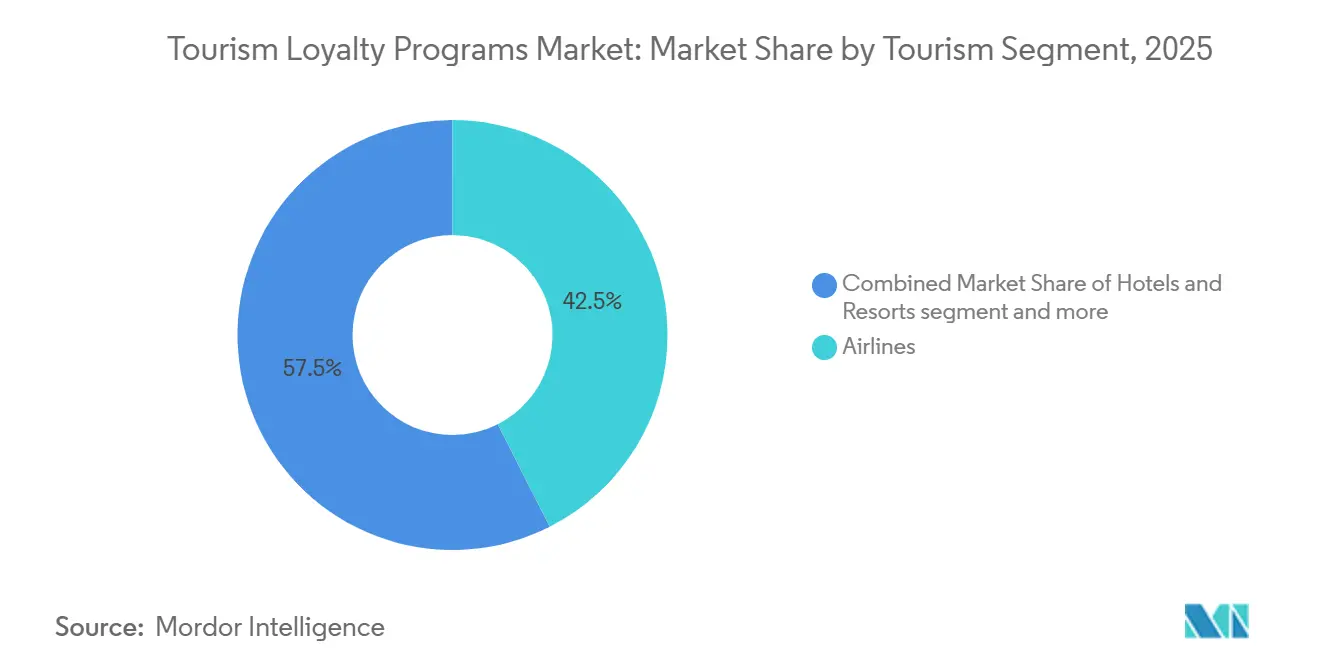
Airlines accounted for 42.53% of the tourism loyalty programs market in 2025, maintaining their leading position because airline loyalty programs benefit from long-established mileage systems, alliance structures, and strong bank partnership models. The tourism loyalty programs industry continues to favor airlines in terms of revenue because these programs have had more time to build member habits, card-linked earning, and international redemption networks. This leadership also reflects the fact that airline programs are deeply embedded in high-frequency traveler behavior, especially where business and premium travel remain important. In the tourism loyalty programs market, airline programs are also better positioned to monetize ancillary behavior beyond the base fare. That makes their position harder to dislodge even as competition broadens across hotels and digital booking platforms.
Hotels and resorts remain the second-largest segment of the tourism loyalty programs market, as large hotel groups continue to scale global membership and app-based engagement. Accor stated that ALL reached 100 million global members in 2025, after adding 11 million new members in 2024, and also reported a 45% year-on-year increase in app business volume, indicating that hotel loyalty is still gaining depth and scale. Online Travel Agencies are the fastest-growing segment, with a 11.94% CAGR through 2031, supported by their ability to connect multiple brands under a single reward currency rather than relying on a single supplier relationship. Expedia Group’s One Key program unifies Expedia, Hotels.com, and Vrbo, and the company reported 9% room night growth in Q4 2025, which supports the view that cross-brand loyalty can improve repeat booking behavior in the OTA channel. This leaves cruise lines and vacation operators as the least developed segment in the current coverage set, even though the tourism loyalty programs market would benefit from wider representation of that category in competitive benchmarking.

By End User: Individual members dominate, corporate travelers gain pace
Individual Members accounted for 82.81% of the market in 2025, reflecting the wide consumer reach of airline, hotel, and OTA loyalty platforms. Expedia Group’s 2025 Traveler Value Index found that 83% of travelers ranked travel as their top category for redeeming loyalty points, and 82% said they were open to booking travel through non-travel loyalty programs such as credit cards or retail partners. That pattern shows why the tourism loyalty programs market remains heavily individual-led, as consumer participation still accounts for the broadest volume base across categories. Marriott Bonvoy’s 2026 survey also showed strong interest in hotel stays, co-branded card spending, dining, and retail-based earning across Asia-Pacific, indicating that individuals want everyday pathways to travel value rather than only trip-based accumulation. In the tourism loyalty programs market, this means the consumer segment is still driven by breadth of participation, daily relevance, and convenience.
Corporate and Business Travelers are the fastest-growing end-user segment, with a 10.67% CAGR through 2031, indicating stronger demand for structured travel value within managed travel environments. The tourism loyalty programs industry is seeing more emphasis on combined benefits that support both the traveler and the corporate account, especially where network reach and premium service matter. Singapore Airlines and Air India signed a cooperation framework in January 2026 to enhance benefits for KrisFlyer and Maharaja Club members while expanding codeshare activity between India and Singapore, demonstrating how loyalty can be more closely tied to corporate and international travel flows. This cohort tends to favor programs with global coverage, strong recognition mechanics, and easier integration into existing travel processes. As a result, the tourism loyalty programs market is likely to see corporate demand concentrate on operators that can combine network scale, premium benefit delivery, and consistent service reliability.[3]
By Program Type: Points-based programs lead, subscriptions reshape engagement
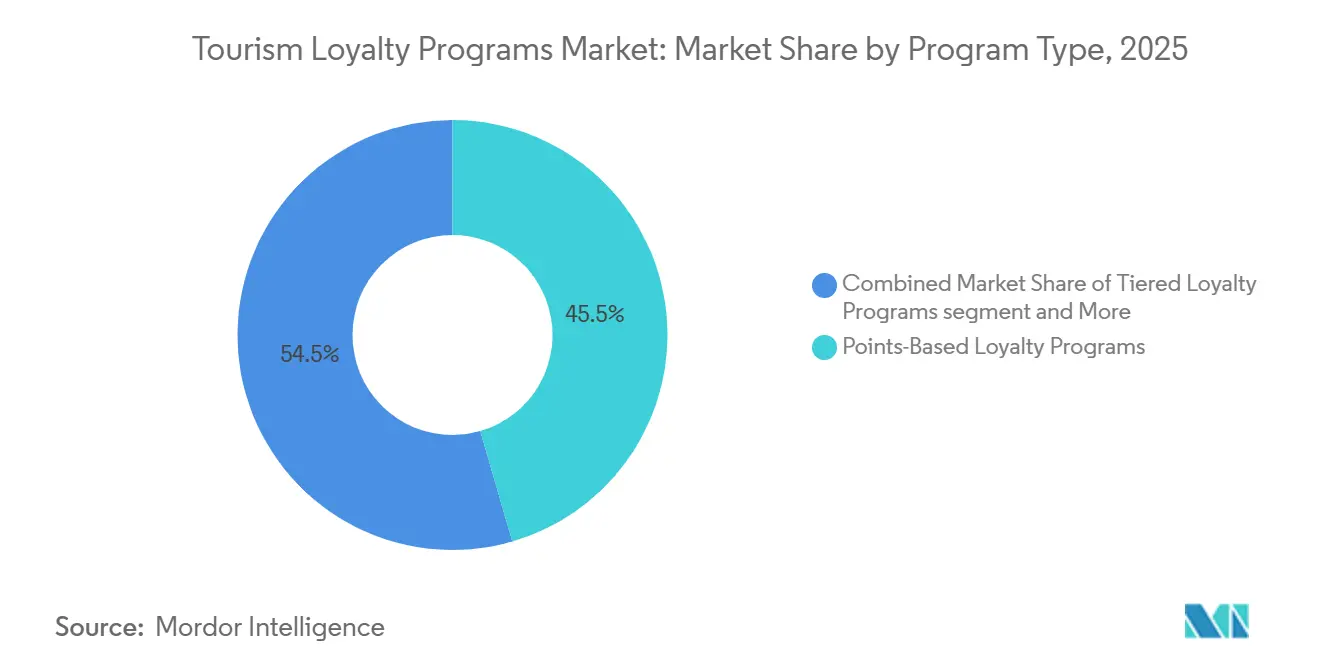
Points-Based Loyalty Programs held 45.52% of the tourism loyalty programs market share in 2025, confirming that the points model remains the most widely accepted across travel categories. The format remains dominant because it is familiar to travelers, easy to explain, and well-suited to co-branded credit card earning. In the tourism loyalty programs market, tiered structures also continue to play an important role because they help operators differentiate between occasional users and high-value members and reward more profitable behavior with status-based treatment. Even so, traditional structures are under pressure to become clearer, more flexible, and less dependent on distant aspirational redemption. That is why the tourism loyalty programs market is moving toward a combination of points, status, and partner value rather than relying on a single earn-and-burn model.
Subscription-Based Loyalty Programs are projected to grow at the fastest rate, with a 10.95% CAGR through 2031, because they provide immediate and visible value to members. eDreams ODIGEO’s Prime platform reached 7.7 million members in H1 FY2026. It contributed 74% of Cash Revenue Margin, which supports the case that subscription-led loyalty can scale commercially while remaining central to the customer proposition. The same program reported stronger renewal among members who used flexibility benefits, indicating that the model works best when membership offers practical travel utility, not just discounts. In the tourism loyalty programs market, this matters because subscriptions reduce deferred reward pressure and make it easier for travelers to assess value at the time of purchase. The shift does not replace points entirely, but it is changing the balance of how engagement and revenue are generated across the category.
Geography Analysis
North America held 38.41% of the tourism loyalty programs market in 2025, making it the largest regional contributor. The region remains central to the tourism loyalty programs market because it has the deepest airline credit card ecosystems and some of the most mature hotel loyalty infrastructures. Large operators in the region have continued to tighten the commercial link between loyalty participation and card-based or premium member value, which reinforces the importance of recurring non-ticket revenue. Marriott’s projected co-branded card royalty revenue of USD 966 million for 2026 underlines the scale that North American bank partnerships can reach when loyalty is treated as a direct income stream. Canada and Mexico are smaller in value terms, but they still matter strategically because coalition structures, retail linkages, and expanding partner networks help keep the regional ecosystem broad. As a result, the tourism loyalty programs market in North America remains the benchmark for monetization depth and commercial maturity.
Europe was the second-largest regional block in 2025, supported by large hotel groups, established airline programs, and a more visible shift toward experiential and partnership-led loyalty. Accor’s membership base reached 100 million globally in 2025, and the company’s app activity also rose strongly, which signals that Europe-based operators remain active in scaling digital and loyalty engagement. Lufthansa Group expanded Miles & More to include ITA Airways from April 1, 2026, bringing ITA’s network into a broader loyalty and alliance framework and strengthening the platform's regional reach. The Middle East and Africa are smaller today, but the tourism loyalty programs market there is gaining relevance as aviation hubs, tourism investment, and digital payment use rise. South America also remains important because travel-linked coalition designs tied to everyday spending improve program stickiness beyond the booking event.
Asia-Pacific is the fastest-growing regional market, with the tourism loyalty programs market size forecast to expand at an 11.65% CAGR through 2031. The region’s growth is supported by high smartphone use, strong outbound travel momentum, and already high loyalty participation across several markets. Marriott Bonvoy reported that 89% of surveyed travelers in Asia-Pacific, excluding China, were enrolled in at least one loyalty program, with hotel loyalty programs showing the highest engagement at 66%. The same regional readout is consistent with the strong performance of India and other fast-growing Asian travel corridors in the user-supplied material, where mobile-led participation and everyday earning are already well established. Singapore Airlines and Air India’s 2026 cooperation framework also shows that the region is moving toward broader airline partnership models that can deepen member value across high-traffic travel routes. For the tourism loyalty programs market, Asia-Pacific is now the key growth region because it combines scale, digital engagement, and a younger member base that responds well to multi-channel reward design.[4]
Competitive Landscape
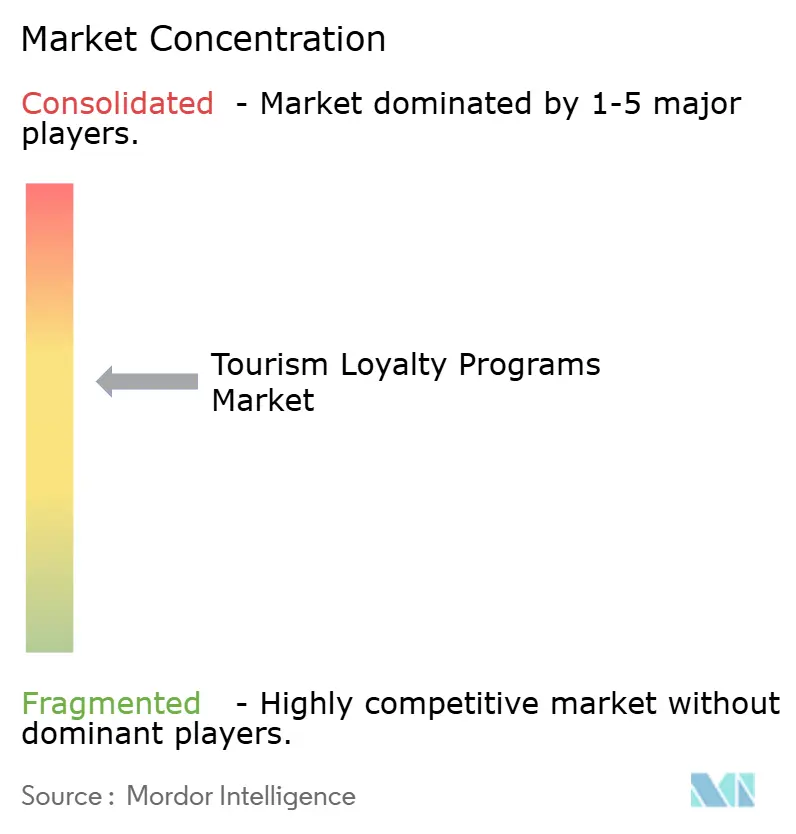
The tourism loyalty programs market shows moderate to high concentration at the top end, where a limited number of global airline, hotel, and OTA operators control the most visible member ecosystems. These leaders benefit from scale in distribution, loyalty technology, card partnerships, and partner network development, making it difficult for smaller operators to match their breadth of value. Marriott Bonvoy, Hilton Honors, World of Hyatt, IHG One Rewards, Expedia One Key, and major airline programs remain important reference points because they shape how members evaluate benefit quality, status recognition, and redemption flexibility across the tourism loyalty programs market. The competitive focus has clearly shifted from simple repeat-stay or repeat-flight incentives toward broader revenue capture across cards, subscriptions, ancillary sales, and cross-category earning. That is why the tourism loyalty programs market now rewards operators that can combine financial monetization with member simplicity rather than treating loyalty as a stand-alone marketing tool.
One major competitive pattern is the deepening role of financial and data infrastructure in program design. Marriott International’s projected co-branded royalty growth in 2026 shows how loyalty economics can strengthen even without equivalent dependence on underlying room growth. Expedia Group’s One Key model shows another route, where a unified currency across multiple travel brands supports repeat usage inside a broader platform environment. Lufthansa Group’s April 2026 integration of ITA Airways into Miles & More is a further example of competitive consolidation through network and loyalty alignment. These moves show that operators are not only competing on benefits, they are also competing on how completely loyalty is embedded into bookings, partnerships, and member data systems.
Another clear pattern is that operators are expanding value through broader ecosystems and practical use cases instead of only promising future redemption. Singapore Airlines and Air India’s cooperation framework in 2026 signals that partnership-led loyalty can support both member benefits and network strength across an important travel corridor. eDreams ODIGEO’s Prime growth shows that subscription-led loyalty is now a meaningful competitive format, especially when the offer includes flexibility features that improve renewal. Accor’s continued membership expansion and stronger app activity show that global hotel groups are still investing heavily in digital engagement and cross-brand relevance. The competitive pressure in the tourism loyalty programs market is therefore rising because leading operators are simultaneously improving monetization, ecosystem breadth, and member engagement. Smaller regional programs can still compete in targeted niches, but they face a harder path if they cannot match the clarity, reach, and everyday usefulness offered by larger platforms.
Tourism Loyalty Programs Industry Leaders
-
Marriott International, Inc.
-
Hilton Worldwide Holdings Inc.
-
Delta Air Lines, Inc.
-
American Airlines Group Inc.
-
InterContinental Hotels Group PLC
- *Disclaimer: Major Players sorted in no particular order
Recent Industry Developments
- June 2026: The oneworld airline alliance and Indian Hotels Company (IHCL) established a partnership connecting their respective loyalty programs. This agreement enables reciprocal tier status matching between oneworld frequent flyers and Taj InnerCircle - NeuPass members. The integration also provides members with standard discounts on rooms and hotel services across IHCL's 630 properties.
- April 2026: ITA Airways formally joined the Lufthansa Group's Miles & More loyalty program and the Star Alliance on April 1, 2026. All 39 million Miles & More members can earn and redeem miles on ITA's Italian network, existing ITA Volare members received status-match offers to migrate to Miles & More.
- January 2026: Air India and Singapore Airlines signed a commercial cooperation framework on January 16, 2026, targeting enhanced loyalty benefits for Maharaja Club and KrisFlyer members, as well as expanded codeshare flights between India and Singapore, pending regulatory approvals.
- September 2025: Singapore Airlines and ANA launched revenue-sharing joint venture flights between Singapore and Japan, with expanded KrisFlyer and ANA Mileage Club reciprocal earning across a broader range of booking classes.
Global Tourism Loyalty Programs Market Report Scope
| Airlines |
| Hotels & Resorts |
| Online Travel Agencies (OTAs) |
| Cruise Lines & Vacation Operators |
| Individual Members |
| Corporate & Business Travelers |
| Points-Based Loyalty Programs |
| Tiered Loyalty Programs |
| Subscription-Based Loyalty Programs |
| Coalition & Partner Loyalty Programs |
| North America | United States |
| Canada | |
| Mexico | |
| South America | Brazil |
| Peru | |
| Chile | |
| Argentina | |
| Rest of South America | |
| Europe | United Kingdom |
| Germany | |
| France | |
| Spain | |
| Italy | |
| BENELUX (Belgium, Netherlands, and Luxembourg) | |
| NORDICS (Denmark, Finland, Iceland, Norway, and Sweden) | |
| Rest of Europe | |
| Asia-Pacific | India |
| China | |
| Japan | |
| Australia | |
| South Korea | |
| South East Asia (Singapore, Malaysia, Thailand, Indonesia, Vietnam, and Philippines) | |
| Rest of Asia-Pacific | |
| Middle East And Africa | United Arab Emirates |
| Saudi Arabia | |
| South Africa | |
| Nigeria | |
| Rest of Middle East And Africa |
| By Program Type | Airlines | |
| Hotels & Resorts | ||
| Online Travel Agencies (OTAs) | ||
| Cruise Lines & Vacation Operators | ||
| By End User | Individual Members | |
| Corporate & Business Travelers | ||
| Points-Based Loyalty Programs | ||
| Tiered Loyalty Programs | ||
| Subscription-Based Loyalty Programs | ||
| Coalition & Partner Loyalty Programs | ||
| By Geography | North America | United States |
| Canada | ||
| Mexico | ||
| South America | Brazil | |
| Peru | ||
| Chile | ||
| Argentina | ||
| Rest of South America | ||
| Europe | United Kingdom | |
| Germany | ||
| France | ||
| Spain | ||
| Italy | ||
| BENELUX (Belgium, Netherlands, and Luxembourg) | ||
| NORDICS (Denmark, Finland, Iceland, Norway, and Sweden) | ||
| Rest of Europe | ||
| Asia-Pacific | India | |
| China | ||
| Japan | ||
| Australia | ||
| South Korea | ||
| South East Asia (Singapore, Malaysia, Thailand, Indonesia, Vietnam, and Philippines) | ||
| Rest of Asia-Pacific | ||
| Middle East And Africa | United Arab Emirates | |
| Saudi Arabia | ||
| South Africa | ||
| Nigeria | ||
| Rest of Middle East And Africa | ||
Key Questions Answered in the Report
What is the 2026 to 2031 growth outlook for tourism loyalty programs?
The Tourism Loyalty Programs Market is projected to grow from USD 8.97 billion in 2026 to USD 14.73 billion by 2031 at a CAGR of 10.43%.
Which tourism segment leads global loyalty revenue today?
Airlines led with 42.53% of total value in 2025, supported by established mileage systems, alliance reach, and bank-linked monetization.
Which segment is growing fastest in this space?
Online Travel Agencies are forecast to grow fastest at an 11.94% CAGR through 2031 because they can unify rewards across multiple travel brands.
Why are subscription models gaining traction in travel rewards?
Subscription-based formats are growing at a 10.95% CAGR because they offer immediate value to members and create more predictable revenue for operators.
Which region is growing fastest for tourism loyalty adoption?
Asia-Pacific is the fastest-growing region at an 11.65% CAGR, supported by high smartphone penetration, rising travel demand, and already strong loyalty participation.
Why is North America still the largest regional market?
North America held 38.41% in 2025 because it combines mature airline credit card ecosystems, large hotel loyalty platforms, and stronger monetization depth.