
Tomato Paste Market Size and Share
Market Overview
| Study Period | 2021 - 2031 |
|---|---|
| Market Size (2026) | USD 20.87 Billion |
| Market Size (2031) | USD 24.16 Billion |
| Growth Rate (2026 - 2031) | 2.97 % |
| Fastest Growing Market | Asia-Pacific |
| Largest Market | Europe |
| Market Concentration | Medium |
Major Players
*Disclaimer: Major Players sorted in no particular order Image © Mordor Intelligence. Reuse requires attribution under CC BY 4.0. |
|
Tomato Paste Market Analysis by Mordor Intelligence
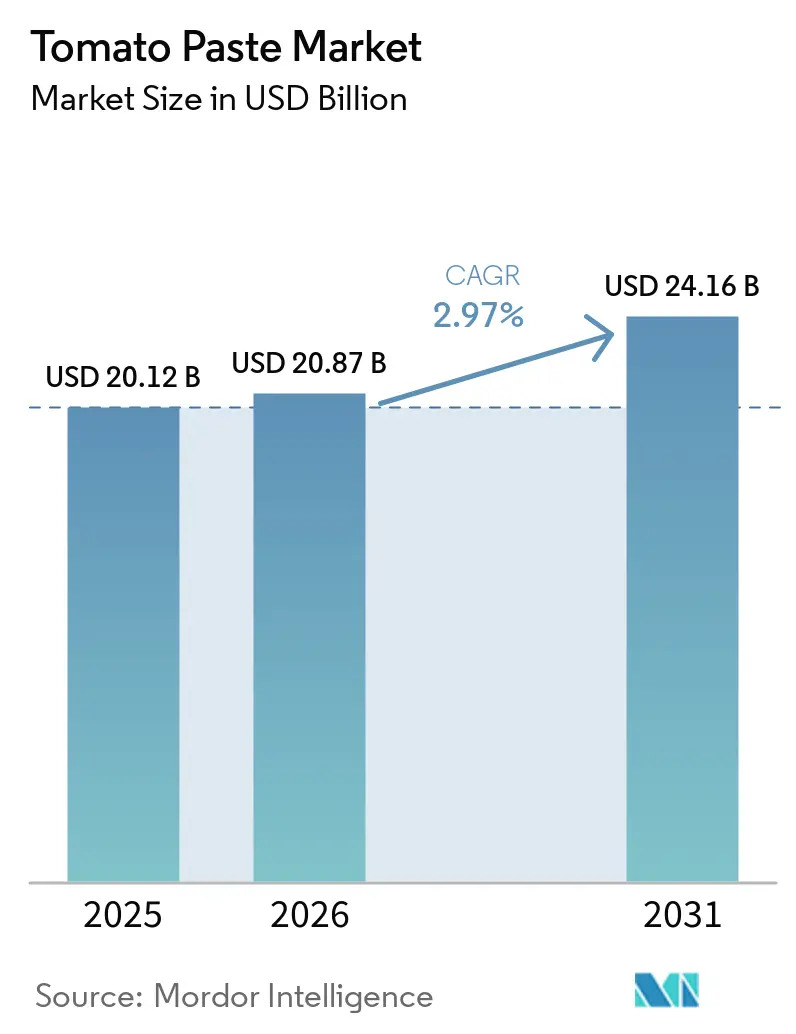
The tomato paste market size is expected to grow from USD 20.12 billion in 2025 to USD 20.87 billion in 2026 and is forecast to reach USD 24.16 billion by 2031 at a 2.97% CAGR over 2026-2031. The tomato paste market is experiencing steady growth, driven by its widespread use in processed foods, foodservice, and household cooking. Rising demand for convenience foods, expanding food processing industries, and increasing preference for shelf-stable ingredients are supporting market growth in both developed and emerging economies. Growing consumer interest in clean-label, organic, and sustainably sourced food products is encouraging manufacturers to expand their product portfolios, while convenient packaging formats are improving accessibility across retail and institutional channels. The market is also benefiting from investments in processing technologies, product innovation, and supply chain integration, enabling manufacturers to improve efficiency, strengthen product quality, and meet evolving consumer and industrial requirements.
Key Report Takeaways
- By product type, double concentrated tomato paste held 38.44% share in 2025 across the global tomato paste market, while other concentrated variants are forecast to grow at 3.44% CAGR during 2026 to 2031.
- By nature, conventional tomato paste accounted for 72.76% share in 2025 in the global tomato paste market, while organic tomato paste is projected to expand at 4.05% CAGR during 2026 to 2031, with stronger premium momentum in Western Europe and North America.
- By packaging type, metal cans captured 34.23% share in 2025 in the global tomato paste market, while pouches and sachets are expected to grow at 3.95% CAGR during 2026 to 2031, driven by convenience demand in developed markets and affordable unit packs in South Asia and Sub-Saharan Africa.
- By end use, food processing and manufacturing held 41.44% share in 2025 in the global tomato paste market, while foodservice is forecast to record 3.75% CAGR during 2026 to 2031, with growth tied to quick-service restaurant expansion and institutional demand across Asia-Pacific, Latin America, and the Middle East.
- By geography, Europe held 31.85% share in 2025 in the tomato paste market size, while Asia-Pacific is forecast to advance at 3.84% CAGR during 2026 to 2031, reflecting Europe’s trade depth and Asia-Pacific’s faster expansion in food manufacturing and out-of-home demand
Note: Market size and forecast figures in this report are generated using Mordor Intelligence’s proprietary estimation framework, updated with the latest available data and insights as of January 2026.
Global Tomato Paste Market Trends and Insights
Drivers Impact Analysis*
| Driver | (~) % Impact on CAGR Forecast | Geographic Relevance | Impact Timeline |
|---|---|---|---|
| Rising demand for convenience foods and ready meal ingredients | +0.7% | Global, with highest intensity in Western Europe and North America | Medium term (2–4 years) |
| Expansion of foodservice and quick-service restaurant networks | +0.6% | Asia-Pacific core, spill-over to Middle East and Africa and South America | Short term (≤ 2 years) |
| Growing consumer preference for clean-label and minimally processed food products | +0.5% | North America and Europe | Medium term (2–4 years) |
| Increasing consumption of packaged sauces, soups, and processed foods | +0.5% | Global | Short term (≤ 2 years) |
| Expansion of industrial tomato processing capacity | +0.3% | North America, Italy, China | Long term (≥ 4 years) |
| Growing household demand for affordable shelf-stable cooking ingredients | +0.2% | Africa, South America, South/Southeast Asia | Medium term (2–4 years) |
| Source: Mordor Intelligence | |||
Rising demand for convenience foods and ready meal ingredients
The rising demand for convenience foods and ready meal ingredients is driving the adoption of tomato paste across the food processing industry. Tomato paste is widely used in sauces, soups, pizzas, pasta products, and ready-to-eat meals. According to The Food Industry Association (FMI), 87% of food retailers leveraged fresh-prepared foodservice programs in 2024 to meet growing consumer demand for convenient meal solutions[1]Source: Food Industry Association, "The State of Fresh Foods 2025: Driving Sales and Operational Innovation to Satisfy Consumer Preferences", fmi.org. As manufacturers expand their ready-to-eat and ready-to-cook product portfolios, demand for tomato paste is increasing due to its versatility, long shelf life, and ability to deliver consistent flavor and texture across a range of processed food applications.
Expansion of foodservice and quick-service restaurant networks
The expansion of foodservice and quick-service restaurant (QSR) networks is driving demand for tomato paste, which is widely used in pizzas, burgers, pasta, sandwiches, sauces, and other menu items. According to the National Restaurant Association, the US restaurant and foodservice industry is expected to employ 15.9 million people in 2025, adding more than 200,000 net new jobs, reflecting ongoing industry growth[2]Source: National Restaurant Association, "Restaurant Industry Poised for Growth in 2025: Industry Expected to Employ 15.9 Million People and Reach $1.5 Trillion in Sales", restaurant.org. The International Franchise Association reported that quick-service restaurant outlets are projected to increase by 2.2% in 2025, supported by continued franchise expansion[3]Source: International Franchise Association, "QSR Magazine: QSR Poised for Another Strong Year in Franchising Growth: Report", franchise.org. As foodservice operators expand their operations and menu offerings, demand for tomato paste grows due to its versatility, consistent quality, and broad application across commercial food preparation.
Growing consumer preference for clean-label and minimally processed food products
Growing consumer preference for clean-label and minimally processed food products is driving demand for tomato paste, which is widely regarded as a natural ingredient with simple formulations and broad culinary applications. Food manufacturers are increasingly reformulating products with shorter ingredient lists and fewer artificial additives to meet consumer demand for transparency and authenticity. Tomato paste is well suited to this, offering natural color, flavor, and texture while supporting clean-label product development across sauces, soups, ready meals, and other processed food applications. This shift is encouraging greater adoption of tomato paste in both retail and foodservice products as manufacturers expand their clean-label portfolios.
Increasing consumption of packaged sauces, soups, and processed foods
The increasing consumption of packaged sauces, soups, and processed foods is driving demand for tomato paste, as it is widely used as a base ingredient that enhances flavor, texture, color, and consistency. Changing consumer lifestyles, a growing preference for convenient meal solutions, and the expansion of the processed food industry are encouraging manufacturers to incorporate tomato paste into a wide range of packaged food products. Its long shelf life, ease of storage, and versatility make it a preferred ingredient in both industrial food processing and retail food production. As manufacturers continue to diversify processed food offerings to meet evolving consumer preferences, demand for tomato paste is expected to grow steadily across multiple food applications.
Climate-induced volatility in raw tomato production
Climate-induced volatility in raw tomato production is a significant restraint for the tomato paste market, as tomato yields are highly sensitive to fluctuations in temperature, rainfall patterns, drought conditions, and extreme weather events. Unpredictable growing conditions can affect crop quality, harvest timing, and raw material availability, creating challenges for processors in maintaining consistent production schedules and managing procurement costs. Variability in agricultural output can also lead to fluctuations in tomato prices and inventory levels across the supply chain. As climate-related disruptions become more frequent, manufacturers are increasingly required to strengthen sourcing strategies, diversify procurement regions, and invest in measures that improve agricultural resilience.
Restraints Impact Analysis*
| Restraint | (~) % Impact on CAGR Forecast | Geographic Relevance | Impact Timeline |
|---|---|---|---|
| Climate-induced volatility in raw tomato production | -0.4% | Global; most acute in California, Italy, China, Spain, and India | Short term (≤ 2 years) |
| High energy and production costs in tomato paste manufacturing | -0.3% | Europe, particularly Italy and Spain; energy-intensive processing hubs globally | Medium term (2–4 years) |
| Stringent quality and food safety requirements for processed tomato products | -0.2% | Europe, North America, and markets adopting Codex Alimentarius standards | Long term (≥ 4 years) |
| Trade restrictions and tariff volatility affecting tomato paste exports | -0.3% | Middle East (Iran), North America-China trade, Middle East and Africa import markets | Short term (≤ 2 years) |
| Source: Mordor Intelligence | |||
High energy and production costs in tomato paste manufacturing
High energy and production costs are a significant restraint for the tomato paste market. The manufacturing process involves energy-intensive operations, including washing, crushing, evaporation, concentration, sterilization, and packaging. Maintaining product quality and consistency requires advanced processing equipment and continuous energy input, which increases overall operational expenses for manufacturers. Investments in efficient processing technologies, quality control systems, and packaging infrastructure add further to production costs. These factors affect manufacturing efficiency and the competitiveness of tomato paste producers across global markets.
*Our forecasts treat driver/restraint impacts as directional, not additive. The impact forecasts reflect baseline growth, mix effects, and variable interactions.
Segment Analysis
By Product Type: Double Concentrate Anchors Industrial Procurement
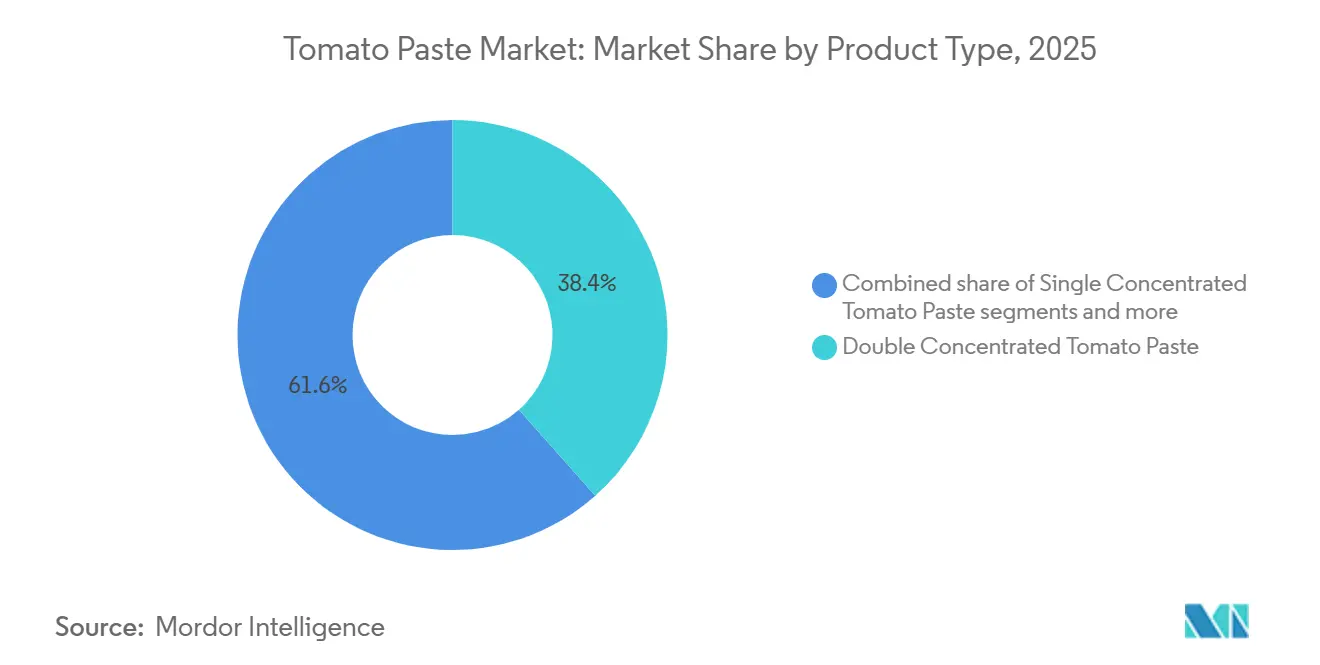
Double-concentrated tomato paste accounted for the largest share, 38.44% of the tomato paste market in 2025, driven by its widespread adoption across the food processing industry. Its higher soluble solids content enables manufacturers to improve formulation efficiency while reducing storage and transportation requirements, making it the preferred choice for sauces, soups, ready meals, and other processed food applications. The segment also benefits from its ability to deliver consistent flavor, texture, and product quality, supporting its extensive use in large-scale industrial food production.
The other concentrated tomato paste segment is projected to register the fastest CAGR of 3.44% during 2026–2031. Growth is driven by increasing demand from food manufacturers for highly concentrated products that offer greater formulation flexibility, lower transportation costs, and improved storage efficiency. Rising exports of concentrated tomato products and expanding applications in industrial food processing are further supporting segment growth, as manufacturers seek ingredients that enhance production efficiency across diverse processed food applications.



By Nature: Organic Leads in Value Growth, Conventional Dominates Market Demand
Conventional tomato paste accounted for the largest share of 72.76%, of the tomato paste market in 2025, supported by its widespread use across food processing, foodservice, and retail applications. Its cost-effectiveness, broad availability, and consistent quality make it the preferred choice for high-volume industrial production and institutional procurement. The segment continues to benefit from strong demand in processed foods, where manufacturers prioritize reliable supply and standardized product performance.
The organic segment is projected to register the fastest CAGR of 4.05% during 2026–2031. Growth is driven by increasing consumer preference for clean-label, organic, and sustainably produced food products, prompting manufacturers and retailers to expand their organic product portfolios. Rising availability of certified organic tomato paste and greater emphasis on ingredient transparency are further supporting the adoption of organic products across retail and foodservice channels.
By Packaging Type: Pouches Displace Cans at the Margin
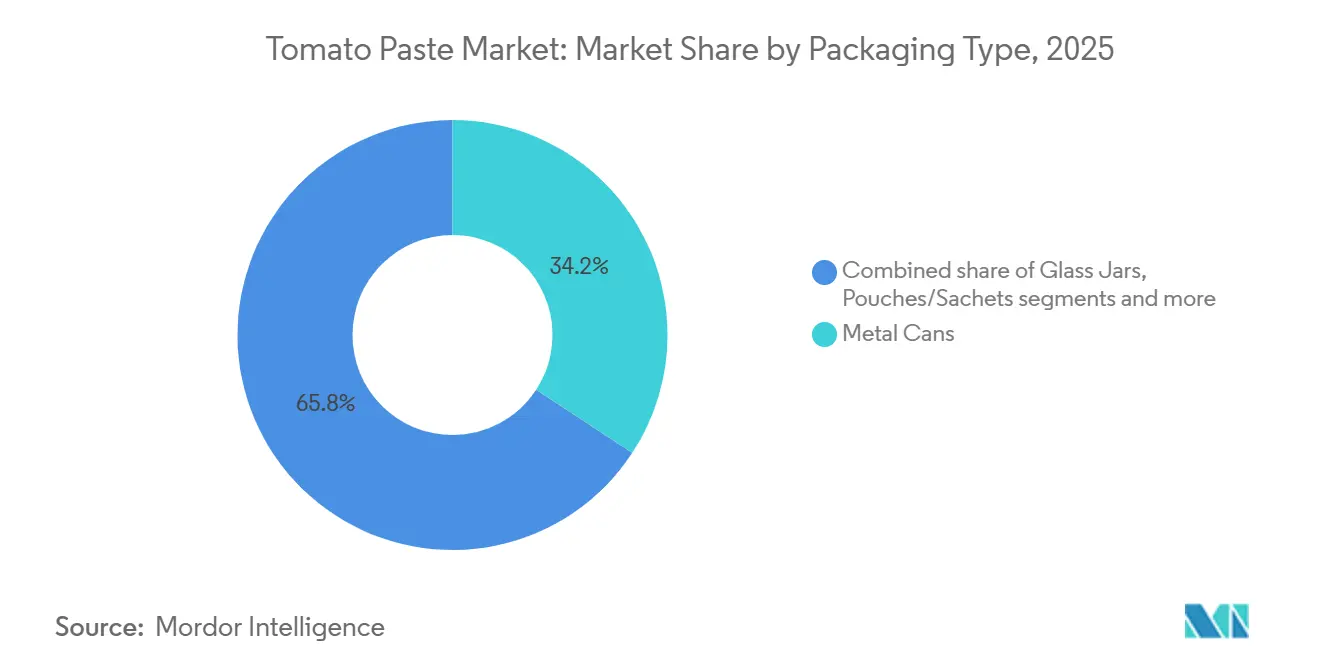
Metal cans accounted for the largest share of the tomato paste market in 2025, at 34.23%, driven by their long shelf life, durability, and suitability for storage and transportation. The format remains widely preferred across retail, foodservice, and industrial applications because it preserves product quality while supporting efficient distribution. Metal cans also continue to benefit from broad acceptance across global supply chains and established packaging infrastructure.
The pouches and sachets segment is projected to register the fastest CAGR of 3.95% during 2026–2031, driven by rising demand for convenient, lightweight, and portable packaging solutions that align with evolving consumer preferences. The segment is also benefiting from increasing adoption across both developed and emerging markets, supported by improved affordability, ease of use, and growing investments in flexible packaging technologies by food manufacturers.
By End-Use: Food Processing Dominates as Foodservice Accelerates
Food Processing and Manufacturing accounted for the largest share, at 41.44%, of the tomato paste market in 2025, driven by the extensive use of tomato paste in the production of sauces, soups, ketchup, ready meals, pizzas, and other processed food products. The segment benefits from consistent demand for high-quality, standardized ingredients that support efficient large-scale food production. Tomato paste remains a key raw material due to its versatility, long shelf life, and ability to deliver consistent flavor, color, and texture across a wide range of food applications.
The Foodservice segment is projected to register the fastest CAGR of 3.75% during 2026–2031. Growth is driven by the continued expansion of restaurants, quick-service restaurant chains, cafés, and institutional catering services, alongside rising consumer expenditure on out-of-home dining. Increasing demand for standardized ingredients that enhance operational efficiency and product consistency is further supporting the adoption of tomato paste across commercial food preparation.
Geography Analysis
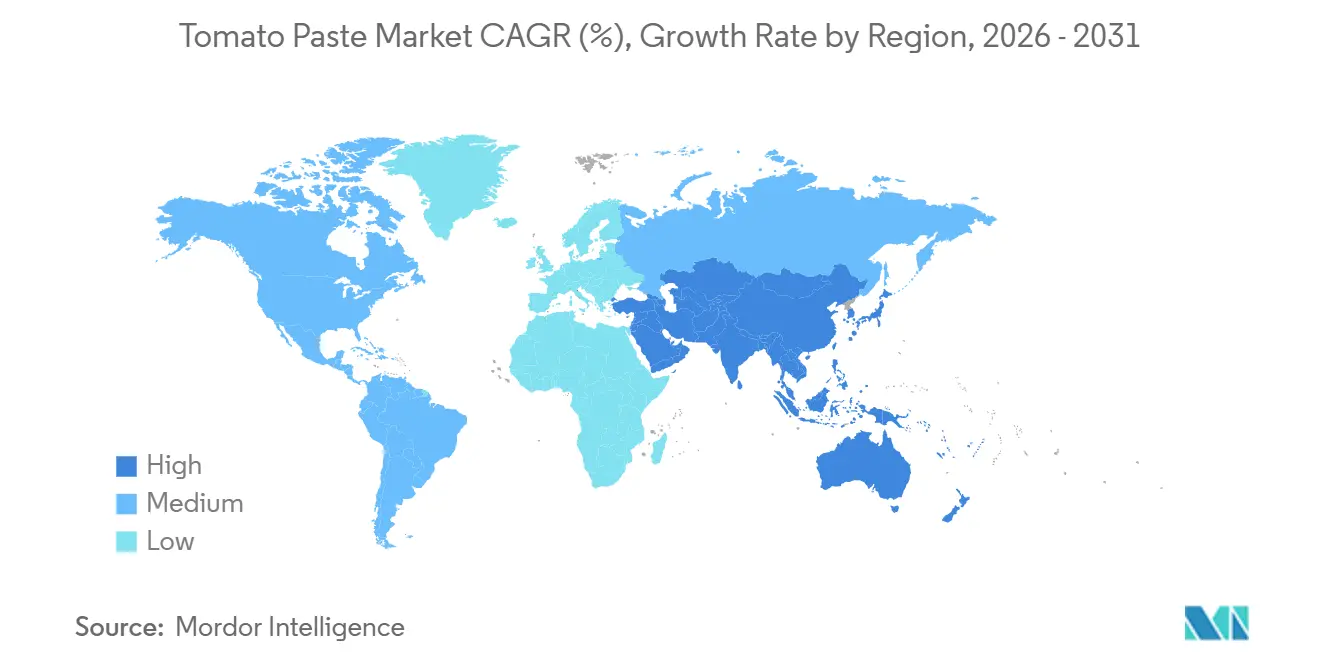
Europe accounted for the largest share, 31.85%, of the global tomato paste market in 2025, supported by its well-established tomato processing industry, advanced food manufacturing sector, and strong demand for processed tomato products across retail and foodservice channels. The region also benefits from a mature supply chain, extensive processing infrastructure, and the presence of major tomato paste producers. Increasing demand for premium, organic, and sustainably sourced products continues to support market growth.
Asia-Pacific is projected to register the fastest CAGR of 3.84% during 2026–2031. Growth is driven by rapid urbanization, expanding food processing industries, and increasing consumption of convenience foods across countries such as China, India, and Southeast Asian nations. Rising investments in food manufacturing, expanding quick-service restaurant networks, and growing demand for packaged sauces, ready meals, and processed foods are further accelerating regional market expansion.
North America represents another significant market, supported by its large-scale tomato processing industry and well-developed food manufacturing sector. South America and the Middle East and Africa are emerging as high-potential markets due to increasing investments in tomato processing capacity, expanding processed food industries, and growing retail penetration. Rising urbanization, improving food distribution networks, and increasing adoption of packaged food products are expected to create new opportunities for tomato paste manufacturers across these regions.

Competitive Landscape
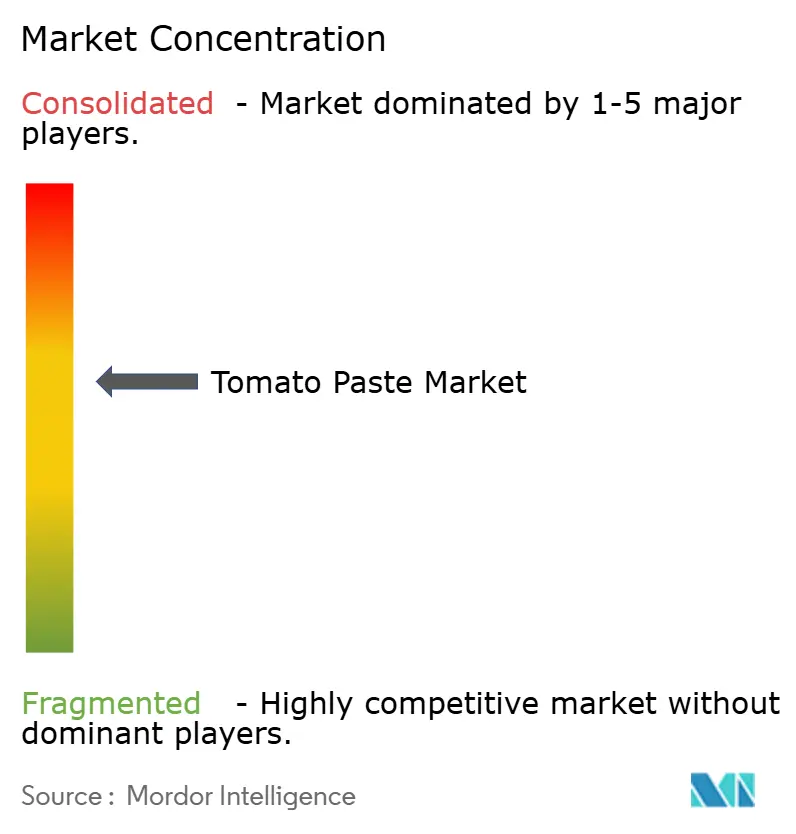
The tomato paste market is moderately consolidated, with competition driven by a mix of global processors and branded food manufacturers competing on production capacity, product quality, supply chain efficiency, and distribution networks. Leading companies are focused on strengthening their market positions through capacity expansion, technological advancements, sustainable sourcing practices, and product innovation to meet the requirements of food processors, foodservice operators, and retail customers.
Major players operating in the market include The Morning Star Company, Kraft Heinz, Inc., Mutti S.p.A., Chalkis Health Industry Co., Ltd., and Sugal Group. These companies continue to invest in processing infrastructure, manufacturing efficiency, packaging innovations, and geographic expansion to enhance their competitive positions. Strategic partnerships, investments in advanced processing technologies, and expansion of production capabilities remain key priorities as manufacturers seek to improve operational efficiency and strengthen their presence across domestic and international markets.
Alongside established market leaders, several regional and emerging manufacturers are expanding their presence by catering to local demand and strengthening export capabilities. Increasing investments in value-added product offerings, clean-label formulations, and sustainable production practices are further intensifying competition, while enabling companies to address evolving consumer preferences and capitalize on growth opportunities across both developed and emerging markets.
Tomato Paste Industry Leaders
-
The Morning Star Company
-
Kraft Heinz, Inc.
-
Mutti S.p.A.
-
Chalkis Health Industry Co., Ltd.
-
Sugal Group
- *Disclaimer: Major Players sorted in no particular order

Recent Industry Developments
- June 2026: La Doria S.p.A. entered into an agreement to acquire 100% of the Solana Group, a leading Italian producer of tomato-based products, including tomato paste and tomato purée. The acquisition strengthens La Doria's position in the tomato products segment, expands its presence in the industrial and foodservice channels, and enhances its production and sourcing network across Northern and Central Italy. Solana reported approximately EUR 90 million in revenue in 2025 and operates three production facilities with a combined processing capacity of 285,000 tonnes per year.
- June 2026: Kraft Heinz Brasil launched Heinz tomato paste in Brazil, marking the brand's entry into the country's tomato paste category. The product is packaged in a 240 g stand-up pouch, produced using tomatoes grown and processed at the company's Nova Goiás facility, and is being distributed through major retail chains nationwide. The launch supports Kraft Heinz's strategy to strengthen its tomato products portfolio while expanding the adoption of convenient flexible packaging formats in the Brazilian market.
- September 2025: Kraft Heinz and The Conesa Group inaugurated a new tomato processing plant in Mora, Portugal, with the capacity to process more than 4,000 tonnes of tomatoes per day. The facility is intended to strengthen Heinz's European tomato supply chain and support condiment production across the region.


Global Tomato Paste Market Report Scope
The tomato paste market comprises concentrated tomato products produced by removing water from fresh tomatoes to create a shelf-stable ingredient widely used across food processing, foodservice, and household applications. Tomato paste is valued for its rich flavor, color, consistency, and versatility in the production of sauces, soups, ready meals, and other processed food products. The tomato paste market is segmented by product type into single concentrated tomato paste, double concentrated tomato paste, triple concentrated tomato paste, and other concentrated tomato paste; by nature into organic and conventional; by packaging type into metal cans, glass jars, pouches and sachets, aseptic drums, and other packaging types; by end-use into food processing and manufacturing, foodservice, and retail; and by geography into North America, Europe, Asia-Pacific, South America, and the Middle East and Africa.
| Single Concentrated Tomato Paste |
| Double Concentrated Tomato Paste |
| Other Concentrated Tomato Paste |
| Organic |
| Conventional |
| Metal Cans |
| Glass Jars |
| Pouches/Sachets |
| Aseptic Drums |
| Tubes |
| Others (Bags-In-Box, PET Containers etc.) |
| Food Processing and Manufacturing |
| Foodservice |
| Retail |
| North America | United States |
| Canada | |
| Mexico | |
| Rest of North America | |
| Europe | Germany |
| United Kingdom | |
| Italy | |
| France | |
| Spain | |
| Netherlands | |
| Poland | |
| Belgium | |
| Sweden | |
| Rest of Europe | |
| Asia-Pacific | China |
| India | |
| Japan | |
| Australia | |
| Indonesia | |
| South Korea | |
| Thailand | |
| Singapore | |
| Rest of Asia-Pacific | |
| South America | Brazil |
| Argentina | |
| Colombia | |
| Chile | |
| Peru | |
| Rest of South America | |
| Middle East and Africa | South Africa |
| Saudi Arabia | |
| United Arab Emirates | |
| Nigeria | |
| Egypt | |
| Morocco | |
| Turkey | |
| Rest of Middle East and Africa |
| By Product Type | Single Concentrated Tomato Paste | |
| Double Concentrated Tomato Paste | ||
| Other Concentrated Tomato Paste | ||
| By Nature | Organic | |
| Conventional | ||
| By Packaging Type | Metal Cans | |
| Glass Jars | ||
| Pouches/Sachets | ||
| Aseptic Drums | ||
| Tubes | ||
| Others (Bags-In-Box, PET Containers etc.) | ||
| By End-Use | Food Processing and Manufacturing | |
| Foodservice | ||
| Retail | ||
| By Geography | North America | United States |
| Canada | ||
| Mexico | ||
| Rest of North America | ||
| Europe | Germany | |
| United Kingdom | ||
| Italy | ||
| France | ||
| Spain | ||
| Netherlands | ||
| Poland | ||
| Belgium | ||
| Sweden | ||
| Rest of Europe | ||
| Asia-Pacific | China | |
| India | ||
| Japan | ||
| Australia | ||
| Indonesia | ||
| South Korea | ||
| Thailand | ||
| Singapore | ||
| Rest of Asia-Pacific | ||
| South America | Brazil | |
| Argentina | ||
| Colombia | ||
| Chile | ||
| Peru | ||
| Rest of South America | ||
| Middle East and Africa | South Africa | |
| Saudi Arabia | ||
| United Arab Emirates | ||
| Nigeria | ||
| Egypt | ||
| Morocco | ||
| Turkey | ||
| Rest of Middle East and Africa | ||


Key Questions Answered in the Report
What is the expected size of the tomato paste sector by 2031?
The tomato paste market is projected to reach USD 24.16 billion by 2031, rising from USD 20.87 billion in 2026 at a 2.97% CAGR.
Which region leads global demand for tomato paste?
Europe led with 31.85% share in 2025, supported by its role as both a major production center and the world’s largest importing bloc.
Which region is growing fastest through 2031?
Asia-Pacific is forecast to grow at 3.84% CAGR from 2026 to 2031, helped by expanding food manufacturing and stronger out-of-home consumption.
Which product format leads the business today?
Double concentrated tomato paste led with 38.44% share in 2025 because it offers freight, storage, and formulation advantages for industrial buyers.
Page last updated on:


 Your data is secure and never sold or shared.


