
Tokenized Deposit Market Size and Share
Market Overview
| Study Period | 2021 - 2032 |
|---|---|
| Market Size (2027) | USD 4.10 Trillion |
| Market Size (2032) | USD 17.20 Trillion |
| Growth Rate (2027 - 2032) | 33.20 % |
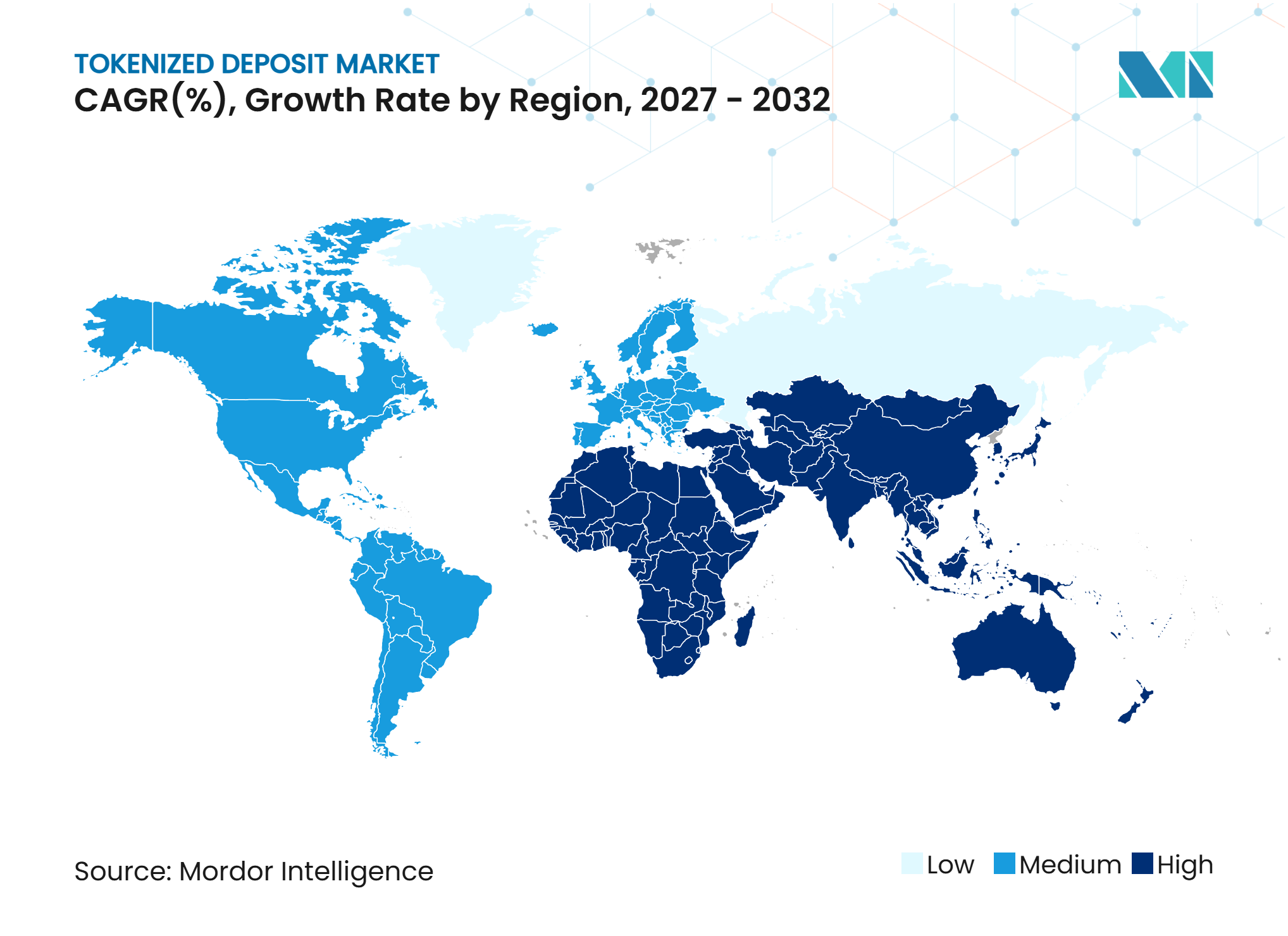
| Fastest Growing Market | Asia-Pacific |
| Largest Market | North America |
| Market Concentration | High |
Major Players *Disclaimer: Major Players sorted in no particular order Image © Mordor Intelligence. Reuse requires attribution under CC BY 4.0. | |
Tokenized Deposit Market Analysis by Mordor Intelligence
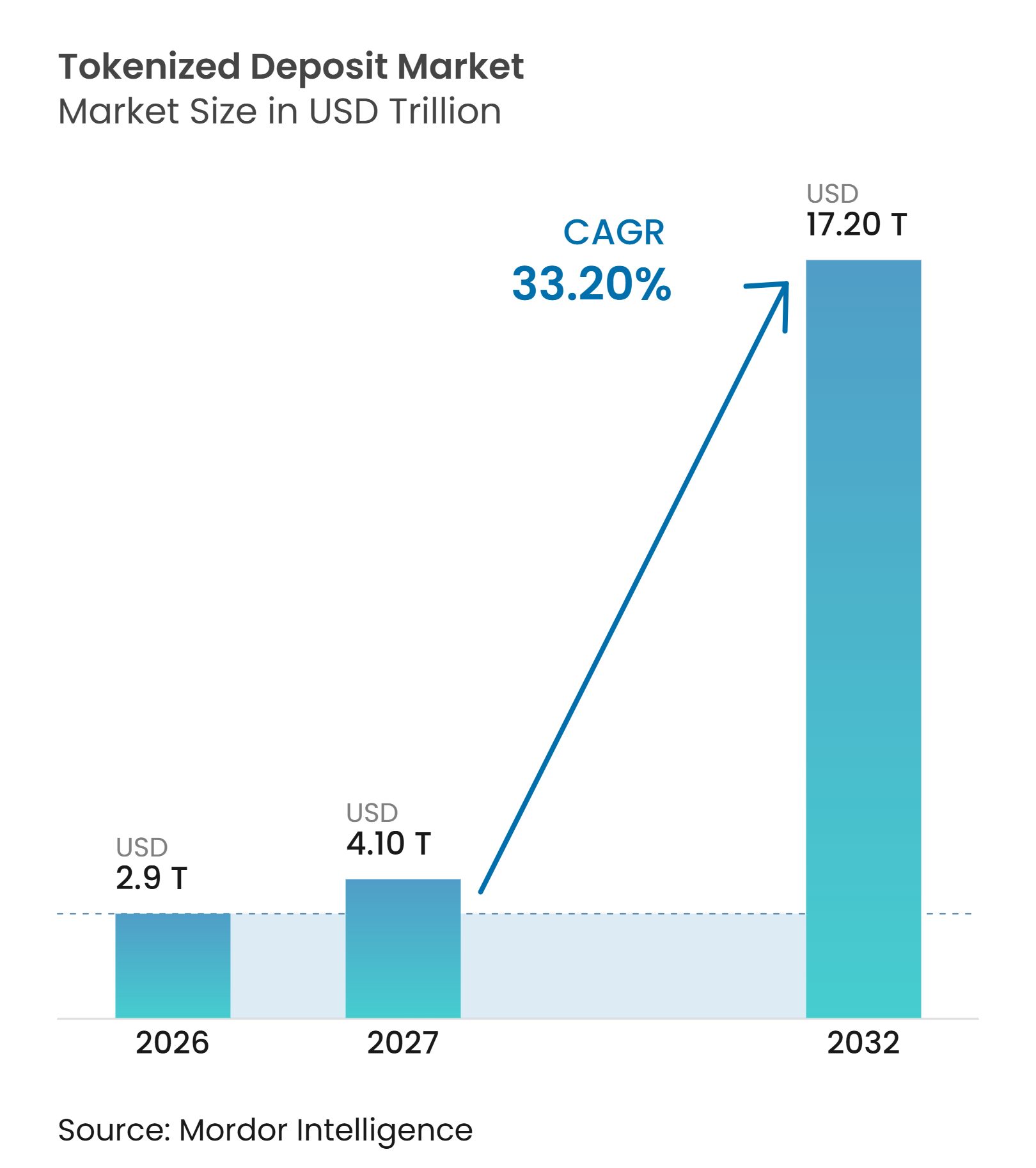
The Tokenized Deposit Market size is expected to grow from USD 2.9 trillion in 2026 to USD 4.10 trillion in 2027 and is forecast to reach USD 17.20 trillion by 2032 at 33.20% CAGR over 2027-2032.
Tokenized deposits represent commercial bank liabilities on distributed ledger technology, while retaining the legal treatment and deposit insurance protections associated with conventional deposits. The tokenized deposit market is responding to settlement delays in correspondent banking, including weekend closures, time-zone gaps, and the liquidity burden these gaps place on global treasury teams. Shared infrastructure is becoming more important as banks seek to connect proprietary deposit networks without replacing existing real-time gross settlement arrangements. Stablecoins also create competitive pressure, which is encouraging incumbent banks to position regulated bank money as the cash leg for institutional on-chain transactions. The resulting opportunity centers on interoperable settlement, programmable treasury services, and connections between bank deposits and tokenized financial assets.
Key Report Takeaways
- By token model, account-based tokenization captured 64.8% of the tokenized deposit market share in 2026, while native deposit tokens are projected to grow at a 45.3% CAGR through 2032.
- By network model, single-bank networks captured 47.6% of the tokenized deposit market share in 2026, while interbank shared multi-bank networks are projected to grow at a 47.6% CAGR through 2032.
- By ledger type, private permissioned ledgers captured 76.3% of the tokenized deposit market share in 2026, while public blockchains with permissioned token access are projected to grow at a 45.7% CAGR through 2032.
- By use case, intra-group treasury and liquidity management captured 30.2% of the tokenized deposit market share in 2026, while foreign exchange and payment-versus-payment settlement are projected to grow at 47.3% CAGR through 2032.
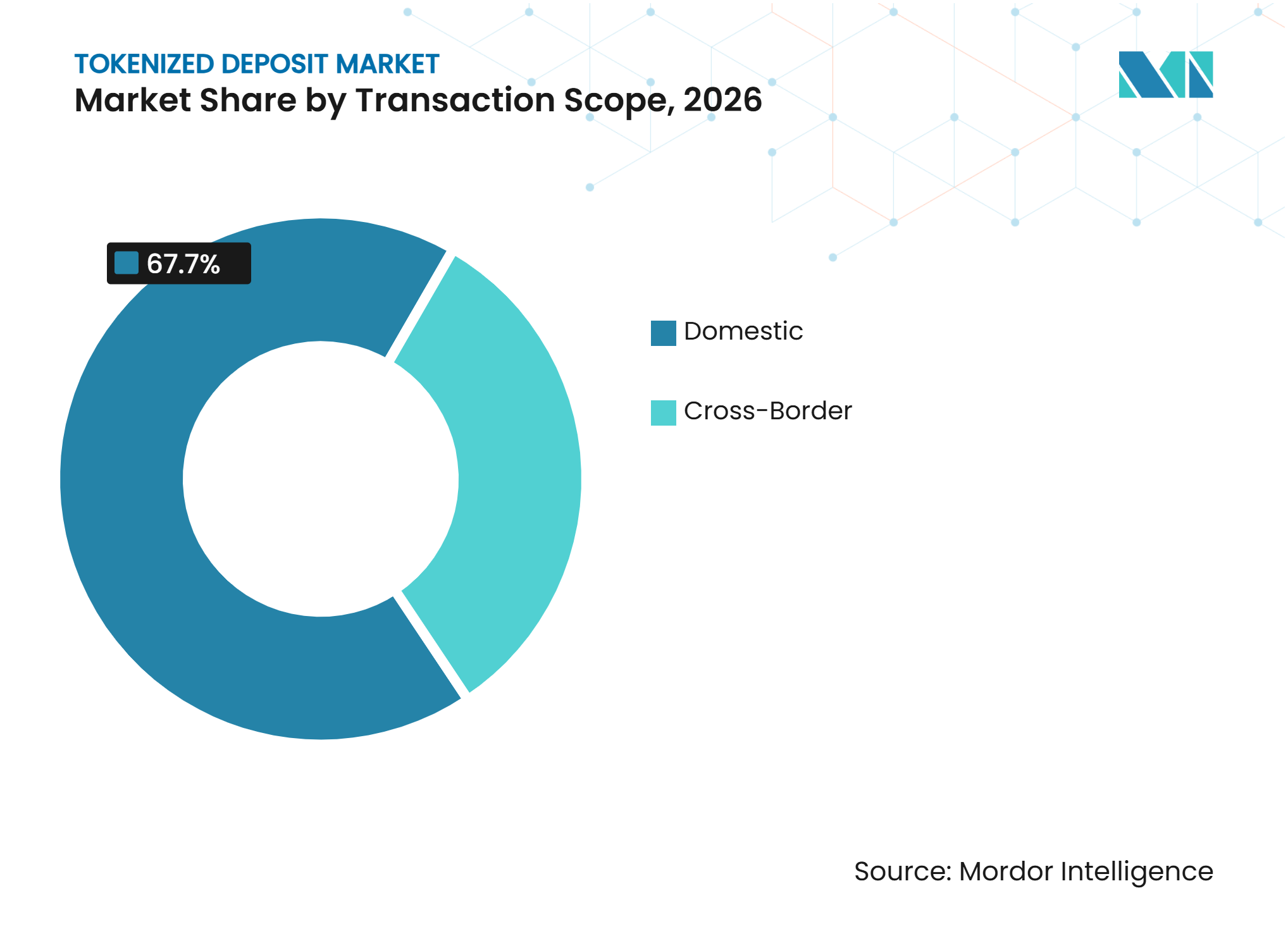
- By transaction scope, domestic transactions captured 67.7% of the tokenized deposit market share in 2026, while cross-border transactions are projected to grow at 45.7% CAGR through 2032.
- By end user, banks and other deposit-taking institutions captured 37.5% of the tokenized deposit market share in 2026, while payments, fintech, and digital-asset firms are projected to grow at a 46.3% CAGR through 2032.
- By geography, North America captured 38.1% of the tokenized deposit market share in 2026, while Asia-Pacific is projected to grow at a 43.5% CAGR through 2032.
Note: Market numbers in this report are based on Mordor Intelligence's proprietary estimation framework, which combines nine months of actuals with Q4 projections for base year 2026.
Market Trends and Insights
Drivers Impact Analysis of Tokenized Deposit Market*
| Driver | (~) % Impact on CAGR Forecast | Geographic Relevance | Impact Timeline |
|---|---|---|---|
| 24/7 Cross-Border Payments and Interbank Settlement | +7.2% | Global, with immediate gains in Asia-Pacific, North America, and Western Europe | Short term (≤ 2 years) |
| Delivery-Versus-Payment Settlement for Tokenized Securities | +5.8% | North America, Europe, Japan, and Singapore | Medium term (2-4 years) |
| Programmable Corporate Treasury and Conditional Payments | +5.5% | Global, concentrated among multinationals in Asia-Pacific and Europe, Middle East, and Africa | Medium term (2-4 years) |
| Integration Into Shared-Ledger Financial Market Infrastructure | +4.9% | Global, particularly the United Kingdom, Eurozone, Singapore, and Hong Kong | Medium term (2-4 years) |
| Demand for Atomic Settlement Using Regulated Commercial Bank Money | +4.6% | Global, with greater progress where tokenized deposits have clear legal status | Long term (≥ 4 years) |
| Corporate Demand for Automated, Real-Time Liquidity Management | +4.3% | Global, with early gains in treasury-intensive sectors in Asia-Pacific and North America | Short term (≤ 2 years) |
| Source: Mordor Intelligence | |||
24/7 Cross-Border Payments and Interbank Settlement
Legacy correspondent banking cannot settle continuously across weekends and time zones, which makes this a direct driver for the tokenized deposit market. DBS and Citi completed a live Singapore-to-New York United States dollar payment over a weekend on September 5, 2026, with settlement completed in minutes rather than the conventional timeline of up to 2 business days[1]. Swift’s shared ledger is designed to match and net interbank obligations while allowing banks to retain their existing settlement relationships and core systems. Its use of ISO 20022 pacs.008 and pacs.009 messages can reduce integration friction for participating banks. The model records and organizes obligations on the shared ledger, then completes settlement through established systems. This approach allows the tokenized deposit market to expand across jurisdictions without requiring every bank to adopt the same underlying technology.
Delivery-Versus-Payment Settlement for Tokenized Securities
Tokenized deposits are increasingly used as the cash leg for delivery-versus-payment settlement of tokenized securities. Kinexys by JPMorgan, Chainlink, and Ondo Finance settled tokenized United States Treasuries against United States dollar deposits across public and permissioned blockchains in real time during May 2025[2]. Japan’s DeCurret DCP moved from test-data verification in August 2025 to live security-token delivery-versus-payment issuances by December 2025 with SBI Securities, Daiwa Securities, and SBI Shinsei Bank. IOSCO stated that atomic T+0 delivery-versus-payment is achievable on distributed ledger technology platforms. This structure reduces principal risk because the asset and cash legs settle together. Banks that provide the settlement deposit can also deepen their role in payment and custody workflows for tokenized assets.
Programmable Corporate Treasury and Conditional Payments
Programmable rules can extend the tokenized deposit market beyond payment execution into treasury management. Ant International completed real-time programmable Singapore dollar and United States dollar token payments through HSBC’s Tokenized Deposit Service in Singapore during October 2025[3]. UBS and Ant International signed a memorandum of understanding in November 2025 to connect UBS Digital Cash with Ant’s Whale platform for real-time multi-currency intragroup flows. Kinexys has operationalized programmable treasury services for BMW Group, Mitsubishi Corporation, and Siemens, and reported cumulative processing above USD 4 trillion in 2026. Conditional payment rules can become embedded in a company’s treasury workflow. Moving to another provider may therefore require more than transferring a deposit balance, because the associated payment logic may also need to be rebuilt.
Integration of Tokenized Deposits Into Shared-Ledger Financial Market Infrastructure
Multilateral platforms are shifting the tokenized deposit market from isolated bank networks toward infrastructure shaped by network effects. BIS Project Agorá completed real-value testing in July 2026 and showed that atomic multicurrency settlement in United States dollar, euro, British pound, Japanese yen, South Korean won, Swiss franc, and Mexican peso can be completed in 80 seconds without replacing real-time gross settlement infrastructure. The Monetary Authority of Singapore launched BLOOM in October 2025 to support tokenized bank liability settlement across Group of Ten and Asian currencies[4]. Participants include DBS, OCBC, UOB, Partior, and Ant International. Hong Kong Monetary Authority’s EnsembleTX pilot supports real-value tokenized deposit transactions for money market fund settlement on Hong Kong’s real-time gross settlement system. As shared settlement layers become available, banks will need to compete through programmability, client connectivity, and ecosystem access rather than settlement capability alone.
Restraints Impact Analysis of Tokenized Deposit Market*
| Restraint | (~) % Impact on CAGR Forecast | Geographic Relevance | Impact Timeline |
|---|---|---|---|
| Limited Interoperability and Fungibility Across Bank-Issued Deposit Tokens | -5.8% | Global, with the greatest effect on cross-border corridors that span several jurisdictions | Medium term (2-4 years) |
| Legal Uncertainty and Inconsistent Regulatory Treatment Across Jurisdictions | -4.8% | Most acute in South America, the Middle East and Africa, and parts of Asia-Pacific, with partial mitigation in the United Kingdom, European Union, and Singapore | Medium term (2-4 years) |
| Legacy Banking-System Integration and Operational Complexity | -4.2% | Global, with higher severity among mid-tier banks without dedicated digital-asset infrastructure | Long term (≥ 4 years) |
| Liquidity Management, Prefunding Requirements, and Deposit-Portability Constraints | -3.6% | Global, with the strongest impact on cross-border tokenized deposit models | Short term (≤ 2 years) |
| Source: Mordor Intelligence | |||
Legal Uncertainty and Inconsistent Regulatory Treatment Across Jurisdictions
Legal uncertainty remains a constraint because tokenized deposit structures operate across banking, payments, digital-asset, and data rules. The Financial Stability Board reported in October 2025 that only 11 surveyed jurisdictions had finalized comprehensive frameworks for crypto-asset activities. The practical challenge is more pronounced for cross-border models, where the treatment of settlement finality, customer protections, and compliance obligations can differ between countries. The United Kingdom, the European Union, and Singapore have clearer paths than some emerging jurisdictions, but legal alignment is not universal. Banks must therefore assess how tokenized deposits fit within existing rules before they can connect networks across borders. This uneven regulatory treatment can delay implementation even when the technical platform is ready.
Liquidity Management, Prefunding Requirements, and Deposit-Portability Constraints
Cross-border tokenized deposit arrangements can require prefunded balances or escrow accounts before a token can be issued and transferred. BIS Project Agorá’s real-value testing used prefunded real-time gross settlement escrow accounts and manual approval steps before issuance. This preserves settlement assurance, but it can limit the flexibility that corporates expect from continuous liquidity services. Deposit portability is also restricted when each bank’s token can only be used in its own network. A client holding balances with multiple issuing banks may still need to maintain separate liquidity positions. Shared ledgers can reduce friction in the exchange of obligations, but they do not by themselves make deposits fungible across all issuers.
*Our forecasts treat driver/restraint impacts as directional, not additive. The impact forecasts reflect baseline growth, mix effects, and variable interactions.
Tokenized Deposit Market Segment Analysis
By Token Model:
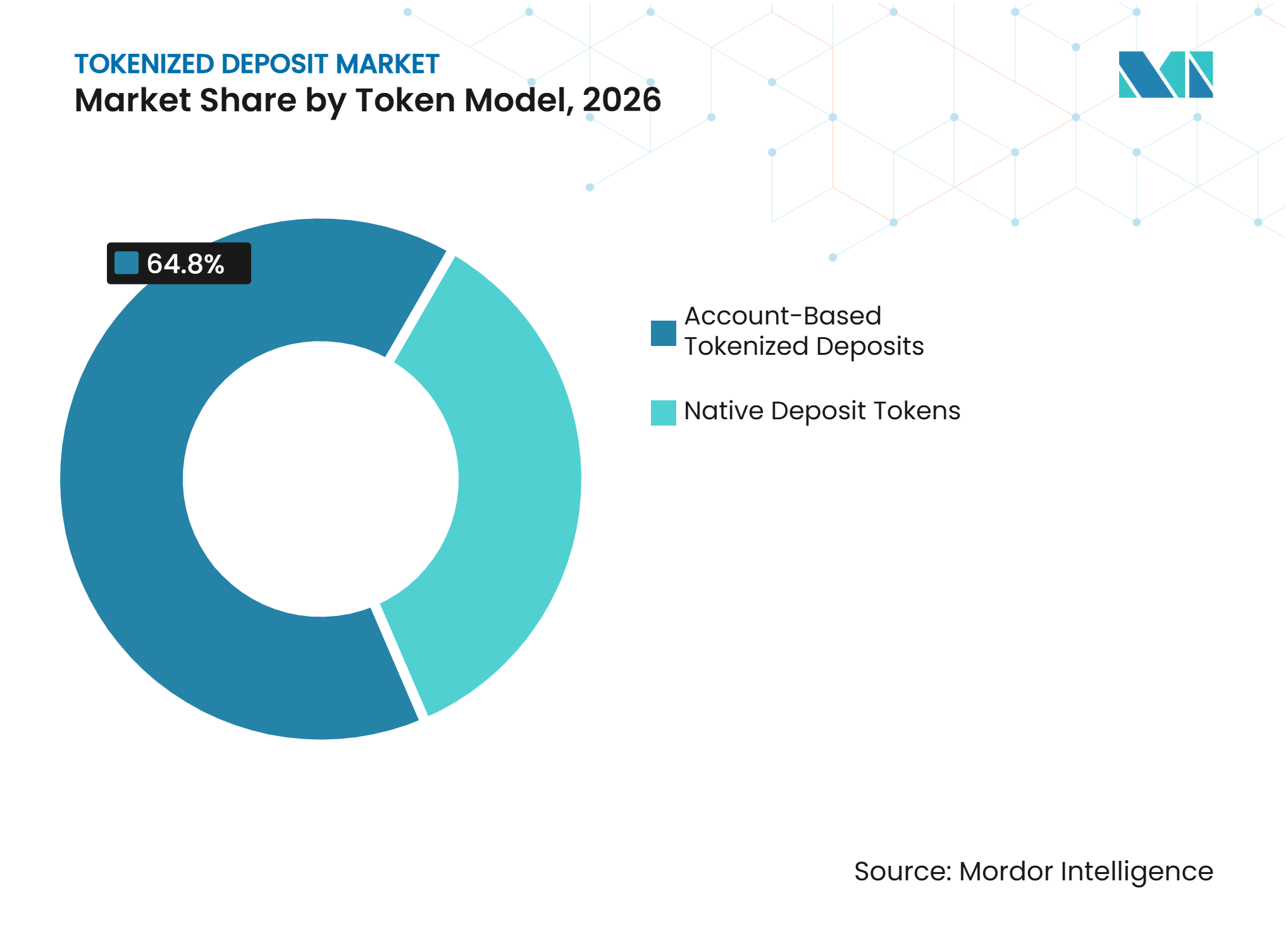
Account-Based Tokenization Supports Near-Term AdoptionAccount-based tokenization held 64.8% of the tokenized deposit market share in 2026 because it fits existing core banking ledger structures. These deposits map a bank account onto a token representation without changing the bank’s balance-sheet accounting. Each transfer updates the issuer’s balance sheet, which preserves the account-based nature of the deposit. This structure gives established banks a practical route into the tokenized deposit industry. It also allows banks to introduce programmable features while retaining familiar account controls.
Native deposit tokens are forecast to grow at a 45.3% CAGR through 2032 within the tokenized deposit market size. They are issued directly on public or hybrid blockchain networks and can support atomic settlement with tokenized assets. JPMorgan expanded JPMD from Coinbase’s Base network in November 2025 to Ethereum mainnet in October 2026. The expansion places institutional cash next to on-chain asset and collateral markets. This can allow issuers to participate in securities settlement alongside payment activity. The model may appeal where clients require controlled access to public blockchain liquidity.


By Network Model:
Shared Networks Change the Competitive StructureSingle-bank networks accounted for 47.6% of the market share in 2026. Citi Token Services spans 7 markets and supports always-on client liquidity across its network. DBS Treasury Tokens also demonstrate how banks are using intrabank models for treasury functions. These models give banks direct control over participant access, compliance checks, and service design. They are especially suited to existing corporate clients that already operate within the bank’s ecosystem. Their main limitation is that the utility of a proprietary network is bounded by the issuer’s reach.
Interbank shared multi-bank networks are projected to grow at a 47.6% CAGR through 2032 in the tokenized deposit market. The United Kingdom’s GBTD initiative completed live tokenized sterling transactions in September 2026 across 7 banks on Quant’s distributed ledger technology infrastructure. Barclays, HSBC UK, Lloyds Banking Group, Monzo, Nationwide, NatWest, and Santander took part in the activity. Bilateral models remain relevant when 2 banks want to complete a transaction without joining a single shared platform. Standard Chartered and HSBC demonstrated this approach in August 2026 on Swift’s ledger. Shared networks can improve reach, but they also require common operating and legal standards.
By Ledger Type:
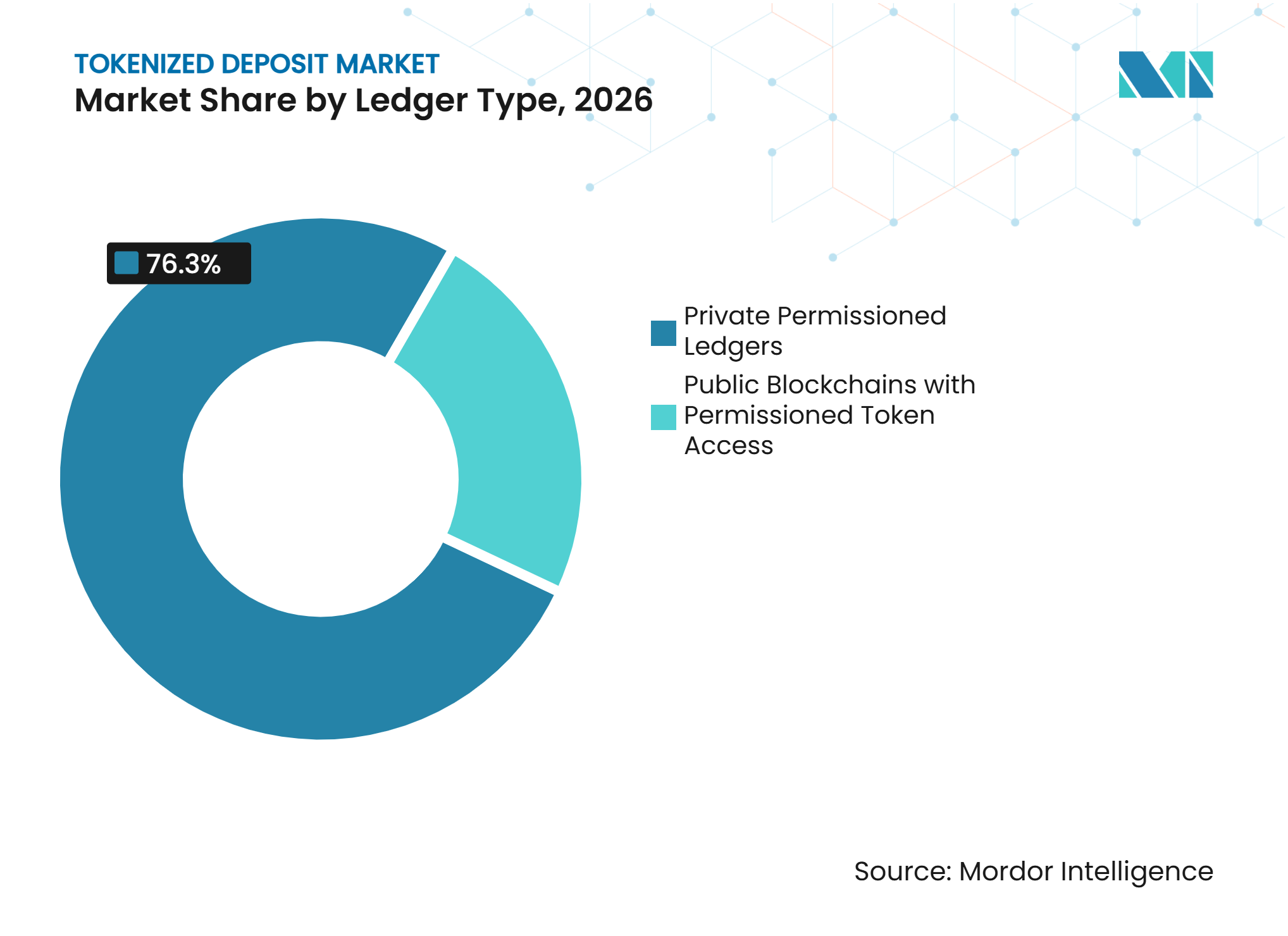
Permissioned Systems Lead as Public Access ExpandsPrivate permissioned ledgers accounted for 76.3% of the market share in 2026. Kinexys Digital Payments, Citi Token Services, and Swift’s shared ledger use controlled participation to support anti-money laundering, countering the financing of terrorism, know-your-customer, and sanctions processes. Swift’s ledger uses an Ethereum Virtual Machine-compatible Hyperledger Besu architecture. Permissioned environments align with the operational controls banks already use for regulated payments. They also limit exposure to unknown counterparties. This design explains why private ledgers remain the primary route for large-scale institutional deployments.
Public blockchains with permissioned token access are forecast to grow at a 45.7% CAGR through 2032 within the tokenized deposit market size. JPMorgan’s October 2026 launch of JPMD on Ethereum mainnet demonstrates this hybrid approach. The token uses permissioning controls intended to preserve a regulatory treatment consistent with conventional deposits. Public infrastructure can provide access to on-chain financial assets and collateral markets. Permissioned token controls can limit transfers to approved participants. This arrangement gives banks a way to combine public network access with regulated operating boundaries.

By Use Case:
Treasury Management Leads While Foreign Exchange Settlement GrowsIntra-group treasury and liquidity management accounted for 30.2% of the market share in 2026. HSBC’s Tokenized Deposit Service used this model for real-time transactions between Hong Kong and Singapore with Ant International. DBS Treasury Tokens also support corporate treasury use cases. Treasury teams can use these services to transfer funds between group entities without relying on bank operating hours. The model is particularly relevant for multinational companies with frequent internal cash movements. It can also support rules-based payments when defined business conditions are met.
Foreign exchange and payment-versus-payment settlement are projected to grow at 47.3% CAGR through 2032 in the tokenized deposit market. BIS Project Agorá tested Swiss franc to British pound and British pound to United States dollar payment-versus-payment scenarios that averaged 80 seconds in July 2026. The process addresses the timing gap that can occur when two currencies settle through different systems. Securities and digital-asset settlement are closely related applications. Kinexys, Chainlink, and Ondo Finance completed a real-time settlement of tokenized United States Treasuries against United States dollar deposits in May 2025. The United Kingdom’s GBTD initiative also demonstrated remortgage and conditional marketplace transactions during September 2026.
By Transaction Scope:
Domestic Activity Leads While Cross-Border Utility Sets the DirectionDomestic transactions accounted for 67.7% of the market share in 2026. Single-jurisdiction regulation and established intrabank infrastructure support this position. DBS, OCBC, and UOB completed live Singapore dollar interbank transactions on Swift’s ledger in September 2026. The activity showed domestic multi-bank interoperability across Singapore’s 3 major participating banks. Domestic deployments can operate within a clearer legal and supervisory setting than cross-border transfers. They also offer a practical setting in which to establish common technical and compliance procedures.
Cross-border transactions are projected to grow at a 45.7% CAGR through 2032 in the tokenized deposit market. The DBS and Citi weekend United States dollar transaction showed that 24/7 cross-border settlement is moving beyond proof-of-concept activity. Legal issues remain more difficult than the underlying technology. Cross-border models must address settlement finality, data sovereignty, and sanctions screening across several jurisdictions. BIS has stated that further contractual standardization is needed for this type of cross-border arrangement. The commercial value of continuous settlement is therefore balanced against the need for aligned legal arrangements.
By End User:
Banks Lead Issuance While Fintech Participation RisesBanks and other deposit-taking institutions held 37.5% of the market share in 2026. They are both the principal issuers of tokenized deposits and the primary users of intrabank networks. Their regulatory status and existing deposit relationships make them central to the operating model. Capital markets and investment firms use tokenized deposits mainly as the cash leg for delivery-versus-payment activity. DeCurret DCP’s work in Japan and Kinexys cross-chain activity illustrate this institutional use. This user group anchors the regulated infrastructure on which other applications depend.
Payments, fintech, and digital-asset firms are projected to grow at a 46.3% CAGR through 2032 in the tokenized deposit market. B2C2, Coinbase, and Mastercard participated in JPMorgan’s JPMD proof-of-concept in November 2025. Their involvement tested bank-grade settlement for firms that operate in digital-asset and payment ecosystems. Non-financial companies such as Ant International, BMW Group, and Siemens use institutional platforms through treasury channels. Individual access is more limited and has appeared through retail-focused programs such as the GBTD initiative. Growth in this segment depends on banks providing controlled connectivity to these broader ecosystems.
Geography Analysis
North America
North America held 38.1% of the tokenized deposit market share in 2026, supported by the United States dollar’s role in wholesale settlement. Kinexys had processed more than USD 4 trillion cumulatively and reported an average daily transaction value of USD 7 billion when JPMD expanded to Ethereum mainnet in October 2026. The expansion gave institutional clients access to peer-to-peer transfers, collateral posting, and tokenized asset settlement. Citi Token Services operates in 7 markets, including the United States, Ireland, Hong Kong, Singapore, the United Kingdom, Japan, and the United Arab Emirates. Its network supports continuous United States dollar and euro liquidity for multinational clients. The region’s scale in dollar clearing gives banks a strong basis for linking deposit tokens to global payment and capital-market activity.
Asia-Pacific
Asia-Pacific is projected to grow at a 43.5% CAGR through 2032 in the tokenized deposit market. The Monetary Authority of Singapore launched BLOOM in October 2025 to develop tokenized bank liability settlement across the Group of Ten and Asian currencies. DBS, OCBC, and UOB completed live Singapore dollar interbank transactions on Swift’s ledger in September 2026. Hong Kong Monetary Authority’s EnsembleTX pilot supports real-value activity for money market fund settlement and intragroup liquidity management. HSBC introduced its Tokenized Deposit Service in Singapore in October 2025 and completed real-time cross-border United States dollar transfers between Hong Kong and Singapore with Ant International. Japan’s DCJPY program also progressed through its Financial Services Agency FinTech Proof-of-Concept Hub work for security-token settlement.
Europe, South America, and the Middle East and Africa
The United Kingdom’s GBTD initiative completed live interbank tokenized sterling deposit transactions in September 2026 with Barclays, HSBC UK, Lloyds Banking Group, Monzo, Nationwide, NatWest, and Santander. The activity included 2 remortgage completions and a conditional marketplace payment. Standard Chartered and HSBC completed a live cross-border transaction on Swift’s ledger in August 2026, demonstrating euro and British pound tokenized deposit flows across European corridors. South America remains at an early stage, although Banco Central do Brasil participates in bilateral distributed ledger technology collaboration with the Hong Kong Monetary Authority. The Middle East and Africa are building momentum through the United Arab Emirates, where Citi Token Services added United States dollar and euro support in September 2026. HSBC also added United Arab Emirates dirham capability for corporate clients in the country.
Competitive Landscape
Market Concentration
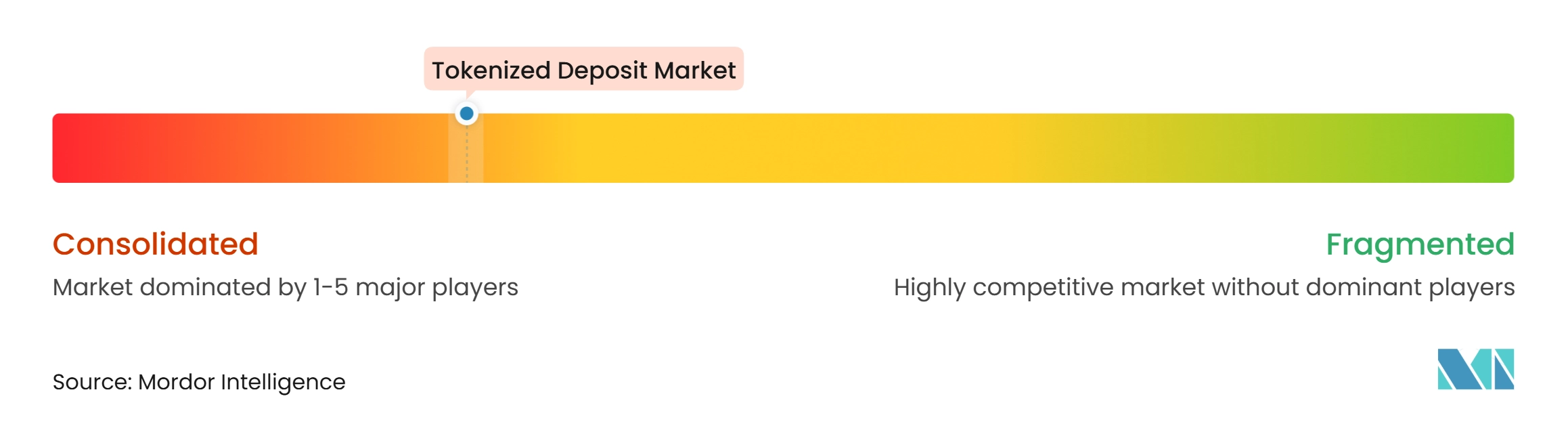
The tokenized deposit market is commercially concentrated among a small group of tier-one banks, while the wider network structure remains fragmented. JPMorgan, Citi, HSBC, DBS, and Standard Chartered account for much of the documented live commercial activity in 2026. Their strategies follow 3 broad paths. Some banks build scaled proprietary networks to deepen client relationships. Others invest in shared infrastructure through Swift’s ledger and Project Agorá. A third group participates in domestic programs that use local regulatory and banking frameworks to establish interoperability.
JPMorgan expanded JPMD to Ethereum mainnet in October 2026, placing institutional cash alongside on-chain asset markets. Citi expanded Token Services to Japan and the United Arab Emirates in September 2026, bringing the network to 7 markets. HSBC introduced Tokenized Deposit Service in Singapore in October 2025, with Ant International as its first client for 24/7 cross-border United States dollar transfers. These moves show how leading banks are combining geographic expansion, treasury services, and on-chain asset connectivity. The tokenized deposit market also includes Partior, which was co-founded by DBS, JPMorgan, and Standard Chartered as an independent wholesale interbank settlement network.
Custodian banks are also positioning themselves within the infrastructure. BNY acted as a settlement facilitator in BIS Project Agorá’s July 2026 real-value testing, linking custody and settlement roles. JPMD’s publicly verifiable smart contracts on Ethereum provide a different transparency model from traditional closed systems. Mid-tier banks remain a gap in the tokenized deposit market because many lack the resources for dedicated platforms. Cross-issuer fungibility also remains unresolved across competing token networks. The Hong Kong Monetary Authority’s Project Ensemble work identifies the need for shared infrastructure that can support broader settlement and liquidity use cases.
Tokenized Deposit Industry Leaders
-
JPMorgan Chase & Co.
-
Citigroup Inc.
-
HSBC Holdings plc
-
DBS Group Holdings Ltd.
-
Partior Pte. Ltd.
- *Disclaimer: Major Players sorted in no particular order
Tokenized Deposit Market Companies Covered in this Report
- JPMorgan Chase & Co.
- Citigroup Inc.
- HSBC Holdings plc
- DBS Group Holdings Ltd.
- Standard Chartered PLC
- Partior Pte. Ltd.
- Wells Fargo & Company
- Barclays PLC
- Lloyds Banking Group plc
- NatWest Group plc
- Banco Santander, S.A.
- Monzo Bank Ltd.
- Nationwide Building Society
- The Huntington National Bank
- First Horizon Corporation
- M&T Bank Corporation
- BNY
- Old National Bancorp
- Royal Bank of Canada
- The Bank of Nova Scotia
Recent Industry Developments in Tokenized Deposit Market
- October 2026: Kinexys by JPMorgan expanded JPMD to the Ethereum mainnet, extending institutional access beyond Base for peer-to-peer transfers, collateral posting, and tokenized asset settlement. Kinexys has processed more than USD 4 trillion cumulatively.
- September 2026: 7 United Kingdom banks completed live interbank tokenized sterling deposit transactions under the GBTD initiative. The activity included 2 remortgage completions and a conditional marketplace payment.
- September 2026: Citi Token Services expanded to Japan and the United Arab Emirates, reaching 7 markets and supporting continuous cross-border liquidity in United States dollars and euros.
- September 2026: DBS and Citi completed a live weekend United States dollar cross-border payment on Swift’s ledger, completing the Singapore-to-New York transfer in minutes.
Global Tokenized Deposit Market Report Scope
Segmentation Overview
| Account-Based Tokenized Deposits |
| Native Deposit Tokens |
| Single-Bank (Intra-Bank) Networks |
| Interbank – Shared Multi-Bank Networks |
| Interbank – Bilateral and Cross-Network Links |
| Private Permissioned Ledgers |
| Public Blockchains with Permissioned Token Access |
| Securities and Digital-Asset Settlement and Collateral Management |
| FX and PvP Settlement |
| Intra-Group Treasury and Liquidity Management |
| Third-Party Commercial and Institutional Payments |
| Retail and Other Payments |
| Domestic |
| Cross-Border |
| Banks and Other Deposit-Taking Institutions | |
| Capital-Markets and Investment Firms | |
| Payments, Fintech and Digital-Asset Firms | |
| Nonfinancial Corporates | Large Corporates and Multinationals |
| SMEs | |
| Public Sector and Government Entities | |
| Individuals |
| North America | United States |
| Canada | |
| Mexico | |
| South America | Brazil |
| Argentina | |
| Rest of South America | |
| Europe | United Kingdom |
| Germany | |
| France | |
| Italy | |
| Spain | |
| Rest of Europe | |
| Asia-Pacific | China |
| Japan | |
| India | |
| South Korea | |
| Australia | |
| Indonesia | |
| Thailand | |
| Malaysia | |
| Singapore | |
| Vietnam | |
| Rest of Asia-Pacific | |
| Middle East and Africa | Saudi Arabia |
| United Arab Emirates | |
| Turkey | |
| South Africa | |
| Egypt | |
| Rest of Middle East and Africa |
| By Token Model | Account-Based Tokenized Deposits | |
| Native Deposit Tokens | ||
| By Network Model | Single-Bank (Intra-Bank) Networks | |
| Interbank – Shared Multi-Bank Networks | ||
| Interbank – Bilateral and Cross-Network Links | ||
| By Ledger Type | Private Permissioned Ledgers | |
| Public Blockchains with Permissioned Token Access | ||
| By Use Case | Securities and Digital-Asset Settlement and Collateral Management | |
| FX and PvP Settlement | ||
| Intra-Group Treasury and Liquidity Management | ||
| Third-Party Commercial and Institutional Payments | ||
| Retail and Other Payments | ||
| By Transaction Scope | Domestic | |
| Cross-Border | ||
| By End User | Banks and Other Deposit-Taking Institutions | |
| Capital-Markets and Investment Firms | ||
| Payments, Fintech and Digital-Asset Firms | ||
| Nonfinancial Corporates | Large Corporates and Multinationals | |
| SMEs | ||
| Public Sector and Government Entities | ||
| Individuals | ||
| By Geography | North America | United States |
| Canada | ||
| Mexico | ||
| South America | Brazil | |
| Argentina | ||
| Rest of South America | ||
| Europe | United Kingdom | |
| Germany | ||
| France | ||
| Italy | ||
| Spain | ||
| Rest of Europe | ||
| Asia-Pacific | China | |
| Japan | ||
| India | ||
| South Korea | ||
| Australia | ||
| Indonesia | ||
| Thailand | ||
| Malaysia | ||
| Singapore | ||
| Vietnam | ||
| Rest of Asia-Pacific | ||
| Middle East and Africa | Saudi Arabia | |
| United Arab Emirates | ||
| Turkey | ||
| South Africa | ||
| Egypt | ||
| Rest of Middle East and Africa | ||
Key Questions Answered in the Report
What is the projected growth rate for tokenized deposits?
The tokenized deposit market is forecast to grow at a 33.2% CAGR from 2027 to 2032, rising from USD 4.1 trillion in 2027 to USD 17.2 trillion by 2032.
What are tokenized deposits used for?
Major uses include intra-group treasury and liquidity management, foreign exchange settlement, payment-versus-payment settlement, and settlement of tokenized securities.
Which token model leads adoption?
Account-based tokenization held 64.8% share in 2026 because it is compatible with existing core banking ledgers. It allows banks to retain established accounting and account-control structures.
Why are cross-border tokenized deposits growing?
They can reduce settlement delays across time zones and weekends. DBS and Citi completed a live Singapore-to-New York United States dollar transfer in minutes during September 2026.
Which region is growing fastest for tokenized deposits?
Asia-Pacific is projected to grow at 43.5% CAGR through 2032, supported by initiatives in Singapore, Hong Kong, and Japan.
What limits wider tokenized deposit adoption?
Cross-issuer interoperability, differing legal treatment, complex core-system integration, and prefunding requirements remain material constraints.