
Title Insurance Market Size and Share
Market Overview
| Study Period | 2021 - 2032 |
|---|---|
| Market Size (2027) | USD 23.40 Billion |
| Market Size (2032) | USD 29.20 Billion |
| Growth Rate (2027 - 2032) | 4.50 % |
| Fastest Growing Market | Asia-Pacific |
| Largest Market | North America |
| Market Concentration | High |
Major Players *Disclaimer: Major Players sorted in no particular order Image © Mordor Intelligence. Reuse requires attribution under CC BY 4.0. | |
Title Insurance Market Analysis by Mordor Intelligence
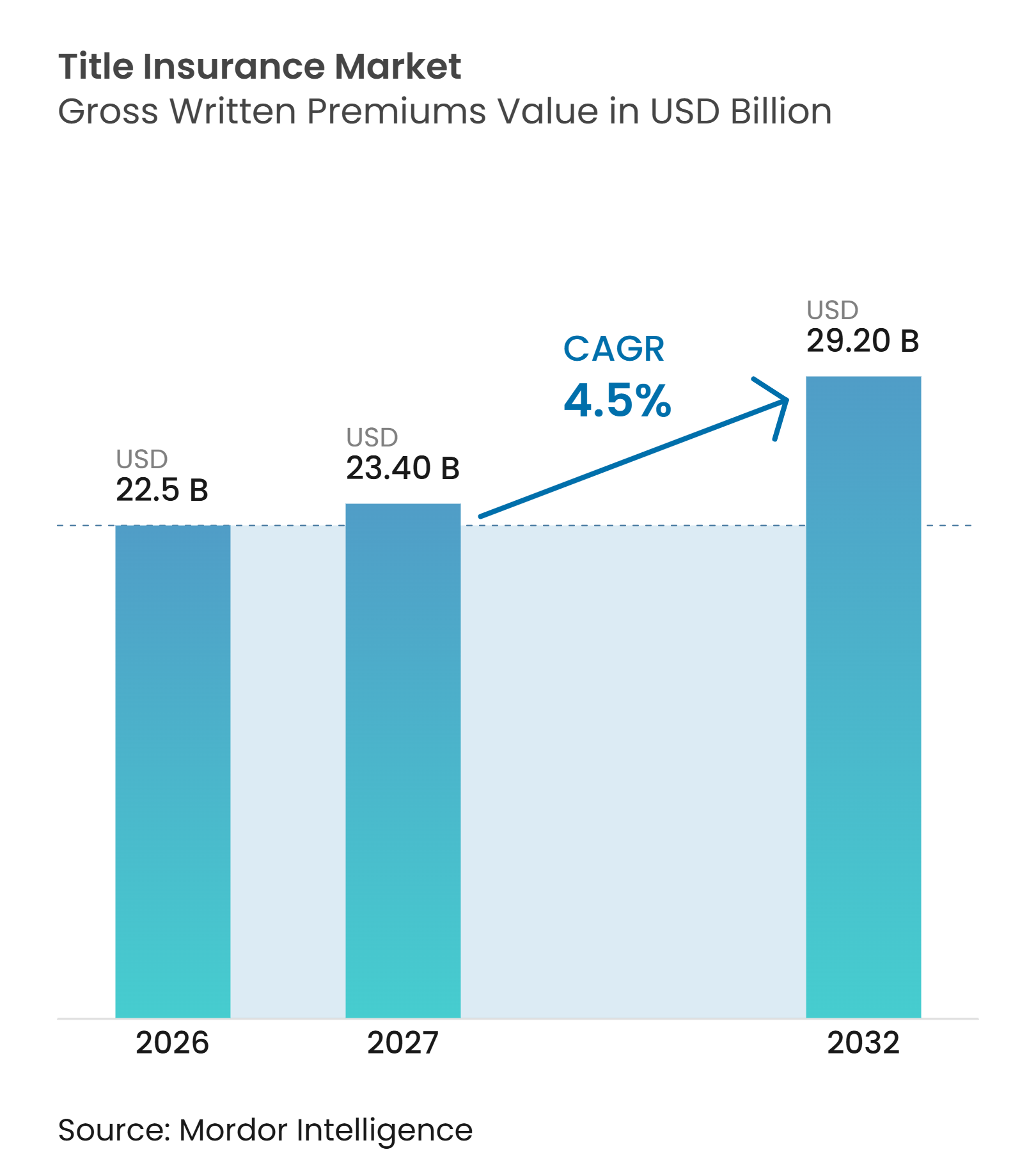
The Title Insurance Market size in terms of gross written premiums value is projected to be USD 22.5 billion in 2026, USD 23.40 billion in 2027, and reach USD 29.20 billion by 2032, growing at a CAGR of 4.5% from 2027 to 2032.
The title insurance market benefits from recovering mortgage origination activity and stronger commercial property transactions in the United States. Title insurance premiums reached USD 18.5 billion in 2025, up 13.8% from 2024, and first-half 2026 premiums increased 16.1% year over year. Commercial transactions are supporting premium income because their policy values are higher than residential transactions. Fraud exposure is also increasing demand for coverage while raising the need for stronger identity checks and notary controls. The title insurance market is also changing as electronic closings and automated title searches improve processing capacity for underwriters and agents.
Key Report Takeaways
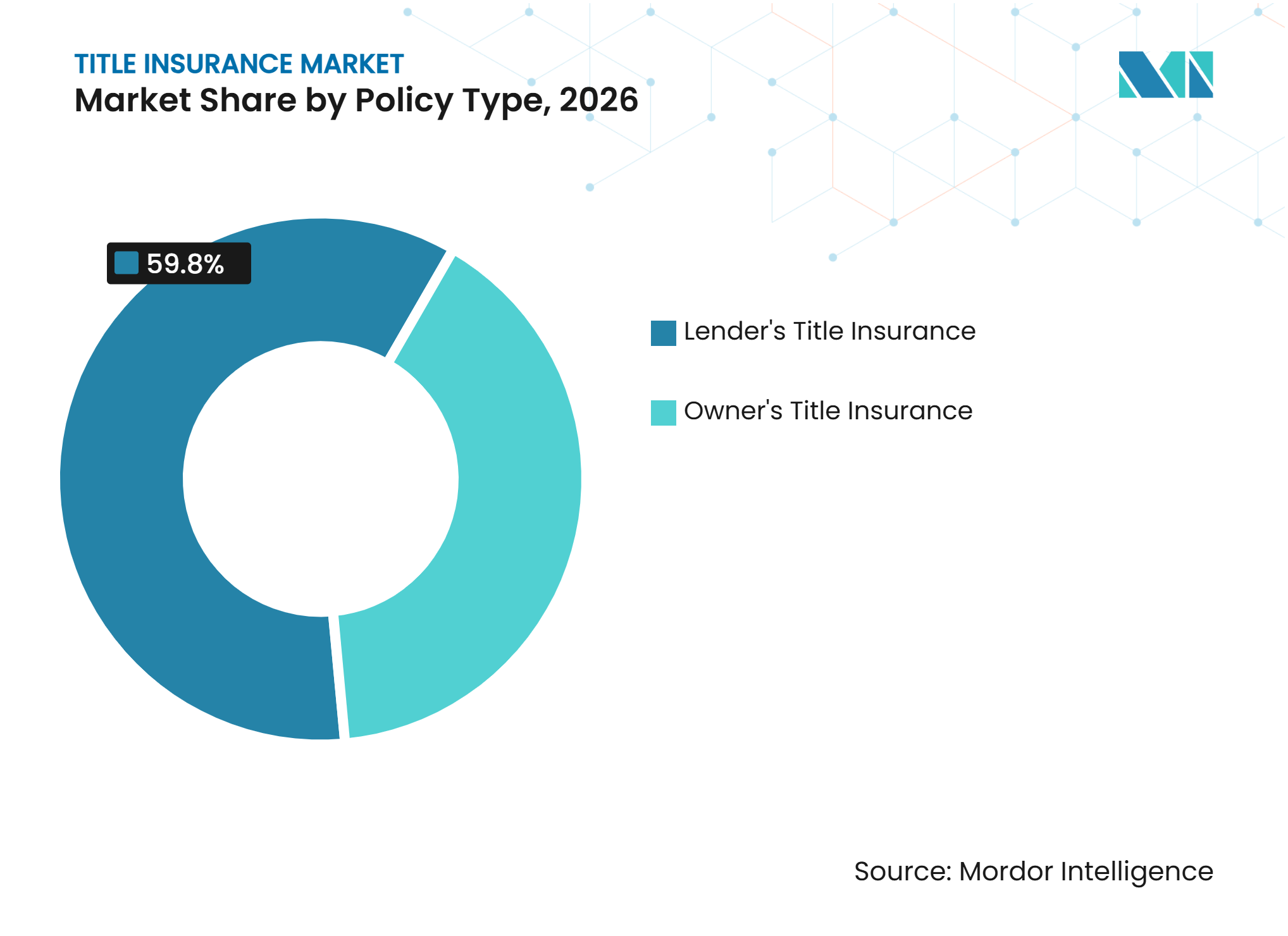
- By policy type, lender’s title insurance captured 59.8% of the title insurance market share in 2026, while owner’s title insurance is projected to grow at a 5.5% CAGR through 2032.
- By property type, residential properties captured 64.7% of the title insurance market share in 2026, while commercial properties are projected to grow at a 5.5% CAGR through 2032.
- By distribution channel, independent and affiliated agents captured 63.2% of the title insurance market share in 2026, while direct operations are projected to grow at a 5.8% CAGR through 2032.
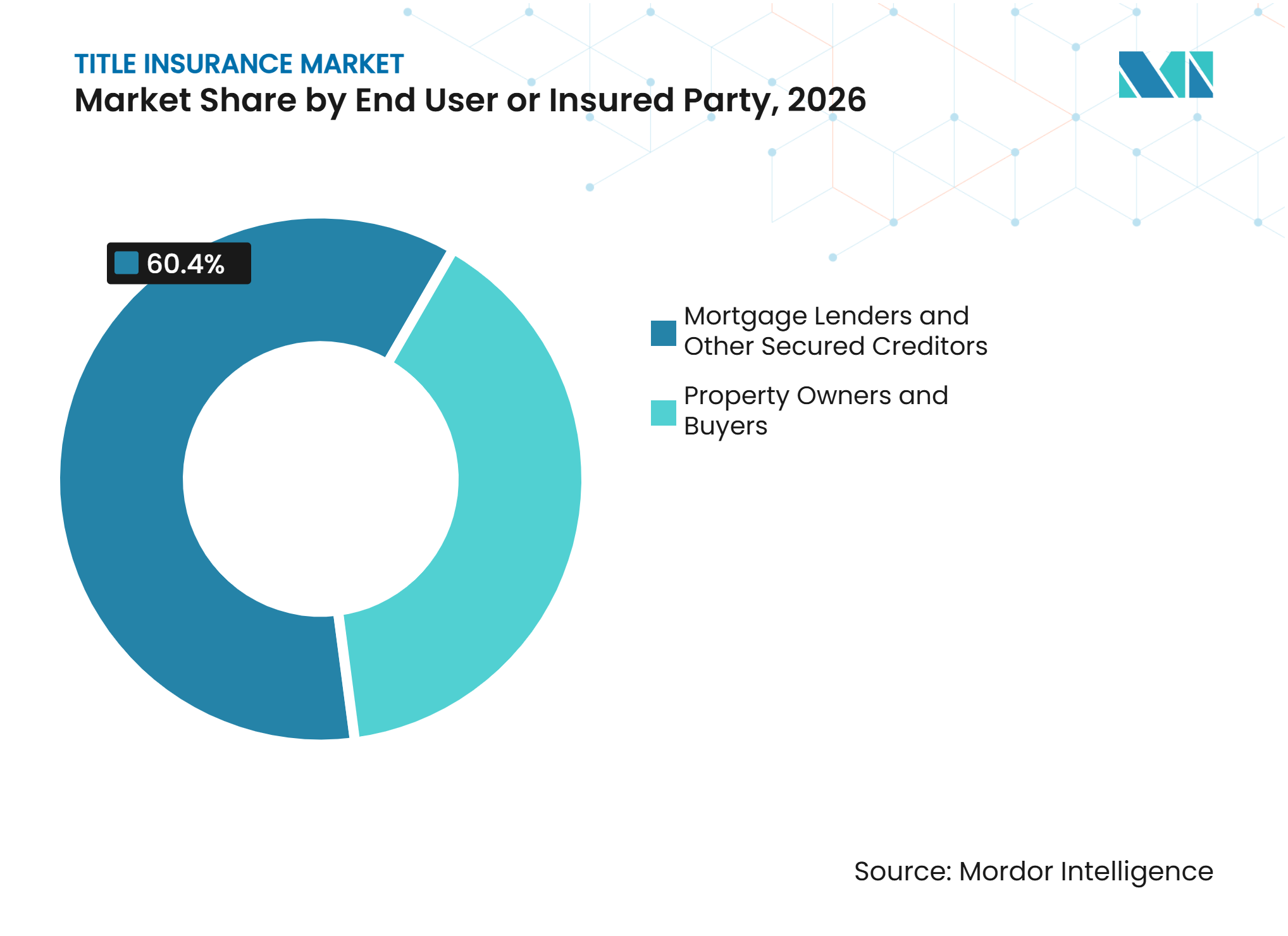
- By end user, mortgage lenders and secured creditors captured 60.4% of the title insurance market share in 2026, while property owners and buyers are projected to grow at a 5.5% CAGR through 2032.
- By transaction type, property purchases captured 65.3% of the title insurance market share in 2026, while other insurable transactions are projected to grow at a 6.2% CAGR through 2032.
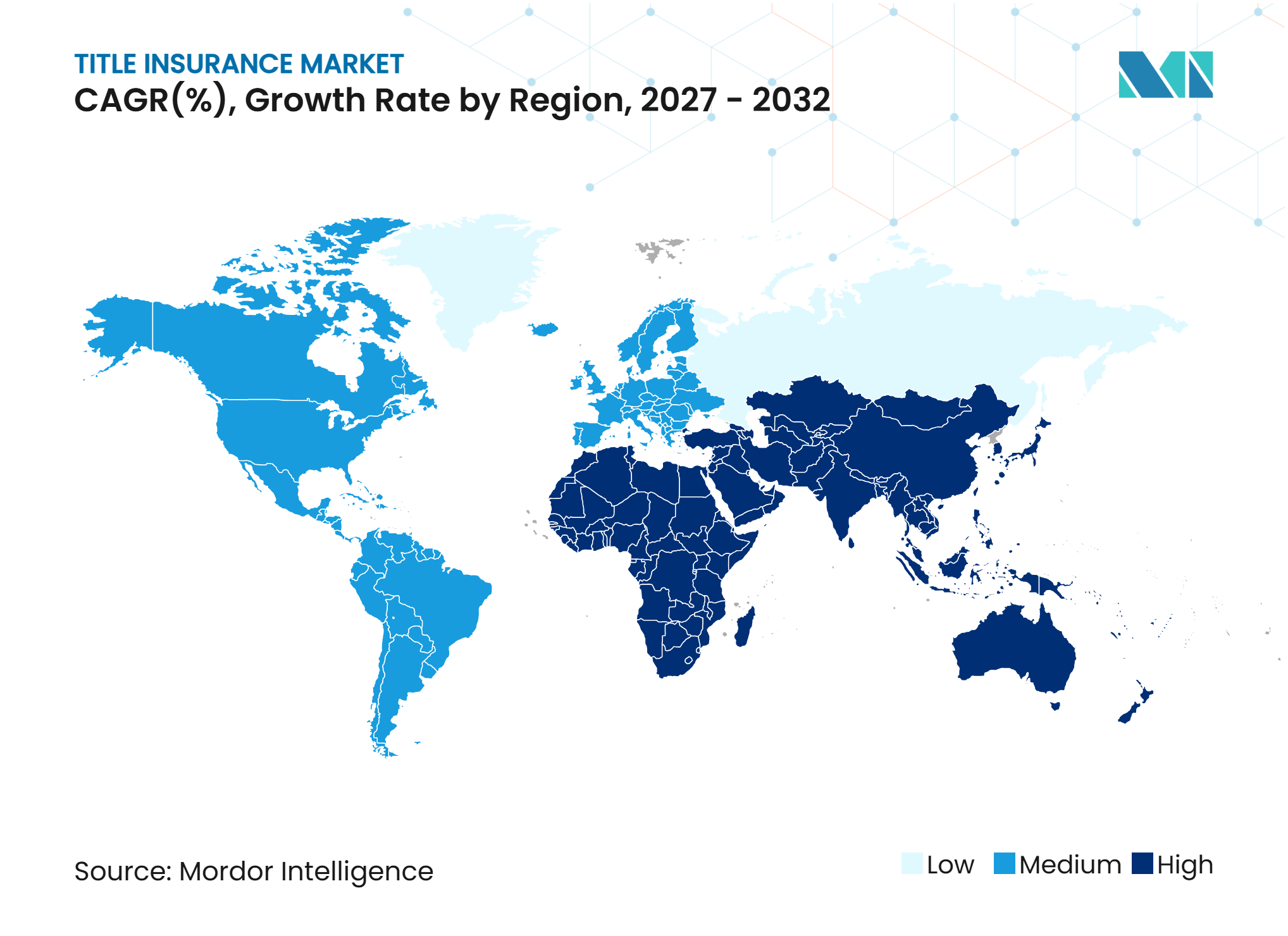
- By geography, North America captured 85.3% of the title insurance market share in 2026, while Asia-Pacific is projected to grow at a 7.8% CAGR through 2032.
Note: Market numbers in this report are based on Mordor Intelligence's proprietary estimation framework, which combines nine months of actuals with Q4 projections for base year 2026.
Market Trends and Insights
Drivers Impact Analysis of Title Insurance Market*
| Driver | (~) % Impact on CAGR Forecast | Geographic Relevance | Impact Timeline |
|---|---|---|---|
| Growth in Property Transactions and Mortgage Originations | +1.2% | Global, concentrated in North America and Asia-Pacific | Short term (≤ 2 years) |
| Rising Exposure to Title Fraud and Ownership Claims | +0.8% | North America, South America, and Middle East and Africa | Medium term (2-4 years) |
| Complex Property Ownership and Title Histories | +0.4% | Global, especially Europe, India, and Southeast Asia | Long term (≥ 4 years) |
| Digitization of Land Records and Electronic Transactions | +0.5% | Asia-Pacific, Middle East and Africa, and South America | Medium term (2-4 years) |
| Expansion of Mortgage Lending and Formal Property Markets | +0.6% | Asia-Pacific, South America, and Middle East and Africa | Long term (≥ 4 years) |
| Technology-Enabled Title Search and Underwriting | +0.7% | Global, led by North America | Medium term (2-4 years) |
| Source: Mordor Intelligence | |||
Growth in Property Transactions and Mortgage Originations
Mortgage origination volumes remain a direct source of premium generation for the Title Insurance Market. The Mortgage Bankers Association expects single-family originations to reach USD 2.2 trillion in 2026, an 8% increase from 2025[1]. Purchase originations are expected to increase 7.7%, while refinance originations are projected to rise 9.2%. Commercial real estate finance and multifamily originations are also expected to expand faster than the broader residential lending base. Higher commercial activity supports premium growth because commercial policies generate more revenue per closing. This pattern favors underwriters that can support large and complex transactions.
Rising Exposure to Title Fraud, Forgery and Undisclosed Ownership Claims
Title fraud is increasing the need for insurance protection across the Title Insurance Market. In 2025, 59% of surveyed title firms reported at least 1 seller impersonation attempt, compared with 28% in the 2024 survey. By April 2026, 45% of firms reported monthly attempts. Vacant land accounted for 82% of documented attempts, and half of firms with paid claims reported losses above USD 100,000. The FBI recorded 12,368 real estate fraud complaints and USD 275.1 million in losses during 2025[2]. This environment supports owner policy demand and requires stronger identity verification, approved notary networks, and fraud detection tools.
Complex Property Ownership and Title Histories
Complex ownership structures strengthen the underwriting role of the Title Insurance Market. Cross-border acquisitions, inherited assets, easements, and construction liens can create risks that are not easily resolved through standard property records. The issue is especially important for energy, industrial, and data center sites, where several rights and approvals may affect a single transaction. Underwriters with specialist legal and technical capability can assess these risks more consistently than smaller agencies. Complexity also increases the value of tailored policies for institutional investors. The result is a shift toward higher-value commercial policies and detailed title examination.
Digitization of Land Records and Electronic Property Transactions
Digital records and electronic closings are improving transaction speed in the Title Insurance Market. As of 2026, 48 states and the District of Columbia had enacted remote online notarization statutes or executive orders[3]. Stewart-owned NotaryCam completed more than 154,000 remote online notarization transactions in 2024. Fannie Mae accepts qualifying remotely notarized loans when lenders meet identity, notary location, and audit trail conditions. These processes create structured records that can improve underwriting review. Digital adoption also reduces friction for lenders, agents, and consumers.
Restraints Impact Analysis of Title Insurance Market*
| Restraint | (~) % Impact on CAGR Forecast | Geographic Relevance | Impact Timeline |
|---|---|---|---|
| High Mortgage Rates and Housing Affordability Constraints | -0.7% | North America, Europe, and Asia-Pacific | Short term (≤ 2 years) |
| Fragmented Land Registries and Inconsistent Property Records | -0.5% | Asia-Pacific, South America, Middle East and Africa, and parts of Europe | Long term (≥ 4 years) |
| Limited Title Insurance Awareness and Price Sensitivity | -0.4% | Asia-Pacific, Middle East and Africa, and South America | Medium term (2-4 years) |
| Alternative Property-Title Assurance Mechanisms | -0.3% | North America and parts of Europe | Medium term (2-4 years) |
| Source: Mordor Intelligence | |||
High Mortgage Rates and Housing Affordability Constraints
High mortgage rates continue to restrict residential transaction activity in the title insurance market. The Mortgage Bankers Association expects mortgage rates to remain between 6% and 6.5% in 2026. These levels reduce the incentive for many existing borrowers to refinance. They also limit affordability for prospective buyers and delay property transfers. Smaller regional underwriters are more exposed because they depend more heavily on residential order flow. Commercial transactions have provided some support, but they do not fully offset weaker housing activity across all operators.
Fragmented Land Registries and Inconsistent Property Records
Incomplete property records limit the ability to scale the Title Insurance Market outside North America. In India, USD 1.6 trillion in real estate asset values remains constrained by unclear titles. Records may be held across revenue, registration, survey, court, and municipal systems. Title is generally presumptive rather than conclusive, which makes underwriting more difficult. Similar conditions affect parts of Southeast Asia and South America. Legal reforms can improve the position over time, but complete change requires a long implementation period.
*Our forecasts treat driver/restraint impacts as directional, not additive. The impact forecasts reflect baseline growth, mix effects, and variable interactions.
Title Insurance Market Segment Analysis
By Policy Type:
Lender Mandates Lead While Owner Coverage ExpandsLenders’ title insurance held 59.8% of the title insurance market share in 2026. Mortgage origination standards in the United States and Canada make lender coverage a normal part of financed property transactions. The segment therefore moves closely with residential and commercial mortgage activity. The expected increase in single-family originations supports lender policy demand in 2026. Commercial lending can further improve premium income because larger transactions require higher policy limits. The requirement-based nature of lender coverage provides a stable base for national underwriters.
Owner’s title insurance is projected to expand at a 5.5% CAGR through 2032. Seller impersonation fraud is strengthening the case for protection in mortgage-free transactions. Vacant land is particularly exposed because it represented 82% of documented seller impersonation attempts. Owner policies address risks that are not covered by a lender policy. Buyers are also becoming more aware of deed fraud, undisclosed heirs, and post-closing claims. This supports growth in voluntary owner coverage where lender requirements do not apply.


By Property Type:
Commercial Policies Improve Revenue MixResidential properties held a 64.7% share of the Title Insurance Market size in 2026. Residential activity remains the main source of policy count because most home purchases involve a mortgage and lender coverage. The segment is sensitive to mortgage rates and housing affordability. Refinancing can add files, but refinance policies tend to produce lower premiums than purchase transactions. This leaves residential results dependent on both lending volume and transaction mix. A sustained recovery in purchase activity would improve the segment’s contribution.
Commercial properties are projected to grow at a 5.5% CAGR through 2032. Data centers, industrial sites, energy assets, and large infrastructure transactions require detailed title review. First American reported USD 271 million in commercial title revenue for the first quarter of 2026, up 48% from the prior year. The Title Insurance Market size for commercial policies benefits from higher revenue per closing than residential policies. Complex easements, liens, and site conditions also create demand for specialized underwriting. These characteristics support premium growth even when housing transactions remain uneven.
By Distribution Channel:
Agent Networks Remain CentralIndependent and affiliated title agents held a 63.2% share in the Title Insurance Market in 2026. Local relationships remain important in residential property transactions and community-level real estate markets. Agents provide geographic knowledge and help manage the closing process for lenders and consumers. Old Republic reported that agency-produced premiums represented 78% of title revenue in the second quarter of 2026. This structure gives national underwriters wide market coverage without requiring direct offices in every location. It also makes agent service and technology support important competitive tools.
Direct operations are projected to grow at a 5.8% CAGR through 2032. Underwriters are using proprietary platforms to manage high-volume transaction types with lower unit costs. First American’s digital tools are intended to improve workflow capacity and support broader branch adoption. Direct models allow insurers to maintain greater control over data, workflow, and customer experience. The channel can be especially attractive for standardized refinance and lender-driven transactions. Agent networks will remain important, but direct capacity can improve profitability as volume recovers.
By End User:
Creditor Demand Is Stable and Buyer Demand Is GrowingMortgage lenders and secured creditors held a 60.4% share in the Title Insurance Market in 2026. Their demand is embedded in institutional mortgage underwriting practices. Policy issuance tracks closely with loan origination because lenders require protection for their collateral interest. The USD 2.2 trillion single-family origination forecast for 2026 therefore supports this end-user base. Commercial lenders also need policies for larger secured transactions. This creates steady demand even when individual buyers do not purchase voluntary owner coverage.
Property owners and buyers are projected to grow at a 5.5% CAGR through 2032. Deed fraud and ownership disputes are raising awareness of risks after a transaction closes. The National Association of REALTORS® found that 63% of respondents knew of fraud in their markets during the prior 12 months. Owner policies can protect against undisclosed heirs, deed fraud, and certain title defects. This segment has room to expand because owner coverage is not mandatory in every transaction. Stronger education and clear policy positioning can support adoption.

By Transaction Type:
Purchases Lead While Other Transactions Grow FasterProperty purchases held a 65.3% share in the Title Insurance Market in 2026. A property transfer usually triggers title examination and policy issuance, particularly when financing is involved. Purchase transactions also produce higher premiums than routine refinances in many cases. The segment remains sensitive to household affordability and property supply. Lender requirements create a dependable link between mortgage-backed purchases and policy demand. This keeps purchases as the largest transaction category for title insurers.
Other insurable transactions are projected to grow at a 6.2% CAGR through 2032. This category includes commercial leases, easements, infrastructure conveyances, tax sale titles, data center acquisitions, and energy site transactions. These transactions often require specialist analysis and carry higher premiums than standard residential policies. Stewart acquired ProTitleUSA and DocSolutionsUSA during the third quarter of 2026 to expand capital markets and investor title services. The acquisitions show the value of building capability in higher-complexity transaction categories. These activities can diversify revenue beyond purchase and refinance cycles.
Geography Analysis
North America held 85.3% of the Title Insurance Market share in 2026. The United States supports this position through mandatory lender coverage, a mature secondary mortgage system, and a large independent agency network. ALTA reported USD 18.5 billion in premiums for 2025 and 16.1% year-over-year premium growth in the first half of 2026. Commercial activity and a partial refinance recovery are contributing to growth. The United States and Canada remain the region’s core markets. The United Kingdom has a different operating structure, where title insurance is used more selectively for identified title risks rather than as a routine part of residential transactions.
Asia-Pacific is projected to grow at a 7.8% CAGR through 2032. India, Australia, and Southeast Asia provide different paths for expansion as lending practices and land records develop. India has considerable unmet need because unclear ownership can constrain property transactions and financing. Australia and South Korea are more developed markets in the region. DUAL’s October 2026 binder expansion targets Asia-Pacific, Europe, and Latin America with capacity of GBP 320 million (USD 431.72 million) per single real estate risk. Digital land records and institutional property investment can increase the use of specialist coverage across Asia-Pacific.
Europe, South America, and the Middle East and Africa held a smaller combined share in 2026. Europe uses title insurance mainly for cross-border property deals, institutional transactions, and documented title defects. Spain is seeing greater visibility for the product in cross-border real estate transactions, although domestic conveyancing remains less dependent on it. First European Title Insurance operates across 29 European countries and reported single-risk capacity of EUR 2.0 billion (USD 2.35 billion). South America has potential in Brazil and Argentina, where tenure and succession disputes can create material risk. Middle East and Africa demand is centered on the United Arab Emirates and Saudi Arabia, where investment in commercial property and infrastructure supports international title assurance practices.
Competitive Landscape
Market Concentration
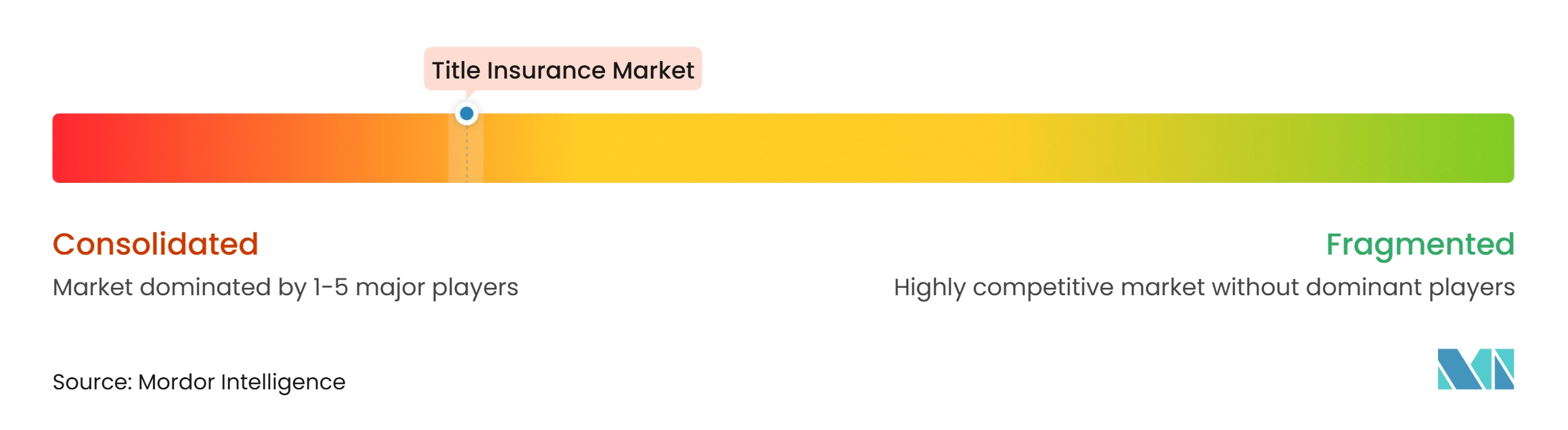
The Title Insurance Market is consolidated at the underwriter level, with a small group of major providers dominating policy issuance, while the agency and distribution layer remains fragmented. Leading companies, including First American Financial Corporation, Fidelity National Financial, Old Republic International, Chicago Title, and Stewart Information Services, benefit from extensive agent networks, established lender relationships, national coverage, and strong operational capabilities. Smaller underwriters and independent agencies compete through specialized services, responsive agent support, local market expertise, and technology partnerships.
Technology investment is increasingly shaping competitive positioning as insurers seek to streamline title searches, accelerate closings, and strengthen fraud prevention. First American introduced AgentNet Assist: Title Intelligence in April 2026 to support title package analysis, while Westcor participated in Fannie Mae’s Title Acceptance Pilot alongside X1 Analytics and Mortgage Connect. Fidelity National Financial has also invested in digital transaction and identity verification capabilities. These initiatives reflect growing demand for more efficient closing workflows, improved data accuracy, and stronger controls against property and mortgage fraud.
Acquisitions are further consolidating service capabilities and expanding geographic reach across the title insurance and closing ecosystem. Stewart Information Services expanded its operations through acquisitions involving Radiken Title, ProTitleUSA, and DocSolutionsUSA in 2026, while Opendoor acquired Doma’s closing and escrow operations in March 2026, subject to regulatory approval. These developments demonstrate that competitive differentiation extends beyond underwriting to encompass escrow management, settlement services, digital closing infrastructure, and fraud prevention. Opportunities also exist in protecting mortgage-free properties and providing specialized title coverage for infrastructure assets, although providers must continue to address regulatory requirements and evolving transaction risks.
Title Insurance Industry Leaders
-
First American Title Insurance Company
-
Fidelity National Title Insurance Company
-
Old Republic National Title Insurance Company
-
Chicago Title Insurance Company
-
Stewart Title Guaranty Company
- *Disclaimer: Major Players sorted in no particular order
Title Insurance Market Companies Covered in this Report
- First American Title Insurance Company
- Fidelity National Title Insurance Company
- Chicago Title Insurance Company
- Commonwealth Land Title Insurance Company
- Old Republic National Title Insurance Company
- Stewart Title Guaranty Company
- Westcor Land Title Insurance Company
- Title Resources Guaranty Company
- WFG National Title Insurance Company
- National Investors Title Insurance Company
- CATIC
- Alliant National Title Insurance Company
- Advocus National Title Insurance Company
- Doma Title Insurance, Inc.
- AXA XL — international and specialty title insurance
Recent Industry Developments in Title Insurance Market
- October 2026: DUAL expanded its title and legal indemnity capacity for Asia-Pacific, Europe, and Latin America. DUAL secured a new binder backed by an AXA XL-led panel that provided up to GBP 320 million (USD 411 million) per single real estate risk, enabling complex cross-border and M&A title cover across 3 growth geographies.
- October 2026: Stewart acquired Radiken Title, ProTitleUSA, and DocSolutionsUSA. Radiken Title strengthened Stewart's Dallas-Fort Worth position. ProTitleUSA and DocSolutionsUSA expanded its capital markets and institutional investor title services, growing that business unit by 20% within the quarter.
- April 2026: First American Title launched AgentNet Assist: Title Intelligence. The capability used AI-assisted title search package analysis to accelerate examiner decision-making. It built on quality control tools that expanded Agency division processing capacity sixfold.
Global Title Insurance Market Report Scope
Segmentation Overview
| Owner’s Title Insurance |
| Lender’s Title Insurance |
| Residential Properties |
| Commercial Properties |
| Direct Operations |
| Independent and Affiliated Title Agents |
| Property Owners and Buyers |
| Mortgage Lenders and Other Secured Creditors |
| Property Purchase Transactions |
| Mortgage Refinance Transactions |
| Other Insurable Title Transactions |
| North America | United States |
| Canada | |
| Mexico | |
| South America | Brazil |
| Argentina | |
| Rest of South America | |
| Europe | United Kingdom |
| Germany | |
| France | |
| Italy | |
| Spain | |
| Rest of Europe | |
| Asia-Pacific | China |
| Japan | |
| India | |
| South Korea | |
| Australia | |
| Indonesia | |
| Thailand | |
| Malaysia | |
| Singapore | |
| Vietnam | |
| Rest of Asia-Pacific | |
| Middle East and Africa | Saudi Arabia |
| United Arab Emirates | |
| Turkey | |
| South Africa | |
| Egypt | |
| Rest of Middle East and Africa |
| By Policy Type | Owner’s Title Insurance | |
| Lender’s Title Insurance | ||
| By Property Type | Residential Properties | |
| Commercial Properties | ||
| By Distribution Channel | Direct Operations | |
| Independent and Affiliated Title Agents | ||
| By End User / Insured Party | Property Owners and Buyers | |
| Mortgage Lenders and Other Secured Creditors | ||
| By Transaction Type | Property Purchase Transactions | |
| Mortgage Refinance Transactions | ||
| Other Insurable Title Transactions | ||
| By Geography | North America | United States |
| Canada | ||
| Mexico | ||
| South America | Brazil | |
| Argentina | ||
| Rest of South America | ||
| Europe | United Kingdom | |
| Germany | ||
| France | ||
| Italy | ||
| Spain | ||
| Rest of Europe | ||
| Asia-Pacific | China | |
| Japan | ||
| India | ||
| South Korea | ||
| Australia | ||
| Indonesia | ||
| Thailand | ||
| Malaysia | ||
| Singapore | ||
| Vietnam | ||
| Rest of Asia-Pacific | ||
| Middle East and Africa | Saudi Arabia | |
| United Arab Emirates | ||
| Turkey | ||
| South Africa | ||
| Egypt | ||
| Rest of Middle East and Africa | ||
Key Questions Answered in the Report
What is the projected size of the title insurance sector by 2032?
The Title Insurance Market is projected to reach USD 29.2 billion by 2032, expanding at a 4.5% CAGR from 2027.
Which policy type holds the largest share?
Lender’s title insurance held 59.8% share in 2026 because it is commonly required for mortgage-backed transactions.
Why is owner’s title insurance growing?
Owner’s coverage is projected to grow at a 5.5% CAGR through 2032 as deed fraud and seller impersonation risks raise buyer awareness.
Which property type is growing fastest?
Commercial properties are projected to grow at a 5.5% CAGR through 2032, supported by data center, industrial, energy, and infrastructure transactions.
Which region has the largest share?
North America held 85.3% share in 2026, supported by lender requirements and a mature secondary mortgage system.
What is driving adoption in Asia-Pacific?
Asia-Pacific is projected to grow at a 7.8% CAGR through 2032 as formal mortgage lending, digital records, and institutional real estate activity develop.