
Tire Derived Fuel Market Size and Share
Market Overview
| Study Period | 2022 - 2032 |
|---|---|
| Market Size (2027) | USD 398.83 Million |
| Market Size (2032) | USD 486.34 Million |
| Growth Rate (2027 - 2032) | 4.05 % |
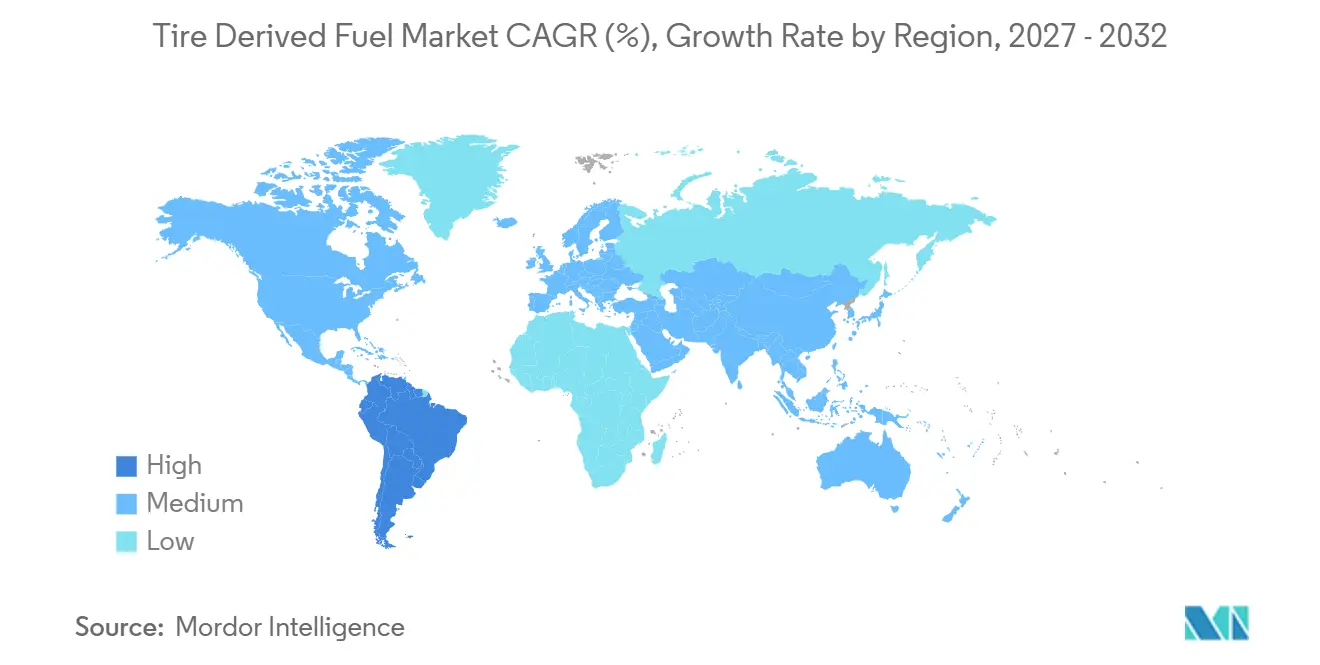
| Fastest Growing Market | South America |
| Largest Market | Asia-Pacific |
| Market Concentration | Medium |
Major Players *Disclaimer: Major Players sorted in no particular order Image © Mordor Intelligence. Reuse requires attribution under CC BY 4.0. | |
Tire Derived Fuel Market Analysis by Mordor Intelligence
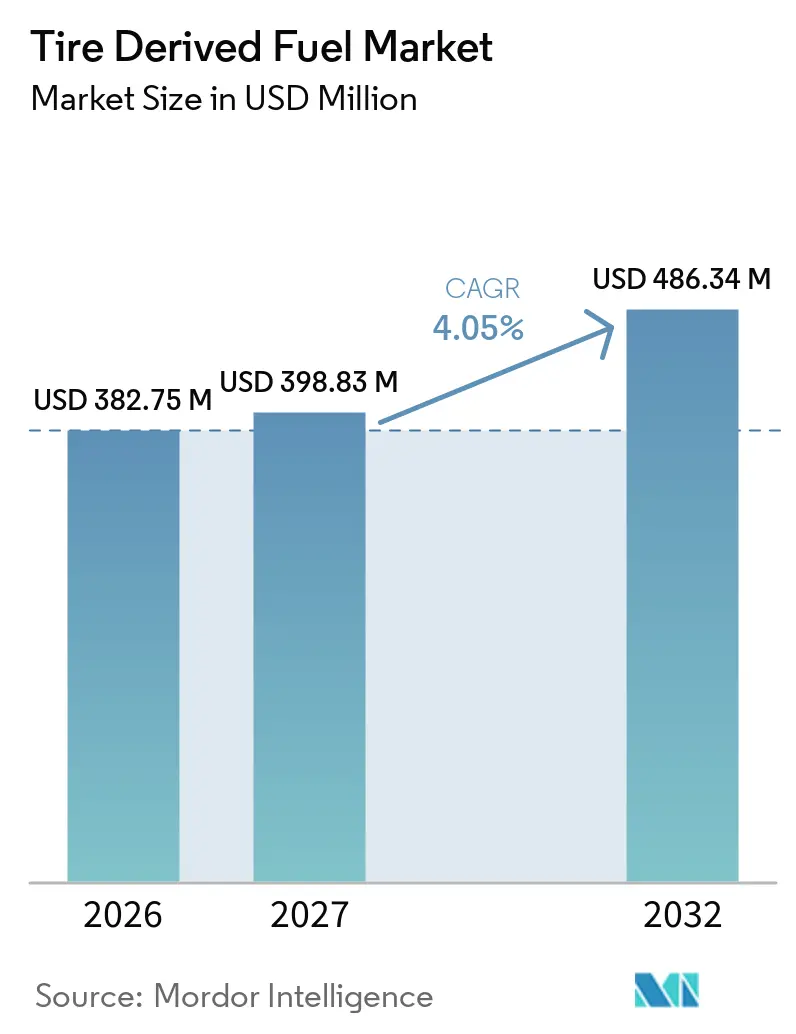
The Tire Derived Fuel Market size is projected to expand from USD 382.75 million in 2026 and USD 398.83 million in 2027 to USD 486.34 million by 2032, registering a CAGR of 4.05% between 2027 and 2032. The tire derived fuel market centers on industrial users that can use end-of-life tires as a controlled fuel input rather than a disposal burden. Cement producers remain important because high-temperature kilns can use the fuel while incorporating tire steel into clinkers. The tire derived fuel market also depends on collection systems that bring discarded tires from fleets, retailers, and legacy tire piles into formal processing routes. Cross-border flows are becoming more important where industrial buyers need fuel that meets defined size, moisture, and heat-value requirements. Competition is increasing among collectors and processors as companies seek scale, secure feedstock, and longer-term supply arrangements with industrial buyers.
Key Report Takeaways
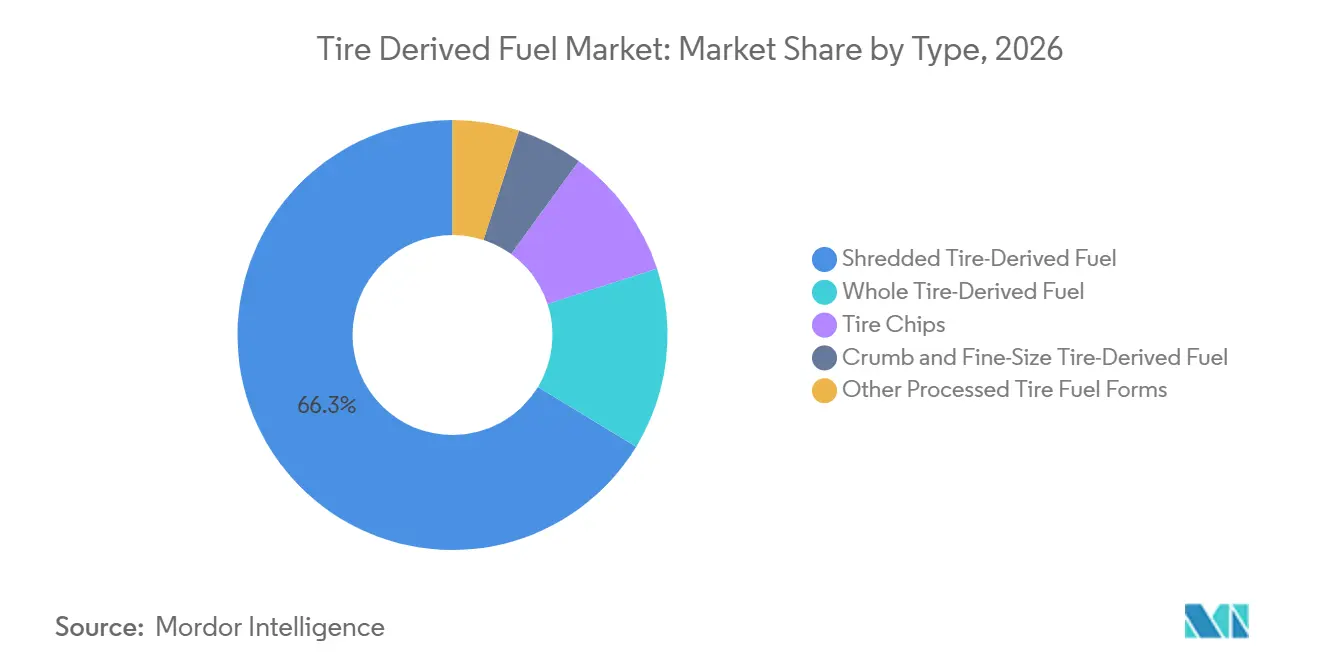
- By type, shredded tire-derived fuel held 66.3% of the tire derived fuel market share in 2026, while whole tire-derived fuel is forecast to grow at a 4.2% CAGR through 2032.
- By tire source, passenger cars and light motor vehicles held 53.7% of the market in 2026, while off-the-road vehicles and equipment are forecast to grow at a 4.7% CAGR through 2032.
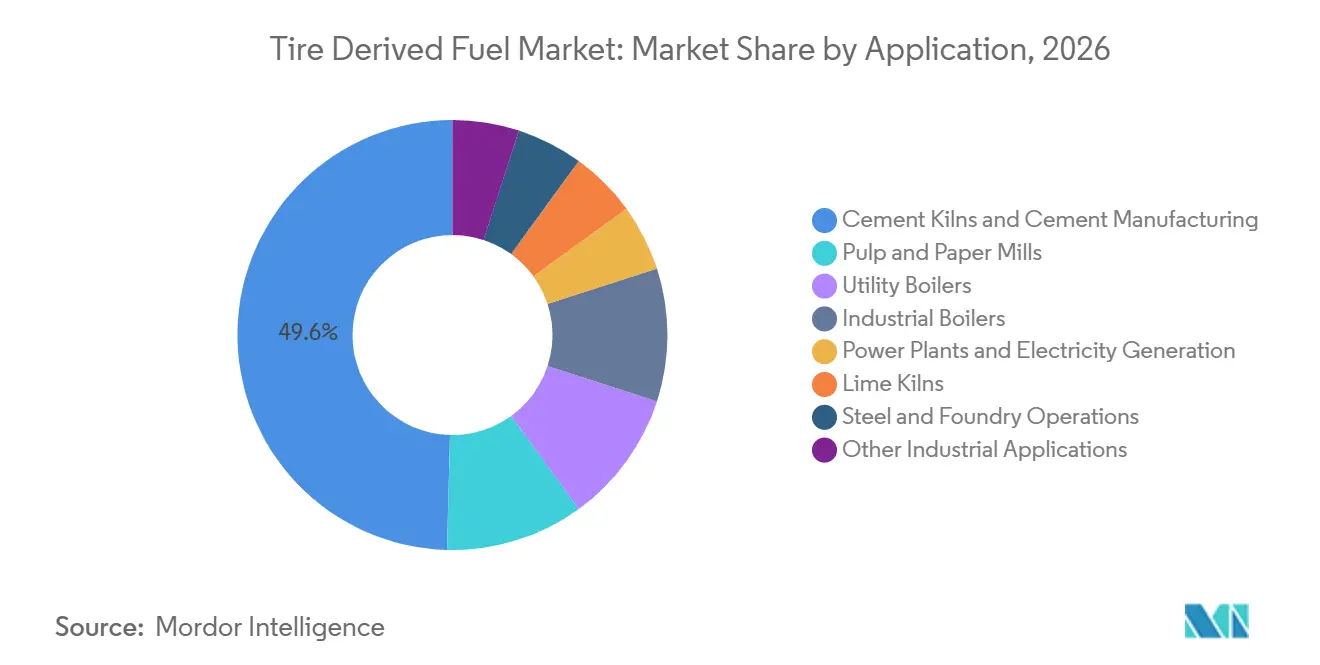
- By application, cement kilns and cement manufacturing accounted for 49.6% of the tire derived fuel market size in 2026 and are forecast to expand at a 4.3% CAGR through 2032.
- By geography, Asia-Pacific held 39.2% of the market in 2026, while South America is forecast to grow at a 4.4% CAGR through 2032.
Note: Market numbers in this report are based on Mordor Intelligence's proprietary estimation framework, which combines nine months of actuals with Q4 projections for base year 2026.
Market Trends and Insights
Drivers Impact Analysis of Tire Derived Fuel Market*
| Driver | (~) % Impact on CAGR Forecast | Geographic Relevance | Impact Timeline |
|---|---|---|---|
| Rising Cement-Kiln Fuel Substitution | +1.4% | Global, with concentrated gains in Asia-Pacific and Latin America | Medium term (2-4 years) |
| Landfill Diversion and End-of-Life Tire Recovery Mandates | +0.9% | North America, Europe, and expanding Asia-Pacific emerging economies | Short term (≤ 2 years) |
| Industrial Decarbonization and Alternative-Fuel Procurement | +0.7% | Global, with early adoption in Europe, Japan, and Brazil | Medium term (2-4 years) |
| Feedstock Availability from Expanding Vehicle Fleets | +0.5% | Asia-Pacific, South America, Middle East and Africa | Long term (≥ 4 years) |
| Access to Abandoned Tire Pile Cleanups | +0.3% | North America, South America, and Middle East and Africa | Short term (≤ 2 years) |
| Specification-Matched Fuel for Cross-Border Offtake | +0.3% | Asia-Pacific import corridors and cross-continental trade routes | Medium term (2-4 years) |
| Source: Mordor Intelligence | |||
Rising Cement-Kiln Fuel Substitution
Cement kilns are a major outlet because their high operating temperatures can support complete combustion of processed tire fuel. A 2025 study of a cement plant in Togo found that shredded material fed at 3.68 to 4.15 tons per hour increased kiln productivity by an average of 54.9 tons per hour. The same study reported an average productivity decline of 59.4 tons per hour under whole-tire operating conditions, showing the importance of feed preparation. Tire steel can also enter the clinker-making process, which reduces the ash-handling issue found in lower-temperature applications. These operating conditions support investment in shredding, storage, and controlled feeding systems at cement sites. The tire derived fuel market therefore benefits where new or upgraded kilns are designed to handle alternative fuels from the start.[1]
Landfill Diversion and End-of-Life Tire Recovery Mandates
Landfill restrictions and recovery requirements can convert unmanaged tire volumes into material available for processing. Ontario amended its tire collection rules in January 2025 and set a 65% management target for 2025 through 2029, followed by a 70% target from 2030. The amendment also expanded provisions for collection sites in rural communities. These requirements improve the tire derived fuel market by directing tires from collection points to authorized management routes. In Alabama, a whole-tire landfill ban supported Liberty Tire Recycling’s decision to open 2 facilities that together can process more than 4 million tires each year. The policy environment can therefore support processing capacity, particularly where collection obligations are paired with clear routes for industrial use.[2]
Industrial Decarbonization and Alternative-Fuel Procurement
Industrial buyers are examining alternative fuels as part of their fuel procurement and emissions programs. Natural rubber represents 20% to 25% of a tire’s composition, which can affect the treatment of its carbon content in some greenhouse gas accounting frameworks. This feature gives buyers a reason to assess tire-derived fuel alongside conventional fossil fuels. The 2025 Togo study also noted lower nitrogen and sulfur oxide emissions for tire-derived fuel than for petroleum coke under the studied combustion conditions. The practical result is growing attention to fuel quality, calorific value, and emissions controls rather than price alone. In the tire-derived fuel market, these factors support direct supply relationships between processors and industrial users that need a reliable fuel specification.
Feedstock Availability from Expanding Vehicle Fleets
Vehicle sales create a future stream of tires that will eventually require collection and treatment. Global vehicle production reached 92.5 million units in 2024, according to data cited in a 2025 scientific publication. A typical replacement cycle of 4 years or 50,000 km means a portion of that installed tire base will move into the end-of-life stream over time. Japan reported 90 million end-of-life tires in 2025 and a 99.6% effective utilization rate. It also imported 206,600 tons of cut and shredded tires, indicating that established energy-recovery facilities may need imported material when domestic supply does not meet their requirements. These conditions make collection reach and dependable sorting important for operators seeking to serve the tire derived fuel market.
Restraints Impact Analysis of Tire Derived Fuel Market*
| Restraint | (~) % Impact on CAGR Forecast | Geographic Relevance | Impact Timeline |
|---|---|---|---|
| Site-Specific Permitting and Emissions Compliance | -0.5% | North America, Europe, and Asia-Pacific markets with evolving frameworks | Medium term (2-4 years) |
| Freight, Storage, and Delivered-Cost Volatility | -0.4% | Global, with higher sensitivity in landlocked markets and smaller economies | Short term (≤ 2 years) |
| Competition from Material Recovery and Pyrolysis | -0.6% | Europe, North America, and East Asia | Long term (≥ 4 years) |
| Inconsistent Classification of Fuel as Waste or Fuel | -0.4% | Cross-border trade corridors, Asia-Pacific, and Middle East and Africa | Medium term (2-4 years) |
| Source: Mordor Intelligence | |||
Site-Specific Permitting and Emissions Compliance
Permitting remains a constraint because approval requirements can differ by facility, fuel use, and jurisdiction. Industry data identifies approval periods of 18 to 36 months in regulated markets, which can delay capacity additions and increase capital exposure. Cement kilns can manage tire steel within clinker, but stand-alone combustion applications can face closer monitoring of zinc and particulate emissions. Operators may also need separate approvals because tire-derived fuel is treated differently from biomass or other alternative fuels. This creates a cost and timing burden for smaller processors and new users. The tire-derived fuel market can therefore expand more readily where environmental rules define a clear permitting path for collection, processing, transport, and end use.
Competition from Material Recovery and Pyrolysis
Pyrolysis and material-recovery routes compete with direct combustion for the same end-of-life tire supply. These routes may be attractive where recovered carbon black and tire-derived oil command stronger value than direct fuel use. Competition is most relevant where collection systems have limited volumes or where processors secure long-term supply contracts. It can reduce the material available to cement kilns, paper mills, and boiler users even when their demand remains steady. The effect is primarily a feedstock issue because processors cannot expand direct fuel output without sufficient tire collection. The tire derived fuel market must therefore compete with collection access, processing reliability, and the ability to meet industrial fuel specifications.
*Our forecasts treat driver/restraint impacts as directional, not additive. The impact forecasts reflect baseline growth, mix effects, and variable interactions.
Tire Derived Fuel Market Segment Analysis
By Type:
Shredded Material Leads, While Whole Tires Grow FasterShredded tire-derived fuel held 66.3% of the tire derived fuel market in 2026. Its leadership in the tire derived fuel market reflects the operational requirements of industrial combustion systems, which need controlled particle size and a more predictable heat release profile. The 2025 cement-plant study in Togo reported higher productivity when shredded fuel was used at feed rates between 3.68 and 4.15 metric tons per hour. The study’s results indicate that preparation of the tire material affects kiln performance as much as the calorific value of the underlying rubber. Modern pneumatic feeding systems are generally designed around consistent material dimensions. This gives established shredding operations an advantage with cement and paper users that need reliable flow through handling equipment. Tire chips continue to serve industrial and utility applications that require smaller particle configurations. Crumb and fine-size materials also face demand from nonfuel uses, including rubber surfacing and asphalt, which can limit the quantities available for combustion. Other processed formats remain relevant when buyers require custom sizes or pretreatment for a specific facility.[3]
Whole tire-derived fuel is forecast to grow at a 4.2% CAGR from 2027 to 2032. This format can reduce processing steps for operators handling large tire volumes, particularly when local shredding capacity is limited. It may be suitable for facilities that can safely manage whole tires within their feeding systems. The format also has relevance in tire-pile cleanup programs where moving material quickly is a priority. Liberty Tire Recycling opened 2 facilities in Alabama in November 2025 after the state’s whole-tire landfill ban, with the sites able to process more than 4 million tires annually. The development illustrates how regulatory changes can create demand for regional processing capacity. Whole tires do not displace shredded material in applications that require strict particle consistency. Instead, the 2 formats serve different handling conditions and capital structures. The tire derived fuel industry remains dependent on matching the processing level to the end user’s equipment and operating controls

By Tire Source:
Passenger Vehicles Provide Volume, While OTR Tires Add MassPassenger cars and light motor vehicles accounted for 53.7% of feedstock in 2026. Their large installed base makes them the most regular source entering the tire derived fuel market through formal collection systems. Mature recovery programs in North America, Europe, and Northeast Asia support this volume by linking tire retailers, collectors, processors, and end users. Japan recovered 708 kilotons of tire material in 2025 across paper mills, cement plants, chemical facilities, and crumb-rubber producers. The country also reported a 99.6% effective utilization rate for end-of-life tires. Its use of several recovery routes shows how broad collection systems can keep material in managed channels. Heavy-duty vehicles and buses add steady volumes linked to freight activity, although their share is below that of passenger vehicles. Motorcycles and two-wheelers contribute to smaller volumes because each tire contains less rubber mass. A stable passenger-car stream gives processors the regular feedstock needed to serve contracted industrial buyers.[4]
Off-the-road vehicles and equipment are forecast to grow at 4.7% CAGR from 2027 to 2032. These tires are valuable because individual units can weigh 500 to 1,000 kg, allowing a small number of tires to produce a large quantity of material. Mining, quarrying, and infrastructure projects increase the relevance of this source in Southeast Asia, South America, and Australia. Collection is more concentrated than it is for passenger tires because equipment owners and operating sites are identifiable. That can simplify sourcing where processors have relationships with mines, contractors, or equipment operators. OTR tires may require specialized handling and cutting because of their scale and construction. Aircraft tires and other specialty sources represent smaller but stable streams for processors that serve tailored combustion applications. The tire derived fuel market can benefit from these sources where processing systems are equipped for large-format tire preparation. Their contribution complemented passenger-car volumes rather than replacing them.
By Application:
Cement Kilns Combine Scale with the Highest Growth RateCement kilns and cement manufacturing accounted for 49.6% of the tire derived fuel market size in 2026 and are forecast to expand at a 4.3% CAGR through 2032. This is the only reported segmentation where the largest use and fastest-growing use are the same. Kilns operate at temperatures above 1,400°C, allowing them to use processed tire fuel in a controlled setting. The tire’s steel content can also be incorporated into clinker, which distinguishes cement use from applications that must manage ash separately. The 2025 Togo study linked shredded tire fuel with improved kiln productivity under the tested operating conditions. These characteristics make cement plants a natural outlet for processors that can provide a consistent size and feed rate. They also make industrial offtake agreements valuable because plants require dependable fuel supply and defined quality. The tire derived fuel industry has a strong connection to cement investment because new kilns can include alternative-fuel systems during development. The result is a relationship between plant design, local collection capacity, and processor investment.
Pulp and paper mills are the second-largest application in the supplied draft. These users value the consistent heat output that supports extended boiler operation and predictable fuel handling. Utility and industrial boilers are also demand outlets where local coal and gas prices support substitution. Their use can be limited by emissions monitoring requirements, particularly for zinc and particulates. Power plants face more direct scrutiny than cement facilities because they do not have the same clinker process to incorporate tire steel. Lime kilns and steel cupola furnaces use the fuel’s calorific density in calcination and iron-reduction activities. The application mix broadens the customer base beyond cement. It also reduces reliance on a single sector, although cement remains the main demand anchor. Within The tire derived fuel market, processors need to adjust size, storage, and delivery practices to meet the operating requirements of each industrial application.
Geography Analysis
Asia-Pacific held 39.2% of the global Tire derived fuel market share in 2026. The region combines large end-of-life tire volumes, substantial cement manufacturing capacity, and established trade routes for processed tires. Japan directed 62 kilotons of end-of-life tires to cement plants in 2025. It also imported 206,600 tons of cut and shredded tires for energy-recovery facilities, marking a third consecutive annual high. The data indicates that large industrial users may source material internationally when domestic collection does not fully meet volume or specification needs. South Korea recorded 121,486 tons of end-of-life tires at cement kilns in 2025. It also exported 33,200 tons to regional markets, which shows its role as both a processor and a supplier. India is another important destination for baled and size-reduced tire material. California’s 2025 data identified growing demand from India, indicating a larger role for cross-border flows into the region.
South America is forecast to grow at a 4.4% CAGR from 2027 to 2032. Tire derived fuel market expansion in the region is linked to cement investment and more structured co-processing programs. Brazil’s cement sector achieved a 32% alternative-fuel co-processing rate in 2025, according to the supplied draft. That progress points to a growing ability to use alternative fuels at industrial sites. The geographic opportunity extends beyond Brazil as collection and co-processing initiatives emerge in several countries. The key requirement is a system that connects municipal tire collection, authorized processing, and cement-kiln demand. This approach can reduce the need for disposal while creating a local fuel outlet. In The tire derived fuel market, growth in South America depends on the pace of cement capacity development and the continuity of collection programs.
North America is a mature region with established tire collection and processing systems. Liberty Tire Recycling’s 2026 acquisitions of All American Tire, Colt Tire Recycling, and Genan’s United States operations expanded its Gulf Coast network across Texas and Louisiana. Europe presents a more mixed outlook because high thermal substitution supports existing demand in some countries, while Spain is setting a progressively lower ceiling on energy recovery. Royal Decree 712/2025 limits energy recovery, including tire-derived fuel combustion, to 35% by weight in 2025 and 20% by 2035. In the Middle East and Africa, formal recovery systems are less developed in some locations, but future feedstock potential is significant. A 2025 scientific study estimated that Nigeria generates 646,000 tons of end-of-life tires annually, while the West African vehicle fleet grows at 7% a year. The tire derived fuel market opportunity in these areas is tied to formal collection, suitable processing equipment, and industrial demand that can absorb the resulting fuel.
Competitive Landscape
The tire derived fuel market is moderately fragmented across collection and processing, although consolidation is increasing in North America. Large operators have an advantage when they can combine collection coverage, processing capacity, and dependable delivery to industrial users. Liberty Tire Recycling acquired All American Tire, Colt Tire Recycling, and Genan’s United States operations in July 2026. The acquisitions expanded its footprint across Texas and Louisiana and created a larger Gulf Coast network. Liberty Tire Recycling reported that it collected 219 million tires in 2025 and placed 81% of the material into reuse markets. These figures show the scale needed to manage collection, sorting, processing, and customer delivery across several end uses. The company’s July 2026 transaction also reflected a strategy of regional densification, where collection routes and processing sites can be coordinated. I Squared Capital’s acquisition of Liberty Tire Recycling closed in December 2025, with stated plans for automation, technology upgrades, and further strategic acquisitions. The competitive focus is therefore moving toward operating scale and consistent delivery rather than simple access to tire volumes.
Long-term offtake relationships matter because cement plants, paper mills, and industrial boiler users need consistent fuel characteristics. Processors that can certify particle size, moisture, and calorific value can better serve buyers whose systems have narrow operating tolerances. Japan’s continued imports of cut and shredded tires show that industrial users may seek international supply when domestic material does not meet their needs. This creates a role for processors that combine quality control with cross-border logistics. Smaller regional companies can remain important because local collection density is difficult to duplicate quickly. Their value often lies in retailer networks, transport routes, permits, and established local relationships. Larger companies may seek acquisitions rather than build these assets from scratch. The tire derived fuel market is therefore shaped by a mix of national-scale processors and regional collection specialists.
Competition also comes from material-recovery and pyrolysis pathways that seek the same tire supply. These alternatives can draw feedstock away from direct combustion where recovered products receive stronger prices or policy support. This pressure is most acute in regions with fixed collection volumes and growing investment in other recovery routes. Direct fuel producers respond by strengthening supply agreements, improving processing reliability, and locating facilities close to both tire sources and industrial users. Clear environmental compliance and documented fuel quality can also help processors retain industrial customers. Liberty Tire Recycling’s Alabama expansion is an example of a regional response to a policy change that increased the need for authorized processing. The company opened 2 sites designed to process more than 4 million tires annually for cement kilns and pulp mills. This move combines collection, processing, and end-use access in a single regional model. The tire derived fuel industry is likely to remain moderately concentrated where a small number of large operators have broad collection networks, but regional specialists will continue to matter where local access determines feedstock supply.
Tire Derived Fuel Industry Leaders
-
Liberty Tire Recycling LLC
-
ResourceCo Pty Ltd
-
Genan A/S
-
Lakin Tire
-
Tyrecycle Pty Ltd
- *Disclaimer: Major Players sorted in no particular order

Tire Derived Fuel Market Companies Covered in this Report
- Champlin Tire Recycling, Inc.
- Ecore International
- Emanuel Tire, LLC
- Entech, Inc.
- Genan A/S
- Globarket Tire Recycling, LLC
- Golden Bear Recycling, LLC
- Klean Industries Inc.
- L&S Tire Company
- Lakin Tire
- Liberty Tire Recycling, LLC
- Mahantango Enterprises
- Reliable Tire Disposal
- Renelux Cyprus Ltd.
- ResourceCo Pty Ltd
- Rumpke Consolidated Companies, Inc.
- Scandinavian Enviro Systems AB
- Tire Disposal & Recycling, Inc.
- Tyrecycle Pty Ltd
- Zhengzhou GEP Ecotech Co., Ltd.
Recent Industry Developments in Tire Derived Fuel Market
- July 2026: Liberty Tire Recycling acquires All American Tire, Colt Tire Recycling, and Genan's US operations: The triple Gulf Coast acquisition creates North America's most comprehensive regional tire recycling network, expanding end-of-life tire (ELT) collections, rubber recycling capacity, and Tire derived fuel (TDF) production infrastructure across Texas and Louisiana to serve growing industrial demand.
- December 2025: Liberty Tire Recycling commits USD 1.4 million equipment upgrade at Cameron, North Carolina: Enabled by SB 706's reinvestment of tire disposal fees, the upgrade adds 3,300 tons of annual processing capacity and expands truck tire handling for crumb rubber and TDF production.
- November 2025: Liberty Tire Recycling opens two new TDF-producing facilities in Alabama: Triggered by Alabama's whole-tire landfill ban, the facilities process over 4 million tires annually, producing TDF for regional cement kilns and pulp mills and creating up to 60 jobs.
- October 2025: Squared Capital signs agreement to acquire Liberty Tire Recycling from Energy Capital Partners, closed
Global Tire Derived Fuel Market Report Scope
Tire-Derived Fuel (TDF) is a supplemental fuel source made from shredded scrap tires co-fired with traditional fuels such as coal, wood, or biomass in industrial kilns and boilers. It is a form of waste-to-energy recovery, transforming discarded tires that would otherwise occupy landfill space into a high-Btu energy source.
The tire derived fuel market is segmented into type, tire source, application, and geography. By type, the market is segmented into whole tire-derived fuel, shredded tire-derived fuel, tire chips, crumb and fine-size tire-derived fuel, and other processed tire fuel forms. By tire source, the market is segmented into passenger cars and light motor vehicles, heavy-duty vehicles, trucks and buses, off-the-road (OTR) vehicles and equipment, motorcycles and two-wheelers, aircraft tires, and other tire sources. By application, the market is divided into cement kilns and cement manufacturing, pulp and paper mills, utility boilers, industrial boilers, power plants and electricity generation, lime kilns, steel and foundry operations, and other industrial applications. The report also covers the market size and forecasts for the global tire derived fuel market across 26 countries in key regions. For each segment, the market sizing and forecasts have been provided on the basis of value (USD).
Segmentation Overview
| Whole Tire-Derived Fuel |
| Shredded Tire-Derived Fuel |
| Tire Chips |
| Crumb and Fine-Size Tire-Derived Fuel |
| Other Processed Tire Fuel Forms |
| Passenger Cars and Light Motor Vehicles |
| Heavy-Duty Vehicles, Trucks and Buses |
| Off-the-Road (OTR) Vehicles and Equipment |
| Motorcycles and Two-Wheelers |
| Aircraft Tires |
| Other Tire Sources |
| Cement Kilns and Cement Manufacturing |
| Pulp and Paper Mills |
| Utility Boilers |
| Industrial Boilers |
| Power Plants and Electricity Generation |
| Lime Kilns |
| Steel and Foundry Operations |
| Other Industrial Applications |
| North America | United States |
| Canada | |
| Mexico | |
| Europe | Germany |
| France | |
| Italy | |
| Spain | |
| United Kingdom | |
| Poland | |
| Russia | |
| Rest of Europe | |
| Asia-Pacific | China |
| India | |
| Japan | |
| South Korea | |
| Australia | |
| Indonesia | |
| Vietnam | |
| Thailand | |
| Rest of Asia-Pacific | |
| South America | Brazil |
| Argentina | |
| Chile | |
| Rest of South America | |
| Middle East and Africa | Saudi Arabia |
| United Arab Emirates | |
| Egypt | |
| South Africa | |
| Morocco | |
| Rest of Middle East and Africa |
| By Type | Whole Tire-Derived Fuel | |
| Shredded Tire-Derived Fuel | ||
| Tire Chips | ||
| Crumb and Fine-Size Tire-Derived Fuel | ||
| Other Processed Tire Fuel Forms | ||
| By Tire Source | Passenger Cars and Light Motor Vehicles | |
| Heavy-Duty Vehicles, Trucks and Buses | ||
| Off-the-Road (OTR) Vehicles and Equipment | ||
| Motorcycles and Two-Wheelers | ||
| Aircraft Tires | ||
| Other Tire Sources | ||
| By Application | Cement Kilns and Cement Manufacturing | |
| Pulp and Paper Mills | ||
| Utility Boilers | ||
| Industrial Boilers | ||
| Power Plants and Electricity Generation | ||
| Lime Kilns | ||
| Steel and Foundry Operations | ||
| Other Industrial Applications | ||
| By Geography | North America | United States |
| Canada | ||
| Mexico | ||
| Europe | Germany | |
| France | ||
| Italy | ||
| Spain | ||
| United Kingdom | ||
| Poland | ||
| Russia | ||
| Rest of Europe | ||
| Asia-Pacific | China | |
| India | ||
| Japan | ||
| South Korea | ||
| Australia | ||
| Indonesia | ||
| Vietnam | ||
| Thailand | ||
| Rest of Asia-Pacific | ||
| South America | Brazil | |
| Argentina | ||
| Chile | ||
| Rest of South America | ||
| Middle East and Africa | Saudi Arabia | |
| United Arab Emirates | ||
| Egypt | ||
| South Africa | ||
| Morocco | ||
| Rest of Middle East and Africa | ||
Key Questions Answered in the Report
What is driving demand for tire-derived fuel?
The Tire derived fuel market is supported by cement-kiln use, formal end-of-life tire collection, and industrial buyers seeking a consistent alternative fuel.
How large is the tire-derived fuel sector?
It is projected to grow from USD 398.83 million in 2027 to USD 486.34 million by 2032 at a 4.05% CAGR.
Which tire-derived fuel format leads demand?
Shredded tire-derived fuel led with 66.3% share in 2026 because industrial systems need controlled particle size and consistent fuel handling.
Why are cement kilns important users of tire-derived fuel?
Cement kilns accounted for 49.6% of consumption in 2026 and are forecast to grow at a 4.3% CAGR through 2032.
Which region is growing fastest for tire-derived fuel?
South America is forecast to grow at a 4.4% CAGR through 2032, supported by cement investment and formalized co-processing programs.
What restricts tire-derived fuel adoption?
Site-specific permits, emissions compliance, freight costs, and competition for end-of-life tire feedstock can limit growth.