
Timber Laminating Adhesives Market Size and Share
Market Overview
| Study Period | 2022 - 2032 |
|---|---|
| Market Size (2027) | USD 1.31 Billion |
| Market Size (2032) | USD 1.78 Billion |
| Growth Rate (2027 - 2032) | 6.25 % |
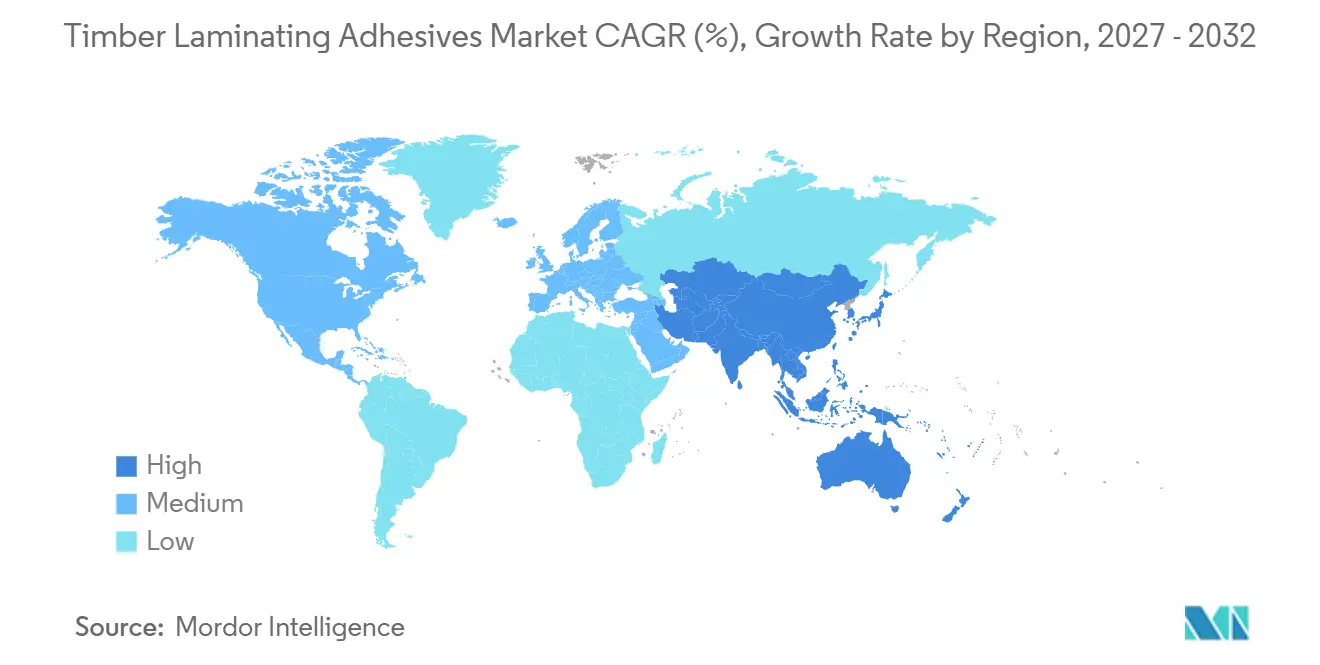
| Fastest Growing Market | Asia-Pacific |
| Largest Market | North America |
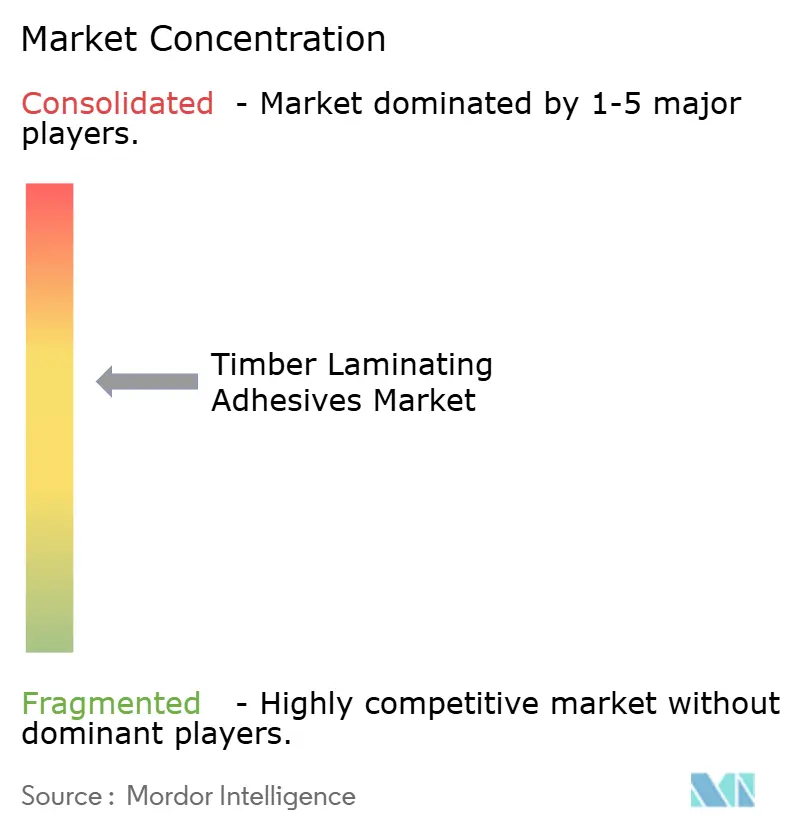
| Market Concentration | Medium |
Major Players *Disclaimer: Major Players sorted in no particular order Image © Mordor Intelligence. Reuse requires attribution under CC BY 4.0. | |
Timber Laminating Adhesives Market Analysis by Mordor Intelligence
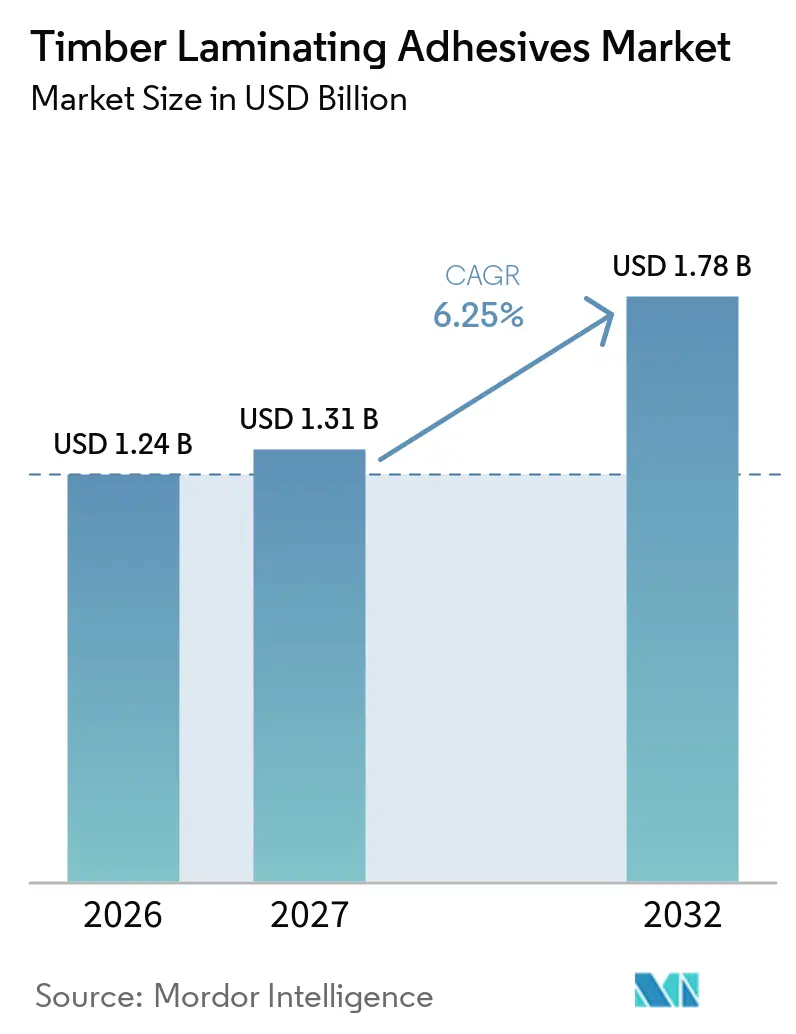
The Timber Laminating Adhesives Market size was valued at USD 1.24 billion in 2026 and is estimated to grow from USD 1.31 billion in 2027 to reach USD 1.78 billion by 2032, at a CAGR of 6.25% during the forecast period (2027-2032). Structural bonding systems have become more important as engineered wood construction faces tighter building, fire-safety, and emissions requirements. Mass timber construction is expanding the addressable demand base, particularly in North America and Europe, while building-code guidance is making approvals more accessible in additional jurisdictions. Low-emission and no-added-formaldehyde formulations are gaining importance as formaldehyde rules and customer specifications become more demanding. Suppliers are responding with fire-tested, automated-line-compatible, and bio-based products, which shift competition from standard resin supply toward certified performance and technical support. Feedstock volatility remains a material constraint because isocyanate, formaldehyde, phenolic, and petrochemical costs can compress margins when customer contracts do not provide complete price escalation.
Key Report Takeaways
- By resin type, melamine formaldehyde held 54.12% of the timber laminating adhesives market share in 2026, while polyurethane is forecast to advance at a 6.89% CAGR through 2032.
- By application, floor beams held 31.54% of the timber laminating adhesives market share in 2026 and are forecast to advance at a 7.13% CAGR through 2032.
- By end-use industry, residential held 42.37% of the timber laminating adhesives market share in 2026 and is forecast to advance at a 7.45% CAGR through 2032.
- By geography, North America held 33.69% of the timber laminating adhesives market share in 2026, while Asia-Pacific is forecast to advance at a 7.31% CAGR through 2032.
Note: Market numbers in this report are based on Mordor Intelligence's proprietary estimation framework, which combines nine months of actuals with Q4 projections for base year 2026.
Market Trends and Insights
Drivers Impact Analysis of Timber Laminating Adhesives Market*
| Driver | (~) % Impact on CAGR Forecast | Geographic Relevance | Impact Timeline |
|---|---|---|---|
| Growth of Mass Timber and Engineered Wood Construction | +2.1% | North America, Europe, APAC spillover to MEA | Short term (≤ 2 years) |
| Adoption of Adhesive-Bonded CLT, Glulam, and LVL Systems | +1.5% | North America & Europe; selective expansion in APAC | Medium term (2-4 years) |
| Demand for Low-Emission and Formaldehyde-Free Adhesives | +1.1% | North America, Europe (regulatory lead); APAC compliance follow | Medium term (2-4 years) |
| Expansion of Prefabricated and Off-Site Timber Construction | +0.9% | APAC core, spillover to North America & Europe | Medium term (2-4 years) |
| Automation-Compatible Adhesives for High-Throughput Timber Lines | +0.6% | North America & Europe; APAC gaining | Long term (≥ 4 years) |
| Source: Mordor Intelligence | |||
Growth of Mass Timber and Engineered Wood Construction
Mass timber construction is becoming a more prominent source of demand in the timber laminating adhesives market. The timber laminating adhesives market benefits as panelized construction relies on consistent factory-applied bonds. The Softwood Lumber Board reported that mass timber represented 24% of the incremental 438 million board feet of lumber demand generated by its programs in Q2 2025. This demand spans multifamily housing, education, offices, and warehouses, which reduces dependence on one construction category. The American Wood Council’s 2025 guide supports permits in jurisdictions that have not adopted updated International Building Code provisions, widening the development pipeline. ANSI/APA PRG 320-2025 and EN 15425:2023 make bond performance and pressing time central to supplier qualification for this expanding timber construction base.
Demand for Low-Emission and Formaldehyde-Free Adhesives
The U.S. Environmental Protection Agency finalized its Toxic Substances Control Act risk evaluation for formaldehyde in January 2025 and found unreasonable risk to workers[1]. The agency convened a Small Business Advocacy Review Panel in July 2026 ahead of formaldehyde risk-management rulemaking, maintaining pressure on formulation decisions. Canada’s Formaldehyde Emissions from Composite Wood Products Regulations took effect in March 2025 and aligned with the Toxic Substances Control Act Title VI, while adding certification and labeling requirements. Huntsman International LLC introduced I-BOND PB BIO 1025 and I-BOND OSB BIO 1025 at LIGNA 2025. The Huntsman resins contain up to 25% bio-based content, offer up to 30% lower carbon footprint, and contain no added formaldehyde. Established suppliers in the timber laminating adhesives market with No-Added-Formaldehyde (NAF) and Ultra-Low-Emitting Formaldehyde (ULEF) portfolios have an advantage because qualification and third-party certification can take 12 to 18 months.
Expansion of Prefabricated and Off-Site Timber Construction
In the timber laminating adhesives market, prefabricated timber construction moves bonding work from variable job sites to controlled factories, where process conditions and defect rates can be managed more consistently. Forestry Agency incentives and wider cross-laminated timber use in mid-rise buildings support the shift, while Japanese fabricators are marketing exportable prefab systems for Australia’s housing shortage. South Korea’s Green Standard for Energy and Environmental Design (G-SEED) environmental product declaration requirements for public buildings increase the value of certified timber adhesive systems. Procurement becomes concentrated among larger panel manufacturers, raising the importance of preferred-supplier status but improving demand visibility for approved suppliers. H.B. Fuller Company reorganized its Building Adhesive Solutions segment at the start of fiscal 2025 to serve this manufacturing-plant customer base with a more focused offering.
Adoption of Adhesive-Bonded CLT, Glulam, and LVL Systems
Within the timber laminating adhesives market, Cross-Laminated Timber, glued laminated timber, and Laminated Veneer Lumber (LVL) require adhesives that meet structural, fire, and emissions requirements at the same time. ANSI/APA PRG 320-2025 requires CLT adhesives to comply with ANSI 405 in the United States and Canadian Standards Association O112.10 in Canada, including elevated-temperature assessment through the Compartment Fire Test. EN 18070:2025 classifies load-bearing timber adhesives by temperature-resistance class under fire exposure. A 2025 study found that polycondensation adhesives, chiefly melamine formaldehyde and melamine urea formaldehyde, retained near-linear bond strength through 270 °C, while polyaddition adhesives approached near-zero residual strength below that threshold. Henkel AG & Co. KGaA launched the Loctite HB XE Line in February 2025 after testing at ETH Zurich, with a charring rate of 0.65 mm/min that met Eurocode 5 requirements. These specifications give qualified formulators a clearer basis for product differentiation in the timber laminating adhesives market.
Restraints Impact Analysis of Timber Laminating Adhesives Market*
| Restraint | (~) % Impact on CAGR Forecast | Geographic Relevance | Impact Timeline |
|---|---|---|---|
| Volatility in Isocyanate, Formaldehyde, Phenolic, and Petrochemical Feedstock Costs | -1.5% | Global; acute exposure in North America & Europe | Short term (≤ 2 years) |
| Formulation and Certification Costs Under Tightening Emission and Chemical Rules | -1.1% | North America, Europe (regulatory lead); APAC compliance follow | Medium term (2-4 years) |
| Limited Process Windows for Moisture, Temperature, Open Time, and Pressing Conditions | -0.7% | Global; particular intensity in tropical APAC markets | Short to medium term (≤ 4 years) |
| Source: Mordor Intelligence | |||
Volatility in Isocyanate, Formaldehyde, Phenolic, and Petrochemical Feedstock Costs
In the timber laminating adhesives market, isocyanates, formaldehyde, phenol, and resorcinol remain exposed to petrochemical cycles and upstream energy costs. AICA Kogyo announced a price revision effective July 2025 that increased water-based isocyanate adhesive prices by 10% or more and synthetic rubber adhesive prices by 5% or more. Persistent input-cost pressure can limit the adoption of premium structural formulations in price-sensitive emerging markets, including the Association of Southeast Asian Nations (ASEAN) and South Asian timber construction segments. Suppliers with backward-integrated resin supply, including Hexion and Dynea, can have a cost advantage over competitors that rely on spot-market procurement. Many engineered wood adhesive contracts do not provide complete feedstock escalation clauses, which leaves formulators exposed between contract renewals. The issue is most immediate in the timber laminating adhesives market, where manufacturing consistency also depends on narrow moisture, temperature, open-time, and pressing-condition windows, particularly in tropical Asia-Pacific facilities.
Formulation and Certification Costs Under Tightening Emission and Chemical Rules
For the timber laminating adhesives market, Toxic Substances Control Act Title VI, Canada’s 2025 rules, European Commission Regulation (EU) 2023/1464 under Registration, Evaluation, Authorisation and Restriction of Chemicals (REACH), and California Air Resources Board Air Toxic Control Measure 93120 create a cumulative compliance burden. The U.S. Environmental Protection Agency finalized updates in October 2026 that added ISO 12460-2:2024 as a quality-control test method and aligned American National Standards Institute A190.1-2022 for structural glued laminated timber. These changes require adhesive manufacturers to requalify products through recognized third-party certifiers. Large multi-product suppliers can spread this cost across broader portfolios, while smaller regional producers face a higher burden. This can narrow local supply options or lead smaller manufacturers to license formulations from larger suppliers.
*Our forecasts treat driver/restraint impacts as directional, not additive. The impact forecasts reflect baseline growth, mix effects, and variable interactions.
Timber Laminating Adhesives Market Segment Analysis
By Resin Type:
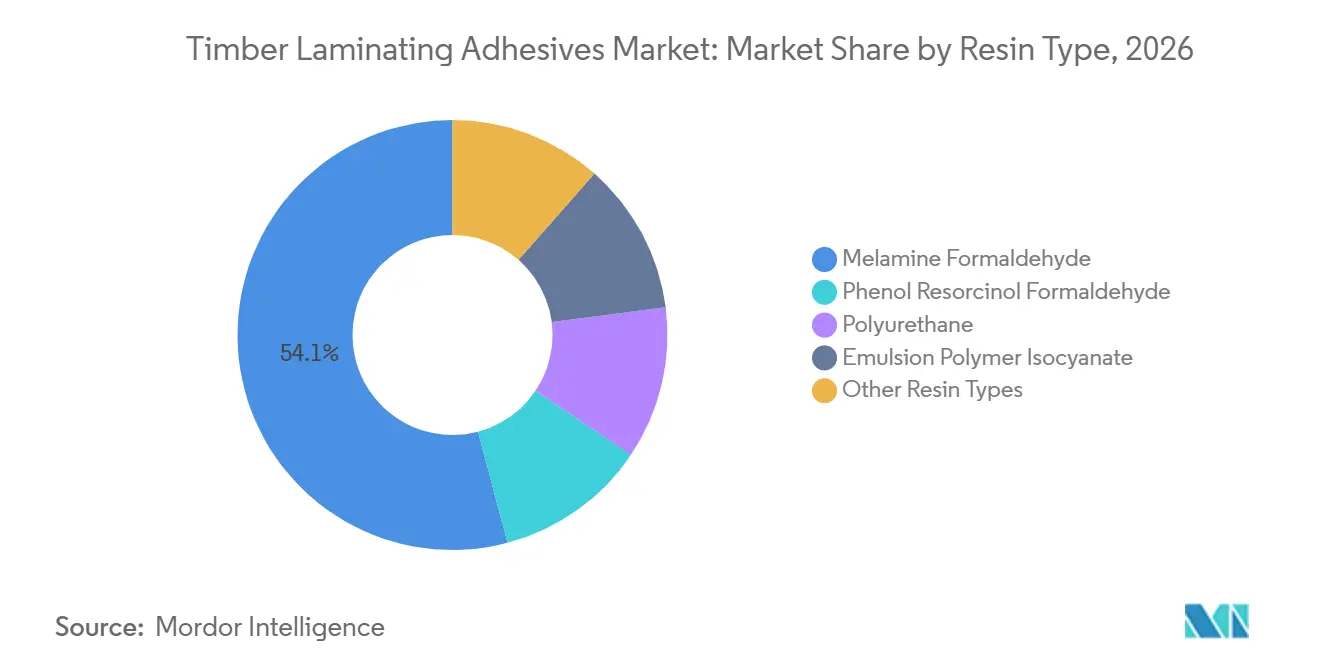
Melamine Formaldehyde Leads, Polyurethane AcceleratesMelamine formaldehyde held a 54.12% segment share in 2026 within the timber laminating adhesives market. Its position reflects established bonding performance in glulam and CLT manufacturing, cost competitiveness against phenol resorcinol formaldehyde and emulsion polymer isocyanate systems, and thermal stability. The 2025 fire-performance study found that polycondensation systems retained near-solid-wood shear strength through 270 °C. Dynea AS presented Prefere 4570 and 4571 melamine urea formaldehyde products at LIGNA 2025, with fire-resistant bond lines and free formaldehyde below 0.1%. Phenol resorcinol formaldehyde adhesives retain a specialized role in weather-exposed and high-load applications where water-immersion resistance is required.
Emulsion polymer isocyanate adhesives serve appearance-grade lamination where lower press temperatures and low staining risk are important. Franklin confirmed its structural adhesive capability for laminated beams and finger-jointed studs in 2025. Polyurethane is projected to advance at a 6.89% CAGR through 2032 in the timber laminating adhesives market size for resin types. Kiilto showed up to 30% productivity improvement by covering 3-, 5-, and 7-layer CLT elements without equipment changes. Jowat SE and KLEIBERIT SE & Co. KG have commercialized micro-emission polyurethane products with less than 0.1% monomeric isocyanate, helping suppliers address hazardous-substance labeling concerns while serving automated production lines.

By Application:
Floor Beams Anchor Structural Adhesive DemandFloor beams held a 31.54% segment share in 2026 within the timber laminating adhesives market. They are adhesive-intensive because multistory mass timber buildings require broad bonding surfaces and dense bond lines in floor systems. Floor beams are also projected to advance at a 7.13% CAGR through 2032 as more buildings use factory-made timber components. Their structural role gives adhesive performance a direct effect on manufacturing consistency and project specifications. Roof beams also require strong structural bonds, with additional exposure to thermal cycling, moisture, and ultraviolet degradation in semi-exposed designs.
Window and door headers, trusses, and supporting columns serve narrower structural uses that can expand with hybrid timber-concrete construction. These designs require more attention to bonding dissimilar materials than traditional timber-to-timber assembly. Prefabricated floor-cassette systems are shifting adhesive use upstream because factory-laminated panels arrive at sites as completed components. H.B. Fuller Company reorganized its building adhesive solutions segment in fiscal 2025 to combine performance woodworking products, including Rakoll and Rapidex, with related construction applications. This procurement shift favors suppliers able to provide reliable volume, process support, and timely technical service to larger panel manufacturers.
By End-Use Industry:
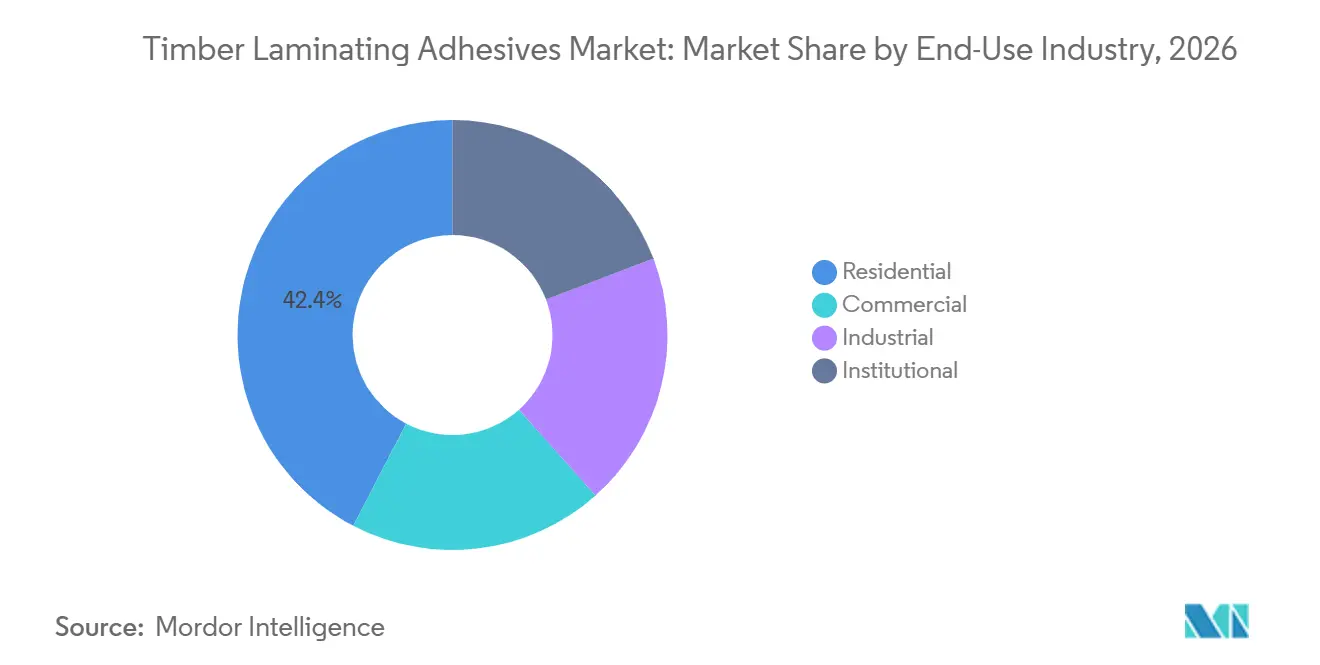
Residential Commands Both Scale and PaceResidential held 42.37% segment share in 2026 within the timber laminating adhesives market and is projected to advance at a 7.45% CAGR through 2032. Housing undersupply in North America and Northern Europe supports the use of prefabricated mass timber housing. Residential buyers and specifiers also place more value on certified low-emission wood products for indoor air quality. Kiilto Pro SW 13 was selected by HOISKO CLT for projects that included Turku Music Hall and Elmo Swimming Hall in Vantaa.
Commercial demand is supported by office, education, and mixed-use projects where exposed timber creates design value. Institutional buildings such as hospitals and government facilities are a slower-moving but high-specification area because adhesives must meet tighter fire-compartment requirements. Industrial development in Europe benefits from green-building systems such as the Building Research Establishment Environmental Assessment Method and the Deutsche Gesellschaft für Nachhaltiges Bauen certification for warehouses and production facilities. The timber laminating adhesives industry, therefore, favors suppliers that can combine NAF and ULEF compliance, fire-performance evidence, and structural approval documentation. A broad certification portfolio can help a supplier serve residential, commercial, institutional, and industrial requirements without reworking core formulations for each project.
Geography Analysis
North America
North America held 33.69% regional share in 2026 within the timber laminating adhesives market. The region has benefited from mass timber code development, a dense network of glulam and CLT plants, and low-carbon construction incentives. The 2025 guide supports permits under pre-2021 codes, while Canada’s rules align formaldehyde certification with U.S. Title VI. Mexico is expanding through manufactured housing and integration with U.S. prefabrication supply chains.
Asia-Pacific
Asia-Pacific is projected to advance at a 7.31% CAGR through 2032 in the timber laminating adhesives market size. Urbanization, green-building requirements, and growing CLT capacity support demand across the region. India is driving demand through the Goa demonstration projects and the Indian Institute of Technology Roorkee training programs, contributing to domestic CLT demand. Japan’s prefabricated construction is growing, and Forestry Agency incentives can provide up to 10% more buildable area for domestic CLT projects.
Europe, South America, Middle East and Africa
Europe is a meaningful center of consumption in the timber laminating adhesives market because it combines mature certification systems with demanding environmental and fire requirements. Germany, home to KLEIBERIT and Jowat SE, and Scandinavia, where Dynea AS and Kiilto operate, are manufacturing and product-development centers. Kiilto supplied adhesive for the Turku Music Hall and the Elmo Swimming Hall in Vantaa, both completed in 2025. EN 18070:2025 classifies adhesive temperature resistance for load-bearing timber structures in fire. Brazil offers a developing outlet for glulam, while Saudi Arabia’s Vision 2030 construction program and South Africa’s modular housing activity create early demand nodes.
Competitive Landscape
The timber laminating adhesives market is moderately concentrated, with the top five players including Henkel AG & Co. KGaA, H.B. Fuller Company, Sika AG, Akzo Nobel N.V., and Hexion Inc. Supplier investment in compliant, fire-tested, and lower-carbon adhesive systems reflects the push toward performance-focused product development. Henkel AG & Co. KGaA launched its Loctite HB XE Line in February 2025, using fire-test evidence and Eurocode 5 compliance documentation to support CLT and glued laminated timber customers. These product strategies make technical evidence and compliance documentation more important in supplier selection.
In the timber laminating adhesives market, bio-based structural adhesives that meet both EN 301 Class D4 performance and T270 fire classification remain at an early stage. This leaves room for a supplier that can deliver the combination on an industrial scale. The ASEAN prefabricated timber sector also has limited local structural-grade adhesive certification infrastructure, which creates an opening for suppliers that invest in testing and approvals. In furniture lamination and window-profile wrapping, competition is more fragmented and includes Jowat SE, KLEIBERIT, and regional Asian producers.
Kiilto adopted vinyl acetate monomer with 65% bio-content from Celanese Corporation in June 2025, reducing the carbon footprint of its D3-class polyvinyl acetate wood adhesive portfolio by up to 25%. AICA Kogyo Co.,Ltd. raised selected adhesive prices in July 2025, indicating continued raw-material pressure. Huntsman International LLC introduced bio-based I-BOND resins with no added formaldehyde at LIGNA 2025[2]. Sika AG continued to expand its construction adhesive capability through investments and acquisitions. These actions show a competitive focus on product compliance, sustainability, manufacturing performance, and regional reach.
Timber Laminating Adhesives Industry Leaders
-
Henkel AG & Co. KGaA
-
H.B. Fuller Company
-
Sika AG
-
Akzo Nobel N.V.
-
Hexion Inc.
- *Disclaimer: Major Players sorted in no particular order
Timber Laminating Adhesives Market Companies Covered in this Report
- 3M
- AICA Kogyo Co.,Ltd.
- Akzo Nobel N.V.
- Arkema
- Dynea AS
- Franklin
- H.B. Fuller Company
- Henkel AG & Co. KGaA
- Hexion Inc.
- Huntsman International LLC
- Jowat SE
- Kiilto
- KLEIBERIT SE & Co. KG
- MAPEI
- Sika AG
Recent Industry Developments in Timber Laminating Adhesives Market
- October 2026: The U.S. Environmental Protection Agency (EPA) finalized updates to formaldehyde emission standards for composite wood products under the Toxic Substances Control Act (TSCA). The updates incorporate ISO 12460-2:2024 as an additional quality-control test method and address relevant consensus standards for structural glued laminated timber. The development supports the timber laminating adhesives market by reinforcing formaldehyde-emission testing and compliance requirements for manufacturers supplying wood products to the U.S. market.
- November 2025: Kiilto partnered with Finnish cross-laminated timber (CLT) manufacturer HOISKO CLT to use its Kiilto Pro SW 13 one-component polyurethane adhesive in CLT production. The adhesive was used for timber elements in the Turku Music Hall and Elmo Swimming Hall projects in Finland, demonstrating its suitability for 3-, 5-, and 7-layer CLT configurations. The partnership supports the timber laminating adhesives market by demonstrating the use of polyurethane adhesives in large-scale engineered timber construction.
Global Timber Laminating Adhesives Market Report Scope
Timber laminating adhesives are bonding agents used to join layers of wood to manufacture engineered timber components with consistent strength and dimensional stability. They help maintain bond integrity under structural loads and varying moisture and temperature conditions.
The Timber Laminating Adhesives Market is segmented by resin type, application, end-use industry, and geography. By resin type, the market is segmented into melamine formaldehyde, phenol resorcinol formaldehyde, polyurethane, emulsion polymer isocyanate, and other resin types. By application, the market is segmented into floor beams, roof beams, window and door headers, trusses and supporting columns, and other applications. By end-use industry, the market is segmented into residential, commercial, industrial, and institutional. The report also covers the market size and forecasts for timber laminating adhesives across 15 countries. For each segment, the market sizing and forecasts have been done on the basis of value (USD).
Segmentation Overview
| Melamine Formaldehyde |
| Phenol Resorcinol Formaldehyde |
| Polyurethane |
| Emulsion Polymer Isocyanate |
| Other Resin Types |
| Floor Beams |
| Roof Beams |
| Window and Door Headers |
| Trusses and Supporting Columns |
| Other Applications |
| Residential |
| Commercial |
| Industrial |
| Institutional |
| Asia-Pacific | China |
| India | |
| Japan | |
| South Korea | |
| ASEAN Countries | |
| Rest of Asia-Pacific | |
| North America | United States |
| Canada | |
| Mexico | |
| Europe | Germany |
| United Kingdom | |
| France | |
| Italy | |
| NORDIC Countries | |
| Rest of Europe | |
| South America | Brazil |
| Argentina | |
| Rest of South America | |
| Middle East and Africa | Saudi Arabia |
| South Africa | |
| Rest of Middle East and Africa |
| By Resin Type | Melamine Formaldehyde | |
| Phenol Resorcinol Formaldehyde | ||
| Polyurethane | ||
| Emulsion Polymer Isocyanate | ||
| Other Resin Types | ||
| By Application | Floor Beams | |
| Roof Beams | ||
| Window and Door Headers | ||
| Trusses and Supporting Columns | ||
| Other Applications | ||
| By End-Use Industry | Residential | |
| Commercial | ||
| Industrial | ||
| Institutional | ||
| By Geography | Asia-Pacific | China |
| India | ||
| Japan | ||
| South Korea | ||
| ASEAN Countries | ||
| Rest of Asia-Pacific | ||
| North America | United States | |
| Canada | ||
| Mexico | ||
| Europe | Germany | |
| United Kingdom | ||
| France | ||
| Italy | ||
| NORDIC Countries | ||
| Rest of Europe | ||
| South America | Brazil | |
| Argentina | ||
| Rest of South America | ||
| Middle East and Africa | Saudi Arabia | |
| South Africa | ||
| Rest of Middle East and Africa | ||
Key Questions Answered in the Report
What is the size of the timber laminating adhesives market?
The timber laminating adhesives market size was valued at USD 1.24 billion in 2026 and is estimated to grow from USD 1.31 billion in 2027 to reach USD 1.78 billion by 2032, at a CAGR of 6.25% during the forecast period (2027-2032).
What is driving demand for timber laminating adhesives?
Growth in mass timber construction, greater use of CLT and glulam, prefabrication, and tighter emissions rules are supporting demand.
Which resin type held the largest share in 2026?
Melamine formaldehyde led with 54.12% share in 2026.
Which application is projected to grow fastest through 2032?
Floor beams are projected to grow at a 7.13% CAGR through 2032.