
Tie Layer Resin Market Size and Share
Market Overview
| Study Period | 2022 - 2032 |
|---|---|
| Market Size (2027) | USD 1.78 Billion |
| Market Size (2032) | USD 2.13 Billion |
| Growth Rate (2027 - 2032) | 3.64 % |
| Fastest Growing Market | Asia-Pacific |
| Largest Market | Asia-Pacific |
| Market Concentration | Medium |
Major Players *Disclaimer: Major Players sorted in no particular order Image © Mordor Intelligence. Reuse requires attribution under CC BY 4.0. | |
Tie Layer Resin Market Analysis by Mordor Intelligence
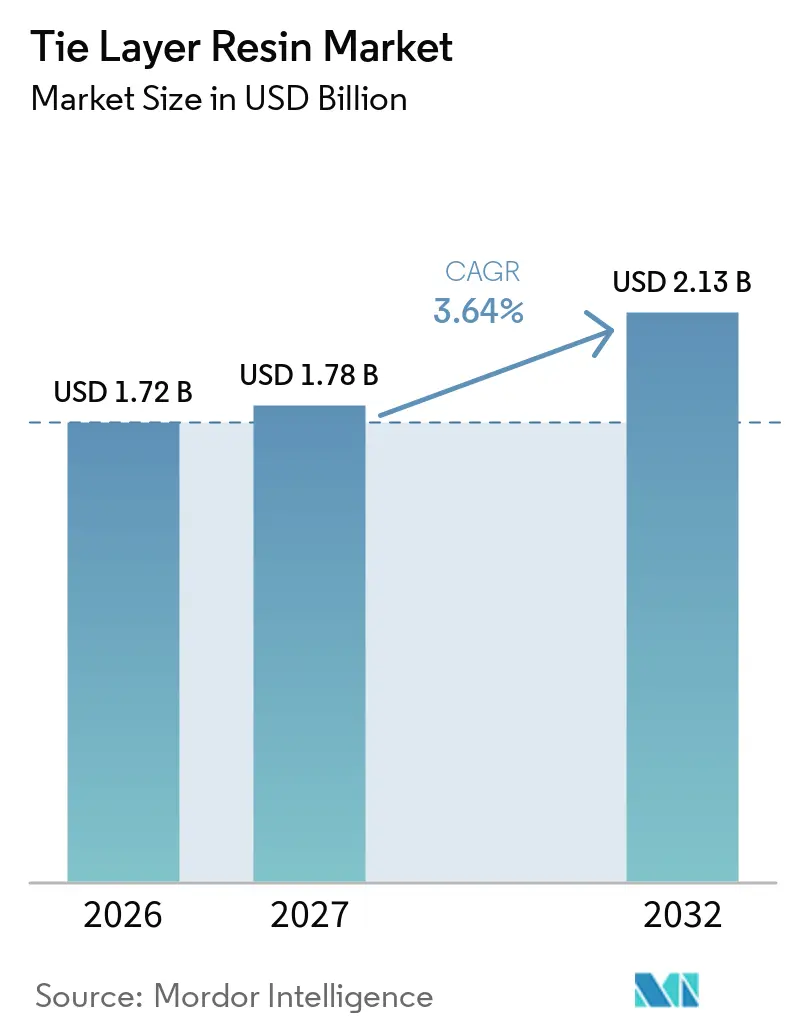
The Tie Layer Resin Market size was valued at USD 1.72 billion in 2026 and is estimated to grow from USD 1.78 billion in 2027 to reach USD 2.13 billion by 2032, at a CAGR of 3.64% during the forecast period (2027-2032). The tie layer resin market supplies the interlayer adhesives that join otherwise incompatible polymers in multilayer packaging, pipes, and automotive components. Maleic anhydride-grafted polyolefins remain central because they support adhesion without reducing barrier or mechanical performance. Demand is supported by food packaging, sterile pharmaceutical films, electric vehicle cooling lines, and automotive fuel systems. Film structures commonly use 5 to 9 layers, which increases the need for grades that join polyethylene with ethylene vinyl alcohol or polyamide. Producers are focusing on more specialized grades because recyclable packaging and high-performance applications require documented compatibility, stable processing, and long qualification cycles.
Key Report Takeaways
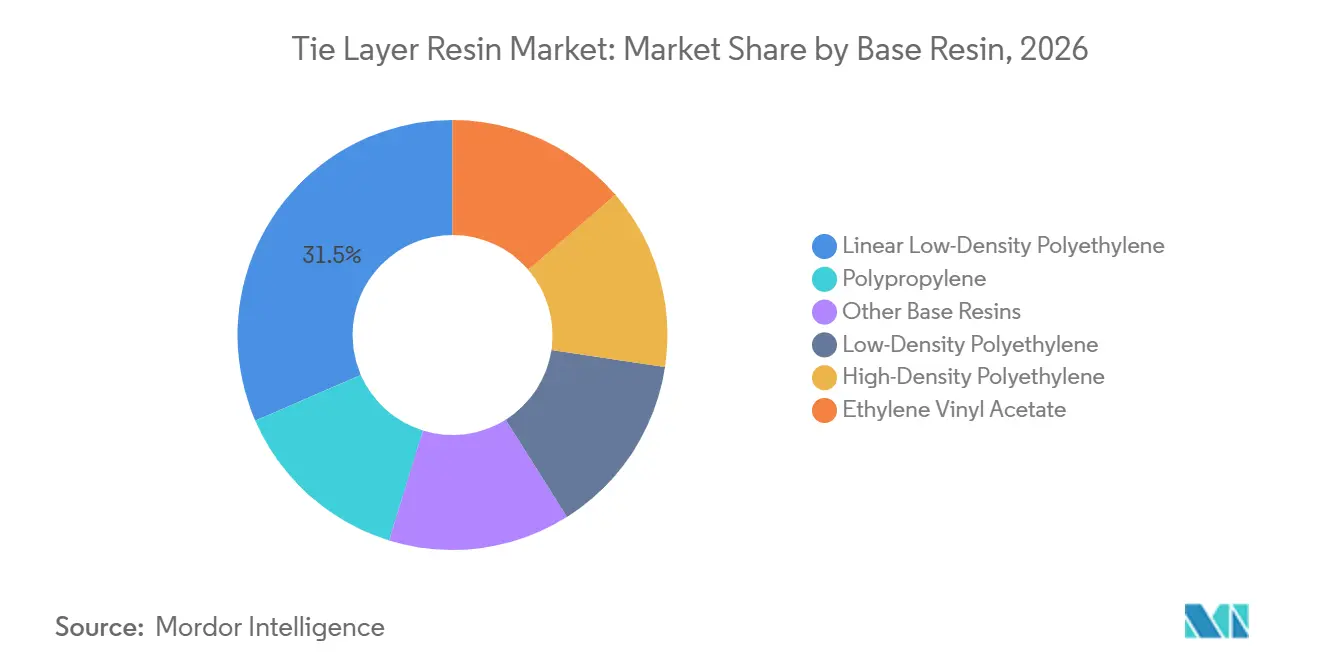
- By base resin, linear low-density polyethylene held 31.53% of the tie layer resin market share in 2026, while low-density polyethylene is forecast to advance at a 4.12% CAGR through 2032.
- By type, reactive tie layer resins held 55.12% of the tie layer resin market share in 2026 and are forecast to advance at a 3.91% CAGR through 2032.
- By application, flexible packaging held 60.47% of the tie layer resin market share in 2026 and is forecast to advance at a 4.26% CAGR through 2032.
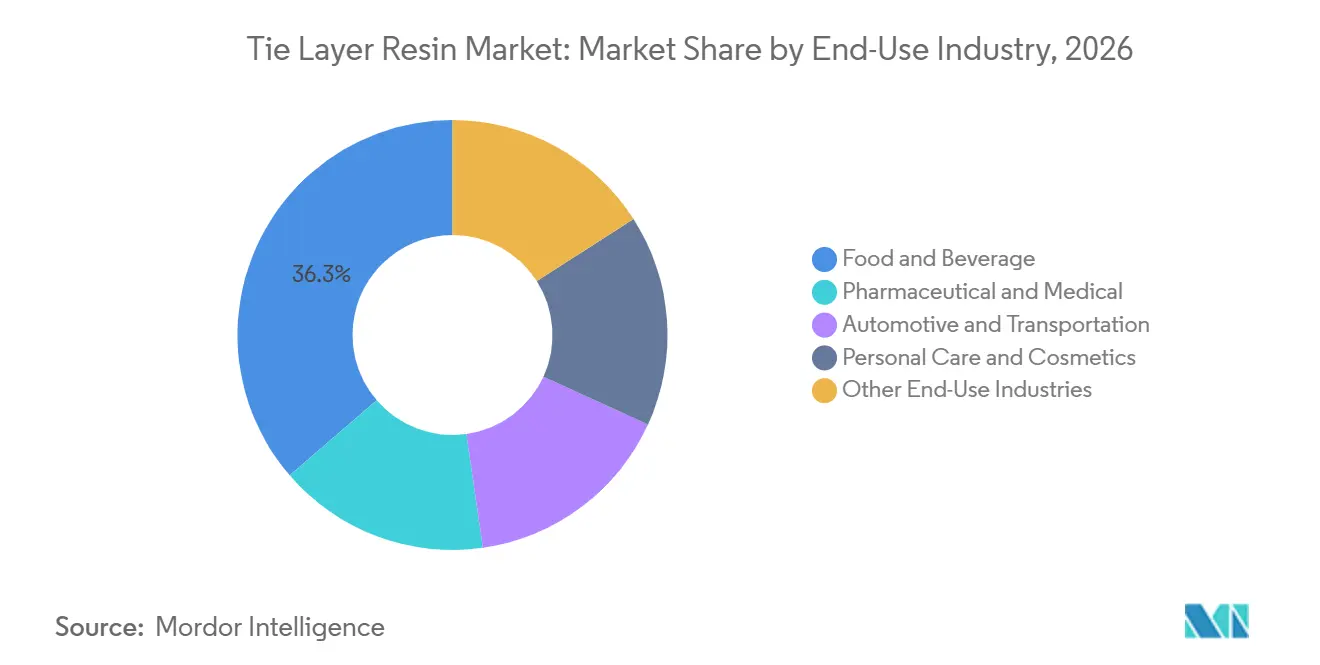
- By end-use industry, food and beverage held 36.32% of the tie layer resin market share in 2026, while pharmaceutical and medical are forecast to advance at a 4.47% CAGR through 2032.
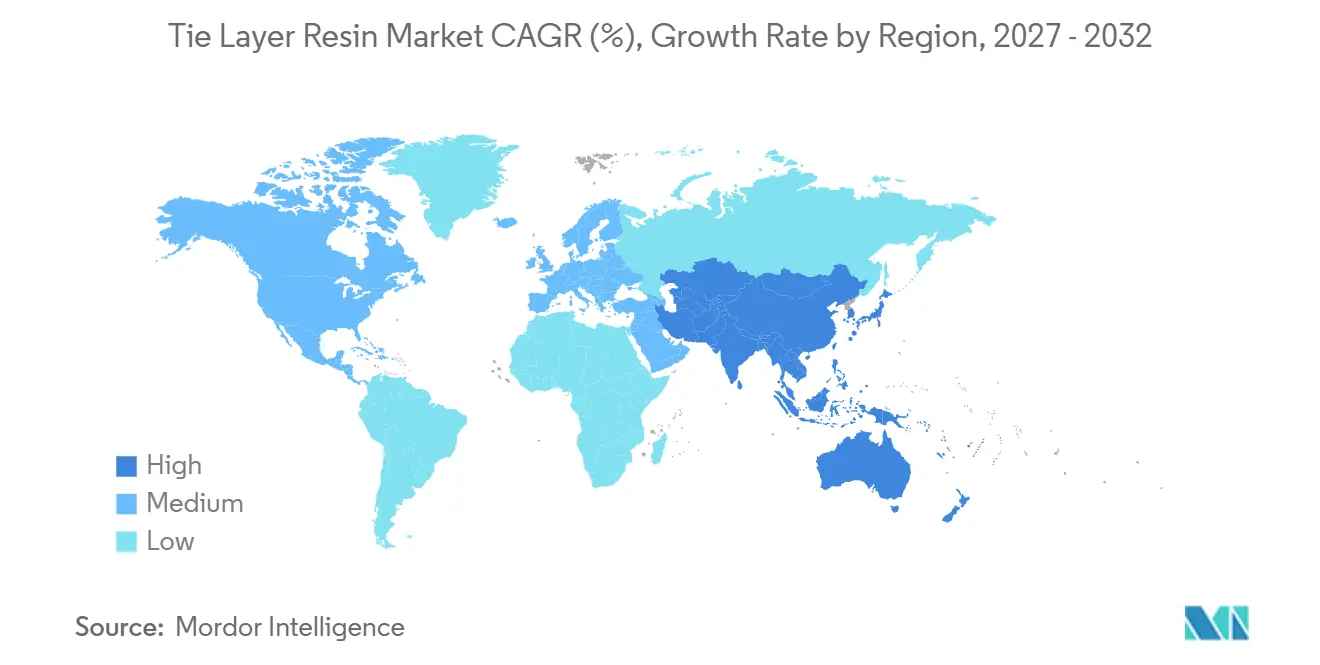
- By geography, Asia-Pacific held 42.39% of the tie layer resin market share in 2026 and is forecast to advance at a 4.52% CAGR through 2032.
Note: Market numbers in this report are based on Mordor Intelligence's proprietary estimation framework, which combines nine months of actuals with Q4 projections for base year 2026.
Market Trends and Insights
Drivers Impact Analysis of Tie Layer Resin Market*
| Driver | (~) % Impact on CAGR Forecast | Geographic Relevance | Impact Timeline |
|---|---|---|---|
| Rising Demand for High-Barrier Flexible Packaging | +1.0% | Global, concentrated in China, ASEAN, and North America | Medium term (2-4 years) |
| Expansion of Recyclable and Mono-Material Packaging Architectures | +0.8% | North America & EU; spillover to APAC core | Medium term (2-4 years) |
| Growth in Pharmaceutical and Medical Packaging | +0.6% | Global; APAC core, strong in North America and EU | Long term (≥ 4 years) |
| Increasing Adoption of Lightweight Multilayer Automotive Components | +0.4% | North America, EU, and China EV market | Long term (≥ 4 years) |
| Qualification of Tie Layers for High-Recycled-Content and Bioplastic Structures | +0.3% | EU and North America; early adoption in APAC | Long term (≥ 4 years) |
| Source: Mordor Intelligence | |||
Rising Demand for High-Barrier Flexible Packaging
The move from single-layer films to coextruded structures supports steady demand in the tie layer resin market. Meat and dairy packaging needs low oxygen transmission rates, often below 1 cm³/m²/day, which requires ethylene vinyl alcohol or polyamide barrier layers and compatible adhesive resins. Simpler 5-layer structures can reduce ethylene vinyl alcohol content while raising the proportion of tie resin in the total film weight. TekniPlex Healthcare expanded 5-layer blown-film capability for pharmaceutical packaging in ISO Class 7 cleanroom conditions during 2025, showing how tighter healthcare specifications can influence other packaging uses. These requirements make adhesion performance an operating necessity rather than a discretionary packaging feature. Food producers and converters therefore continue to specify grades that can perform across cold-chain handling, retort processing, and high-speed conversion.
Expansion of Recyclable and Mono-Material Packaging Architectures
The Packaging and Packaging Waste Regulation entered into force on February 11, 2025, and requires packaging placed on the European Union market to be recyclable by 2030[1]. This rule directs converters toward all-polyolefin structures that retain a thin barrier layer while supporting recycling compatibility. In August 2025, PTT Global Chemical, TPN FlexPak, and Windmöller & Hölscher introduced a 7-layer machine direction-oriented polyethylene (MDOPE) film with an ethylene vinyl alcohol barrier that was classified as 100% recyclable under Circular Economy for Flexible Packaging (CEFLEX) design guidelines. Tie layers must maintain adhesion through machine direction orientation while remaining compatible with mainstream polyolefin recycling streams. The same qualification work is needed when structures incorporate post-consumer recycled polyolefins or bioplastic middle layers. Suppliers with recyclable-grade testing and certification programs are better placed to serve converters as these formats move into broader commercial use.
Growth in Pharmaceutical and Medical Packaging
Pharmaceutical packaging is a higher-value outlet for the tie layer resin market because sterile barrier applications require detailed material documentation. Regulatory review of extractables and leachables favors multilayer films with characterized chemical stability and controlled formulations. A 2025 review identified anti-counterfeiting, drug monitoring, quality preservation, sustainability, and patient compliance as active areas for pharmaceutical packaging development. Honeywell International Inc. announced in June 2025 that Evertis selected its Aclar film technology for the Evercare pharmaceutical packaging brand. That selection reflects the importance of documented barrier performance in supplier qualification. Rising sterility requirements support demand for specialized grades in pharmaceutical films, blister structures, and consumer healthcare packaging.
Increasing Adoption of Lightweight Multilayer Automotive Components
Electric vehicle thermal-management systems use coextruded cooling lines that join a high-density polyethylene outer layer with a barrier polymer. These systems create demand for reactive adhesive resins because single-polymer structures cannot meet all permeation requirements. Mitsui Chemicals, Inc. identifies its ADMER adhesive resin as a solution for automotive fuel systems and electric vehicle cooling lines. A Ford Motor Company technical report released in March 2025 reported a 38% mass saving for recyclable composite materials compared with steel in lightweight vehicle structures[2]. Battery enclosures, thermal barriers, and fluid distribution systems are extending the range of multilayer automotive components. Automotive converters must still qualify each construction for processing stability, durability, and end-use performance, which makes application development a longer process.
Restraints Impact Analysis of Tie Layer Resin Market*
| Restraint | (~) % Impact on CAGR Forecast | Geographic Relevance | Impact Timeline |
|---|---|---|---|
| Volatility in Polyolefin and Petrochemical Feedstock Prices | -0.7% | Global, most acute in naphtha-dependent Asia and Europe | Short term (≤ 2 years) |
| Complex Processing and Qualification Requirements for Multilayer Structures | -0.5% | Global, with high burden in regulated markets (EU, North America) | Medium term (2-4 years) |
| Limited Recycling Infrastructure for Delamination and Material Separation | -0.4% | Acute in South America, MEA, and developing APAC markets | Long term (≥ 4 years) |
| Source: Mordor Intelligence | |||
Volatility in Polyolefin and Petrochemical Feedstock Prices
Polyolefin price changes create margin uncertainty for the tie layer resin market and complicate capacity planning. Producers may face rapid changes in ethylene and propylene input costs while customer contract prices adjust more slowly. This timing mismatch can limit the ability to recover higher costs during a contract period. Volatility also makes it harder for converters to evaluate the economics of premium grades against conventional formulations. The impact is especially pronounced in regions that depend on naphtha-based production and imported feedstocks. Long-term supply agreements can reduce exposure, but they can also slow price adjustments when market conditions change.
Complex Processing and Qualification Requirements for Multilayer Structures
Multilayer coextrusion requires close control of processing temperature and cooling conditions to avoid failures at the interface. A 2025 peer-reviewed study found that these conditions strongly influence interfacial morphology in ethylene vinyl alcohol and polyethylene-grafted maleic anhydride films. A new grade may need adhesion testing, heat-seal checks, food-contact review, pharmaceutical documentation, and recyclability assessment before commercial use. These requirements can extend qualification cycles for 12 to 24 months. The burden is greater in regulated markets where documentation requirements are more extensive. Limited recycling infrastructure for delamination and material separation remains a related constraint in developing regions because it can limit the adoption of advanced multilayer structures even when compatible grades are available.
*Our forecasts treat driver/restraint impacts as directional, not additive. The impact forecasts reflect baseline growth, mix effects, and variable interactions.
Tie Layer Resin Market Segment Analysis
By Base Resin:
Linear Low-Density Polyethylene Leads, While Low-Density Polyethylene ExpandsLinear low-density polyethylene held 31.53% of the tie layer resin market share in 2026 because it works across blown and cast film lines. Low-density polyethylene is projected to advance at a 4.12% CAGR through 2032, supported by its behavior during film orientation and its fit with recyclable mono-material structures. High-density polyethylene is used in cooling pipes and barrier bottles, while polypropylene grades are gaining use in retort packaging and automotive underhood applications. Ethylene vinyl acetate grades remain relevant for non-barrier laminates and wire-and-cable applications, while metallocene plastomers and ethylene-propylene copolymers serve applications that need clarity or low-temperature sealing. Grade selection in the tie layer resin market depends on the intended film architecture and processing conditions.
LyondellBasell Industries Holdings B.V. launched Plexar PX3990 in May 2025 as a linear low-density polyethylene grade developed for machine direction-oriented film processing. The launch shows the shift toward formulations that can retain adhesion after orientation. The Association of Plastic Recyclers design guidance places limits on ethylene vinyl alcohol content in recyclable polyethylene films, which increases the need for precise resin selection. Low-density polyethylene can gain relevance as converters redesign films for recyclability. The tie layer resin industry is moving from broadly interchangeable grades toward formulations selected for defined film architectures.

By Type:
Reactive Tie Layer Resins Lead Both Scale and GrowthReactive tie layer resins held 55.12% of the tie layer resin market share in 2026 and are projected to advance at a 3.91% CAGR through 2032. Maleic-anhydride grafted polyolefin grades form strong bonds with polar barrier polymers during conventional coextrusion. Their performance supports packaging structures that face retort sterilization, orientation, and demanding barrier requirements. Mitsui Chemicals, Inc. supplies its ADMER portfolio for packaging, automotive, and industrial applications. The tie layer resin market benefits when converters require thinner layers that retain adhesion under more severe processing conditions.
Non-reactive tie layer resins remain useful when moderate bond strength, lower cost, or processing flexibility is more important. Typical uses include industrial films, non-food-contact laminates, and wire-and-cable jacketing. Some ethylene vinyl acetate-based grades can show favorable melt-blend behavior in recycling tests, which supports their role in selected applications. Reactive and non-reactive grades serve different technical needs rather than directly replacing each other. The tie layer resin industry is likely to retain a two-part structure, with reactive grades leading high-barrier applications and non-reactive grades serving established lower-specification uses.
By Application:
Flexible Packaging Leads Both Scale and GrowthFlexible packaging held 60.47% of the tie layer resin market share in 2026 and is projected to advance at a 4.26% CAGR through 2032. The segment includes pouches, retort bags, meat and dairy films, stand-up pouches, and thermoform base films. Thinner films require close adhesion control because they allow less room for delamination during converting. Rigid packaging is used in pharmaceutical blisters, food trays, and cosmetic containers. The tie layer resin market also serves wire and cable jacketing, underfloor heating pipes, agricultural films, and industrial flooring.
Flexible packaging benefits from packaged food demand in the Asia-Pacific and material redesign in Europe and North America. The tie layer resin market size for flexible packaging is supported by formulations that meet barrier and recycling requirements. Pharmaceutical-grade documentation is moving into consumer healthcare packaging, creating demand for higher-value reactive grades. Rigid applications can command a premium when they require validated barrier structures and cleanroom-compatible production. This mix supports suppliers that can adapt a grade to a converter's equipment, barrier layer, and regulatory needs.
By End-Use Industry:
Food and Beverage Lead, While Pharmaceutical and Medical ExpandFood and beverage held 36.32% of the tie layer resin market share in 2026 because meat, dairy, coffee, and snack packaging require oxygen and moisture barriers. Pharmaceutical and medical are projected to advance at a 4.47% CAGR through 2032. Food packaging demand is broad and durable, although standard film structures have limited scope to increase resin loading. Pharmaceutical applications need materials with documented extractables profiles and controlled performance. The tie layer resin market also serves automotive and transportation through fuel systems and electric vehicle cooling lines.
Personal care and cosmetics uses tie layers in aerosol barriers, laminate tubes, and stand-up pouches. Taghleef Industries and EcoFlexibles demonstrated polypropylene mono-material cosmetics pouches in 2025 that replace conventional multi-material laminate formats. Construction, agricultural films, and electronics provide further demand diversity. Food and beverage applications drive demand, while pharmaceutical and automotive uses require more specialized portfolios. End-users in the tie layer resin market value suppliers that can document food-contact, sterility, and recyclability performance.
Geography Analysis
APAC Tie Layer Resin Market
Asia-Pacific held 42.39% of the tie layer resin market share in 2026 and is projected to advance at a 4.52% CAGR through 2032. China has a large coextruded-film manufacturing base that supports demand from food processing and export packaging. India is adding pharmaceutical packaging capacity and biaxial film capacity, which supports demand for higher-value adhesive grades. LyondellBasell Industries Holdings B.V. expanded its Suzhou Technology and Innovation Hub in September 2025 with extrusion lines and polymer-testing infrastructure for packaging and automotive applications. Japan and South Korea contribute to the tie layer resin market through pharmaceutical laminates and automotive components.
North America and Europe Tie Layer Resin Market
North America and Europe drive demand through pharmaceutical manufacturing, technical converter capacity, and stricter packaging rules. Bostik, Arkema's adhesive solutions segment, announced a USD 27 million investment in its Middleton, Massachusetts, plant during May 2025 to expand high molecular weight polyester production. The European Union's packaging regulation is directing converters toward recyclable mono-material structures. Germany is an important location for packaging recyclability qualification under its 2025 minimum standard. Nordic countries provide earlier opportunities for voluntary sustainability adoption in the tie layer resin market.
MEA and South America Tie Layer Resin Market
South America, the Middle East, and Africa have smaller markets with a higher weighting toward commodity-grade tie layers. Brazil supports regional demand through food processing and meat and poultry export packaging, while Argentina and other South American countries rely more heavily on imported multilayer resin grades. Saudi Arabia is extending its petrochemical base into higher-value polymer applications, while BASF reported continued investment across its global production network in its 2025 report. Growth is constrained by limited converter capability and recycling infrastructure, although packaged food demand and pharmaceutical self-sufficiency efforts can support longer-term adoption in the tie layer resin market.
Competitive Landscape
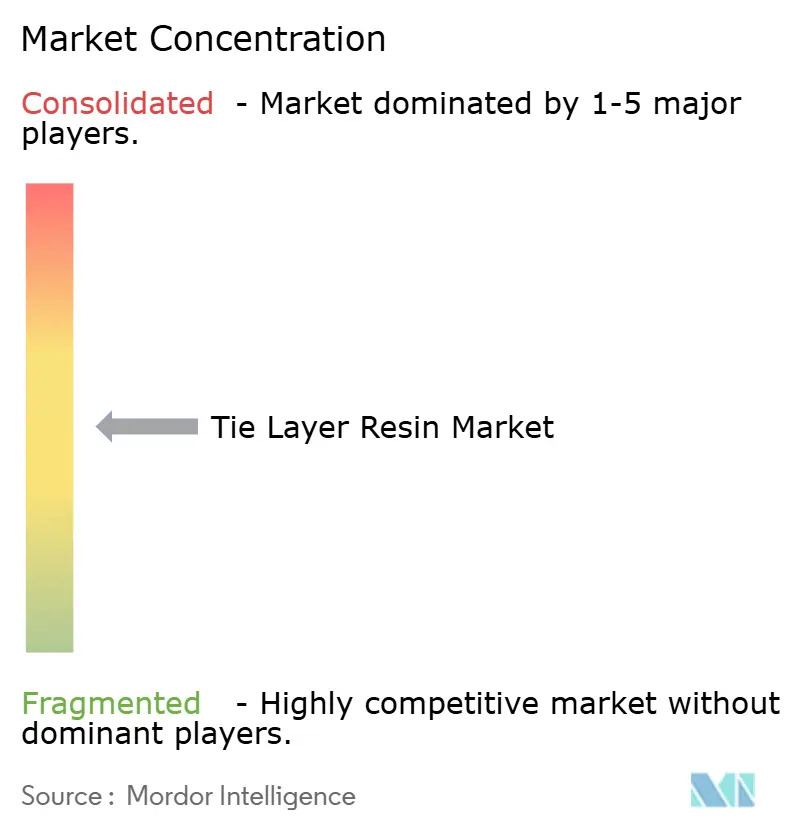
The tie layer resin market is moderately concentrated, with the top five players including Arkema, DuPont, Mitsui Chemicals, Inc., Dow, and LyondellBasell Industries Holdings B.V. Dow, LyondellBasell Industries Holdings B.V., Mitsui Chemicals, Inc., and Arkema are prominent suppliers across specialty polyolefin and adhesive-resin applications. BASF, Borealis GmbH, DuPont, Eastman Chemical Company, Evonik Industries AG, Exxon Mobil Corporation, Hanwha Solutions Corporation, INEOS, Mitsubishi Chemical Group Corporation, SABIC, SK Functional Polymer, and Sumitomo Chemical Co., Ltd. also operate across related polymer and specialty-material fields. Food-contact clearance and converter approval create multi-year switching barriers that favor suppliers with technical-service teams and validated material portfolios.
LyondellBasell Industries Holdings B.V. introduced Plexar PX3990 in May 2025 for machine direction-oriented films, targeting adhesion performance during and after orientation. Dow launched INNATE TF 220 Precision Packaging Resin for biaxially oriented polyethylene films in June 2025 and linked the product to design-for-recyclability work in flexible packaging. Evonik Industries AG localized the final production step for POLYVEST ST-E 60 at its Shanghai facility in June 2025 to increase supply security in Asia. These actions show the tie layer resin market moving toward application-specific formulations, regional technical support, and material systems that meet circularity requirements. Companies that can support converter trials are better positioned to secure long-term supply relationships.
A 2025 Nature Communications study described a light-responsive thermoplastic adhesive that enabled polyethylene-polyamide delamination and reported lower lifecycle environmental impact after repeated reuse cycles. This work points toward a future focus on controlled separation at the end of a product's life. SK Functional Polymer offers OREVAC 18730, a polypropylene tie resin for polypropylene-based multilayer applications. The tie layer resin market includes global suppliers with broad regulatory support and regional specialists serving defined packaging and industrial uses.
Tie Layer Resin Industry Leaders
-
Arkema
-
DuPont
-
Mitsui Chemicals, Inc.
-
Dow
-
LyondellBasell Industries Holdings B.V.
- *Disclaimer: Major Players sorted in no particular order
Tie Layer Resin Market Companies Covered in this Report
- Arkema
- BASF
- Borealis GmbH
- Dow
- DuPont
- Eastman Chemical Company
- Evonik Industries AG
- Exxon Mobil Corporation
- Hanwha Solutions Corporation
- INEOS
- LyondellBasell Industries Holdings B.V.
- Mitsubishi Chemical Group Corporation
- Mitsui Chemicals, Inc.
- SABIC
- SK Functional Polymer
- Sumitomo Chemical Co., Ltd.
Recent Industry Developments in Tie Layer Resin Market
- October 2026: BYK Additives introduced three SCONA adhesion promoters, including SCONA TSPE 1013 GALL, SCONA TSPP 4012 GB, and SCONA TSPP 5013 GB, to improve bonding between polyolefins and polar materials such as steel, aluminum, and wood. The launch supports the tie layer resin market by advancing adhesion technologies for multilayer structures, pipe coatings, metal packaging, and automotive components.
- May 2025: LyondellBasell Industries Holdings B.V. expanded its Plexar portfolio with Plexar PX3990, a high-performance linear low-density polyethylene (LLDPE) tie-layer resin developed for machine-direction-oriented films. The resin improves adhesion after orientation and supports film downgauging, strengthening the tie layer resin market through solutions for lightweight, high-barrier flexible packaging.
Global Tie Layer Resin Market Report Scope
Tie layer resins are polymer materials used as bonding layers to improve adhesion between dissimilar materials in multilayer structures. They help maintain layer integrity and improve the performance of packaging and other products that combine materials with different chemical and physical properties.
The Tie Layer Resin Market is segmented by base resin, type, application, end-use industry, and geography. By base resin, the market is segmented into linear low-density polyethylene, low-density polyethylene, high-density polyethylene, polypropylene, ethylene vinyl acetate, and other base resins. By type, the market is segmented into reactive tie layer resins and non-reactive tie layer resins. By application, the market is segmented into flexible packaging, rigid packaging, and other applications. By end-use industry, the market is segmented into food and beverage, pharmaceutical and medical, automotive and transportation, personal care and cosmetics, and other end-use industries. The report also covers the market size and forecasts for tie layer resins across 15 countries. For each segment, the market sizing and forecasts have been done on the basis of value (USD).
Segmentation Overview
| Linear Low-Density Polyethylene |
| Low-Density Polyethylene |
| High-Density Polyethylene |
| Polypropylene |
| Ethylene Vinyl Acetate |
| Other Base Resins |
| Reactive Tie Layer Resins |
| Non-Reactive Tie Layer Resins |
| Flexible Packaging |
| Rigid Packaging |
| Other Applications |
| Food and Beverage |
| Pharmaceutical and Medical |
| Automotive and Transportation |
| Personal Care and Cosmetics |
| Other End-Use Industries |
| Asia-Pacific | China |
| India | |
| Japan | |
| South Korea | |
| ASEAN Countries | |
| Rest of Asia-Pacific | |
| North America | United States |
| Canada | |
| Mexico | |
| Europe | Germany |
| United Kingdom | |
| France | |
| Italy | |
| NORDIC Countries | |
| Rest of Europe | |
| South America | Brazil |
| Argentina | |
| Rest of South America | |
| Middle East and Africa | Saudi Arabia |
| South Africa | |
| Rest of Middle East and Africa |
| By Base Resin | Linear Low-Density Polyethylene | |
| Low-Density Polyethylene | ||
| High-Density Polyethylene | ||
| Polypropylene | ||
| Ethylene Vinyl Acetate | ||
| Other Base Resins | ||
| By Type | Reactive Tie Layer Resins | |
| Non-Reactive Tie Layer Resins | ||
| By Application | Flexible Packaging | |
| Rigid Packaging | ||
| Other Applications | ||
| By End-Use Industry | Food and Beverage | |
| Pharmaceutical and Medical | ||
| Automotive and Transportation | ||
| Personal Care and Cosmetics | ||
| Other End-Use Industries | ||
| By Geography | Asia-Pacific | China |
| India | ||
| Japan | ||
| South Korea | ||
| ASEAN Countries | ||
| Rest of Asia-Pacific | ||
| North America | United States | |
| Canada | ||
| Mexico | ||
| Europe | Germany | |
| United Kingdom | ||
| France | ||
| Italy | ||
| NORDIC Countries | ||
| Rest of Europe | ||
| South America | Brazil | |
| Argentina | ||
| Rest of South America | ||
| Middle East and Africa | Saudi Arabia | |
| South Africa | ||
| Rest of Middle East and Africa | ||
Key Questions Answered in the Report
What is the size of the tie layer resin market?
The tie layer resin market size was valued at USD 1.72 billion in 2026 and is estimated to grow from USD 1.78 billion in 2027 to reach USD 2.13 billion by 2032, at a CAGR of 3.64% during the forecast period (2027-2032).
What is driving demand for tie layer resins?
High-barrier food packaging, recyclable mono-material films, pharmaceutical packaging, and lightweight automotive components support demand.
Which base resin held the largest share in 2026?
Linear low-density polyethylene held a 31.53% share in 2026.
Which application held the largest share in 2026?
Flexible packaging held a 60.47% share in 2026.