
Thorium Reactor Market Size and Share
Market Overview
| Study Period | 2022 - 2032 |
|---|---|
| Market Size (2027) | USD 6.86 Billion |
| Market Size (2032) | USD 11.29 Billion |
| Growth Rate (2027 - 2032) | 10.48 % |
| Fastest Growing Market | Asia-Pacific |
| Largest Market | Asia-Pacific |
| Market Concentration | Low |
Major Players *Disclaimer: Major Players sorted in no particular order Image © Mordor Intelligence. Reuse requires attribution under CC BY 4.0. | |
Thorium Reactor Market Analysis by Mordor Intelligence
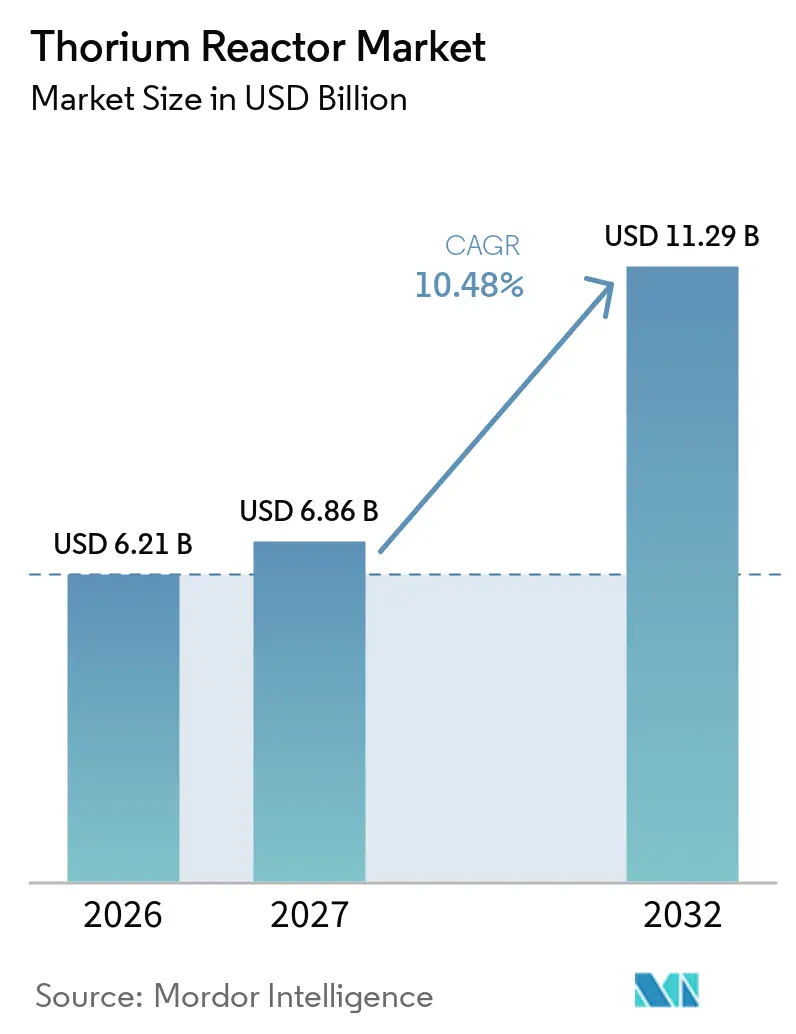
The Thorium Reactor Market size is projected to be USD 6.21 billion in 2026, USD 6.86 billion in 2027, and reach USD 11.29 billion by 2032, at a CAGR of 10.48% from 2027 to 2032. The global thorium reactor market is advancing as governments seek firm, low-carbon power that can complement variable renewable generation. Energy security is also shaping decisions because countries with thorium resources can pursue a domestic fuel pathway rather than rely fully on uranium imports. Development activity remains centered on demonstrations, licensing work, and fuel qualification rather than large commercial orders. State-backed programs provide long funding horizons, while private developers focus on modular designs, materials development, and regulatory progress. The global thorium reactor market, therefore, depends on whether demonstrations can produce the operating and licensing evidence needed before the next investment cycle. The next phase will require more than technical results because fuel availability, qualified materials, and regulatory acceptance must advance together. Developers who build those links early can move from experimental systems to repeatable project designs. The global thorium reactor market is still shaped by national policy choices, even where private companies lead the engineering work.
Key Report Takeaways
- By reactor type, molten salt reactors held 37.3% of the global thorium reactor market share in 2026, while liquid fluoride thorium reactors are projected to grow at an 11.8% CAGR through 2032.
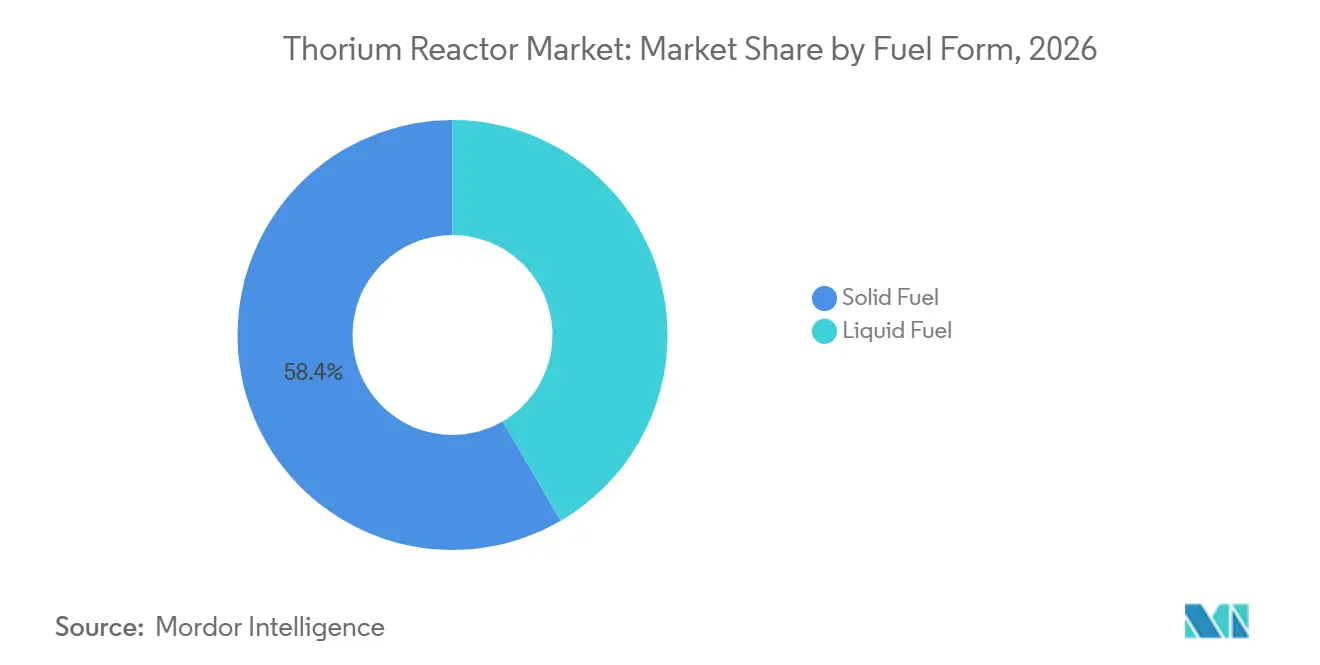
- By fuel form, solid fuel held 58.4% of the global thorium reactor market share in 2026, while liquid fuel is projected to grow at an 11.6% CAGR through 2032.
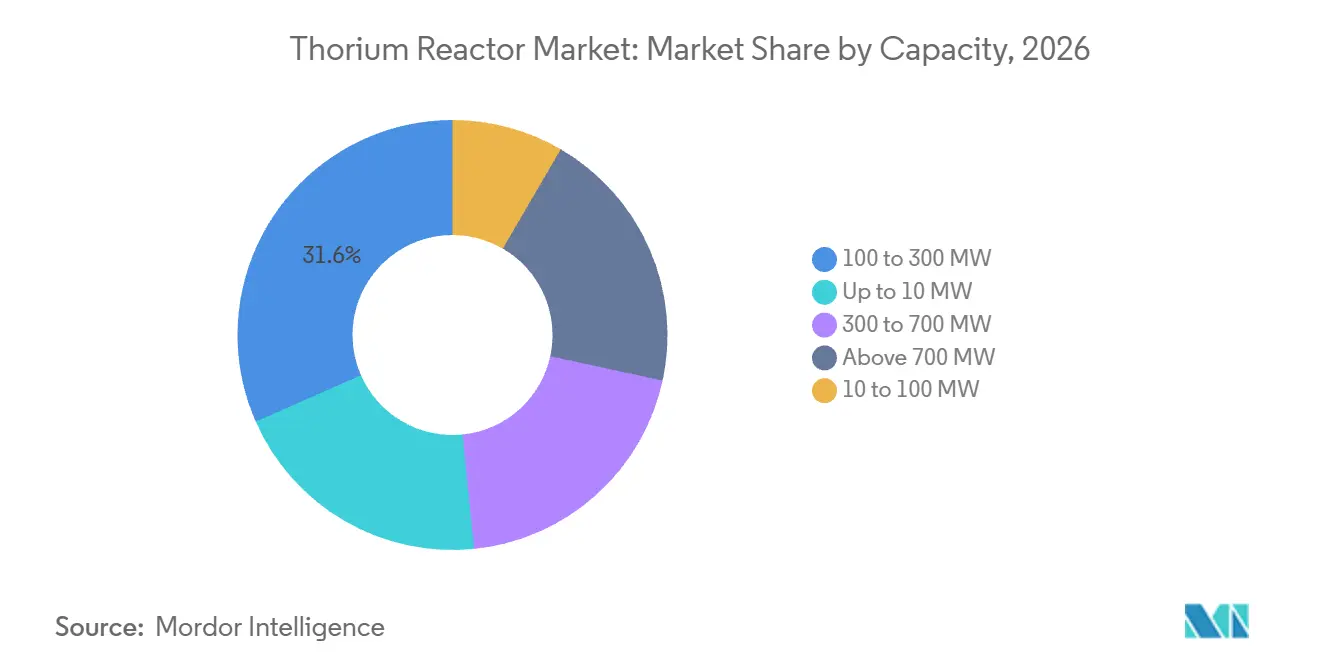
- By capacity, the 100-300 MW band held 31.6% of the global thorium reactor market share in 2026, while the 10-100 MW band is projected to grow at a 12.1% CAGR through 2032.
- By end user, nuclear utilities held 29.7% of the global thorium reactor market share in 2026, while research institutions are projected to grow at a 12.5% CAGR through 2032.
- By geography, Asia-Pacific held 45.3% of the global thorium reactor market share in 2026 and is projected to grow at a 12.8% CAGR through 2032.
Note: Market numbers in this report are based on Mordor Intelligence's proprietary estimation framework, which combines nine months of actuals with Q4 projections for base year 2026.
Market Trends and Insights
Drivers Impact Analysis of Thorium Reactor Market*
| Driver | (~) % Impact on CAGR Forecast | Geographic Relevance | Impact Timeline |
|---|---|---|---|
| Decarbonization and Firm-Capacity Demand | +2.4% | Global; concentrated in EU, Japan, and South Korea | Medium term (2–4 years) |
| Government Support for Advanced Nuclear Demonstration | +2.1% | North America, China, India, Europe | Short term (≤ 2 years) |
| Thorium-Uranium Fuel-Cycle Diversification | +1.6% | Asia-Pacific core (China, India); spill-over to Canada | Medium term (2–4 years) |
| High-Temperature Heat and Hydrogen Demand | +1.3% | North America & EU; early gains in Japan and South Korea | Long term (≥ 4 years) |
| Licensing and Supply-Chain Learning from Non-Thorium MSRs | +0.9% | North America, EU | Medium term (2–4 years) |
| Shipyard and Modular Manufacturing Models for Island Grids | +0.6% | Southeast Asia, Pacific island nations, MEA coastal regions | Long term (≥ 4 years) |
| Source: Mordor Intelligence | |||
Decarbonization and Firm-Capacity Demand
The global thorium reactor market is supported by demand for dispatchable, low-carbon electricity that can support variable renewable generation. Thorium is more widely distributed than uranium and is associated with fuel-cycle options that governments consider when assessing long-term energy security. Countries with sizeable thorium resources see domestic fuel development as a way to reduce exposure to imported uranium. More than 40 countries plan to expand nuclear power, while China has the largest number of reactors under construction globally in 2026.[1] High-temperature reactor concepts also create a potential role in industrial heat, hydrogen, and synthetic-fuel applications. This widens the addressable use case for the global thorium reactor market beyond electricity generation. It also changes the commercial discussion because industrial customers may value dependable heat and hydrogen supply alongside power output. Projects intended for these users must still demonstrate that operating temperatures, fuel systems, and delivery schedules can meet industrial requirements. The resulting demand is tied to decarbonization goals, but it also rests on practical requirements for a reliable energy supply.
Government Support for Advanced Nuclear Demonstration
Public funding and regulatory support are helping advanced reactor developers finance early technical work. The ADVANCE Act reduced U.S. Nuclear Regulatory Commission application fees by 50% for eligible advanced reactor applicants in fiscal year 2025. Kairos Power's Hermes program has a combined project value of USD 629 million through the U.S. Department of Energy's Advanced Reactor Demonstration Program. In August 2025, the ZILT consortium led by Thorizon received EUR 10 million, equivalent to USD 10.8 million, from the EU Just Transition Fund for work in Zeeland. Thorizon One is also part of the EU Industrial Alliance on Small Modular Reactors and France 2030 investment plan. Data from supported non-thorium molten salt projects can inform materials testing and licensing practices relevant to the global thorium reactor market. Government cost sharing also allows developers to produce evidence that would be difficult to finance through early private funding alone. For regulators, such evidence can clarify how novel materials and reactor systems should be reviewed. This relationship makes public demonstration programs important even when the individual project does not use thorium fuel.
Thorium-Uranium Fuel-Cycle Diversification
Fuel-cycle progress is becoming a central consideration for the global thorium reactor market. In November 2025, the Shanghai Institute of Applied Physics achieved thorium-to-uranium-233 conversion in the TMSR-LF1 liquid-fuel reactor in Wuwei, Gansu Province. SINAP plans a 30 MWth research reactor followed by a 100 MWth demonstration plant by 2035, with State Power Investment Corporation participating in supply-chain industrialization. In May 2026, Clean Core Thorium Energy reported that ANEEL fuel surpassed 60 GWd/MTU burnup in Idaho National Laboratory's Advanced Test Reactor. The reported result supports a potential retrofit pathway for CANDU and PHWR fleets without hardware modification. These programs show parallel development of liquid-fuel breeding and solid-fuel substitution options. The two approaches do not compete on identical timelines because liquid-fuel systems need integrated reactor and chemical-process validation. Solid fuel can use parts of an existing heavy-water reactor operating base, although it still requires qualification. This difference gives the global thorium reactor market a range of routes to commercialization rather than a single development path.
High-Temperature Heat and Hydrogen Demand
Industrial users are seeking low-carbon heat for processes that cannot readily be electrified. The U.S. Department of Energy identifies nuclear heat as a potential substitute for fossil combustion in steel, ammonia, refining, and chemical manufacturing.[2] These sectors account for more than 40% of U.S. industrial energy consumption. Thorium-compatible high-temperature gas reactors and molten salt reactors can support process temperatures above 750°C. A 2026 Nature Communications study estimated that deployment of small modular reactors for industrial hydrogen in ammonia, steel, and refining could reach 91 GWe under existing U.S. hydrogen production tax credit conditions. Direct industrial offtake may therefore complement power purchase agreements as projects move from research into commercial development. This creates a longer-term source of demand for the global thorium reactor market. It may also encourage developers to design projects around site-specific industrial loads rather than standard grid-only applications. Such arrangements could improve the commercial case where a customer has a continuous demand for heat, hydrogen, or electricity. Their viability remains dependent on performance data from operating advanced reactors.
Restraints Impact Analysis of Thorium Reactor Market*
| Restraint | (~) % Impact on CAGR Forecast | Geographic Relevance | Impact Timeline |
|---|---|---|---|
| Fuel Fabrication and Recycling Infrastructure Gap | -2.1% | Global; most acute in South America, MEA, Southeast Asia | Long term (≥ 4 years) |
| First-of-a-Kind Capital and Schedule Risk | -1.8% | Global; highest for private developers in North America and Europe | Medium term (2–4 years) |
| U-233 Handling, Safeguards and Regulatory Qualification Complexity | -1.3% | North America, EU, India; IAEA safeguards compliance globally | Long term (≥ 4 years) |
| Corrosion, Tritium and Materials Qualification Constraints | -0.9% | Global; most acute where GH3535 alloy supply chains are immature | Medium term (2–4 years) |
| Source: Mordor Intelligence | |||
Fuel Fabrication and Recycling Infrastructure Gap
The absence of commercial-scale thorium fabrication and reprocessing capacity constrains the global thorium reactor market. Current work is concentrated at research facilities, including SINAP in China, Bhabha Atomic Research Centre in India, and Canadian Nuclear Laboratories at Chalk River. These facilities are not scaled for broad industrial deployment. The International Atomic Energy Agency notes that uranium-233 can contain uranium-232, which emits hard gamma radiation and requires dedicated remote-handling and radiation-protection arrangements. This requirement makes fuel supply a challenge for island grids, industrial users, and countries without established nuclear infrastructure. Until fabrication and recycling systems are commissioned at commercial scale, uncertainty over fuel availability will continue to complicate reactor offtake discussions. Developers face a circular challenge because customers need confidence in fuel supply before committing to projects, while fuel investment needs credible future demand. This issue is particularly relevant where national nuclear supply chains are limited. It also reinforces the importance of partnership models that connect reactor, fuel, and regulatory capabilities.
First-of-a-Kind Capital and Schedule Risk
First-of-a-kind capital requirements and schedule risk remain major restraints on the global thorium reactor market. Generation IV demonstration programs have experienced cost overruns of 40-150% against initial estimates, according to the supplied research draft. Liquid-fuel MSRs and LFTRs require work on corrosion, tritium management, and online reprocessing, while solid-fuel designs have a different set of technical needs. Developers are seeking to limit exposure through modular 10-100 MW designs rather than single large plants. Public-sector backing, sovereign capital, and creditworthy offtake arrangements are still important for early projects. Thorizon expects cumulative investment in its Netherlands program to exceed EUR 1 billion, equivalent to more than USD 1 billion, with expected support from the European Investment Bank and IPCEI mechanisms.
*Our forecasts treat driver/restraint impacts as directional, not additive. The impact forecasts reflect baseline growth, mix effects, and variable interactions.
Thorium Reactor Market Segment Analysis
By Reactor Type:
Molten Salt Reactors Lead Current DevelopmentMolten salt reactors held a 37.3% of the global thorium reactor market share in 2026. Their position reflects the operational status of the thorium-loaded TMSR-LF1 and the development activity of European MSR companies. SINAP has outlined an experimental reactor, a 30 MWt research reactor, and a 100 MWt demonstration plant by 2035. The thorium reactor industry is also examining export opportunities linked to Chinese supply-chain development. Liquid fluoride thorium reactors are forecast to grow at an 11.8% CAGR through 2032. Their appeal rests on the prospect of a closed fuel cycle, continuous uranium-233 breeding, and operation at atmospheric pressure.
High-temperature gas reactors are supported by the wider development of TRISO fuel supply chains, which could be adapted for thorium-bearing pebbles. The thorium reactor industry can draw on qualification work that is already underway for non-thorium advanced reactor programs. Heavy water and pressurized heavy water reactors retain near-term relevance because ANEEL fuel could provide a retrofit option for existing CANDU and PHWR units. Accelerator-driven systems remain complex and capital-intensive. Liquid-metal and light-water reactor approaches have fewer funded engineering commitments than MSR and LFTR concepts. The global thorium reactor market consequently has several technical pathways, although their readiness levels differ substantially.
By Fuel Form:
Solid Fuel Retains the Largest PositionSolid fuel accounted for a 58.4% of the global thorium reactor market share in 2026. This position reflects the established base of PHWR and HTGR programs that use, or are designed to use, thorium-bearing fuel assemblies. Manufacturing knowledge at Chalk River, Bhabha Atomic Research Centre, and Idaho National Laboratory supports continued work on solid-fuel concepts. In May 2026, ANEEL fuel exceeded 60 GWd/MTU burnup in Idaho National Laboratory's Advanced Test Reactor. The result was more than 8 times the typical PHWR discharge burnup of 7.5 GWd/MTU stated in the supplied research draft. Clean Core Thorium Energy and Canadian Nuclear Laboratories are preparing full-scale demonstration irradiation bundles under Canadian Standards Association requirements.
Liquid fuel is projected to expand at an 11.6% CAGR through 2032. MSR designs use continuous fuel-salt management, removal of gaseous fission products, and online refueling. Copenhagen Atomics secured USD 80 million in early 2026 to advance its 100 MWt containerized liquid-fuel MSR and planned critical experiment work at the Paul Scherrer Institute. Commercial adoption will require progress in fluoride-salt chemistry, GH3535 alloy corrosion resistance, and online radiochemistry. These requirements remain active engineering issues across international programs. Developers must show that material performance and fuel-salt handling can be maintained over expected operating periods. They must also translate laboratory and prototype results into procedures suitable for licensed plants. Those steps will determine how quickly liquid fuel can move from a high-growth segment into practical commercial use. The global thorium reactor market will need both fuel forms because they serve different reactor architectures and deployment timelines. Solid fuel offers a nearer pathway for heavy-water reactor applications, while liquid fuel is central to the operating model of many MSR concepts. Their relative adoption will reflect progress in qualification, fuel availability, and reactor licensing. Neither form has removed the need for long-duration operating evidence.
By Capacity:
Mid-Scale Systems Hold the Largest BaseThe 100-300 MW band accounted for a 31.6% of the global thorium reactor market size in 2026. This range is intended to provide meaningful output while avoiding some construction complexity associated with large nuclear units. India's AHWR-300 combines passive safety features with a thorium-plutonium fuel cycle. Thorizon One is designed as a 100 MWe reactor and is targeted for first commercial operation in Zeeland in 2034. The 300-700 MW and above-700 MW bands remain mainly conceptual, with fewer funded engineering programs. Their commercial role will depend on financing and construction performance. Large units may offer scale, but they also place greater pressure on project delivery, supply chains, and access to capital. The experience of first projects will influence whether developers and governments retain interest in these capacity ranges. For now, the global thorium reactor market gives greater visibility to systems that can be built and tested in smaller increments.
The 10-100 MW band is forecast to grow at a 12.1% CAGR through 2032. Developers favor factory-built units that can be manufactured in repeatable configurations and developed through successive iterations. Copenhagen Atomics is pursuing a container-scale 100 MWt modular MSR. ThorCon's proposed 500 MWe Kelasa Island project received site-evaluation approval from Indonesia's BAPETEN in July 2025. The micro-reactor category, up to 10 MW, is still at an early stage. It is being considered for remote locations and island grids where transmission connections are costly. The global thorium reactor market can use smaller units to test manufacturing, licensing, and operating models before wider deployment.

By End User:
Utilities Lead While Research Institutions Grow FastestNuclear utilities accounted for a 29.7% of the global thorium reactor market size in 2026. Their role is important because utilities would be the principal buyers or operators of commercially deployed reactors. Tennessee Valley Authority has a binding advanced-nuclear power purchase agreement framework with Kairos Power. Government and public-sector users follow through state-owned nuclear operators in China, India, and France. These organizations can provide funding continuity that private companies may not have. Industrial companies are also emerging as prospective buyers. Equinix pre-ordered power from Stellaria's planned Stellarium MSR in November 2025, according to the supplied research draft.
Research institutions are projected to grow at a 12.5% CAGR through 2032. Their importance reflects the need for engineering data, material certification, and regulatory submissions before commercial operation. National laboratory partnerships are used to produce engineering data, material certifications, and regulatory submissions for developers. This work can reduce uncertainty before a project reaches first power. Energy developers form the remaining group of potential users, including independent power producers examining advanced nuclear options. Defense and strategic organizations are smaller but relevant for naval propulsion and remote-site energy applications. The global thorium reactor market will continue to depend on research institutions until operating reactors produce broader commercial performance data.
Geography Analysis
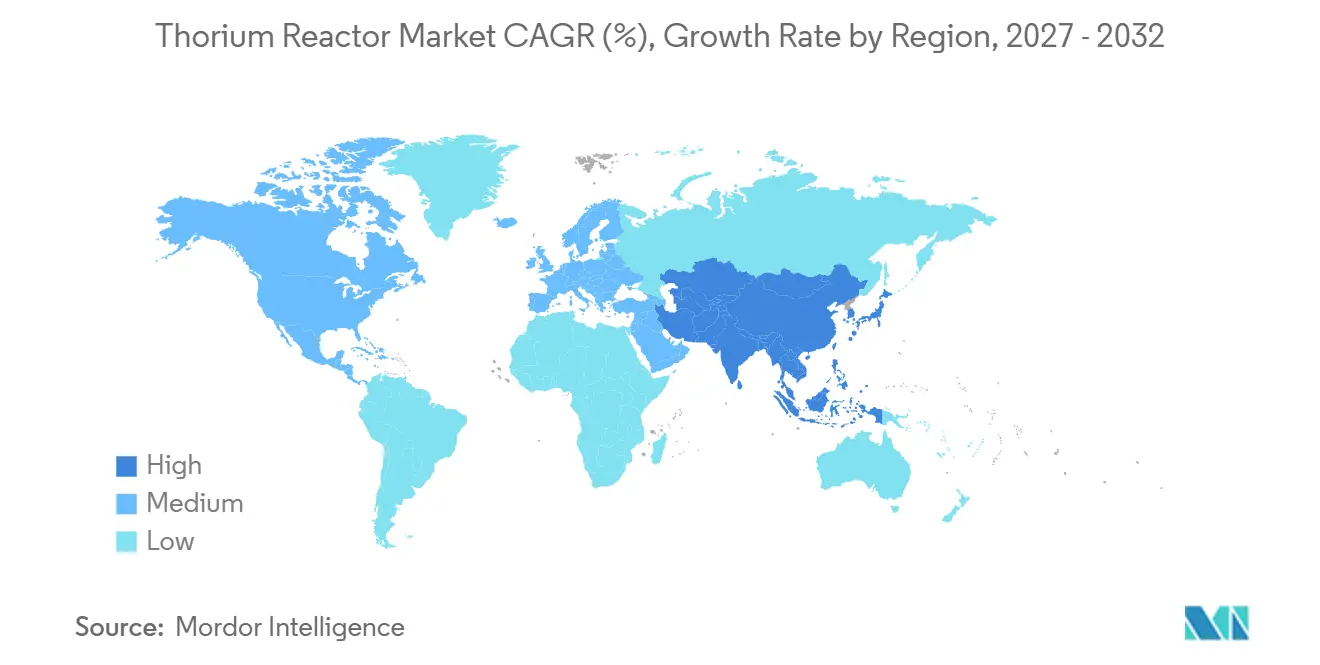
Asia-Pacific held a 45.3% of the global thorium reactor market share in 2026 and is projected to grow at a 12.8% CAGR through 2032. China leads regional development through SINAP's TMSR-LF1 program. In November 2025, SINAP reported the first thorium-to-uranium-233 conversion in an operational liquid-fuel MSR. Its roadmap covers an operating 2 MWt experimental reactor, a 30 MWt research reactor, and a 100 MWt demonstration plant by 2035. India is pursuing the AHWR pathway alongside its three-stage nuclear power program. India has a national target of 100 GW of nuclear capacity by 2047.
Indonesia represents a further regional opportunity after BAPETEN granted ThorCon site-evaluation approval for a proposed 500 MWe MSR on Kelasa Island in July 2025. The company targets construction in 2027 and full power in 2031, according to the supplied research draft. North America and Europe account for most of the remaining global thorium reactor market. In the United States, the NRC finalized the technology-inclusive Part 53 framework in April 2026. Kairos Power broke ground on Hermes 2 in Tennessee in April 2026 and agreed to a binding investment of up to USD 100 million from Samsung C&T in September 2026.
Canada's ANEEL qualification program at Chalk River could establish a fuel pathway for CANDU reactors without hardware modifications. In Europe, Thorizon plans a commercial MSR in the Netherlands by 2034, while Copenhagen Atomics plans a 2027 critical experiment with the Paul Scherrer Institute. THORIZON Brazil, Saudi Arabia, South Africa, and other markets remain early-stage opportunities. Brazil has significant thorium resources but no funded commercial project at the pre-licensing stage in 2026. Saudi Arabia and South Africa have policies or regulatory conditions that could support future technology-transfer projects. The global thorium reactor market in these areas will likely depend on complete licensing packages from established developers.
Competitive Landscape
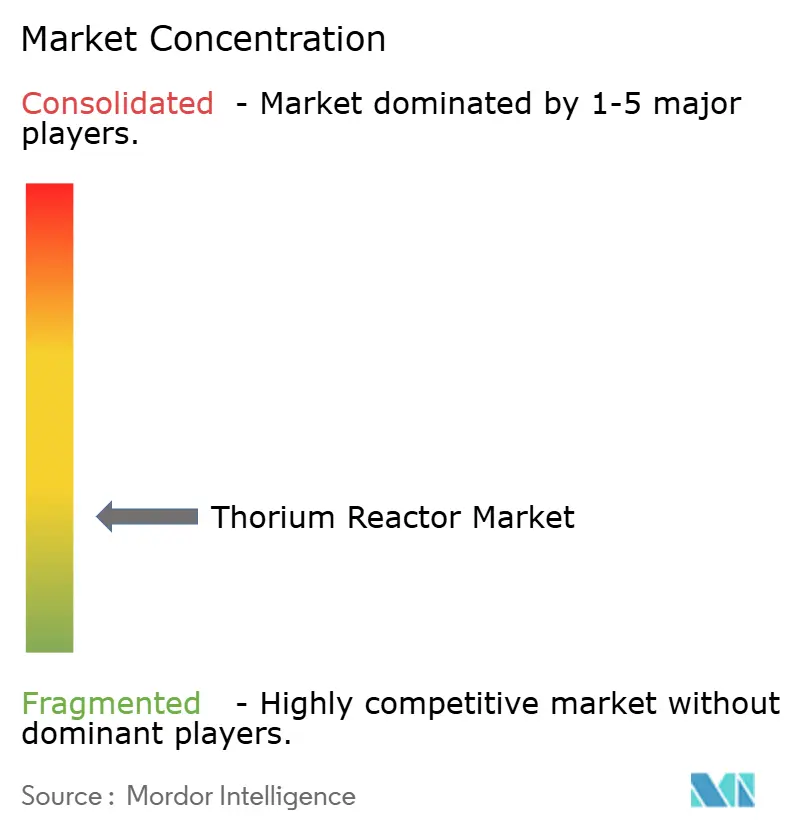
The global thorium reactor market remains fragmented because leading programs use different reactor and fuel-cycle approaches. China's SINAP has a differentiated position as the operator of a thorium-loaded reactor that achieved thorium-to-uranium-233 conversion. Kairos Power has a U.S. NRC construction permit for a fluoride-salt design, while Clean Core Thorium Energy has reported a thorium-fuel irradiation result above 60 GWd/MTU. Materials knowledge, fuel-chemistry intellectual property, and regulatory experience create barriers for new entrants. These capabilities are difficult to replicate quickly, even when capital is available.
Companies are seeking earlier supply-chain integration and formal engineering, procurement, and construction relationships. Thorizon signed an MoU with Hyundai Engineering and Construction for MSR commercialization, according to the supplied research draft. Kairos Power agreed with Samsung C&T on investment and EPC collaboration for Hermes 2 and future KP-FHR deployments in September 2026. KAIROS POWER Copenhagen Atomics has identified thorium supply as part of its development roadmap. These actions aim to reduce uncertainty in project delivery, equipment supply, and fuel availability. They also show that progress in the global thorium reactor market requires coordination beyond reactor design.
Opportunities remain in thorium fuel supply and maritime or island-grid deployment. ThorCon's Indonesian licensing progress could provide a model for projects in Southeast Asia and the Pacific. Thorium Atomics began NRC pre-application engagement in August 2026 for the 250 MWth Tesseract TGR under Part 53. Its parallel engagement with the Canadian Nuclear Safety Commission broadens its regulatory options. New companies can enter as fee reductions and technology-inclusive rules lower the cost of initial regulatory engagement. The global thorium reactor market could therefore have additional active developers by 2032.
Thorium Reactor Industry Leaders
-
China National Nuclear Corporation
-
Terrestrial Energy Inc.
-
Moltex Energy Limited
-
ThorCon Power, Inc.
-
Flibe Energy, Inc.
- *Disclaimer: Major Players sorted in no particular order
Thorium Reactor Market Companies Covered in this Report
- Canadian Nuclear Laboratories Ltd.
- China National Nuclear Corporation
- Clean Core Thorium Energy, Inc.
- Copenhagen Atomics ApS
- Department of Atomic Energy, Government of India
- Flibe Energy, Inc.
- GE Hitachi Nuclear Energy, LLC
- General Atomics
- Kairos Power LLC
- Lightbridge Corporation
- Mitsubishi Heavy Industries, Ltd.
- Moltex Energy Limited
- Nuclear Power Corporation of India Limited
- Orano SA
- Rolls-Royce SMR Limited
- Seaborg Technologies ApS
- Shanghai Institute of Applied Physics, Chinese Academy of Sciences
- TerraPower, LLC
- Terrestrial Energy Inc.
- Thor Energy AS
- ThorCon Power, Inc.
- Thorizon B.V.
- Westinghouse Electric Company LLC
- X-energy, Inc.
Recent Industry Developments in Thorium Reactor Market
- September 2026: Kairos Power signed a binding term sheet with Samsung C&T Engineering and Construction Group for a strategic investment of up to USD 100 million and EPC collaboration on the Hermes 2 commercial-scale demonstration plant in Oak Ridge, Tennessee. Samsung C&T joins the EPC team for Hermes 2 and future KP-FHR commercial deployments.
- May 2026: Clean Core Thorium Energy confirmed that its ANEEL fuel achieved more than 60 GWd/MTU burnup at Idaho National Laboratory's Advanced Test Reactor.
- April 2026: Thorizon, EPZ, NRG PALLAS, the Provinces of Zeeland and Noord-Holland, Impuls Zeeland, ROM InWest, and Invest-NL signed an MoU to build a commercial molten salt reactor in the Netherlands. The plan targets a demonstrator at Petten by 2028, operation by 2030, and first commercial operation of the 100 MWe Thorizon One in Zeeland by 2034.
Global Thorium Reactor Market Report Scope
A thorium reactor is a type of nuclear reactor designed to use thorium (specifically thorium-232) as its primary fuel source. Because thorium is a fertile rather than a fissile material, it cannot sustain a nuclear chain reaction on its own. Instead, it must absorb neutrons from a fissile "starter" fuel (such as uranium or plutonium) to transmute into uranium-233, which then undergoes fission to release energy.
The global thorium reactor market is segmented by reactor type, fuel form, capacity, end-user, and geography. By reactor type, the market is segmented into molten salt reactors (MSRs), liquid fluoride thorium reactors (LFTRs), high-temperature gas-cooled reactors (HTGRs), heavy water reactors (HWRs/PHWRs), accelerator-driven systems (ADS), liquid metal reactors (LMRs), light water reactors (LWRs), and other thorium-compatible reactor designs. By fuel form, the market is segmented into solid fuel and liquid fuel. By capacity, the market is segmented into up to 10 MW, 10–100 MW, 100–300 MW, 300–700 MW, and above 700 MW. By end-user, the market is segmented into nuclear utilities, government and public sector, industrial companies, research institutions, defense and strategic organizations, energy developers, and other end users. The report also covers the market size and forecasts for the global thorium reactor market across 15 countries in the key regions. For each segment, market sizing and forecasts are provided in terms of value (USD).
Segmentation Overview
| Molten Salt Reactors (MSRs) |
| Liquid Fluoride Thorium Reactors (LFTRs) |
| High-Temperature Gas-Cooled Reactors (HTGRs) |
| Heavy Water Reactors (HWRs/PHWRs) |
| Accelerator-Driven Systems (ADS) |
| Liquid Metal Reactors (LMRs) |
| Light Water Reactors (LWRs) |
| Other Thorium-Compatible Reactor Designs |
| Solid Fuel |
| Liquid Fuel |
| Up to 10 MW |
| 10-100 MW |
| 100-300 MW |
| 300-700 MW |
| Above 700 MW |
| Nuclear Utilities |
| Government and Public Sector |
| Industrial Companies |
| Research Institutions |
| Defense and Strategic Organizations |
| Energy Developers |
| Other End Users |
| North America | United States |
| Canada | |
| Rest of North America | |
| Europe | Germany |
| France | |
| United Kingdom | |
| Russia | |
| Norway | |
| Netherlands | |
| Belgium | |
| Rest of Europe | |
| Asia-Pacific | China |
| India | |
| Japan | |
| Rest of Asia-Pacific | |
| South America | Brazil |
| Rest of South America | |
| Middle East and Africa | Saudi Arabia |
| South Africa | |
| Rest of Middle East and Africa |
| By Reactor Type | Molten Salt Reactors (MSRs) | |
| Liquid Fluoride Thorium Reactors (LFTRs) | ||
| High-Temperature Gas-Cooled Reactors (HTGRs) | ||
| Heavy Water Reactors (HWRs/PHWRs) | ||
| Accelerator-Driven Systems (ADS) | ||
| Liquid Metal Reactors (LMRs) | ||
| Light Water Reactors (LWRs) | ||
| Other Thorium-Compatible Reactor Designs | ||
| By Fuel Form | Solid Fuel | |
| Liquid Fuel | ||
| By Capacity | Up to 10 MW | |
| 10-100 MW | ||
| 100-300 MW | ||
| 300-700 MW | ||
| Above 700 MW | ||
| By End User | Nuclear Utilities | |
| Government and Public Sector | ||
| Industrial Companies | ||
| Research Institutions | ||
| Defense and Strategic Organizations | ||
| Energy Developers | ||
| Other End Users | ||
| By Geography | North America | United States |
| Canada | ||
| Rest of North America | ||
| Europe | Germany | |
| France | ||
| United Kingdom | ||
| Russia | ||
| Norway | ||
| Netherlands | ||
| Belgium | ||
| Rest of Europe | ||
| Asia-Pacific | China | |
| India | ||
| Japan | ||
| Rest of Asia-Pacific | ||
| South America | Brazil | |
| Rest of South America | ||
| Middle East and Africa | Saudi Arabia | |
| South Africa | ||
| Rest of Middle East and Africa | ||
Key Questions Answered in the Report
What is the projected value of the global thorium reactor market by 2032?
The Thorium Reactor Market size is projected to be USD 6.21 billion in 2026, USD 6.86 billion in 2027, and reach USD 11.29 billion by 2032, growing at a CAGR of 10.48% from 2027 to 2032.
Which reactor design leads current thorium development?
Molten salt reactors held 37.3% share in 2026, supported by operational and demonstration activity in China and Europe.
Why are countries considering thorium-based reactors?
Governments are assessing thorium for firm low-carbon power, potential domestic fuel pathways, and high-temperature industrial applications.
What is the main constraint on deployment?
Commercial fuel fabrication and recycling capacity is limited, while first-of-a-kind projects face capital, material qualification, and schedule risks.
Which region is growing fastest?
Asia-Pacific held 45.3% share in 2026 and is projected to grow at a 12.8% CAGR through 2032.
Which end user is expected to grow fastest?
Research institutions are expected to grow at a 12.5% CAGR through 2032 because they provide testing, certification, and licensing support.