
Thermoplastic Tape Market Size and Share
Market Overview
| Study Period | 2022 - 2032 |
|---|---|
| Market Size (2027) | USD 7.25 Billion |
| Market Size (2032) | USD 10.33 Billion |
| Growth Rate (2027 - 2032) | 7.32 % |
| Fastest Growing Market | Asia-Pacific |
| Largest Market | North America |
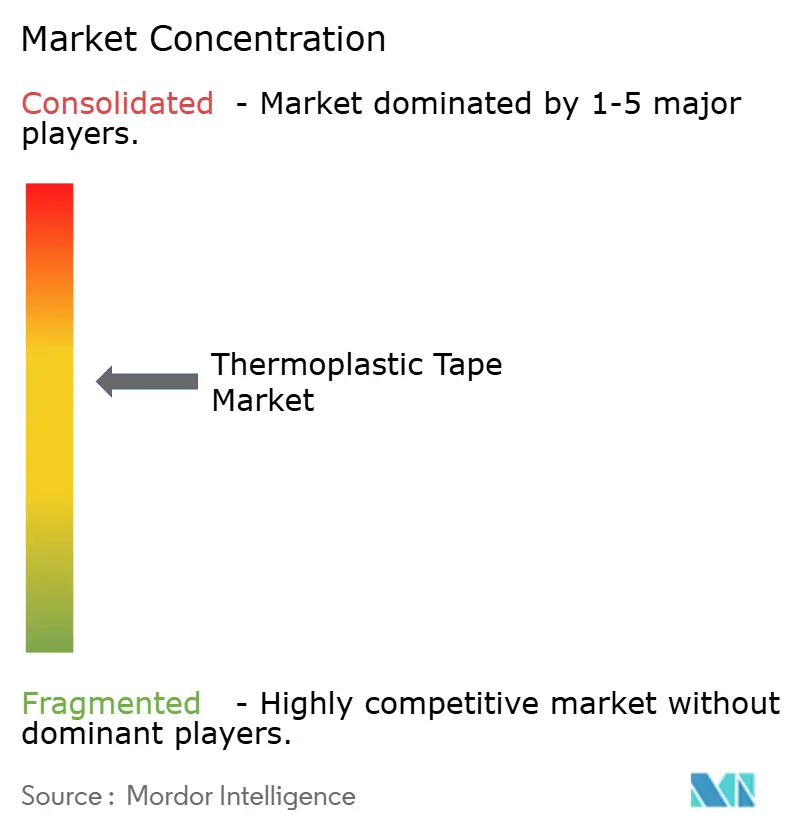
| Market Concentration | Medium |
Major Players *Disclaimer: Major Players sorted in no particular order Image © Mordor Intelligence. Reuse requires attribution under CC BY 4.0. | |
Thermoplastic Tape Market Analysis by Mordor Intelligence
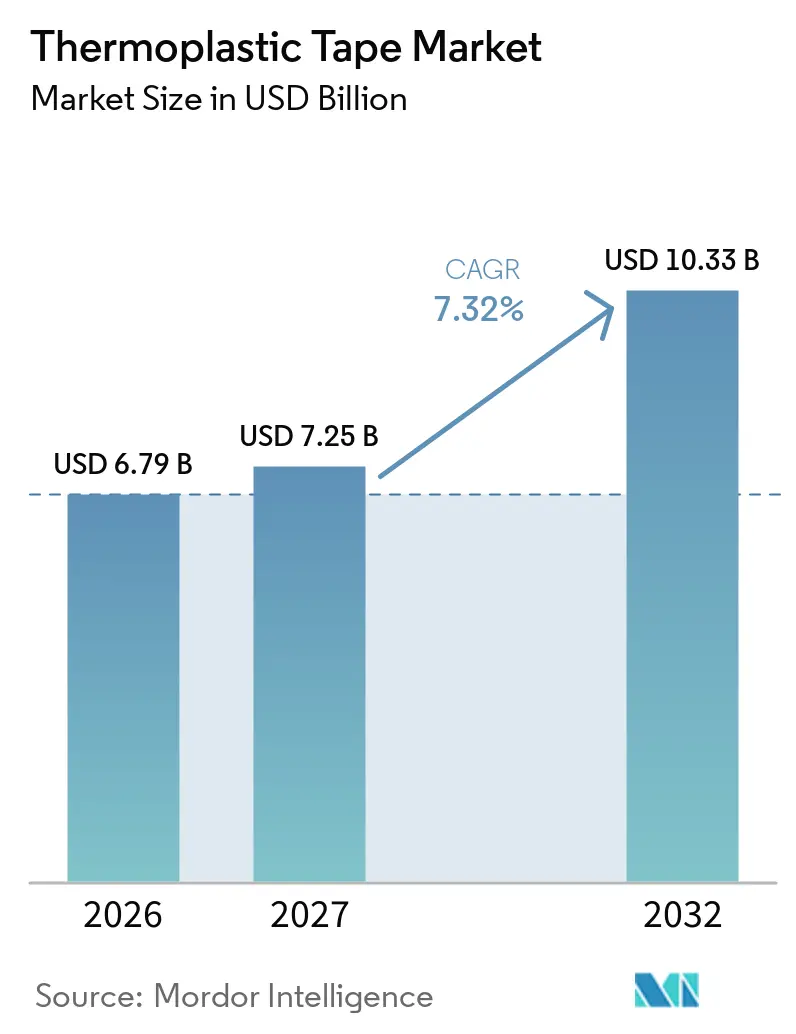
The Thermoplastic Tape Market size was valued at USD 6.79 billion in 2026 and is estimated to grow from USD 7.25 billion in 2027 to USD 10.33 billion by 2032, at a CAGR of 7.32% during the forecast period (2027-2032). The thermoplastic tape market is benefiting from production methods that reduce composite manufacturing time and limit dependence on autoclaves. Aerospace manufacturers require higher output from single-aisle aircraft programs, which favors materials that can be placed and consolidated rapidly. Automotive producers are also using these materials in battery enclosures and structural parts as they seek lighter vehicle designs. Recyclability is becoming increasingly relevant in material selection, especially for manufacturers managing production scrap and end-of-life obligations. However, the market faces constraints due to high equipment costs, high prices of PAEK and carbon fiber systems, and underdeveloped certification processes for welded thermoplastic structures.
Key Report Takeaways
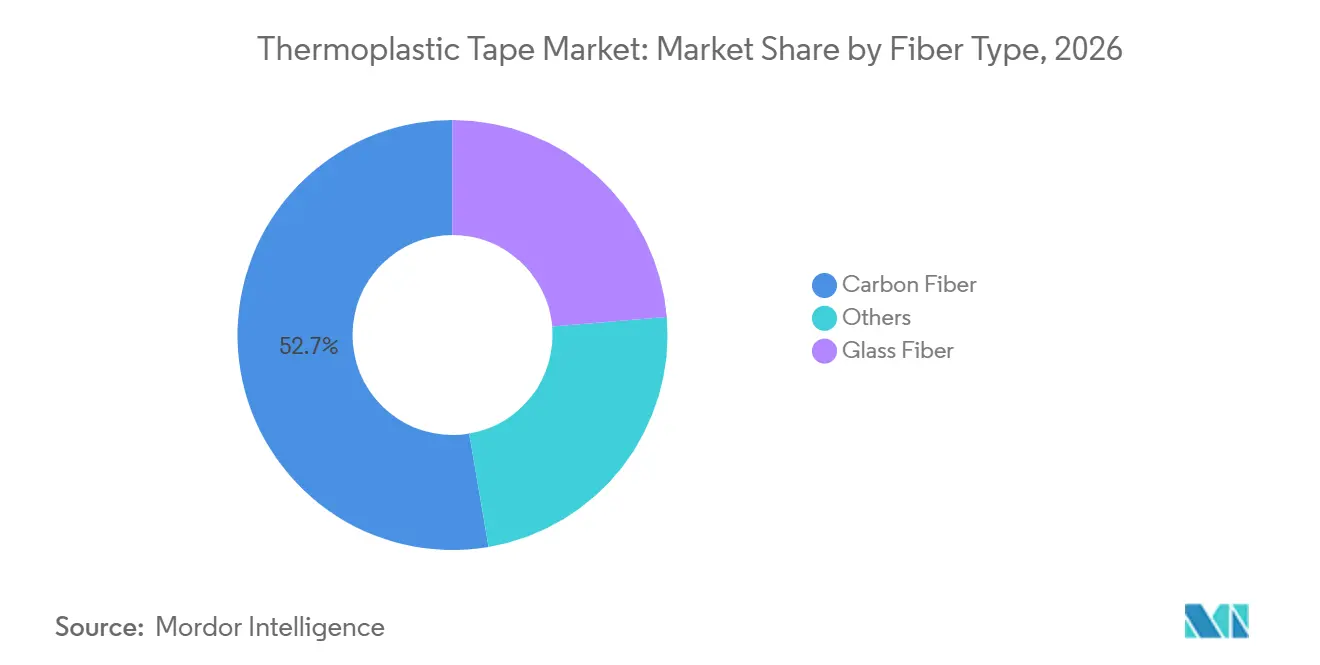
- By fiber type, carbon fiber held 52.67% of the Thermoplastic Tape Market share in 2026 and is forecast to grow at an 8.07% CAGR through 2032.
- By resin type, Polyaryletherketone (PAEK) held 38.14% of the Thermoplastic Tape Market share in 2026, while Polypropylene (PP) is forecast to expand at an 8.42% CAGR through 2032.
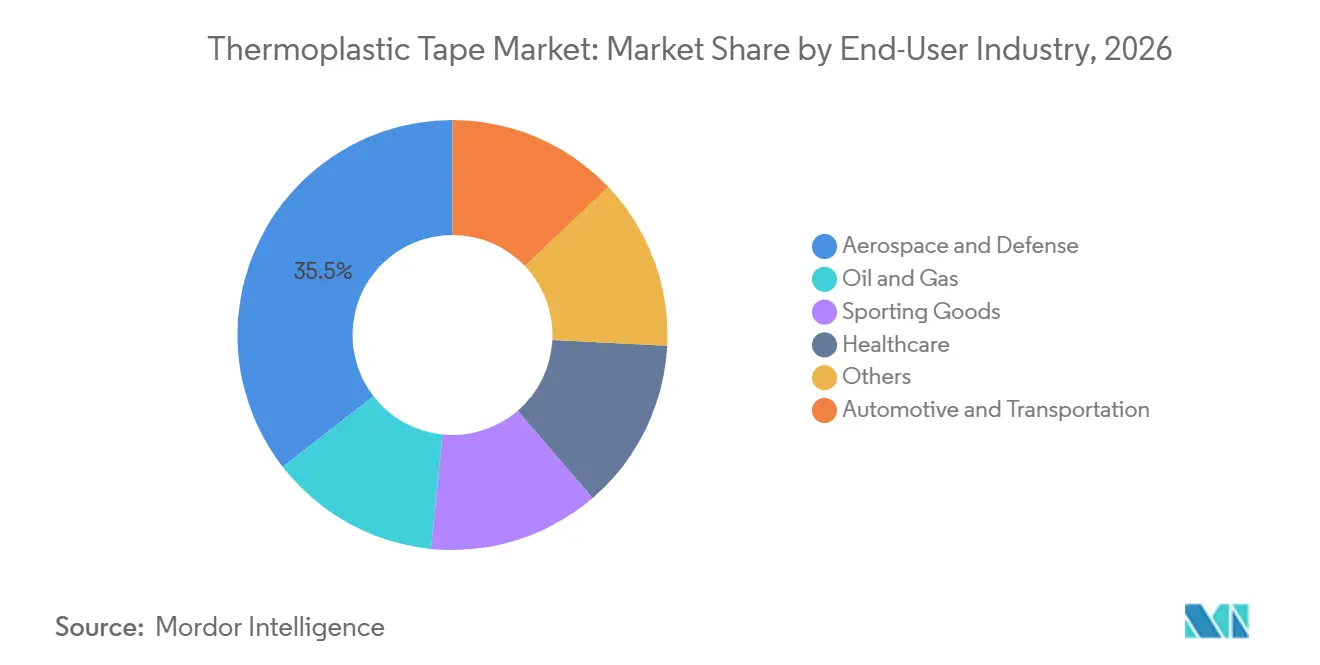
- By end-user industry, aerospace and defense accounted for 35.51% of the Thermoplastic Tape Market size in 2026, while automotive and transportation are projected to grow at a 9.04% CAGR through 2032.
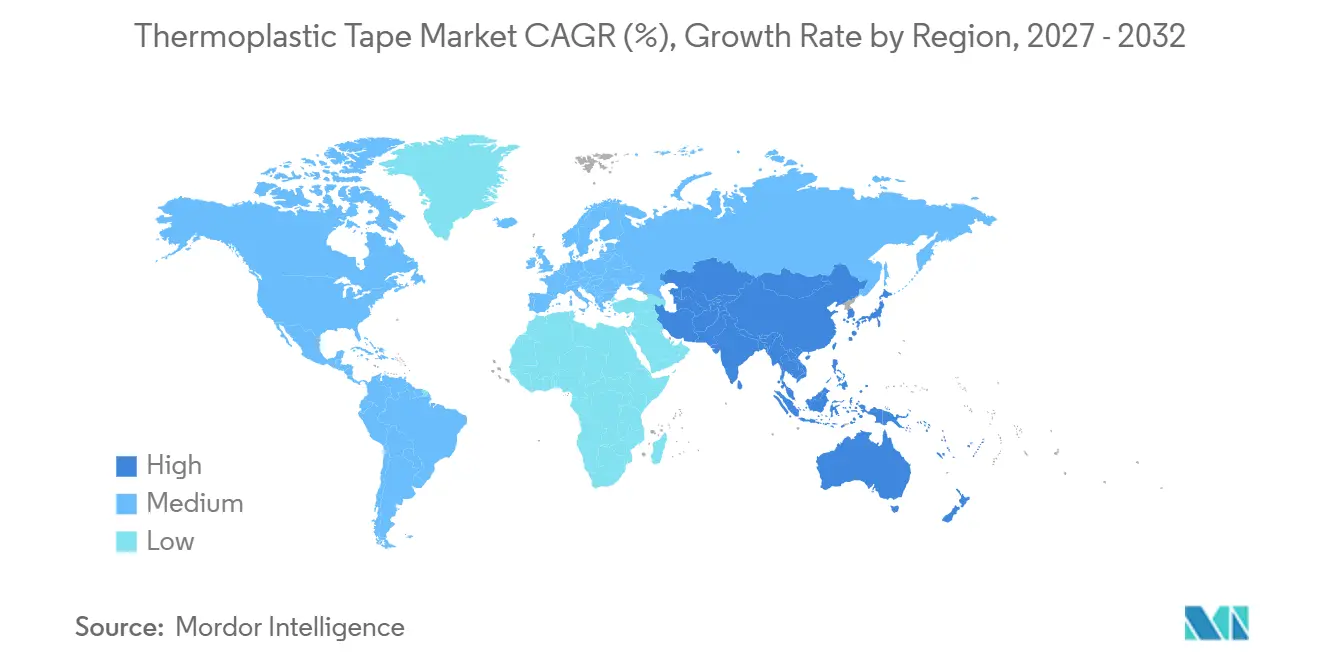
- By geography, North America accounted for 32.33% of the Thermoplastic Tape Market share in 2026, while Asia-Pacific is projected to expand at an 8.73% CAGR through 2032.
Note: Market numbers in this report are based on Mordor Intelligence's proprietary estimation framework, which combines nine months of actuals with Q4 projections for base year 2026.
Market Trends and Insights
Drivers Impact Analysis of Thermoplastic Tape Market*
| Drivers | (~) % Impact on CAGR Forecast | Geographic Relevance | Impact Timeline |
|---|---|---|---|
| Aerospace and Automotive Lightweighting Requirements | +1.8% | Global, with concentration in North America, Europe, and Japan | Long term (≥ 4 years) |
| Adoption of Automated Fiber Placement and Automated Tape Laying | +1.5% | North America and Europe, with rapid uptake in Japan and South Korea | Medium term (2-4 years) |
| Recyclability and Circular-Design Requirements | +0.8% | European Union core, with spillover to North America and Japan | Medium term (2-4 years) |
| Faster Out-of-Autoclave Processing and Fusion Welding | +1.2% | Global, led by North America, Germany, and the Netherlands | Medium term (2-4 years) |
| Electric Vehicle Battery-Enclosure Lightweighting | +1.4% | China, Germany, and South Korea, with early gains in North America | Short term (≤ 2 years) |
| Source: Mordor Intelligence | |||
Aerospace and Automotive Lightweighting Requirements
Weight reduction supports both regulatory compliance and product performance, strengthening demand for high-performance tapes. The thermoplastic tape market benefits as aircraft manufacturers increase output from single-aisle programs. Automated tape laying and automated fiber placement can shorten composite production cycles compared with conventional thermoset processes. Carbon fiber-reinforced thermoplastics are used in fuselage, wing, and pressure-vessel applications due to their combination of stiffness and recyclability. Automotive producers are also considering tape-based organosheets for floor structures and pillar reinforcement. This wider use could extend demand beyond aerospace applications in the thermoplastic tape market.
Adoption of Automated Fiber Placement and Automated Tape Laying
Automated fiber placement and automated tape laying are established production methods in certified aerospace programs. Their broader use is increasing demand for tapes that can be placed at controlled speeds and temperatures. Research published in 2025 found that compaction force and tool temperature were key factors in achieving sound infrared-assisted AFP laminates[1]. Lower-melt polyaryletherketone (PAEK) systems can reduce energy use and widen the practical operating window for automated processing. In May 2026, Toray Advanced Composites reported expanded National Center for Advanced Materials Performance (NCAMP) qualifications for its low-melt PAEK material system, supporting its use in aerospace design programs. These process advances improve the case for automated production across the thermoplastic tape market.
Recyclability and Circular-Design Requirements
Recyclability is becoming a procurement consideration in regulated product categories, especially in Europe. Thermoplastic composite tapes can be reheated and reshaped, allowing recovery of in-process scrap and supporting component disassembly. A 2025 study found that a thermoplastic composite scenario provided recyclability benefits and the lowest production cost among the scenarios assessed, while still requiring careful design for high-load applications. These characteristics matter to manufacturers responding to circular-design and producer-responsibility requirements. Polypropylene (PP) tape systems are particularly relevant in mid-performance products where closed-loop material recovery has commercial value. This factor is broadening the application base of the thermoplastic tape market.
Faster Out-of-Autoclave Processing and Fusion Welding
The thermoplastic tape market benefits from production methods that address total manufacturing costs rather than material prices alone. NASA documented high-rate automated fiber placement (AFP) followed by vacuum-bag-only consolidation for carbon fiber/PEEK (CF/PEEK) and CF/PEKK systems under its HiCAM project. The project targeted a 4- to 6-fold improvement in composite aircraft manufacturing speed. Thermoplastic laminates can also be joined through resistance, induction, or ultrasonic welding. These approaches can reduce the need for mechanical fasteners and adhesive films. Faster forming and welding can help manufacturers develop more automated assembly lines for aerospace structures.
Restraints Impact Analysis of Thermoplastic Tape Market*
| Restraints | (~) % Impact on CAGR Forecast | Geographic Relevance | Impact Timeline |
|---|---|---|---|
| High Processing Temperatures and Equipment Requirements | -0.6% | Global, most constraining in Southeast Asia and South America | Medium term (2-4 years) |
| Premium Cost of PAEK, PEEK, PEKK, and Carbon Fiber Systems | -0.8% | Global, especially limited to price-sensitive markets in Asia and South America | Long term (≥ 4 years) |
| Incomplete Thermoplastic Composite Certification Standards | -0.5% | North America and Europe, the primary certification jurisdictions | Medium term (2-4 years) |
| Source: Mordor Intelligence | |||
High Processing Temperatures and Equipment Requirements
PAEK, PEEK, and PEKK systems require processing temperatures of 300 to 400°C. This raises capital costs for heating, placement, consolidation, and inspection equipment. As a result, adoption is concentrated among larger suppliers that operate dedicated Automated Fiber Placement (AFP) and Automated Tape Laying (ATL) lines. Smaller composite fabricators may face difficulty acquiring the equipment needed to process these materials. This limitation can create supply bottlenecks when aerospace programs increase output and restrict market access in regions with less established composite manufacturing capacity.
Premium Cost of PAEK, PEEK, PEKK, and Carbon Fiber Systems
PAEK-family resins and carbon fiber remain more expensive than thermoset epoxy and glass fiber in many applications. This cost difference limits their use in cases where performance requirements do not justify a premium material system, most directly affecting price-sensitive automotive, industrial, and consumer applications. Carbon fiber precursor costs also influence tape economics, as manufacturers have fewer formulation options to absorb feedstock changes. Integrated suppliers can partially manage this exposure by combining polymer, fiber, and tape operations. However, the capital requirements for this level of integration remain a cost barrier within the thermoplastic tape market.
*Our forecasts treat driver/restraint impacts as directional, not additive. The impact forecasts reflect baseline growth, mix effects, and variable interactions.
Thermoplastic Tape Market Segment Analysis
By Fiber Type:
Carbon Fiber Leads Across Both Share and GrowthCarbon fiber holds 52.67% of the thermoplastic tape market share in 2026 and is expected to grow at an 8.07% CAGR through 2032. Its position reflects the high mechanical performance required in aerospace and defense structures, where reinforcement must sustain demanding loads and temperatures. High-temperature PAEK, PEKK, and PEEK systems rely on carbon fiber reinforcement to maintain structural performance at elevated temperatures. Carbon fiber tapes are being assessed for applications ranging from primary aerospace structures to automotive battery frames, pillar reinforcements, and crash-management parts. This range of applications supports demand across both high-value aerospace uses and quantity-oriented automotive programs.
Glass fiber remains relevant where cost, electrical insulation, or radar transparency takes priority over stiffness. It is used in applications such as battery enclosure sidewalls and radome structures, where these properties matter more than load-bearing capability. A 2025 study reported that combining carbon fiber tape with glass fiber thermoplastics improved tensile properties by 129% and flexural strength by 192%. Hybrid structures can help manufacturers balance performance and cost across parts with different design requirements. PP-matrix glass fiber products face strong price competition in industrial and sporting goods applications, which can broaden their customer base while compressing supplier margins. Carbon fiber retains the leading role in the thermoplastic tape market, while glass fiber broadens adoption in cost-sensitive applications.

By Resin Type:
PAEK Anchors Aerospace, While PP Accelerates in AutomotivePAEK accounted for 38.14% of the thermoplastic tape market share in 2026. Its high-temperature capability and compatibility with Automated Fiber Placement (AFP), Automated Tape Laying (ATL), and thermoforming support its use in primary aerospace structures requiring controlled, repeatable manufacturing. Low-melt PAEK systems can offer a wider processing window than conventional PEEK systems, reducing energy demand and equipment stress during high-rate processing. Toray's 2026 expansion of the National Center for Advanced Materials Performance (NCAMP) qualifications for a low-melt PAEK material system supports its use in qualified aerospace applications. PAEK remains central to the thermoplastic tape market, where temperature resistance and certification status are the primary requirements.
PPS is used in applications requiring chemical resistance, including industrial piping and defense components. PA tapes are used in automotive and sporting goods products, where resin selection reflects processing, weight, and sustainability requirements. Arkema featured bio-based PA11 unidirectional tape at JEC World 2026, demonstrating how renewable feedstocks can be incorporated into resin choices. PP is forecast to grow at an 8.42% CAGR through 2032, the fastest rate among resin types, due to its low density, impact resistance, recyclability, and compatibility with automotive cycle times. PEI, PC, and PVDF occupy specialized positions in semiconductor handling, medical devices, and offshore applications.
By End-User Industry:
Aerospace Dominates While Automotive Posts Highest VelocityAerospace and defense accounted for 35.51% of the thermoplastic tape market size in 2026. New-generation aircraft are increasingly using tapes in structural components as manufacturers seek faster, more repeatable, and less labor-intensive manufacturing processes. The HELUES project demonstrated an overwing door component made using one-step forming and injection overmolding. Arkema and Hexcel reported that this approach reduced assembly steps by up to 90% and kept cycle time below 2 minutes. This result demonstrates the potential for simplified production of aerospace parts, while aerospace remains the primary value segment of the thermoplastic tape market.
Automotive and transportation are projected to grow at a 9.04% CAGR through 2032. EV battery enclosures and body-in-white inserts are the near-term sources of demand, as manufacturers require lighter parts that can be produced in high quantities. Automotive producers also need materials that improve impact behavior while fitting established production schedules. Oil and gas remain important for thermoplastic composite pipe used in offshore risers and downhole tubing. Victrex reported that TechnipFMC received a technology contract from Petrobras for its Magma composite pipe program in May 2025. Sporting goods and healthcare provide smaller, specialized opportunities, including recyclable sports components and sterilization-resistant PEEK or PAEK medical parts.
Geography Analysis
North America
North America held 32.33% of the thermoplastic tape market share in 2026. The region has a strong concentration of aerospace OEM suppliers, defense composite facilities, and FAA certification activity. NASA's HiCAM work reflects public support for faster thermoplastic composite processing in US aviation manufacturing. The regional certification environment benefits suppliers that develop validated design data, but it can slow entry for smaller companies without the resources for qualification work. These conditions make North America the primary demand base for the thermoplastic tape market.
Asia-Pacific
Asia-Pacific is projected to expand at an 8.73% CAGR through 2032. China's EV production supports demand for lightweight battery enclosure systems, while Japan is advancing the qualification of carbon fiber-reinforced thermoplastics for future domestic aviation applications. Fukuvi Chemical Industry completed a New Energy and Industrial Technology Development Organization (NEDO) project on mass-production technology for thermoplastic CFRTP in October 2025[2]. The project indicates that Japanese suppliers are building domestic production capability for advanced composite applications, and Asian producers are increasing price competition in PP and glass-fiber systems.
Europe, South America, the Middle East, and Africa
Europe has an integrated base of composite research, material chemistry, and application engineering. Circular-design requirements support interest in remeltable materials and scrap recovery, while specialty resin development supports the thermoplastic tape market. South America remains at an earlier stage, although offshore oil and gas applications can create demand for thermoplastic composite pipe. Demand in the Middle East and Africa is also driven by oil and gas infrastructure, where corrosion resistance and lower installed weight are valuable. These regional markets are likely to develop through specialized projects before broader adoption in the automotive or aerospace sectors.
Competitive Landscape
The thermoplastic tape market is moderately consolidated. Suppliers that combine polymer chemistry, fiber production, and tape conversion hold an advantage in aerospace programs, as they can pair materials with manufacturing knowledge and qualification support. Victrex, Arkema, and Syensqo hold positions in the PAEK and PEKK supply chains, where material expertise and qualification data create substantial barriers to entry. Toray and Teijin offer integrated capabilities in carbon fiber and resin that support complete material packages. These positions make it more difficult for independent tape converters to compete in the higher-value segments of the thermoplastic tape market.
In May 2026, Toray Advanced Composites expanded National Center for Advanced Materials Performance (NCAMP) qualifications for its Cetex TC1225 low-melt PAEK composite material system. Qualified data sets support durable customer relationships because aerospace designers build material allowables around approved systems. At the 2025 Paris Air Show, Arkema and Hexcel demonstrated the HELUES overwing door concept, which showed a route to reducing aerospace assembly steps through forming and overmolding. These developments indicate that qualified materials and scalable manufacturing methods are key competitive factors in the thermoplastic tape market.
The mid-tier automotive segment remains more open, as PP-based and PA-based systems have fewer mature, large-scale supply chains. In August 2025, Avient launched a 50-inch-wide Polystrand unidirectional composite tape to improve manufacturing efficiency and scale for customers. This addresses conversion cost and throughput, which are central considerations for automotive buyers. China-based producers are expanding domestic output in EV and sporting goods applications; however, the available material does not indicate qualification status for export aerospace programs. Competition is therefore likely to remain strongest in aerospace qualification and in process efficiency for automotive and industrial applications.
Thermoplastic Tape Industry Leaders
-
Solvay
-
TORAY INDUSTRIES, INC.
-
Evonik Industries AG
-
SABIC
-
TEIJIN LIMITED
- *Disclaimer: Major Players sorted in no particular order
Thermoplastic Tape Market Companies Covered in this Report
- Arkema
- Avient Corporation
- BASF
- Celanese Corporation
- CompTape B.V.
- Covestro AG
- Evonik Industries AG
- Hexcel Corporation
- Mitsui Chemicals, Inc.
- SABIC
- SGL Carbon
- Solvay
- Syensqo
- TEIJIN LIMITED
- TORAY INDUSTRIES, INC.
- Victrex plc
Recent Industry Developments in Thermoplastic Tape Market
- October 2025: Syensqo's CYCOM EP2190 epoxy prepreg was added to the National Center for Advanced Materials Performance (NCAMP) database in both unidirectional (UD) tape (on Teijin IMS65 fiber) and woven fabric formats. The publicly available qualification data packages are expected to accelerate adoption timelines for aerospace programs.
- September 2025: Avient Corporation introduced its Polystrand 50-inch-wide Continuous Fiber-Reinforced Thermoplastic UD Tape at the Composites and Advanced Materials Expo (CAMX) 2025. The thermoplastic tape is manufactured in Englewood, Colorado, and is intended to improve manufacturing efficiency and production scalability for thermoplastic composites across existing and developing markets.
Global Thermoplastic Tape Market Report Scope
A thermoplastic tape is a polymer-based ribbon or strip that softens and becomes pliable when heated, then hardens into a strong, durable shape or bond as it cools. These tapes are widely used across industries such as aerospace, automotive, and construction, where reliable bonding and structural integrity are required.
The thermoplastic tape market is segmented by fiber type, resin type, end-user industry, and geography. By fiber type, the market is segmented into carbon fiber, glass fiber, and others. By resin type, the market is segmented into polyaryletherketone (PAEK), polyphenylene sulfide (PPS), polyamide (PA), polypropylene (PP), and others. By end-user industry, the market is segmented into aerospace and defense, automotive and transportation, oil and gas, sporting goods, healthcare, and others. The report also covers market sizes and forecasts for the thermoplastic tape across 15 countries in major regions. The market sizes and forecasts are provided in terms of value (USD).
Segmentation Overview
| Carbon Fiber |
| Glass Fiber |
| Others |
| Polyaryletherketone (PAEK) |
| Polyphenylene Sulfide (PPS) |
| Polyamide (PA) |
| Polypropylene (PP) |
| Others |
| Aerospace and Defense |
| Automotive and Transportation |
| Oil and Gas |
| Sporting Goods |
| Healthcare |
| Others |
| Asia-Pacific | China |
| India | |
| Japan | |
| South Korea | |
| ASEAN Countries | |
| Rest of Asia-Pacific | |
| North America | United States |
| Canada | |
| Mexico | |
| Europe | Germany |
| United Kingdom | |
| France | |
| Italy | |
| NORDIC Countries | |
| Rest of Europe | |
| South America | Brazil |
| Argentina | |
| Rest of South America | |
| Middle East and Africa | Saudi Arabia |
| South Africa | |
| Rest of Middle East and Africa |
| By Fiber Type | Carbon Fiber | |
| Glass Fiber | ||
| Others | ||
| By Resin Type | Polyaryletherketone (PAEK) | |
| Polyphenylene Sulfide (PPS) | ||
| Polyamide (PA) | ||
| Polypropylene (PP) | ||
| Others | ||
| By End-User Industry | Aerospace and Defense | |
| Automotive and Transportation | ||
| Oil and Gas | ||
| Sporting Goods | ||
| Healthcare | ||
| Others | ||
| By Geography | Asia-Pacific | China |
| India | ||
| Japan | ||
| South Korea | ||
| ASEAN Countries | ||
| Rest of Asia-Pacific | ||
| North America | United States | |
| Canada | ||
| Mexico | ||
| Europe | Germany | |
| United Kingdom | ||
| France | ||
| Italy | ||
| NORDIC Countries | ||
| Rest of Europe | ||
| South America | Brazil | |
| Argentina | ||
| Rest of South America | ||
| Middle East and Africa | Saudi Arabia | |
| South Africa | ||
| Rest of Middle East and Africa | ||
Key Questions Answered in the Report
What is current market size of Thermoplastic Tape Market?
The Thermoplastic Tape Market size was valued at USD 6.79 billion in 2026 and is estimated to grow from USD 7.25 billion in 2027 to USD 10.33 billion by 2032, at a CAGR of 7.32% during the forecast period (2027-2032).
Which type of resin is growing fastest in thermoplastic tape applications?
PP is forecast to grow at an 8.42% CAGR through 2032, supported by demand for automotive battery enclosures.
Which end-user application is expected to grow fastest?
Automotive and transportation are expected to expand at a 9.04% CAGR through 2032, led by EV battery enclosures and structural components.
Which region is expanding fastest for thermoplastic tape?
Asia-Pacific is projected to grow at an 8.73% CAGR through 2032, supported by EV production in China and the development of Carbon Fiber Reinforced Thermoplastic (CFRTP) in Japan.