
Thermoplastic Polyolefins Market Size and Share
Market Overview
| Study Period | 2021 - 2031 |
|---|---|
| Market Size (2026) | USD 6.46 Billion |
| Market Size (2031) | USD 8.79 Billion |
| Growth Rate (2026 - 2031) | 6.36 % |
| Fastest Growing Market | Asia-Pacific |
| Largest Market | Asia-Pacific |
| Market Concentration | Medium |
Major Players *Disclaimer: Major Players sorted in no particular order Image © Mordor Intelligence. Reuse requires attribution under CC BY 4.0. | |
Thermoplastic Polyolefins Market Analysis by Mordor Intelligence
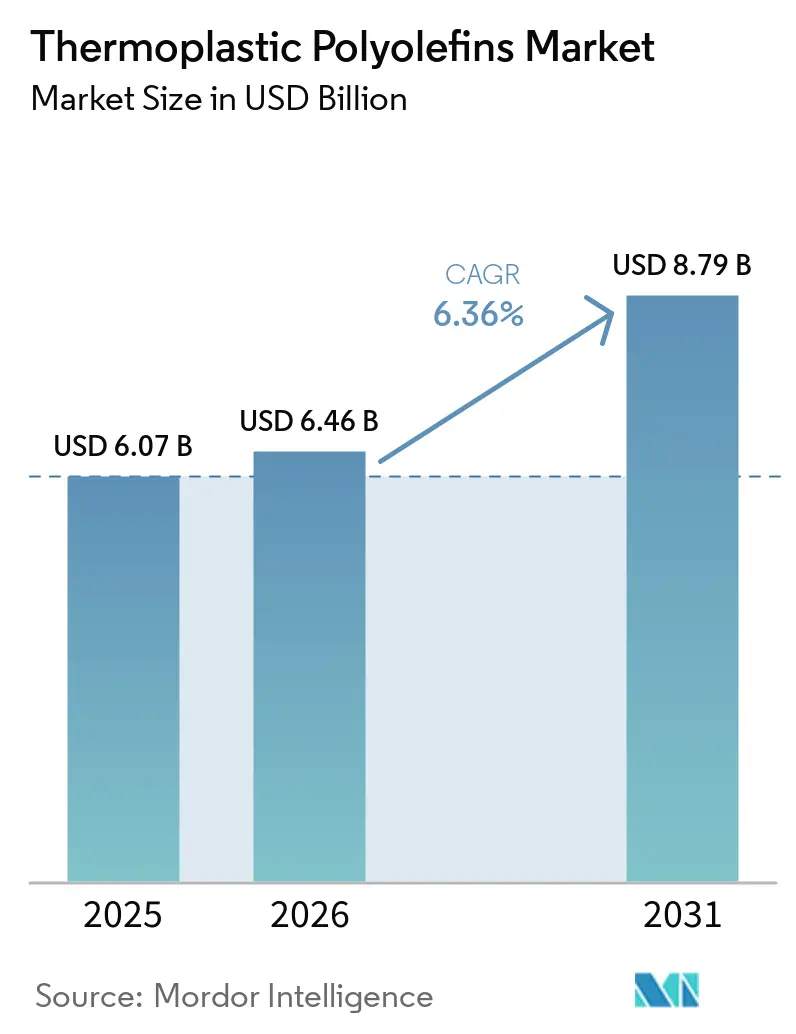
The Thermoplastic Polyolefins Market size was valued at USD 6.07 billion in 2025 and is estimated to grow from USD 6.46 billion in 2026 to reach USD 8.79 billion by 2031, at a CAGR of 6.36% during the forecast period (2026-2031). Automotive lightweighting, construction membranes, and sterile medical devices support demand across the thermoplastic polyolefins market. The material combines low density, impact resistance, chemical resistance, recyclability, and compatibility with extrusion and injection molding. Automotive manufacturers are also increasing their focus on materials with documented recycled content and low volatile organic compound credentials. Integrated producers can support these requirements through feedstock access and closed-loop supply arrangements, while specialty compounders can compete where customer specifications require tailored performance. Feedstock price swings and temperature limits will continue to shape product selection and supplier margins in the thermoplastic polyolefins market.
Key Report Takeaways
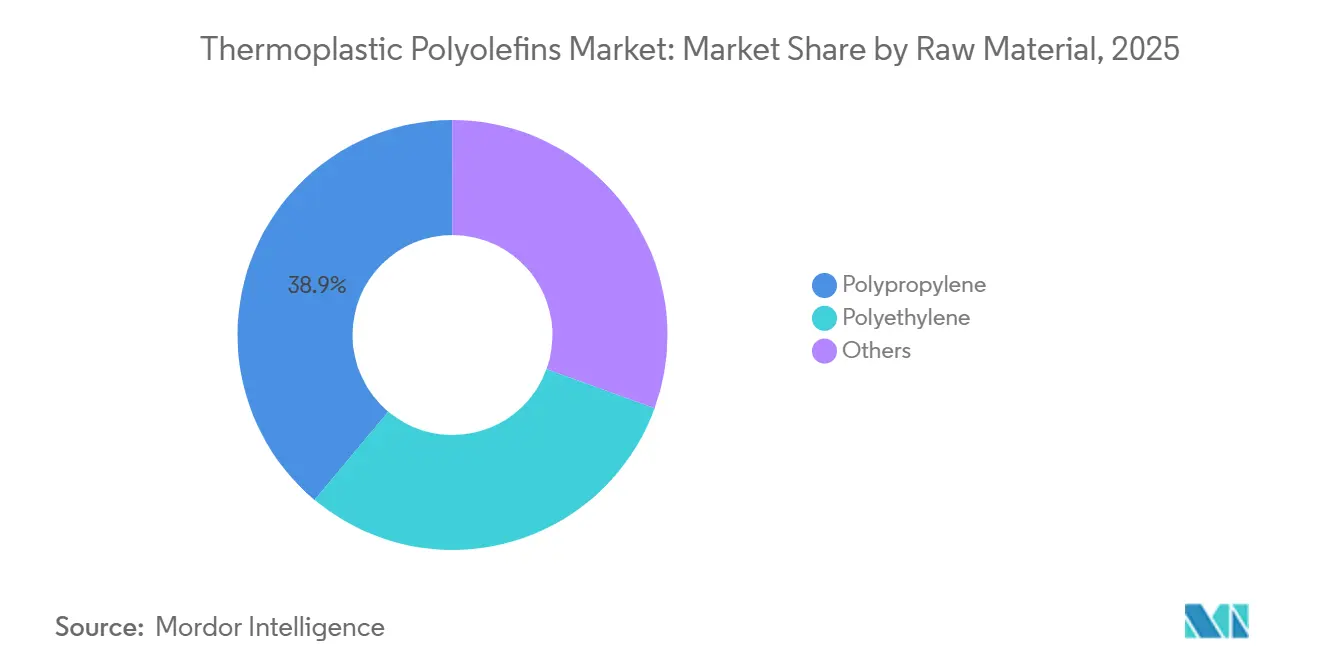
- By raw material, polypropylene held 38.91% of the thermoplastic polyolefins market share in 2025, while polyethylene is projected to advance at a 6.89% CAGR through 2031.
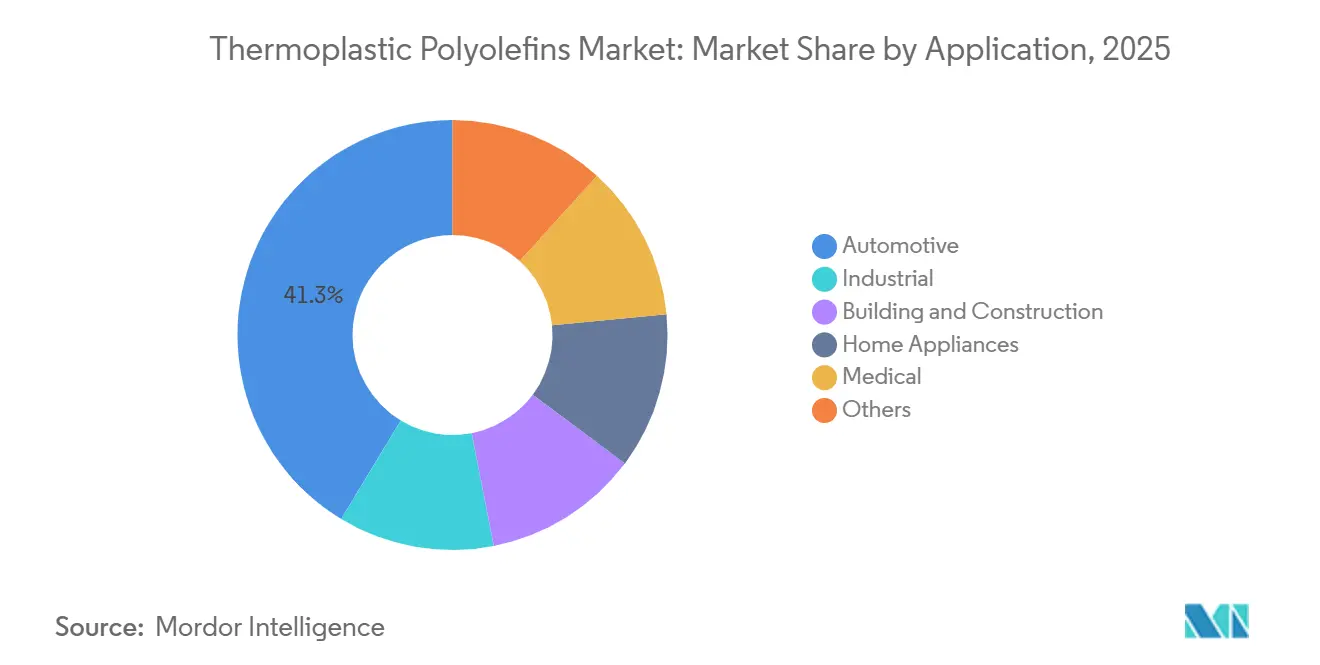
- By application, automotive held 41.34% of the thermoplastic polyolefins market share in 2025, while medical is projected to advance at a 7.42% CAGR through 2031.
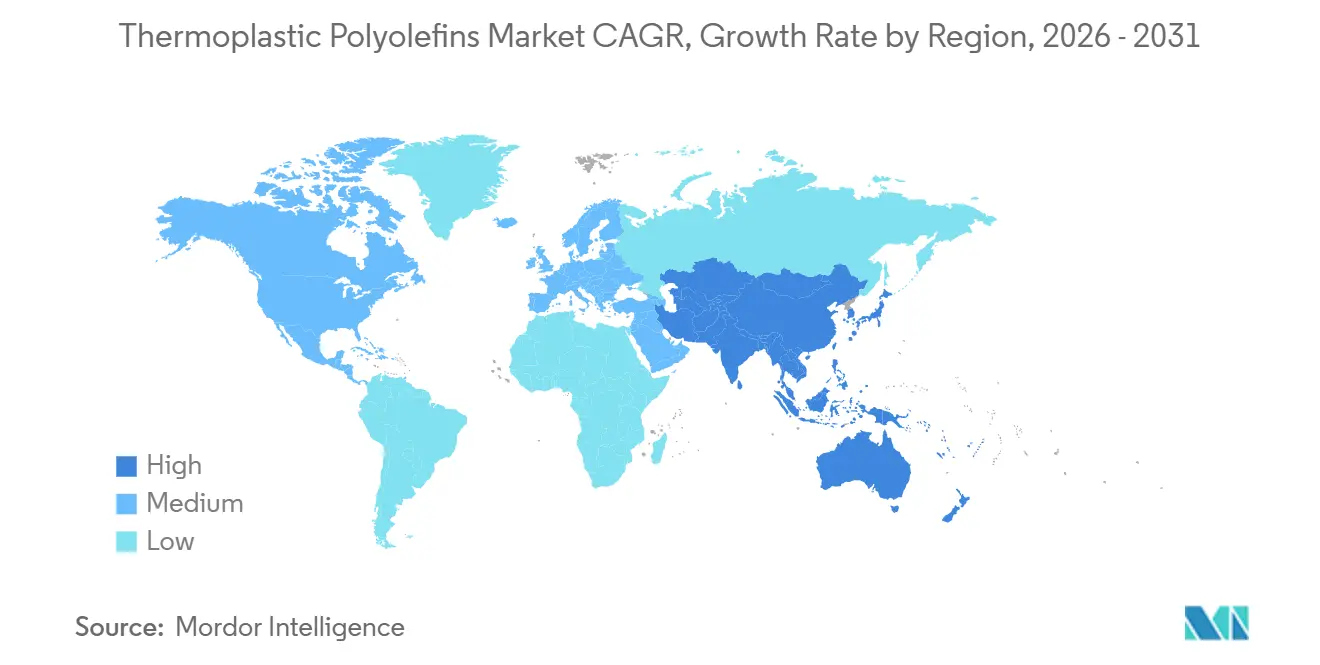
- By geography, Asia-Pacific held 43.66% of the thermoplastic polyolefins market share in 2025 and is projected to advance at a 7.05% CAGR through 2031.
Note: Market size and forecast figures in this report are generated using Mordor Intelligence’s proprietary estimation framework, updated with the latest available data and insights as of January 2026.
Market Trends and Insights
Drivers Impact Analysis of Thermoplastic Polyolefins Market*
| Driver | (~) % Impact on CAGR Forecast | Geographic Relevance | Impact Timeline |
|---|---|---|---|
| Automotive Lightweighting and Emissions Compliance | +1.8% | Global, with largest volume uplift in Europe, China, and North America | Medium term (2-4 years) |
| Electric Vehicle Battery and Interior Component Demand | +1.5% | Global, core demand concentrated in China, South Korea, and Germany | Long term (≥ 4 years) |
| Recyclable and Low-VOC Material Adoption | +1.2% | North America & EU, spillover to APAC core markets | Medium term (2-4 years) |
| Growth of TPO Roofing and Waterproofing Membranes | +0.9% | APAC core, North America, spillover to MEA | Medium term (2-4 years) |
| Recycled-TPO Performance Recovery Through Compatibilizers | +0.6% | Europe & North America, emerging adoption in APAC | Long term (≥ 4 years) |
| Source: Mordor Intelligence | |||
Automotive Lightweighting and Emissions Compliance
Automotive lightweighting remains a central source of demand for the thermoplastic polyolefins market. The European Commission presented its Automotive Package on December 16, 2025, setting a 90% tailpipe-emissions reduction target for cars from 2035. The remaining 10% can be addressed through low-carbon steel produced in the European Union, e-fuels, or biofuels[1]European Commission, “Automotive Package, Action Plan for the Future Automotive Sector,” Transport, European Commission, transport.ec.europa.eu. Thermoplastic polyolefins have densities of 0.89 to 1.05 g/cm³ and can replace heavier materials in bumper fascias, door panels, and fender liners. This combination supports vehicle programs that need lower mass without sacrificing impact resistance or exterior durability. Battery electric vehicle platforms add further pressure to reduce vehicle weight because battery packs increase overall vehicle mass and raise the importance of materials used across the thermoplastic polyolefins market.
Electric Vehicle Battery and Interior Component Demand
Electric vehicle designs support demand for thermoplastic polyolefins in interior and battery-related components. Lower powertrain noise raises requirements for noise, vibration, and harshness control in cabin panels. Standard thermoplastic polyolefins (TPO) grades can serve interior and underbody areas that do not face the high temperatures associated with combustion engines. Kautex Textron won a 2025 contract for a battery housing on a multi-brand battery electric vehicle platform under its Pentatonic portfolio. These developments expand the range of vehicle areas in which TPO compounders can seek qualification in the thermoplastic polyolefins market.
Recyclable and Low-VOC Material Adoption
Material purchasing requirements increasingly include recycled content and low-volatile organic compound performance. Polypropylene-based TPO grades can support low volatile organic compound requirements for vehicle interiors without the plasticizers associated with some alternative materials. Regulation (EU) 2026/1738 entered into force on August 13, 2026, and requires new vehicles launched from 2032 to contain at least 15% post-consumer recycled plastic. The requirement rises to 25% from 2036 and includes at least 3% from end-of-life vehicle waste in a car-to-car loop. The regulation includes thermoplastically processed elastomers, extending the compliance requirement to relevant TPO formulations. Producers with recycled polypropylene supply chains and traceability systems can therefore strengthen their position in the thermoplastic polyolefins market.
Growth of TPO Roofing and Waterproofing Membranes
TPO roofing and waterproofing membranes provide a separate demand channel from automotive production. Energy-efficiency rules and cool-roof specifications support the use of materials with solar reflectance and thermal emittance performance. The United States Environmental Protection Agency ENERGY STAR Roof Products Program provides a framework for roof product performance requirements. Large warehouse and logistics projects in China and India support industrial roofing demand in Asia-Pacific. Green building systems can reinforce demand because membrane specifications remain in place through long building service lives. This construction channel gives the thermoplastic polyolefins market exposure to infrastructure activity as well as vehicle production, creating a demand base that follows building programs rather than automotive production cycles.
Restraints Impact Analysis of Thermoplastic Polyolefins Market*
| Restraint | (~) % Impact on CAGR Forecast | Geographic Relevance | Impact Timeline |
|---|---|---|---|
| Polypropylene and Elastomer Feedstock Price Volatility | -0.9% | Global, most acute in Asia-Pacific and Europe | Short term (≤ 2 years) |
| Limited High-Temperature Performance | -0.7% | Global | Medium term (2-4 years) |
| Inconsistent End-of-Life Recovery Infrastructure | -0.5% | MEA, South America, and Rest of Asia-Pacific | Long term (≥ 4 years) |
| Source: Mordor Intelligence | |||
Polypropylene and Elastomer Feedstock Price Volatility
Polypropylene and elastomer feedstock price volatility can weaken margins for TPO compounders. Propylene pricing follows refinery and steam-cracker conditions, which can move separately from TPO demand. Ethylene-propylene-diene monomer and polyolefin elastomer prices introduce another source of variability because they are linked to ethylene markets. Smaller compounders are more exposed when they purchase feedstocks in the spot market without the protection available to integrated producers. Margin pressure can lead to capacity rationalization when customer demand is increasing. The Carbon Border Adjustment Mechanism can add cost pressure for European compounders that import naphtha-derived feedstocks.
Limited High-Temperature Performance
Standard TPO grades have heat deflection temperatures of 100 °C to 120 °C under load. This limit restricts their use in under-hood vehicle components, battery thermal management modules, and continuous industrial equipment. Polyamide, polyphthalamide, and polyphenylene sulfide retain advantages in applications with higher operating temperatures or demanding chemical exposure. Compounders can raise TPO performance through glass-fiber reinforcement, nucleating agents, and catalyst approaches. These changes can increase formulation cost or add processing complexity. The resulting cost-performance balance limits TPO substitution in thermal pathways as electric vehicle thermal management systems become more complex, which narrows the accessible application base for the thermoplastic polyolefins market.
*Our forecasts treat driver/restraint impacts as directional, not additive. The impact forecasts reflect baseline growth, mix effects, and variable interactions.
Thermoplastic Polyolefins Market Segment Analysis
By Raw Material:
Polypropylene Anchors Revenue, Polyethylene AcceleratesPolypropylene held 38.91% of the value in 2025, supported by established supply chains and broad processing compatibility. The material works across injection molding and extrusion processes used for automotive, construction, appliance, and industrial parts. Its cost position remains difficult for another TPO backbone to match at a commercial scale. Polypropylene compounds can also be formulated for vehicle components that require impact resistance, surface quality, and low density. This scale and flexibility keep polypropylene central to the thermoplastic polyolefins industry.
Polyethylene is projected to advance at a 6.89% CAGR through 2031 within the thermoplastic polyolefins market size. Metallocene-catalyzed polyethylene variants support soft and impact-tolerant profiles with low-temperature performance. Their use is concentrated in medical packaging, flexible industrial sheeting, and soft-touch interior applications. These uses give the thermoplastic polyolefins market access to applications where flexibility and low-temperature impact performance carry greater weight than material cost alone. The others category includes bio-sourced building blocks and ethylene-propylene-diene terpolymers, but it remains constrained by feedstock availability and processing consistency.



By Application:
Automotive Retains Dominance, Medical Leads the Growth CurveAutomotive accounted for 41.34% of the value in 2025. Bumpers, door panels, fender liners, dashboards, and roof modules require ultraviolet stability, paintability, impact resistance, and low density. TPO formulations can address these requirements while remaining suited to high-volume component production. Vehicle producers also use lightweight material selection to manage vehicle mass and meet evolving emissions requirements. Automotive demand is tied to new platform launches and the ability of suppliers to meet detailed qualification requirements.
Medical is projected to advance at a 7.42% CAGR through 2031 in the thermoplastic polyolefins market size. Healthcare systems are moving toward single-use sterile devices that reduce cross-contamination risks. TPO materials offer chemical resistance and can be compatible with gamma, ethylene oxide, and steam sterilization processes. The Food and Drug Administration recognizes ISO 10993-1 biological evaluation standards in its medical device biocompatibility framework[2]United States Food and Drug Administration, “Use of International Standard ISO 10993-1, Biological Evaluation of Medical Devices,” U.S. Food and Drug Administration, fda.gov. Medical demand can provide resilience when automotive output weakens and broadens demand conditions across the thermoplastic polyolefins market.
Geography Analysis
APAC Thermoplastic Polyolefins Market
Asia-Pacific held 43.66% of the value in 2025 and is projected to advance at a 7.05% CAGR through 2031. China, Japan, and South Korea concentrate substantial automotive manufacturing and related materials demand. China’s National VI vehicle emissions standard supports continued interest in lighter vehicle components. India’s vehicle production and infrastructure activity also support automotive and roofing-related consumption. South Korea and Japan contribute to the demand for electric vehicle interior skin and appliance-grade TPO materials.
North America and Europe Thermoplastic Polyolefins Market
North America benefits from vehicle fuel-economy requirements and shale-derived ethane feedstock availability. The Corporate Average Fuel Economy framework continues to guide fuel-economy standards for vehicle manufacturers in the United States. Feedstock access supports the cost position of polyethylene-based grades in construction and industrial applications. The United States represents much of the regional value, while Mexico gains from automotive assembly investment by Asian and European manufacturers. Europe relies on Regulation (EU) 2019/631 and Regulation (EU) 2026/1738, which favor suppliers with lightweight materials and traceable recycled-content supply.
MEA and South America Thermoplastic Polyolefins Market
South America and the Middle East and Africa have smaller positions in the thermoplastic polyolefins market size. Brazil leads South American demand through automotive assembly and construction activity, with Braskem providing an integrated regional feedstock presence. Argentina’s economic volatility limits near-term demand, despite its infrastructure needs. Saudi Arabia’s Vision 2030 construction programs can support waterproofing membrane demand. South Africa provides a steadier base through industrial activity and vehicle assembly, while limited recovery systems restrain premium recycled-content TPO grades. These conditions leave growth linked to local construction, automotive investment, and recycling system development in the thermoplastic polyolefins market.

Competitive Landscape
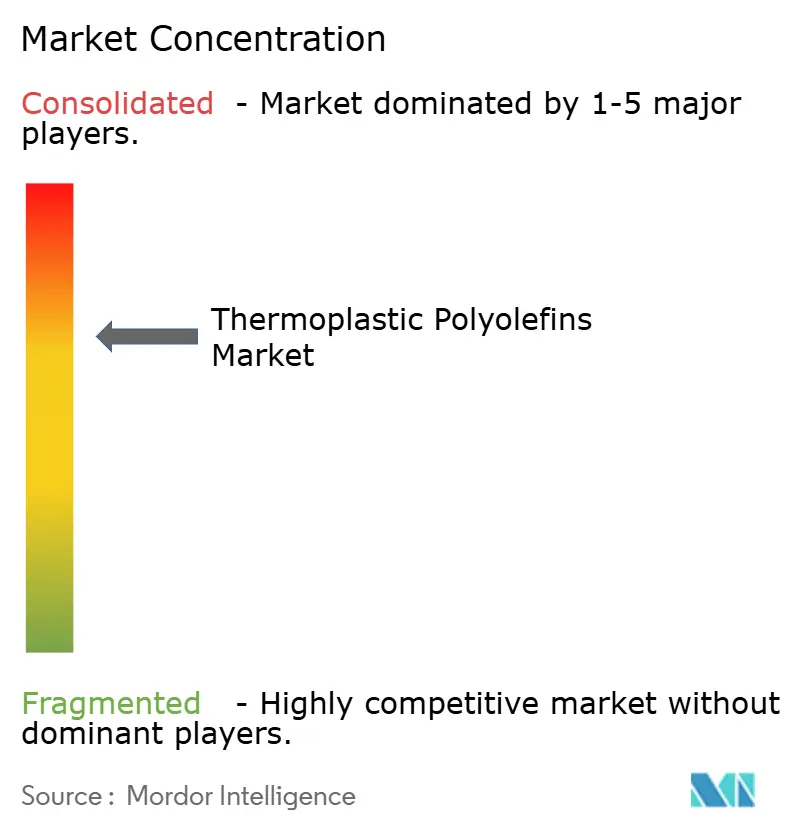
The thermoplastic polyolefins market is moderately concentrated, with the top five players including Exxon Mobil Corporation, SABIC, LyondellBasell Industries Holdings B.V., Dow, and INEOS. LyondellBasell Industries Holdings B.V., Dow, Exxon Mobil Corporation, Borealis GmbH, and SABIC benefit from feedstock access and proprietary compounding platforms. This integration can provide cost control and supply continuity during feedstock volatility. Competition increasingly centers on recycled content, electric vehicle platform qualification, and regional capacity alignment. Specialty compounders, including RTP Company, Avient Corporation, and Celanese Corporation, compete where application-specific performance reduces the relevance of commodity pricing.
Borealis GmbH and Borouge launched the Recleo brand in December 2025 for mechanically recycled polyolefins, including post-industrial and post-consumer recyclates and compounds. The portfolio serves mobility, building and construction, appliances, and consumer goods. Borealis also announced an investment in January 2026 to expand Borstar Nextension single-site polypropylene production at Burghausen, Germany. The investment supports mono-material polypropylene solutions for packaging, healthcare, and mobility uses.
Avient Corporation expanded its Therma-Tech portfolio in June 2026 with 8 natural-graphite-based thermally conductive grades for electric vehicle heat sinks, advanced driver assistance systems thermal management, and light-emitting diode lighting. LyondellBasell Industries Holdings B.V. approved a propylene capacity expansion at its Channelview Complex in March 2025, targeting 400,000 metric tons of additional annual output with a startup projected for late 2028. Customer demand for certified recycled materials can increase direct links between vehicle manufacturers and recyclers. This may limit available volume for stand-alone compounders without integrated recycling or supply partnerships in the thermoplastic polyolefins market.
Thermoplastic Polyolefins Industry Leaders
Exxon Mobil Corporation
SABIC
LyondellBasell Industries Holdings B.V.
Dow
INEOS
- *Disclaimer: Major Players sorted in no particular order
Thermoplastic Polyolefins Market Companies Covered in this Report
- Arkema
- Avient Corporation
- Borealis GmbH
- Braskem
- Celanese Corporation
- Dow
- Exxon Mobil Corporation
- Formosa Plastics Corporation
- INEOS
- LyondellBasell Industries Holdings B.V.
- Mitsui Chemicals, Inc.
- RTP Company
- SABIC
- Sumitomo Chemical Co., Ltd.

Recent Industry Developments in Thermoplastic Polyolefins Market
- March 2026: BASF inaugurated its Zhanjiang Verbund site in China, including the world’s first ethylene cracker with main compressors powered entirely by renewable electricity. The project expanded ethylene production infrastructure and strengthened the regional supply of ethylene, a key thermoplastic polyolefin used across multiple downstream chemical applications.
- January 2026: Borealis GmbH announced a EUR 49 million (approximately USD 57 million) investment to scale up Borstar Nextension polypropylene production at its Burghausen, Germany, site. The investment increased downstream polypropylene capacity and supports demand for propylene.


Global Thermoplastic Polyolefins Market Report Scope
Thermoplastic polyolefins are polymeric materials that combine the processing characteristics of thermoplastics with the flexibility, impact resistance, and durability associated with elastomeric materials. They can be processed through conventional thermoplastic manufacturing methods and are used where lightweight, weather-resistant, and flexible material solutions are required.
The Thermoplastic Polyolefins Market is segmented by raw material, application, and geography. By raw material, the market is segmented into polypropylene, polyethylene, and others. By application, the market is segmented into automotive, building and construction, home appliances, medical, industrial, and others. The report also covers the market size and forecasts for thermoplastic polyolefins in 15 countries across major regions. For each segment, the market sizing and forecasts have been done on the basis of value (USD).
| Polypropylene |
| Polyethylene |
| Others |
| Automotive |
| Building and Construction |
| Home Appliances |
| Medical |
| Industrial |
| Others |
| Asia-Pacific | China |
| India | |
| Japan | |
| South Korea | |
| Rest of Asia-Pacific | |
| North America | United States |
| Canada | |
| Mexico | |
| Europe | Germany |
| United Kingdom | |
| France | |
| Italy | |
| Rest of Europe | |
| South America | Brazil |
| Argentina | |
| Rest of South America | |
| Middle East and Africa | Saudi Arabia |
| South Africa | |
| Rest of Middle East and Africa |
| By Raw Material | Polypropylene | |
| Polyethylene | ||
| Others | ||
| By Application | Automotive | |
| Building and Construction | ||
| Home Appliances | ||
| Medical | ||
| Industrial | ||
| Others | ||
| By Geography | Asia-Pacific | China |
| India | ||
| Japan | ||
| South Korea | ||
| Rest of Asia-Pacific | ||
| North America | United States | |
| Canada | ||
| Mexico | ||
| Europe | Germany | |
| United Kingdom | ||
| France | ||
| Italy | ||
| Rest of Europe | ||
| South America | Brazil | |
| Argentina | ||
| Rest of South America | ||
| Middle East and Africa | Saudi Arabia | |
| South Africa | ||
| Rest of Middle East and Africa | ||


Key Questions Answered in the Report
What is the size of the thermoplastic polyolefins market?
The thermoplastic polyolefins market stands at USD 6.46 billion in 2026 and is projected to reach USD 8.79 billion by 2031.
What is driving demand for thermoplastic polyolefins?
Vehicle lightweighting, recycled-content requirements, electric vehicle components, roofing membranes, and sterile medical devices support demand.
Which raw material led the market demand in 2025?
Polypropylene held 38.91% of the value in 2025 because of its established supply chain, processing flexibility, and cost position.
Which application is expected to grow fastest through 2031?
Medical is projected to advance at a 7.42% CAGR through 2031, supported by demand for single-use sterile devices.
Page last updated on:





