
Thermal Power Plant Market Size and Share
Market Overview
| Study Period | 2022 - 2032 |
|---|---|
| Market Volume (2027) | 4.76 terawatt |
| Market Volume (2032) | 4.97 terawatt |
| Growth Rate (2027 - 2032) | 0.87 % |
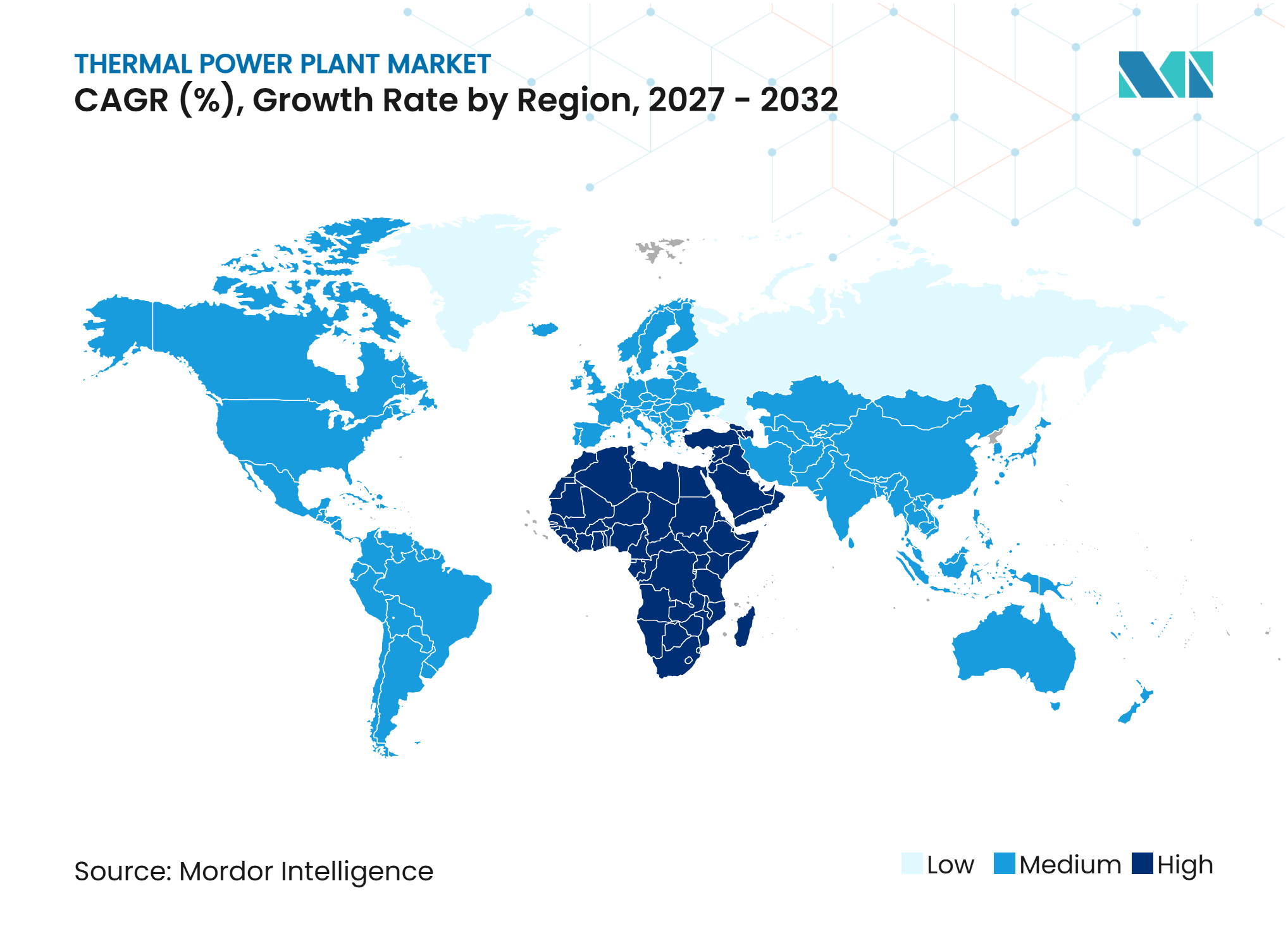
| Fastest Growing Market | Middle East and Africa |
| Largest Market | Asia-Pacific |
| Market Concentration | Low |
Major Players *Disclaimer: Major Players sorted in no particular order Image © Mordor Intelligence. Reuse requires attribution under CC BY 4.0. | |
Thermal Power Plant Market Analysis by Mordor Intelligence
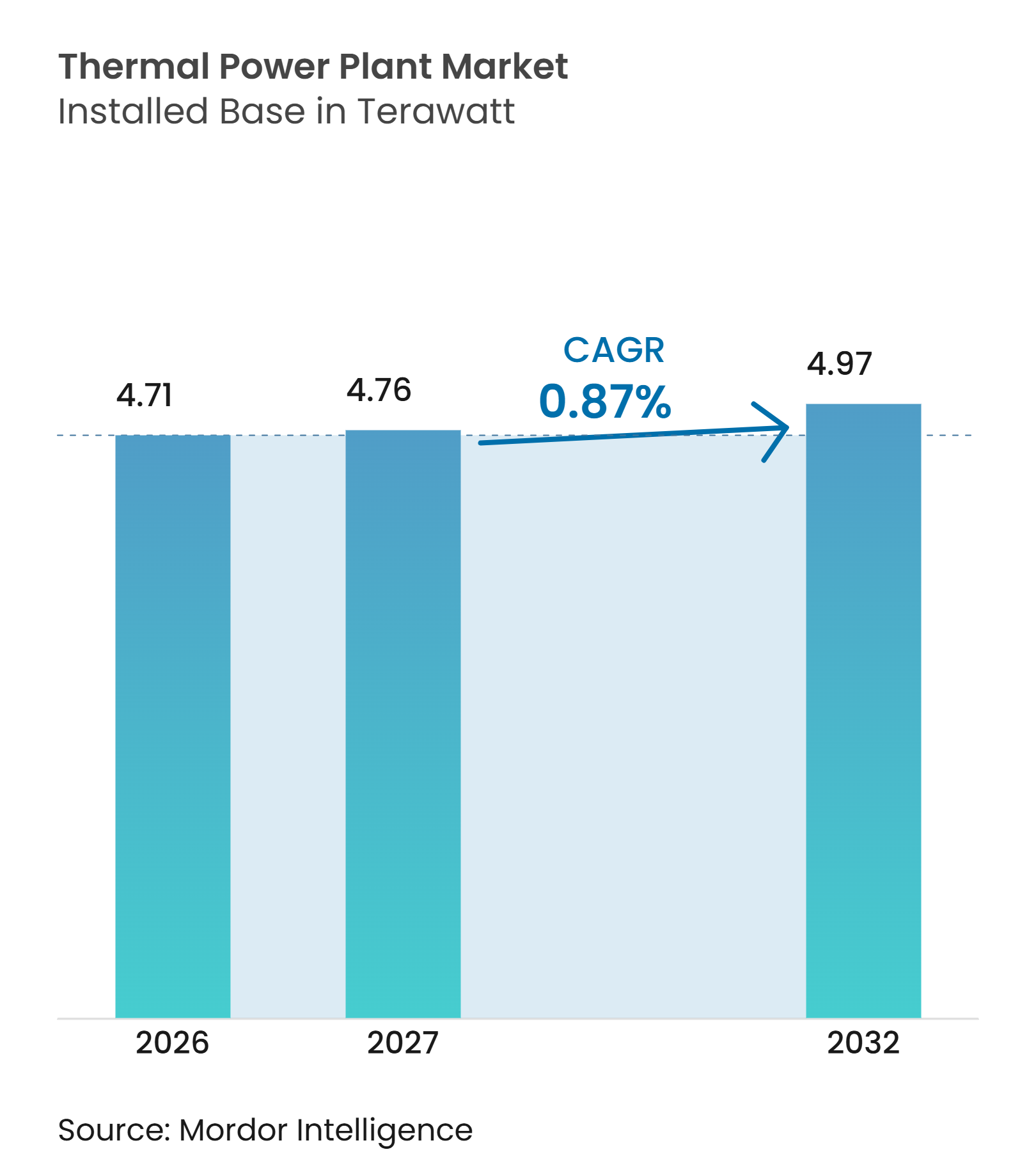
The Thermal Power Plant Market size in terms of installed base is projected to be 4.71 terawatt in 2026, 4.76 terawatt in 2027, and reach 4.97 terawatt by 2032, growing at a CAGR of 0.87% from 2027 to 2032. The small increase reflects a mature installed fleet that is being renewed and upgraded rather than expanded at the earlier pace, with operators concentrating on investment on plant efficiency, equipment reliability, and compliance with local operating rules. Electricity demand from data centers is raising the need for dependable generation in several power systems, especially where transmission and storage additions cannot yet meet rapidly rising load. The International Energy Agency expects global data center electricity demand to exceed 1,000 TWh by 2030, compared with 460 TWh in 2024, and expects gas and coal to meet more than 40% of the additional load.[1] Energy security concerns are also supporting new projects in Asia-Pacific and the Middle East and Africa, even as renewable capacity expands and utilities seek to maintain adequate reserves during periods of peak demand. The thermal power plant market is therefore being shaped by the availability of efficient equipment, fuel flexibility, and the different carbon rules that apply in each country.
Key Report Takeaways
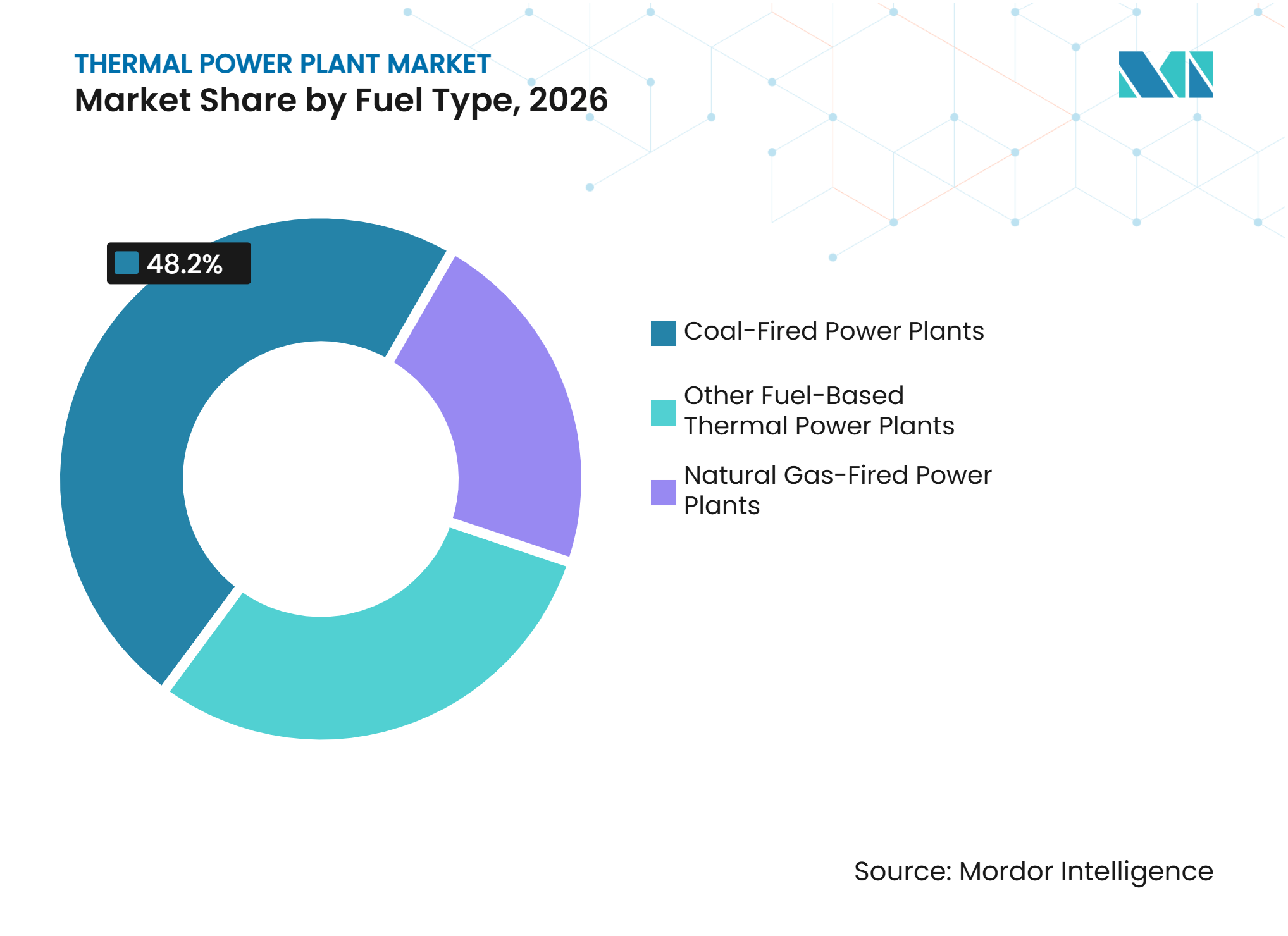
- By fuel type, coal-fired power plants held 48.2% of the thermal power plant market share in 2026, while natural gas-fired power plants are forecast to grow at a 2.1% CAGR through 2032.
- By plant capacity, above 800 MW plants held 33.1% of installed capacity in 2026, while below 100 MW plants are forecast to grow at a 1.4% CAGR through 2032.
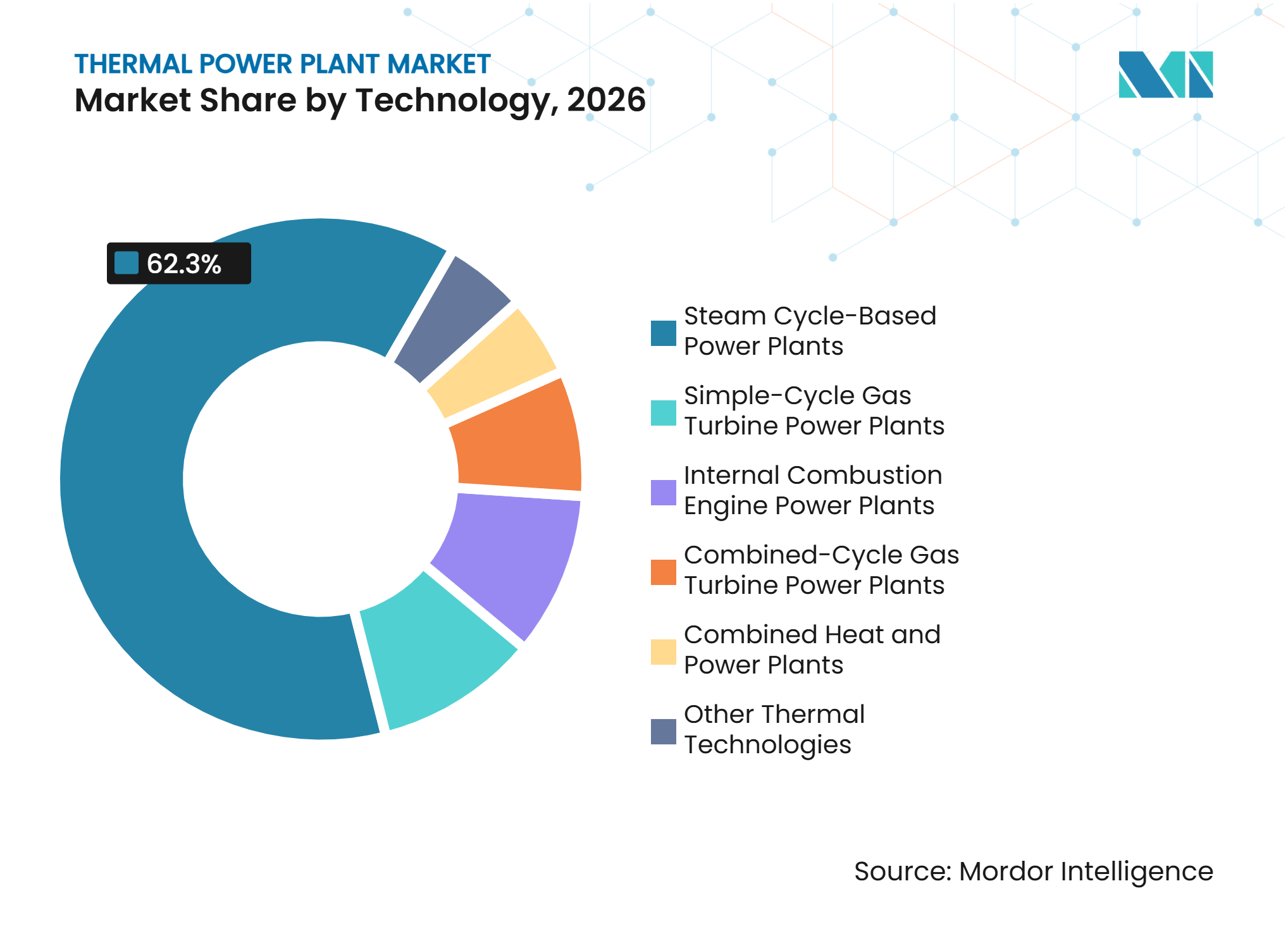
- By technology, steam cycle-based power plants held 62.3% share in 2026, while combined-cycle gas turbine plants are forecast to grow at a 2.6% CAGR through 2032.
- By geography, Asia-Pacific held 48.5% share in 2026, while the Middle East and Africa is forecast to grow at a 2.7% CAGR through 2032.
Note: Market numbers in this report are based on Mordor Intelligence's proprietary estimation framework, which combines nine months of actuals with Q4 projections for base year 2026.
Market Trends and Insights
Drivers Impact Analysis of Thermal Power Plant Market*
| Driver | (~) % Impact on CAGR Forecast | Geographic Relevance | Impact Timeline |
|---|---|---|---|
| AI Data Center and Digital Infrastructure Demand | +0.4% | Global, concentrated in North America and Asia-Pacific | Short term (≤ 2 years) |
| Coal Retirement Deferrals Linked to Reliability Demand | +0.4% | North America, with relevance in Asia-Pacific | Short term (≤ 2 years) |
| Energy Security Supporting New Thermal Capacity | +0.3% | Asia-Pacific, with spillover to the Middle East, Africa, and South America | Medium term (2-4 years) |
| CCGT Orders Linked to Data Centers and Coal-to-Gas Switching | +0.2% | North America and the Middle East and Africa, with spillover to Asia-Pacific | Short term (≤ 2 years) |
| Equipment Availability and CCGT Delivery Lead Times | +0.2% | North America, the Middle East and Africa, and Asia-Pacific | Short term (≤ 2 years) |
| Ultra-Supercritical and Advanced Coal Technologies | +0.1% | Asia-Pacific, especially China and India, with global spillover | Medium term (2-4 years) |
| Source: Mordor Intelligence | |||
AI and Data Center Power Demand
The thermal power plant market is receiving support from the growth in electricity use by artificial intelligence and digital infrastructure. Global data center electricity demand is expected to rise from 460 TWh in 2024 to more than 1,000 TWh by 2030.[2] The same outlook indicates that natural gas and coal could provide more than 40% of the additional data center electricity demand during this period. This demand profile favors generation that can be developed near large loads or provide steady supply while grids add renewable capacity. U.S. policy actions to keep some coal units available also show how reliability concerns can affect retirement schedules. Within the thermal power plant market, this need supports new gas capacity and continued operation of selected existing thermal assets where dependable supply remains limited.
Energy Security Supporting Thermal Capacity in Asia-Pacific and the Middle East and Africa
Energy security is sustaining project approvals in markets where electricity demand continues to rise faster than grid investment. India had 226.23 GW of coal-based installed capacity in November 2025, with 40.35 GW under construction.[3] NTPC has also set a target to add 30 GW of coal capacity by FY2032.[4]The International Energy Agency reported that Middle East and North Africa (MENA) power-sector investment reached USD 44 billion in 2024 and could increase 50% by 2035. Gas-fired capacity is expected to account for 20% of global investment in gas-fired capacity through 2035. The thermal power plant market in these regions is expanding alongside renewables because storage and transmission systems have not yet expanded enough to cover all balancing needs.
CCGT Orders and Equipment Lead Times
The thermal power plant market is also supported by a strong order cycle for combined-cycle gas turbine (CCGT) equipment. Siemens Energy reported 194 gas turbine unit sales in FY2025, compared with nearly 100 units in FY2024, showing the scale of the current demand for large equipment. Within the thermal power plant market, suppliers with secured manufacturing capacity and established service networks can offer greater delivery certainty to utilities. TAQA, JERA, and AlBawani Capital reached financial close in September 2025 for the 3.6 GW Rumah 2 and Al Nairyah 2 plants in Saudi Arabia under 25-year power purchase agreements. Siemens Energy is the original equipment manufacturer for those plants. Utilities that secure turbine slots early can reduce delivery risk and improve the certainty of their construction schedules.
Ultra-Supercritical Technology and Coal Fleet Efficiency
Modern coal technology is extending the operating life of thermal assets in countries where coal remains part of the power system and where a rapid replacement of existing generation would challenge affordability or grid stability. Dongfang Electric connected a 700 MW ultra-supercritical circulating fluidized bed coal unit in Yunnan in March 2025. The unit achieved 46.34% thermal efficiency and is expected to reduce carbon emissions by 500,000 metric tons each year. India is developing Advanced Ultra-Supercritical technology with Bharat Heavy Electricals Limited (BHEL), National Thermal Power Corporation (NTPC), and Indira Gandhi Centre for Atomic Research (IGCAR), targeting 46% efficiency and a 10% to 15% reduction in carbon dioxide emissions compared with subcritical equipment. These projects support the thermal power plant market where policymakers seek lower fuel consumption without retiring existing coal supply chains quickly. They also direct spending toward upgrades, specialized boilers, controls, higher-performance materials, and specialist services needed to sustain complex units.
Restraints Impact Analysis of Thermal Power Plant Market*
| Restraint | (~) % Impact on CAGR Forecast | Geographic Relevance | Impact Timeline |
|---|---|---|---|
| Renewable and Storage Cost Declines | -0.2% | Global, most acute in Europe and North America | Medium term (2-4 years) |
| Lower Thermal Utilization From Renewable Expansion | -0.2% | Europe and North America | Medium term (2-4 years) |
| Divergent Carbon Rules | -0.1% | European Union and OECD countries, with lower pressure in Asia-Pacific and the Middle East and Africa | Long term (≥ 4 years) |
| Carbon-Related Financing and Approval Uncertainty | -0.1% | European Union and OECD countries, with lower pressure in Asia-Pacific and the Middle East and Africa | Long term (≥ 4 years) |
| Source: Mordor Intelligence | |||
Renewable and Storage Cost Pressure
Renewable expansion is lowering running hours for some thermal power plant market assets in highly integrated electricity systems. Coal provided a historic low of 9.2% of European Union electricity generation in 2025. Solar and wind supplied a record 30% of European Union electricity in 2025, which reduced gas generation during periods of strong renewable output. Lower average utilization weakens the financial case for baseload-oriented steam assets that were designed to run consistently. The pressure is strongest in Europe and North America, where grids have deeper renewable integration and more mature flexibility options. It favors plants that can ramp quickly, including combined-cycle and simple-cycle gas turbines, over older units with less flexible operating profiles.
Carbon Rules and Project Financing Uncertainty
Different carbon rules are making project development more complex across the thermal power plant market. The European Union Emissions Trading System continues to place a price on emissions from covered power plants. The U.S. Environmental Protection Agency proposed in June 2025 to repeal greenhouse gas standards for fossil fuel-fired generating units under Section 111 of the Clean Air Act. India revised its sulfur dioxide control requirements in July 2025, creating different compliance obligations for parts of its coal fleet. Developers must assess each country’s rules, fuel pathway, and financing conditions rather than relying on a common global policy outlook. This adds an operating and financing burden across the thermal power plant market and raises the value of fuel-flexible designs and clear long-term offtake arrangements.
*Our forecasts treat driver/restraint impacts as directional, not additive. The impact forecasts reflect baseline growth, mix effects, and variable interactions.
Thermal Power Plant Market Segment Analysis
By Fuel Type:
Gas Gains Ground While Coal Supports BaseloadCoal-fired plants held 48.2% of installed capacity in 2026, reflecting their established role across India, China, Indonesia, and sub-Saharan Africa. India commissioned 7.21 GW of coal-based capacity in FY2025-26 through November 2025. China and India are pursuing higher-efficiency coal units to address fuel use and reliability needs. This supports spending on advanced boilers, steam turbines, emissions systems, and controls.
Natural gas-fired plants are forecast to grow at a 2.1% CAGR through 2032. Combined-cycle projects benefit from their efficiency, shorter construction cycles, and fit with variable renewable grids. Mitsubishi Power received a contract for 2 M701JAC turbines for Vietnam’s 1,155 MW O Mon 4 plant in September 2025. Other fuel-based systems, including oil-fired units, biomass co-firing, and waste-heat recovery, remain specialized applications. The thermal power plant market is likely to see further oil-to-gas conversions where LNG infrastructure is available.



By Plant Capacity:
Utility-Scale Units Remain Central While Smaller Plants ExpandAbove 800 MW plants accounted for 33.1% of the thermal power plant market size in 2026. Large units spread capital costs over greater output and support high-demand national grids. China and India continue to use 800 MW supercritical and ultra-supercritical units for new coal projects. BHEL received an award from NTPC in March 2026 for the 3×800 MW Telangana Stage-II project.
Plants below 100 MW are forecast to grow at a 1.4% CAGR through 2032. These units serve industrial parks, remote sites, captive users, and weaker grids. Indonesia’s Electricity Supply Business Plan (RUPTL) 2025-2034 includes gas capacity for nickel-processing industrial parks that require dedicated supply. Distributed turbines and engines can be installed in phases that follow industrial load growth. This thermal power plant market segment creates demand for modular equipment, maintenance, and fuel-management services.
By Technology:
Steam Cycle Retains Scale While CCGT Builds New CapacitySteam cycle-based plants held 62.3% of installed capacity in 2026. Their installed base includes coal and gas units developed over several decades. New commissioning is increasingly focused on supercritical and ultra-supercritical designs that use less fuel per unit of output. This part of the thermal power plant market supports replacement and upgrading work even where net capacity growth is limited.
Combined-cycle gas turbine plants are forecast to grow at a 2.6% CAGR through 2032. Mitsubishi Power received a September 2025 contract for 5 combined-cycle units totaling 2,800 MW at Taiwan Power Company’s Tung Hsiao plant. GE Vernova received an order for 2 H-Class combined-cycle blocks at Poland’s Kozienice station in November 2025. Simple-cycle turbines, combined heat and power systems, and internal combustion engines serve peaking, district-heating, captive, and remote applications. International Electrotechnical Commission (IEC) performance standards and national grid codes increasingly favor modern equipment that can meet ramp-rate and emissions-monitoring requirements.

Geography Analysis
Asia-Pacific
Asia-Pacific held 48.5% of the thermal power plant market share in 2026. China operated coal plants with combined capacity of 1,263.1 GW in 2026, while India’s fossil fuel-based capacity reached 245,600 MW in October 2025. National Thermal Power Corporation (NTPC) had 16.9 GW under construction in March 2025 and is targeting 30 GW of further coal-based additions by FY2032. Indonesia is pursuing new fossil capacity under its Rencana Usaha Penyediaan Tenaga Listrik (RUPTL) 2025-2034 plan, including gas supply for industrial demand. Vietnam is advancing gas-to-power projects, including O Mon 4, while national grid codes and fuel rules shape investment choices.
Middle East and Africa
The Middle East and Africa are forecast to record a 2.7% CAGR through 2032. Rumah 2 and Al Nairyah 2 in Saudi Arabia reached financial close in September 2025, adding 3.6 GW under 25-year power purchase agreements. Doosan Enerbility won a contract in August 2026 for the 1,700 MW Misfah Combined Cycle Gas Turbine (CCGT) plant in Oman, with completion planned for April 2029. The IEA expects MENA power-sector investment to increase from its USD 44 billion level in 2024 as infrastructure requirements grow. Long-term PPAs, gas availability, and national development plans remain central to project bankability.
Europe, North America, and South America
Germany announced a plan in January 2026 to tender 12 GW of new gas-fired capacity, with plants required to be hydrogen-ready by 2045. North America is adding gas capacity and maintaining selected coal units where data center demand has increased reliability needs. South American systems continue to use gas and oil-fired assets alongside hydropower, while Japan is preparing 20% ammonia co-firing at Hekinan Unit 4 in FY2029. The thermal power plant market size in these geographies increasingly depends on flexible replacement capacity and fuel-transition investments.
Competitive Landscape
Market Concentration
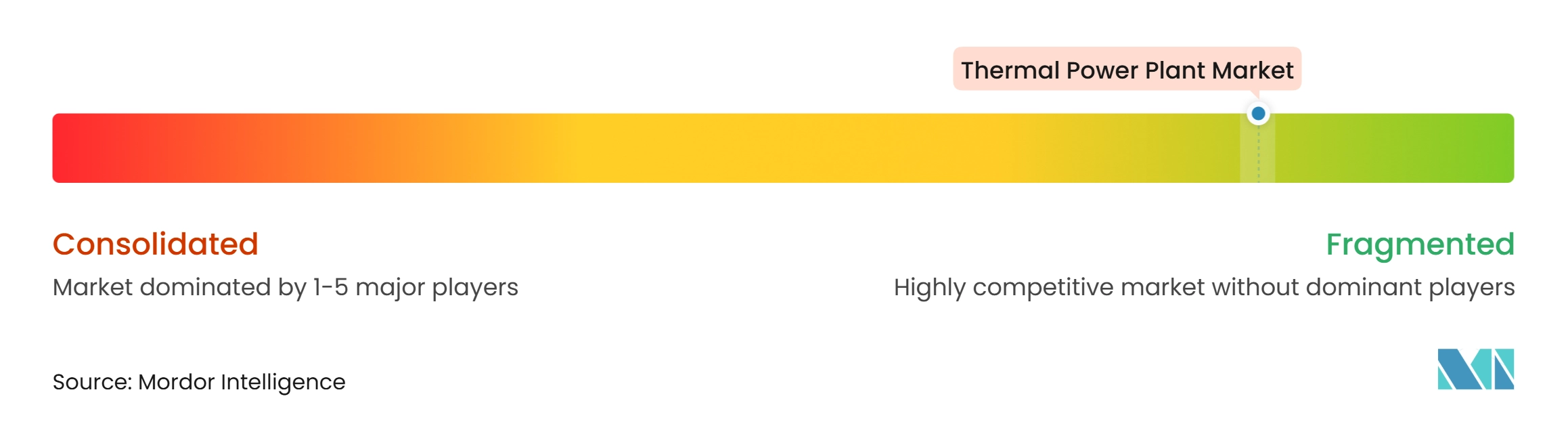
The thermal power plant market is fragmented and has separate competitive conditions across equipment supply, engineering and construction, and plant ownership. GE Vernova, Siemens Energy, and Mitsubishi Power are leading suppliers of large-frame gas turbines for combined-cycle projects. Their delivery schedules have become important because demand has extended equipment lead times by multiple years. Siemens Energy sold 194 gas turbine units in FY2025, compared with close to 100 units in FY2024. Doosan Enerbility strengthened its construction position through major contracts in Oman, Saudi Arabia, and Vietnam during 2025 and 2026.
Suppliers are using fuel flexibility and technology performance to distinguish their offerings in the thermal power plant market. Mitsubishi Power completed a 50% hydrogen co-firing test at Plant McDonough-Atkinson in Georgia in 2025. Dongfang Electric’s 700 MW ultra-supercritical unit shows its ability to serve coal-dependent systems with lower fuel consumption. GE Vernova’s H-Class order at Kozienice reflects a competing strategy based on replacing coal capacity with efficient gas technology. International Electrotechnical Commission (IEC) performance requirements and national grid codes increasingly influence technology selection.
The thermal power plant market also includes opportunities in distributed and industrial projects. The below 100 MW segment supports demand for modular turbines, engines, heat-recovery equipment, and service contracts in Southeast Asia and Africa. Combined heat and power projects in Eastern Europe are supported by district-heating modernization. BHEL remains important in India through domestic utility orders and supercritical project delivery.
Thermal Power Plant Industry Leaders
-
China Huaneng Group Co., Ltd.
-
China Energy Investment Corporation Co., Ltd.
-
China Datang Corporation Ltd.
-
Saudi Electricity Company
-
Korea Electric Power Corporation
- *Disclaimer: Major Players sorted in no particular order
Thermal Power Plant Market Companies Covered in this Report
- Ansaldo Energia S.p.A.
- Bechtel Corporation
- Bharat Heavy Electricals Limited
- China Energy Investment Corporation Co., Ltd.
- China Huadian Corporation Ltd.
- China Datang Corporation Ltd.
- Dongfang Electric Corporation Limited
- Doosan Enerbility Co., Ltd.
- Électricité de France S.A.
- ENGIE SA
- Fluor Corporation
- GE Vernova Inc.
- Harbin Electric Corporation
- JERA Co., Inc.
- Korea Electric Power Corporation
- Mitsubishi Heavy Industries, Ltd. (Mitsubishi Power)
- NTPC Limited
- Saudi Electricity Company
- Siemens Energy AG
- Toshiba Energy Systems & Solutions Corporation
Recent Industry Developments in Thermal Power Plant Market
- October 2026: Doosan Enerbility signed a USD 620 million (KRW 838 billion) Engineering, Procurement and Construction (EPC) contract with Vietnam's PVN for the O Mon III combined-cycle power plant in Can Tho, with a completion target of October 2030. The project advances Vietnam's gas-to-power transition under its revised PDP VIII framework.
- August 2026: Doosan Enerbility, in consortium with SEPCO III, secured a USD 683 million (KRW 930 billion) EPC contract for the 1,700 MW Misfah CCGT power plant in Oman, targeting completion by April 2029. The contract marks Doosan's second major Oman CCGT award within three months.
- June 2026: BHEL received a USD 2.23 billion (INR 21,000 crore) order from Meja Urja Nigam Limited for a 3×800 MW EPC thermal power project, raising its total order book to USD 27.94 billion (INR 2.63 trillion).
- June 2026: Doosan Enerbility signed an approximately USD 621.4 million (KRW 840 billion) contract for the Saudi Arabia Jafurah Cogeneration Power Plant Phase 2, designed to supply 330 MW of electricity and 465 tons of steam per hour to the Jafurah Gas Field, in a consortium with KEPCO and Aramco.
Global Thermal Power Plant Market Report Scope
A thermal power plant is an industrial facility that converts heat energy into electrical energy, typically using steam-driven thermodynamic cycles.
The thermal power plant market is segmented into fuel type, plant capacity, technology, and geography. By fuel type, the market is segmented into coal-fired power plants, natural gas-fired power plants, and other fuel-based thermal power plants. By plant capacity, the market is divided into below 100 MW, 100–400 MW, 400–800 MW, and above 800 MW. By technology, the market is segmented into steam cycle-based power plants, combined-cycle gas turbine power plants, simple-cycle gas turbine power plants, internal combustion engine power plants, combined heat and power plants, and other thermal technologies. The report also covers the market size and forecasts for the global thermal power plant market across 26 countries in key regions. For each segment, the market sizing and forecasts have been provided on the basis of volume (TW).
Segmentation Overview
| Coal-Fired Power Plants |
| Natural Gas-Fired Power Plants |
| Other Fuel-Based Thermal Power Plants |
| Below 100 MW |
| 100–400 MW |
| 400–800 MW |
| Above 800 MW |
| Steam Cycle-Based Power Plants |
| Combined-Cycle Gas Turbine Power Plants |
| Simple-Cycle Gas Turbine Power Plants |
| Internal Combustion Engine Power Plants |
| Combined Heat and Power Plants |
| Other Thermal Technologies |
| North America | United States |
| Canada | |
| Mexico | |
| Europe | Germany |
| France | |
| Italy | |
| Spain | |
| United Kingdom | |
| Netherlands | |
| Norway | |
| Russia | |
| Rest of Europe | |
| Asia-Pacific | China |
| India | |
| Japan | |
| Australia | |
| Indonesia | |
| Malaysia | |
| Thailand | |
| Rest of Asia-Pacific | |
| South America | Brazil |
| Argentina | |
| Colombia | |
| Rest of South America | |
| Middle East and Africa | Saudi Arabia |
| United Arab Emirates | |
| Egypt | |
| Oman | |
| Nigeria | |
| Rest of Middle East and Africa |
| By Fuel Type | Coal-Fired Power Plants | |
| Natural Gas-Fired Power Plants | ||
| Other Fuel-Based Thermal Power Plants | ||
| By Plant Capacity | Below 100 MW | |
| 100–400 MW | ||
| 400–800 MW | ||
| Above 800 MW | ||
| By Technology | Steam Cycle-Based Power Plants | |
| Combined-Cycle Gas Turbine Power Plants | ||
| Simple-Cycle Gas Turbine Power Plants | ||
| Internal Combustion Engine Power Plants | ||
| Combined Heat and Power Plants | ||
| Other Thermal Technologies | ||
| By Geography | North America | United States |
| Canada | ||
| Mexico | ||
| Europe | Germany | |
| France | ||
| Italy | ||
| Spain | ||
| United Kingdom | ||
| Netherlands | ||
| Norway | ||
| Russia | ||
| Rest of Europe | ||
| Asia-Pacific | China | |
| India | ||
| Japan | ||
| Australia | ||
| Indonesia | ||
| Malaysia | ||
| Thailand | ||
| Rest of Asia-Pacific | ||
| South America | Brazil | |
| Argentina | ||
| Colombia | ||
| Rest of South America | ||
| Middle East and Africa | Saudi Arabia | |
| United Arab Emirates | ||
| Egypt | ||
| Oman | ||
| Nigeria | ||
| Rest of Middle East and Africa | ||
Key Questions Answered in the Report
What is the forecast growth rate for thermal power plants?
Installed capacity is forecast to grow at a 0.87% CAGR from 2027 to 2032, reaching 4.97 TW.
Which fuel type holds the largest installed capacity?
Coal-fired plants hold 48.2% of capacity in 2026, supported by large fleets in Asia-Pacific and Africa.
Why are gas-fired plants gaining importance?
Natural gas-fired plants are forecast to grow at a 2.1% CAGR through 2032 because combined-cycle units offer efficient and flexible supply.
Which technology is growing fastest?
Combined-cycle gas turbine plants are forecast to grow at a 2.6% CAGR through 2032.
Which region has the largest installed base?
Asia-Pacific holds 48.5% of global capacity in 2026, supported by extensive coal and growing gas fleets.
What is the key constraint on new thermal projects?
Renewable deployment, lower utilization rates, and different carbon rules can weaken project economics and complicate financing.