
Thailand Pharmaceutical Cold Chain Air Logistics Market Size and Share
Market Overview
| Study Period | 2020 - 2031 |
|---|---|
| Forecast Data Period | 2026 - 2031 |
| Base Year Market Size (2025) | USD 74.46 Million |
| Market Size (2026) | USD 80.55 Million |
| Market Size (2031) | USD 117.19 Million |
| Growth Rate (2026 - 2031) | 7.79 % |
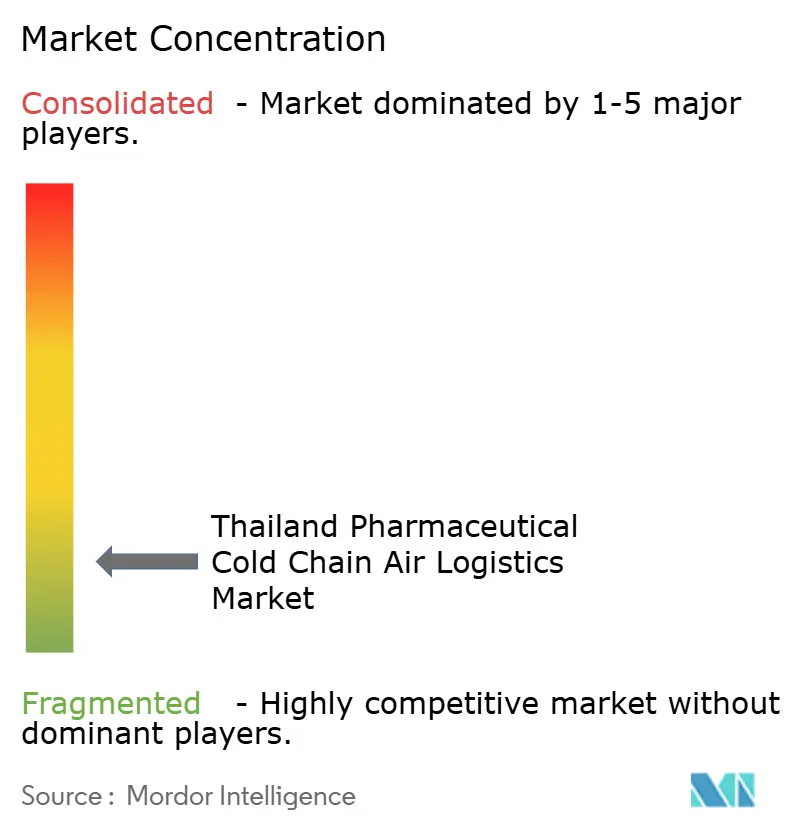
| Market Concentration | Low |
Major Players *Disclaimer: Major Players sorted in no particular order Image © Mordor Intelligence. Reuse requires attribution under CC BY 4.0. | |
Thailand Pharmaceutical Cold Chain Air Logistics Market Analysis by Mordor Intelligence
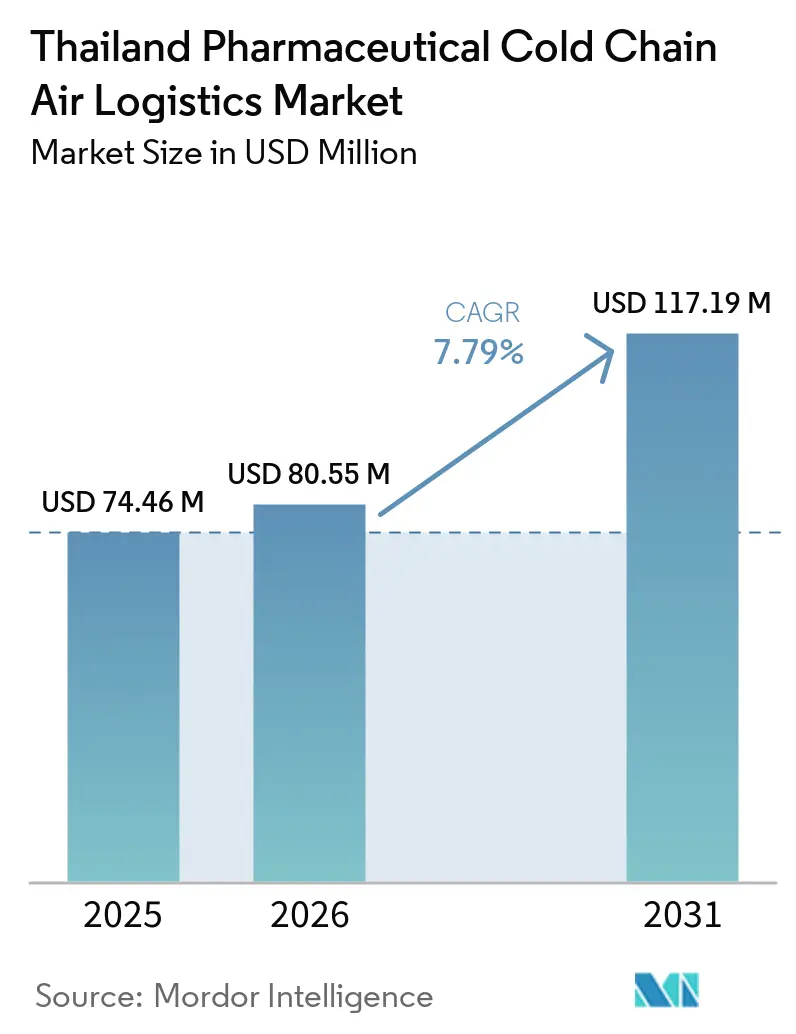
The Thailand pharmaceutical cold chain air logistics market size was valued at USD 74.46 million in 2025, and is projected to grow from USD 80.55 million in 2026 to reach USD 117.19 million in 2031, registering a CAGR of 7.79% from 2026 to 2031.
Demand is linked to stricter pharmaceutical distribution requirements and the greater use of medicines that need controlled temperatures. Biologics, vaccines, specialty medicines, and clinical trial materials require documented handling across international and domestic transport lanes. Thailand’s medical hub policy also supports demand for advanced therapies that need ultra-low temperature transport. Providers are strengthening GDP-compliant facilities, validated packaging, and digital temperature records to meet shipper qualification requirements. Competition, therefore, depends increasingly on certified capability and reliable documentation rather than freight price alone.
Key Report Takeaways
- By temperature range, frozen products held 52.55% of Thailand pharmaceutical cold chain air logistics market share in 2025, while deep-frozen and ultra-low temperature products are forecast to grow at an 11.77% CAGR through 2031.
- By pharmaceutical product type, biological pharmaceuticals accounted for 42.65% of the Thailand pharmaceutical cold chain air logistics market size in 2025, while cell and gene therapies are projected to grow at a 13.91% CAGR through 2031.
- By shipment flow, international shipments accounted for a 61.23% of the Thailand pharmaceutical cold chain air logistics market share in 2025 and are forecast to expand at an 8.68% CAGR through 2031.
- By region, the Central region held a 28.72% share of the Thailand pharmaceutical cold chain air logistics market in 2025, while the Eastern region is forecast to grow at a 9.15% CAGR through 2031.
Note: Market size and forecast figures in this report are generated using Mordor Intelligence’s proprietary estimation framework, updated with the latest available data and insights as of January 2026.
Thailand Pharmaceutical Cold Chain Air Logistics Market Trends and Insights
Drivers Impact Analysis*
| Driver | (~) % Impact on CAGR Forecast | Geographic Relevance | Impact Timeline |
|---|---|---|---|
| Growth in Biologics, Vaccines, and Specialty Medicines | +2.2% | National, with a concentration in the Central and Eastern regions | Medium term (2-4 years) |
| Expansion of GDP-Compliant Pharmaceutical Distribution Networks | +1.8% | National, with early compliance gains in the Bangkok metropolitan area | Short term (≤ 2 years) |
| Thailand’s Development as a Regional Medical Hub | +1.2% | National, with spillover to the Eastern Economic Corridor | Long term (≥ 4 years) |
| Increasing Use of Validated Temperature-Controlled Air Freight | +0.9% | Central, with relevance to Suvarnabhumi Airport, and Northern, with relevance to Chiang Mai | Medium term (2-4 years) |
| Expansion of Clinical Trial and Cell and Gene Therapy Logistics | +0.7% | Central, with concentration in the Bangkok academic hospital clusters | Long term (≥ 4 years) |
| Digital Temperature Visibility and Predictive Excursion Management | +0.4% | National | Medium term (2-4 years) |
| Source: Mordor Intelligence | |||
Growth in Biologics, Vaccines, and Specialty Medicines
Biologics and specialty medicines are increasing the technical requirements placed on Thailand pharmaceutical cold chain air logistics market providers. These products need stable conditions from the manufacturing origin through airport handling, customs clearance, and final delivery to a clinical destination. WHO guidance states that time and temperature-sensitive pharmaceutical products require controlled storage and transport arrangements that protect product quality, including during handoffs between supply chain partners.[1]World Health Organization, “Model Guidance for the Storage and Transport of Time- and Temperature-Sensitive Pharmaceutical Products,” WHO Technical Report Series, who.int Monoclonal antibodies, enzyme replacement therapies, vaccines, and blood-derived products often need tightly controlled handling during air transit, with some products requiring 2 °C to 8 °C or narrower conditions. Their movement depends on qualified packaging, calibrated monitoring equipment, and documented action when a temperature deviation occurs, rather than standard cargo processes alone. This requirement gives certified logistics providers a stronger role in shipments where product stability, clinical availability, and documented quality controls are all material considerations.
Expansion of GDP-Compliant Pharmaceutical Distribution Networks
Thailand’s Good Distribution Practice requirements have changed how pharmaceutical logistics providers organize cold chain activities. The Thai FDA’s framework requires pharmaceutical distributors to maintain quality systems that cover transport, storage, monitoring, and outsourced activities, with responsibilities that remain visible across each supplier relationship.[2]Thai Food and Drug Administration, “GDP Notification, Good Distribution Practice for Modern Drugs,” Ministry of Public Health, drug.fda.moph.go.th Existing pharmaceutical licensees faced mandatory Phase 1 quality-management requirements in January 2026, including documented cold chain plans and calibrated temperature monitoring. Additional quality-system requirements are due to become mandatory in January 2027, while full Phase 3 compliance is scheduled for January 2029. Importers, freight forwarders, handling agents, and bonded storage operators must therefore maintain auditable controls across each handoff instead of relying on informal delegation to a logistics provider. This is encouraging investment in qualified cold rooms, monitoring systems, active containers, documented subcontractor arrangements, and internationally recognized certification that can support shipper audits.
Thailand’s Development as a Regional Medical Hub
Thailand’s medical hub strategy supports demand for specialized pharmaceutical logistics. The Strategy for Developing Thailand as a Medical Hub 2025-2034 set out a national agenda covering medical services, wellness, products, academia, MICE, and facilitation.[3]Royal Thai Government, “3 Strategies to Propel Thailand as a Medical Hub,” Thailand Government, thailand.go.th The strategy identifies advanced therapy medicinal products as a priority area, which increases the need for ultra-low temperature connections between overseas manufacturers and Thai treatment centers. Thailand had 61 JCI-accredited hospitals and more than 500 medical facilities, according to government material that cites the Tourism Authority of Thailand. Medical travelers create demand for time-sensitive biologics and specialty injectables that are procured for specific treatment episodes, while the country’s hospital network supports the distribution of those products. The medical hub agenda also supports academic and clinical activity that requires compliant transport of investigational materials, specialized treatment inputs, and advanced therapies between international origins and Thai providers.
Validated Air Freight, Clinical Trial Logistics, and Digital Visibility
Validated temperature-controlled air freight is becoming a standard requirement for high-value pharmaceutical shipments. IATA’s Temperature Control Regulations set out packaging, labeling, acceptance, and documentation practices for time and temperature-sensitive shipments, creating a common operating reference for the parties handling a consignment.[4]International Air Transport Association, “Temperature Control Regulations, 13th Edition,” International Air Transport Association, iata.org The rules support consistent checks by airlines, forwarders, and ground handlers at origin and destination, including the use of the IATA Time and Temperature Sensitive Label where applicable. Digital temperature loggers and monitoring dashboards help providers create records that can be reviewed by pharmaceutical clients, regulators, and quality teams after a shipment is delivered. Clinical trials and cell therapy programs add demand for highly controlled, time-critical movements between hospitals, laboratories, manufacturing sites, and sometimes overseas partners. These combined requirements increase the value of integrated services that link validated air transport with qualified ground handling, final delivery, and predictable management of temperature excursions.
Restraints Impact Analysis*
| Restraint | (~) % Impact on CAGR Forecast | Geographic Relevance | Impact Timeline |
|---|---|---|---|
| High Cost of Qualified Packaging, Dry Ice, and Active Containers | -1.8% | National | Long term (≥ 4 years) |
| Limited Pharmaceutical Air-Cargo Capacity at Certified Airport Facilities | -1.4% | Central, with relevance to Suvarnabhumi Airport, and Northern, with relevance to Chiang Mai | Medium term (2-4 years) |
| Temperature Excursion Risk During Customs Clearance and Ramp Handling | -1.0% | Central, with relevance to Suvarnabhumi Airport, and Eastern, with relevance to U-Tapao Airport | Short term (≤ 2 years) |
| Shortage of Specialized Cold-Chain Quality and Refrigeration Personnel | -0.7% | National, with an acute shortfall in Northern and Northeastern regions | Long term (≥ 4 years) |
| Source: Mordor Intelligence | |||
High Cost of Qualified Packaging, Dry Ice, and Active Containers
Qualified packaging and active containers add a high cost to pharmaceutical air shipments in the Thailand pharmaceutical cold chain air logistics market. WHO guidance requires shipping containers to be qualified so that their thermal performance is shown under relevant operating conditions, including design, operational, and performance qualification. The requirement limits the use of lower-cost packaging options that have not been validated for the intended route and handling conditions. Cell and gene therapies may require dry ice or other cryogenic cooling systems, as well as trained handling and dangerous goods controls. WHO vaccine shipping guidance also addresses the need to maintain product conditions during international transport, including the management of packaging and cooling materials. Active containers for long or complex routes can cost 300% to 500% more than standard refrigerated transport per unit. Dry ice availability can also differ across origin and transit airports, which may require backup packaging approaches that reduce payload density and add expense. The cost burden is greatest for smaller consignees, public procurement bodies, and products whose margin cannot absorb a premium logistics service. These factors concentrate qualified air cold chain use in high-value products, even when other temperature-sensitive medicines can benefit from the same level of control.
Certified Airport Capacity, Excursion Risk, and Skills Shortages
Certified pharmaceutical handling capacity at Thai airports is more limited than general cargo capacity in the Thailand pharmaceutical cold chain air logistics market. IATA’s CEIV Pharma program requires suitable infrastructure, trained personnel, quality systems, and documented operating procedures. Facilities also need continuous environmental monitoring, qualified cold rooms for relevant temperature ranges, dedicated pharmaceutical processes, and staff who can follow controlled procedures. Suvarnabhumi Airport remains the main gateway, but verified pharmaceutical handling positions are fewer than the airport’s total cargo handling positions. Temperature-sensitive shipments can face risk during ramp staging, customs clearance, and temporary storage when a qualified handoff is unavailable. Certified capacity cannot be added quickly because new facilities need capital investment, operating procedures, staff training, and validation before they can handle pharmaceutical cargo. Secondary airports, including Chiang Mai, have less certified capacity for pharmaceutical traffic than the Bangkok gateway. A shortage of qualified cold chain validation and refrigeration personnel further limits the ability of operators to expand certified services outside the Central region. The resulting gap is most visible where provincial hospitals need reliable access to high-complexity products, but local airport handling remains limited.
*Our forecasts treat driver/restraint impacts as directional, not additive. The impact forecasts reflect baseline growth, mix effects, and variable interactions.
Segment Analysis
By Temperature Range: Frozen Volumes Lead While Ultra-Low Therapies Expand
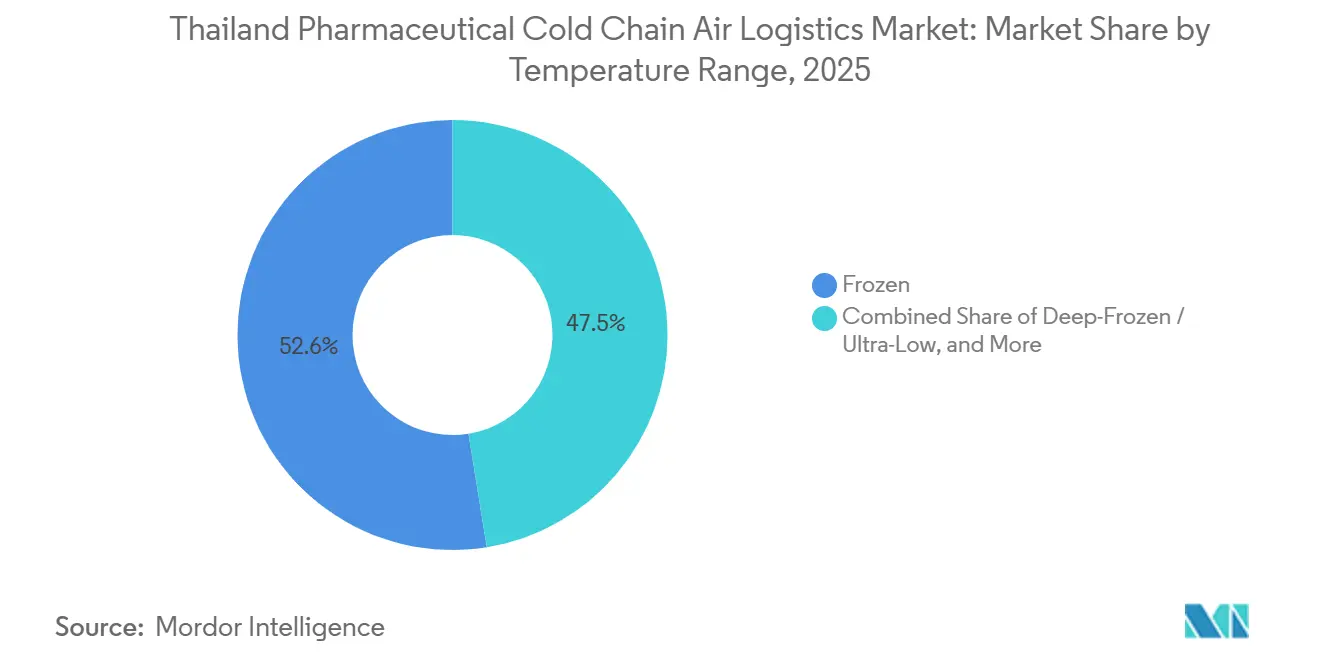
Frozen products held 52.55% of the Thailand pharmaceutical cold chain air logistics market size in 2025. This range covers many vaccines, frozen blood products, and biologic imports that move through established distribution systems. The frozen range extends from -20 °C to 0 °C and is supported by GDP-certified facilities in Samut Prakan and the Bangkok metropolitan area. The fastest expected expansion is in deep-frozen and ultra-low temperature products. It reflects demand from cell therapies, gene therapies, cryopreserved products, and advanced biologics that require dry ice or vapor-phase liquid nitrogen conditions.
Deep-frozen and ultra-low temperature products are forecast to expand at an 11.77% CAGR from 2026 to 2031. Chilled shipments remain important for monoclonal antibodies, recombinant proteins, and specialty injectables. IATA guidance identifies a 2 °C to 8 °C service level that is relevant to many of these products. Ambient products transported at 15 °C to 25 °C represent a smaller air freight opportunity because surface transport can serve many non-urgent shipments. Ultra-low temperature handling requires protocols that go beyond established frozen processes. These shipments need qualified containers, specialized materials, and staff trained to manage dry ice or other cryogenic systems. Genepeutic Bio’s GMP-certified cell and gene therapy facility in Thailand adds domestic activity that can create future ultra-low temperature logistics demand. Point-of-care and autologous therapies also create two-way movements between collection sites, manufacturing locations, and treatment centers.



By Pharmaceutical Product Type: Biologics Lead While Cell and Gene Therapies Change Requirements
Biological pharmaceuticals held a 42.65% share of the Thailand pharmaceutical cold chain air logistics market in 2025. The category includes biologics, biosimilars, vaccines, and blood-derived medicinal products. It is the main source of demand for controlled air freight because these products often need continuous temperature management. Cell and gene therapies are the fastest-growing product categories. Their expansion is linked to Thailand’s conditional approval route for advanced therapy medicinal products, introduced in October 2024. Academic centers in Bangkok are also expanding Phase 1 and Phase 1b clinical trial activity for these therapies.
Cell and gene therapies are projected to grow at a 13.91% CAGR from 2026 to 2031. Thailand’s domestic manufacturers produced relatively few biologic active pharmaceutical ingredients at the required scale, which supports import demand for biologic treatments. Small-molecule medicines still provide a substantial base of cold chain volume, although many have wider temperature tolerances and can use surface transport for non-urgent orders. Specialty medicines, including orphan medicines and rare disease therapies, carry high value per dose and are often imported when required for a specific patient. eXmoor Pharma and Siam Bioscience announced a partnership to develop a cell and gene therapy manufacturing hub near Bangkok. The planned activity will require cryogenic inbound movement of starting materials and outbound clinical-scale distribution. Veterinary biologics and vaccines are a smaller niche, but they use the same frozen and chilled infrastructure as many human pharmaceutical products. Thai FDA clinical trial requirements also make documented handling necessary for temperature-sensitive investigational products.
By Shipment Flow: International Routes Lead and Continue to Grow
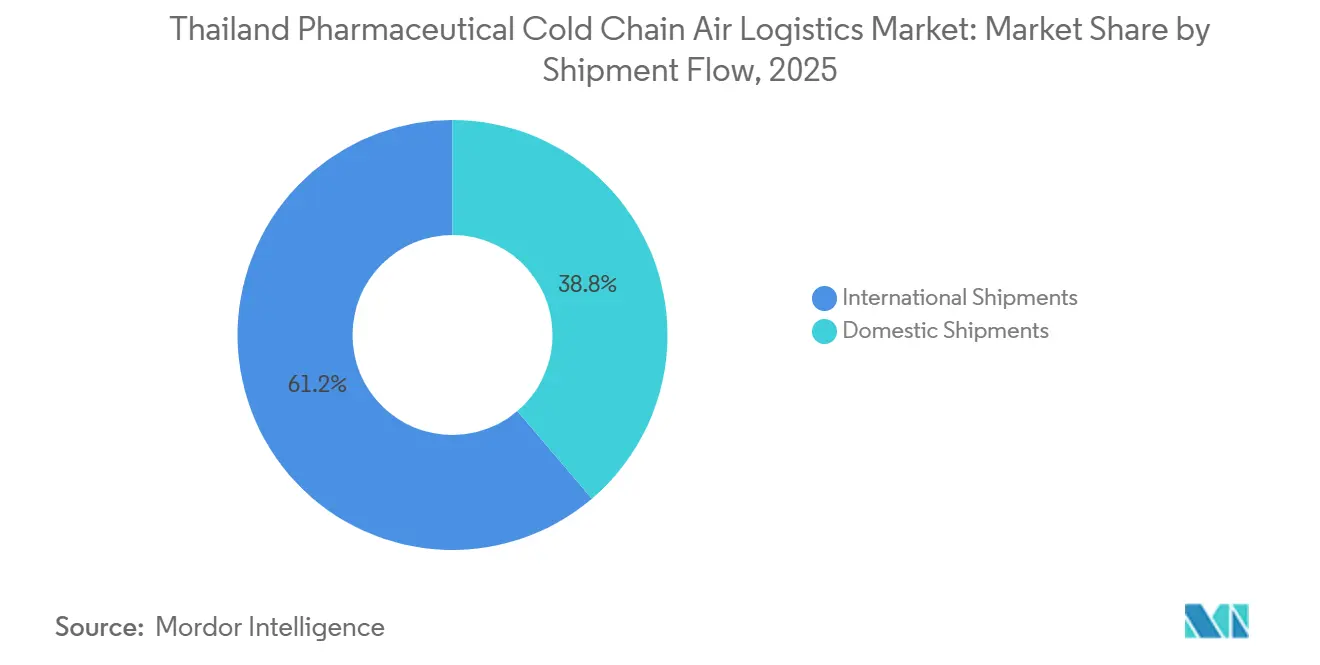
International shipments accounted for a 61.23% of the Thailand pharmaceutical cold chain air logistics market share in 2025. They are also projected to grow at an 8.68% CAGR from 2026 to 2031. The growth reflects complex pharmaceutical imports, clinical trial materials, and some emerging outbound specialty product flows. International movements also require coordination between Thai FDA import procedures and the origin-country GDP requirements. Domestic lanes still connect Bangkok’s airport gateway with hospital networks in the Northern, Northeastern, and Southern regions. Their role reflects the distance between Suvarnabhumi Airport and provincial care providers that receive imported biologics and specialty medicines.
Germany, the United States, and China were major origins for pharmaceutical imports into Thailand. The temperature-sensitive portion of these imports requires more controlled handling than generic or ambient products. Domestic transport remains necessary because long surface journeys can increase temperature exposure during Thailand’s hot months. DSV expanded its Southeast Asian cold chain network in April 2026, including multi-temperature pharmaceutical warehousing in Thailand. The initiative added 75,000 square meters of specialized storage across the regional network. Kuehne+Nagel also added Cool Corridor routes that improve healthcare air freight connectivity with Japan, Europe, and the United States. Digital air waybill systems and real-time data sharing can reduce documentation friction in international pharmaceutical movements.
Geography Analysis
The Central region held a 28.72% share of the Thailand pharmaceutical cold chain air logistics market in 2025. Bangkok, Nonthaburi, Pathum Thani, and Samut Prakan form the country’s main pharmaceutical logistics cluster. Suvarnabhumi Airport in Samut Prakan is the main node for customs clearance, qualified cold storage, and dispatch of pharmaceutical imports. The region also contains tertiary hospitals, pharmaceutical importers, distribution centers, and registered licenses. Zuellig Pharma expanded its Samut Prakan distribution center in July 2025 with an investment exceeding THB 130 million (USD 4.13million), adding 1,800 pallet positions and a -20 °C to -30 °C freezer room. The DHL and Berli Jucker Logistics joint venture also planned GDP-compliant distribution across BJC Healthcare’s nationwide network of 1,271 hospitals, 2,687 clinics, and 4,688 pharmacies. Central region infrastructure serves as the operating base for this broader distribution model.
The Eastern region is forecast to grow at a 9.15% CAGR from 2026 to 2031. Chonburi, Rayong, and Chachoengsao are part of the Eastern Economic Corridor, where life sciences and pharmaceutical manufacturing activity support imports of temperature-sensitive inputs and exports of finished products. The development of U-Tapao International Airport could provide a second air cargo gateway for Eastern region pharmaceutical consignments and reduce reliance on Suvarnabhumi Airport for certain flows. The airport’s role would be particularly relevant for manufacturers that need timely access to imported materials and direct outbound air connections. Northern Thailand is centered on Chiang Mai, which supplies regional hospitals in Chiang Rai, Lamphun, and Phrae. Its medical tourism activity and referral hospital network support demand for imported biologics and specialty medicines. Mountainous terrain increases surface travel times and makes continuous temperature control more difficult for deliveries to provincial facilities.
The Northeastern and Southern regions have smaller positions in the Thailand pharmaceutical cold chain air logistics market size, but both serve specific care and trade needs. Khon Kaen supports distribution across the Isan provinces and some cross-border trade with Laos. The city’s airport and hospital network make it an important distribution point for a large population outside Bangkok. Formulary expansion for biologics and specialty medicines under national health insurance coverage can increase demand for qualified transport in this corridor. Phuket and Hat Yai serve Southern hospital networks and medical travelers from Malaysia and Indonesia. Their airports receive imported specialty medicines, but certified cold chain capacity remains less developed than in the Central region. This capacity gap limits the extent to which patient demand can translate into high-complexity air logistics growth in these areas. The Thailand pharmaceutical cold chain air logistics market will need stronger regional handling and last-mile capability if these locations are to receive the same level of validated service as the Bangkok gateway.
Competitive Landscape
The Thailand pharmaceutical cold chain air logistics market is highly fragmented, with globally certified forwarders competing with regional specialists and local operators. Global providers focus on high-value biologics, clinical trial materials, and advanced therapies that require documented handling standards. Their competitive position depends on CEIV Pharma certification, GDP-compliant bonded storage, digital temperature visibility, and the ability to manage a shipment across several international handoffs. Local and Japanese logistics groups compete through provincial reach, Thai FDA process familiarity, established hospital relationships, and cost structures that may suit mid-tier temperature-sensitive products. The Thailand pharmaceutical cold chain air logistics industry also gives value to IoT loggers and monitoring dashboards that create audit-ready temperature records. IATA ONE Record-aligned data-sharing tools can support faster access to shipment records when customers need evidence of cold chain continuity. The leading opportunity lies in certified last-mile coverage for Northern and Northeastern provinces, where capabilities remain thinner than in the Central region. Operators that invest in provincial facilities and trained staff can address a service gap that airport capacity alone does not resolve.
DHL Supply Chain Thailand and Berli Jucker Logistics formed a joint venture in January 2026 to deliver GDP-compliant healthcare logistics across BJC Healthcare’s network. The partnership combines DHL’s standards and technology with BJC Healthcare’s local distribution reach, hospital access, and familiarity with domestic clinical requirements. DHL Group has also committed EUR 500 million (USD 15.88 million) to Asia-Pacific healthcare logistics through 2030, including GDP-certified hubs, multi-temperature lanes, temperature-controlled fleets, and IT systems. DSV expanded its Southeast Asian cold chain infrastructure in April 2026, including Thailand, to increase multi-temperature pharmaceutical warehousing. These actions show that infrastructure scale, compliance credentials, visibility tools, and regional connectivity are being developed together rather than as separate services. They also put competitive pressure on providers that have local distribution reach but lack certified processes for premium shipments.
Japanese logistics groups are also moving into pharmaceutical air logistics through CEIV Pharma certification at Suvarnabhumi Airport. Certification offers a clear qualification signal for shippers that use IATA-aligned handling requirements. Specialist clinical trial couriers compete at the premium end of the Thailand pharmaceutical cold chain air logistics market. Their capabilities are particularly relevant for autologous therapies, frozen biologics, time-critical samples, and shipments that need close chain-of-custody control. The competition is not based only on warehouse capacity because customers also assess personnel training, exception management, packaging capability, and the availability of records after delivery. Providers that can connect overseas clinical sites, manufacturing locations, and Thai hospitals have an advantage in advanced therapy logistics. These requirements make it difficult for general cargo operators to compete for high-complexity shipments without sustained investment in people, quality systems, and infrastructure. They also support a premium for reliable service when a temperature excursion could affect product availability or quality documentation.
Thailand Pharmaceutical Cold Chain Air Logistics Industry Leaders
DHL Group
Kuehne+Nagel International AG
DSV A/S
DKSH Thailand
SCGJWD Logistics Public Company Limited
- *Disclaimer: Major Players sorted in no particular order

Recent Industry Developments
- September 2026: FedEx Corporation earned IATA CEIV Pharma certification for its FedEx Incheon Gateway at Incheon International Airport, strengthening the CEIV-compliant transshipment network available to Thai pharmaceutical importers using FedEx services from the Korean, Japanese, and broader Northeast Asian manufacturing base. The certification added to FedEx’s global portfolio of over 130 cold chain facilities and reinforced its Healthcare Life Science Centers in Seoul’s Gimpo and Tokyo, which are transit-critical for high-value biologics destined for Thailand.
- June 2026: Kuehne+Nagel expanded its Cool Corridor dedicated healthcare airfreight network, adding 4 new routes, including Frankfurt-Atlanta, Chicago-Narita, Brussels-Sao Paulo, and Chicago-Sao Paulo, bringing the total dedicated network to 12 airfreight lanes. The Frankfurt-Narita and Chicago-Narita routes are relevant to Thai pharmaceutical importers sourcing from Japan and the United States, creating GDP-compliant connectivity options for biologics and specialty medicines destined for Thailand.
- January 2026: Berli Jucker Logistics and DHL Supply Chain Thailand formed a joint venture to deliver specialized, GDP-compliant healthcare logistics across BJC Healthcare’s network of over 1,271 hospitals, 2,687 clinics, and 4,688 pharmacies in Thailand. The partnership is designed to accelerate healthcare logistics capabilities toward a projected THB 645 billion (USD 20.48 million) Thai healthcare sector by 2030 and directly increase certified pharmaceutical distribution reach in the Central and Eastern regions.
- April 2025: DHL Group announced a EUR 500 million (USD 15.88 million) investment across Asia-Pacific through 2030, targeting GDP-certified pharmaceutical hubs, multi-temperature cold chain lane expansion, new temperature-controlled vehicle fleets, and advanced IT systems for end-to-end pharmaceutical temperature visibility. Thailand is part of DHL’s 15-country Asia-Pacific pharmaceutical logistics network with over 300,000 square meters of compliant warehousing space.


Thailand Pharmaceutical Cold Chain Air Logistics Market Report Scope
| Chilled (0–5 °C) |
| Frozen (-20–0 °C) |
| Ambient |
| Deep-Frozen / Ultra-Low (Less than -20 °C) |
| Small-Molecule Pharmaceuticals | Branded Pharmaceuticals |
| Over-the-Counter (OTC) Pharmaceuticals | |
| Generic Pharmaceuticals | |
| Biological Pharmaceuticals (Biologics, Biosimilars, Vaccines, and Blood-Derived Medicinal Products) | |
| Specialty Pharmaceuticals | |
| Cell and Gene Therapies | |
| Veterinary Pharmaceuticals | |
| Other Pharmaceutical Products |
| Domestic Shipments |
| International Shipments |
| Central |
| Eastern |
| Northern |
| Northeastern |
| Southern |
| By Temperature Range | Chilled (0–5 °C) | |
| Frozen (-20–0 °C) | ||
| Ambient | ||
| Deep-Frozen / Ultra-Low (Less than -20 °C) | ||
| By Pharmaceutical Product Type | Small-Molecule Pharmaceuticals | Branded Pharmaceuticals |
| Over-the-Counter (OTC) Pharmaceuticals | ||
| Generic Pharmaceuticals | ||
| Biological Pharmaceuticals (Biologics, Biosimilars, Vaccines, and Blood-Derived Medicinal Products) | ||
| Specialty Pharmaceuticals | ||
| Cell and Gene Therapies | ||
| Veterinary Pharmaceuticals | ||
| Other Pharmaceutical Products | ||
| By Shipment Flow | Domestic Shipments | |
| International Shipments | ||
| By Region | Central | |
| Eastern | ||
| Northern | ||
| Northeastern | ||
| Southern | ||


Key Questions Answered in the Report
What is the projected value of Thailand pharmaceutical cold chain air logistics in 2031?
The sector is projected to reach USD 117.19 million by 2031, growing at a 7.79% CAGR from 2026.
Which temperature range leads pharmaceutical air logistics in Thailand?
Frozen products led with 52.55% share in 2025, supported by vaccine, biologic, and blood-product distribution.
Why are cell and gene therapies important for pharmaceutical air freight in Thailand?
They are projected to grow at a 13.91% CAGR through 2031 and require highly controlled, often ultra-low temperature transport.
Which shipment flow is growing fastest in Thailand?
International shipments are projected to grow at an 8.68% CAGR through 2031 because of complex imports, clinical trial materials, and specialty product flows.
Which Thai region has the largest pharmaceutical air logistics presence?
The Central region held 28.72% share in 2025 because Suvarnabhumi Airport, hospitals, importers, and distribution centers are concentrated there.
What limits the expansion of qualified pharmaceutical air logistics services?
High packaging and active-container costs, constrained certified airport capacity, excursion exposure, and shortages of specialist personnel remain key limits. The Thailand pharmaceutical cold chain air logistics market also needs qualified regional facilities to extend validated handling beyond the Central region, as coverage remains uneven across provincial healthcare corridors for complex shipments and patient care.
Page last updated on:





