
Temporary Bonding Adhesive Market Size and Share
Market Overview
| Study Period | 2022 - 2032 |
|---|---|
| Market Size (2027) | USD 296.96 Million |
| Market Size (2032) | USD 439.57 Million |
| Growth Rate (2027 - 2032) | 8.16 % |
| Fastest Growing Market | Asia-Pacific |
| Largest Market | Asia-Pacific |
| Market Concentration | Medium |
Major Players *Disclaimer: Major Players sorted in no particular order Image © Mordor Intelligence. Reuse requires attribution under CC BY 4.0. | |
Temporary Bonding Adhesive Market Analysis by Mordor Intelligence
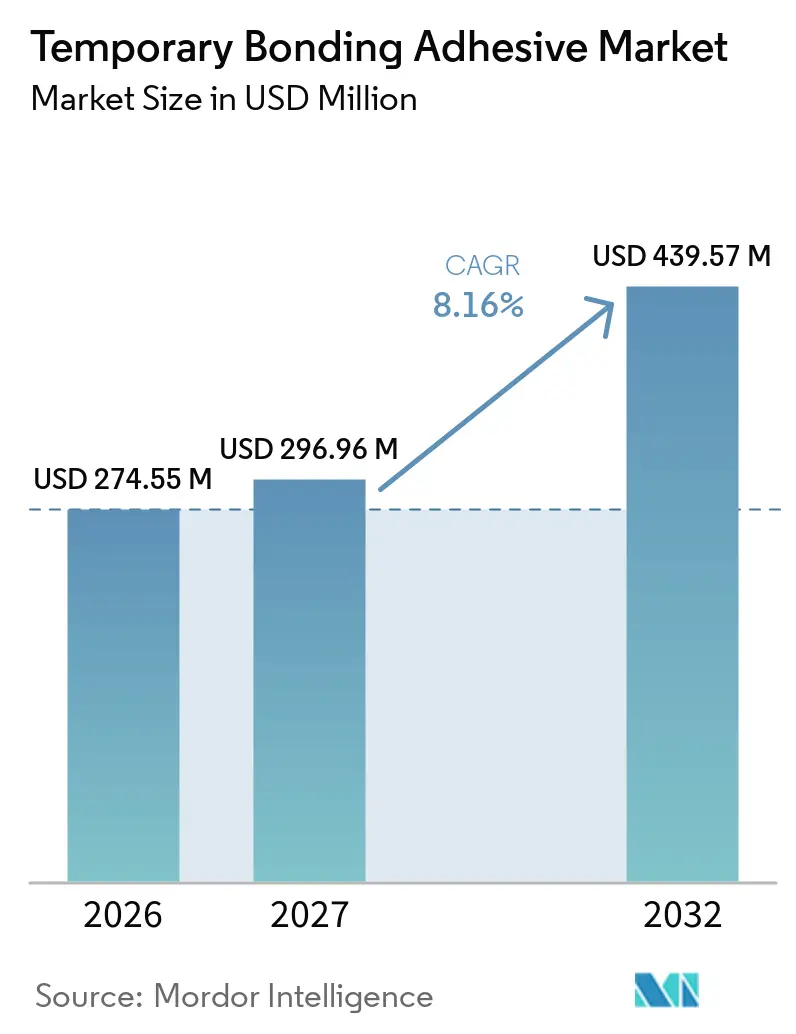
The Temporary Bonding Adhesive Market size was valued at USD 274.55 million in 2026 and is estimated to grow from USD 296.96 million in 2027 to reach USD 439.57 million by 2032, at a CAGR of 8.16% during the forecast period (2027-2032). Growth is tied to advanced semiconductor packaging, where thin wafers require temporary support during grinding, deposition, and transfer steps. AI accelerators, high-bandwidth memory, chiplets, and 3D integration increase the number of bonding and debonding steps within a finished device. This raises demand for materials that remain stable during heat, plasma treatment, and chemical exposure, then release cleanly without damaging the device wafer. Suppliers are competing through high-temperature stability, low residue, and compatibility with laser debonding equipment rather than price alone. The temporary bonding adhesive market also benefits as large packaging investments create qualification opportunities for suppliers that already meet foundry process requirements.
Key Report Takeaways
- By product type, acrylic held 24.67% of the temporary bonding adhesive market share in 2026, while polyurethane is projected to advance at a 9.12% CAGR through 2032.
- By material type, organic polymer materials held 45.13% of the temporary bonding adhesive market share in 2026, while polyimide and related high-temperature materials are projected to advance at a 9.34% CAGR through 2032.
- By debonding technology, laser debonding held 47.56% of the temporary bonding adhesive market share in 2026 and is projected to advance at a 9.81% CAGR through 2032.
- By application, advanced packaging held 63.28% of the temporary bonding adhesive market share in 2026 and is projected to advance at a 10.13% CAGR through 2032.
- By geography, Asia-Pacific held 51.41% of the temporary bonding adhesive market share in 2026 and is projected to advance at a 10.04% CAGR through 2032.
Note: Market numbers in this report are based on Mordor Intelligence's proprietary estimation framework, which combines nine months of actuals with Q4 projections for base year 2026.
Global Temporary Bonding Adhesive Market Trends and Insights
Drivers Impact Analysis*
| Driver | (~) % Impact on CAGR Forecast | Geographic Relevance | Impact Timeline |
|---|---|---|---|
| Advanced Packaging and Chiplet Integration | +3.2% | Global, concentrated in APAC (Taiwan, South Korea) and North America | Short term (≤ 2 years) |
| Wafer Thinning and Ultra-Thin Substrate Handling | +2.1% | Global, led by APAC (Japan, South Korea, Taiwan) | Short term (≤ 2 years) |
| Semiconductor Fab and Advanced Packaging Capacity Expansion | +1.8% | APAC core, spillover to North America | Medium term (2–4 years) |
| MEMS, Image Sensor and Compound Semiconductor Growth | +1.4% | Global, led by APAC with growth in North America | Medium term (2–4 years) |
| Low-Force, Low-Residue Debonding Requirements | +0.8% | Global | Long term (≥ 4 years) |
| Source: Mordor Intelligence | |||
Advanced Packaging and Chiplet Integration
Chiplet architectures for AI accelerators are increasing demand in the temporary bonding adhesive market. Multi-die packages need wafer thinning below 50 µm across several device layers. Each thinning stage needs a bonding cycle with strict thermal, mechanical, and chemical requirements. Research presented at the IEEE Electronic Components and Technology Conference (ECTC) 2025 showed that infrared laser debonding on silicon temporary carriers supported 2.5D and 3D chiplet integration processes. The approach supports the use of adhesive chemistry and debonding methods as a combined process solution. Larger panel-level packaging formats also require uniform coating thickness because variation can affect subsequent lithography alignment.
Wafer Thinning and Ultra-Thin Substrate Handling
Wafer thinning below 30 µm is becoming more common in fan-out packaging, high-bandwidth memory, and 3D integrated circuits. The adhesive must support the wafer during chemical mechanical polishing and withstand plasma or chemical processes. In December 2025, Brewer Science, Inc., EV Group (EVG), and Fraunhofer IZM-ASSID demonstrated handling of 300 mm wafers thinned to 15 µm with BrewerBOND C1301-10 and EVG880 LayerRelease technology[1]. The system remained stable at temperatures up to 450 °C and enabled laser debonding. Research from the Yongjiang Laboratory also reported thinning of 12-inch silicon power wafers to 15 µm with total thickness variation at or below 2 µm. These requirements favor formulations with controlled rheology and consistent bonding-layer thickness.
Semiconductor Fab and Advanced Packaging Capacity Expansion
New fabrication and packaging capacity is creating a larger production base for the temporary bonding adhesive market. In March 2025, Taiwan Semiconductor Manufacturing Company (TSMC) announced an additional USD 100 billion U.S. investment, bringing its planned U.S. commitment to USD 165 billion. The plan included 3 fabrication plants, 2 advanced packaging facilities, and a research and development center in Arizona. New facilities need adhesive qualification before they reach full output. This process gives incumbent suppliers an advantage because their products can be evaluated alongside tool installation and process development. The temporary bonding adhesive market can therefore gain demand visibility before each site reaches peak throughput.
MEMS, Image Sensor and Compound Semiconductor Growth
Micro-Electro-Mechanical Systems (MEMS), complementary metal-oxide-semiconductor (CMOS) image sensors, and compound semiconductors broaden the temporary bonding adhesive market beyond advanced packaging. These devices need wafer-level handling during backside thinning, micromachining, or stacking. In March 2025, EV Group (EVG) introduced its next-generation GEMINI automated production wafer bonding system for 300 mm MEMS manufacturing. The system had already been delivered to several MEMS manufacturers, indicating production-scale adoption. Compound semiconductor substrates can also require materials that tolerate different chemicals and temperatures from mainstream silicon processes. This creates demand for more specialized formulations in the temporary bonding adhesive market.
Restraints Impact Analysis*
| Restraint | (~) % Impact on CAGR Forecast | Geographic Relevance | Impact Timeline |
|---|---|---|---|
| Specialty Material and Process Qualification Costs | -1.5% | Global | Long term (≥ 4 years) |
| Residue, Warpage and Yield-Failure Risk | -0.9% | Global, acutely in APAC advanced packaging hubs | Short to medium term (≤ 4 years) |
| Solvent, Emissions and Waste-Management Compliance Burden | -0.5% | North America & Europe, spillover to APAC | Medium to long term (2–5 years) |
| Source: Mordor Intelligence | |||
Specialty Material and Process Qualification Costs
Qualification of a new temporary bonding adhesive at a leading-edge fabrication facility requires extensive joint process testing. A material must show performance across bonding, thinning, downstream processing, and debonding before it can enter production. The qualification period can last 12 to 24 months, which limits the speed at which new formulations can gain volume. After approval, customers are reluctant to replace a material because changing suppliers can require another qualification cycle. This protects established suppliers but can slow the spread of new chemistry across the temporary bonding adhesive market. Smaller suppliers face the greatest challenge when they try to support several process nodes at the same time.
Residue, Warpage and Yield-Failure Risk
Residue and wafer warpage remain important technical barriers in the temporary bonding adhesive market. Residue can create defects in later metallization and plating steps, while warpage can affect alignment and handling. A 2024 review found that a mismatch in the coefficient of thermal expansion among the adhesive, carrier, and device substrate is a persistent source of wafer-level packaging warpage. Research published in 2025 also showed that wafer warpage increased with wafer size under comparable thermal conditions. A single yield excursion can outweigh savings from a lower-cost material. As a result, buyers place a premium on proven residue control and dimensional stability.
*Our forecasts treat driver/restraint impacts as directional, not additive. The impact forecasts reflect baseline growth, mix effects, and variable interactions.
Segment Analysis
By Product Type: Acrylic Retains Broad Use as Polyurethane Builds Demand
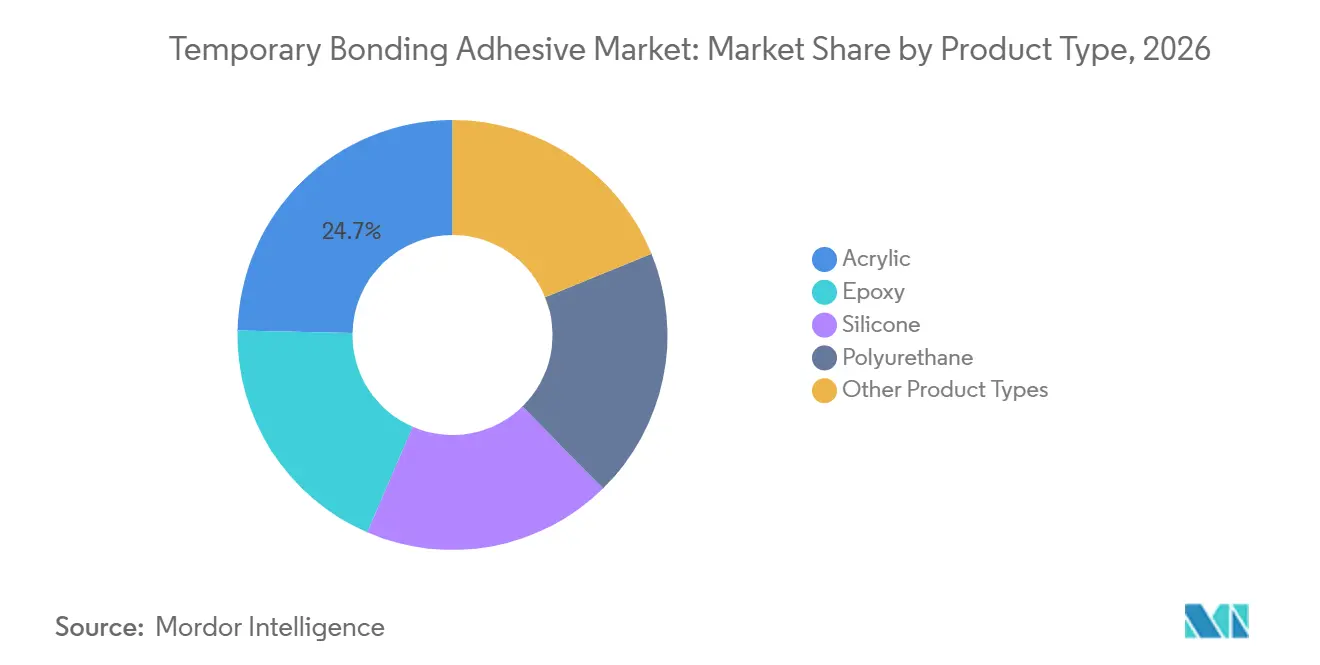
Acrylic held 24.67% of the temporary bonding adhesive market share in 2026. It remained widely used in wafer-level packaging and fan-out processes with temperatures in the 200 °C to 250 °C range. Its cost profile and compatibility with established ultraviolet and thermal debonding equipment support broad adoption. Polyurethane is projected to expand at a 9.12% CAGR through 2032. The material provides mechanical flexibility, low residue after debonding, and suitable chemical resistance for fan-out applications.
Silicone remains important where processing temperatures exceed 300 °C, including compound semiconductor and through-silicon via workflows. Epoxy formulations are used where stability during high-force grinding is more important than easy release. Laser-induced interfacial separation can reduce stress during debonding at lower energy density than ablative techniques. This supports the development of polyurethane and silicone grades designed for low-energy laser release. Wax-based and composite tape formats continue to serve cost-sensitive MEMS and power semiconductor applications. The temporary bonding adhesive market is separating into value-focused materials and performance-focused materials that emphasize thermal stability and residue control.

By Material Type: Organic Polymer Materials Anchor Revenue, While High-Temperature Materials Accelerate
Organic polymer materials held 45.13% of the temporary bonding adhesive market share in 2026. Polyacrylates, thermoplastics, and polyurethane matrices are compatible with established spin-coating and ultraviolet curing processes. Their operating range supports many processes up to 200 °C to 250 °C. This installed equipment base supports their continued role in high-volume wafer-level packaging. Polyimide and related high-temperature materials are projected to advance at a 9.34% CAGR through 2032 as hybrid bonding, silver sintering, and plasma-enhanced chemical vapor deposition require higher thermal resistance.
Inorganic release-layer materials serve a smaller but growing role in silicon-carrier systems using infrared laser debonding. These deposited films can provide low thickness variation and high mechanical stability. The imec presented work at Electronics Components and Technology Conference (ECTC) 2025 on silicon-based temporary carrier systems for 2.5D and 3D integration. The shift toward silicon carriers can favor deposition and equipment specialists over suppliers focused only on coated organic materials. Composite and hybrid materials retain a role in flexible electronics and heterogeneous substrate applications. The temporary bonding adhesive industry is therefore likely to require both conventional coated materials and specialized release layers.
By Debonding Technology: Laser Debonding Leads Current Adoption and Future Growth
Laser debonding held 47.56% of the temporary bonding adhesive market share in 2026. It is projected to advance at a 9.81% CAGR through 2032, making it both the largest and fastest-growing debonding technology. Its room-temperature operation and controlled release support ultra-thin wafer handling. Research on laser debonding found that separation at the release-layer and adhesive boundary can reduce stress and surface damage. This capability makes laser processes attractive for device wafers below 25 µm.
EV Group (EVG) introduced the EVG880 LayerRelease system in May 2024 with twice the throughput of its prior platform. Thermal slide-off debonding continues in applications where carrier transparency is unavailable or thermoplastic processes are already approved. Mechanical debonding has lower suitability for ultra-thin wafers because it can introduce flexural stress. EV Group (EVG) has positioned infrared LayerRelease as an alternative to mechanical debonding for high-bandwidth memory and 3D dynamic random-access memory applications. Xenon flash light methods are also being developed for clean separation without carbonized debris. Resonac announced a temporary bonding film using this method in September 2024.
By Application: Advanced Packaging Leads Current Adoption and Future Growth
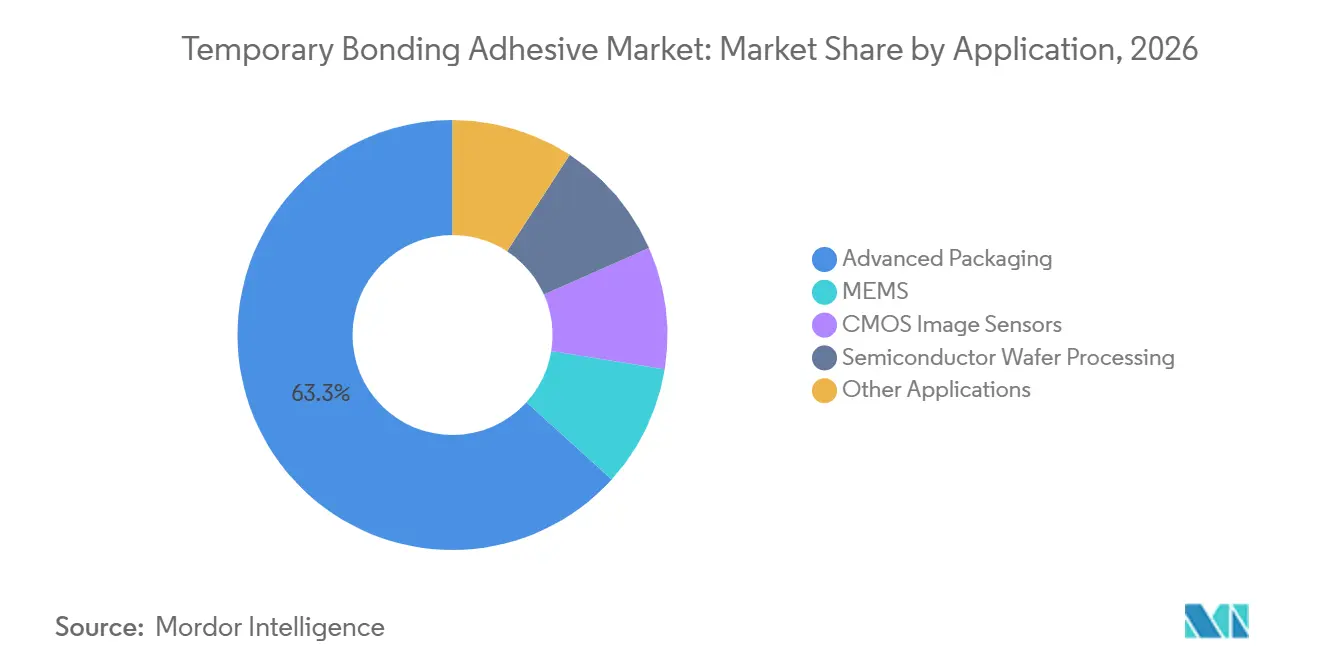
Advanced packaging held 63.28% of the temporary bonding adhesive market share in 2026. It is projected to advance at a 10.13% CAGR through 2032. CoWoS, SoIC, fan-out wafer-level packaging, 3D integrated circuits, and high-bandwidth memory depend on temporary support during thin-wafer processing. This concentration means the temporary bonding adhesive market is closely linked to packaging capacity investments. TSMC’s U.S. plans include 2 advanced packaging facilities, which will create additional material qualification activity.
MEMS applications use temporary bonding for micromachining and wafer handling. CMOS image sensors also require clean temporary support during backside-illuminated and stacked sensor processing. Semiconductor wafer processing, including through-silicon via formation and power device thinning, provides a steady demand base for mid-tier formulations. ECTC 2025 research demonstrated a temporary bonding film and photonic debonding approach for handling wafers thinned to 25 µm. Existing qualification data in advanced packaging can help suppliers enter adjacent MEMS and image sensor processes. Flexible electronics and medical device assembly remain smaller applications, but can provide longer-term adjacency opportunities.
Geography Analysis
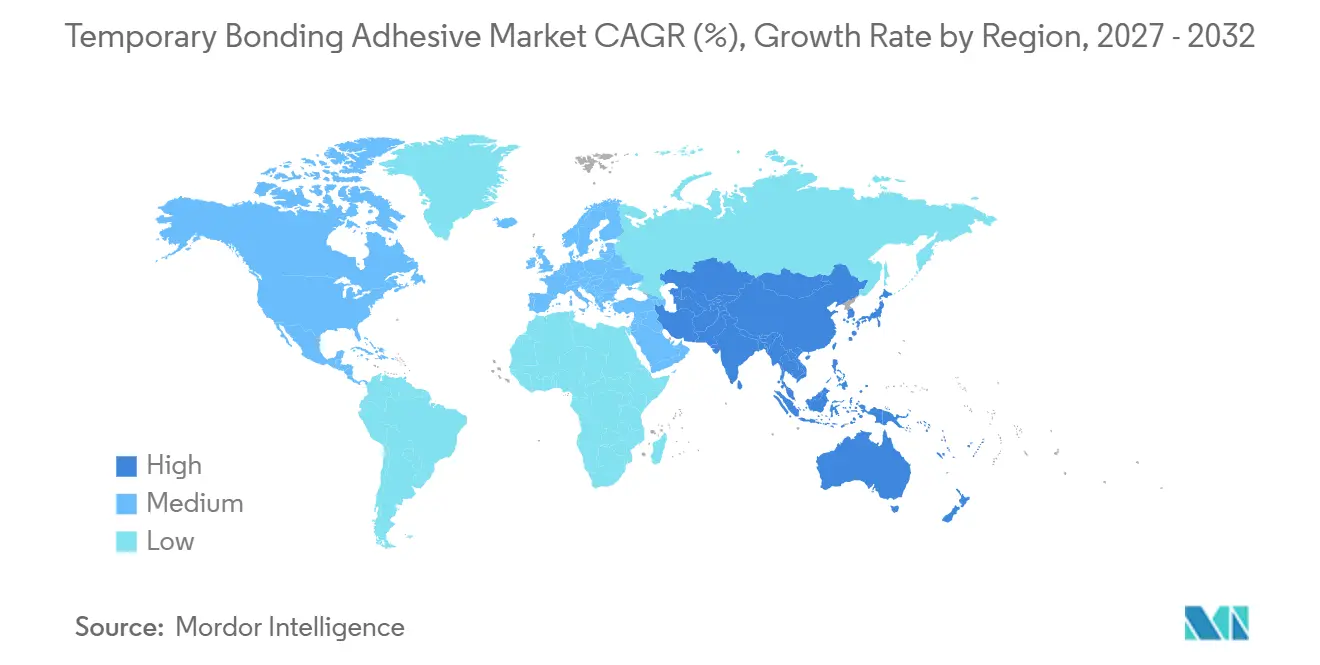
Asia-Pacific held 51.41% of the temporary bonding adhesive market share in 2026 and is projected to advance at a 10.04% CAGR through 2032. Taiwan, South Korea, Japan, and China combine advanced fabrication, memory production, packaging capacity, and materials supply. Taiwan is central because TSMC operates leading CoWoS and SoIC capacity. Asia-Pacific, therefore, remains the main source of high-performance material qualification and demand. Japan also contributes through specialist electronic materials and image sensor supply chains.
China is gaining importance as both a consumption market and a local materials supply base. Domestic developers are advancing organosilicon and other temporary bonding formulations for 8-inch and 12-inch wafer lines. This supports regional alternatives in cost-sensitive applications. TSMC’s USD 165 billion planned U.S. commitment includes its first U.S. advanced packaging facilities. Suppliers qualified on TSMC processes in Taiwan may have an advantage as these facilities progress.
U.S. emissions requirements can influence the selection of solvent-based materials. A September 2026 Federal Register action covered hazardous air pollutant standards for semiconductor manufacturing[2]. This creates an incentive for lower-volatile-organic-compound formulations. Europe remains technically active through research institutions, including Fraunhofer IZM-ASSID, and through the European Semiconductor Manufacturing Company facility in Dresden. South America and the Middle East and Africa have limited direct demand because they have less wafer-level manufacturing infrastructure. Their semiconductor role remains more focused on downstream assembly and electronics production.
Competitive Landscape
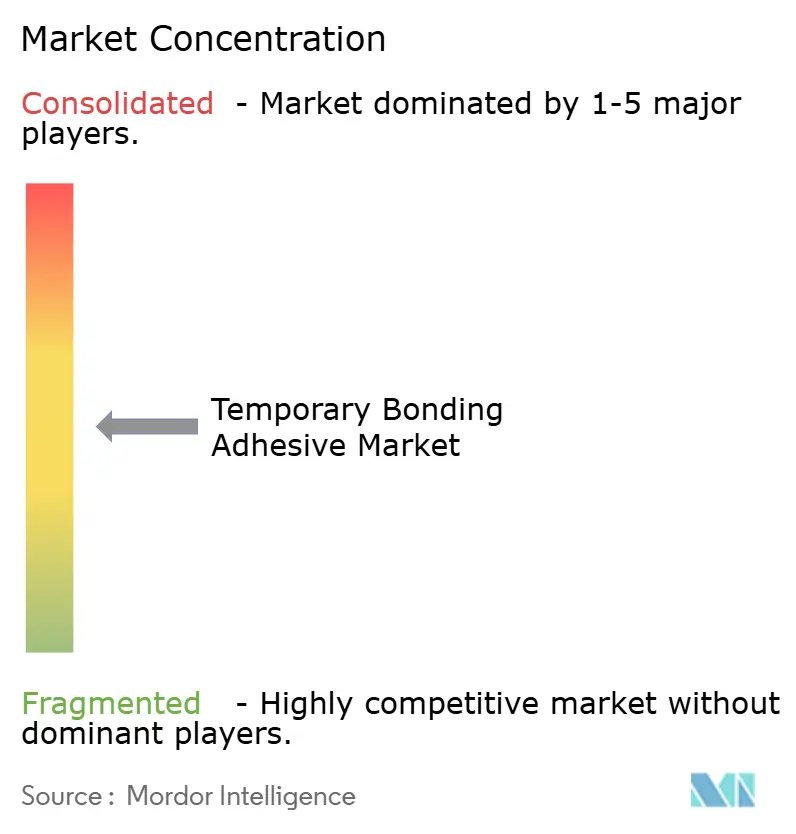
The temporary bonding adhesive market is moderately concentrated, with the top five players including 3M, Brewer Science, Inc., DAXIN Inc., AI Technology, Inc., and Micro Materials Inc. Brewer Science, Inc. demonstrated a 300 mm thin-wafer handling flow using BrewerBOND C1301-10 with silicon carriers and infrared laser release in December 2025. The process supported temperatures up to 450 °C and handling of wafers thinned to 15 µm. These capabilities shape competition in the high-temperature tier of the temporary bonding adhesive market.
The Brewer Science, Inc. and EV Group (EVG) collaboration illustrates how adhesive suppliers and equipment providers can jointly support a complete process flow. This model can improve integration between material performance and debonding tools. In February 2026, EV Group (EVG) presented its GEMINI FB production bonding systems and infrared LayerRelease technology for advanced memory and packaging applications. In September 2026, Brewer Science, Inc. presented a laser-release material for processes up to 350 °C and release at 308 nm and 355 nm wavelengths. These moves show the growing importance of high-temperature and laser-compatible systems.
DuPont, Dow, Arkema, and BASF bring broad chemical capabilities to related materials categories. Nitto Denko Corporation and JSR Corporation have process-specific experience developed through foundry engagement. DAXIN and other China-based suppliers are expanding in cost-sensitive applications supported by domestic development programs. H.B. Fuller Company and Promerus, LLC address narrower MEMS and specialty polymer needs. Opportunity areas include lower-emission chemistry, xenon flash-compatible materials, and uniform coatings for panel-level packaging. Nitto Denko Corporation’s 2026 patent activity in ultraviolet-curable adhesive tapes reflects ongoing work on controlled release for wafer processing.
Temporary Bonding Adhesive Industry Leaders
-
3M
-
Brewer Science, Inc.
-
DAXIN Inc.
-
AI Technology, Inc.
-
Micro Materials Inc.
- *Disclaimer: Major Players sorted in no particular order
Recent Industry Developments
- September 2026: Hyrnus launched two wafer bonders designed for the temporary bonding of wafers to substrates. The development supports the temporary bonding adhesive market by expanding equipment adoption for wafer processing and temporary bonding applications.
- February 2026: Shin-Etsu Chemical Co., Ltd. received a U.S. patent for a dry adhesive designed for the temporary bonding of semiconductor devices to silicon wafers and carriers. The adhesive can be debonded without heat or chemicals and leaves no residue, supporting demand for advanced temporary bonding solutions in semiconductor manufacturing.
Global Temporary Bonding Adhesive Market Report Scope
Temporary bonding adhesives are specialized materials used to temporarily attach substrates, wafers, or components during precision manufacturing and processing steps. They provide sufficient bonding strength during processing and enable controlled separation after the required fabrication or handling operations are completed.
The Temporary Bonding Adhesive Market is segmented by product type, material type, debonding technology, application, and geography. By product type, the market is segmented into acrylic, silicone, polyurethane, epoxy, and other product types. By material type, the market is segmented into organic polymer materials, inorganic release-layer materials, polyimide and related high-temperature materials, and other material types. By debonding technology, the market is segmented into thermal slide-off debonding, mechanical debonding, laser debonding, and other debonding technologies. By application, the market is segmented into advanced packaging, MEMS, CMOS image sensors, semiconductor wafer processing, and other applications. The report also covers the market size and forecasts for temporary bonding adhesives across 15 countries. For each segment, the market sizing and forecasts have been done on the basis of value (USD).
| Acrylic |
| Silicone |
| Polyurethane |
| Epoxy |
| Other Product Types |
| Organic Polymer Materials |
| Inorganic Release-Layer Materials |
| Polyimide and Related High-Temperature Materials |
| Other Material Types |
| Thermal Slide-Off Debonding |
| Mechanical Debonding |
| Laser Debonding |
| Other Debonding Technologies |
| Advanced Packaging |
| MEMS |
| CMOS Image Sensors |
| Semiconductor Wafer Processing |
| Other Applications |
| Asia-Pacific | China |
| India | |
| Japan | |
| South Korea | |
| ASEAN Countries | |
| Rest of Asia-Pacific | |
| North America | United States |
| Canada | |
| Mexico | |
| Europe | Germany |
| United Kingdom | |
| France | |
| Italy | |
| NORDIC Countries | |
| Rest of Europe | |
| South America | Brazil |
| Argentina | |
| Rest of South America | |
| Middle East and Africa | Saudi Arabia |
| South Africa | |
| Rest of Middle East and Africa |
| By Product Type | Acrylic | |
| Silicone | ||
| Polyurethane | ||
| Epoxy | ||
| Other Product Types | ||
| By Material Type | Organic Polymer Materials | |
| Inorganic Release-Layer Materials | ||
| Polyimide and Related High-Temperature Materials | ||
| Other Material Types | ||
| By Debonding Technology | Thermal Slide-Off Debonding | |
| Mechanical Debonding | ||
| Laser Debonding | ||
| Other Debonding Technologies | ||
| By Application | Advanced Packaging | |
| MEMS | ||
| CMOS Image Sensors | ||
| Semiconductor Wafer Processing | ||
| Other Applications | ||
| By Geography | Asia-Pacific | China |
| India | ||
| Japan | ||
| South Korea | ||
| ASEAN Countries | ||
| Rest of Asia-Pacific | ||
| North America | United States | |
| Canada | ||
| Mexico | ||
| Europe | Germany | |
| United Kingdom | ||
| France | ||
| Italy | ||
| NORDIC Countries | ||
| Rest of Europe | ||
| South America | Brazil | |
| Argentina | ||
| Rest of South America | ||
| Middle East and Africa | Saudi Arabia | |
| South Africa | ||
| Rest of Middle East and Africa | ||
Key Questions Answered in the Report
What is the size of the temporary bonding adhesive market?
The Temporary Bonding Adhesive Market size was valued at USD 274.55 million in 2026 and is estimated to grow from USD 296.96 million in 2027 to reach USD 439.57 million by 2032, at a CAGR of 8.16% during the forecast period (2027-2032).
Which product type led the temporary bonding adhesive demand in 2026?
Acrylic held a 24.67% share in 2026.
Which debonding technology is projected to advance fastest through 2032?
Laser debonding is projected to advance at a 9.81% CAGR through 2032.
Why are laser debonding systems important for advanced packaging?
They enable controlled, lower-stress release for ultra-thin wafers and can support high-volume processes with silicon carriers.