
Telecom V2X Connectivity Services Market Size and Share
Market Overview
| Study Period | 2021 - 2032 |
|---|---|
| Market Size (2027) | USD 3.87 Billion |
| Market Size (2032) | USD 12.43 Billion |
| Growth Rate (2027 - 2032) | 26.29 % |
| Fastest Growing Market | Asia-Pacific |
| Largest Market | Asia-Pacific |
| Market Concentration | Medium |
Major Players *Disclaimer: Major Players sorted in no particular order Image © Mordor Intelligence. Reuse requires attribution under CC BY 4.0. | |
Telecom V2X Connectivity Services Market Analysis by Mordor Intelligence
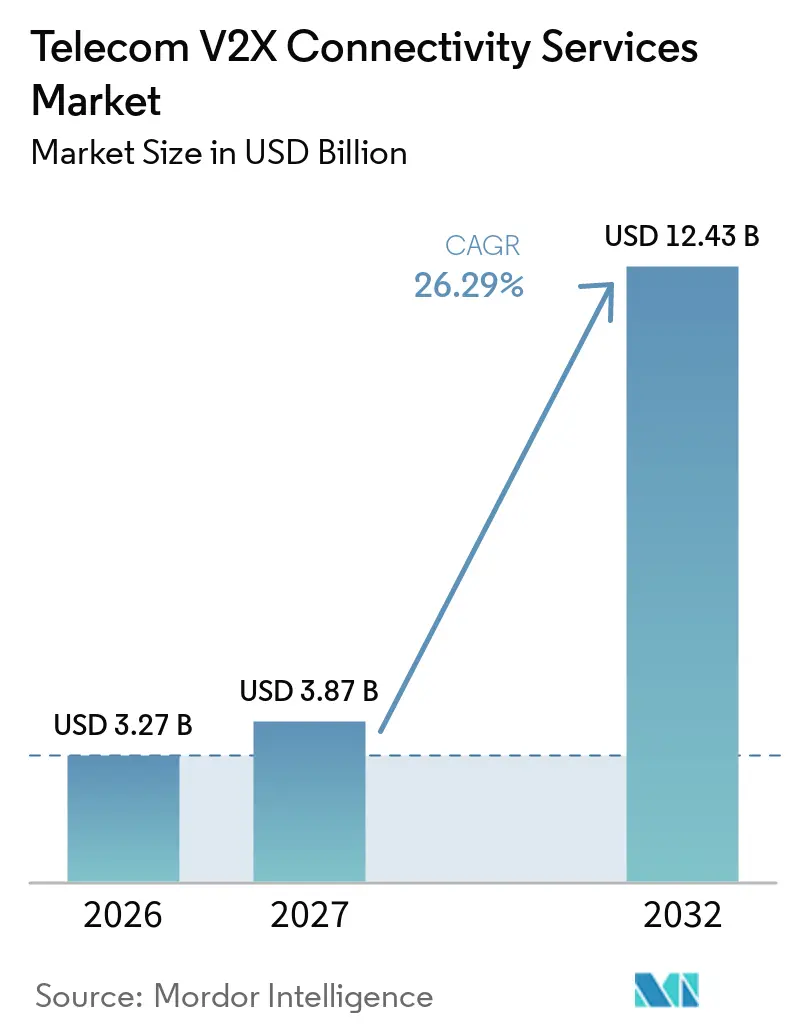
The Telecom V2X Connectivity Services Market size is projected to expand from USD 3.27 billion in 2026 and USD 3.87 billion in 2027 to USD 12.43 billion by 2032, registering a CAGR of 26.29% between 2027 to 2032. The market is moving beyond isolated demonstration corridors as mobile network operators, road authorities, and automotive original equipment manufacturers fund production deployments. The 2025 United States decision favoring C-V2X in the upper 5.9 GHz band reduced uncertainty around the technology path in North America. Factory-fitted connectivity, virtualized roadside systems, and mobile edge computing are changing how service providers structure contracts and deliver low-latency functions. The Telecom V2X Connectivity Services Market also benefits when cities place traffic operations, emergency response, and connected-vehicle programs within a single digital infrastructure plan. High roadside deployment costs, unresolved cybersecurity liability, and inconsistent spectrum policies across borders remain material limits on commercial scale.
Key Report Takeaways
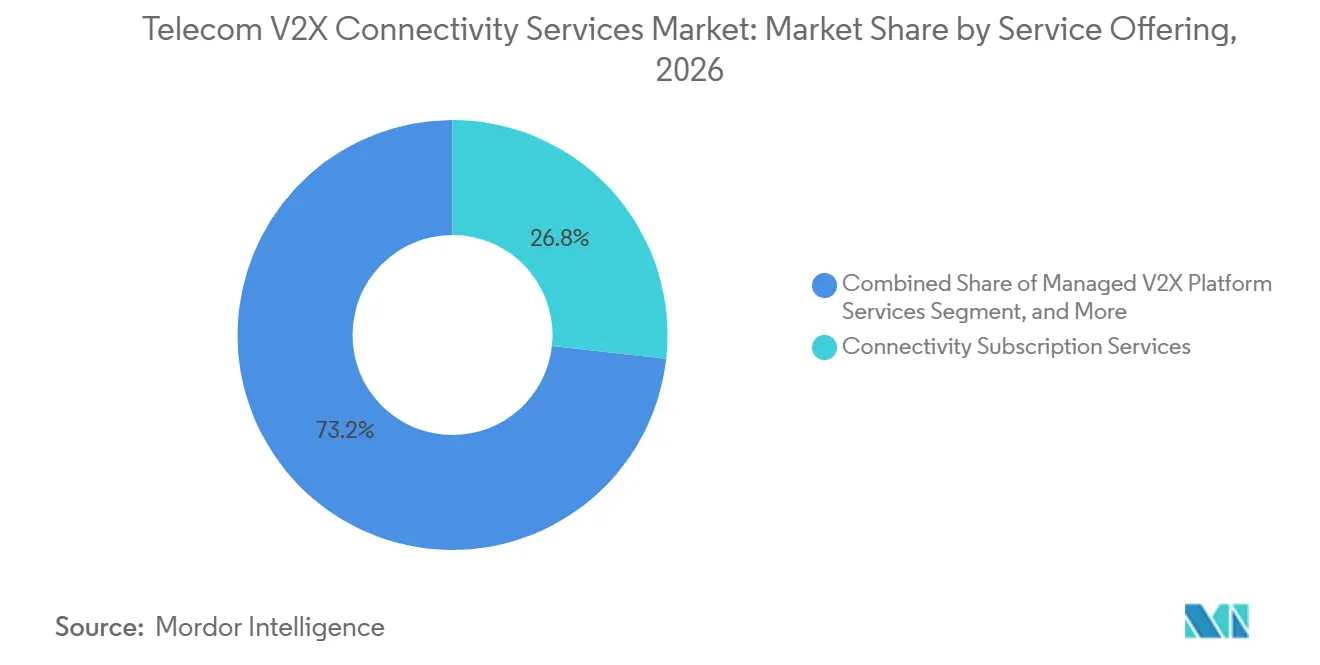
- By service offering, Connectivity Subscription Services held 26.77% of the Telecom V2X Connectivity Services Market in 2026, while Edge and Cloud V2X Services is projected to expand at a 27.65% CAGR through 2032.
- By connectivity technology, LTE-V2X held 49.88% share in 2026, while 5G is projected to expand at a 28.14% CAGR through 2032.
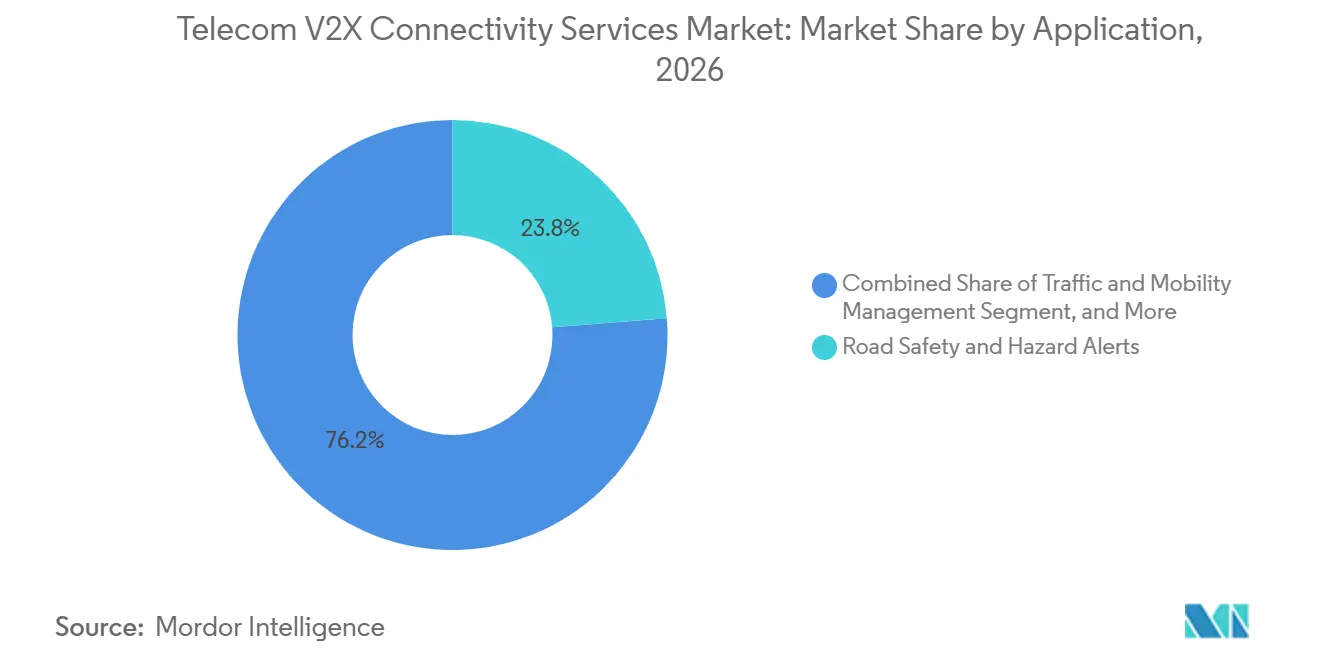
- By application, Road Safety and Hazard Alerts held 23.76% share in 2026, while Cooperative Perception and Automated Driving Support is projected to expand at a 27.89% CAGR through 2032.
- By end user, Automotive OEMs and Tier-1 Suppliers held 25.08% share in 2026, while Smart Cities and Municipal Governments is projected to expand at a 28.55% CAGR through 2032.
- By geography, Asia-Pacific held 31.12% share in 2026 and is projected to expand at a 27.13% CAGR through 2032.
Note: Market numbers in this report are based on Mordor Intelligence's proprietary estimation framework, which combines nine months of actuals with Q4 projections for base year 2026.
Market Trends and Insights
Drivers Impact Analysis of Telecom V2X Connectivity Services Market*
| DRIVER | (~) % IMPACT ON CAGR FORECAST | GEOGRAPHIC RELEVANCE | IMPACT TIMELINE |
|---|---|---|---|
| Connected and Automated Vehicle Rollouts | +5.50% | Global | Medium term (2-4 years) |
| 5G URLLC and Edge-Computing Enablement | +5.00% | Global, Asia-Pacific core, spillover to North America and Europe | Medium term (2-4 years) |
| Government Road-Safety Mandates and Vision-Zero Targets | +4.50% | North America and Europe, with early gains in South Korea and India | Short term (≤ 2 years) |
| OEM and Fleet Investment in Smart Mobility | +4.00% | Global | Medium term (2-4 years) |
| Vehicle-to-Grid and Energy-Service Integration | +2.50% | Europe and North America | Long term (≥ 4 years) |
| Virtualized Roadside Infrastructure Reducing Deployment Cost | +2.00% | North America and Europe | Short term (≤ 2 years) |
| Source: Mordor Intelligence | |||
Connected and Automated Vehicle Rollouts
OEM production decisions now set the pace for V2X service deployment more than pilot programs do. BMW launched its first production vehicle with built-in C-V2X in China in January 2025, using technology supplied by JOYNEXT, which showed that factory-fitted deployment had entered commercial production. The 5GAA roadmap expects mass deployment of 5G-V2X in commercial vehicle models from 2026 onward, aligning with East Asian design wins for 2028 production programs.[1] The Telecom V2X Connectivity Services Market therefore follows vehicle refresh cycles, because an agreement secured at the design stage can establish a subscription relationship for years and can influence the choice of platform, modem, network service, and software support over a vehicle program's life. Vehicles sold without embedded modems still require aftermarket equipment, creating a separate opportunity for logistics fleets and for suppliers that can provide installation, activation, and support at a manageable cost. This opportunity is particularly relevant in Southeast Asia, where fleet operators are evaluating connectivity alongside safety and operational needs, and the Telecom V2X Connectivity Services Market can serve both factory-fitted and retrofit vehicle populations.
5G URLLC and Edge-Computing Enablement
3GPP Release 16 supports the low-latency and highly reliable communications required for cooperative driving functions. The standard enables sidelink communication that can support collective perception, sensor fusion, and real-time map updates near the vehicle rather than in a distant cloud environment. Processing these workloads at the network edge can reduce the onboard hardware burden and enable software updates, allowing vehicle capabilities to improve without replacing installed equipment. South Korea has tested 12 V2X services along an LTE-V2X route between Daejeon and Sejong, providing a useful reference for corridor deployment. The Telecom V2X Connectivity Services Market depends on dense mid-band 5G coverage along transport routes, since weak coverage can undermine the reliability of network-supported services and lead to uneven performance between urban centers and less densely served road corridors. Network investment decisions by mobile operators are therefore closely linked to the quality and timing of V2X service availability, and this connection is central to the development of the Telecom V2X Connectivity Services Market.
Government Road-Safety Mandates and Vision-Zero Targets
Regulatory programs are changing V2X from a discretionary technology choice into a planning requirement for vehicle makers and public infrastructure operators. The European Union required packet-switched eCall capability for new vehicle types from January 2026, establishing a connectivity baseline to support additional safety functions. India issued a 2025 mandate to advance vehicle-to-vehicle communications as a road-safety measure, providing an early policy basis for local deployment. Euro NCAP's 2029 roadmap considers V2X in intervention-oriented safety evaluations, giving automakers a reason to act before any formal deadline. These policy signals bring road authorities, OEMs, and operators into the same investment cycle. The Telecom V2X Connectivity Services Market benefits when safety requirements are linked to established vehicle approval and assessment processes, as compliance planning provides suppliers with clearer deployment timing.
OEM and Fleet Investment in Smart Mobility
OEMs and Tier-1 suppliers are investing in V2X for mobility services and to comply with safety requirements. Verizon Business launched its Edge Transportation Exchange as a virtualized and edge-enabled platform for connected vehicles, with Volkswagen Group of America, the Delaware Department of Transportation, and Rutgers University among its early customers.[2] The early customer mix indicates demand from public agencies and commercial organizations, with different operating needs but a shared requirement for reliable connectivity. Fleet operators are considering collision avoidance, route optimization, and priority signaling, particularly where these functions can reduce avoidable delays and improve the use of established routes. Their decisions remain cautious because recurring connectivity costs must be weighed against operational benefits that are difficult to measure in advance. The Telecom V2X Connectivity Services Market is likely to see OEM demand develop sooner than fleet demand, as service providers clarify the cost case, especially when road operators, vehicle makers, and mobile networks coordinate their implementation plans.
Restraints Impact Analysis of Telecom V2X Connectivity Services Market*
| RESTRAINT | (~) % IMPACT ON CAGR FORECAST | GEOGRAPHIC RELEVANCE | IMPACT TIMELINE |
|---|---|---|---|
| High Roadside and Backhaul Deployment Cost | -3.50% | Global | Short term (≤ 2 years) |
| Cybersecurity, Privacy and Liability Exposure | -2.80% | Global | Medium term (2-4 years) |
| Spectrum and Cross-Border Interoperability Uncertainty | -1.80% | Europe and Asia-Pacific cross-border corridors | Long term (≥ 4 years) |
| Weak Fleet-Operator Return on Investment | -1.20% | North America and Europe | Medium term (2-4 years) |
| Source: Mordor Intelligence | |||
High Roadside and Backhaul Deployment Cost
Roadside infrastructure costs are an immediate limit on deployments that require dense physical roadside-unit networks. A fiber-backhauled roadside unit network with 1-kilometer spacing costs USD 52,000 per kilometer, while a wireless-backhaul configuration costs USD 36,500 per kilometer in the cited United States assessment.[3] The national V2X plan prepared by ITS America placed the long-term United States deployment goal at USD 6.5 billion over 10 years.[4] These costs are harder for state and municipal agencies to absorb because funding decisions are spread across separate authorities and procurement cycles. Security credential management can add recurring annual costs to the initial capital requirement. Virtualized roadside architectures can reduce the need for dedicated hardware, although the Telecom V2X Connectivity Services Market still requires dependable mobile network coverage along rural and semi-urban corridors.
Cybersecurity, Privacy and Liability Exposure
A compromised roadside unit or on-board unit can affect safety-related messages, making V2X security more sensitive than conventional connected-device security. Cooperative Awareness Messages can carry position and identifier data, which creates a risk of detailed movement tracking if communications are intercepted.[5] The Telecom V2X Connectivity Services Market must also address uncertainty regarding liability among vehicle manufacturers, mobile operators, and infrastructure owners, as service responsibilities span multiple organizations. A 2026 NRMA study reported that many vehicle makers and suppliers underestimate the risks associated with privacy and data security failures in connected vehicle systems. Buyers can delay procurement when they face unclear legal exposure after a cybersecurity event. Clearer contractual responsibilities, secure credential management, and repeatable incident processes are needed before public agencies and enterprises expand deployments.
*Our forecasts treat driver/restraint impacts as directional, not additive. The impact forecasts reflect baseline growth, mix effects, and variable interactions.
Telecom V2X Connectivity Services Market Segment Analysis
By Service Offering:
Subscriptions Anchor Revenue While Edge Services Gain MomentumConnectivity Subscription Services are expected to account for 26.77% of the Telecom V2X Connectivity Services Market in 2026. Recurring agreements linked to cellular data plans and embedded telematics SIMs support this segment, providing buyers with an ongoing service relationship rather than a one-time equipment purchase. This model allows operators to add V2X messaging capacity without requiring separate hardware installations in every vehicle while maintaining a familiar billing structure for customers and network operators. Managed V2X Platform Services support for buyers requiring data management, application support, operational oversight, message routing, and coordinated connections with roadside systems. Integration, Deployment, and Lifecycle Services remain important for road authorities and city operators that need support in planning, deploying, testing, maintaining, and updating infrastructure across dispersed road networks. Other Service Offerings include data-as-a-service arrangements, under which anonymized traffic data can support urban planning and insurance use cases as the underlying service portfolio continues to diversify.
Edge and Cloud V2X Services are projected to expand at a CAGR of 27.65% through 2032. Mobile edge computing places applications closer to road corridors, reducing the time required to process safety and driving-support messages. This capability is valuable for applications that require rapid and predictable responses. It enables providers to offer service commitments that centralized cloud systems cannot consistently match and allows users to run functions without relying solely on vehicle-based processing. Verizon is expected to introduce its Edge Transportation Exchange in 2025, combining 5G Edge infrastructure with a virtual roadside unit architecture. The platform illustrates how operators can reduce dependence on fixed roadside hardware when deploying selected services and integrate network, application, and infrastructure functions within a single operating environment. Competition in the Telecom V2X Connectivity Services Market is likely to increasingly focus on software capabilities, edge-node placement, and the ability to operate across different vehicle and infrastructure environments.

By Connectivity Technology:
LTE-V2X Holds Majority Share as 5G Transition BeginsLTE-V2X is expected to account for a 49.88% share in 2026. Its position reflects earlier investments in 3GPP Release 14-based equipment across the United States, South Korea, China, and Europe, where pilot routes and early production programs established installed equipment bases. This installed base creates demand for services and upgrades as road authorities and OEMs move beyond basic broadcast functions toward services that require consistent interaction with road and network systems. LTE-V2X is well-suited for use cases already operating in connected corridors, including hazard warnings, location-based infrastructure messages, and road-condition notifications. However, its PC5 interface has limitations for applications that require more coordinated driving behavior and broader data exchange. As a result, providers must support installed LTE-V2X systems, protect earlier investments, and prepare customers for higher-capacity 5G capabilities during the transition period.
The 5G segment is projected to expand at a CAGR of 28.14% through 2032. Release 16 introduced NR-V2X sidelink communication, enabling direct vehicle-to-vehicle data exchange over 5G spectrum and providing service providers with a foundation for more demanding connected-driving applications. This technology reduces limitations associated with early network-only designs and supports functions that require more responsive data sharing, particularly when multiple vehicles and roadside systems exchange information simultaneously. The 5GAA stated that 5G-V2X is on track for mass deployment in commercial vehicle models between 2026 and 2029. Other Connectivity Technologies include legacy DSRC installations and non-terrestrial network satellite links for locations without reliable terrestrial coverage, providing operators with options for remote highway sections. A Paris demonstration planned for 2025 is expected to combine satellite non-terrestrial connectivity with 5G-V2X direct vehicle communication, demonstrating how hybrid connectivity can extend V2X service coverage beyond existing cellular infrastructure.
By Application:
Road Safety Commands Scale While Cooperative Perception Drives Value GrowthRoad Safety and Hazard Alerts are expected to account for 23.76% of the Telecom V2X Connectivity Services Market in 2026. These applications have established safety rationales and lower latency requirements than advanced automated-driving use cases, making them practical early services for transport agencies and road operators. Signal Phase and Timing messages, intersection movement assistance, and work-zone speed alerts are operating across intersections in North America and Europe, connecting vehicle information with operational road data. Their deployment generates the data flows that integrate connected-vehicle services into routine road operations and builds familiarity among agencies, drivers, and technology suppliers. Traffic and Mobility Management and Emergency, Public-Safety, and Work-Zone Services are also well-suited to public procurement because authorities can link them to congestion and response-time costs. Fleet, Logistics, and Commercial-Vehicle Operations are developing more slowly, although platooning and freight-priority applications are gaining attention along high-volume logistics routes with repeatable operating patterns.
Cooperative Perception and Automated Driving Support are projected to expand at a CAGR of 27.89% through 2032. This application combines Level 3 and Level 4 vehicle programs with the expanding availability of 5G-V2X, aligning vehicle programs and network capabilities within the same deployment timeline. It allows vehicles to receive LiDAR, radar, and camera information from roadside infrastructure or other vehicles, supplementing rather than replacing onboard sensing systems. This capability can extend a vehicle's perception beyond its sensor range and reduce the hardware threshold for advanced automation in complex driving environments. China's NCAP program is exploring C-V2X-triggered warnings as part of its 2027 evaluation criteria, providing Asian OEMs with an early policy signal. Other Applications include vulnerable road-user protection through smartphone alerts. This use case is receiving greater attention as cities strengthen cycling and pedestrian safety programs and seek tools that can support mixed urban traffic.
By End User:
OEMs Lead Adoption as Smart Cities Drive the Fastest ExpansionAutomotive OEMs and Tier-1 Suppliers are expected to hold 25.08% of the Telecom V2X Connectivity Services Market in 2026. They integrate connectivity modules into production vehicles and influence chipset volumes, network specifications, and mobile operator agreements across vehicle families. Consequently, their purchasing decisions affect multiple layers of suppliers and substantially influence how platform and connectivity providers configure services, which features they support, and when modules enter production. Telecom Operators and Connectivity Service Providers act as both buyers and sellers within the ecosystem. They acquire platform software and infrastructure capabilities while offering managed connectivity to OEMs, cities, and fleet customers, making their role commercially distinct from that of traditional network-only providers. Road Authorities and Intelligent Transport Agencies provide a steady source of publicly funded demand for traffic-management and road-safety functions linked to defined public responsibilities.
Smart Cities and Municipal Governments are projected to expand at a CAGR of 28.55% through 2032. Cities increasingly view V2X as shared digital infrastructure rather than a single-purpose transport project, enabling multiple municipal departments to consider the same roadside and network investments. Integrating traffic management, parking, emergency response, and environmental monitoring into connected-city platforms broadens the business case for intersection investments and can align projects with wider digital programs. South Korea is expected to add V2X capabilities to its TP-SS-9 accident prevention protocol revision in February 2025, demonstrating how safety scoring can influence municipal procurement. Public Transit, Logistics, and Fleet Operators remain cautious buyers because their return on investment can be indirect and may depend on coordination with road agencies. Charging Network Operators, utilities, insurers, and mobility-service providers have longer-term opportunities through vehicle-to-grid services and behavior-based pricing, which can expand revenue sources beyond road-safety use cases.
Geography Analysis
APAC Telecom V2X Connectivity Services Market
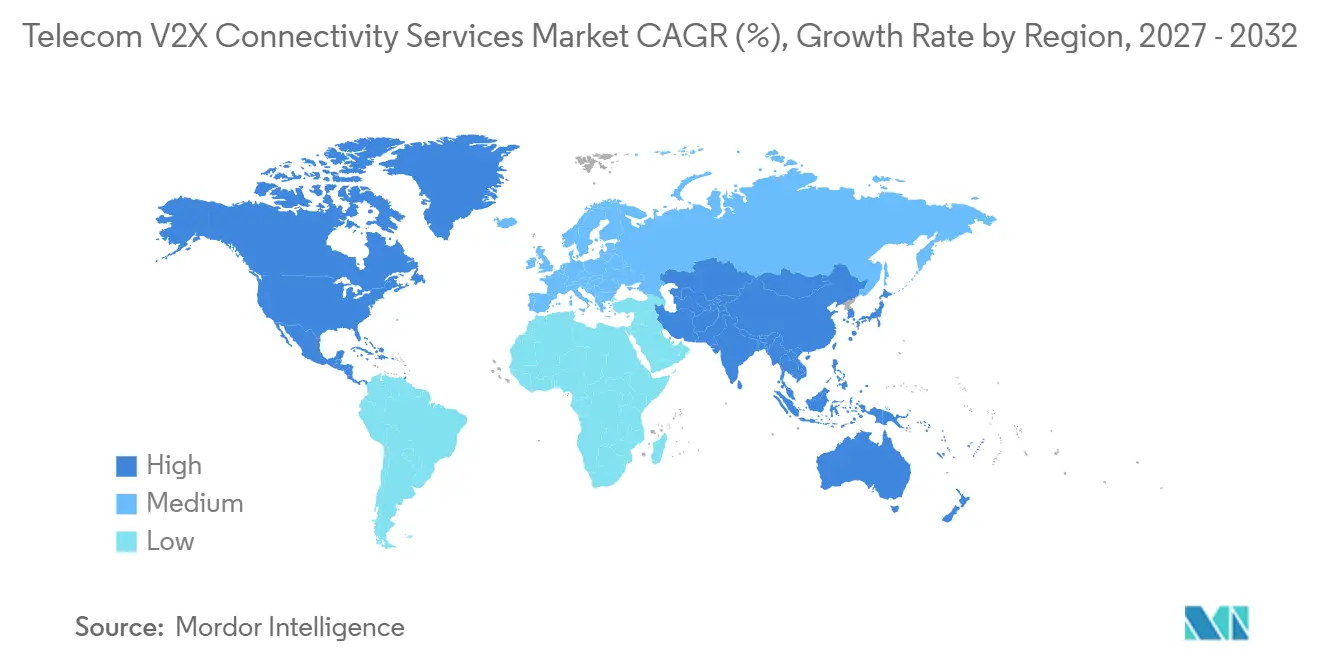
Asia-Pacific held a 31.12% share of the Telecom V2X Connectivity Services Market in 2026 and is projected to expand at a CAGR of 27.13% through 2032. China supports regional scale through vehicle-road-cloud programs and released GB/T 45315-2025, its first national LTE-V2X Direct standard, during the first half of 2025. The standard reduced uncertainty for OEMs and infrastructure operators planning large-scale deployments. Japan allocated the 5.9 GHz band for V2X in 2025 and aims to achieve practical deployment by 2030 following standardization efforts. South Korea tested 12 V2X services along a nearly 50-kilometer route between Daejeon and Sejong. India has established an early regulatory foundation for vehicle-to-vehicle communication through its 2025 road-safety directive.
North America and Europe Telecom V2X Connectivity Services Market
North America has a more established policy environment following the United States' adoption of C-V2X for ITS use in the upper 5.9 GHz band in 2025. In August 2025, Atlanta became the first United States Day One Deployment District for C-V2X, providing an urban operating example. In Europe, the packet-switched eCall requirement introduced in January 2026 provides a foundation for connectivity for additional safety and traffic-management services. Germany, the United Kingdom, and France lead regional activity through cross-border cooperative ITS corridors. The Telecom V2X Connectivity Services Market in these regions benefits from mature road agencies, established vehicle supply chains, and existing connected transportation programs.
MEA and South America Telecom V2X Connectivity Services Market
The Middle East, Africa, and South America remain early-stage markets, although they offer specific deployment opportunities. Saudi Arabia has established a 5.9 GHz roadmap for V2X systems and recognizes C-V2X compatibility with 4G and 5G networks. Abu Dhabi and Dubai are expanding smart-city V2X pilots across intersections and expressway corridors, although broader commercialization is expected after 2029. Brazil's 2025 electricity reform and its 2026 approval of a vehicle-to-grid pilot provide an initial pathway for energy-focused V2X services.
Competitive Landscape
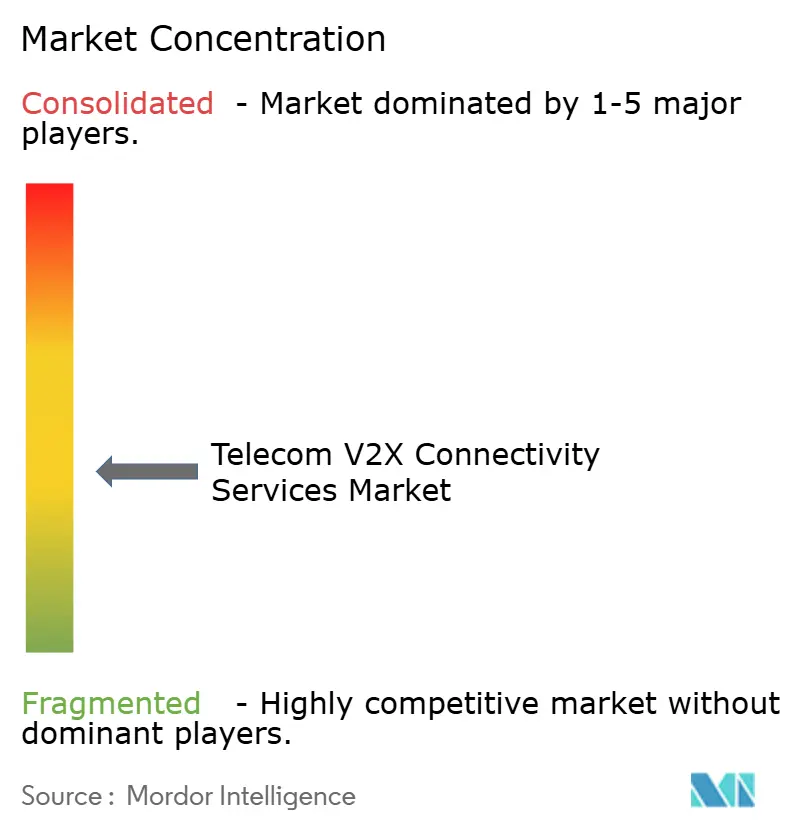
The Telecom V2X Connectivity Services Market is moderately fragmented at the platform and service layers, while the chipset and hardware segments are more concentrated. As of December 2025, the 5G Automotive Association had 117 members, including 13 OEMs and 9 mobile network operators. This membership base supports joint demonstrations, deployment guidance, and alignment on common technical priorities. Verizon Communications differentiates its offering through virtual roadside systems and mobile edge computing, enabling it to provide managed services without requiring public agencies to own all roadside assets. Continental and Robert Bosch compete by integrating V2X modules into vehicle controllers and advanced driver-assistance systems (ADAS), while Qualcomm Technologies supplies chipsets used in Cohda Wireless on-board units, Bosch vehicle computers, and roadside deployments.
Infrastructure specialists, including Commsignia, Kapsch TrafficCom, and Cohda Wireless, compete for public tenders through certified equipment and configurations that meet United States procurement requirements. Cohda Wireless achieved full United States C-V2X platform certification in August 2026 after its MK6 on-board unit received OmniAir approval. In February 2026, Kapsch TrafficCom introduced a communication-agnostic connected tolling platform that processed 5G Network V2X and 5.9 GHz PC5 C-V2X transactions in a live setting with Verizon. Bosch and Qualcomm expanded their ADAS collaboration in April 2026, securing design wins from East Asian automakers for 2028 vehicle programs. These developments demonstrate that suppliers are combining certified hardware with software, edge computing capabilities, and relationships with vehicle manufacturers.
Two commercial gaps remain significant. First, the market requires a neutral data-sharing infrastructure that enables road agencies to receive consistent message feeds across multiple mobile network operators. The 5GAA's V2N2X framework identifies this need and outlines a network-based architecture to support interoperability. Second, fleet operators require service models that offer clearer financial returns from safety, routing, and priority functions, including services that reduce delays and improve coordination along defined freight routes. A market concentration score of 5 is appropriate because no combined share for leading players is available, and competition remains distributed across chipset providers, platform providers, mobile network operators, and infrastructure specialists.
Telecom V2X Connectivity Services Industry Leaders
-
Qualcomm Incorporated
-
Ericsson AB
-
Nokia Corporation
-
Huawei Technologies Co., Ltd.
-
Verizon Communications Inc.
- *Disclaimer: Major Players sorted in no particular order
Telecom V2X Connectivity Services Market Companies Covered in this Report
- Qualcomm Incorporated
- Ericsson AB
- Nokia Corporation
- Huawei Technologies Co., Ltd.
- Verizon Communications Inc.
- AT&T Inc.
- China Mobile Limited
- Deutsche Telekom AG
- SK Telecom Co., Ltd.
- NTT DOCOMO, INC.
- Vodafone Group Plc
- Telenor ASA
- Continental AG
- Robert Bosch GmbH
- NXP Semiconductors N.V.
- HARMAN International Industries, Incorporated
- DENSO CORPORATION
- Aptiv PLC
- Commsignia Ltd.
- Cohda Wireless Pty Ltd.
- Kapsch TrafficCom AG
- Quectel Wireless Solutions Co., Ltd.
- Cisco Systems, Inc.
- LG Electronics Inc.
Recent Industry Developments in Telecom V2X Connectivity Services Market
- October 2026: Kapsch TrafficCom was awarded a USD 32 million contract for Phase 2 of the North Carolina Turnpike Authority's Complete 540 project, extending the Triangle Expressway and scaling the world's first production V2X tolling system. The award validates the commercial viability of V2X-based toll collection and represents the largest single V2X tolling infrastructure contract awarded globally to date.
- October 2026: Kapsch TrafficCom was selected to supply Roadside Units for the Avondale corridor as part of the Maricopa County Department of Transportation's Connected Vehicle Acceleration Zone (CVAZ), a USDOT-backed deployment connecting approximately 750 physical and virtual RSUs with 400 OBUs across transit, emergency, and freight fleets. The deployment sets a new benchmark for multi-use-case V2X infrastructure in a metropolitan corridor.
- August 2026: Cohda Wireless's MK6 On-Board Unit received OmniAir Consortium certification for LTE-V2X conformance, completing full C-V2X platform certification in the United States for both its OBU and RSU. The certification unlocks eligibility for federally funded deployments and confirms compliance with interoperability, performance, and security standards required by major United States state DOT programs.
- July 2026: Hyundai Motor Group launched AllDayEnergy, its global V2X energy services brand, unifying Vehicle-to-Grid, Vehicle-to-Home, and V1G smart-charging capabilities under a single identity. United Kingdom rollout commenced via the Kia App in Q2 2026 with planned expansion to Europe, the United States, and South Korea, positioning Hyundai as the first major OEM to commercialize a global V2X energy services platform.
Global Telecom V2X Connectivity Services Market Report Scope
Telecom V2X Connectivity Services Market Report is Segmented by Service Offering (Connectivity Subscription, Managed V2X Platform, Edge and Cloud V2X Services, and Integration, Deployment and Lifecycle Services), Connectivity Technology (LTE-V2X, and 5G), Application (Road Safety and Hazard Alerts, Traffic and Mobility Management, Cooperative Perception and Automated Driving Support, Fleet, Logistics and Commercial-Vehicle Operations, and Emergency, Public-Safety and Work-Zone Services), End User (Automotive OEMs and Tier-1 Suppliers, Telecom Operators and Connectivity Service Providers, Road Authorities and Intelligent Transport Agencies, Public Transit, Logistics and Fleet Operators, Smart Cities and Municipal Governments, Charging Network Operators and Utilities, and Insurance and Mobility-Service Providers), and Geography (North America, South America, Europe, Asia-Pacific, and the Middle East and Africa). The Market Forecasts are Provided in Value (USD).
Segmentation Overview
| Connectivity Subscription Services |
| Managed V2X Platform Services |
| Edge and Cloud V2X Services |
| Integration, Deployment and Lifecycle Services |
| Other Service Offerings |
| LTE-V2X |
| 5G |
| Other Connectivity Technologies |
| Road Safety and Hazard Alerts |
| Traffic and Mobility Management |
| Cooperative Perception and Automated Driving Support |
| Fleet, Logistics and Commercial-Vehicle Operations |
| Emergency, Public-Safety and Work-Zone Services |
| Other Applications |
| Automotive OEMs and Tier-1 Suppliers |
| Telecom Operators and Connectivity Service Providers |
| Road Authorities and Intelligent Transport Agencies |
| Public Transit, Logistics and Fleet Operators |
| Smart Cities and Municipal Governments |
| Charging Network Operators and Utilities |
| Insurance and Mobility-Service Providers |
| North America | United States |
| Canada | |
| Mexico | |
| South America | Brazil |
| Argentina | |
| Rest of South America | |
| Europe | Germany |
| United Kingdom | |
| France | |
| Italy | |
| Spain | |
| Rest of Europe | |
| Asia-Pacific | China |
| Japan | |
| South Korea | |
| India | |
| Australia | |
| Rest of Asia-Pacific | |
| Middle East | United Arab Emirates |
| Saudi Arabia | |
| Rest of Middle East | |
| Africa | South Africa |
| Nigeria | |
| Rest of Africa |
| By Service Offering | Connectivity Subscription Services | |
| Managed V2X Platform Services | ||
| Edge and Cloud V2X Services | ||
| Integration, Deployment and Lifecycle Services | ||
| Other Service Offerings | ||
| By Connectivity Technology | LTE-V2X | |
| 5G | ||
| Other Connectivity Technologies | ||
| By Application | Road Safety and Hazard Alerts | |
| Traffic and Mobility Management | ||
| Cooperative Perception and Automated Driving Support | ||
| Fleet, Logistics and Commercial-Vehicle Operations | ||
| Emergency, Public-Safety and Work-Zone Services | ||
| Other Applications | ||
| By End User | Automotive OEMs and Tier-1 Suppliers | |
| Telecom Operators and Connectivity Service Providers | ||
| Road Authorities and Intelligent Transport Agencies | ||
| Public Transit, Logistics and Fleet Operators | ||
| Smart Cities and Municipal Governments | ||
| Charging Network Operators and Utilities | ||
| Insurance and Mobility-Service Providers | ||
| By Geography | North America | United States |
| Canada | ||
| Mexico | ||
| South America | Brazil | |
| Argentina | ||
| Rest of South America | ||
| Europe | Germany | |
| United Kingdom | ||
| France | ||
| Italy | ||
| Spain | ||
| Rest of Europe | ||
| Asia-Pacific | China | |
| Japan | ||
| South Korea | ||
| India | ||
| Australia | ||
| Rest of Asia-Pacific | ||
| Middle East | United Arab Emirates | |
| Saudi Arabia | ||
| Rest of Middle East | ||
| Africa | South Africa | |
| Nigeria | ||
| Rest of Africa | ||
Key Questions Answered in the Report
What is the size of the Telecom V2X Connectivity Services Market?
The Telecom V2X Connectivity Services Market is projected to expand from USD 3.27 billion in 2026 and USD 3.87 billion in 2027 to USD 12.43 billion by 2032, at a 26.29% CAGR. The forecast reflects the movement from corridor demonstrations to commercial service deployments, with connected vehicles, road systems, mobile networks, and application platforms forming the operating base.
What is driving demand for telecom V2X connectivity services?
Production vehicle deployment, 5G and edge computing, road safety policies, and city digital infrastructure programs are driving demand. The Telecom V2X Connectivity Services Market also benefits from service contracts that can extend through vehicle refresh cycles, although road equipment costs and security obligations still constrain the pace of deployment.
Which telecom V2X service offering is the largest?
Connectivity Subscription Services held the largest share of the service offering at 26.77% in 2026. It uses mobile network agreements and embedded telematics SIMs to support recurring service revenue, while managed platforms and deployment services support the operational needs of public agencies and city customers.
Which V2X technology is expanding fastest?
5G is projected to expand at a 28.14% CAGR through 2032 as NR-V2X supports direct and responsive data exchange. The Telecom V2X Connectivity Services Market depends on adequate network coverage to realize this capability, particularly along routes where connected-driving services require reliable communication with roadside assets.
Which end users are expected to expand fastest?
Smart Cities and Municipal Governments is projected to expand at a 28.55% CAGR through 2032. These buyers can combine V2X with traffic, parking, emergency response, and environmental monitoring systems, which supports broader use of an infrastructure investment across several municipal functions.
Which region leads V2X connectivity services?
Asia-Pacific led with a 31.12% share in 2026 and is projected to expand at a 27.13% CAGR through 2032. The Telecom V2X Connectivity Services Market in the region is supported by national standards, vehicle-road programs, and ongoing work by automakers and road agencies across China, Japan, South Korea, and India.