
Telecom UAV Network Services Market Size and Share
Market Overview
| Study Period | 2021 - 2032 |
|---|---|
| Market Size (2027) | USD 0.83 Billion |
| Market Size (2032) | USD 2.47 Billion |
| Growth Rate (2027 - 2032) | 24.37 % |
| Fastest Growing Market | Asia-Pacific |
| Largest Market | North America |
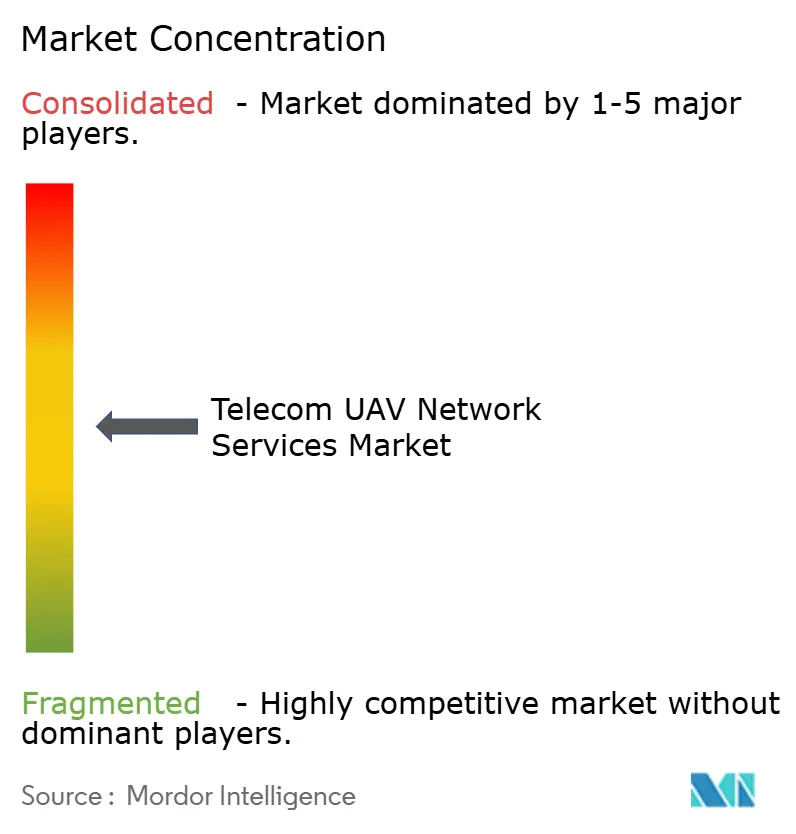
| Market Concentration | Medium |
Major Players *Disclaimer: Major Players sorted in no particular order Image © Mordor Intelligence. Reuse requires attribution under CC BY 4.0. | |
Telecom UAV Network Services Market Analysis by Mordor Intelligence
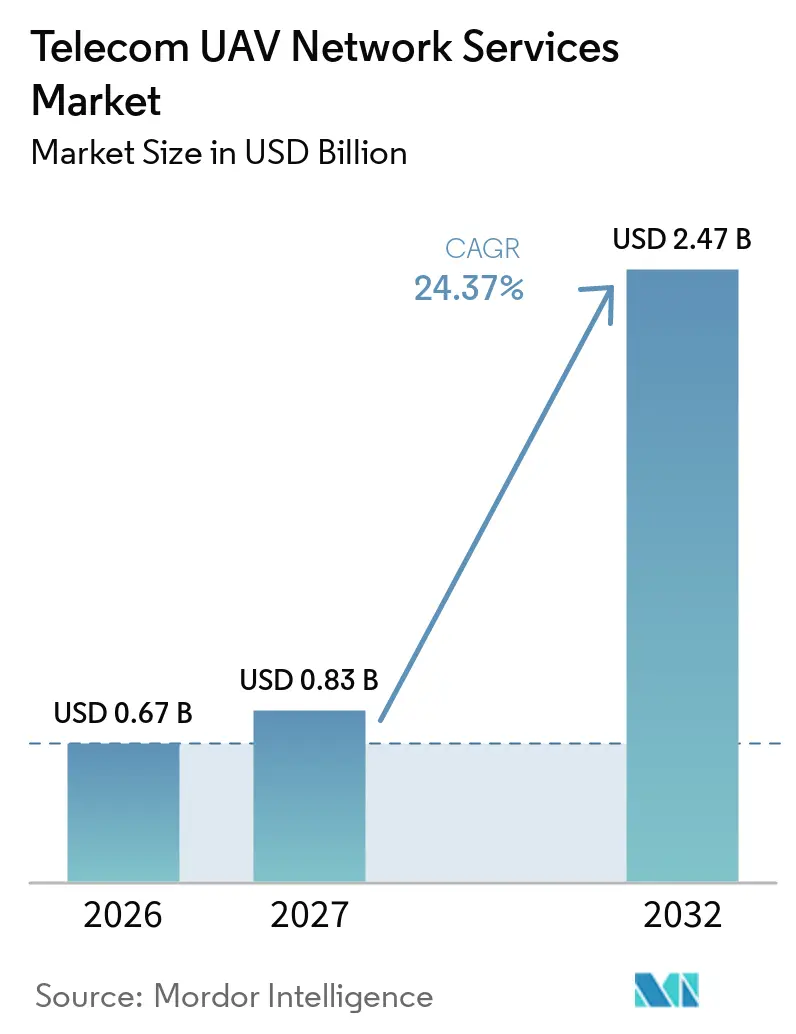
The Telecom UAV Network Services Market size was valued at USD 0.67 billion in 2026 and is estimated to grow from USD 0.83 billion in 2027 to reach USD 2.47 billion by 2032, at a CAGR of 24.37% during the forecast period (2027-2032). The move toward persistent, cellular-connected Beyond Visual Line of Sight, or BVLOS, missions is shifting revenue away from one-time equipment sales and toward recurring connectivity, airspace, and operational services. The United States had 424,516 active commercial drone registrations at the end of 2025, while the Federal Aviation Administration expects annual new commercial registrations to rise from 1.07 million in 2025 to 1.49 million by 2030. This installed base provides telecom providers with a larger pool of aircraft that require reliable command, control, identity, and data connectivity. Regulatory rules are also making resilient connectivity and flight data exchange core operating requirements rather than optional features. The Telecom UAV Network Services market, therefore, favors providers that can combine network access, security, coverage assurance, and airspace coordination in a managed service.
Key Report Takeaways
- By service type, connectivity and access services held 41.25% of the Telecom UAV Network Services market share in 2026, while UTM, remote identification, and airspace data services are projected to expand at a 26.14% CAGR through 2032.
- By operational range, visual line-of-sight operations accounted for 45.35% of the telecom UAV network services market share in 2026, while beyond visual line-of-sight operations are projected to expand at a 26.08% CAGR through 2032.
- By application, energy and utilities inspection held 29.45% of the telecom UAV network services market share in 2026, while logistics and delivery is projected to expand at a 25.96% CAGR through 2032.
- By end user, enterprises and industrial asset owners held 30.85% market share in the telecom UAV network services market in 2026, while drone operators and logistics providers are projected to expand at a 25.88% CAGR through 2032.
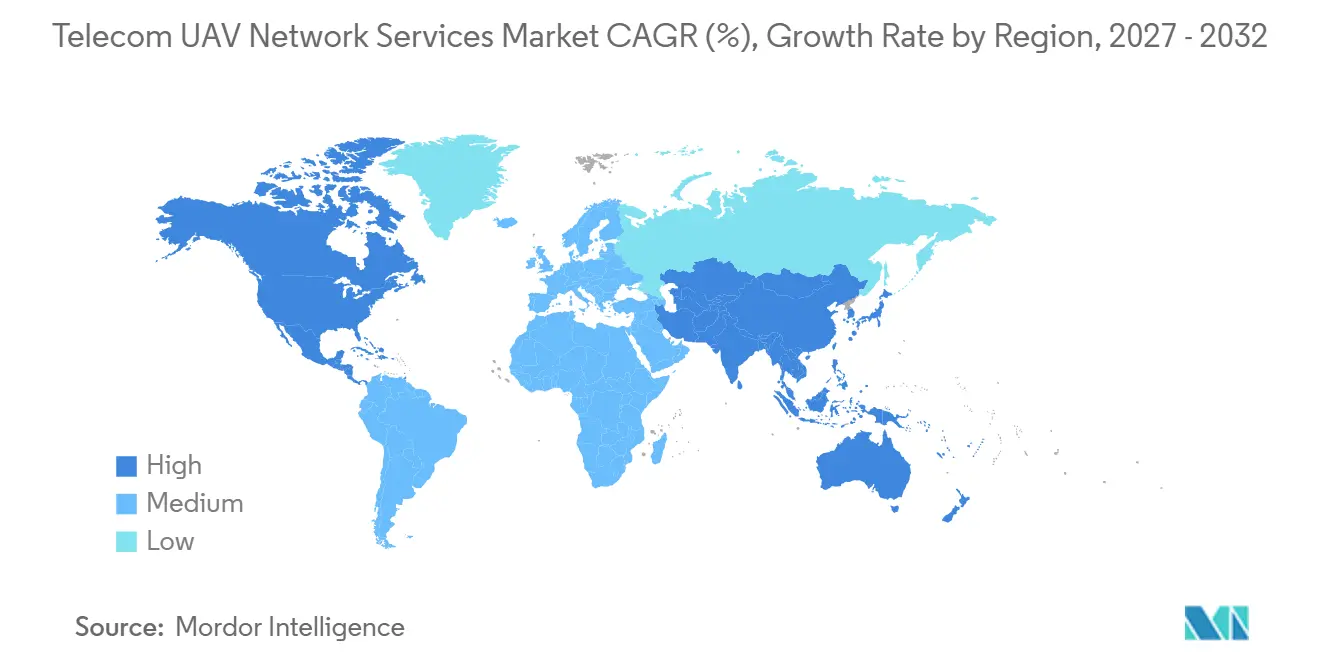
- By geography, North America held 34.65% market share in the telecom UAV network services market in 2026, while Asia-Pacific is projected to expand at a 26.19% CAGR through 2032.
Note: Market numbers in this report are based on Mordor Intelligence's proprietary estimation framework, which combines nine months of actuals with Q4 projections for base year 2026.
Market Trends and Insights
Drivers Impact Analysis of Telecom UAV Network Services Market*
| Driver | (~) % Impact on CAGR Forecast | Geographic Relevance | Impact Timeline |
|---|---|---|---|
| Expansion of BVLOS Commercial Operations | +3.5% | Global, with immediate concentration in North America and Europe | Short term (≤ 2 years) |
| 5G and Private Wireless Enable High-Throughput UAV Fleets | +3.0% | North America, Europe, and Asia-Pacific core markets | Medium term (2-4 years) |
| Regulatory Demand for Resilient Command-and-Control Links | +2.5% | Global, binding for BVLOS operators | Short term (≤ 2 years) |
| Drone Fleet Growth Increases Recurring Connectivity Demand | +2.0% | Global, strongest in North America, China, and Europe | Medium term (2-4 years) |
| Hybrid Cellular-Satellite Coverage for Remote and Disrupted Areas | +1.8% | Global, with high relevance in the Middle East, Africa, Asia-Pacific remote corridors, and South America | Long term (≥ 4 years) |
| Telecom Operators Monetize Network, Edge, and Airspace Assets | +1.5% | Europe, North America, and Asia-Pacific early movers | Medium term (2-4 years) |
| Source: Mordor Intelligence | |||
Expansion of BVLOS Commercial Operations
BVLOS operations create direct demand for the Telecom UAV Network Services market because each flight needs dependable communications beyond the pilot's visual range. The Federal Aviation Administration's proposed Part 108 rule, published in August 2025, set out a scalable framework and included automated data-service requirements for relevant providers.[1] The US Department of Transportation Office of Inspector General recorded a rise in approved BVLOS operations from 1,229 in 2020 to 26,870 in 2023.[2] The change from repeated approvals to a more repeatable process supports planned investment by network service providers. Longer routes and more frequent flights require continuous command-and-control coverage, tracking, and data exchange. Zipline's February 2026 Rwanda agreement shows the delivery scale that an established BVLOS framework can support.
5G and Private Wireless Enable High-Throughput UAV Fleets
Private 5G gives industrial drone fleets controlled spectrum, managed access, and handover support across wider operating areas. Research from Helmut Schmidt University found higher median latency than WLAN in a controlled comparison, but stronger performance for coordinated UAV activity across large areas. The important advantages are coverage and operational control, rather than minimum latency, in a small test area. Network slicing can reserve capacity for a drone mission and support contractual service-level commitments. The US Air Force awarded Skydweller Aero, Nokia Federal Solutions, and Tangram Flex a contract in January 2026 for an airborne private 5G network demonstration.[3] These capabilities allow providers to sell managed performance rather than basic data access in the Telecom UAV Network Services market.
Regulatory Demand for Resilient Command-and-Control Links
Regulators increasingly treat command-and-control links as safety-critical elements of UAV operations. The proposed Part 108 framework identifies automated data services as a required part of the wider BVLOS operating environment. The International Civil Aviation Organization called in 2025 for harmonized BVLOS and unmanned traffic management standards. An FAA-sponsored uAvionix demonstration reported 99.98% combined command-and-control availability across cellular, C-band, and low Earth orbit satellite links with automatic failover. The result shows why a single link may not meet the reliability expected for critical missions. This positions multi-link managed connectivity as a premium layer in the Telecom UAV Network Services market.
Drone Fleet Growth Increases Recurring Connectivity Demand
A larger commercial fleet expands the potential customer base for managed UAV connectivity. The FAA estimated that there were 424,516 active commercial drone registrations in the United States at the end of 2025 and projected continued growth in registrations through 2030. The Government Accountability Office reported that FAA planning projected the US commercial fleet to exceed 1 million aircraft by the end of 2025 and reach 1.18 million by 2029. Revenue depends on the share of aircraft moving from local radio control to persistent cellular or multi-network connections. Each connected aircraft may need a SIM, data plan, monitoring, and access to service platforms. The Telecom UAV Network Services market is strengthened when industrial, delivery, and public-safety operators build these requirements into normal operations.
Restraints Impact Analysis of Telecom UAV Network Services Market*
| Restraint | (~) % Impact on CAGR Forecast | Geographic Relevance | Impact Timeline |
|---|---|---|---|
| Fragmented Spectrum and Cross-Border Authorization | -2.5% | Global, with highest friction in European border corridors, Asia-Pacific, and South America | Short term (≤ 2 years) |
| High Cost of Certified BVLOS Network Assurance | -2.0% | North America and Europe, where certification requirements are most stringent | Medium term (2-4 years) |
| Aerial Handover and Coverage Gaps in Ground-Optimized Networks | -1.5% | Global, with acute exposure in rural and coastal Asia-Pacific, the Middle East, and Africa | Medium term (2-4 years) |
| Cybersecurity Liability Across Federated UTM Data Exchanges | -1.2% | Global, concentrated in cross-provider UTM data-exchange nodes | Long term (≥ 4 years) |
| Source: Mordor Intelligence | |||
Fragmented Spectrum and Cross-Border Authorization
Spectrum policy and operating authorization remain national responsibilities, limiting the ability to offer a single standard service across several countries. A drone operating along a cross-border pipeline, power route, or logistics corridor may face separate spectrum, airspace, and operator requirements in every jurisdiction. The International Civil Aviation Organization recognized this risk in its 2025 work on unmanned traffic management and air traffic management integration. The GSMA also warned in 2025 that isolated national approaches to drone visibility and connectivity could become fixed before interoperable arrangements are established. This fragmentation raises design, compliance, and contracting costs for network providers. It also limits the economies of scale available in the Telecom UAV Network Services market.
High Cost of Certified BVLOS Network Assurance
Certified BVLOS services require more than ordinary mobile-network availability. Providers must support testing, documentation, performance measurement, liability management, and continued compliance with aviation-grade operating expectations. The Part 108 proposal described requirements that would go beyond standard commercial mobile service agreements. These requirements can require investment before a provider has a large contracted customer base. Smaller specialists may find it difficult to fund certification and maintenance at the required scale. The restraint favors businesses with established networks, aerospace capabilities, or public backing.
*Our forecasts treat driver/restraint impacts as directional, not additive. The impact forecasts reflect baseline growth, mix effects, and variable interactions.
Telecom UAV Network Services Market Segment Analysis
By Service Type:
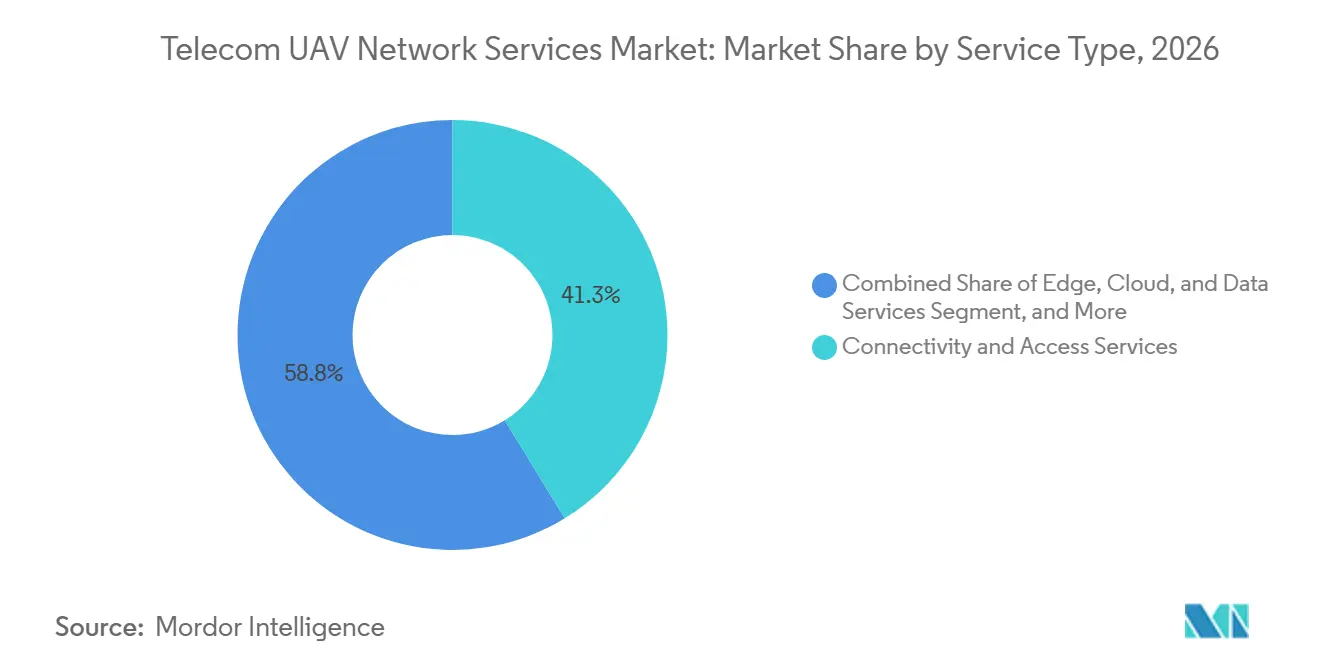
Connectivity Provides the Core While Airspace Services Expand FasterConnectivity and Access Services accounted for 41.25% of revenue in 2026, making it the largest service category. The segment includes managed cellular and satellite connections that keep aircraft linked to pilots, control systems, and operational platforms. Because every connected aircraft needs an access path, this category reaches the widest set of drone operators. More demanding missions are raising interest in systems that can select among cellular, satellite, and radio-frequency links as conditions change.
UTM, Remote Identification, and Airspace Data Services are projected to expand at a 26.14% CAGR through 2032. Their role becomes more important when operators must share flight intent, confirm aircraft identity, and coordinate access to airspace. EASA certified ANRA Technologies as its first U-space service provider in 2025, establishing a compliant subscription model across member states.[4] Edge, cloud, and data services add video analysis, anomaly detection, and mission-data storage to the service mix. Telefónica has brought together 5G, artificial intelligence analytics, Open Gateway APIs, and drone operations into a single commercial offering. Integration, certification, and compliance services also become more valuable as operators work across multiple jurisdictions.

By Operational Range:
VLOS Provides the Base While BVLOS Changes Service NeedsVisual Line of Sight operations accounted for 45.35% of revenue in 2026. They remain the operating base for many deployed drone programs and support a stable demand for connectivity, telemetry, and operator tools. VLOS missions generally take place in constrained locations where the pilot can observe the aircraft directly. They are common in localized inspection, site monitoring, and early-stage enterprise programs. Extended Visual Line of Sight operations provide a transition between direct visual operations and fully remote flight. This model uses additional observers and broader procedures to support activity near the normal visual boundary. The Telecom UAV Network Services market continues to serve these missions because operators need tracking, communications, and access to operational data. VLOS activity, therefore, remains important even as more advanced use cases develop.
Beyond Visual Line of Sight operations are projected to expand at a 26.08% CAGR through 2032. Their growth changes the required quality and duration of connected flight services. FAA Part 108 and European U-space frameworks support the shift toward more formal operating conditions for these missions. Research published in 2026 showed that hybrid terrestrial and non-terrestrial networks can maintain command-and-control latency within acceptable thresholds along rural BVLOS delivery corridors. This matters where a ground network alone cannot provide complete coverage. Mobile network operators can combine spectrum, network slicing, and satellite roaming arrangements in a single service relationship. The operational model can reduce the need for a drone operator to manage several communications providers. Each new authorization framework may require separate assurance work, helping preserve the value of managed services in the Telecom UAV Network Services market.
By Application:
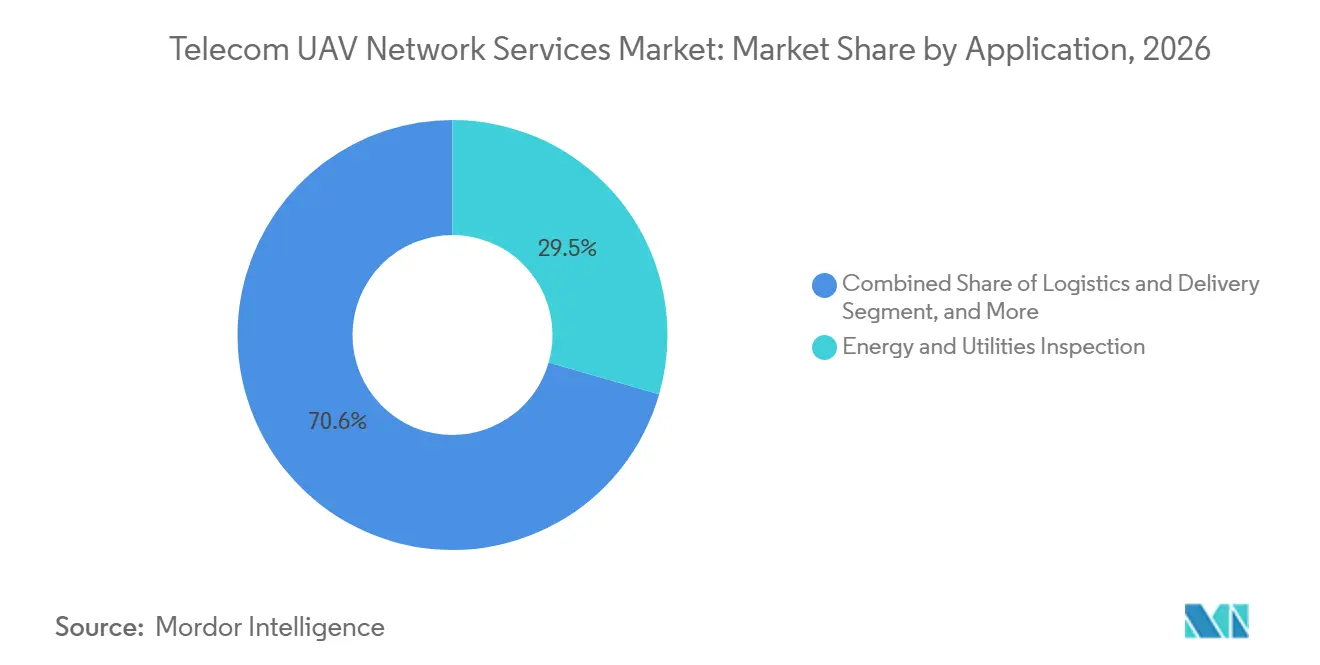
Energy Inspection Leads While Logistics Sets the PaceEnergy and Utilities Inspection held 29.45% of revenue in 2026. Power grid operators use drones for repeated inspections of towers, conductors, and other distributed assets. These programs favor planned contracts because inspection routes are frequent, long, and safety-sensitive. National Grid Electricity Transmission awarded a GBP 22,950,000 contract (USD 29.1 million) for BVLOS drone inspection in May 2025, with extension options through 2032. The Telecom UAV Network Services market size for this application is supported by the need to maintain reliable links across fixed utility corridors. Telecommunications Infrastructure Inspection is a related use case because mobile network operators can inspect their own towers and transmission assets. Nokia's drone approach for grid observability combines private 4G and 5G connectivity with utility-focused operations in hazardous areas. These applications support steady demand for data, monitoring, and compliant flight operations.
Logistics and delivery are projected to expand at a 25.96% CAGR through 2032. Large delivery networks need persistent coverage through each location where a drone launches, travels, and hands over a shipment. Wing and Walmart confirmed 7 new metropolitan areas in June 2026 and stated that their program was progressing toward more than 270 locations and service for 40 million people by 2027. This expansion strengthens the need for citywide managed connectivity rather than local trial connections. Public Safety and Emergency Response also creates demand because agencies need secure and responsive communications during incidents. Verizon reported in 2025 that 48% of surveyed US first-responder agencies expected to use drones daily within 5 years. Defense and security users represent a smaller-volume but high-value application where resilient connections and cybersecurity are especially important. These use cases give the Telecom UAV Network Services market exposure to both commercial and public-sector demand.
By End-User:
Enterprises Provide Volume While Drone Operators Lead ExpansionEnterprises and Industrial Asset Owners held 30.85% of revenue in 2026. Energy companies, utilities, and manufacturers use captive fleets for inspection, monitoring, and site security. Their programs often have high usage per aircraft because missions follow regular schedules across established facilities or corridors. This pattern supports continuing demand for data access, tracking, and mission management. This user group's revenue share reflects the immediate value that industrial users can obtain from remote asset information. These users also place strong emphasis on safe operations and documented connectivity performance. Mobile Network Operators occupy a dual position: they can use drones to inspect their own infrastructure while also providing network services to other operators. Telecom tower companies constitute a related user group as their inspection activities shift from VLOS work to contracted BVLOS services.
Drone Operators and Logistics Providers are projected to expand at a 25.88% CAGR through 2032. These businesses build connectivity requirements into delivery, inspection-as-a-service, and public-safety operating models. Chunghwa Telecom completed nearly 1,200 deliveries during an August 2026 Taiwan food-delivery trial, demonstrating that telecom operators can participate directly in drone logistics. Deutsche Telekom deployed a managed connectivity service for Morpheus drone logistics, using dual IoT SIM cards, 5G-capable plans, and national-roaming redundancy. The approach shows how operators can offer a managed service rather than a consumer data plan. Government, Defense, and Public Safety Agencies also contribute high-value contracts that can run for long periods. Their requirements can include resilience, security, and operational support. This broad end-user base improves the range of opportunities available to the Telecom UAV Network Services market.
Geography Analysis
North America Telecom UAV Network Services Market
North America held 34.65% of the Telecom UAV Network Services market in 2026, supported by commercial BVLOS approvals, dense 5G coverage, and active inspection and delivery programs. The FAA's 2026 Drone Normalization Strategy outlined a path that includes a BVLOS final rule, artificial intelligence-supported Part 107 waiver processing, and additional Part 135 UAS operator certificates. AT&T and Ericsson demonstrated drone detection and tracking through 5G Massive MIMO at AT&T Stadium in July 2026. The demonstration showed that providers can add sensing and airspace intelligence to connectivity offers. Canada and Mexico contribute to regional activity through progress in BVLOS authorization and urban drone-corridor trials.
APAC Telecom UAV Network Services Market
Asia-Pacific is projected to expand at a 26.19% CAGR through 2032, making it the fastest-growing region in the Telecom UAV Network Services market. China contributes manufacturing capacity, while Japan has advanced BVLOS permissions, and Southeast Asian countries are deploying national UTM platforms. Terra Drone subsidiary Unifly became a technology partner for Malaysia's national UTM platform in May 2026. Optus and Nokia explored drone-based network disaster-response solutions in Australia in 2025. Fragmented UTM and air traffic management interfaces remain a constraint on cross-border activity.
EMEA Telecom UAV Network Services Market
Europe ranked third by revenue and is supported by EASA's U-space framework, especially in Germany, the United Kingdom, and France. EASA's 2025 certification of ANRA Technologies gave the region a compliant U-space service model across member states. The Middle East is a smaller high-value market, including Dubai's move toward integrated digital airspace management. Africa has the lowest current revenue base, but Zipline's Rwanda program shows how satellite-supported networks can serve operations where ground coverage is limited.
Competitive Landscape
The Telecom UAV Network Services market is moderately fragmented. Verizon, AT&T, Vodafone, and Telefónica hold strong positions because they can build on established network infrastructure. Specialized UTM, satellite connectivity, and multi-link providers compete for airspace data and application-layer revenue. A common approach starts with drone connectivity and then adds route planning, multi-link management, and managed mission operations. Telefonica has combined 5G, artificial intelligence analytics, Open Gateway APIs, remote piloting, and related services into a single commercial offering.
Indra Group acquired Altitude Angel's GuardianUTM platform in January 2026, including a platform serving 64 airports and 350,000 direct users. The acquisition strengthened Indra's position in digital airspace services across Europe and Asia. Consolidation can favor firms able to sustain investment and establish regulatory credibility. Certification evidence, dependable service design, and support for several links are important competitive strengths.
Satellite providers position their services as a safety layer that complements cellular connections. Viasat and Galaxy 1 announced a partnership in March 2026 to support scalable and secure communications for uncrewed aircraft. Viasat, TTP, and Frequentis conducted European Space Agency Iris RPAS trials in May 2026 to test satellite connectivity with UTM services. Vodafone and Manna Air Delivery completed a 2-kilometer BVLOS flight over Vodafone's 4G network in Ireland in July 2025. Competition remains active in the Telecom UAV Network Services market because no single provider covers all geographies and use cases.
Telecom UAV Network Services Industry Leaders
-
Verizon Communications Inc.
-
AT&T Inc.
-
Vodafone Group Plc
-
Telefonica, S.A.
-
Telefonaktiebolaget LM Ericsson
- *Disclaimer: Major Players sorted in no particular order
Telecom UAV Network Services Market Companies Covered in this Report
- Verizon Communications Inc.
- AT&T Inc.
- Vodafone Group Plc
- Telefonica, S.A.
- Nokia Corporation
- Telefonaktiebolaget LM Ericsson
- Viasat, Inc.
- Iridium Communications Inc.
- Thales S.A.
- Elsight Limited
- Qualcomm Technologies, Inc.
- Wing Aviation LLC
- Airbus SE
- Frequentis AG
- Terra Drone Corporation
- Unifly NV
- Indra Sistemas, S.A.
- ANRA Technologies, LLC
- SkyGrid, LLC
- Droniq GmbH
- Silvus Technologies, Inc.
- Doodle Labs, Inc.
Recent Industry Developments in Telecom UAV Network Services Market
- June 2026: Wing and Walmart confirmed 7 new metro areas, including Philadelphia, San Francisco Bay Area, Phoenix, and San Diego, for drone delivery, advancing a coast-to-coast network toward 20 US markets on track to exceed 270 locations and serve 40 million Americans by 2027.
- May 2026: Terra Drone subsidiary Unifly was selected as the technology partner for Malaysia's national UTM platform under the ClearPath UASTMS Program, delivering real-time flight management, Remote ID, and traffic information services as part of a significant commercial expansion of national-level UTM infrastructure in Southeast Asia.
- May 2026: Viasat, TTP, and Frequentis conducted Iris RPAS flight trials at Cranfield University under the European Space Agency's Iris program, testing satellite connectivity integration with UTM for BVLOS operations in complex managed airspace.
- February 2026: Zipline signed an expansion agreement with Rwanda under a USD 150 million US Department of State pay-for-performance award, establishing a nationwide autonomous delivery network, including Africa's first urban drone delivery system, and generating satellite-assisted, managed connectivity demand at a national scale.
Global Telecom UAV Network Services Market Report Scope
The Telecom UAV Network Services Market Report is Segmented by Service Type (Connectivity and Access Services, Network Orchestration and Multi-Link Management, UTM, Remote Identification and Airspace Data Services, Edge, Cloud and Data Services, Integration, Certification and Compliance Services, and Other Service Types), Operational Range (Visual Line of Sight, Extended Visual Line of Sight, and Beyond Visual Line of Sight), Application (Telecommunications Infrastructure Inspection, Energy and Utilities Inspection, Logistics and Delivery, Public Safety and Emergency Response, Defense and Security, and Other Applications), End-User (Mobile Network Operators, Telecom Tower Companies, Enterprises and Industrial Asset Owners, Government, Defense and Public Safety Agencies, Drone Operators and Logistics Providers, and Other End-Users), and Geography (North America, South America, Europe, Asia-Pacific, Middle East, and Africa). The Market Forecasts are Provided in Terms of Value (USD).
Segmentation Overview
| Connectivity and Access Services |
| Network Orchestration and Multi-Link Management |
| UTM, Remote Identification and Airspace Data Services |
| Edge, Cloud and Data Services |
| Integration, Certification and Compliance Services |
| Other Service Types |
| Visual Line of Sight |
| Extended Visual Line of Sight |
| Beyond Visual Line of Sight |
| Telecommunications Infrastructure Inspection |
| Energy and Utilities Inspection |
| Logistics and Delivery |
| Public Safety and Emergency Response |
| Defense and Security |
| Other Applications |
| Mobile Network Operators |
| Telecom Tower Companies |
| Enterprises and Industrial Asset Owners |
| Government, Defense and Public Safety Agencies |
| Drone Operators and Logistics Providers |
| Other End-Users |
| North America | United States |
| Canada | |
| Mexico | |
| South America | Brazil |
| Argentina | |
| Rest of South America | |
| Europe | United Kingdom |
| Germany | |
| France | |
| Russia | |
| Rest of Europe | |
| Asia-Pacific | China |
| Japan | |
| India | |
| South Korea | |
| Australia | |
| Rest of Asia-Pacific | |
| Middle East | United Arab Emirates |
| Saudi Arabia | |
| Rest of Middle East | |
| Africa | South Africa |
| Nigeria | |
| Rest of Africa |
| By Service Type | Connectivity and Access Services | |
| Network Orchestration and Multi-Link Management | ||
| UTM, Remote Identification and Airspace Data Services | ||
| Edge, Cloud and Data Services | ||
| Integration, Certification and Compliance Services | ||
| Other Service Types | ||
| By Operational Range | Visual Line of Sight | |
| Extended Visual Line of Sight | ||
| Beyond Visual Line of Sight | ||
| By Application | Telecommunications Infrastructure Inspection | |
| Energy and Utilities Inspection | ||
| Logistics and Delivery | ||
| Public Safety and Emergency Response | ||
| Defense and Security | ||
| Other Applications | ||
| By End-User | Mobile Network Operators | |
| Telecom Tower Companies | ||
| Enterprises and Industrial Asset Owners | ||
| Government, Defense and Public Safety Agencies | ||
| Drone Operators and Logistics Providers | ||
| Other End-Users | ||
| By Geography | North America | United States |
| Canada | ||
| Mexico | ||
| South America | Brazil | |
| Argentina | ||
| Rest of South America | ||
| Europe | United Kingdom | |
| Germany | ||
| France | ||
| Russia | ||
| Rest of Europe | ||
| Asia-Pacific | China | |
| Japan | ||
| India | ||
| South Korea | ||
| Australia | ||
| Rest of Asia-Pacific | ||
| Middle East | United Arab Emirates | |
| Saudi Arabia | ||
| Rest of Middle East | ||
| Africa | South Africa | |
| Nigeria | ||
| Rest of Africa | ||
Key Questions Answered in the Report
What is the Telecom UAV Network Services market size?
The Telecom UAV Network Services market is projected to expand from USD 0.67 billion in 2026 and USD 0.83 billion in 2027 to USD 2.47 billion by 2032, at a 24.37% CAGR.
What is driving demand for telecom services used by drones?
BVLOS operations, larger connected fleets, private 5G, and regulatory requirements for resilient command-and-control links are increasing demand for managed services.
Which service type has the largest revenue share?
Connectivity and Access Services held 41.25% of revenue in 2026 because connected drones need dependable cellular or satellite access.
Which UAV application is projected to expand fastest?
Logistics and Delivery is projected to expand at a 25.96% CAGR through 2032 as operators scale last-mile drone programs.
Which region is projected to expand fastest?
Asia-Pacific is projected to expand at a 26.19% CAGR through 2032, supported by manufacturing capacity, BVLOS development, and national UTM deployments.
What limits broader deployment of telecom-enabled UAV operations?
Fragmented spectrum rules, cross-border authorization requirements, certification costs, network coverage gaps, and cybersecurity obligations can delay deployment.