
Telecom Renewable Energy Management Market Size and Share
Market Overview
| Study Period | 2021 - 2032 |
|---|---|
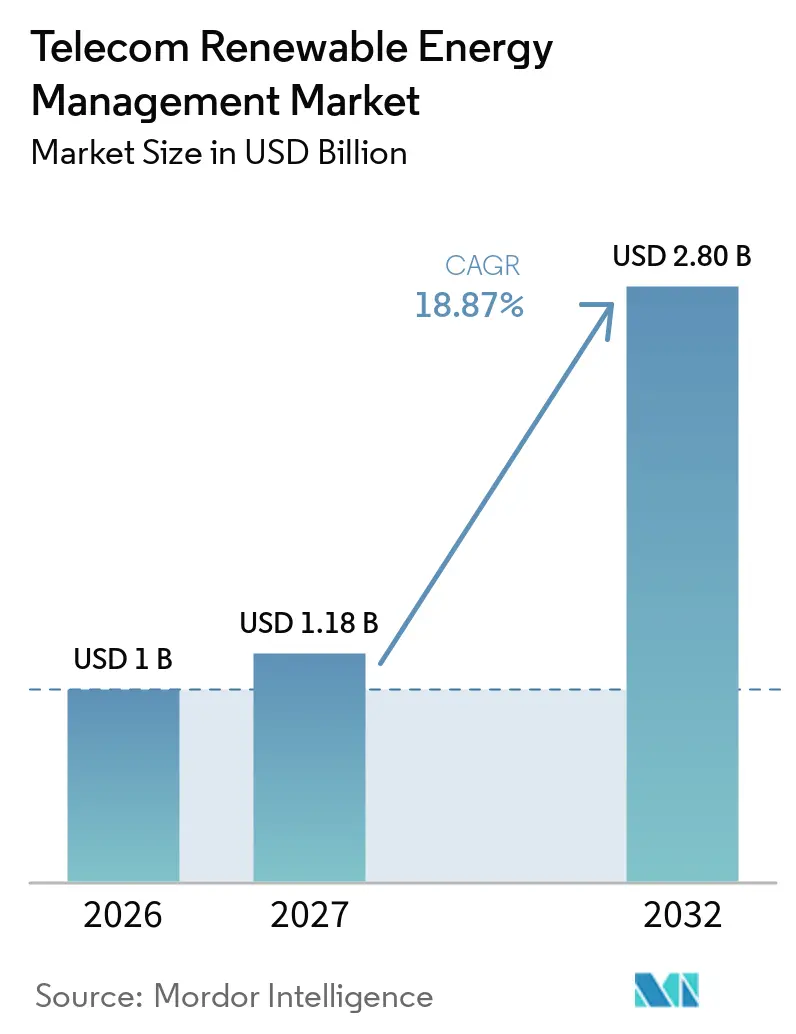
| Market Size (2027) | USD 1.18 Billion |
| Market Size (2032) | USD 2.80 Billion |
| Growth Rate (2027 - 2032) | 18.87 % |
| Fastest Growing Market | Africa |
| Largest Market | Asia-Pacific |
| Market Concentration | Low |
Major Players *Disclaimer: Major Players sorted in no particular order Image © Mordor Intelligence. Reuse requires attribution under CC BY 4.0. | |
Telecom Renewable Energy Management Market Analysis by Mordor Intelligence
The Telecom Renewable Energy Management Market size is projected to expand from USD 1 billion in 2026 to USD 1.18 billion in 2027, and to USD 2.80 billion by 2032, registering a CAGR of 18.87% between 2027 and 2032. Higher electricity demand from denser 5G networks is increasing the need for reliable site power across both urban and remote locations. Renewable procurement commitments are also shifting power decisions from short-term fuel management toward longer-term infrastructure planning. Lower costs for batteries, solar equipment, and power electronics are improving the operating case for hybrid systems. Operators are increasingly integrating generation, storage, and digital controls rather than treating backup power as a standalone asset. This creates opportunities for suppliers that can finance, install, monitor, and operate reliable energy systems over the life of a telecom site.
Key Report Takeaways
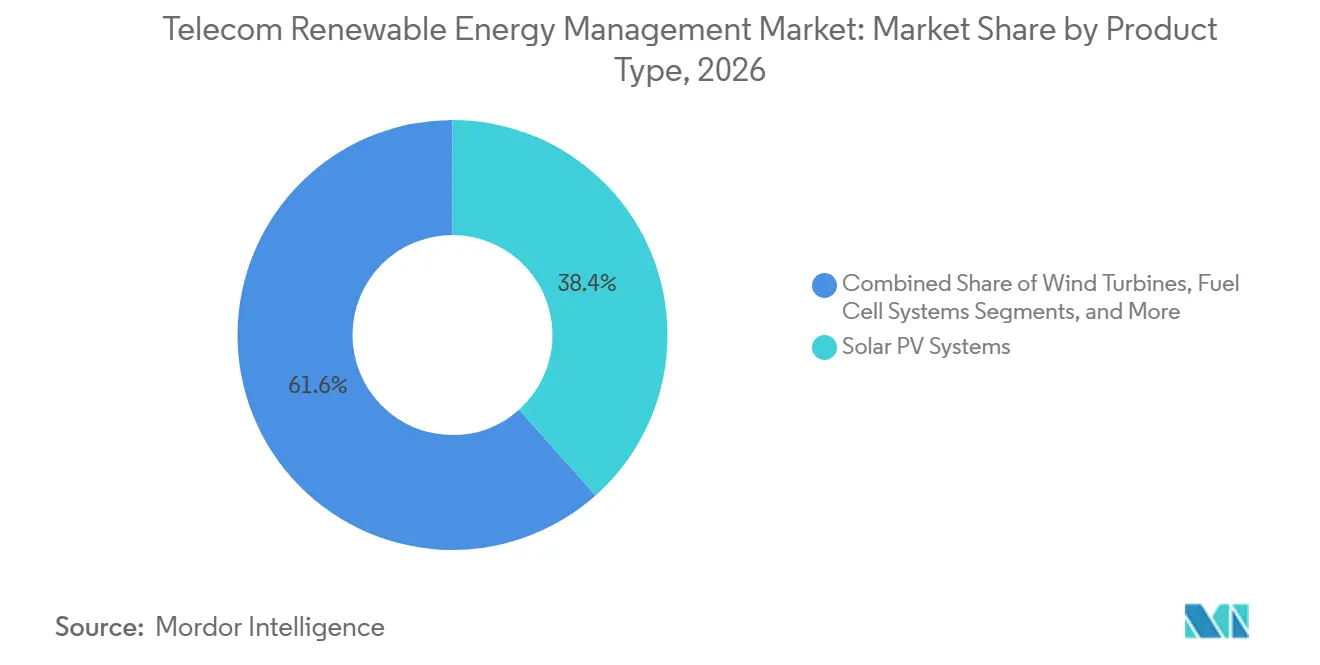
- By product type, solar PV systems held 38.42% of the telecom renewable energy management market in 2026, while battery energy storage systems are projected to expand at a 20.42% CAGR through 2032.
- By power source, off-grid configurations accounted for 57.36% of the telecom renewable energy management market in 2026, while on-grid configurations are projected to expand at a 20.18% CAGR through 2032.
- By power rating, the 2-10 kW tier held 40.28% of the telecom renewable energy management market in 2026, while the above 20 kW tier is projected to expand at a 20.36% CAGR through 2032.
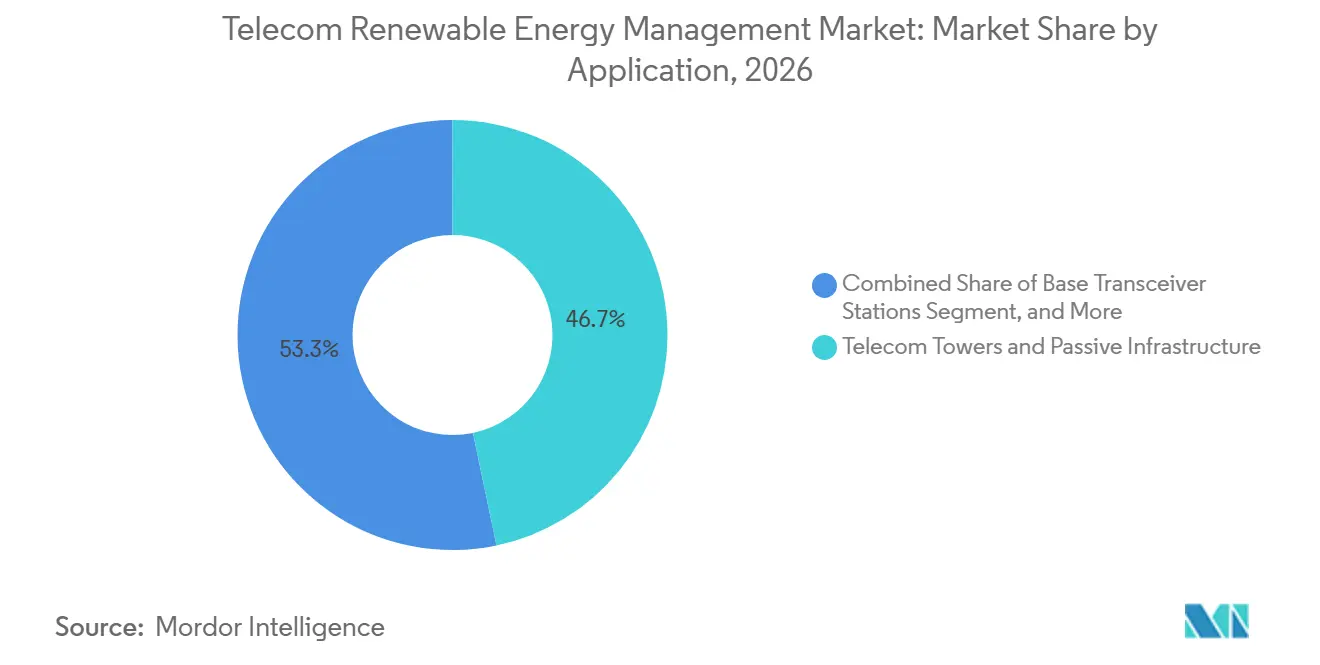
- By application, telecom towers and passive infrastructure accounted for 46.72% of the market in 2026, while edge computing and distributed data centers are projected to expand at a 20.54% CAGR through 2032.
- By end-user, tower companies held 43.56% of the market in 2026, while telecom energy service companies are projected to expand at a 20.61% CAGR through 2032.
- By geography, Asia-Pacific held 36.24% of the telecom renewable energy management market in 2026, while Africa is projected to expand at a 20.47% CAGR through 2032.
Note: Market numbers in this report are based on Mordor Intelligence's proprietary estimation framework, which combines nine months of actuals with Q4 projections for base year 2026.
Global Telecom Renewable Energy Management Market Trends and Insights
Drivers Impact Analysis*
| Driver | (~) % Impact on CAGR Forecast | Geographic Relevance | Impact Timeline |
|---|---|---|---|
| 5G and Edge Network Power Demand | +4% | Global, with highest intensity in Asia-Pacific and North America | Short term (≤ 2 years) |
| Grid Instability and Rural Connectivity | +3.5% | Africa, South Asia, Southeast Asia, and parts of South America | Medium term (2-4 years) |
| Net-Zero Commitments and Renewable Procurement | +3.2% | Europe and North America, with spillover into Asia-Pacific | Medium term (2-4 years) |
| Falling Solar, Battery, and Power Electronics Costs | +2.8% | Global, with stronger relevance in high-irradiance regions | Short term (≤ 2 years) |
| Battery Flexibility Monetization Through Demand Response and Virtual Power Plants | +2% | Europe, North America, and Asia-Pacific | Medium term (2-4 years) |
| Remote-Site Renewable Power-as-a-Service Models | +1.5% | Africa, Southeast Asia, South America, and the Middle East | Long term (≥ 4 years) |
| Source: Mordor Intelligence | |||
5G and Edge Network Power-Density Growth
The Telecom renewable energy management market is being supported by the higher power needs of dense 5G radio networks. A 2026 study of live 5G networks found that a fully loaded macro radio unit reached an average maximum power consumption of 1,090 W. Base stations account for 60-80% of total radio access network energy use, making site-level power efficiency a major operating concern. Energy use increases during parallel 4G and 5G operations, even though 5G sleep mode improves static energy efficiency by 10× compared with 4G, because traffic growth and multi-carrier deployments mitigate the effect at the site level. Edge computing equipment placed near radio access sites adds another layer of continuous demand. These conditions make dependable, renewable, and storage upgrades more important for network continuity.
Rising Grid Instability and Rural Connectivity Expansion
Grid instability is increasing demand for off-grid and weak-grid telecom power systems in the Telecom renewable energy management market. GSMA reported that bad-grid telecom sites experience more than 6 hours of outages per day on average, leaving diesel generation as a common backup source and a major operating expense. Rural coverage programs are adding sites where grid connection is unavailable or unreliable, requiring systems that combine solar generation, batteries, and backup equipment across the Telecom renewable energy management market. In March 2026, IFC invested USD 45 million in IPT PowerTech Group to modernize 2,235 telecom sites across Ethiopia, Liberia, and Sierra Leone, with more than 90% of those sites classified as off-grid or weak-grid.[1] IFC stated that the project could reduce operator power costs in Ethiopia by up to 52%. Development finance can therefore reduce the capital barrier that has limited the conversion of renewable energy in remote markets.
Telecom Net-Zero Commitments and Renewable Electricity Procurement
Net-zero commitments are making renewable electricity procurement a more durable source of demand for the Telecom renewable energy management market. As of June 2026, 81 mobile operators had set or committed to near-term science-based targets, representing 47% of global mobile connections. The share of operator-sourced electricity from renewables more than doubled, from 10% in 2019 to 24% in 2024. TELUS achieved 100% renewable and low-emitting electricity sourcing on December 31, 2025, and its validated targets include an 85% absolute reduction in Scope 1 and 2 emissions by 2033.[2] Deutsche Telekom reported that power purchase agreements and self-generation supplied 31.7% of its electricity at the end of 2025.[3] Virgin Media O2 signed a 10-year power purchase agreement in October 2025 to cover 15% of its total energy supply, supporting longer-term revenue visibility for energy suppliers and service companies.[4]
Falling Solar, Battery, and Power-Electronics Costs
Falling component costs are improving the lifecycle economics of hybrid site power in the Telecom renewable energy management market. IRENA reported that battery storage costs declined 93% between 2010 and 2024 to USD 192/kWh. NREL reported a further 45% decline in stationary battery pack prices between 2024 and 2025 to USD 70/kWh. A 2026 study in Tanzania found a levelized cost of energy of USD 0.11/kWh for a solar PV-battery-generator telecom configuration, compared with USD 0.27/kWh for a generator-only system and USD 0.71/kWh for grid extension. The result shows why hybrid systems can be attractive at remote sites with expensive diesel logistics. Lower costs for solar modules, batteries, and inverters improve project economics across the Telecom renewable energy management market and allow providers to tailor configurations to local load and weather conditions.
Restraints Impact Analysis*
| Restraint | (~) % Impact on CAGR Forecast | Geographic Relevance | Impact Timeline |
|---|---|---|---|
| High Upfront Retrofit and Interconnection Costs | -2.8% | Global, with greater pressure in North America and Europe | Medium term (2-4 years) |
| Renewable Intermittency and Backup-Reliability Requirements | -2% | Global, with stronger pressure in Africa and South Asia | Short term (≤ 2 years) |
| Site-Level Space, Permitting, and Security Constraints | -1.2% | Dense urban markets in Asia-Pacific, Europe, and North America | Medium term (2-4 years) |
| Currency, Climate, and Diesel-Logistics Exposure | -0.8% | Africa, South Asia, Southeast Asia, and parts of South America | Long term (≥ 4 years) |
| Source: Mordor Intelligence | |||
High Upfront Retrofit and Interconnection Costs
Upfront retrofit costs remain a material constraint for the Telecom renewable energy management market. Solar, battery, and control equipment, as well as site preparation, must often be installed before the operator begins to realize fuel savings. This requirement competes with spending on spectrum, 5G networks, and fiber deployment. Grid-connected projects can also face interconnection procedures that do not align with corporate decarbonization schedules. Energy service company models can shift capital costs away from operators, but they depend on creditworthy customers and durable contracts. This can leave smaller operators with fewer financing options in the Telecom renewable energy management market than their larger, better-capitalized peers.
Renewable Intermittency and Backup-Reliability Requirements
Renewable intermittency limits the use of pure renewable systems at sites that require continuous service. ITU-T Recommendation L.1397, issued in October 2025, sets out monitoring and control interfaces for battery systems at telecommunications sites. The standard supports better reserve management, but it does not remove the physical limits created by prolonged low solar generation. A 2026 study of Bangladesh telecom towers found that 99.9% availability required careful optimization of the solar share at 48-52% of annual demand. This creates a need for site-specific design, battery autonomy, and backup capacity. Multi-day weather events can increase both equipment size and project cost, so hybrid configurations remain important across the Telecom renewable energy management market, where outage risk cannot be accepted.
*Our forecasts treat driver/restraint impacts as directional, not additive. The impact forecasts reflect baseline growth, mix effects, and variable interactions.
Segment Analysis
By Product Type: Solar PV Leads Installed Systems While Battery Storage Advances
Solar PV Systems held 38.42% of the Telecom renewable energy management market share in 2026. The installed base reflects years of deployment at off-grid and weak-grid sites where solar resources and diesel costs favor photovoltaic generation. Solar systems remain a practical starting point for operators seeking to reduce fuel use at remote assets. Their role is strongest where daytime generation can directly serve the network load. Battery Energy Storage Systems are projected to expand at a 20.42% CAGR through 2032. Storage is gaining attention because it can support existing solar assets while improving backup capability and power quality.
Battery systems allow operators to store excess generation and use it when solar output falls or grid conditions weaken. They also help reduce generator runtime, which can lower maintenance needs and fuel exposure. NTT DOCOMO and NTT began a demonstration in October 2026 that combines workload shifting with distributed energy management at radio base stations. The demonstration uses AI to coordinate renewable energy use, demand-response participation, and backup power during outages. Hybrid renewable-diesel systems remain relevant for operators that need added reliability during the transition away from diesel. Wind turbines are more limited because they depend on suitable coastal or elevated locations. Fuel cell systems can provide weather-independent power, but their higher costs limit use to applications with stringent reliability requirements. Energy management software and microgrid controllers add a service layer to the Telecom renewable energy management market by coordinating hardware assets and supporting recurring revenue.

By Power Source: Off-Grid Demand Remains Larger While On-Grid Adoption Accelerates
Off-Grid configurations accounted for 57.36% of the Telecom renewable energy management market size in 2026. Their lead reflects the number of telecom sites in South Asia, Sub-Saharan Africa, and Southeast Asia that lack dependable grid service. These locations face high diesel transport costs and recurring outages, making decentralized power necessary. Off-grid systems can combine solar, batteries, and generators according to local climate and load needs. A 2025 University of Rwanda study found that a 30.2 kWp solar PV system paired with 7,400 Ah lithium-ion storage delivered a 1,139% ROI and a 2-year payback period for an off-grid telecom tower. Such results explain why renewable systems can be deployed on a cost basis even without a formal sustainability target.
On-Grid configurations are projected to expand at a 20.18% CAGR through 2032. Their growth is tied to renewable procurement requirements at grid-connected sites in Europe, North America, and urban Asia-Pacific. Behind-the-meter storage can help manage peak demand and support grid services at suitable locations. On-grid decarbonization often depends on a mix of local generation and contracted electricity. This approach supports the policy direction of renewable procurement across major telecom markets. On-grid systems are expected to narrow the gap with off-grid systems across the Telecom renewable energy management market as renewable sourcing becomes more common at urban and suburban sites.
By Power Rating: Mid-Range Systems Form the Core While High-Capacity Systems Gain Use Cases
The 2-10 kW tier held 40.28% of market value in 2026. This range fits the continuous power requirements of a standard 4G or 5G macro base transceiver station. It can support the base load and provide battery autonomy for overnight operation or periods of lower solar generation. The tier avoids the complexity of large multi-cabinet microgrids while serving the core telecom tower requirement. The 10-20 kW range serves sites with co-located carriers, backhaul equipment, and edge computing gear. The below 2 kW tier serves smaller installations such as microcells, small cells, and IoT gateway nodes.
Clear Blue Technologies announced 1,000 orders for the Pico-Plus smart off-grid power system from Eutelsat in November 2025, for deployment across African countries. The above 20 kW tier is projected to expand at a 20.36% CAGR through 2032. Demand comes from edge data centers at tower locations and village-anchor microgrids that combine telecom power with local energy supply. A 2026 study found that photovoltaic-equipped microgrids at radio access nodes can maintain service quality during grid outages while also serving local loads. These dual-use configurations can justify larger system capacity in places with a clear need for community power. Tanzania-based research also found that high-capacity hybrid systems can reduce CO₂ emissions by more than 93% compared with generator-only systems. This demand adds a higher-capacity use case to the Telecom renewable energy management market.
By Application: Tower Infrastructure Provides the Base While Edge Sites Increase Demand
Telecom Towers and Passive Infrastructure accounted for 46.72% of the Telecom renewable energy management market size in 2026. Tower companies face energy costs directly, so reducing diesel use can improve operating margins. Their large portfolios also allow them to standardize equipment, procurement, and maintenance across many sites. Solar integration has been operationalized at scale within passive infrastructure management. Base Transceiver Stations remain a separate application, in which operators manage radio equipment directly rather than through passive infrastructure providers.
Edge Computing and Distributed Data Centers are projected to expand at a 20.54% CAGR through 2032. Their growth is linked to 5G network slicing, private networks, and workloads that need processing close to radio access nodes. These sites combine computing and connectivity loads, which raises the importance of resilient local power. Network Operations Centers also use on-site generation and storage to reduce exposure to grid disruptions. Fiber access and broadband hubs in rural programs present another use case where low-power solar can be the only practical energy source. This broadens the Telecom renewable energy management market beyond conventional towers. It also increases the need for designs that match storage, generation, and controls to the criticality of each application.
By End-User: Tower Companies Provide Scale While Energy Service Companies Lead Growth
Tower Companies held 43.56% of the market value in 2026. They own and operate a large share of powered telecom infrastructure and usually manage energy use across extensive site portfolios. Energy pass-through charges give them a direct incentive to control power costs. Long-term leases can also support the financing period needed for renewable equipment. Mobile Network Operators are another important user group, particularly at sites they own directly. They are adopting behind-the-meter systems while using energy service companies for off-grid operations.
Telecom Energy Service Companies are projected to expand at a 20.61% CAGR through 2032. Under the T-ESCO model, the service provider funds the equipment and receives long-term revenue through a per-kWh or fixed-fee structure. This can ease the initial capital requirements for operators while providing providers with an asset-backed revenue stream. IFC's 2026 investment in IPT PowerTech Group supports this model across Ethiopia, Liberia, and Sierra Leone. The program targets annual emissions reductions exceeding 10,624 tCO₂e. Network equipment vendors, government and public-safety networks, and enterprise private networks remain smaller user groups. Their requirements are expanding across the Telecom renewable energy management market as critical communication sites adopt the renewable-hybrid approach established in the tower sector.
Geography Analysis
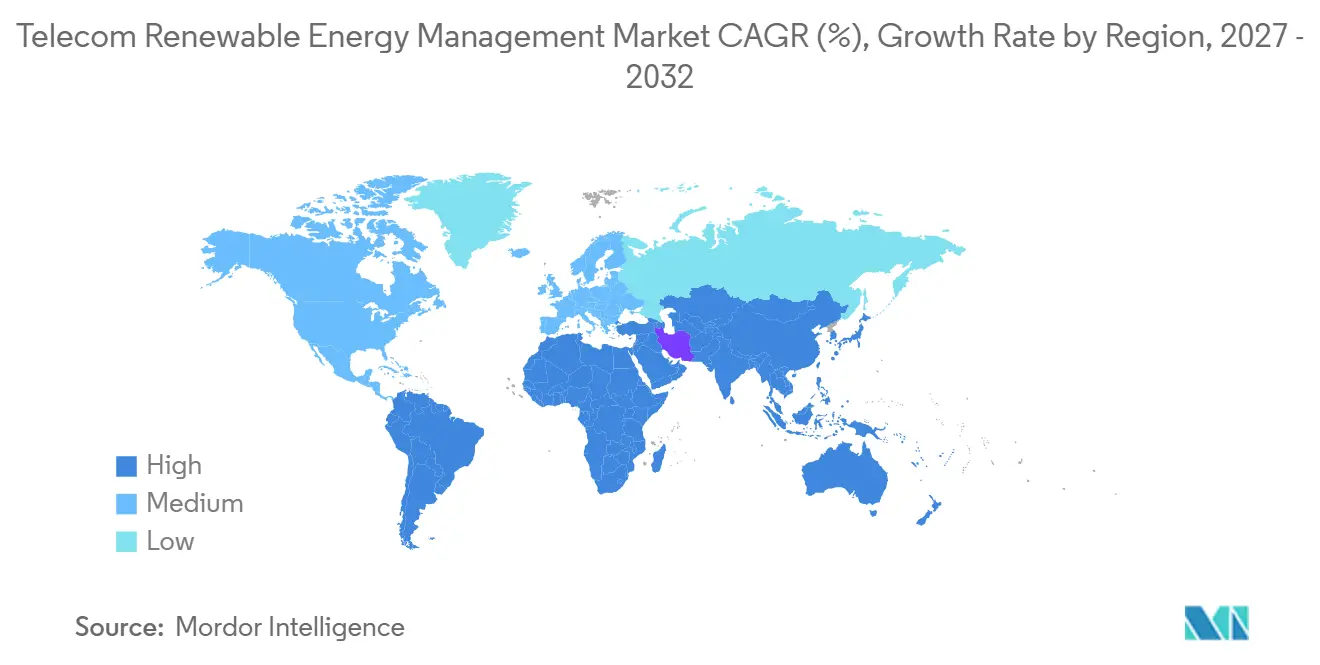
Asia-Pacific held 36.24% of the Telecom renewable energy management market share in 2026. China, India, Japan, and South Korea combine large tower bases, active 5G deployment, and government-backed renewable energy goals. India has become an active deployment area for solar power at tower sites. NTT DOCOMO and NTT began a radio base station demonstration in Japan in October 2026 that combines AI-coordinated workload shifting with distributed energy management. The project is scheduled to run through December 31, 2026. Its design may broaden the operational role of site batteries in demand-response programs.
Europe and North America have more mature deployment patterns centered on renewable procurement and compliance commitments. GSMA reported that European operators sourced 70% of their electricity from renewables in 2024, compared with 50% in North America. Telefónica achieved 100% renewable electricity in its Spanish, Brazilian, and German operations by 2025. Virgin Media O2's agreement, effective April 2026, provides wind power from Scotland and Wales for 15% of its total energy supply. South America is advancing solar integration, where remote and weak-grid conditions make local power attractive. The Middle East is moving toward structured deployments at macro towers and 5G core data centers. IRENA found that solar-plus-battery firm power costs in high-irradiance regions declined from more than USD 100/MWh in 2020 to USD 54-82/MWh by 2025. These regional conditions are widening the addressable use cases for the Telecom renewable energy management market.
Africa is projected to expand at a 20.47% CAGR through 2032, the highest regional rate in the Telecom renewable energy management market. GSMA estimated that tower infrastructure consumed 4 billion liters of diesel in Africa in 2024. Nigeria and South Africa remain the largest individual markets by tower count. Facility for Energy Inclusion and Norfund provided USD 40 million in March 2025 for solar-battery systems at 2,625 Orange Mali sites under a 10-year energy-as-a-service agreement. MIGA stated that all 499 planned MTN South Sudan site refurbishments had been completed by June 2026, with 5.8 MW of solar power and 25.5 MWh of battery storage deployed. These projects show that the development finance, commercial energy service providers, and equipment suppliers can address the capital and technical barriers that have slowed diesel replacement.
Competitive Landscape
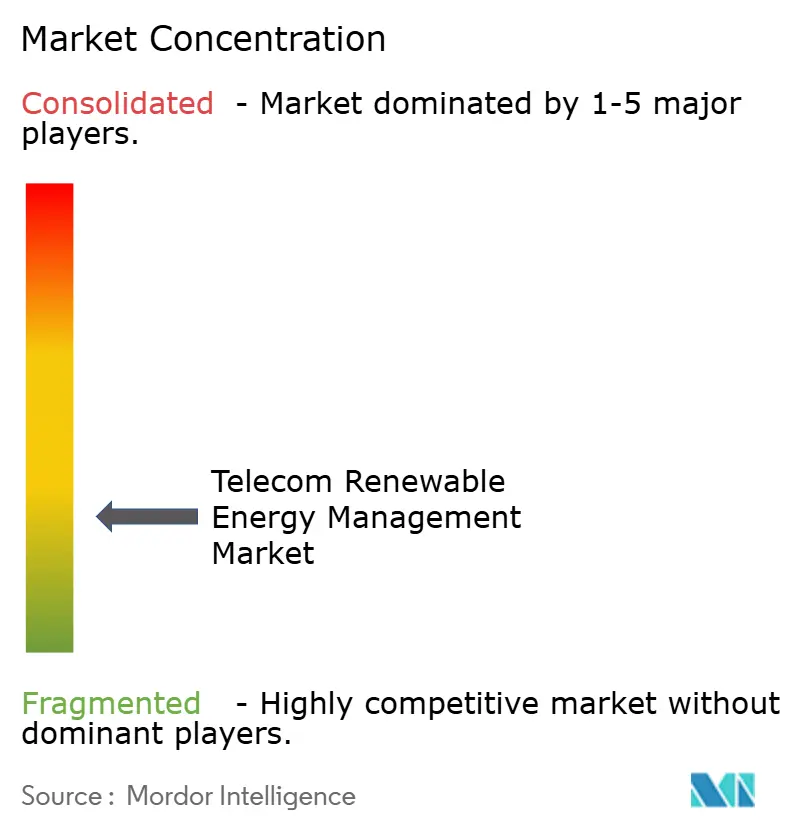
The Telecom renewable energy management market is fragmented across global technology suppliers, regional energy service providers, and off-grid specialists. Huawei Technologies, Schneider Electric, ABB, Vertiv, Eaton, and Delta Electronics compete through broad equipment portfolios and integrated control platforms. IPT PowerTech, Camusat, Energy Vision, and Yoma Micro Power focus on local delivery and operating capability. Clear Blue Technologies, Caban Systems, GenCell, and OMC Power target specific site types through system economics and service models. ITU-T Recommendation L.1397 supports common battery monitoring and control interfaces for telecom sites. Wider interoperability can reduce proprietary lock-in and raise the importance of software-led energy management. Suppliers that combine hardware, monitoring, and operations are better positioned to manage site performance over the long term of contracts.
Large vendors are pursuing arrangements that combine system design, procurement, financing, and monitoring under multi-year agreements. These structures reduce complexity for network operators who want to manage energy costs without directly owning every asset. Smaller providers are focusing on diesel conversion opportunities in Sub-Saharan Africa and Southeast Asia. Their projects often use support from development finance institutions to address credit and currency constraints. Clear Blue Technologies received a CAD 1.5 million (USD 1.08 million) order from iSat Africa in November 2025 for off-grid telecom power systems across the Democratic Republic of the Congo, South Sudan, Liberia, and Zambia. The company also launched a commercial Energy-as-a-Service offering with that order. Caban Systems announced a solar-powered mobile-site retrofit program with Digicel Jamaica in October 2025, with rollout planned through 2026.
Competitive opportunities are emerging in predictive maintenance for hybrid assets and in platforms that aggregate distributed batteries for grid services. Enterprise private networks are also an underdeveloped application because campus operators need resilient energy for critical communications. ZTE benefits from linking energy systems with telecom equipment deployments. National net-zero requirements are adding pressure for suppliers to document lifecycle emissions and energy performance. Schneider Electric and SK Telecom signed a comprehensive electrical and mechanical procurement agreement for SK Telecom's AI data center in Ulsan in August 2025. The agreement covers switchgear, UPS systems, transformers, automated controls, and ETAP digital twin power software. This move shows how power management capabilities are entering adjacent parts of the Telecom renewable energy management market. Market participants, therefore, need to balance equipment performance, financing capacity, local service delivery, and digital controls.
Telecom Renewable Energy Management Industry Leaders
-
Huawei Technologies Co., Ltd.
-
Vertiv Holdings Co.
-
Schneider Electric SE
-
Delta Electronics, Inc.
-
Eaton Corporation plc
- *Disclaimer: Major Players sorted in no particular order
Recent Industry Developments
- October 2026: NTT DOCOMO and NTT began the world's first demonstration of AI-coordinated workload shifting combined with distributed energy resource management at radio base stations, running through December 31, 2026. The system uses reinforcement-learning-based AI to optimize renewable energy use, demand-response participation, and backup power extension during outages, with workload redistribution reducing consumption at affected sites.
- March 2026: IFC invested USD 45 million in IPT PowerTech Group to modernize 2,235 telecom sites, more than 90% of which are off-grid or on weak-grid networks, across Ethiopia, Liberia, and Sierra Leone. The package includes a USD 27 million A-loan and USD 18 million in blended finance, with projected operator power cost reductions of up to 52% in Ethiopia and annual emissions cuts exceeding 10,624 tCO₂e.
- February 2026: TELUS Corporation became the first Canadian telecom to achieve 100% renewable and low-emitting electricity sourcing as of December 31, 2025, and unveiled its Climate Transition Framework with SBTi-validated targets, net-zero across Scopes 1, 2, and 3 by 2040, and an 85% absolute reduction in Scope 1 and 2 emissions by 2033.
- October 2025: Virgin Media O2 signed a 10-year power purchase agreement with The Renewables Infrastructure Group to supply 15% of its total energy from wind farms in Scotland and Wales, Earlseat and Garreg Lwyd, effective April 2026, as part of its commitment to 100% renewable energy at sites where it controls the energy bill.
Global Telecom Renewable Energy Management Market Report Scope
The Telecom Renewable Energy Management Market Report is Segmented by Product Type (Solar PV Systems, Wind Turbines, Battery Energy Storage Systems, Hybrid Renewable-Diesel Systems, Fuel Cell Systems, and Other Product Types), Power Source (On-Grid and Off-Grid), Power Rating (Less Than 2 KW, 2-10 KW, 10-20 kW, and Above 20 kW), Application (Base Transceiver Stations, Telecom Towers and Passive Infrastructure, Network Operations Centers, Edge Computing and Distributed Data Centers, Fiber Access and Broadband Hubs, and Other Applications), End-User (Mobile Network Operators, Tower Companies, Telecom Energy Service Companies, Network Equipment Vendors, Government and Public-Safety Networks, and Enterprise Private Networks), and Geography (North America, South America, Europe, Asia-Pacific, Middle East, and Africa). The Market Forecasts are Provided in Terms of Value (USD).
| Solar PV Systems |
| Wind Turbines |
| Battery Energy Storage Systems |
| Hybrid Renewable-Diesel Systems |
| Fuel Cell Systems |
| Other Product Types |
| On-Grid |
| Off-Grid |
| Less Than 2 kW |
| 2-10 kW |
| 10-20 kW |
| Above 20 kW |
| Base Transceiver Stations |
| Telecom Towers and Passive Infrastructure |
| Network Operations Centers |
| Edge Computing and Distributed Data Centers |
| Fiber Access and Broadband Hubs |
| Other Applications |
| Mobile Network Operators |
| Tower Companies |
| Telecom Energy Service Companies |
| Network Equipment Vendors |
| Government and Public-Safety Networks |
| Enterprise Private Networks |
| North America | United States |
| Canada | |
| Mexico | |
| South America | Brazil |
| Argentina | |
| Rest of South America | |
| Europe | Germany |
| United Kingdom | |
| France | |
| Italy | |
| Spain | |
| Russia | |
| Rest of Europe | |
| Asia-Pacific | China |
| India | |
| Japan | |
| South Korea | |
| Australia | |
| Rest of Asia-Pacific | |
| Middle East | Saudi Arabia |
| United Arab Emirates | |
| Rest of Middle East | |
| Africa | Nigeria |
| South Africa | |
| Rest of Africa |
| By Product Type | Solar PV Systems | |
| Wind Turbines | ||
| Battery Energy Storage Systems | ||
| Hybrid Renewable-Diesel Systems | ||
| Fuel Cell Systems | ||
| Other Product Types | ||
| By Power Source | On-Grid | |
| Off-Grid | ||
| By Power Rating | Less Than 2 kW | |
| 2-10 kW | ||
| 10-20 kW | ||
| Above 20 kW | ||
| By Application | Base Transceiver Stations | |
| Telecom Towers and Passive Infrastructure | ||
| Network Operations Centers | ||
| Edge Computing and Distributed Data Centers | ||
| Fiber Access and Broadband Hubs | ||
| Other Applications | ||
| By End-User | Mobile Network Operators | |
| Tower Companies | ||
| Telecom Energy Service Companies | ||
| Network Equipment Vendors | ||
| Government and Public-Safety Networks | ||
| Enterprise Private Networks | ||
| By Geography | North America | United States |
| Canada | ||
| Mexico | ||
| South America | Brazil | |
| Argentina | ||
| Rest of South America | ||
| Europe | Germany | |
| United Kingdom | ||
| France | ||
| Italy | ||
| Spain | ||
| Russia | ||
| Rest of Europe | ||
| Asia-Pacific | China | |
| India | ||
| Japan | ||
| South Korea | ||
| Australia | ||
| Rest of Asia-Pacific | ||
| Middle East | Saudi Arabia | |
| United Arab Emirates | ||
| Rest of Middle East | ||
| Africa | Nigeria | |
| South Africa | ||
| Rest of Africa | ||
Key Questions Answered in the Report
What is the Telecom renewable energy management market size?
The market is projected to be USD 1 billion in 2026 and USD 1 billion in 2027, reaching USD 2.8 billion by 2032 at an 18.87% CAGR.
Which product category has the largest share of telecom renewable energy management demand?
Solar PV Systems held the largest product-type share at 38.42% in 2026, supported by long-term use at off-grid and weak-grid telecom sites.
Why are telecom operators adopting renewable energy systems?
Higher 5G power demand, unreliable grids, renewable procurement commitments, and lower battery and solar costs are increasing adoption.
Which power-source configuration leads telecom renewable energy management demand?
Off-Grid configurations led with 57.36% of market value in 2026 because many sites lack reliable grid access.
Which end-user group is expected to expand fastest through 2032?
Telecom Energy Service Companies are projected to expand at a 20.61% CAGR as operators use long-term power-as-a-service models.
Which region is projected to expand fastest through 2032?
Africa is projected to expand at a 20.47% CAGR, supported by diesel replacement needs and development-financed renewable projects.