
Telecom Product Catalog Management Software Market Size and Share
Market Overview
| Study Period | 2020 - 2031 |
|---|---|
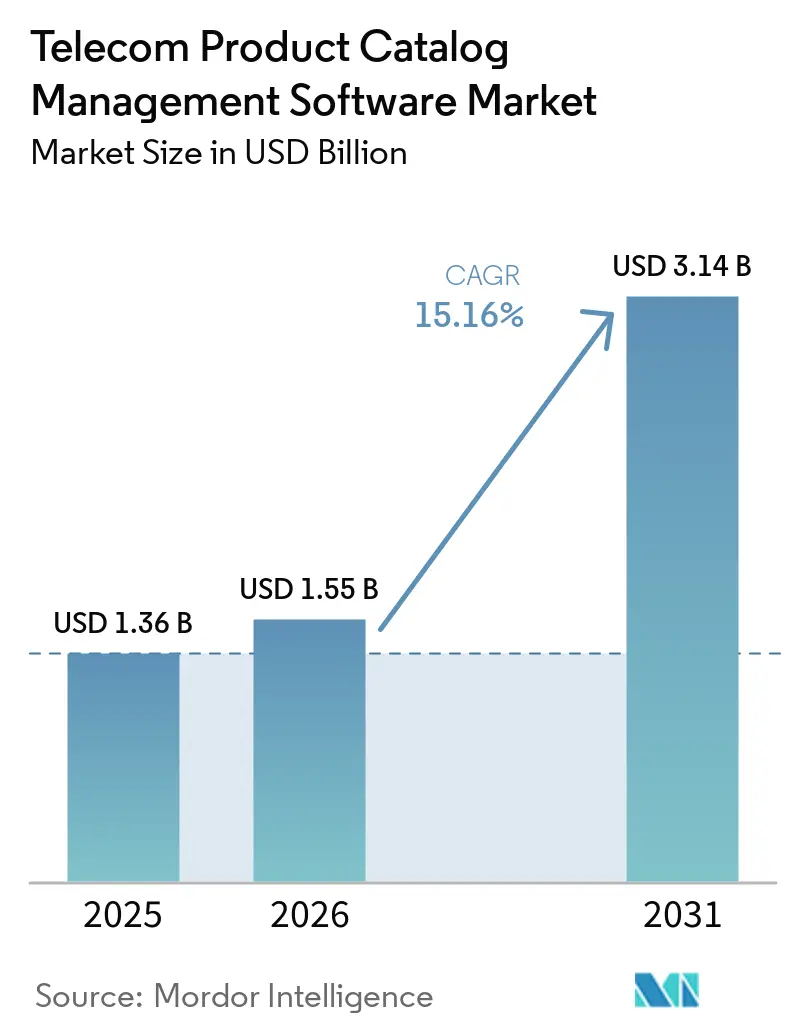
| Market Size (2026) | USD 1.55 Billion |
| Market Size (2031) | USD 3.14 Billion |
| Growth Rate (2026 - 2031) | 15.16 % |
| Fastest Growing Market | Asia-Pacific |
| Largest Market | North America |
| Market Concentration | Medium |
Major Players *Disclaimer: Major Players sorted in no particular order Image © Mordor Intelligence. Reuse requires attribution under CC BY 4.0. | |
Telecom Product Catalog Management Software Market Analysis by Mordor Intelligence
The Telecom product catalog management software market size is projected to expand from USD 1.36 billion in 2025 and USD 1.55 billion in 2026 to USD 3.14 billion by 2031, registering a CAGR of 15.16% between 2026 to 2031. The growing number of 5G, IoT, edge computing, and cloud-native offerings is increasing the number of commercial and network elements that operators must define, price, and fulfill. This is making the catalog layer more important for commercial operations, rather than treating it only as a back-office system. Separate definitions across billing, provisioning, and sales systems can create revenue leakage and make legacy business support system replacement more urgent. Telecom product catalog management software market demand is therefore shifting toward platforms that unite commerce, charging, and resource definitions in 1 central data store. Vendors are responding with cloud-native architectures, managed delivery, and tools that support faster offer configuration.
Key Report Takeaways
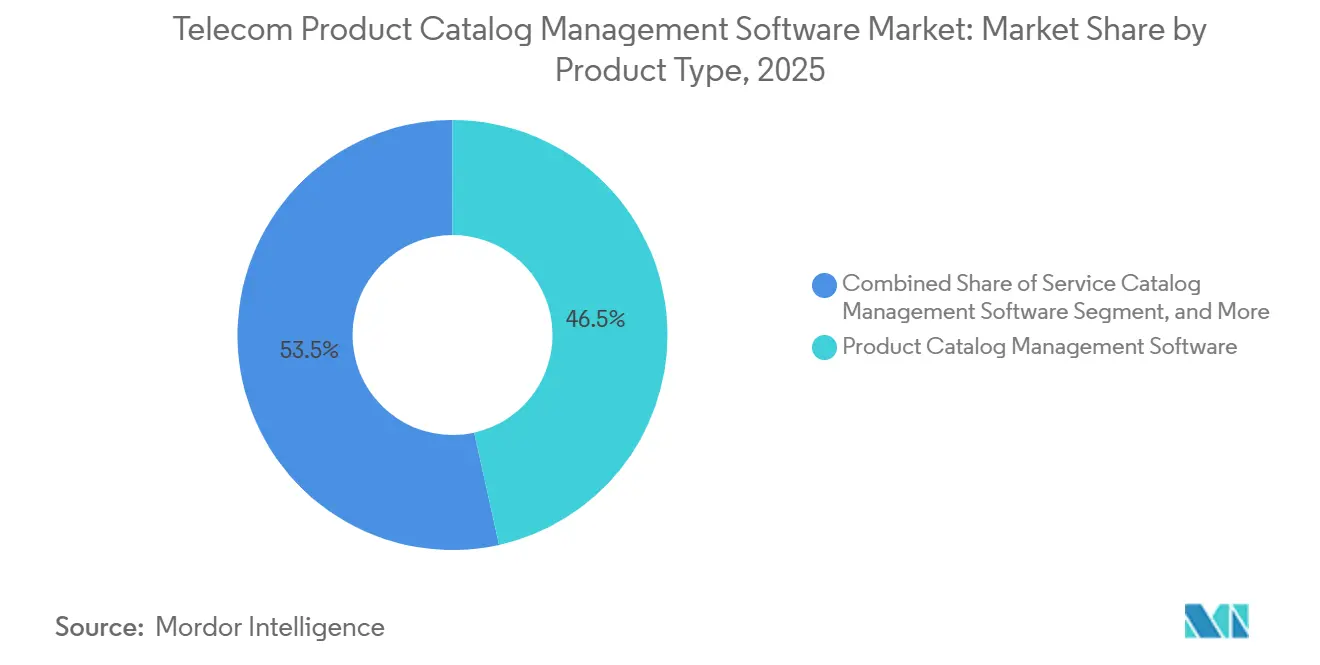
- By product type, Product Catalog Management Software held 46.53% of the Telecom product catalog management software market share in 2025, while Unified Product, Service, and Resource Catalog Platforms are projected to expand at a 16.21% CAGR through 2031.
- By component, software held 62.14% share in 2025, while services are projected to expand at a 15.87% CAGR through 2031.
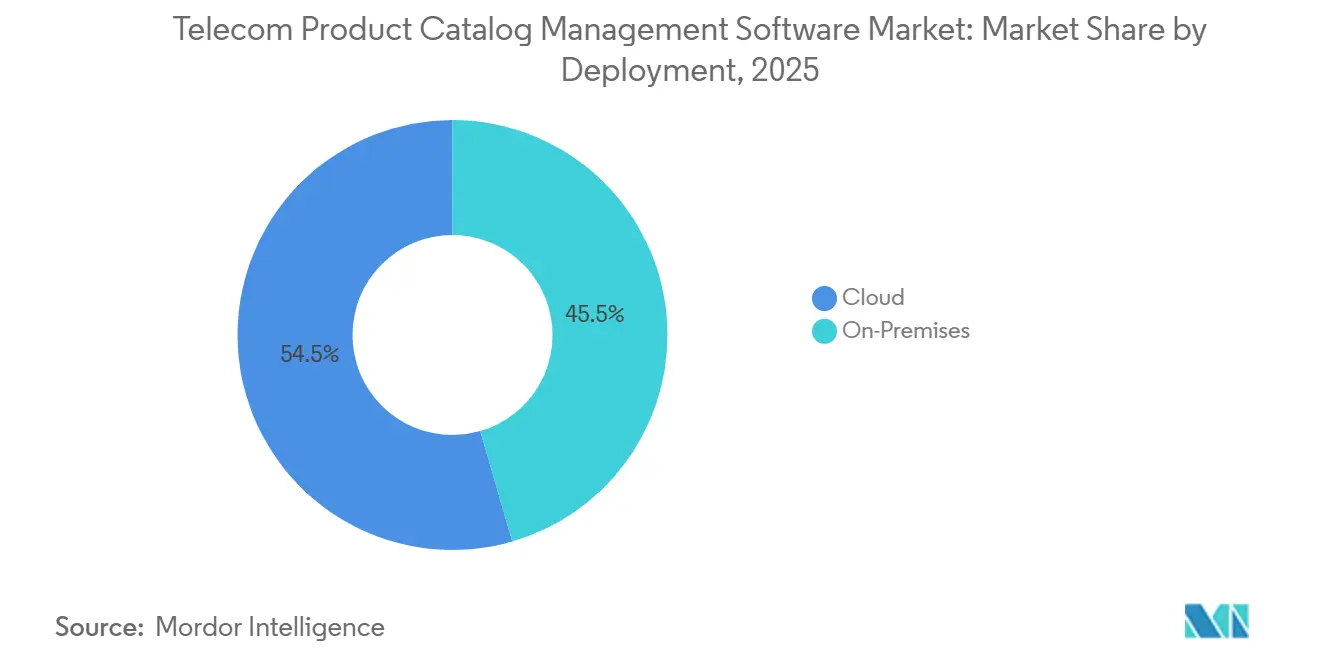
- By deployment, cloud held 54.48% share in 2025, while On-Premises is projected to expand at a 16.42% CAGR through 2031.
- By organization size, large enterprises held 71.84% share in 2025, while small and medium enterprises are projected to expand at a 16.53% CAGR through 2031.
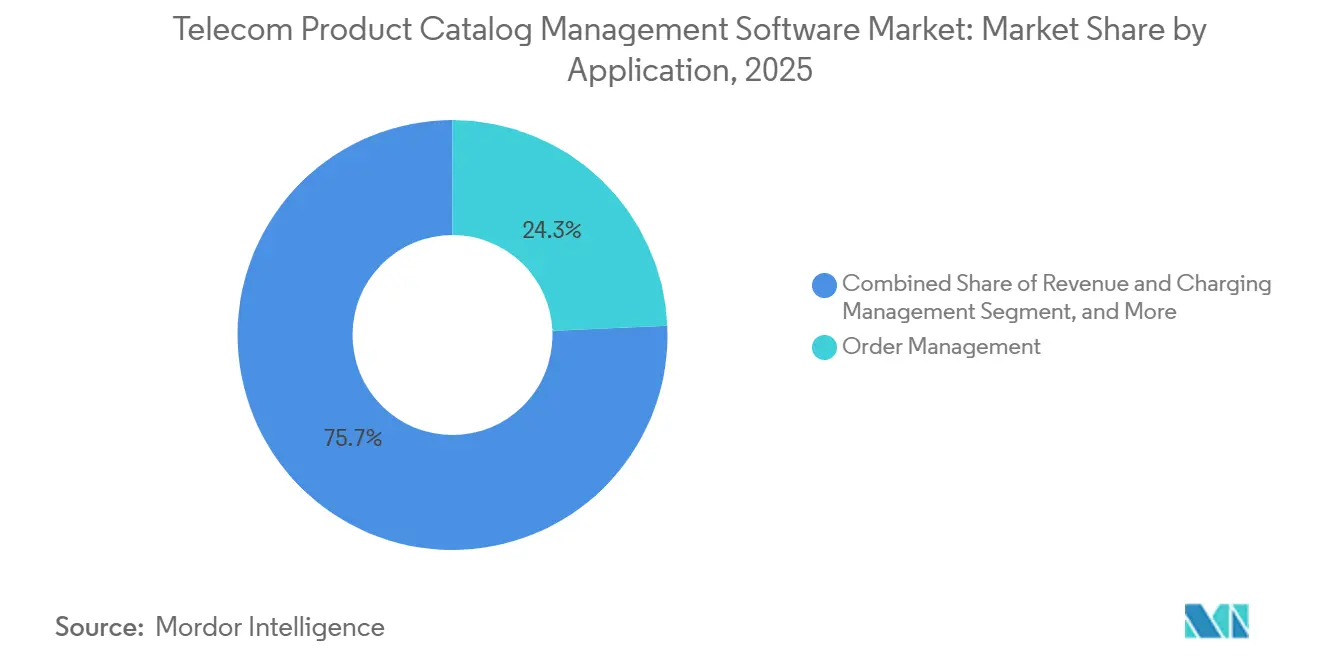
- By application, Order Management held 24.31% share in 2025, while Inventory and Serviceability Management is projected to expand at a 15.79% CAGR through 2031.
- By end user, telecommunications operators held 38.42% share in 2025, while Digital Service Providers and Communications Technology Companies are projected to expand at a 16.41% CAGR through 2031.
- By geography, North America held 34.56% share in 2025, while Asia-Pacific is projected to expand at a 16.14% CAGR through 2031.
Note: Market size and forecast figures in this report are generated using Mordor Intelligence’s proprietary estimation framework, updated with the latest available data and insights as of January 2026.
Global Telecom Product Catalog Management Software Market Trends and Insights
Drivers Impact Analysis*
| Driver | (~) % Impact on CAGR Forecast | Geographic Relevance | Impact Timeline |
|---|---|---|---|
| 5G, IoT, Cloud, and Edge Service Complexity | +3.5% | Global | Short term (≤ 2 years) |
| Demand for Faster Telecom Offer Launches | +2.9% | Global | Short term (≤ 2 years) |
| Growth of Partner-Led B2B2X Monetization | +2.3% | Global, particularly Asia-Pacific and Europe, Middle East, and Africa | Medium term (2-4 years) |
| Omnichannel Consistency Across Digital and Assisted Sales | +1.8% | North America and Europe | Medium term (2-4 years) |
| AI-Assisted Offer Design and Catalog Enrichment | +1.5% | Global | Medium term (2-4 years) |
| Real-Time Serviceability and Dynamic Pricing Requirements | +1.1% | Asia-Pacific and Middle East | Long term (≥ 4 years) |
| Source: Mordor Intelligence | |||
5G, IoT, Cloud, and Edge Service Complexity
5G has changed the product definition from a rate-plan task into a more detailed operational requirement. Private networks, network slices, edge nodes, and IoT bundles require catalog entries that link service terms to fulfillment settings. These entries can include service level agreement tiers, latency requirements, and uplink and downlink commitments. TM Forum released TMF936 Product Catalog API v5.0 in August 2025 to support catalog synchronization and dynamic product publishing across operators.[1]TM Forum, “Open Gateway Product Catalog API TMF936-v5.0,” TM Forum Open API Directory, tmforum.org. Telecom product catalog management software market adoption benefits when these products can connect commercial offers to technical delivery without repeated manual coding. Without a unified product, service, and resource model, teams must duplicate pricing and technical specifications in several legacy systems.
Demand for Faster Telecom Offer Launches
Competitive conditions have shortened the useful window for new service launches. Offer-launch speed now affects commercial performance because promotions and service propositions can change quickly. Netcracker stated that Zain KSA reduced product development time by 50% after completing its BSS and OSS transformation in March 2025. Traditional platforms can require long integration and testing cycles for complex changes. Ericsson released an updated OSS and BSS portfolio in June 2025, including an AI-driven CPQ tool for guided B2B offer design. Telecom product catalog management software providers that centralize rules can reduce repeated exchanges between product and IT teams.
Growth of Partner-Led B2B2X Monetization
B2B2X models require operators to define partner components, pricing terms, and settlement logic across several participants. Existing BSS stacks were often not designed for this level of partner configuration. Telecom product catalog management software market platforms can support these models by making offer definitions available through product APIs. GSMA stated in April 2026 that vertical packaging and outcome-based pricing are necessary for network API monetization at scale. These requirements increase the value of catalogs that can describe multi-sided services and commercial conditions. They also make open interfaces more important as operators work with enterprise customers, developers, and service partners.
Omnichannel Consistency Across Digital and Assisted Sales
Separate product definitions can lead to different prices, availability, and configurations across web stores, retail systems, and contact centers. This can make the customer experience inconsistent across assisted and digital channels. A central catalog can publish the same product definition to each sales interface. KPN reported that its Net Promoter Score for the Disruptions category improved from -4 in 2023 to +9 in 2025 as it improved customer journeys. Telecom product catalog management software market demand is supported when operators seek to reduce manual reconciliation and address differences in offer definitions. It can also reduce the operating effort required to keep channels aligned.
Restraints Impact Analysis*
| Restraint | (~) % Impact on CAGR Forecast | Geographic Relevance | Impact Timeline |
|---|---|---|---|
| Legacy OSS/BSS Integration Complexity | -2.4% | Global, most acute in North America and Europe | Long term (≥ 4 years) |
| High Migration and Data-Model Harmonization Costs | -1.9% | Global, particularly mid-market operators | Medium term (2-4 years) |
| Fragmented Product, Service, and Resource Taxonomies | -1.2% | Global | Medium term (2-4 years) |
| Catalog Governance Risks Across Multi-Operator Environments | -0.8% | Europe and Asia-Pacific multi-country groups | Long term (≥ 4 years) |
| Source: Mordor Intelligence | |||
Legacy OSS/BSS Integration Complexity
Legacy OSS and BSS environments remain a major constraint on catalog modernization. They often include custom logic, manual billing fixes, older tariffs, and poorly documented integrations. These systems were not designed for catalog-led operations. The technical challenge is paired with internal processes that have developed in response to legacy system limitations. Telecom product catalog management software market projects can take longer when teams must change systems and operating practices simultaneously. This can lengthen sales cycles and favor vendors that already manage large BSS environments.
High Migration and Data-Model Harmonization Costs
Data-model harmonization creates a separate challenge even after an operator addresses integration issues. This is most difficult for mid-tier operators and groups that use different product taxonomies across national operations. Cleanup, legacy rule identification, and post-cutover corrections can add substantial costs to a migration. Each market can also have older tariffs and local pricing rules that need to be retained or reconciled. The Telecom product catalog management software market can benefit from modular replacement approaches that reduce the need to harmonize every system at the start of a program. These approaches allow operators to replace selected catalog functions before pursuing broader BSS change.
*Our forecasts treat driver/restraint impacts as directional, not additive. The impact forecasts reflect baseline growth, mix effects, and variable interactions.
Segment Analysis
By Product Type: Unified Platforms Gain Ground Over Standalone Catalog Tools
Product Catalog Management Software held 46.53% share in 2025, reflecting its established position among operators that managed commercial products separately from network service specifications. This segment remains the standard choice for many operators with existing standalone catalog systems. Unified Product, Service, and Resource Catalog Platforms are projected to grow at a 16.21% CAGR through 2031. Their growth reflects demand for 1 source of information across commerce, charging, and resource fulfillment. This structure reduces the need to synchronize several catalogs. It also gives product, charging, and fulfillment teams a shared reference for the same commercial offer. That shared reference can reduce the need to repeatedly translate product rules between commercial and technical systems. The Telecom product catalog management software market size for this segment is supported by operator demand for closer links between product design and technical fulfillment.
Amdocs presented CatalogONE in February 2025 as a central catalog spanning the BSS and OSS domains, featuring carrier-grade automation, TM Forum Open APIs, and an AI assistant.[2]Amdocs, “CatalogONE, Your Business Growth Is as Easy as the Product It Can Launch,” Amdocs, amdocs.com. TM Forum listed Cerillion Enterprise Product Catalog as an ODA Component Certified through November 2026. Service Catalog Management Software remains a mid-tier category. Vendors are increasingly offering it as a component of unified BSS suites rather than as a separate system. Cerillion released a Service Catalogue module in version 25.2 during October 2025, using the same publishing engine as its Enterprise Product Catalogue. This approach gives vendors a closer connection between product design and service fulfillment. It keeps the commercial offer and the technical service description within a common publishing framework. That can reduce the need for teams to maintain separate definitions when a service changes, when a promotion is introduced, or when a new fulfillment rule is required. The resulting platform model can also make governance more consistent across catalog functions. The telecom product catalog management software industry is therefore placing greater emphasis on combined platforms than isolated modules.



By Component: Managed Services Close the Gap as Operators Outsource Catalog Operations
Software held 62.14% share in 2025, accounting for most new catalog deployments and legacy replacement programs. Operators commonly begin BSS modernization by purchasing on-premises or SaaS software. Services are projected to grow at a 15.87% CAGR through 2031. Their expansion reflects the ongoing work required to maintain models, update rules, and govern APIs. Many operators, especially those below Tier-1 scale, lack sufficient in-house BSS capacity for this work. Therefore, growth in the telecom product catalog management software market is supported by contracts that combine technology with operational delivery. The service requirement does not end once the software is installed, as product models, pricing rules, and API controls require ongoing attention. This creates a longer relationship between the operator and supplier than a one-time software license.
Netcracker combined an AI-driven BSS platform with managed delivery for Zain KSA, resulting in a 50% reduction in product development time. Managed delivery can reduce initial capital exposure and shift part of the implementation risk to the supplier. Vendors without managed services capabilities can be less competitive when Tier-1 procurement includes both software and operational delivery. Amdocs reported a new multiyear managed services and AI innovation agreement with T-Mobile and an expanded Vodafone Germany engagement in its February 2026 fiscal first-quarter results. These arrangements extend vendor involvement beyond the first implementation. They give suppliers a direct role in day-to-day catalog operations, including the changes needed when operators launch new products or revise existing offers. They also make the quality of service delivery and rule management part of the supplier's long-term commercial position. For operators, this can reduce reliance on internal teams that must otherwise support several BSS tools. The telecom product catalog management software industry increasingly rewards suppliers that can keep catalog operations running after deployment.
By Deployment: Hybrid and Sovereign Cloud Disrupts the Public Cloud Default
Cloud deployments held 54.48% share in 2025, making cloud the leading deployment choice for catalog modernization. It offers a route to move away from older on-premises systems. On-Premises is projected to grow at a 16.42% CAGR through 2031. This reflects data residency requirements and demand for local control over sensitive subscriber information. The model also supports operators that want cloud operating practices without moving all workloads to a public environment. It can keep sensitive data or selected functions within a country while allowing other catalog functions to use cloud services. This makes deployment decisions part of the commercial and regulatory planning for a modernization program. The leading cloud deployment position shows that deployment flexibility is becoming central to procurement decisions.
Cerillion announced an Omantel deployment in April 2026 through Cerillion Cloud in Oman Data Park, designed to meet national data sovereignty and security requirements. This type of local cloud design is becoming more relevant in the Middle East and Asia-Pacific markets. On-premises deployment remains important for highly regulated operators and areas with limited nearby cloud capacity. These deployments are also moving toward private cloud environments based on Kubernetes and OpenShift. The distinction between on-premises and hybrid deployment is becoming less clear as technical architectures change. Telecom product catalog management software market participants must therefore support public, private, and local cloud configurations. A supplier may need to deliver the same catalog functions while adapting hosting, data control, and security arrangements for each operating country.
By Organization Size: SME Adoption Accelerates as SaaS Delivery Lowers Entry Costs
Large enterprises held 71.84% share in 2025, led by Tier-1 and Tier-2 operators conducting multiyear BSS transformation programs. Their demand is supported by the capital required for modernization and by complex legacy integration requirements. Small and medium enterprises are projected to grow at a 16.53% CAGR through 2031. SaaS delivery, modular pricing, and pre-integrated BSS suites can reduce initial costs for these buyers. This broadens potential adoption among mobile virtual network operators, regional broadband providers, and digital service brands. These buyers can focus on defined service launches rather than replacing every legacy system at once. Their purchasing needs favor products with standard configurations and clear operating boundaries. The Telecom product catalog management software market size for this group benefits when providers enable smaller, faster deployments.
Smaller operators can use the same product and billing framework for several service lines without extensive custom development. This approach can make catalog platforms viable for businesses with hundreds of thousands of subscribers rather than tens of millions. It also allows operators to add mobile, broadband, or digital services more quickly. Suppliers are creating tiered SaaS offers with limited configurations for this customer group. These products focus on rapid offer launch rather than a full BSS replacement. They can help a regional provider introduce a limited new service without first funding a large integration program. The same approach can give digital-native brands a route to use established product and billing functions while retaining a smaller operating model. This keeps the initial project scope closer to the needs of the buyer. The telecom product catalog management software industry is expanding into a customer group that large incumbent vendors had previously served less directly.
By Application: Partner and Marketplace Management Leads Growth
Order Management held 24.31% share in 2025 because it links catalog product structures to order capture, decomposition, and fulfillment. Its position also reflects the large installed base of order management applications. Inventory and Serviceability Management is projected to grow at a 15.79% CAGR through 2031. Operators are investing in tools that support partner onboarding, revenue-sharing rules, product APIs, and settlement. These functions are important for B2B2X relationships where several parties contribute to a final offer. A catalog must describe the partner service element, its pricing terms, and the rules for revenue sharing or payment settlement. It must also make those definitions accessible to the systems that manage orders and partner interactions. The leading position of Order Management reflects its role as a core BSS function.
Revenue and Charging Management remains important because catalogs must support real-time rating, usage plans, and promotional credits in the same product model. Customer and Channel Management also requires consistent product definitions across sales interfaces. Inventory and Serviceability Management is gaining attention, where operators check resource availability before accepting a complex order. This can reduce order fallout and support faster activation for fixed and fiber services. Other Applications include mediation, API monetization, and wholesale management. Telecom product catalog management software market suppliers are adding these functions as operators use catalogs across a wider set of operating processes. A catalog can supply consistent data to the systems that price a service, accept an order, verify available resources, and apply charging rules. Its use therefore extends from initial product design into the processes that determine whether an order can be completed. This wider role increases the value of integration across BSS functions.
By End User: Digital Service Providers Drive the Next Growth Wave
Telecommunications operators held 38.42% share in 2025, making them the largest end-user group. Mobile network operators, fixed and broadband operators, and cable and converged providers each form important buyer groups. Converged operators have a strong need for shared product models across mobile, broadband, video, and enterprise services. Internet service providers are also becoming more active buyers as fiber competition increases. Digital Service Providers and Communications Technology Companies are projected to grow at a 16.41% CAGR through 2031. The Telecom product catalog management software market is moving beyond its traditional carrier customer base. Digital operators can have fewer legacy constraints but still need a consistent record of the connectivity, cloud, and third-party services they sell. This expands the range of customer environments that catalog vendors must address.
This end-user group includes cloud communications providers, over-the-top connectivity providers, and digital-native operators. These organizations need to manage service portfolios that combine connectivity, cloud services, and third-party applications. Circles announced a February 2026 partnership with by.U that consolidated several legacy BSS and digital experience systems into a unified cloud-native SaaS platform. The project shows how digital operators can pursue a unified architecture without the same legacy constraints as established carriers. Providers such as Amdocs, Netcracker, and Cerillion are adding capabilities for portfolios that include connectivity and digital services. Telecom product catalog management software market opportunities therefore extend to businesses that do not fit the traditional carrier model. These organizations may have service portfolios that change quickly because they combine connectivity with cloud features and partner applications. Their requirements reinforce the need for catalog products that can manage a varied set of offer components without creating separate definitions for each channel or service. This keeps the catalog relevant as the portfolio expands.
Geography Analysis
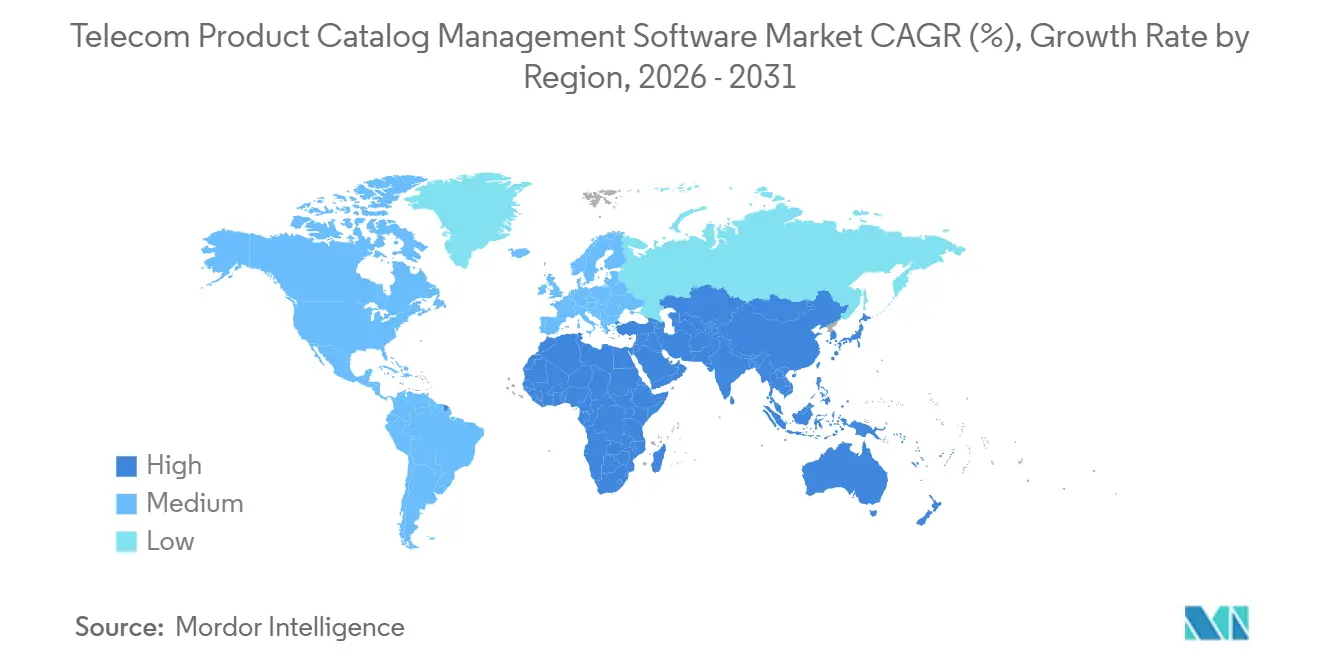
North America held a 34.56% regional share in 2025. Tier-1 operators in the United States, Canada, and Mexico are running multiyear BSS transformation programs with important catalog components. United States carriers are replacing proprietary legacy environments with cloud-native and API-driven systems. These projects commonly produce multiyear software and services agreements. Amdocs reported an extended relationship with T-Mobile in its February 2026 fiscal first-quarter results. Canada contributes to demand through enterprise broadband investment and network expansion programs.
Europe is experiencing significant modernization in Germany, the United Kingdom, France, and the Netherlands. Data residency requirements and GDPR obligations support the demand for hybrid and private cloud deployments. Google Cloud described Deutsche Telekom's sovereign data platform in 2024. South America is attracting longer BSS transformation contracts.[3]Google Cloud, “Engineering Deutsche Telekom's Sovereign Data Platform,” Google Cloud Blog, cloud.google.com. Liberty Latin America announced a 10-year strategic engagement with Amdocs in August 2026. The region remains behind North America and Europe in absolute spending, but recent contract durations indicate larger transformation programs.
Asia-Pacific is projected to grow at a 16.14% CAGR through 2031, the fastest regional rate in the Telecom product catalog management software market. China, India, South Korea, Japan, and Southeast Asia are pursuing 5G monetization through differentiated enterprise and consumer offerings. Netcracker completed a large cloud deployment for AIS in Thailand in December 2025. The Middle East is also investing in BSS and OSS modernization, including Cerillion's Omantel program in April 2026. Africa is a developing opportunity where operators are investing in catalog functions through broader BSS consolidation programs. These programs support 4G monetization and preparatory 5G infrastructure investment.

Competitive Landscape
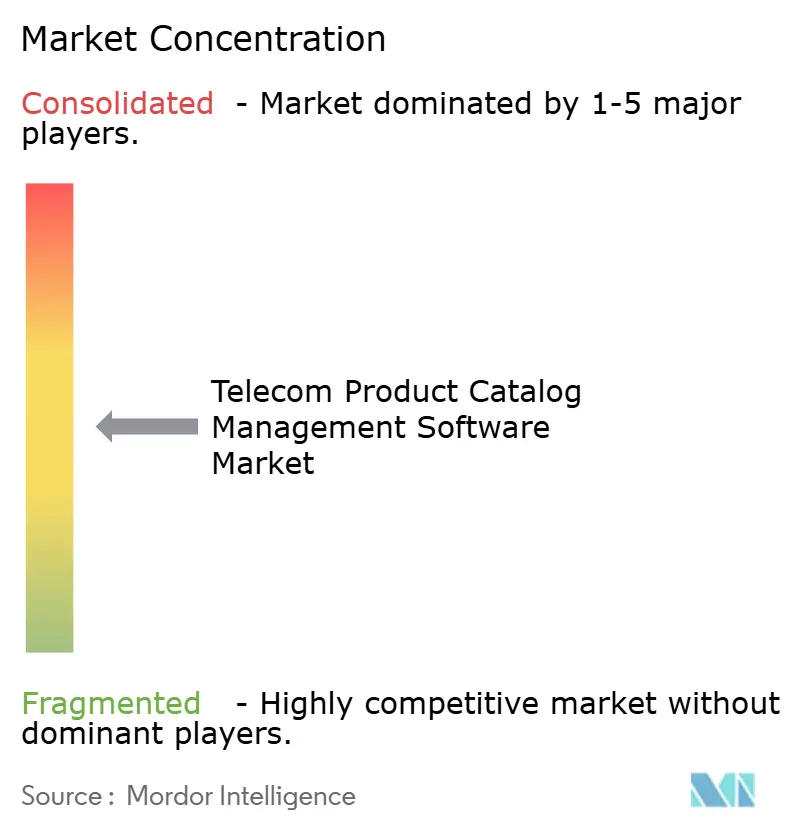
The Telecom product catalog management software market is moderately concentrated. Amdocs, Netcracker, Ericsson, Nokia, and Oracle form the upper tier of full-stack BSS suppliers. Their position is supported by managed services relationships, integration with charging and order management, and catalog configuration capabilities. These companies compete largely on transformation, delivery, and integration depth. Catalog modules are commonly sold as part of broader BSS and OSS programs. This makes the supplier's ability to manage charging, orders, fulfillment, and operations relevant to a catalog purchase. It also means that specialist catalog vendors must demonstrate how their tools can integrate with the systems an operator chooses to retain. Amdocs completed its acquisition of MATRIXX Software in early 2026, adding real-time charging capabilities to its catalog-to-monetization workflow.
Cerillion, Hansen Technologies, Tecnotree, Comarch, and Qvantel compete as more focused suppliers. They offer modular catalog products that operators can adopt without replacing a full BSS stack. This approach can appeal to mid-market operators with smaller transformation budgets. An operator can introduce a catalog module for a defined service or channel and then extend its use when the operating model is proven. This reduces the requirement to commit to a full stack replacement before benefits are established. Cerillion introduced Agent2Agent capabilities in its April 2026 release. Hansen Technologies renewed its Telefónica Germany partnership in May 2026 for cloud, AI, and API-powered BSS capabilities. These releases show that suppliers are using AI-supported configuration as one point of differentiation.
TM Forum ODA conformance, cloud-native design, and AI-assisted offer configuration are becoming common competitive requirements. This reduces the scope for differentiation on features alone. Operators are assessing whether a supplier can configure offers quickly, connect to established systems, and provide ongoing operational support. These factors can be more important than a standalone product feature when a transformation program covers several business functions. Suppliers are instead competing on integration speed, managed services coverage, and commercial flexibility. Netcracker reached a March 2026 milestone in a major OSS modernization program for BICS that included resource inventory, service inventory, and network planning capabilities.[4]Netcracker Technology, “Netcracker Reaches Significant Milestone with Major OSS Modernization Program for BICS,” Netcracker Technology, netcracker.com. Cerillion's Omantel program also shows the importance of deploying an integrated BSS and OSS suite in a sovereign cloud environment. The Telecom product catalog management software market rewards vendors that can adapt their delivery model to local data requirements and existing systems.
Telecom Product Catalog Management Software Industry Leaders
Amdocs Limited
NetCracker Technology Corporation
Ericsson AB
Nokia Corporation
Oracle Corporation
- *Disclaimer: Major Players sorted in no particular order

Recent Industry Developments
- August 2026: Amdocs and Millicom signed a multi-year managed services agreement for Telefónica Chile and Telefónica Moviles Chile, covering full-stack BSS/OSS, AI-driven application management, and software factory expertise to accelerate product and service delivery across Millicom's Chilean operations, marking a significant milestone in South America's BSS modernization momentum.
- May 2026: Hansen Technologies renewed its strategic partnership with Telefónica Germany, extending cloud, AI, and API-powered BSS solutions spanning product definition through to order fulfillment, Telefónica Germany was among the first operators globally to trial Hansen's pre-integrated agentic AI capability in its catalog module.
- April 2026: Cerillion signed a major BSS/OSS transformation program with Omantel, Oman's leading integrated telecommunications provider, deploying its pre-integrated BSS/OSS suite via Cerillion Cloud hosted within the Oman Data Park to satisfy national data sovereignty requirements while maintaining SaaS agility and AI enablement.
- March 2026: Netcracker announced a strategic OSS modernization program for BICS, a Proximus Global company, encompassing all components of Netcracker Digital OSS, including resource inventory, service inventory, service information management, and network planning and design, as part of BICS's wholesale and carrier services modernization.


Global Telecom Product Catalog Management Software Market Report Scope
Telecom Product Catalog Management Software Market: This market includes software solutions that enable telecommunications service providers to create, manage, configure, and maintain product catalogs for voice, data, messaging, and digital services. The market scope covers product lifecycle management, pricing and offer configuration, bundling, order management integration, and catalog governance across fixed-line, mobile, and converged telecom services.
The Telecom Product Catalog Management Software Market Report is Segmented by Product Type (Product Catalog Management Software, Service Catalog Management Software, and Unified Product, Service, and Resource Catalog Platforms), Component (Software, and Service), Deployment (Cloud, and On-Premises), Organization Size (Large Enterprises, and Small and Medium Enterprises), Application (Order Management, Revenue and Charging Management, Customer and Channel Management, Inventory and Serviceability Management, and Other Applications), End User (Telecommunications Operators, Internet Service Providers, Mobile Network Operators, Fixed and Broadband Operators, Cable and Converged Communications Providers, and Digital Service Providers and Communications Technology Companies), and Geography (North America, South America, Europe, Asia-Pacific, Middle East, and Africa). The Market Forecasts are Provided in Terms of Value (USD).
| Product Catalog Management Software |
| Service Catalog Management Software |
| Unified Product, Service, and Resource Catalog Platforms |
| Software |
| Services |
| Cloud |
| On-Premises |
| Large Enterprises |
| Small and Medium Enterprises |
| Order Management |
| Revenue and Charging Management |
| Customer and Channel Management |
| Inventory and Serviceability Management |
| Other Applications |
| Telecommunications Operators |
| Internet Service Providers |
| Mobile Network Operators |
| Fixed and Broadband Operators |
| Cable and Converged Communications Providers |
| Digital Service Providers and Communications Technology Companies |
| North America | United States |
| Canada | |
| Mexico | |
| South America | Brazil |
| Argentina | |
| Rest of South America | |
| Europe | Germany |
| United Kingdom | |
| France | |
| Italy | |
| Russia | |
| Spain | |
| Rest of Europe | |
| Asia-Pacific | China |
| India | |
| Japan | |
| South Korea | |
| Australia | |
| Rest of Asia-Pacific | |
| Middle East | Saudi Arabia |
| United Arab Emirates | |
| Turkey | |
| Rest of Middle East | |
| Africa | South Africa |
| Nigeria | |
| Egypt | |
| Rest of Africa |
| By Product Type | Product Catalog Management Software | |
| Service Catalog Management Software | ||
| Unified Product, Service, and Resource Catalog Platforms | ||
| By Component | Software | |
| Services | ||
| By Deployment | Cloud | |
| On-Premises | ||
| By Organization Size | Large Enterprises | |
| Small and Medium Enterprises | ||
| By Application | Order Management | |
| Revenue and Charging Management | ||
| Customer and Channel Management | ||
| Inventory and Serviceability Management | ||
| Other Applications | ||
| By End User | Telecommunications Operators | |
| Internet Service Providers | ||
| Mobile Network Operators | ||
| Fixed and Broadband Operators | ||
| Cable and Converged Communications Providers | ||
| Digital Service Providers and Communications Technology Companies | ||
| By Geography | North America | United States |
| Canada | ||
| Mexico | ||
| South America | Brazil | |
| Argentina | ||
| Rest of South America | ||
| Europe | Germany | |
| United Kingdom | ||
| France | ||
| Italy | ||
| Russia | ||
| Spain | ||
| Rest of Europe | ||
| Asia-Pacific | China | |
| India | ||
| Japan | ||
| South Korea | ||
| Australia | ||
| Rest of Asia-Pacific | ||
| Middle East | Saudi Arabia | |
| United Arab Emirates | ||
| Turkey | ||
| Rest of Middle East | ||
| Africa | South Africa | |
| Nigeria | ||
| Egypt | ||
| Rest of Africa | ||


Key Questions Answered in the Report
What is the size of the telecom product catalog management software market?
The market was valued at USD 1.36 billion in 2025, is USD 1.55 billion in 2026, and is forecast to reach USD 3.14 billion by 2031 at a 15.16% CAGR.
What is driving demand for telecom product catalog management software?
Demand is supported by 5G, IoT, cloud-native services, edge computing, faster offer launches, and the need for consistent product definitions across sales channels.
Which product type is growing fastest?
Unified Product, Service, and Resource Catalog Platforms are projected to grow at a 16.21% CAGR through 2031.
Which deployment model is expanding fastest?
On-Premises is projected to grow at a 16.42% CAGR through 2031 as operators address data residency and control requirements.
Which end-user group is expanding fastest?
Digital Service Providers and Communications Technology Companies are projected to grow at a 16.41% CAGR through 2031.
Which region is growing fastest?
Asia-Pacific is projected to grow at a 16.14% CAGR through 2031, supported by 5G monetization and cloud-based BSS modernization.
Page last updated on:


 Your data is secure and never sold or shared.


