
Telecom Network Carbon Intelligence Market Size and Share
Market Overview
| Study Period | 2021 - 2032 |
|---|---|
| Market Size (2027) | USD 0.67 Billion |
| Market Size (2032) | USD 1.55 Billion |
| Growth Rate (2027 - 2032) | 18.26 % |
| Fastest Growing Market | Asia-Pacific |
| Largest Market | Europe |
| Market Concentration | Medium |
Major Players *Disclaimer: Major Players sorted in no particular order Image © Mordor Intelligence. Reuse requires attribution under CC BY 4.0. | |
Telecom Network Carbon Intelligence Market Analysis by Mordor Intelligence
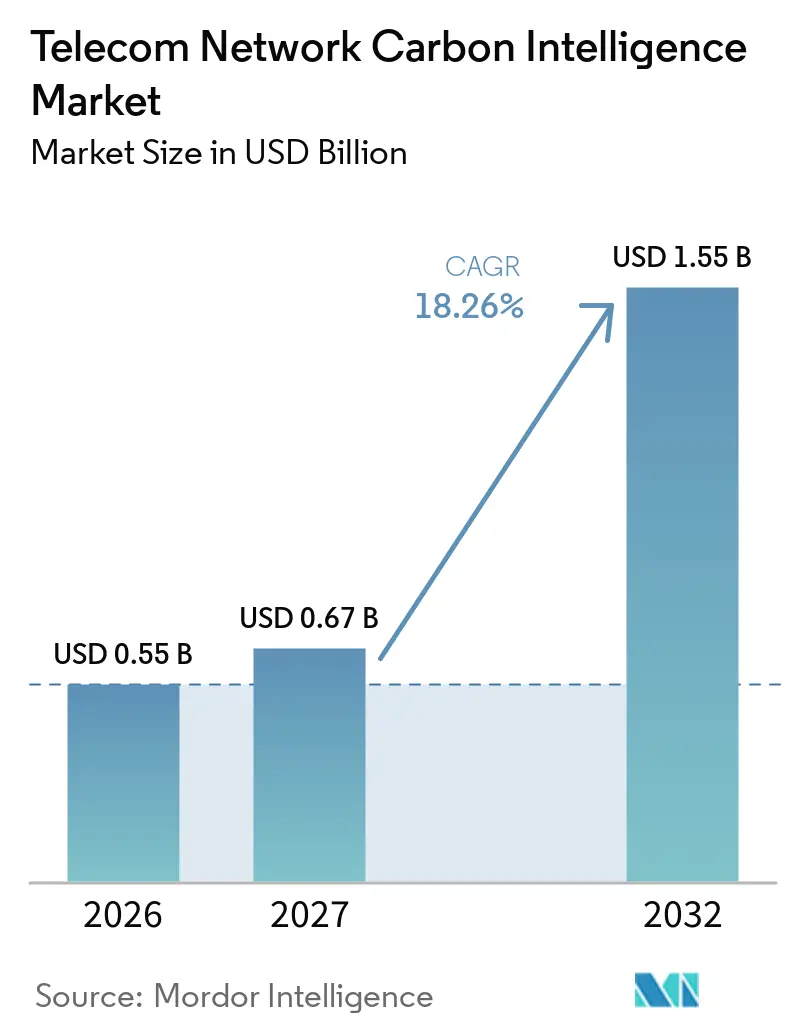
The Telecom Network Carbon Intelligence Market size was valued at USD 0.55 billion in 2026 and is estimated to grow from USD 0.67 billion in 2027 to reach USD 1.55 billion by 2032, at a CAGR of 18.26% during the forecast period (2027-2032). Demand is being shaped by tighter disclosure rules and by operators’ need for reliable, site-level energy and emissions records. Carbon reporting is moving closer to network operations because operators need to connect energy use, renewable power, and equipment performance across distributed estates. The telecom network carbon intelligence market also benefits from the need to manage 5G energy use without compromising service quality. Providers are combining carbon reporting with energy optimization, which makes the software relevant to compliance teams as well as network engineers. This creates opportunities for vendors that can connect multi-vendor networks, power systems, and reporting workflows without adding excessive implementation effort.
Key Report Takeaways
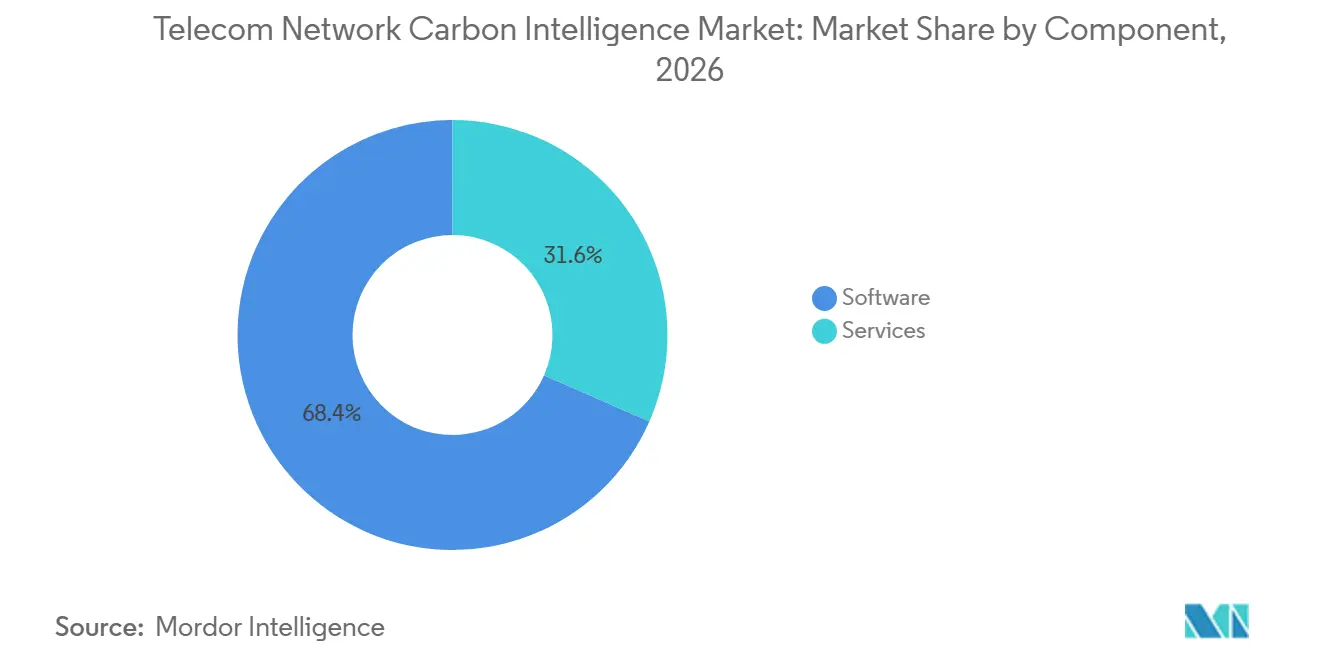
- By component, software held 68.42% of the telecom network carbon intelligence market share in 2026, while services are projected to expand at a CAGR of 19.72% through 2032.
- By network domain, Radio Access Network (RAN) accounted for 42.36% of the telecom network carbon intelligence market share in 2026, while data centers and edge computing sites are projected to expand at a CAGR of 19.84% through 2032.
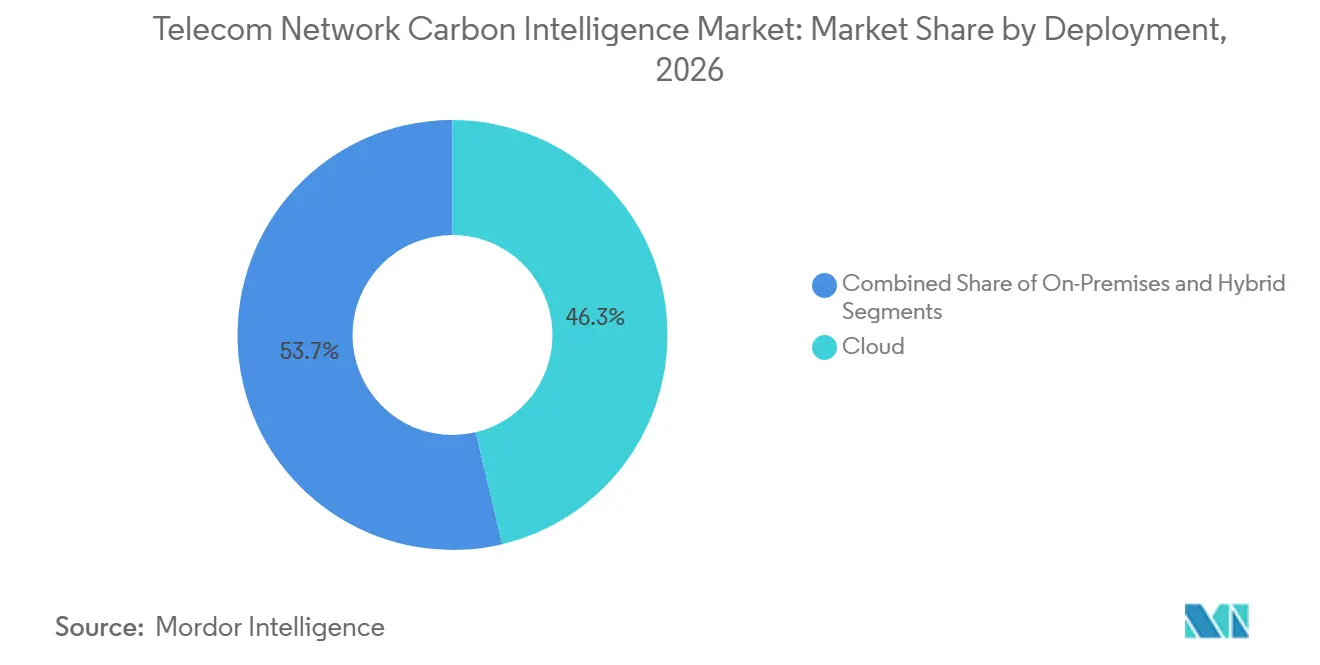
- By deployment, cloud held 46.28% of the telecom network carbon intelligence market share in 2026, while hybrid deployment is projected to expand at a CAGR of 19.65% through 2032.
- By end-user, Mobile Network Operators (MNOs) accounted for 60.74% of the telecom network carbon intelligence market share in 2026, while data center and edge infrastructure operators are projected to grow at a 19.92% CAGR through 2032.
- By geography, Europe held 33.16% of the telecom network carbon intelligence market share in 2026, while Asia-Pacific is projected to expand at a CAGR of 19.88% through 2032.
Note: Market numbers in this report are based on Mordor Intelligence's proprietary estimation framework, which combines nine months of actuals with Q4 projections for base year 2026.
Global Telecom Network Carbon Intelligence Market Trends and Insights
Drivers Impact Analysis*
| Driver | (~) % Impact on CAGR Forecast | Geographic Relevance | Impact Timeline |
|---|---|---|---|
| 5G Network Densification and Rising Energy Intensity | +5.2% | Global, concentrated in Asia-Pacific, Europe, and North America | Short term (≤ 2 years) |
| AI-Enabled Closed-Loop Network Energy Optimization | +4.5% | Global, with North America and Europe leading commercial deployment | Short term (≤ 2 years) |
| Net-Zero Disclosure and Carbon-Data Assurance Requirements | +3.5% | Europe, North America, and expanding Asia-Pacific markets | Short term (≤ 2 years) |
| Renewable Energy Procurement and Distributed Power Integration | +2.5% | Global, with Asia-Pacific and Sub-Saharan Africa driving distributed integration | Medium term (2-4 years) |
| Multi-Vendor Network Complexity and Unified Intelligence Needs | +1.8% | Global, especially Open RAN and mixed-vendor estates | Medium term (2-4 years) |
| Carbon-Aware Network Design and Energy Dispatch | +1.2% | North America and Europe, with spillover to Asia-Pacific | Long term (≥ 4 years) |
| Source: Mordor Intelligence | |||
5G Network Densification and Rising Energy Intensity
5G expansion is a central driver of demand in the telecom network carbon intelligence market. Additional radio equipment, baseband capacity, and edge computing resources increase the number of assets operators need to monitor, often across estates with different equipment vintages and power arrangements. A 2026 study found that modern multi-band equipment can improve energy efficiency per site by an average of 70%, but efficiency gains do not remove the need to manage the larger network footprint. Operators need reliable data to identify where power is being used, how usage changes with traffic, and whether energy-saving features are delivering the intended results. This need links carbon management directly to operating-cost control and network planning because teams can compare actions across individual sites instead of relying on estate-wide estimates. The telecom network carbon intelligence market helps platforms consolidate cell, site, and network data, enabling operators to prioritize actions across rapidly expanding 5G estates.
AI-Enabled Closed-Loop Network Energy Optimization
AI-based energy optimization is increasing the value of detailed network energy data. These systems can use traffic patterns, site loads, and service thresholds to adjust power states without routine manual intervention, thereby reducing the time needed to respond to changing network conditions. Nokia deployed an AI- and machine learning-based energy-efficiency solution with Indosat Ooredoo Hutchison in July 2025, using a software-as-a-service model to turn down idle radio equipment during periods of low demand.[1] The telecom network carbon intelligence market is strengthened when these operational actions are converted into traceable records of energy and emissions that sustainability, finance, and network teams can use. More frequent energy events also provide a richer dataset for reporting, planning, and reviewing prior energy-saving decisions. Operators can therefore use a single connected process to improve efficiency, demonstrate progress, and monitor service-quality boundaries across multiple network domains.
Net-Zero Disclosure and Carbon-Data Assurance Requirements
Disclosure requirements are making measured carbon data more important for telecom operators. ITU-T Recommendation L.1510, approved in October 2025, sets environmental key performance indicators for digital infrastructure, including energy use, emissions, renewable energy factors, and carbon usage effectiveness.[2] The GSMA also published climate transition planning guidance in 2025 that addresses operator-specific challenges in Scope 3 assessment.[3] These frameworks increase demand for consistent information from shared assets, suppliers, and network operations, particularly where several organizations contribute to the same service or site. Audit expectations make estimated values less useful where traceable data is available and require clearer documentation of the methods used. The telecom network carbon intelligence market offers vendors an opportunity to align their products with reporting standards and reduce the reporting burden on operator sustainability teams.
Renewable Energy Procurement and Distributed Power Integration
Renewable power assets are adding new information requirements at telecom sites. Solar equipment, battery storage, and power purchase agreements create energy records that must be linked to network loads and emissions calculations, rather than reviewed only at the end of a reporting period. Huawei and Ethio Telecom launched Solar-on-Tower sites in Ethiopia in August 2025, integrating photovoltaic panels with telecom towers and reducing diesel generator use by 40% per site.[4] Carbon intelligence tools can convert these site-level changes into records that support Scope 1 and Scope 2 reporting while showing how energy supply decisions affect network operations. The telecom network carbon intelligence market is supported by systems that treat distributed energy assets as operating assets and keep their data connected with the rest of the network estate. This approach can help operators compare energy sources, assess battery behavior, and plan investments across different site conditions.
Restraints Impact Analysis*
| Restraint | (~) % Impact on CAGR Forecast | Geographic Relevance | Impact Timeline |
|---|---|---|---|
| Fragmented Site Telemetry and Incomplete Asset Data | -2.3% | Global, most acute in developing markets with mixed infrastructure vintages | Medium term (2-4 years) |
| Integration Complexity Across OSS, RAN, Power, and ESG Systems | -1.8% | Global | Medium term (2-4 years) |
| Service-Quality Risk From Aggressive Network Power Saving | -1.0% | Global | Short term (≤ 2 years) |
| Uncertain Scope 3 Allocation Across Shared Infrastructure and Suppliers | -0.7% | Global, with the EU and North America under the highest regulatory scrutiny | Long term (≥ 4 years) |
| Source: Mordor Intelligence | |||
Fragmented Site Telemetry and Incomplete Asset Data
Network estates include macro towers, small cells, distributed antenna systems, edge sites, generators, rectifiers, and cooling equipment. These assets can come from different suppliers and may use incompatible monitoring formats, particularly where older equipment remains in service alongside newer 5G infrastructure. A 2026 study reported that support equipment, such as cooling, rectifiers, and backup power, can account for up to 40% of energy use at traditional telecom sites. Incomplete metering limits the accuracy of emissions reporting and reduces confidence in optimization results because the platform may be unable to distinguish measured values from estimated values. The telecom network carbon intelligence market must address this issue through data remediation, including new sensors, harmonized data pipelines, and better asset records. These preparatory requirements can lengthen sales cycles, increase deployment costs, and place a greater burden on operators with older infrastructure.
Integration Complexity Across OSS, RAN, Power, and ESG Systems
Carbon intelligence platforms need to receive data from operational support systems, RAN management systems, power equipment, and reporting applications. Each system is often maintained by a different team and may use a different data standard, leaving important records separated across the organization. Companion.energy and Nokia announced an integration in October 2025 that connects network energy forecasting with renewable energy contracts and carbon-intensity signals. The example shows why useful solutions often require tailored connections between specialized systems that already perform separate operating tasks. The telecom network carbon intelligence market faces additional implementation effort in multi-vendor environments because providers must maintain compatibility as network software and reporting rules change. This complexity can constrain vendor margins and delay adoption, especially for operators with older infrastructure.
*Our forecasts treat driver/restraint impacts as directional, not additive. The impact forecasts reflect baseline growth, mix effects, and variable interactions.
Segment Analysis
By Component: Software Leads Adoption While Services Extend Support
Software accounted for 68.42% of the telecom network carbon intelligence market in 2026, reflecting operators’ preference for continuously updated platforms that support both operational energy decisions and formal emissions reporting from a single data environment. Operators favor software platforms because they provide regular updates, real-time dashboards, and automated reporting without requiring equipment replacement. Cloud-ready software can incorporate analytics for additional network domains, updated emissions factors, and changing reporting requirements. This flexibility suits operators with widely distributed sites because improvements can be introduced consistently across the estate. It also lets providers improve the platform throughout the customer relationship.
Services are projected to expand at a CAGR of 19.72% through 2032, as many operators need practical support to map assets, configure data flows, validate calculations, and maintain reporting processes after initial deployment. Implementation, system integration, and managed reporting services remain important because operators often need help connecting network and sustainability data. The telecom network carbon intelligence industry relies on these services, where internal teams lack experience with complex integration work. Service relationships can remain durable because providers maintain data pipelines across multi-vendor network estates. In May 2025, Schneider Electric announced an AI-native ecosystem for sustainability and energy management that combines emissions management, climate risk, reporting, compliance, and energy efficiency products.
By Network Domain: RAN Leads Demand as Edge Sites Expand
RAN accounted for 42.36% of the telecom network carbon intelligence market size in 2026, reflecting its broad physical footprint and the need to link radio equipment activity with site power use, traffic conditions, and emissions records. The radio layer is a priority because it includes a large share of an operator’s distributed network equipment and energy use. Carbon intelligence at this layer can connect radio performance, traffic demand, power settings, and emissions records. Transport and backhaul networks, core and cloud network functions, and passive site systems expand the requirement beyond individual cell sites. The telecom network carbon intelligence market is moving toward connected views of these domains instead of separate energy records.
Data centers and edge computing sites are projected to expand at a CAGR of 19.84% through 2032. AI inference workloads and distributed computing are bringing server, cooling, and power requirements closer to the network edge. These sites need monitoring to address server-level usage, cooling systems, and data-center operational measures. Deutsche Telekom reported up to 65% energy savings in initial live-network tests for its 5G core in February 2026, using demand-driven control across server hardware, operating systems, cloud infrastructure, and core functions. Vendors that cover network and computing assets can support operators as edge estates become more complex.
By Deployment: Cloud Scales Reporting While Hybrid Supports Control
Cloud deployment accounted for 46.28% of the market in 2026, as the model enables distributed operational data to be collected, reviewed, and shared without routine intervention at individual sites. Operators use cloud platforms to aggregate data from large site estates and make reporting available across business functions. The model reduces the need for on-site maintenance and supports regular platform updates. It can also support shared reporting arrangements for tower companies and infrastructure partnerships. The telecom network carbon intelligence market benefits when cloud systems convert dispersed operational data into a consistent reporting record.
Hybrid deployment is projected to expand at a CAGR of 19.65% through 2032, because it can preserve local control for rapid network responses while retaining a common environment for longer-cycle reporting and planning. This model combines cloud-based data aggregation and reporting with local control capabilities for time-sensitive network actions. Energy decisions at the cell level may need rapid responses, while emissions reporting and scenario analysis can use centralized computing resources. Hybrid architecture gives operators a path for data-sovereignty rules and latency-sensitive applications without forcing all processes into one environment. Providers that link local events to cloud reporting records can reduce manual reconciliation and improve transparency.

By End-User: MNOs Hold Demand While Edge Operators Gain Relevance
MNOs accounted for 60.74% of the telecom network carbon intelligence market demand in 2026. Their large network of estates creates a strong need to manage energy costs, emissions data, and equipment performance at scale. MNOs also face reporting demands that span radio networks, transport assets, core functions, and facilities. Fixed network operators, internet service providers, tower companies, network infrastructure providers, and enterprise private network operators form the remaining user base. Tower companies need clear allocation methods because shared passive infrastructure can affect tenants’ reported energy and emissions positions.
Data center and edge infrastructure operators are projected to expand at a 19.92% CAGR through 2032, as their energy management needs increasingly overlap with those of telecom operators managing distributed connectivity and computing assets. The telecom network carbon intelligence market can serve this segment as telecom companies operate or support more distributed computing capacity. These operators need tools that account for server loads, cooling, backup power, and renewable supply. Integrated sustainability data management is becoming more relevant across digital infrastructure assets with different operational profiles. Platforms that support connectivity and compute operations can address this wider customer base.
Geography Analysis
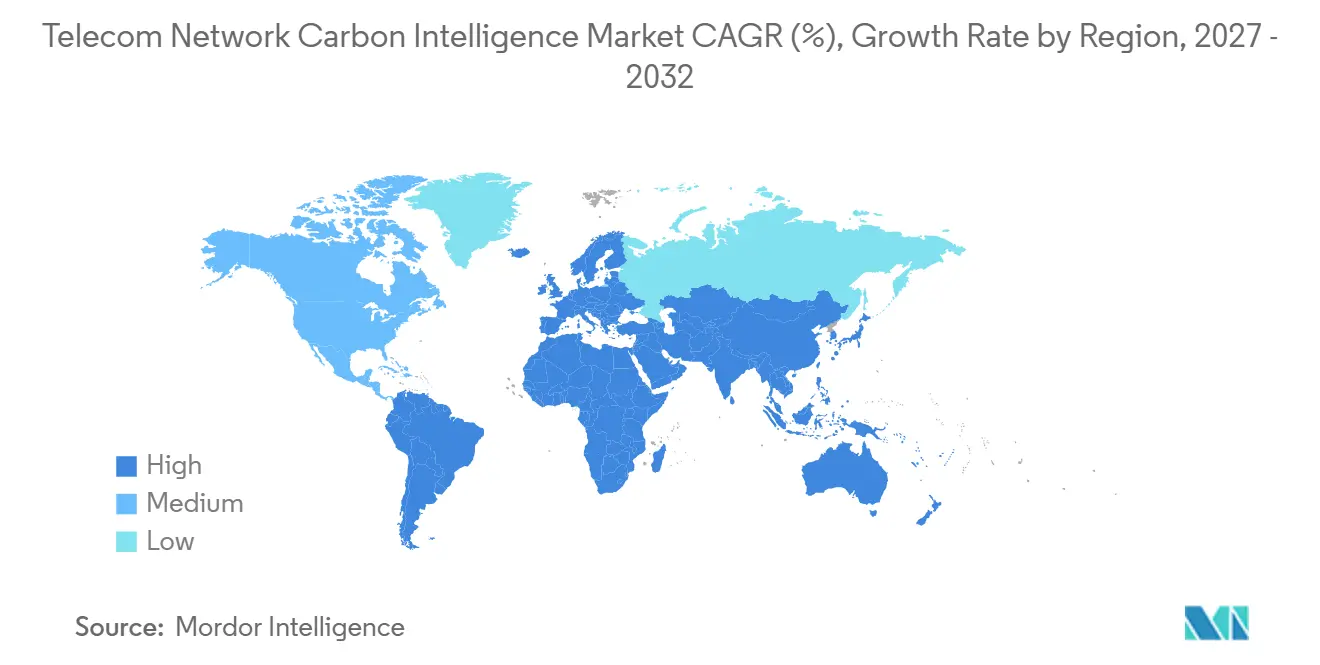
Europe accounted for 33.16% of the telecom network carbon intelligence market in 2026. The region benefits from established operator sustainability programs and the effect of EU reporting requirements. The Corporate Sustainability Reporting Directive increases the need for traceable emissions records and independent assurance. This makes data quality, asset-level information, and the allocation of shared infrastructure more important for operators. Elisa Industriq deployed its Gridle battery optimization solution with Elisa Estonia in May 2026, enabling mobile network batteries to participate in Estonia’s automatic frequency restoration reserve markets.
Asia-Pacific is projected to expand at a CAGR of 19.88% through 2032. The telecom network carbon intelligence market in the region combines large 5G infrastructure programs with increasingly formal carbon disclosure expectations in China, Japan, South Korea, India, and other markets. Varied regulatory maturity means suppliers need products that address local reporting rules and operator operating models. Japan, South Korea, and Australia provide examples of earlier adoption that can influence regional requirements. Nokia’s July 2025 deployment with Indosat Ooredoo Hutchison shows the use of AI-based energy management across a nationwide Indonesian RAN.
North America remains an important demand center as large operators link disclosure obligations with network efficiency programs, and California’s SB 253 requires Scope 1 and Scope 2 reporting for qualifying companies doing business in the state. South America is influenced by multinational operator practices, including Telefónica’s sustainability approach in Brazil. The Middle East and Africa need tools to manage policy requirements, diesel use, off-grid infrastructure, and the development of metering systems. Solar-on-Tower projects can generate operational data to enable more accurate accounting as renewable infrastructure becomes more widely available.
Competitive Landscape
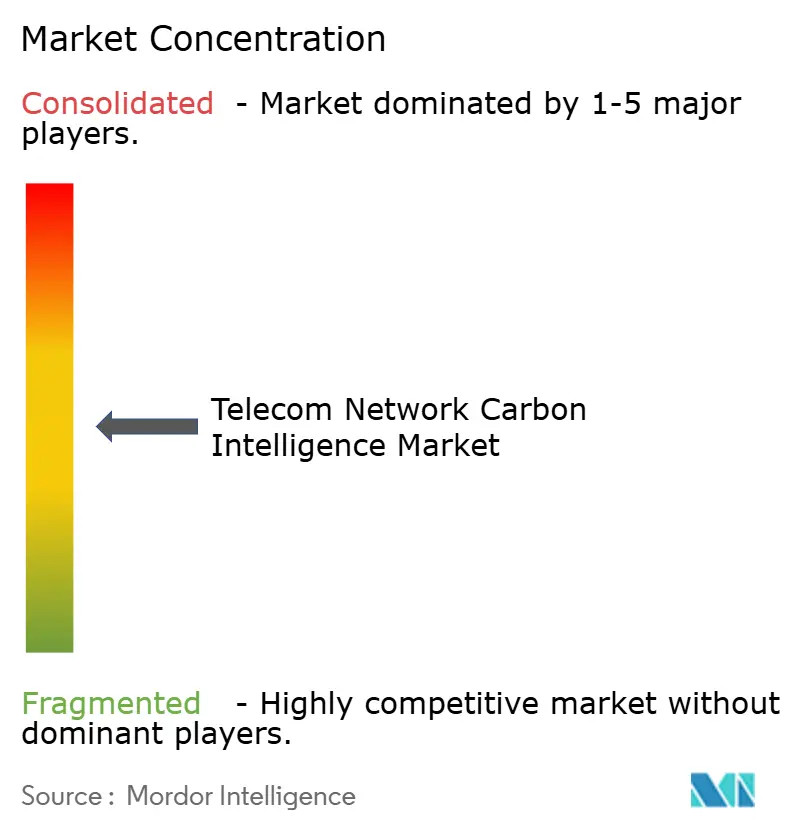
The telecom network carbon intelligence market is moderately concentrated. Ericsson, Nokia, Huawei, ZTE, and Cisco can build carbon intelligence into established network management portfolios. Their position is strengthened by existing operator relationships and direct access to network operating data. These companies can reduce integration effort for customers who already use their network platforms. Their strategy focuses on integrating energy and carbon functions into everyday network management.
Schneider Electric, Vertiv, IBM, and Elisa Industriq focus more on the connection between energy infrastructure and network carbon accounting. Their offerings address power systems, cooling, batteries, and site-level energy visibility. VIAVI Solutions describes test, monitoring, and assurance tools as part of energy-efficient network validation, placing measurement earlier in the network development process. Specialized vendors, including Tupl, Novisto, and Infozech Software, place greater emphasis on reporting integrations and auditable sustainability data. The telecom network carbon intelligence market supports these different positions because operators vary in priorities for network optimization, energy systems, and reporting compliance.
Scope 3 allocation across shared infrastructure, equipment suppliers, and service partners remains an important gap, as several parties may use the same assets yet report emissions using different methods. Another opportunity is to connect batteries and distributed energy assets with electricity balancing markets. Elisa Industriq’s Gridle deployment illustrates how an energy management layer can support resilience, cost control, and renewable integration. Vendors that combine carbon reporting with energy-market functions may offer operators a more complete business case in the telecom network carbon intelligence market.
Telecom Network Carbon Intelligence Industry Leaders
-
Telefonaktiebolaget LM Ericsson
-
Nokia Corporation
-
Huawei Technologies Co., Ltd.
-
ZTE Corporation
-
Cisco Systems, Inc.
- *Disclaimer: Major Players sorted in no particular order
Recent Industry Developments
- May 2026: ZTE’s AI-powered RAN energy-saving solution was commercially deployed by Ucell across its nationwide network in Uzbekistan, improving the operator’s energy efficiency ratio by 10.6% by applying dynamic, multi-level energy-saving actions, including symbol-level, channel-level, carrier-level, and equipment-level shutdowns, during low-traffic periods without impacting user experience.
- May 2026: Elisa Industriq deployed its AI-powered Gridle battery optimization solution at Elisa Estonia, enabling base station backup batteries to participate in both upward and downward automatic frequency restoration reserve markets operated by Estonia’s Elering grid operator. The deployment combines network resilience enhancement, electricity cost reduction, and renewable integration support in a single AI-driven optimization layer.
- March 2026: Novisto acquired Minimum, a London-based carbon management software company, to deliver a comprehensive sustainability management platform that combines enterprise-grade carbon accounting across Scopes 1, 2, and 3 with ESG data management and global reporting framework coverage within a single system of record.
- February 2026: Deutsche Telekom reported achieving up to 65% energy savings in its 5G core network during initial live-network tests, developed through its Full Stack Energy Efficiency concept in collaboration with Lenovo, HPE, AMD, and Mavenir. The approach applies demand-driven, intelligent resource allocation across technology layers from hardware through cloud infrastructure to 5G core functions.
Global Telecom Network Carbon Intelligence Market Report Scope
The Telecom Network Carbon Intelligence Market Report is Segmented by Component (Software and Services), Network Domain (Radio Access Network, Transport and Backhaul Network, Core Network and Cloud Network Functions, Data Centers and Edge Computing Sites, and Passive Infrastructure and Site Power Systems), Deployment (Cloud, On-Premises, and Hybrid), End-User (Mobile Network Operators, Fixed Network Operators and Internet Service Providers, Tower Companies, Network Infrastructure Providers, Data Center and Edge Infrastructure Operators, and Enterprise Private Network Operators), and Geography (North America, South America, Europe, Asia-Pacific, Middle East, and Africa). The Market Forecasts are Provided in Terms of Value (USD).
| Software |
| Services |
| Radio Access Network |
| Transport and Backhaul Network |
| Core Network and Cloud Network Functions |
| Data Centers and Edge Computing Sites |
| Passive Infrastructure and Site Power Systems |
| Cloud |
| On-Premises |
| Hybrid |
| Mobile Network Operators |
| Fixed Network Operators and Internet Service Providers |
| Tower Companies |
| Network Infrastructure Providers |
| Data Center and Edge Infrastructure Operators |
| Enterprise Private Network Operators |
| North America | United States |
| Canada | |
| Mexico | |
| South America | Brazil |
| Argentina | |
| Rest of South America | |
| Europe | Germany |
| United Kingdom | |
| France | |
| Italy | |
| Spain | |
| Russia | |
| Rest of Europe | |
| Asia-Pacific | China |
| India | |
| Japan | |
| South Korea | |
| Australia | |
| Rest of Asia-Pacific | |
| Middle East | Saudi Arabia |
| United Arab Emirates | |
| Rest of Middle East | |
| Africa | South Africa |
| Egypt | |
| Rest of Africa |
| By Component | Software | |
| Services | ||
| By Network Domain | Radio Access Network | |
| Transport and Backhaul Network | ||
| Core Network and Cloud Network Functions | ||
| Data Centers and Edge Computing Sites | ||
| Passive Infrastructure and Site Power Systems | ||
| By Deployment | Cloud | |
| On-Premises | ||
| Hybrid | ||
| By End-User | Mobile Network Operators | |
| Fixed Network Operators and Internet Service Providers | ||
| Tower Companies | ||
| Network Infrastructure Providers | ||
| Data Center and Edge Infrastructure Operators | ||
| Enterprise Private Network Operators | ||
| By Geography | North America | United States |
| Canada | ||
| Mexico | ||
| South America | Brazil | |
| Argentina | ||
| Rest of South America | ||
| Europe | Germany | |
| United Kingdom | ||
| France | ||
| Italy | ||
| Spain | ||
| Russia | ||
| Rest of Europe | ||
| Asia-Pacific | China | |
| India | ||
| Japan | ||
| South Korea | ||
| Australia | ||
| Rest of Asia-Pacific | ||
| Middle East | Saudi Arabia | |
| United Arab Emirates | ||
| Rest of Middle East | ||
| Africa | South Africa | |
| Egypt | ||
| Rest of Africa | ||
Key Questions Answered in the Report
What is the telecom network carbon intelligence market size?
The telecom network carbon intelligence market is valued at USD 0.55 billion in 2026 and is projected to reach USD 1.55 billion by 2032, at a CAGR of 18.26% from 2027 to 2032.
What is driving demand for telecom network carbon intelligence platforms?
5G densification, AI-enabled energy optimization, carbon disclosure requirements, and renewable power integration are driving demand for connected energy and emissions data.
Which component leads adoption?
Software leads adoption with a 68.42% share in 2026 because operators need updated analytics, dashboards, and reporting capabilities across distributed network estates.
Which network domain has the largest share?
RAN holds the largest share at 42.36% in 2026, reflecting its central role in mobile network energy use and operational management.
Which deployment model is expanding fastest?
Hybrid deployment is projected to expand at a CAGR of 19.65% through 2032 because it combines cloud reporting with local controls for time-sensitive network actions.
Which region is expanding fastest?
Asia-Pacific is projected to expand at a CAGR of 19.88% through 2032, supported by major 5G build-outs and developing carbon disclosure requirements.