
Telecom Lithium-Ion Battery Management Market Size and Share
Market Overview
| Study Period | 2021 - 2032 |
|---|---|
| Market Size (2027) | USD 1.72 Billion |
| Market Size (2032) | USD 2.65 Billion |
| Growth Rate (2027 - 2032) | 9.03 % |
| Fastest Growing Market | Africa |
| Largest Market | Asia-Pacific |
| Market Concentration | Medium |
Major Players *Disclaimer: Major Players sorted in no particular order Image © Mordor Intelligence. Reuse requires attribution under CC BY 4.0. | |
Telecom Lithium-Ion Battery Management Market Analysis by Mordor Intelligence
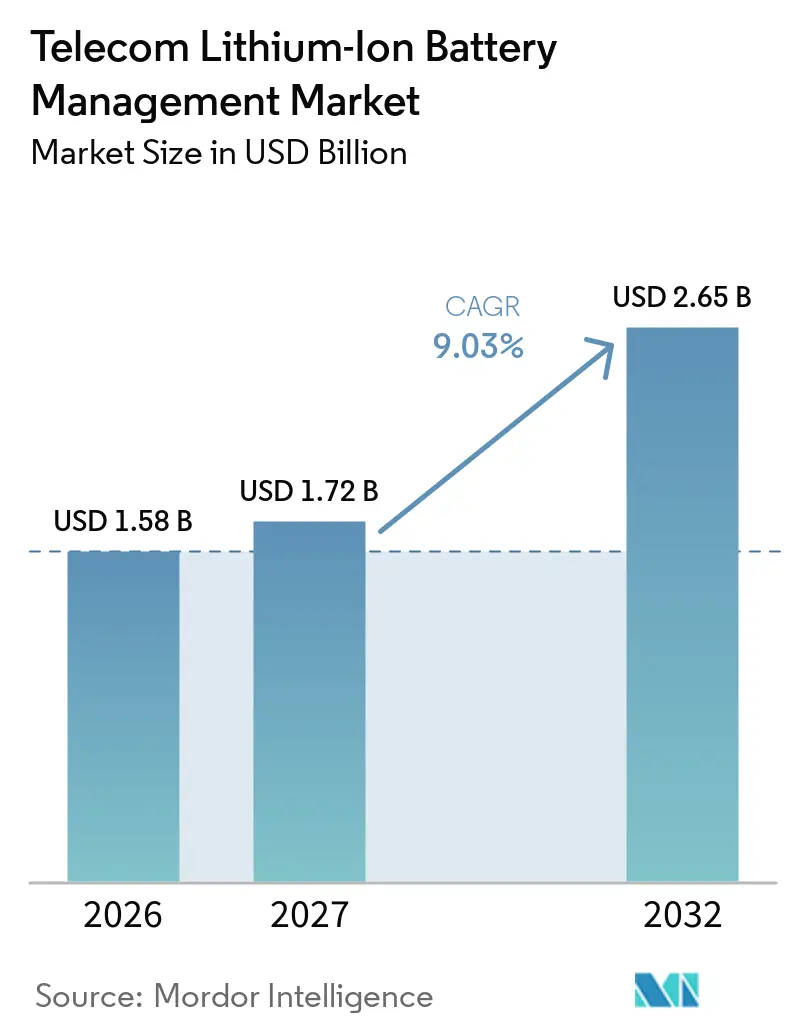
The Telecom Lithium-Ion Battery Management Market size is expected to increase from USD 1.58 billion in 2026 to USD 1.72 billion in 2027 and reach USD 2.65 billion by 2032, growing at a CAGR of 9.03% over 2027-2032. Higher power demand from 5G networks is increasing the need for closely monitored backup power at distributed sites. Operators are also moving beyond standalone controllers toward connected platforms that record battery condition and support remote maintenance. This shift gives software and managed services a larger role in procurement decisions, even though hardware remains the largest spending category. Open interfaces can help operators manage mixed fleets and avoid being tied to a single equipment supplier. High initial costs, legacy power systems, and security requirements for connected devices remain important constraints across the telecom lithium-ion battery management market.
Key Report Takeaways
- By component, hardware held 65.42% of the telecom lithium-ion battery management market in 2026, while software is projected to expand at a 10.62% CAGR through 2032.
- By battery chemistry, lithium iron phosphate held 67.36% of the telecom lithium-ion battery management market in 2026 and is expected to expand at a 10.48% CAGR through 2032.
- By BMS topology, pack-level systems accounted for 43.28% of the telecom lithium-ion battery management market in 2026, while modular BMS is projected to expand at a 10.76% CAGR through 2032.
- By connectivity, wired systems held 87.64% of the telecom lithium-ion battery management market in 2026, while wireless BMS is projected to expand at a 10.84% CAGR through 2032.
- By application and telecom deployment, macrocell and BTS sites accounted for 42.76% of the telecom lithium-ion battery management market in 2026, while telecom data centers and core networks are projected to expand at a 10.57% CAGR through 2032.
- By geography, Asia-Pacific held 38.42% of the telecom lithium-ion battery management market in 2026, while Africa is projected to expand at a 10.71% CAGR through 2032.
Note: Market numbers in this report are based on Mordor Intelligence's proprietary estimation framework, which combines nine months of actuals with Q4 projections for base year 2026.
Global Telecom Lithium-Ion Battery Management Market Trends and Insights
Drivers Impact Analysis*
| Driver | (~) % Impact on CAGR Forecast | Geographic Relevance | Impact Timeline |
|---|---|---|---|
| 5G Network Densification | +2.80% | Global, with primary gains in Asia-Pacific and EMEA | Short term (≤ 2 years) |
| Telecom Site Reliability Requirements | +1.80% | Global | Medium term (2-4 years) |
| Replacement of Lead-Acid Backup Systems | +1.50% | Global, strongest in Asia-Pacific and Africa | Medium term (2-4 years) |
| Demand for Remote Battery Diagnostics | +1.20% | Global, led by Asia-Pacific and North America | Medium term (2-4 years) |
| Renewable Hybridization of Telecom Sites | +0.80% | Africa, Middle East, South and Southeast Asia | Long term (≥ 4 years) |
| Rising Energy Costs at Distributed Sites | +0.50% | Europe, North America, and emerging markets | Medium term (2-4 years) |
| Source: Mordor Intelligence | |||
5G Network Densification Drives Distributed Power Demand
The telecom lithium-ion battery management market is responding to the increased energy demands of dense 5G networks. ETSI states that a complex massive MIMO macro base station typically draws 8,000 W and can peak at 24,000 W. The standard also indicates that adding a 5G carrier can nearly double total site power in multi-carrier configurations.[1] Research published in 2025 found that electricity use by 5G base stations could account for 2.1% of China’s national energy use in 2026, exceeding the expected share for data centers.[2] These conditions make accurate state-of-charge measurement and remote oversight more important for network availability. Smaller cells and microcells also require equipment that fits their lower-scale operating needs rather than a direct copy of macro-site designs.
Telecom Site Reliability Requirements Raise BMS Performance Thresholds
Network uptime commitments are making battery monitoring requirements more specific across the telecom lithium-ion battery management market. ITU-T Recommendation L.1397 sets out monitoring parameters for cell voltage, current, temperature, state of charge, and state of health. It also describes architectures for integrated battery units and integrated battery systems, including a master module for larger parallel installations.[3] Continuous records of battery performance give operators clearer evidence when reviewing service-level compliance. Safety and parallel-system requirements under IEC 62619 and IEC 63056 are increasingly relevant in procurement where cell-level information is required. Persistent data logging, therefore, strengthens the commercial role of software alongside battery hardware.
Lead-Acid Replacement Cycle Opens an Installed-Base Opportunity
Replacement of aging VRLA equipment remains a major source of demand in the telecom lithium-ion battery management market. ETSI states that lead-acid storage is no longer sufficient for 5G evolution due to space constraints, limited power delivery distance, and shorter service life. Exide introduced Solition Telecom in January 2025 as an LFP system with an integrated smart BMS, capacity options from 100 Ah to 200 Ah, and support for up to 15 parallel units.[4] The system is designed to offer up to 3,500 cycles and 94% round-trip efficiency. Sites installed with 12-year VRLA systems between 2012 and 2017 are entering replacement cycles through 2027 to 2030. This timing concentrates upgrade decisions within the forecast period.
Remote Battery Diagnostics Support Software-Led Services
Remote diagnostics are expanding software's role in the telecom lithium-ion battery management market. Polarium launched Connected Batteries in May 2025 with integrated cellular connectivity, an encrypted operator-originated VPN, cloud access, and over-the-air firmware updates. The ITU and Huawei white paper recommends using historical, operating, and environmental data to support predictive battery diagnostics. Such functions extend monitoring beyond voltage, current, and temperature readings. The same paper notes that battery theft can affect 15% of installed units in some locations. GPS, Wi-Fi, and Cell ID tools can therefore link asset protection with monitoring subscriptions.
Restraints Impact Analysis*
| Restraint | (~) % Impact on CAGR Forecast | Geographic Relevance | Impact Timeline |
|---|---|---|---|
| High Upfront Cost of Lithium-Ion Systems | -1.80% | Global, most acute in Africa and South America | Short term (≤ 2 years) |
| Interoperability Gaps Across Legacy Telecom Power Platforms | -1.20% | Global, particularly EMEA and North America | Medium term (2-4 years) |
| Cybersecurity Risks in Connected Battery Fleets | -0.70% | Global, most impactful in North America and Europe | Long term (≥ 4 years) |
| Thermal Management and Fire-Safety Requirements | -0.50% | Global, most acute in high-density deployments | Medium term (2-4 years) |
| Source: Mordor Intelligence | |||
High Upfront Cost of Lithium-Ion Systems Slows Adoption
Higher initial spending continues to limit wider adoption across the telecom lithium-ion battery management market. A complete lithium-ion installation includes power conversion equipment, cabinet integration, communication modules, commissioning, and the BMS itself. This package can cost more than a comparable VRLA upgrade at sites with long capital-recovery periods. Remote-site owners in Africa and South America must compare this investment with the revenue available from each location. Parallel-management modules, wireless equipment, and cloud licenses can make the economics more favorable over a 7-10-year operating life. Battery-as-a-Service contracts may spread the initial cost, although contract enforcement and standardization remain challenges in less mature leasing environments.
Interoperability Gaps Limit Migration From Legacy Power Platforms
Legacy equipment creates a practical migration barrier for the telecom lithium-ion battery management market. Telecom fleets contain proprietary rectifiers, DC power shelves, and battery protocols that have been installed over several decades. Modern BMS platforms may need to bridge CAN bus, MODBUS, and RS-485 data from older controllers to newer monitoring models. ITU-T L.1397 provides protocol-agnostic application-layer models, but it cannot remove the physical connection challenges at sites using older equipment. Large tower portfolios must either replace power shelves or add gateway equipment at individual sites to obtain fleet-wide visibility. Suppliers that support legacy and modern interfaces can reduce this operational burden.
*Our forecasts treat driver/restraint impacts as directional, not additive. The impact forecasts reflect baseline growth, mix effects, and variable interactions.
Segment Analysis
By Component: Software Monetization Reshapes Hardware-Led Economics
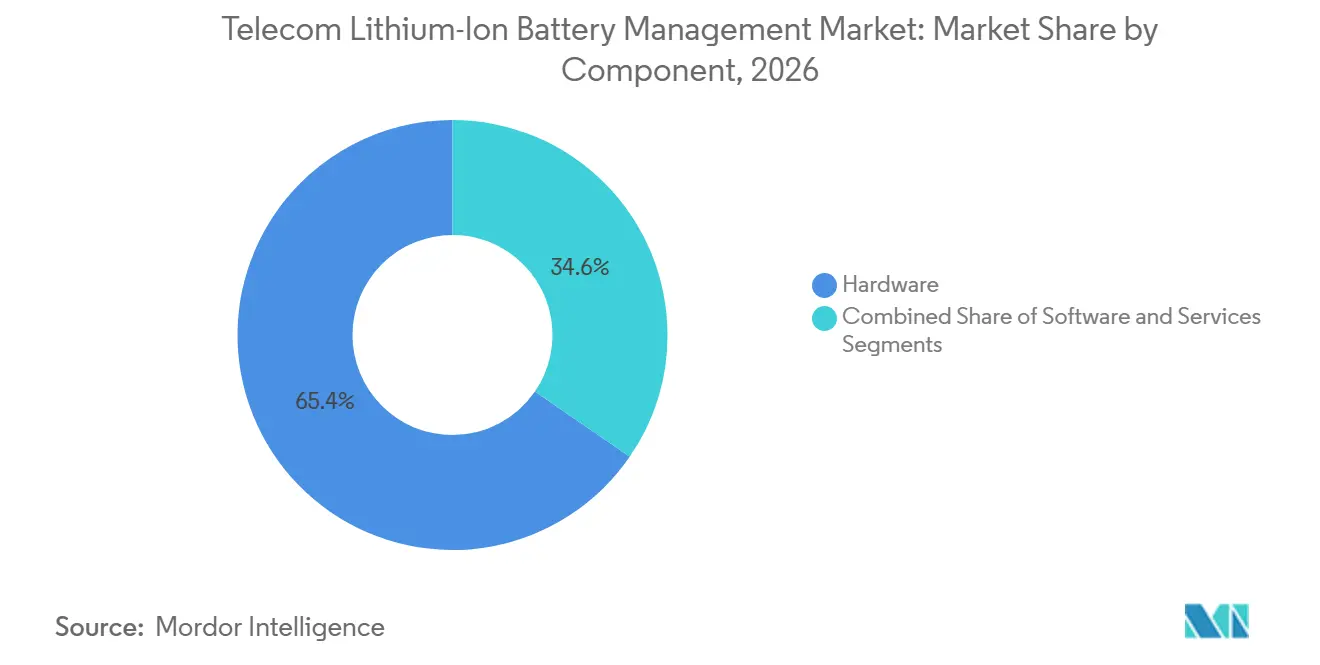
Hardware held 65.42% of the telecom lithium-ion battery management market share in 2026. Controller units, monitoring modules, shunt circuits, and enclosures account for a substantial part of deployment spending at large telecom sites. Established -48 V DC designs also fit existing operator procurement processes. Engineering teams remain familiar with centralized hardware platforms and their long replacement cycles. These factors preserve hardware’s leading position in the telecom lithium-ion battery management market. Software is projected to expand at a 10.62% CAGR through 2032. This rate reflects growing demand for condition monitoring, event records, and fleet-level reporting.
The ITU and Huawei white paper supports cloud-enabled analysis that combines historical, operating, and environmental battery data. This approach gives software providers a clearer role in fault detection and maintenance planning. EnerSys released its Cordex CXPS-HX and CXPS-W front-access DC power systems in April 2025. The company stated that the systems can recover up to 17.5% of floor space in a standard telecom shelter. The product shows how physical power equipment is increasingly combined with monitoring and lifecycle functions. This combination is strengthening service offerings across the telecom lithium-ion battery management market. Services such as commissioning, managed monitoring, and end-of-life support are especially relevant where operators prefer predictable operating costs.

By Battery Chemistry: LFP Establishes Its Position as the Telecom Standard
Lithium iron phosphate held 67.36% segment share in 2026. ETSI sets requirements for LFP backup applications, including thermal decomposition above 300°C, an energy density of at least 25 Ah/U for in-situ 5G replacement, and a state-of-charge deviation below 5%. LFP is also projected to expand at a 10.48% CAGR through 2032. The chemistry combines safety, cycle life, and operating characteristics suited to stationary telecom backup. The ITU and Huawei paper states that LFP thermal decomposition does not generate oxygen. That characteristic helps limit the spread of thermal runaway.
NMC remains relevant for high-power, thermally controlled data-center UPS applications. Its higher energy density can justify additional thermal-management investment in those locations. LMO and NCA serve narrower requirements where particular discharge profiles are needed. Other lithium-ion chemistries remain at early commercial or research stages for telecom use. They are not expected to reach a broad telecom deployment scale during 2027 to 2032. The telecom lithium-ion battery management industry is therefore concentrating product design and compliance work around LFP. This concentration gives battery suppliers a clearer basis for standardizing integrated BMS designs.
By BMS Topology: Modular Architecture Gains Over Pack-Level Systems
Pack-level BMS held 43.28% share in 2026. The design uses one controller for an entire parallel string and is common in conventional telecom battery cabinets. It keeps equipment costs lower at each site. However, it gives operators less flexibility when they need to add capacity over time. Modular BMS is projected to expand at a 10.76% CAGR through 2032. Operators replacing VRLA systems value the ability to add battery modules without replacing the management layer. This need supports modular designs across the telecom lithium-ion battery management market.
Vertiv introduced the PowerDirect 7100 Energy system for EMEA in November 2025. The company stated that the hybrid-ready system can deliver up to 52 kW of 48 V DC power at 98% efficiency and combine grid, generator, solar, wind, and fuel-cell inputs. Centralized systems remain useful for large portfolio management programs. Distributed systems support multi-cabinet sites that need independent module control. Cell-level BMS serves premium applications where early anomaly detection is important. ITU-T L.1397 helps standardize data models for integrated batteries, which makes basic controller functions easier to compare across suppliers. These choices are broadening the supplier opportunity in the telecom lithium-ion battery management market.
By Connectivity: Wireless BMS Broadens Access to Remote Sites
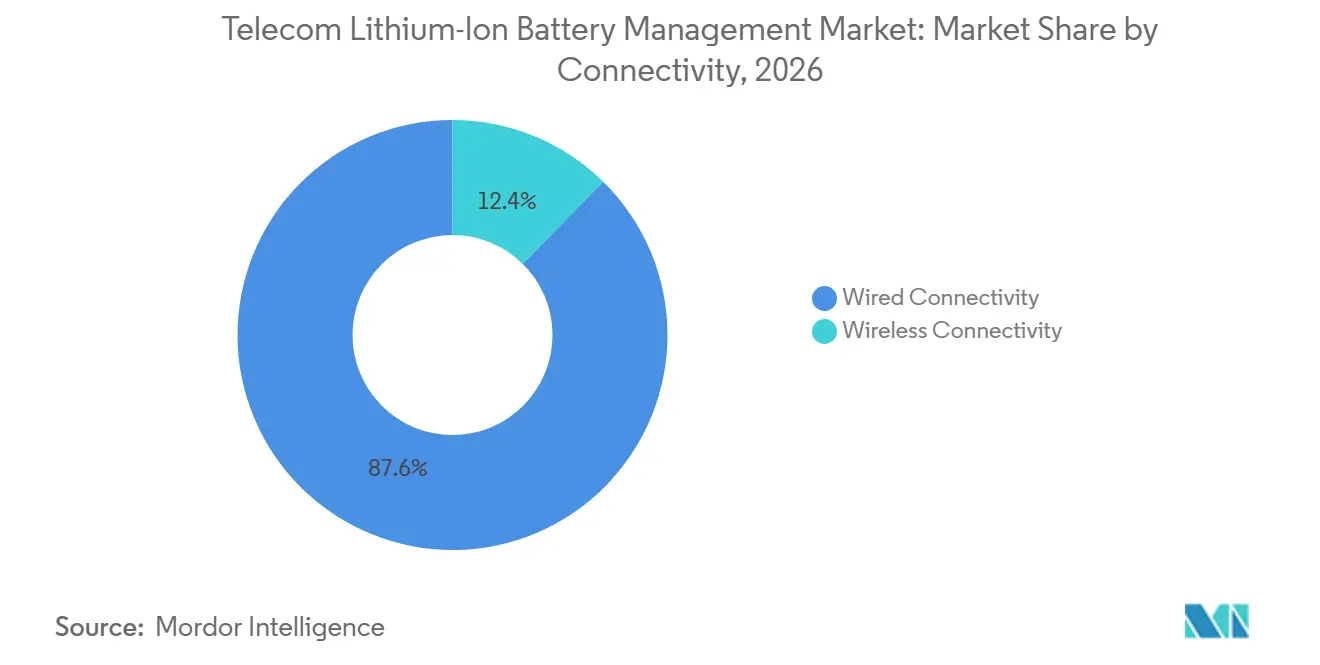
Wired connectivity held 87.64% share in 2026. RS-485, CAN bus, and MODBUS are already common across telecom power infrastructure. These interfaces offer predictable communication performance and avoid radio-frequency interference concerns. Wireless BMS is projected to expand at a 10.84% CAGR through 2032. It is particularly relevant where adding cables is difficult or costly. The telecom lithium-ion battery management market is using wireless connectivity to extend monitoring to remote and hard-to-access locations. Standardized monitoring models can support this shift.
Polarium’s Connected Batteries introduced integrated cellular connectivity for telecom fleet management in May 2025. The system includes encrypted traffic, GPS-based tracking, geofencing, remote disablement, and over-the-air updates. These features help address monitoring and theft risks at dispersed sites. They also raise cybersecurity requirements for connected battery fleets. ETSI EN 303 645 is beginning to influence IoT device security expectations in Europe, especially for public-safety procurement. Wireless suppliers must therefore show both operational value and credible security controls in the telecom lithium-ion battery management market. Wired systems are likely to remain important where existing infrastructure and compliance preferences favor fixed connections.
By Application and Telecom Deployment: Macrocell Sites Lead as Data Centers Accelerate
Macrocell and BTS sites accounted for 42.76% share in 2026. Their large installed base and standard 48 V DC power arrangements make BMS integration relatively straightforward. The telecom lithium-ion battery management market size for these sites is supported by the need to manage backup power across broad radio networks. The ITU and Huawei paper identifies theft as a material problem at some macro sites. Geofencing and remote-disabling functions can therefore become standard requirements in higher-risk locations. Telecom data centers and core networks are projected to expand at a 10.57% CAGR through 2032.
5G core functions are moving closer to radio networks through edge data-center deployments. This change turns simple backup cabinets into continuously monitored lithium-ion arrays that support higher power needs. Vertiv launched EnergyCore Grid in December 2025 as a factory-integrated LFP energy storage system scalable from 1 MW to more than 200 MW. Small cells and microcells are also expanding as networks densify. Tower sites are moving beyond passive hosting toward active management of several energy inputs. Enterprise private networks and public-safety networks continue to require high resilience and early-warning capabilities.
Geography Analysis
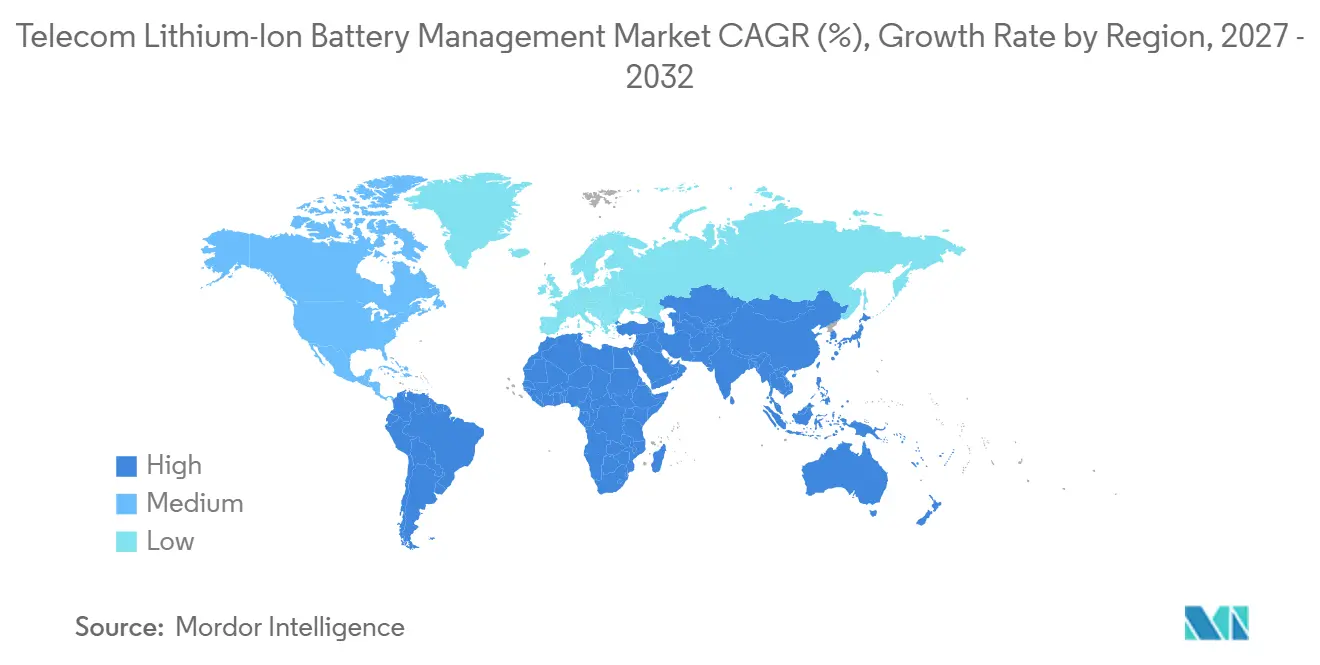
Asia-Pacific held 38.42% of the telecom lithium-ion battery management market share in 2026. China’s 5G deployment and India’s network rollout support demand for managed lithium-ion backup systems. Narada won a China Tower battery supply bid in March 2025 valued at CNY 330 million (USD 45.9 million). The company also won China Telecom’s centralized procurement project in October 2025, valued at CNY 450 million (USD 62.6 million). These contracts show the scale of integrated battery procurement in China’s tower ecosystem.
Lineage Power Private Limited received a BSNL order in January 2026 valued at INR 94.35 crore (USD 11.2 million) for 25,000 lithium-ion battery modules rated at 100 Ah and 48 V, along with 2,500 IP55-rated racks that require TSEC/TAC BMS certification and Telecom Trusted Portal registration. Japan and South Korea add recurring demand through long-cycle operator infrastructure programs. North America and Europe rely more on replacement economics, efficiency needs, and compliance-led upgrades. EnerSys launched the AlphaCell 4.0HP+ for outdoor and edge communications networks in North America in May 2026 with a six-year extended warranty.
Africa is projected to expand at a 10.71% CAGR through 2032. Operators are moving sites with weak or absent grid connections toward solar-battery hybrid systems, and GSMA reports that early adopters have recorded operating-cost reductions of 30-65% compared with diesel-dependent options. IFC announced USD 45 million in financing for IPT PowerTech in March 2026 to modernize 2,235 sites in Ethiopia, Liberia, and Sierra Leone, with more than 90% of the locations off-grid or on weak-grid and projected power cost reductions in Ethiopia of up to 52%, alongside annual emissions cuts of more than 10,624 tCO₂e. This work expands the telecom lithium-ion battery management market in locations where reliable grid power is limited. South America is led by Brazil and Argentina, although fiscal constraints slow fleet-wide replacement compared with Asia-Pacific.
Competitive Landscape
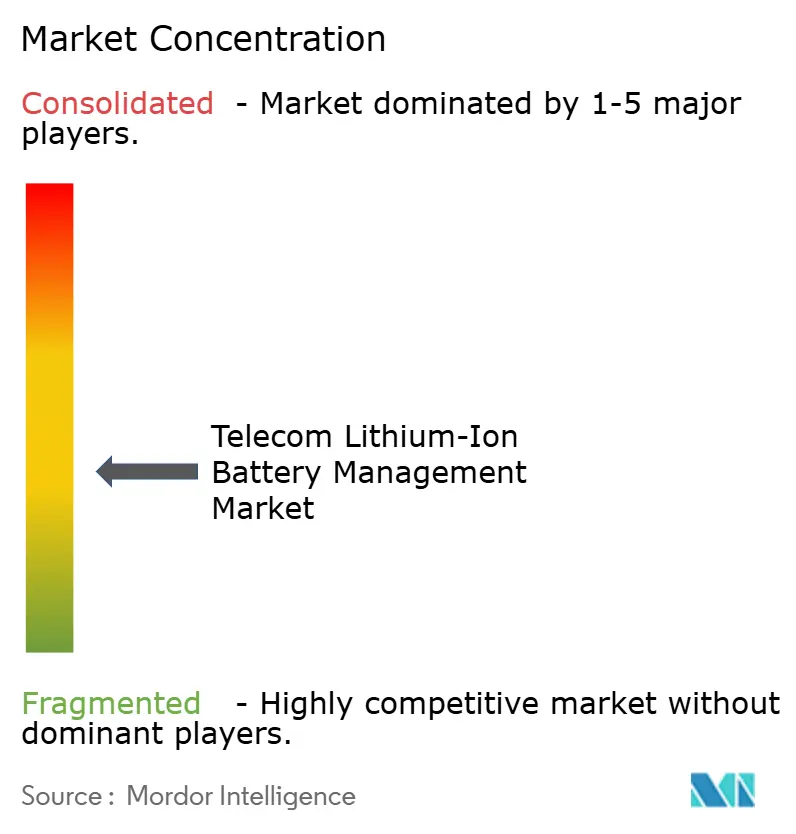
The telecom lithium-ion battery management market is moderately fragmented, with no supplier holding a sufficient disclosed share to set pricing or technology standards on its own. Huawei Technologies and ZTE Corporation compete by embedding BMS capabilities within broader digital power systems that combine rectification, renewable integration, and network-wide energy management. This approach can make replacement of a single BMS more difficult for existing customers. EnerSys, Vertiv Holdings, Polarium AB, Exide Technologies, and Narada Power Source compete through product breadth, chemistry knowledge, and service delivery. Their 2025 and 2026 releases show a clear focus on connectivity-enabled products and lifecycle management in the telecom lithium-ion battery management market.
Schneider Electric worked with SK Telecom on a BMS and energy-storage initiative that includes UPS development using SK On lithium-ion cells. This collaboration positions power-management suppliers as integrated energy partners for telecom operators. Vertiv’s December 2025 EnergyCore Grid combines batteries, a power conversion system, and an energy-management system in a modular LFP configuration. Polarium’s May 2025 Connected Batteries product combines cellular communication, cloud connectivity, tracking, and remote updates. These releases show how providers are competing on both fleet visibility and battery hardware.
Software-defined platforms that manage mixed equipment fleets remain an open area in the telecom lithium-ion battery management market. CATL and BYD have also moved into BMS-integrated battery modules for telecom applications, which can pressure pure-play BMS suppliers that purchase cells from the same companies. Huawei has participated in the ITU-T Study Group 5 L.ITLB standard-development cycle, and larger suppliers can use this involvement to shape interoperability requirements. Smaller vendors must maintain compatibility with emerging specifications while differentiating their implementation and service model.
Telecom Lithium-Ion Battery Management Industry Leaders
-
Vertiv Holdings Co.
-
Exide Technologies S.A.S.
-
Polarium AB
-
Caban Systems, Inc.
-
Huawei Technologies Co., Ltd.
- *Disclaimer: Major Players sorted in no particular order
Recent Industry Developments
- October 2026: China Unicom, China Tower Corporation, and Shuangdeng Group submitted the fifth draft of ITU-T Recommendation L.ITLB, titled "Application Practices of Smart Managements of Lithium Iron Phosphate Battery in Telecommunication Rooms and Data Centers," to ITU-T Study Group 5 for consent consideration. The draft addresses smart management practices for lithium iron phosphate battery systems used in telecommunications rooms and data centers, reflecting ongoing standardization efforts to improve the management of energy storage infrastructure in critical communications environments.
- May 2026: EnerSys launched the AlphaCell 4.0HP+ Thin Plate Pure Lead (TPPL) battery for outdoor and edge communications networks in North America, incorporating a proprietary integrated catalyst for internal gas recombination that moderates float-current demand and supports replacement-interval predictability. The product is backed by a six-year extended warranty.
- March 2026: IFC announced a USD 45 million corporate financing package, comprising a USD 27 million A-Loan and USD 18 million in blended finance from the Canada-IFC Blended Climate Finance Program and the IDA20 Private Sector Window, to IPT PowerTech for the modernization of 2,235 telecom sites in Ethiopia, Liberia, and Sierra Leone, projecting operator power cost reductions of up to 52% in Ethiopia and annual emission cuts exceeding 10,624 tCO₂e.
- January 2026: Pace Digitek's subsidiary, Lineage Power Private Limited, secured an advance purchase order worth INR 94.35 crore from Bharat Sanchar Nigam Limited (BSNL) for the supply of 25,000 lithium-ion battery modules rated at 100 Ah/48 V with integrated Battery Management Systems (BMS), along with 2,500 IP55-rated battery racks. The contract includes a five-year comprehensive warranty followed by a five-year annual maintenance agreement. The supplied systems are required to comply with applicable TSEC/TAC certification procedures and Telecom Trusted Portal registration requirements, supporting the modernization of BSNL's telecommunications backup power infrastructure.
Global Telecom Lithium-Ion Battery Management Market Report Scope
The Telecom Lithium-Ion Battery Management Market Report is Segmented by Component (Hardware, Software, and Services), Battery Chemistry (Lithium Iron Phosphate, Nickel Manganese Cobalt, Lithium Manganese Oxide, Lithium Nickel Cobalt Aluminum Oxide, and Other Lithium-Ion Chemistries), BMS Topology (Centralized BMS, Distributed BMS, Modular BMS, Pack-Level BMS, and Cell-Level BMS), Connectivity (Wired Connectivity and Wireless Connectivity), Application and Telecom Deployment (Macrocell and Base Transceiver Station Sites, Small-Cell and Microcell Sites, Tower Company Sites, Telecom Data Centers and Core Networks, and Enterprise Private Networks and Public Safety Networks), and Geography (North America, South America, Europe, Asia-Pacific, Middle East, and Africa). The Market Forecasts are Provided in Terms of Value (USD).
| Hardware |
| Software |
| Services |
| Lithium Iron Phosphate |
| Nickel Manganese Cobalt |
| Lithium Manganese Oxide |
| Lithium Nickel Cobalt Aluminum Oxide |
| Other Lithium-Ion Chemistries |
| Centralized BMS |
| Distributed BMS |
| Modular BMS |
| Pack-Level BMS |
| Cell-Level BMS |
| Wired Connectivity |
| Wireless Connectivity |
| Macrocell and Base Transceiver Station Sites |
| Small-Cell and Microcell Sites |
| Tower Company Sites |
| Telecom Data Centers and Core Networks |
| Enterprise Private Networks and Public Safety Networks |
| North America | United States |
| Canada | |
| Mexico | |
| South America | Brazil |
| Argentina | |
| Rest of South America | |
| Europe | Germany |
| United Kingdom | |
| France | |
| Italy | |
| Spain | |
| Russia | |
| Rest of Europe | |
| Asia-Pacific | China |
| India | |
| Japan | |
| South Korea | |
| Australia | |
| Rest of Asia-Pacific | |
| Middle East | Saudi Arabia |
| United Arab Emirates | |
| Rest of Middle East | |
| Africa | South Africa |
| Nigeria | |
| Rest of Africa |
| By Component | Hardware | |
| Software | ||
| Services | ||
| By Battery Chemistry | Lithium Iron Phosphate | |
| Nickel Manganese Cobalt | ||
| Lithium Manganese Oxide | ||
| Lithium Nickel Cobalt Aluminum Oxide | ||
| Other Lithium-Ion Chemistries | ||
| By BMS Topology | Centralized BMS | |
| Distributed BMS | ||
| Modular BMS | ||
| Pack-Level BMS | ||
| Cell-Level BMS | ||
| By Connectivity | Wired Connectivity | |
| Wireless Connectivity | ||
| By Application and Telecom Deployment | Macrocell and Base Transceiver Station Sites | |
| Small-Cell and Microcell Sites | ||
| Tower Company Sites | ||
| Telecom Data Centers and Core Networks | ||
| Enterprise Private Networks and Public Safety Networks | ||
| By Geography | North America | United States |
| Canada | ||
| Mexico | ||
| South America | Brazil | |
| Argentina | ||
| Rest of South America | ||
| Europe | Germany | |
| United Kingdom | ||
| France | ||
| Italy | ||
| Spain | ||
| Russia | ||
| Rest of Europe | ||
| Asia-Pacific | China | |
| India | ||
| Japan | ||
| South Korea | ||
| Australia | ||
| Rest of Asia-Pacific | ||
| Middle East | Saudi Arabia | |
| United Arab Emirates | ||
| Rest of Middle East | ||
| Africa | South Africa | |
| Nigeria | ||
| Rest of Africa | ||
Key Questions Answered in the Report
What is the size of the telecom lithium-ion battery management market?
The market is valued at USD 1.58 billion in 2026 and is forecast to reach USD 2.65 billion by 2032, advancing at a 9.03% CAGR from 2027 to 2032.
What is driving demand for telecom lithium-ion battery management systems?
5G network power needs, replacement of VRLA batteries, stronger uptime requirements, and demand for remote diagnostics are central demand factors across the telecom lithium-ion battery management market.
Which battery chemistry leads telecom backup deployments?
Lithium iron phosphate held 67.36% share in 2026 and is projected to expand at a 10.48% CAGR through 2032.
Which BMS connectivity type is expanding fastest?
Wireless BMS is projected to expand at a 10.84% CAGR through 2032, while wired systems held 87.64% share in 2026.
Which telecom application has the largest BMS demand?
Macrocell and BTS sites accounted for 42.76% share in 2026, supported by their broad installed base and standardized 48 V DC power systems across the telecom lithium-ion battery management market.
Which region is expected to expand fastest?
Africa is projected to expand at a 10.71% CAGR through 2032, supported by solar-battery hybrid systems at off-grid and weak-grid sites.