
Telecom Drone Connectivity Services Market Size and Share
Market Overview
| Study Period | 2021 - 2032 |
|---|---|
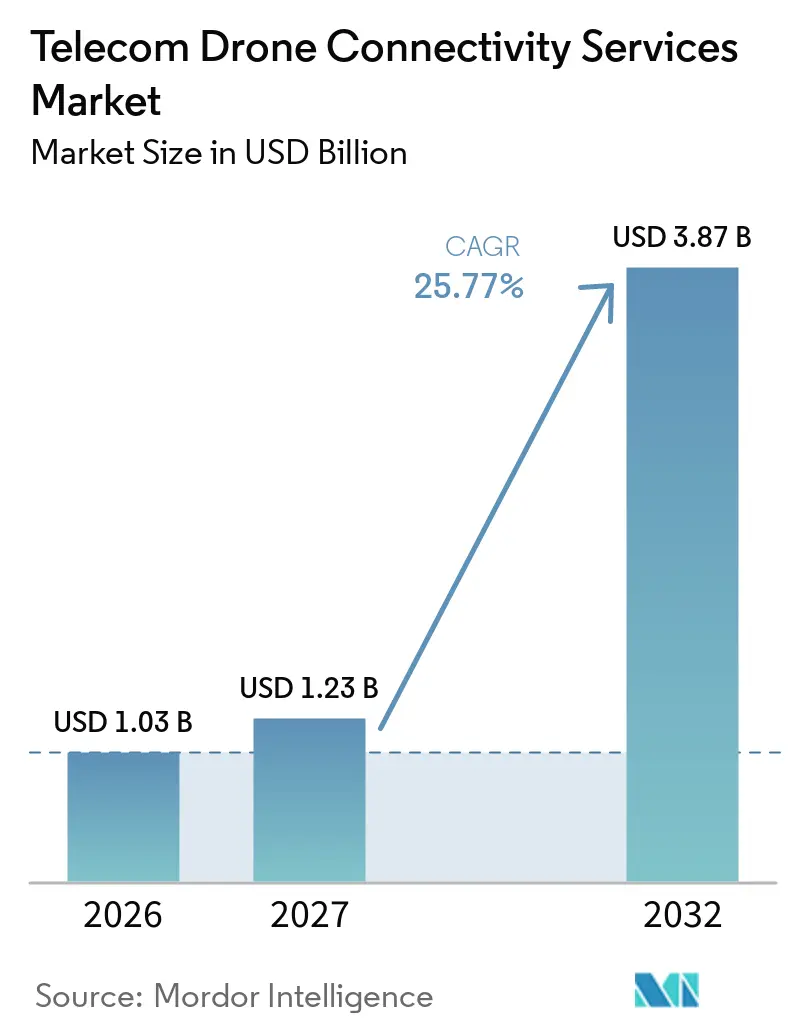
| Market Size (2027) | USD 1.23 Billion |
| Market Size (2032) | USD 3.87 Billion |
| Growth Rate (2027 - 2032) | 25.77 % |
| Fastest Growing Market | Asia-Pacific |
| Largest Market | North America |
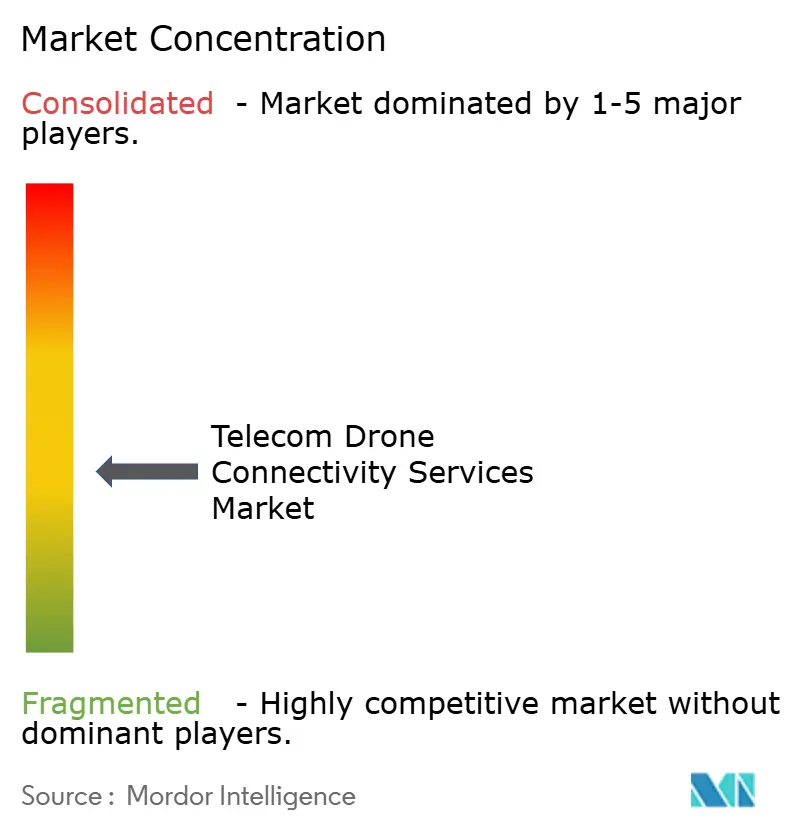
| Market Concentration | Medium |
Major Players *Disclaimer: Major Players sorted in no particular order Image © Mordor Intelligence. Reuse requires attribution under CC BY 4.0. | |
Telecom Drone Connectivity Services Market Analysis by Mordor Intelligence
The Telecom Drone Connectivity Services Market size is projected to expand from USD 1.03 billion in 2026 and USD 1.23 billion in 2027 to USD 3.87 billion by 2032, registering a CAGR of 25.77% between 2027 and 2032. The expansion reflects wider acceptance of beyond-visual-line-of-sight (BVLOS) operations and telecom operators’ efforts to commercialize 5G network slicing and private wireless assets. Demand is supported by inspection work, where drones can improve worker safety and reduce the cost of checking towers, pipelines, and power grids. Operators are also moving beyond basic connectivity by packaging edge computing, video analytics, flight operations, and connectivity into one service. The telecom drone connectivity services market is increasingly reliant on reliable command-and-control links as missions become longer and more autonomous. Different national BVLOS rules remain a constraint, as they increase compliance workload and limit cross-border fleet deployment.
Key Report Takeaways
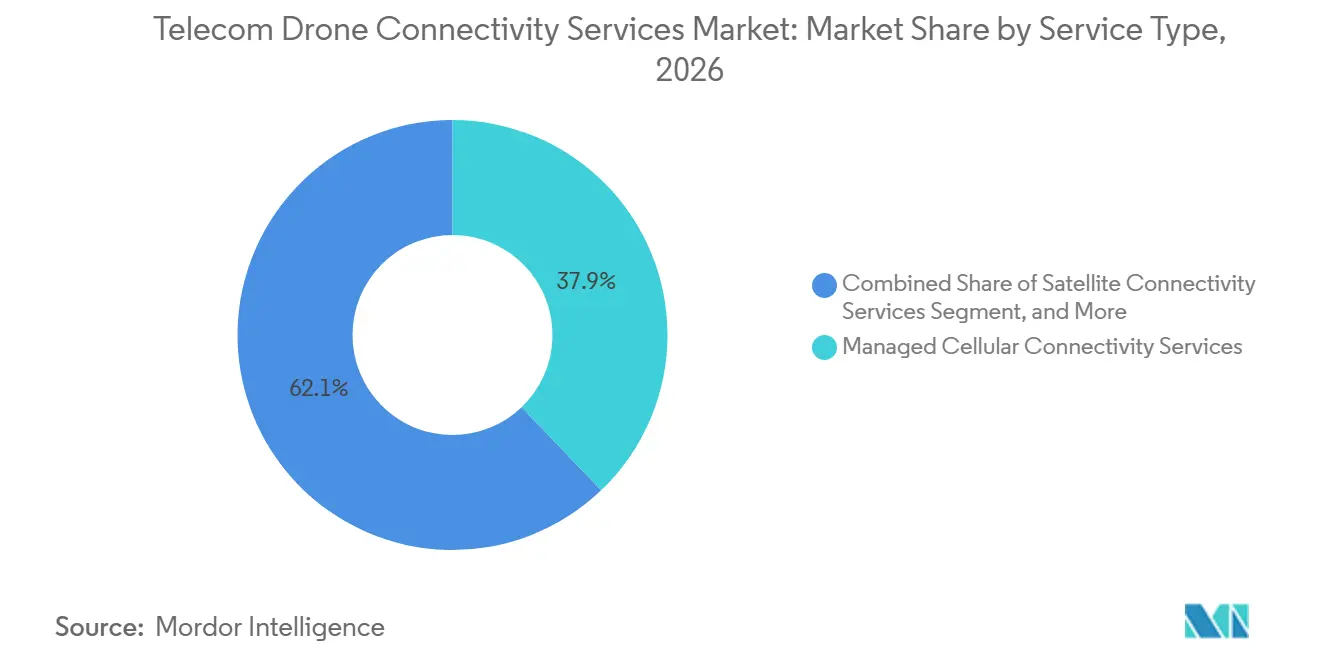
- By service type, managed cellular connectivity services held 37.85% of the telecom drone connectivity services market share in 2026, while the hybrid multi-link connectivity services segment is projected to expand at a 27.54% CAGR through 2032.
- By operational range, visual line-of-sight operations accounted for 43.65% of the telecom drone connectivity services market share in 2026, while beyond visual line-of-sight operations are projected to expand at a 27.68% CAGR through 2032.
- By data function, payload data and video transmission held 38.75% of the telecom drone connectivity services market share in 2026, while the remote identification and authentication is projected to expand at a 27.35% CAGR through 2032.
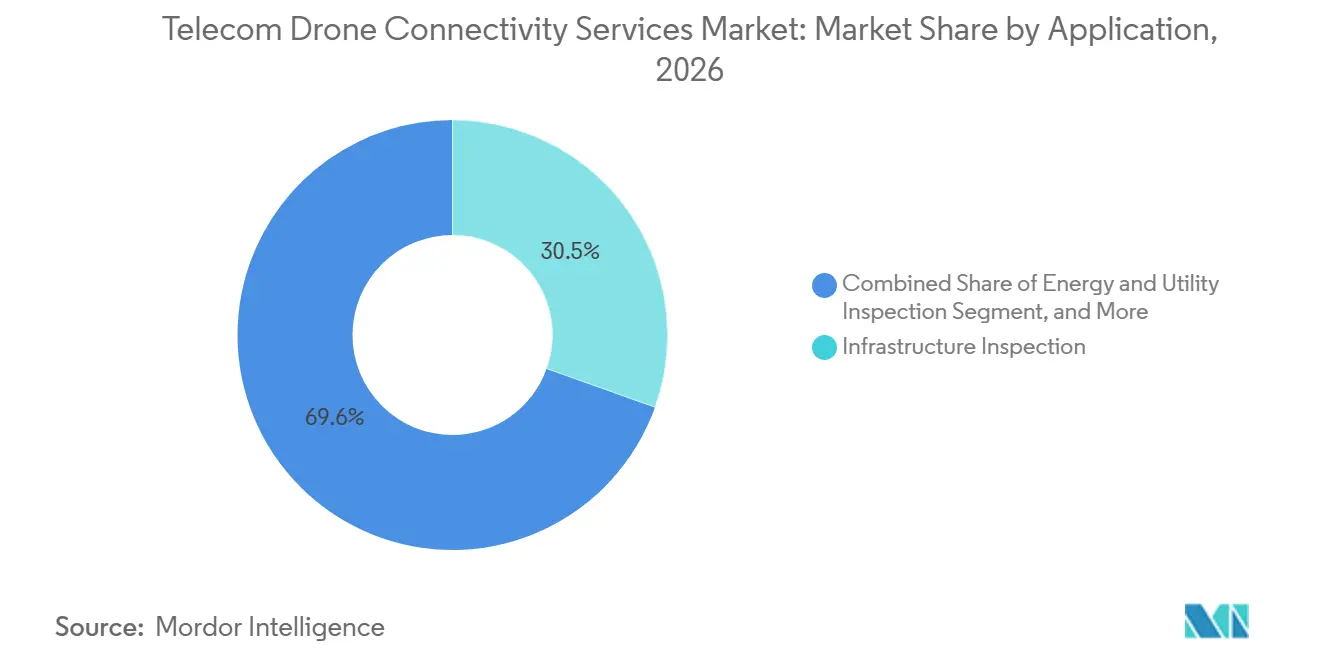
- By application, infrastructure inspection accounted for 30.45% of the telecom drone connectivity services market share in 2026, while telecom network inspection and restoration is projected to expand at a 27.46% CAGR through 2032.
- By end-user, drone operators and UAS service suppliers accounted for 33.25% of the telecom drone connectivity services market share in 2026, while mobile network operators are projected to expand at a 27.12% CAGR through 2032.
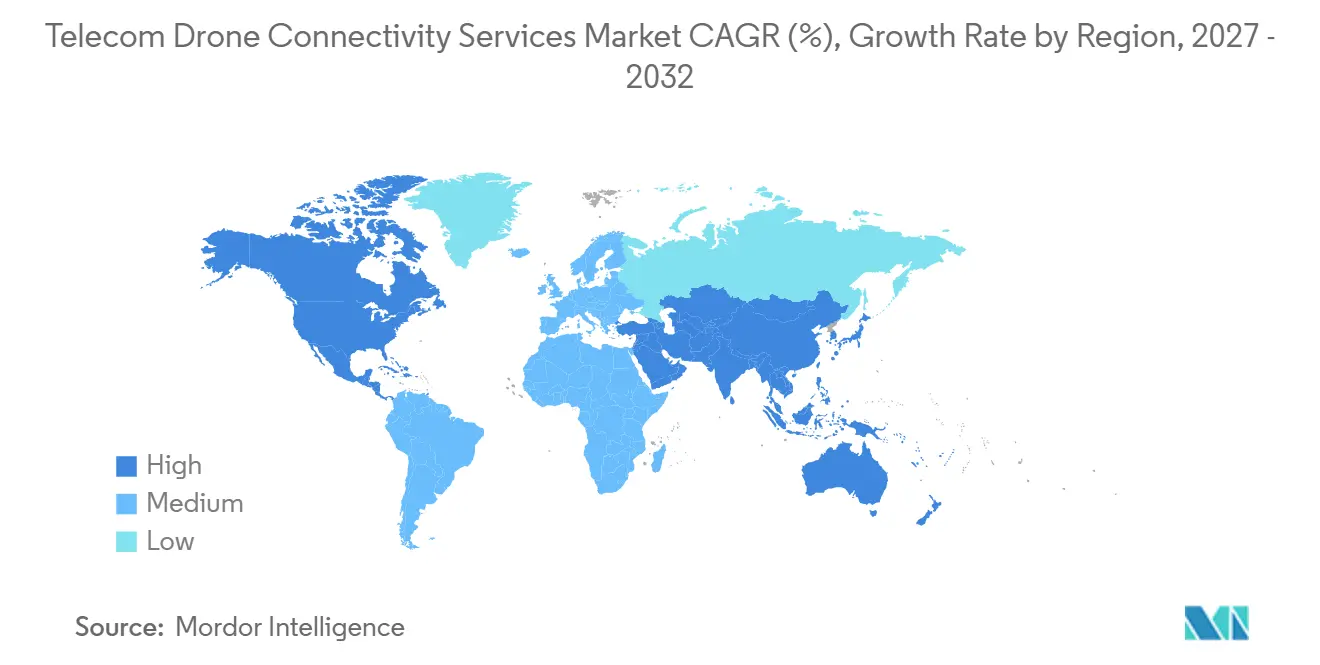
- By geography, North America held 35.65% of the telecom drone connectivity services market share in 2026, while Asia-Pacific is projected to expand at a 27.62% CAGR through 2032.
Note: Market numbers in this report are based on Mordor Intelligence's proprietary estimation framework, which combines nine months of actuals with Q4 projections for base year 2026.
Market Trends and Insights
Drivers Impact Analysis of Telecom Drone Connectivity Services Market*
| Driver | (~) % Impact on CAGR Forecast | Geographic Relevance | Impact Timeline |
|---|---|---|---|
| Expansion of BVLOS Regulatory Pathways | +4.5% | Global, with early-mover gains in North America and Europe | Short term (≤ 2 years) |
| Demand for Reliable Command-and-Control Connectivity | +3.8% | Global | Short term (≤ 2 years) |
| Growth of Autonomous and Multi-Drone Operations | +3.2% | Asia-Pacific core, with spillover to North America and Europe | Medium term (2-4 years) |
| Rising Payload Data and Real-Time Video Requirements | +2.9% | Global | Short term (≤ 2 years) |
| 5G Network Exposure and Private Network Monetization | +2.4% | North America, Europe, and Asia-Pacific | Medium term (2-4 years) |
| Telecom Infrastructure Inspection and Network Resilience Requirements | +1.8% | Global, with strength in North America, Middle East, and Africa | Medium term (2-4 years) |
| Source: Mordor Intelligence | |||
Expansion of BVLOS Regulatory Pathways
BVLOS rules can turn limited trials into regular commercial services with clearer operating requirements. In August 2025, the Federal Aviation Administration and Transportation Security Administration published a proposed Part 108 framework for routine BVLOS operations. The proposed framework would replace much of the case-by-case waiver approach with performance-based requirements. Persistent and assured command-and-control links would become central to routine BVLOS missions under the proposed approach. This requirement provides connectivity providers with a clearer path to recurring service revenue as approved operations expand. The telecom drone connectivity services market benefits when regulatory approvals cover wider operating areas rather than isolated projects.
Demand for Reliable Command-and-Control Connectivity
Command-and-control connectivity is essential because pilots must retain a dependable connection throughout a flight. A link failure can interrupt a mission and cause the aircraft to return home automatically. This requirement applies regardless of the payload, customer sector, or mission revenue. Providers, therefore, need to design services around low latency and continuity, rather than only data capacity. Multi-link platforms are increasingly relevant because they can combine cellular, satellite, and radio links when a single network is insufficient. Elsight reported more than 500,000 operational hours across more than 100 customers for its Halo platform in September 2026.
Growth of Autonomous and Multi-Drone Operations
Autonomous fleets increase demand for connectivity because each aircraft requires its own command link, telemetry stream, and payload connection. Concurrent flights can also require network resources across several coverage cells. Nokia described network application programming interfaces that allow flight planning around congestion and service conditions.[1] This capability is useful where several drones operate within the same area at the same time. The U.S. Defense Innovation Unit selected Elsight for Phase 3 of Project G.I. in November 2025, following testing of multi-drone connectivity in contested settings. Telecom providers can differentiate through pooled spectrum allocation and service quality commitments for fleet customers.
Rising Payload Data and Real-Time Video Requirements
High-resolution video, thermal imaging, and LiDAR data make connectivity more valuable for inspection and emergency missions. These data streams can support rapid analysis through artificial intelligence tools located near the network edge. Verizon used drone-captured imagery in its 2026 digital twin program to identify cell-site damage before crews reached affected locations.[2] Vodafone, Frequentis, DLR, and the Rostock Fire Brigade reported that live drone video reduced emergency response planning from more than 9 minutes to 2 minutes during ADELE testing.[3] These uses need sustained uplink capacity that standard legacy plans may not provide. The telecom drone connectivity services market, therefore, has a stronger case for 5G standalone networks and network slicing.
Restraints Impact Analysis of Telecom Drone Connectivity Services Market*
| Restraint | (~) % Impact on CAGR Forecast | Geographic Relevance | Impact Timeline |
|---|---|---|---|
| Fragmented BVLOS Authorization and Airspace Rules | -3.2% | Global, most acute in Europe and Asia-Pacific | Short term (≤ 2 years) |
| Aerial Coverage Interference and Handover Reliability | -2.5% | Global, most pronounced in dense urban areas | Medium term (2-4 years) |
| High Cost of Certified Redundant Connectivity | -2.1% | Global, most acute in emerging markets | Medium term (2-4 years) |
| Cybersecurity Exposure Across Multi-Network Links | -1.5% | Global | Long term (≥ 4 years) |
| Source: Mordor Intelligence | |||
Fragmented BVLOS Authorization and Airspace Rules
BVLOS requirements differ across jurisdictions, which can slow the rollout of fleet services across several countries. A provider may need separate radio certification, airspace interfaces, and unmanned traffic management integrations in each location. EASA issued Opinion No. 06/2026 in September 2026 as part of its ongoing work on unmanned aircraft security rules. Many European authorizations remain project-specific rather than operator-wide. National rules in the Asia-Pacific also vary, from strict operating limits to controlled pilot programs. The telecom drone connectivity services market incurs higher compliance costs when a service cannot use a single operating model across jurisdictions.
Aerial Coverage Interference and Handover Reliability
Cellular networks were primarily designed for users at ground level rather than aircraft at 100-400 feet. Drones may receive signals from several base stations simultaneously, which can increase interference and increase handover failures. The problem is particularly important in dense urban areas where network usage is high. Providers may need dual-modem systems or other redundant designs to retain a stable connection at cell edges. Such measures improve mission reliability but can raise equipment and service costs. They also make providers cautious about service commitments in locations with the highest concentration of potential customers.
*Our forecasts treat driver/restraint impacts as directional, not additive. The impact forecasts reflect baseline growth, mix effects, and variable interactions.
Telecom Drone Connectivity Services Market Segment Analysis
By Service Type:
Managed Cellular Services Lead While Multi-Link Options AccelerateManaged Cellular Connectivity Services accounted for 37.85% of the telecom drone connectivity services market in 2026. Carrier-managed SIM provisioning, integrated billing, and nationwide coverage can reduce deployment work for enterprise fleets. These services can also offer priority access for command-and-control traffic. Public safety users value this approach because it enables fast deployment across a wide operating area. Satellite Connectivity Services remain important for remote, maritime, and other locations without LTE coverage. Viasat launched its VuaLe government UAV portfolio in February 2026 with services for public safety, emergency response, and border security.[4] The portfolio included terminals starting at 440 grams for smaller aircraft. Private Wireless and Dedicated Network Services support customers who need controlled coverage, lower latency, or separation from shared public spectrum. Connectivity Analytics and Coverage Assurance Services are also gaining relevance as operators seek visibility into signal quality and congestion before flight.
Hybrid Multi-Link Connectivity Services is projected to expand at a 27.54% CAGR through 2032. The segment reflects the need to maintain connectivity when one network type has limited coverage or becomes unavailable. Elsight’s Halo platform combines cellular, satellite, and radio communications at the packet level. The approach is designed to support uninterrupted handover between communication paths. Galaxy 1 Communications partnered with Viasat in March 2026 to extend Velaris satellite communications for uncrewed aircraft through a distribution model. Hybrid services can support extended-range missions where terrestrial coverage is uneven. The telecom drone connectivity services industry is shifting toward software-managed stacks that add satellite and radio layers to cellular connections as conditions require. This model can improve resilience while retaining cellular connectivity as the primary service layer.

By Operational Range:
Visual Line of Sight Leads While BVLOS Gains PaceVisual Line of Sight operations accounted for 43.65% in 2026, making this the largest operational range segment. This operating mode remains common because it has simpler regulatory requirements and lower connectivity needs. Infrastructure inspection, construction monitoring, and public safety work often take place near the pilot. Standard LTE connectivity is generally adequate for missions within this operating environment. Extended Visual Line of Sight provides an intermediate option where observers help maintain awareness along the route. These flights require stronger connection management than basic visual operations do. They do not always require the full redundant architecture associated with BVLOS missions. The transition from VLOS to BVLOS is usually driven by regulatory thresholds rather than a gradual technical change. Operators need certified connectivity services when direct visual contact with the aircraft is no longer available.
Beyond Visual Line of Sight is projected to expand at a 27.68% CAGR from 2027 to 2032. BVLOS operations create a more demanding service environment because reliable command links are required for the mission to be fully executed. The FAA’s 2025 proposed Part 108 rules provide a clearer regulatory pathway for routine BVLOS operations. Viasat, Gotonomi, and Videosoft Global completed a BVLOS demonstration in October 2025 using satellite connectivity and real-time video streaming. These demonstrations show the role of satellite support when terrestrial networks are unavailable. As authorizations become broader, providers can offer standardized services to larger fleets. Higher deployment volumes may also lower per-flight connectivity costs through purchasing scale. The telecom drone connectivity services market is likely to see its most specialized service requirements emerge from BVLOS operations.
By Data Function:
Payload Transmission Leads While Remote Identification AcceleratesPayload Data and Video Transmission accounted for 38.75% in 2026, the largest data function. High-definition video, thermal imagery, photogrammetry, and LiDAR mapping often justify the investment in a connected drone mission. Inspection teams use these data to assess transmission towers, pipeline routes, and construction sites. Verizon’s digital twin program used high-resolution drone imagery to create baseline models of cell sites. Command and Control is a separate service because a safe pilot response needs low latency. Telemetry and Tracking can tolerate higher latency as long as reliability is maintained. Positioning and Navigation Support is increasingly relevant where satellite navigation signals are weak or unavailable. Other Data Functions include sensor data from aircraft carrying multiple payload types. Providers need different service designs and pricing models for these distinct functions.
Remote Identification and Authentication is projected to expand at a 27.35% CAGR through 2032. Singapore requires broadcast Remote ID for unmanned aircraft above 250 grams beginning December 1, 2025. The requirement covered 17,300 registered aircraft without built-in broadcast Remote ID capability when it was announced. EASA’s September 2026 opinion proposed reducing the European threshold for mandatory registration and direct Remote ID from 250 grams to 100 grams. This proposal could increase the number of drones needing authenticated identity capabilities. IEEE research published in 2026 identified gaps in authentication provisions within current Remote ID standards. Network-layer authentication can address risks that basic broadcast protocols do not fully resolve. The telecom drone connectivity services market has an opportunity to provide verified identity functions alongside transport connectivity.
By Application:
Infrastructure Inspection Leads While Network Restoration AcceleratesInfrastructure Inspection accounted for 30.45% of the market in 2026, making it the largest application. Asset owners use drones to reduce exposure to tower climbs, specialized access equipment, and lengthy inspection windows. The resulting images and sensor data can support predictive maintenance work. e& UAE launched autonomous, artificial-intelligence-powered drone inspections of telecom towers in April 2025. The program operated from a centralized Drones Operations Center with support from national authorities. Energy and Utility Inspection, Oil and Gas Monitoring, and Mining and Industrial Monitoring share similar needs for safe and frequent asset assessment. A common connectivity layer across these applications can reduce complexity for operators serving several sectors. The telecom drone connectivity services market is supported when customers use a single platform for various inspection tasks. This approach can also make recurring drone service contracts easier to manage.
Telecom Network Inspection and Restoration is projected to expand at a 27.46% CAGR from 2027 to 2032. The application is important because operators need to restore damaged sites quickly after severe weather or other disruptions. Verizon’s 2026 system used drone images and artificial intelligence to identify damage before crews reached cell sites. This process can help engineering teams prepare equipment and repair sequences earlier. Telia introduced the Nordlänk RSQ in Sweden in June 2025 to support communications, network maintenance, and situational awareness during major outages. Drone deployment is part of the vehicle’s operating model. The use case strengthens demand for resilient links that continue working in damaged or remote areas. It also shifts purchasing toward services that are valued for restoration outcomes rather than data consumption alone.
By End-User:
Drone Operators Lead While MNOs Reshape DemandDrone Operators and UAS Service Suppliers accounted for 33.25% in 2026, representing the largest end-user group. These providers operate contracted fleets for asset owners and need scalable connectivity agreements across several customer sites. Their recurring fleet contracts can support predictable subscription revenue for connectivity service providers. Defense and Homeland Security users place especially high requirements on reliability, cybersecurity, and supply-chain compliance. Elsight’s Halo platform was added to the U.S. Government’s DCMA Blue UAS List in April 2026. Government and Public Safety Agencies also require priority connectivity for emergency missions. Energy and Utilities, Construction, Mining, and Industrial Enterprises are significant non-telecom customer groups. Carrier-managed services can differentiate themselves by providing access arrangements tailored to these operational needs.
Mobile Network Operators are projected to expand at a 27.12% CAGR through 2032. MNOs are moving from infrastructure providers to direct drone service operators in some markets. This shift can combine network access, operational support, and analytics under a single commercial offer. Energy and utilities, construction, mining, and industrial enterprises remain important non-telecom customer groups. These users seek alternatives to manual inspection cycles that are costly or hazardous. The telecom drone connectivity services industry is also moving toward commercial models based on completed inspections or restored network nodes. Such contracts can give customers a clearer link between service costs and operating outcomes.
Geography Analysis
North America Telecom Drone Connectivity Services Market
North America held 35.65% in 2026, giving it the largest regional share. The region has developed commercial drone rules, extensive 5G coverage, and substantial demand for telecom infrastructure inspection. The United States is the main revenue contributor. The FAA’s proposed BVLOS rules, published in August 2025, set out a performance-based approach for routine operations. AT&T, T-Mobile, and Verizon announced an agreement in principle in 2026 to create a joint venture focused on reducing wireless dead zones through direct-to-device satellite connectivity. Wider satellite coverage may extend managed drone services into areas without conventional cellular access. Canada has a regulatory framework that broadly aligns with FAA structures. Mexico is expanding drone use for energy-sector inspections linked to hydrocarbon infrastructure monitoring.
APAC Telecom Drone Connectivity Services Market
Asia-Pacific is projected to expand at a 27.62% CAGR from 2027 to 2032. China’s large 5G investments, manufacturing base, and demand for infrastructure monitoring support regional activity. China Mobile and China Telecom are investing in drone-connected services for agriculture, energy grid inspection, and logistics. Japan and South Korea are advancing private 5G projects for industrial drone inspection with government support. Singapore’s Remote ID requirement created a need for a connectivity module upgrade across registered aircraft. Australia is also broadening BVLOS waiver programs for mining and agricultural fleets.
EMEA and South America Telecom Drone Connectivity Services Market
Europe accounted for a significant share of the telecom drone connectivity services market in 2026, led by the United Kingdom, Germany, and France. Vodafone’s ADELE work in Germany showed how 5G-connected drones can support emergency service planning. The Middle East is an emerging area for autonomous network-connected drone programs. e& UAE’s tower inspection program illustrates the region’s support for deployments that involve national regulators. Africa remains the smallest regional market, although telecom operators are formalizing inspection programs. South America is at an earlier stage of adoption. Brazil and Argentina represent the region’s largest near-term opportunities in energy and agricultural inspection.
Competitive Landscape
The telecom drone connectivity services market is moderately fragmented. Large telecom operators provide managed cellular connectivity at scale, while specialist platform providers focus on multi-link services for demanding BVLOS missions. AT&T, Verizon, T-Mobile, Deutsche Telekom, Telefonica, Vodafone, and China Mobile can draw on network assets and enterprise sales channels. Elsight and Viasat compete through specialized systems designed for mission-critical operations. Competition increasingly centers on integrating connectivity, airspace interfaces, edge computing, and operational services. Nokia received an EASA Design Verification Report for its LTE/5G Drone System in 2025. The report supports enhanced containment under the M2 high-risk mitigation standard. Compliance capabilities may help providers compete for enterprise and public-sector work.
Private wireless networks for remote industrial sites are a significant open area for the telecom drone connectivity services market. Hybrid platforms that combine cellular and satellite links are another important area. AeroVironment and Elsight partnered in October 2026 to integrate Halo into the Mayhem 10 launched effects system. The system combined satellite, private and public cellular, and point-to-point radio connections. Viasat, TTP, Frequentis, and Dimetor conducted a BVLOS connectivity demonstration under the European Space Agency Iris program in May 2026. These initiatives show that live operational demonstrations are becoming a means of proving airspace-compliant connectivity. Iridium’s L-band network remains relevant for maritime, polar, and deep-inland operations where cellular coverage is limited. This geographic reach gives satellite providers an enduring role in the service mix.
Viasat’s February 2026 VuaLe launch shows a strategy focused on segmented satellite services for government UAV missions. Elsight’s U.S. Army Marketplace listing illustrates the value of procurement eligibility in defense-oriented connectivity. These moves suggest that technical capability alone may not determine competitive success. Providers also need regulatory alignment, access to procurement, and commercial offerings that fit specific mission types.
Telecom Drone Connectivity Services Industry Leaders
-
AT&T Inc.
-
BT Group plc
-
Deutsche Telekom AG
-
Telefonica, S.A.
-
Vodafone Group Plc
- *Disclaimer: Major Players sorted in no particular order
Telecom Drone Connectivity Services Market Companies Covered in this Report
- AT&T Inc.
- BT Group plc
- Deutsche Telekom AG
- Telefonica, S.A.
- Vodafone Group Plc
- Orange S.A.
- Verizon Communications Inc.
- T-Mobile US, Inc.
- China Mobile Limited
- China Telecom Corporation Limited
- NTT DOCOMO, INC.
- Telia Company AB
- Nokia Corporation
- Viasat, Inc.
- Iridium Communications Inc.
- Elsight Limited
- Dimetor d.o.o.
Recent Industry Developments in Telecom Drone Connectivity Services Market
- October 2026: AeroVironment and Elsight announced a partnership to integrate Elsight's Halo multi-link connectivity technology into AV's Mayhem 10 launched effects system, bonding satellite, private and public cellular, and point-to-point radio into a single resilient connection. This convergence of defense-grade drone platforms with commercial multi-link connectivity architectures signals a shift toward dual-use connectivity stacks in the BVLOS drone market.
- October 2026: Elsight launched a precise positioning solution for uncrewed systems in GNSS-denied environments at AUSA 2026, expanding its connectivity platform into navigation assurance for mission-critical drone operations in electronic warfare environments, directly addressing a capability gap in the Blue UAS supply chain.
- September 2026: Elsight's Halo technology secured an official listing on the U.S. Army's UAS Marketplace following a Basic Ordering Agreement and prior DCMA Blue UAS List certification, enabling fast-tracked procurement for the U.S. Army, other branches of the U.S. Armed Forces, and partner nations, positioning multi-link BVLOS connectivity for defense-scale commercialization.
- May 2026: Verizon unveiled its digital twin technology for network restoration, leveraging drone-captured 3D imagery and AI to automatically identify storm damage at cell sites before field crews can physically access affected areas. Expanded ahead of the 2026 hurricane season, the program directly links telecom drone connectivity services to network resilience operations at carrier scale.
Global Telecom Drone Connectivity Services Market Report Scope
The Telecom Drone Connectivity Services Market Report is Segmented by Service Type (Managed Cellular Connectivity Services, Satellite Connectivity Services, Hybrid Multi-Link Connectivity Services, Private Wireless and Dedicated Network Services, Connectivity Analytics and Coverage Assurance Services, and Other Services), Operational Range (Visual Line of Sight, Extended Visual Line of Sight, and Beyond Visual Line of Sight), Data Function (Command and Control, Telemetry and Tracking, Payload Data and Video Transmission, Remote Identification and Authentication, Positioning and Navigation Support, and Other Data Functions), Application (Infrastructure Inspection, Telecom Network Inspection and Restoration, Energy and Utility Inspection, Oil and Gas Monitoring, Mining and Industrial Monitoring, and Other Applications), End-User (Mobile Network Operators, Drone Operators and UAS Service Suppliers, Defense and Homeland Security, Government and Public Safety Agencies, Energy and Utilities, Construction, Mining, and Industrial Enterprises, and Other End-Users), and Geography (North America, South America, Europe, Asia-Pacific, Middle East, and Africa). The Market Forecasts are Provided in Terms of Value (USD).
Segmentation Overview
| Managed Cellular Connectivity Services |
| Satellite Connectivity Services |
| Hybrid Multi-Link Connectivity Services |
| Private Wireless and Dedicated Network Services |
| Connectivity Analytics and Coverage Assurance Services |
| Other Services |
| Visual Line of Sight |
| Extended Visual Line of Sight |
| Beyond Visual Line of Sight |
| Command and Control |
| Telemetry and Tracking |
| Payload Data and Video Transmission |
| Remote Identification and Authentication |
| Positioning and Navigation Support |
| Other Data Functions |
| Infrastructure Inspection |
| Telecom Network Inspection and Restoration |
| Energy and Utility Inspection |
| Oil and Gas Monitoring |
| Mining and Industrial Monitoring |
| Other Applications |
| Mobile Network Operators |
| Drone Operators and UAS Service Suppliers |
| Defense and Homeland Security |
| Government and Public Safety Agencies |
| Energy and Utilities |
| Construction, Mining, and Industrial Enterprises |
| Other End-Users |
| North America | United States |
| Canada | |
| Mexico | |
| South America | Brazil |
| Argentina | |
| Rest of South America | |
| Europe | United Kingdom |
| Germany | |
| France | |
| Spain | |
| Italy | |
| Russia | |
| Rest of Europe | |
| Asia-Pacific | China |
| Japan | |
| India | |
| South Korea | |
| Australia | |
| Rest of Asia-Pacific | |
| Middle East | United Arab Emirates |
| Saudi Arabia | |
| Rest of Middle East | |
| Africa | South Africa |
| Nigeria | |
| Rest of Africa |
| By Service Type | Managed Cellular Connectivity Services | |
| Satellite Connectivity Services | ||
| Hybrid Multi-Link Connectivity Services | ||
| Private Wireless and Dedicated Network Services | ||
| Connectivity Analytics and Coverage Assurance Services | ||
| Other Services | ||
| By Operational Range | Visual Line of Sight | |
| Extended Visual Line of Sight | ||
| Beyond Visual Line of Sight | ||
| By Data Function | Command and Control | |
| Telemetry and Tracking | ||
| Payload Data and Video Transmission | ||
| Remote Identification and Authentication | ||
| Positioning and Navigation Support | ||
| Other Data Functions | ||
| By Application | Infrastructure Inspection | |
| Telecom Network Inspection and Restoration | ||
| Energy and Utility Inspection | ||
| Oil and Gas Monitoring | ||
| Mining and Industrial Monitoring | ||
| Other Applications | ||
| By End-User | Mobile Network Operators | |
| Drone Operators and UAS Service Suppliers | ||
| Defense and Homeland Security | ||
| Government and Public Safety Agencies | ||
| Energy and Utilities | ||
| Construction, Mining, and Industrial Enterprises | ||
| Other End-Users | ||
| By Geography | North America | United States |
| Canada | ||
| Mexico | ||
| South America | Brazil | |
| Argentina | ||
| Rest of South America | ||
| Europe | United Kingdom | |
| Germany | ||
| France | ||
| Spain | ||
| Italy | ||
| Russia | ||
| Rest of Europe | ||
| Asia-Pacific | China | |
| Japan | ||
| India | ||
| South Korea | ||
| Australia | ||
| Rest of Asia-Pacific | ||
| Middle East | United Arab Emirates | |
| Saudi Arabia | ||
| Rest of Middle East | ||
| Africa | South Africa | |
| Nigeria | ||
| Rest of Africa | ||
Key Questions Answered in the Report
What is the telecom drone connectivity services market size?
The telecom drone connectivity services market size is USD 1.03 billion in 2026 and is projected to reach USD 3.87 billion by 2032 at a 25.77% CAGR.
What is driving demand for telecom drone connectivity services?
Broader BVLOS pathways, reliable command-and-control needs, multi-drone operations, and high-resolution payload data requirements support demand. The telecom drone connectivity services market also benefits when customers adopt drone programs for repeatable inspections and network restoration.
Which service type leads telecom drone connectivity services?
Managed Cellular Connectivity Services leads with 37.85% share in 2026, supported by carrier billing, SIM provisioning, and broad network coverage. The telecom drone connectivity services market uses these established network capabilities to reduce procurement complexity for enterprise fleet operators.
Which operational range is expanding fastest?
Beyond Visual Line of Sight is projected to expand at a 27.68% CAGR through 2032 because it needs certified and resilient connectivity. The telecom drone connectivity services market requires more specialized connection design as flights move beyond direct visual supervision.
Which application has the largest demand?
Infrastructure Inspection leads with 30.45% share in 2026, as asset owners use drones to improve safety and inspection efficiency. The telecom drone connectivity services market supports this work through reliable transmission of video, imagery, and sensor data.
Which region has the largest share?
North America leads with 35.65% share in 2026, while Asia-Pacific is projected to record the highest CAGR of 27.62% through 2032. The telecom drone connectivity services market has distinct regional needs because regulation, coverage, and drone program maturity vary.