
Telecom Autonomous Vehicle Connectivity Services Market Size and Share
Market Overview
| Study Period | 2021 - 2032 |
|---|---|
| Market Size (2027) | USD 7.53 Billion |
| Market Size (2032) | USD 18.47 Billion |
| Growth Rate (2027 - 2032) | 19.66 % |
| Fastest Growing Market | Asia-Pacific |
| Largest Market | Asia-Pacific |
| Market Concentration | Medium |
Major Players *Disclaimer: Major Players sorted in no particular order Image © Mordor Intelligence. Reuse requires attribution under CC BY 4.0. | |
Telecom Autonomous Vehicle Connectivity Services Market Analysis by Mordor Intelligence
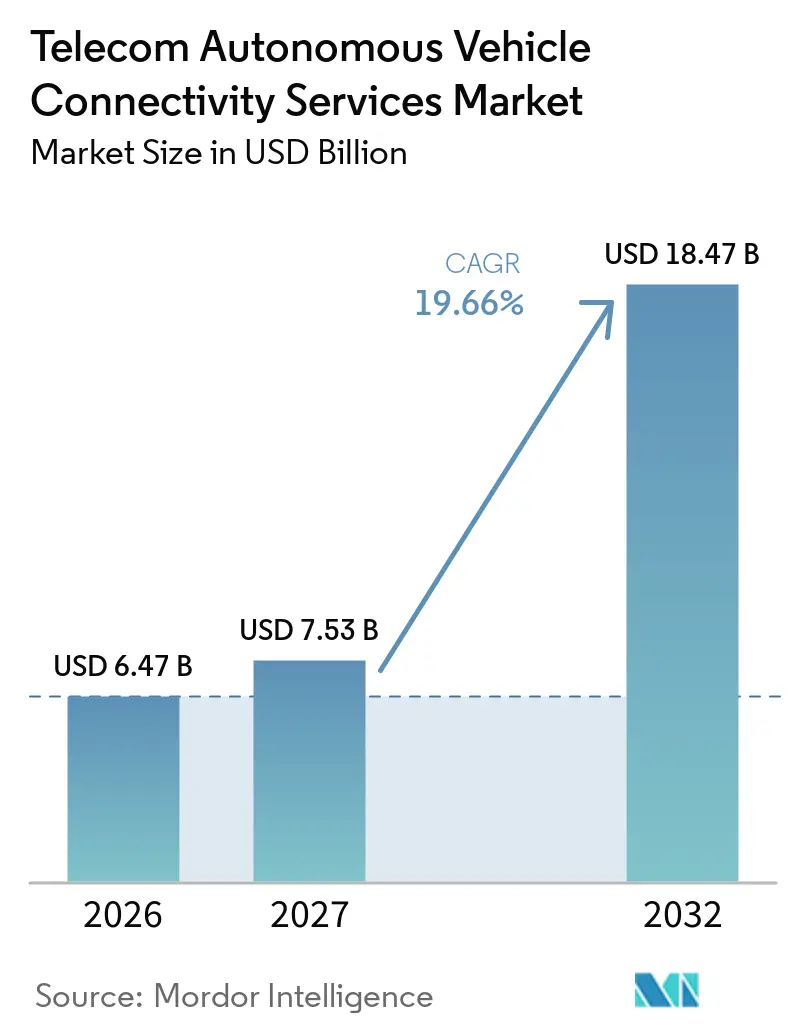
The Telecom Autonomous Vehicle Connectivity Services Market size is projected to expand from USD 6.47 billion in 2026 and USD 7.53 billion in 2027 to USD 18.47 billion by 2032, registering a CAGR of 19.66% between 2027 to 2032. The telecom autonomous vehicle connectivity services market is moving beyond basic in-car data services as vehicle makers, mobile operators, and public agencies develop connectivity that supports safety, remote assistance, and software updates. Commercial 5G standalone networks make it easier to offer dedicated network performance for automated driving, while C-V2X deployments connect vehicles with roads, other vehicles, and pedestrians. The telecom autonomous vehicle connectivity services market also benefits when vehicle software becomes more centralized, as this can bring data, safety, and update services under fewer connectivity agreements. Public investment and safety programs can speed adoption, although the cost of roadside equipment and fiber backhaul can delay deployment outside well-funded corridors. Providers that combine cellular coverage, edge computing, cybersecurity controls, and automotive partnerships are better placed to serve higher-value autonomous operations.
Key Report Takeaways
- By geography, Asia-Pacific held 29.87% revenue share in 2026 and is projected to expand at a 20.43% CAGR through 2032 in the telecom autonomous vehicle connectivity services marketsaging services are projected to expand at a 20.13% CAGR through 2032.
- By connectivity technology, 4G/LTE and LTE-M held 51.12% revenue share in 2026, while 5G is projected to expand at a 21.56% CAGR through 2032.
- By communication mode, V2V held 32.98% revenue share in 2026, while vehicle-to-pedestrian and vulnerable road user connectivity is projected to expand at a 20.66% CAGR through 2032.
- By end user, automotive OEMs held a 33.12% revenue share in 2026, while autonomous mobility operators are projected to expand at a 21.76% CAGR through 2032.
- By geography, Asia-Pacific held 29.87% revenue share in 2026 and is projected to expand at a 20.43% CAGR through 2032 in the telecom autonomous vehicle connectivity services market.
Note: Market numbers in this report are based on Mordor Intelligence's proprietary estimation framework, which combines nine months of actuals with Q4 projections for base year 2026.
Market Trends and Insights
Drivers Impact Analysis of Telecom Autonomous Vehicle Connectivity Services Market*
| DRIVER | (~) % IMPACT ON CAGR FORECAST | GEOGRAPHIC RELEVANCE | IMPACT TIMELINE |
|---|---|---|---|
| Accelerating 5G and C-V2X Rollouts for Automated Driving | +4.50% | Global, with early gains in China, the United States, Germany, and South Korea | Short term (≤ 2 years) |
| Government-Led V2X Safety and Smart-Mobility Deployment | +3.70% | Asia-Pacific core, North America, and the European Union | Medium term (2-4 years) |
| OEM Migration to Software-Defined and Connected Vehicle Architectures | +3.00% | Global, led by North America, Germany, South Korea, and China | Medium term (2-4 years) |
| Teleoperation and Remote-Assistance Connectivity Requirements | +2.50% | Japan, the United States, Germany, and South Korea | Medium term (2-4 years) |
| Network APIs, Quality on Demand, and Cross-Border Service Orchestration | +2.00% | European Union core, with spillover to North America and Asia-Pacific | Long term (≥ 4 years) |
| High-Volume Uplink Demand from Cooperative Perception and HD Mapping | +1.60% | Global, with early gains in China, the United States, and the European Union | Long term (≥ 4 years) |
| Source: Mordor Intelligence | |||
Accelerating 5G and C-V2X Rollouts for Automated Driving
The commercial expansion of 5G standalone networks supports more demanding automated-driving services than earlier 4G telematics. Standalone architecture can support network slicing, ultra-reliable low-latency communication, and quality-on-demand APIs that help operators define network performance for a vehicle service. Atlanta became the United States’ first Day One Deployment District for C-V2X at ITS World Congress 2025, showing that permanent deployment can move beyond pilots into an operating urban district.[1] China approved 2 industry standards for 5G networks that support advanced autonomous driving in 2026, with the standards taking effect on September 1, 2026. Germany’s 5G coverage reached 95.3% of the national territory by mid-2025, providing a broad radio foundation for connected-vehicle services. In the telecom autonomous-vehicle connectivity services market, programmable network capacity enables operators to sell managed services with defined performance commitments rather than only data plans.
Government-Led V2X Safety and Smart-Mobility Deployment
Government action creates a demand signal that private incentives alone may not provide at the scale needed for road infrastructure. India’s Telecom Regulatory Authority issued Consultation Paper No. 08/2026 in April 2026 on the regulatory framework for V2X communication, including a proposed 50 MHz spectrum block in the 5,875-5,925 MHz band.[2] Japan’s Ministry of Internal Affairs and Communications published its Communication Infrastructure Strategy to Support Autonomous Driving Society in July 2026, directing operators to upgrade to 5G standalone networks to meet Level 4 remote-monitoring requirements starting in fiscal year 2027. The U.S. Department of Transportation has also established a National V2X Deployment Plan that supports coordinated deployment activity across public agencies. These programs make the telecom autonomous vehicle connectivity services market more dependent on spectrum policy, procurement schedules, and common technical rules. They can also provide the vehicle volume that draws chip suppliers and network providers into markets that previously had limited deployment activity.
OEM Migration to Software-Defined and Connected Vehicle Architectures
Vehicle makers are shifting from many separate electronic control units toward centralized computing and zone-based systems. This change can bring consumer data services, over-the-air updates, and safety communications into a unified connectivity agreement. General Motors announced a centralized vehicle computing platform in October 2025 that will use NVIDIA Thor processors, beginning with the Cadillac ESCALADE IQ in 2028.[3] Hyundai Motor Group introduced the Pleos software brand and expects Pleos Connect to reach more than 20 million vehicles by 2030.[4] These architectures underscore the importance of reliable embedded connectivity, as a single network relationship may support multiple vehicle functions over a program’s life. The telecom autonomous vehicle connectivity services market, therefore, gains value when OEM platform choices favor integrated data, updates, and safety channels.
Teleoperation and Remote-Assistance Connectivity Requirements
Teleoperation requires continuous remote monitoring, assistance, and in some situations, direct vehicle control. This use case needs more reliable uplink capacity and lower latency than ordinary telematics. ISO 7856:2025 specifies requirements for remotely supervised Level 4 autonomous driving systems, including video bandwidth and latency. NTT Communications, NTT DOCOMO, and May Mobility demonstrated 5G standalone network slicing in Aichi Prefecture in April 2025, sustaining a target uplink throughput of over 96% for the Level 4 route, compared with 73% on conventional connections. A GSMA automotive report published in June 2026 identified the need for sub-200 millisecond end-to-end latency and stronger uplink prioritization in congested areas. The telecom autonomous vehicle connectivity services market can benefit as operators redesign radio access networks and offer service levels that match remote-operation requirements.
Restraints Impact Analysis of Telecom Autonomous Vehicle Connectivity Services Market*
| RESTRAINT | (~) % IMPACT ON CAGR FORECAST | GEOGRAPHIC RELEVANCE | IMPACT TIMELINE |
|---|---|---|---|
| High Cost of Roadside, Backhaul, and Edge Infrastructure | -2.0% | Global, most severe in India, the Middle East, Africa, and South America | Short term (≤ 2 years) |
| Cybersecurity, Privacy, and Functional-Safety Liability Exposure | -1.7% | Global, most acute in the European Union and North America | Medium term (2-4 years) |
| Fragmented Spectrum, Standards, and Cross-Border Interoperability | -1.2% | European Union and North American borders, Asia-Pacific multi-jurisdictional markets | Medium term (2-4 years) |
| Unclear Monetization and Fleet Return on Investment | -0.9% | North America, South America, and Africa | Long term (≥ 4 years) |
| Source: Mordor Intelligence | |||
High Cost of Roadside, Backhaul, and Edge Infrastructure
Dense V2X systems require roadside units, backhaul links, and, in some cases, edge computing near the road. The U.S. Department of Transportation documented roadside-unit hardware costs of USD 3,800-USD 5,100 per unit and installed intersection costs of USD 7,500- USD 15,000 in 2025. The same source reported fiber-backhaul upgrades starting at USD 20,000 per location where part of the infrastructure exists and reaching USD 40,000 or more for new installations. A 2026 evaluation of a 1,700-intersection deployment estimated total costs of USD 25- USD 45 million. The telecom autonomous vehicle connectivity services market may develop unevenly when vehicle-side adoption advances faster than roadside coverage. The constraint is most material in countries that lack equivalent support for public infrastructure investment.
Cybersecurity, Privacy, and Functional-Safety Liability Exposure
Vehicle connectivity expands the number of systems that can affect a vehicle’s operation or availability. A March 2026 attack on a U.S.-based ignition interlock service provider disrupted service for 150,000 connected vehicles and illustrated the effect of an incident at the service layer. The same white paper discussed potential legal exposure exceeding USD 100 million in such an event. UN Regulation No. 155 and ISO/SAE 21434 require ongoing cybersecurity management across the connected-vehicle supply chain. Larger mobile network operators can spread the cost of security systems across several service categories, while smaller platform providers may face higher costs per contract. This difference can concentrate the telecom autonomous-vehicle connectivity services market among providers with established security, compliance, and incident-response capabilities.
*Our forecasts treat driver/restraint impacts as directional, not additive. The impact forecasts reflect baseline growth, mix effects, and variable interactions.
Telecom Autonomous Vehicle Connectivity Services Market Segment Analysis
By Service Type:
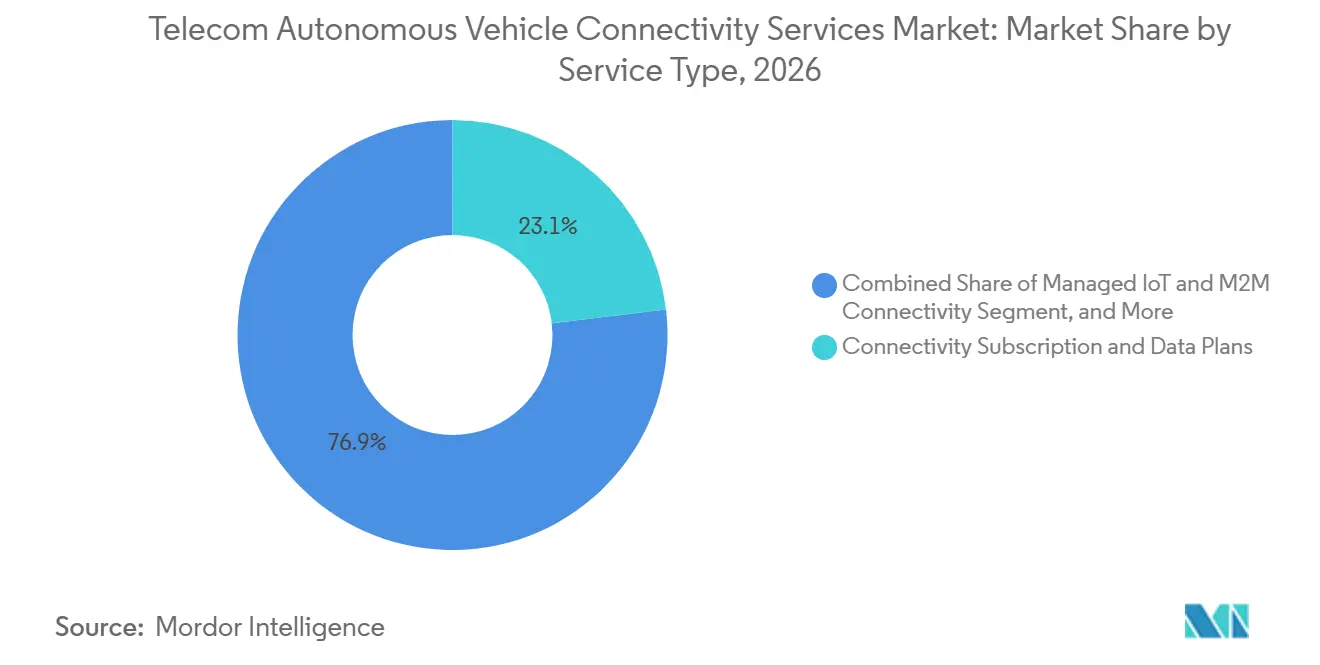
C-V2X and V2N Messaging Support Premium Connectivity ServicesConnectivity subscriptions and data plans are expected to account for 23.11% of the telecom autonomous vehicle connectivity services market share in 2026. They represent the established monetization model for embedded SIM connectivity across OEM vehicle programs. C-V2X and V2N messaging services are projected to expand at a CAGR of 20.13% through 2032. This stronger outlook reflects safety applications that require regular and reliable message exchanges among vehicles, road infrastructure, and networks. The 5G Automotive Association has participation from 10 of the top 15 global automakers and 8 of the top 10 mobile network operators, indicating broad institutional support for C-V2X commercialization. This participation is expected to move messaging services from experimental deployments toward repeatable offerings across vehicle programs.
Network slicing and quality-on-demand services can generate higher revenue per connection by offering assured performance, compared with standard mobile data services. The GSMA noted that autonomous mobility operators seek advanced quality-on-demand APIs with dynamic uplink prioritization. Private 5G and mobile private network services are increasingly supporting controlled logistics and production environments. Deutsche Telekom plans to deploy 5G mobile edge cloud services for Unikie’s automated vehicle-marshaling solution at Volkswagen’s Emden terminal in June 2025. Managed IoT and M2M connectivity, edge connectivity, HD map updates, and positioning enhancements provide additional service opportunities. These services enable the telecom autonomous vehicle connectivity services market to address both vehicle operations and embedded consumer connectivity.

By Connectivity Technology:
5G Gains Relevance While 4G Supports the Installed Base4G/LTE and LTE-M are expected to account for 51.12% of the telecom autonomous vehicle connectivity services market size in 2026. Their position reflects the large installed base of connected vehicles and roadside assets designed around earlier cellular capabilities. 5G is projected to expand at a CAGR of 21.56% through 2032. OEM commitments to 5G standalone networks are driving demand for network slicing to support teleoperation and low-latency C-V2X safety messages. AT&T plans to introduce 5G connectivity for selected 2026 Toyota vehicles, beginning with the RAV4, in October 2025.
Verizon plans to deploy its 5G standalone service for connected BMW Group vehicles in the United States in collaboration with KDDI, based on 3GPP Release 16 standards. Such deployments demonstrate how OEMs can introduce 5G connectivity on a model-by-model basis before standardizing it across their portfolios. The telecom autonomous vehicle connectivity services market will continue to include 2G and 3G assets during their managed decline, particularly in long-life commercial vehicles and transport infrastructure. However, these legacy networks have limited capacity to support advanced safety and remote-operation functions. 3GPP specifications for C-V2X and 5G NR sidelink remain important because they establish a shared technical foundation for cross-vendor interoperability. The transition will depend on OEM production cycles and network retirement schedules.
By Communication Mode:
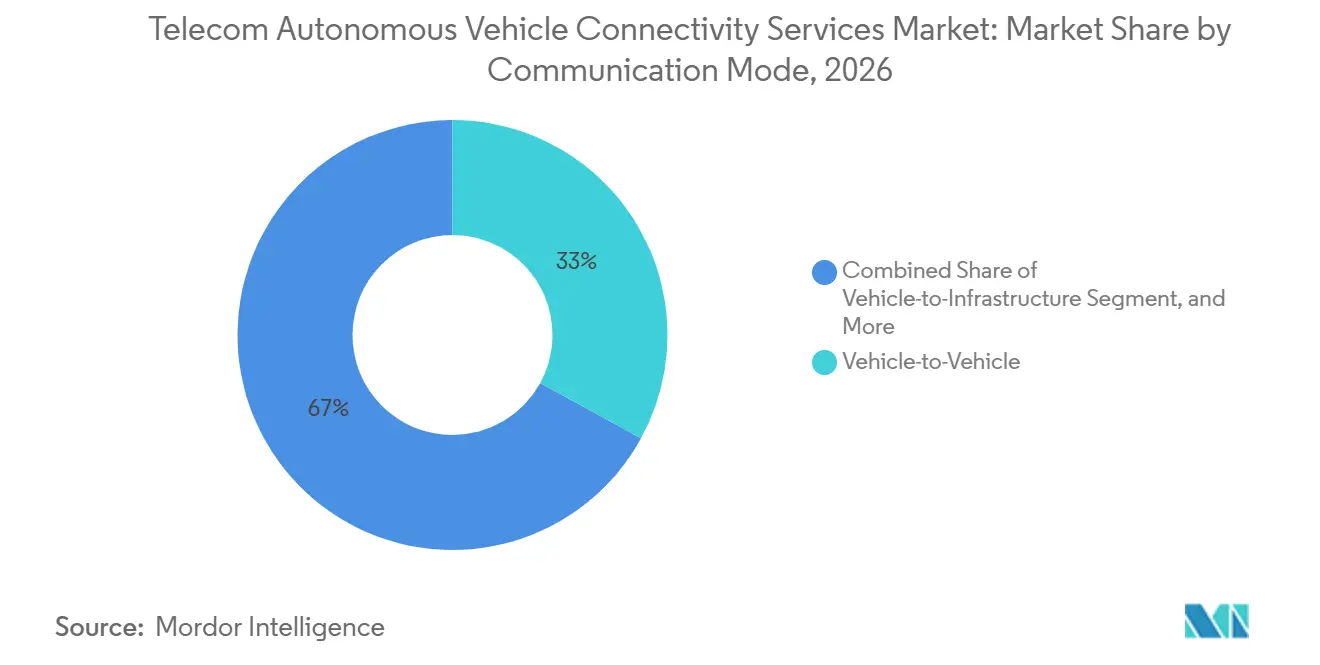
Vehicle-to-Pedestrian Connectivity Gains Safety ImportanceV2V communication is expected to hold 32.98% of the telecom autonomous vehicle connectivity services market share in 2026. It has the most mature deployment history because vehicles can exchange cooperative awareness messages directly. Vehicle-to-pedestrian and vulnerable road user connectivity is projected to expand at a CAGR of 20.66% through 2032. This outlook is linked to safety requirements for pedestrian alerts, emergency braking, and intersection conflict warnings. The 5G Automotive Association plans to demonstrate 5G-V2X Direct protection for vulnerable road users in live urban traffic during its 2025 Paris Meeting Week. A U.S. Department of Transportation pilot in College Station, Texas, is scheduled to conclude in March 2025 and will test C-V2X intersection protection for blind and low-vision pedestrians using equipment from multiple vendors.
V2I communication is also well established at urban intersections and toll corridors, where fixed roadside systems are practical. V2N traffic is expanding through teleoperation, cooperative perception uploads, and other services that require a cellular network connection. ETSI TS 103 324 governs collective perception messages in European deployments and helps define cross-vendor message exchange. Each communication mode has distinct coverage and latency requirements, creating opportunities for multiple managed connectivity offerings. The telecom autonomous vehicle connectivity services market will need to support direct radio communications and network-supported services simultaneously.
By End User:
OEMs Provide Scale and Autonomous Operators Raise Service RequirementsAutomotive OEMs are expected to account for 33.12% of the telecom autonomous vehicle connectivity services market in 2026. Their scale stems from embedded connectivity that supports consumer features, safety channels, vehicle diagnostics, and over-the-air software delivery. Autonomous mobility operators are projected to expand at a CAGR of 21.76% through 2032. Robotaxi and robo-shuttle services rely on network availability as an operational requirement rather than solely as a customer feature. Their requirements for remote supervision, incident response, and continuous data transfer can increase the value of each connection. The transition toward software-defined vehicle platforms also supports longer and more integrated connectivity relationships with OEMs.
Logistics and fleet operators offer a near-term use case because autonomous operations can be introduced in controlled environments. Deutsche Telekom and Unikie plan to scale automated vehicle marshaling from Volkswagen’s Emden AutoLog project using Deutsche Telekom’s 5G mobile edge cloud. KDDI plans to establish KDDI Smart Mobility Co., Ltd. in July 2026 to provide Level 4 transit connectivity in partnership with JR East. Public transit agencies, road authorities, and smart-city operators can generate additional demand for V2I and V2N systems. Their contracts often involve longer planning cycles and public procurement requirements. Together, these users expand the telecom autonomous vehicle connectivity services market beyond passenger-car connectivity.
Geography Analysis
APAC Telecom Autonomous Vehicle Connectivity Services Market
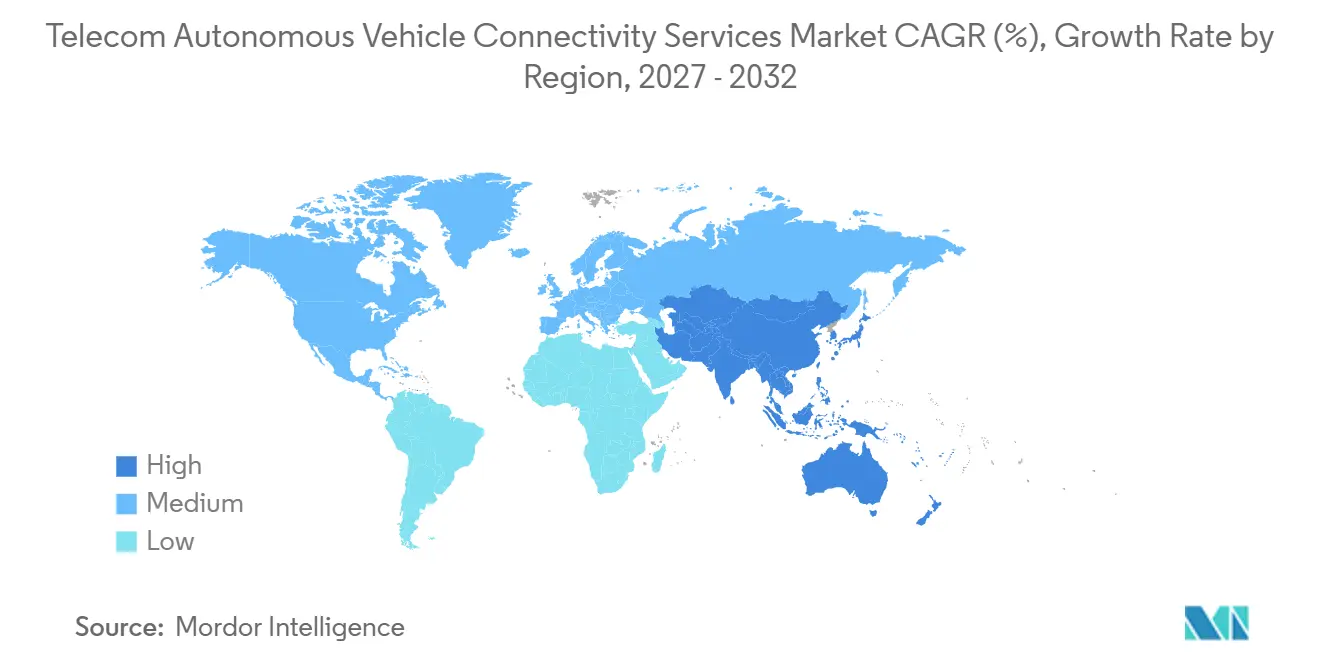
Asia-Pacific accounted for 29.87% of the telecom autonomous vehicle connectivity services market in 2026 and is projected to expand at a CAGR of 20.43% through 2032. China’s vehicle-road-cloud integration program covered 20 pilot cities as part of a joint 2024–2026 initiative involving five national ministries. In November 2025, China Mobile, Dongfeng Automotive, and CICT launched a factory-installed 5G+ C-V2X solution. China’s 15th Five-Year Plan for intelligent connected new-energy vehicles targets 5G penetration in 50% of new vehicles by 2026 and C-V2X direct-communication penetration in 30% of vehicles by 2030. These initiatives provide domestic vehicle manufacturers and operators with clear direction for network and roadside infrastructure investments. The scale of coordinated pilot programs positions Asia-Pacific as a major deployment hub for the telecom autonomous vehicle connectivity services market.
Japan, India and South Korea Telecom Autonomous Vehicle Connectivity Services Market
Japan supports Level 4 connectivity through the NTT, DOCOMO, and May Mobility network-slicing demonstration, as well as its national communications infrastructure strategy. India is evaluating a regulatory framework for V2X spectrum, which could establish a common foundation for future vehicle and roadside deployments. South Korea further supports market growth through Hyundai Motor Group’s investments in software-defined vehicles. Although these countries follow different regulatory models, all require reliable cellular networks and stronger interoperability practices. The pace at which standards, spectrum policies, and vehicle production programs converge will shape the telecom autonomous vehicle connectivity services market in Asia-Pacific.
North America and Europe Telecom Autonomous Vehicle Connectivity Services Market
North America is the second-largest regional market, with the United States accounting for the majority of regional revenue. In June 2025, Verizon Business launched its Edge Transportation Exchange, which uses 5G, LTE, mobile edge computing, and Hyper Precise Location. Volkswagen Group of America, the Arizona Commerce Authority, the Delaware Department of Transportation, and Rutgers University CAIT served as launch customers. AT&T also expanded its 5G vehicle relationships through Toyota and collaborated with DENSO on a road-safety application. Europe benefits from a robust regulatory environment and extensive 5G coverage, with Germany leading at 95.3% national coverage by mid-2025. Deutsche Telekom is collaborating with Unikie on logistics and with other partners on cross-border connectivity, strengthening the region’s practical foundation for the telecom autonomous-vehicle connectivity services market.
Competitive Landscape
The telecom autonomous vehicle connectivity services market includes mobile network operators, telecommunications infrastructure providers, chipset companies, and automotive technology specialists. Verizon Communications Inc., AT&T Inc., China Mobile Limited, Deutsche Telekom AG, and Vodafone Group Plc are among the operators with sufficient network scale to support multiple vehicle programs. No single company provides every layer of the ecosystem, from V2X chips to managed connectivity services. As a result, competitive strength depends on the ability to integrate network access, edge computing, cybersecurity, and automotive-grade service-level commitments. This market structure encourages partnerships among operators, vehicle manufacturers, cloud providers, and specialized hardware companies.
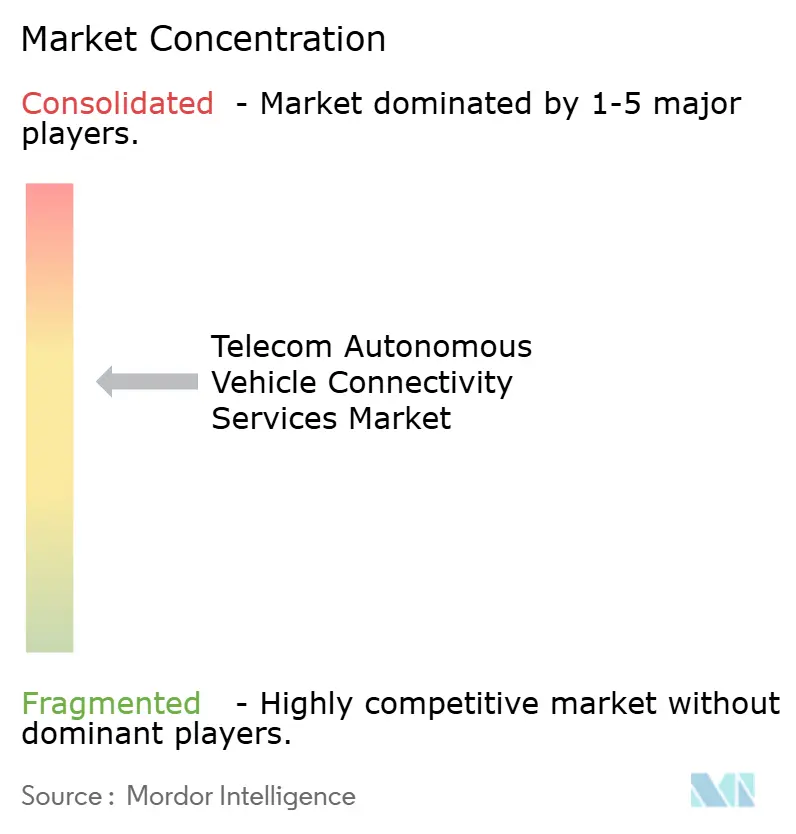
The market is moderately concentrated, as large operators possess extensive network assets but rely on technical partners for several components of the vehicle technology stack. Verizon’s Edge Transportation Exchange uses edge computing and a virtualized architecture to reduce reliance on dense physical roadside unit deployments. Deutsche Telekom’s collaboration with Unikie uses mobile edge cloud infrastructure for automated vehicle marshaling. These initiatives demonstrate that compute placement and service integration can be as important as spectrum ownership. Cybersecurity requirements may also favor large operators and established service providers that can maintain continuous compliance processes.
Cross-border V2X roaming remains an emerging commercial opportunity, as autonomous vehicles require reliable connectivity when operating across national networks. In early 2025, Orange and its partners began construction of the 60-kilometer 5G Autobahn-to-Autoroute corridor between Metz, France, and Saarbrücken, Germany, with completion targeted for 2027. While the project offers a practical test case, the service model layered on top of the physical corridor remains under development. GSMA participants have also called for more capable automotive quality-on-demand APIs that address uplink capacity and latency requirements. The telecom autonomous vehicle connectivity services market may favor providers that can convert these technical capabilities into reliable fleet services supported by clear contractual accountability.
Telecom Autonomous Vehicle Connectivity Services Industry Leaders
-
Verizon Communications Inc.
-
AT&T Inc.
-
Vodafone Group Plc
-
China Mobile Limited
-
Nokia Corporation
- *Disclaimer: Major Players sorted in no particular order
Telecom Autonomous Vehicle Connectivity Services Market Companies Covered in this Report
- Verizon Communications Inc.
- AT&T Inc.
- China Mobile Limited
- Deutsche Telekom AG
- Vodafone Group Plc
- Telefonaktiebolaget LM Ericsson
- Nokia Corporation
- Qualcomm Technologies, Inc.
- Robert Bosch GmbH
- Continental AG
- HARMAN International Industries, Incorporated
- NXP Semiconductors N.V.
- DENSO CORPORATION
- Kapsch TrafficCom AG
- Geotab Inc.
- Aptiv PLC
- Sierra Wireless, Inc. (Semtech Corporation)
- NTT Communications Corporation
Recent Industry Developments in Telecom Autonomous Vehicle Connectivity Services Market
- October 2026: China’s MoII put 2 industry standards for 5G networks supporting advanced autonomous driving into effect on September 1, 2026. The Shanghai Municipal Communications Administration and China Mobile led the development of standards that define 5G network performance and deployment-acceptance requirements for high-level autonomous driving in China.
- July 2026: KDDI Corporation established KDDI Smart Mobility Co., Ltd. as a dedicated autonomous-driving subsidiary. The company also won a Ministry of Internal Affairs contract to provide technical verification of V2X communication systems for autonomous driving deployment.
- July 2026: Japan’s Ministry of Internal Affairs published the Communication Infrastructure Strategy to Support Autonomous Driving Society. The strategy directed mobile operators to upgrade to 5G standalone networks and to build V2X coverage for Level 4 deployment on priority roads starting in fiscal year 2027.
- December 2025: NTT Group established NTT Mobility Co., Ltd., a wholly owned subsidiary for autonomous vehicle services and mobility AI platforms. The company formalized a collaboration with Toyota on infrastructure-cooperative safety applications.
Global Telecom Autonomous Vehicle Connectivity Services Market Report Scope
The Telecom Autonomous Vehicle Connectivity Services Report is Segmented by Service Type (Connectivity Subscription and Data Plans, Managed IoT and M2M Connectivity, C-V2X and V2N Messaging Services, Private 5G and Mobile Private Network Services, Network Slicing and Quality-on-Demand Services, and Edge and Cloud Connectivity Services), Technology (2G/3G, 4G/LTE-M, 5G), Communication Mode (Vehicle-to-Vehicle, Vehicle-to-Infrastructure, and Vehicle-to-Pedestrian and Vulnerable Road User), End User (Automotive OEMs, Autonomous-Mobility Operators, Logistics and Fleet Operators, and Public Transit Agencies), and Geography (North America, South America, Europe, Asia-Pacific, and the Middle East and Africa). The Market Forecasts are Provided in Value (USD).
Segmentation Overview
| Connectivity Subscription and Data Plans |
| Managed IoT and M2M Connectivity |
| C-V2X and V2N Messaging Services |
| Private 5G and Mobile Private Network Services |
| Network Slicing and Quality-on-Demand Services |
| Edge and Cloud Connectivity Services |
| Other Service Types |
| 2G and 3G Legacy Connectivity |
| 4G/LTE and LTE-M |
| 5G |
| Vehicle-to-Vehicle |
| Vehicle-to-Infrastructure |
| Vehicle-to-Pedestrian and Vulnerable Road User |
| Other Communication Modes |
| Automotive OEMs |
| Autonomous-Mobility Operators |
| Logistics and Fleet Operators |
| Public Transit Agencies |
| Other End-users |
| North America | United States |
| Canada | |
| Mexico | |
| South America | Brazil |
| Argentina | |
| Rest of South America | |
| Europe | Germany |
| United Kingdom | |
| France | |
| Italy | |
| Spain | |
| Rest of Europe | |
| Asia-Pacific | China |
| Japan | |
| South Korea | |
| India | |
| Australia | |
| Rest of Asia-Pacific | |
| Middle East | United Arab Emirates |
| Saudi Arabia | |
| Rest of Middle East | |
| Africa | South Africa |
| Nigeria | |
| Rest of Africa |
| By Service Type | Connectivity Subscription and Data Plans | |
| Managed IoT and M2M Connectivity | ||
| C-V2X and V2N Messaging Services | ||
| Private 5G and Mobile Private Network Services | ||
| Network Slicing and Quality-on-Demand Services | ||
| Edge and Cloud Connectivity Services | ||
| Other Service Types | ||
| By Connectivity Technology | 2G and 3G Legacy Connectivity | |
| 4G/LTE and LTE-M | ||
| 5G | ||
| By Communication Mode | Vehicle-to-Vehicle | |
| Vehicle-to-Infrastructure | ||
| Vehicle-to-Pedestrian and Vulnerable Road User | ||
| Other Communication Modes | ||
| By End User | Automotive OEMs | |
| Autonomous-Mobility Operators | ||
| Logistics and Fleet Operators | ||
| Public Transit Agencies | ||
| Other End-users | ||
| By Geography | North America | United States |
| Canada | ||
| Mexico | ||
| South America | Brazil | |
| Argentina | ||
| Rest of South America | ||
| Europe | Germany | |
| United Kingdom | ||
| France | ||
| Italy | ||
| Spain | ||
| Rest of Europe | ||
| Asia-Pacific | China | |
| Japan | ||
| South Korea | ||
| India | ||
| Australia | ||
| Rest of Asia-Pacific | ||
| Middle East | United Arab Emirates | |
| Saudi Arabia | ||
| Rest of Middle East | ||
| Africa | South Africa | |
| Nigeria | ||
| Rest of Africa | ||
Key Questions Answered in the Report
What is the size of the Telecom Autonomous Vehicle Connectivity Services Market?
The Telecom Autonomous Vehicle Connectivity Services Market is projected at USD 6.47 billion in 2026 and USD 18.47 billion by 2032, with a 19.66% CAGR from 2027 to 2032.
Which service type leads autonomous vehicle connectivity services?
Connectivity subscription and data plans lead service types with 23.11% share in 2026, while C-V2X and V2N messaging services have the highest projected CAGR at 20.13%.
Why is 5G important for autonomous vehicles?
5G supports network slicing, lower latency, and prioritized uplink capacity, which are important for teleoperation, safety messaging, and remote monitoring.
Which connectivity technology has the largest revenue share?
4G/LTE and LTE-M hold 51.12% revenue share in 2026 because they support a large installed base of connected vehicles and roadside systems.
Which region has the fastest outlook for connected autonomous vehicles?
Asia-Pacific leads with 29.87% revenue share in 2026 and is projected to expand at a 20.43% CAGR through 2032.
What limits deployment of autonomous vehicle connectivity services?
Major limitations include the cost of roadside and fiber infrastructure, cybersecurity and liability exposure, fragmented spectrum rules, and uncertain fleet returns on investment.