
Telecom AIOps Platforms Market Size and Share
Market Overview
| Study Period | 2020 - 2031 |
|---|---|
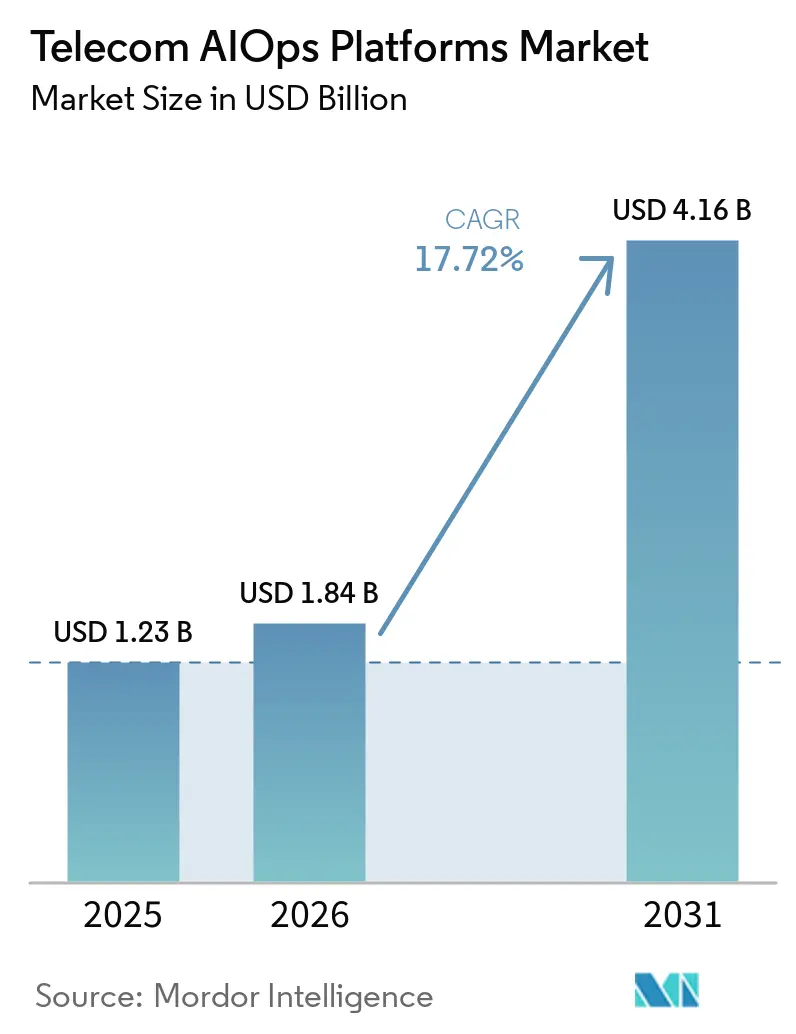
| Market Size (2026) | USD 1.84 Billion |
| Market Size (2031) | USD 4.16 Billion |
| Growth Rate (2026 - 2031) | 17.72 % |
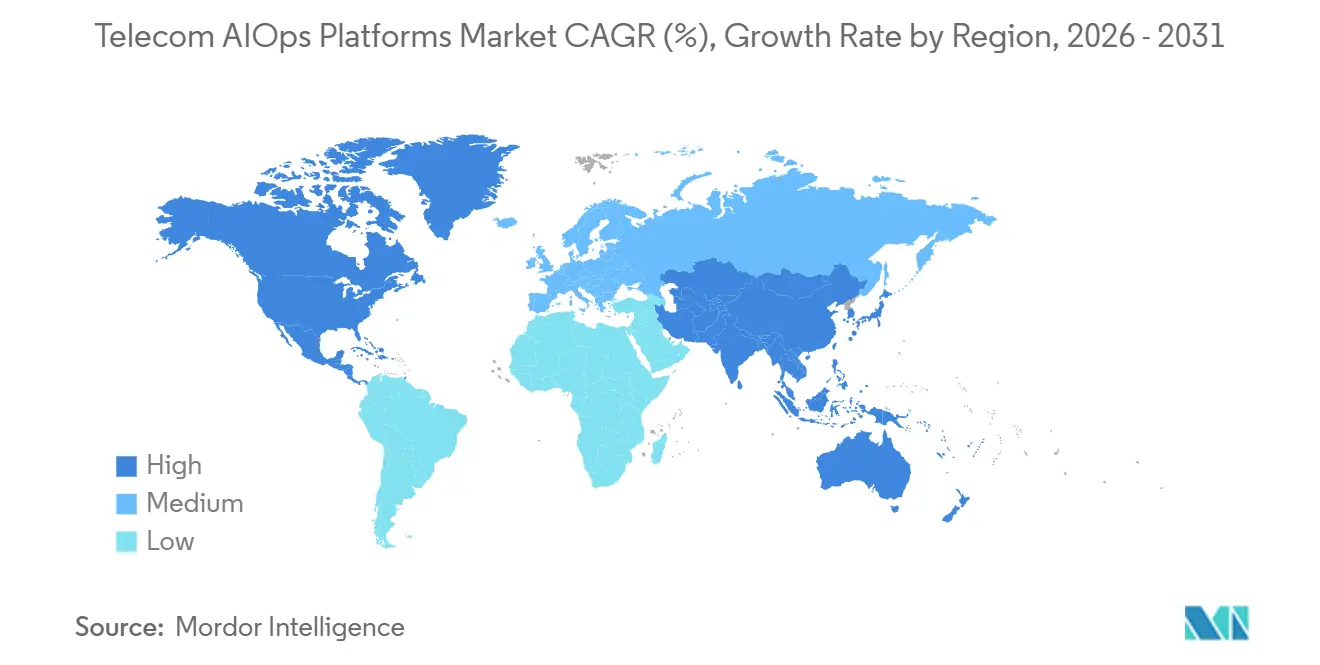
| Fastest Growing Market | Asia-Pacific |
| Largest Market | North America |
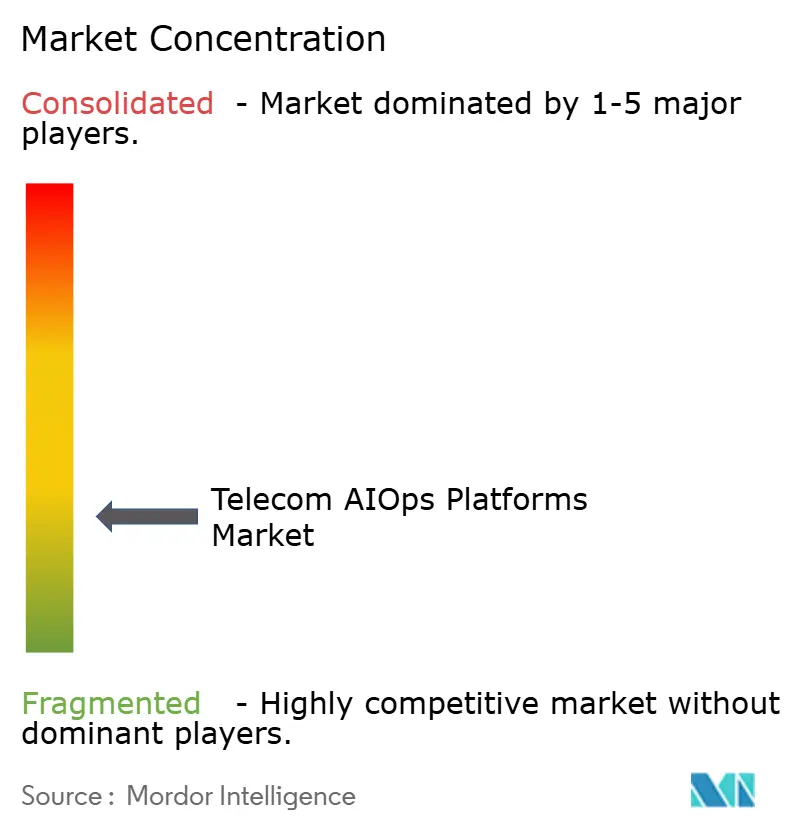
| Market Concentration | Low |
Major Players *Disclaimer: Major Players sorted in no particular order Image © Mordor Intelligence. Reuse requires attribution under CC BY 4.0. | |
Telecom AIOps Platforms Market Analysis by Mordor Intelligence
The telecom AIOps platforms market size was valued at USD 1.23 billion in 2025 and is estimated to expand from USD 1.84 billion in 2026 to reach USD 4.16 billion by 2031, at a CAGR of 17.72% during the forecast period (2026-2031). Network operations have become harder to manage as operators combine 5G, Open RAN, cloud, and edge infrastructure. This has made manual monitoring and fault response less practical across large, multi-vendor networks. Operators are therefore looking for platforms that connect network data, automate routine decisions, and support more reliable service delivery. Procurement is also shifting toward solutions that meet data governance requirements and integrate with existing operational systems. The telecom AIOps platforms market is driven by the need to reduce operational pressure without losing control over critical network decisions.
Key Report Takeaways
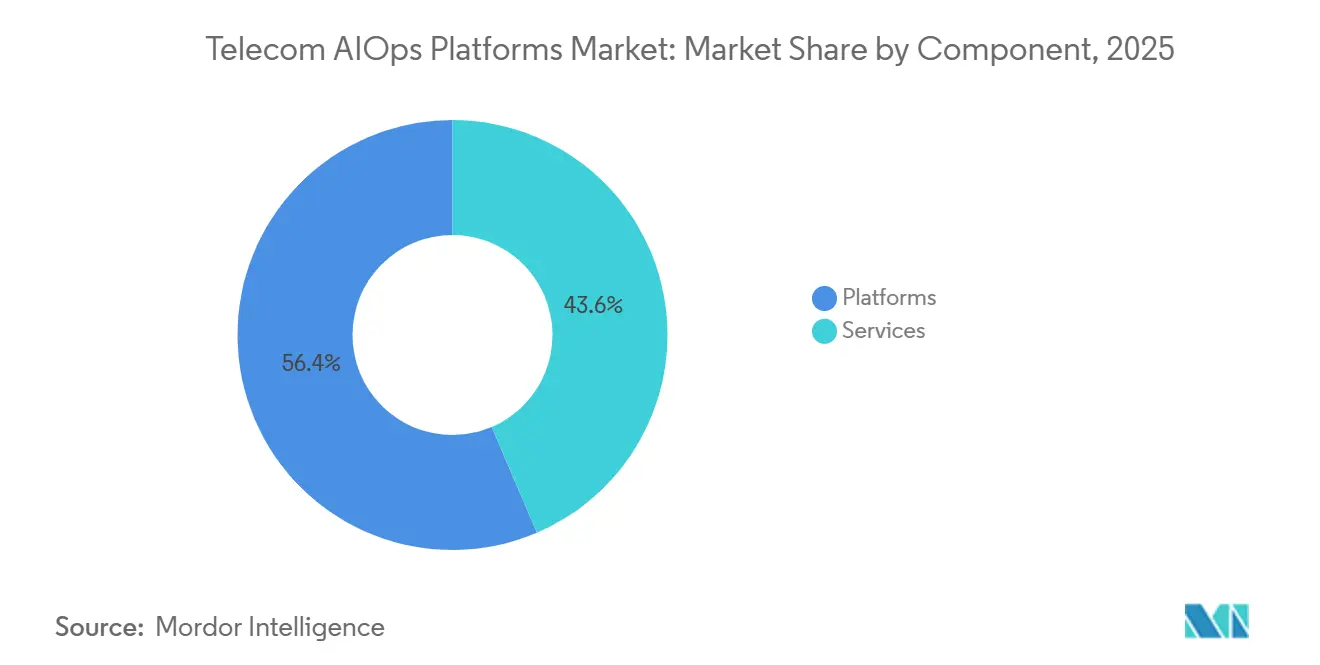
- By component, platforms held 56.43% share in 2025, while services are projected to expand at an 18.21% CAGR through 2031 in the telecom AIOps platforms market.
- By deployment mode, public cloud held 47.88% share in 2025, while hybrid cloud is projected to expand at a 19.41% CAGR through 2031.
- By application, network performance management accounted for 38.77% share in 2025, while network and security operations are projected to expand at an 18.87% CAGR through 2031 in the telecom AIOps platforms market.
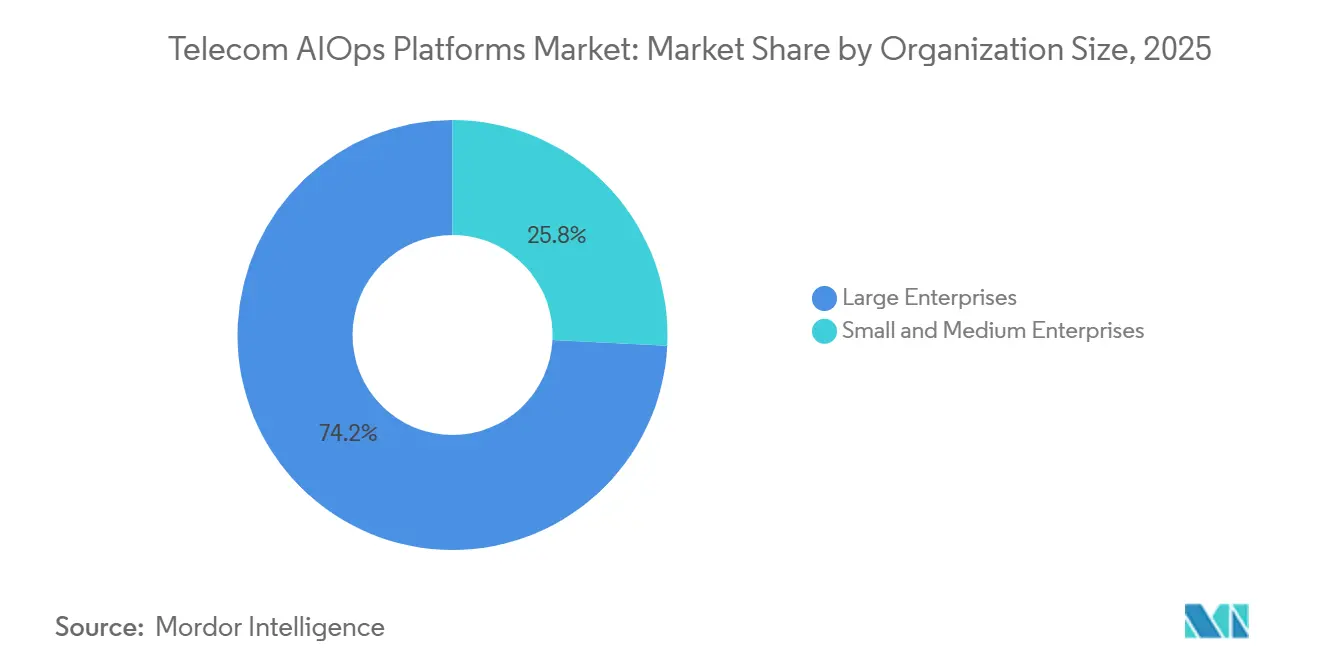
- By organization size, large enterprises held 74.21% share in 2025, while small and medium enterprises are projected to expand at an 18.61% CAGR through 2031.
- By end user, communications service providers held 36.65% share in 2025, while managed service providers are projected to expand at a 19.88% CAGR through 2031 in the telecom AIOps platforms market.
- By geography, North America held 28.76% share in 2025, while Asia-Pacific is projected to expand at a 19.17% CAGR through 2031.
Note: Market size and forecast figures in this report are generated using Mordor Intelligence’s proprietary estimation framework, updated with the latest available data and insights as of January 2026.
Global Telecom AIOps Platforms Market Trends and Insights
Drivers Impact Analysis*
| DRIVER | (~) % IMPACT ON CAGR FORECAST | GEOGRAPHIC RELEVANCE | IMPACT TIMELINE |
|---|---|---|---|
| 5G, Open RAN, Edge, and Multi-Domain Complexity | +3.9% | Global, concentrated in North America, Europe, and the Asia-Pacific | Short term (≤ 2 years) |
| Faster MTTR, Resilience, and SLA Compliance | +3.3% | Global | Short term (≤ 2 years) |
| Hybrid and Multi-Cloud Operations Expansion | +2.8% | North America and Europe, with spillover to the Asia-Pacific | Medium term (2-4 years) |
| Telecom OPEX and Operations Labor Pressure | +2.5% | Global, highest in mature markets including North America, Europe, and Japan | Medium term (2-4 years) |
| Network Digital Twins and Intent-Driven Closed-Loop Automation | +2.1% | Global, with early concentration in China, South Korea, and Japan | Long term (≥ 4 years) |
| Monetization of AI-Enabled Network Insights | +1.7% | North America and Europe, emerging in the Middle East | Long term (≥ 4 years) |
| Source: Mordor Intelligence | |||
5G, Open RAN, Edge, and Multi-Domain Network Complexity
The separation of radio access network functions has increased the number of systems that operations teams must coordinate. Distributed units, central units, radio units, and standardized Open RAN interfaces can involve multiple suppliers within a single network environment. Legacy network management systems were not designed to correlate this range of events at scale. 3GPP TS 23.288 defines the Network Data Analytics Function as part of analytics-led 5G core management, while leaving control choices to intelligence platforms outside the core function. That design gives AIOps suppliers a wider role in interpreting network data and supporting operational decisions. Standardized RIC interfaces from the O-RAN Alliance also make it more feasible to introduce automation across multi-vendor radio environments. The telecom AIOps platforms market benefits when operators need a shared operational view rather than separate tools for each network domain. These requirements are especially relevant as 5G deployments, edge sites, and virtualized functions expand simultaneously. The need is not simply to add more alerts, but to determine which alerts require action and which can be resolved through defined workflows.
Demand for Faster MTTR, Network Resilience, and SLA Compliance
Mean time to repair is increasingly linked to service obligations in enterprise connectivity contracts. A service interruption can create contractual exposure when private 5G and business network customers expect defined availability levels. This puts more focus on identifying faults before they affect users and on reducing the number of manual handoffs between teams. Indosat Ooredoo Hutchison and Huawei reported an 80% one-hop fault-closure rate in their AUTINOps deployment. They also reported a 15% reduction in mean time to repair and an improvement in availability from 99.3% to 99.7% across more than 17,000 islands.[1]Huawei Technologies Co., Ltd., “Indonesia’s Indosat Ooredoo Hutchison and Huawei Win TM Forum 2026 Excellence in AI and Data for Business Impact Award,” Huawei, huawei.com Documented operating results can shorten evaluation cycles for peer operators by demonstrating that automation can be applied beyond pilot settings. The telecom AIOps platforms market gains support from this shift toward measurable service outcomes. Network teams still need human review for complex and high-risk incidents, but repeatable fault patterns are better suited to automation. Faster triage also helps network operations centers and security operations centers coordinate during events with both performance and security implications.
Hybrid and Multi-Cloud Operations Expansion
Telecom workloads now operate across public cloud, private infrastructure, and edge locations. This creates data paths that are difficult for a monitoring tool designed for one cloud environment to cover. Operational analytics often need to run near the relevant data because moving sensitive telemetry can create cost, latency, and governance issues. AIOps platforms, therefore, need to support distributed analysis and coordination across several environments. Hybrid designs can provide elastic computing capacity for AI workloads while keeping selected data and controls in local infrastructure. NTT DOCOMO introduced Nokia MantaRay AutoPilot for AI-driven radio quality optimization on public cloud infrastructure in June 2026.[2]NTT DOCOMO, Inc., “National First, Introduction of Nokia MantaRay AutoPilot That Automatically Optimizes Communication Quality Using AI,” NTT DOCOMO Press Release, docomo.ne.jp The deployment demonstrates that cloud-based operations can extend to sensitive radio network functions when the appropriate architecture and controls are in place. The telecom AIOps platforms market has an opportunity in platforms that make these mixed environments easier to operate without requiring a complete replacement of existing systems. Operators will continue to choose different deployment combinations based on national rules, internal policies, and network design.
Telecom OPEX and Network Operations Labor Pressure
Operators face pressure to maintain complex infrastructure with limited experienced engineering capacity. Routine automation can reduce repetitive work, but the greater value comes from capturing specialist troubleshooting knowledge within operational models and workflows. Experienced personnel are difficult to replace when networks include several technology generations and supplier interfaces. AIOps tools can preserve this knowledge through fault patterns, escalation rules, and model training processes. This makes automation relevant to both workforce planning and near-term spending discipline. The telecom AIOps platforms market also reflects the need to assign technical teams to exceptions that require judgment, rather than to recurring alerts that follow known patterns. Platforms must be continuously tuned, as network behavior changes with new equipment, services, and software releases. This creates ongoing demand for implementation, integration, and model-maintenance services. The operating case is stronger where platform deployment can reduce alert overload while maintaining clear accountability for each automated decision.
Restraints Impact Analysis*
| RESTRAINT | (~) % IMPACT ON CAGR FORECAST | GEOGRAPHIC RELEVANCE | IMPACT TIMELINE |
|---|---|---|---|
| Fragmented Telemetry, OSS/BSS Data Silos, and Data Quality | -2.4% | Global, most severe in legacy-heavy markets | Short term (≤ 2 years) |
| Data Sovereignty, AI Governance, and Critical-Infrastructure Compliance | -2.0% | European Union, the Middle East, Southeast Asia, and India | Medium term (2-4 years) |
| Liability and Trust Concerns Around Autonomous Remediation | -1.6% | Global, most pronounced in regulated Western markets | Medium term (2-4 years) |
| Legacy OSS/BSS Semantic Mismatch and Model Drift | -1.3% | Global, concentrated among operators with long-standing OSS/BSS stacks | Long term (≥ 4 years) |
| Source: Mordor Intelligence | |||
Fragmented Telemetry, OSS/BSS Data Silos, and Inconsistent Data Quality
Many incumbent operators maintain operations and business support systems that were built through acquisitions, supplier choices, and successive network upgrades. The resulting data can differ in format, timing, and meaning between domains. An AIOps model trained on one event vocabulary may therefore classify alerts poorly when it receives data from another generation of technology. This weakens confidence in automated decisions and can slow a wider deployment. The problem is particularly serious when data records are incomplete or when asset, customer, and network records do not align. Operators need common data definitions and network knowledge structures before they can reliably scale automation. The telecom AIOps platforms market is constrained when these preparation tasks are treated as secondary to software selection. Vendors increasingly need to include data integration, model calibration, and knowledge graph work in deployment programs. Those services can improve the long-term value of a platform, but they also increase initial implementation effort. Clear data ownership and operating processes remain necessary after the platform is installed, as network changes can introduce new inconsistencies.
Data Sovereignty, AI Governance, and Critical-Infrastructure Compliance
An AIOps deployment can involve data from infrastructure that governments consider critical. Operators must therefore decide where network data is stored, where model inference occurs, and who can review automated decisions. The EU AI Act treats certain uses of AI in critical digital infrastructure as high-risk, placing importance on oversight and explainability. The EU Digital Omnibus adopted in June 2026 moved the relevant compliance deadline to December 2027. This gives operators time to build compliance processes, but it does not remove the need to prepare them. The telecom AIOps platforms market favors suppliers that can provide audit trails, configurable controls, and deployment choices that align with data-residency requirements. IEEE Communications Standards Magazine described sovereign AI as a basis for trustworthy AI-native 6G networks and proposed an O-RAN-based architecture for operator-controlled AI lifecycle management.[3]M. Bensalem et al., “SovAI for 6G, Towards the Future of AI-Native Networks,” IEEE Communications Standards Magazine, ieee.org These requirements can slow implementation, especially where cross-border systems are involved, but they can also distinguish vendors that embed governance into their operating model. Human oversight is especially important where a platform can trigger or recommend changes to service-critical network functions.
*Our forecasts treat driver/restraint impacts as directional, not additive. The impact forecasts reflect baseline growth, mix effects, and variable interactions.
Segment Analysis
By Component: Platforms Held The Largest Share While Services Expanded Fastest
Platforms accounted for 56.43% of the telecom AIOps platforms market size in 2025. Operators favored integrated intelligence layers that can consolidate information from several operational tools. Telecom-specific offerings are built around 3GPP and O-RAN interfaces and can connect more deeply with OSS/BSS environments. General-purpose AIOps products are also extending into telecom through cloud partnerships and marketplace distribution. The first group can offer stronger domain alignment, while the second can benefit from broader enterprise software ecosystems. Both approaches must address data quality, alert correlation, and integration with existing workflows. TM Forum Open Digital Architecture compliance is becoming a screening factor for some Tier-1 operator evaluations. This supports suppliers that arrive with tested interfaces and documented interoperability. It also raises the importance of implementation capability, not only core platform features.
Services are projected to expand at an 18.21% CAGR from 2026 to 2031. Implementation specialists are needed to connect models with existing OSS/BSS stacks and to set operating rules for automated actions. Managed AIOps services can take responsibility for model maintenance, alert calibration, and updates to anomaly patterns. Consulting and integration services held the largest revenue share within the services category. Major operator implementations averaged USD 2.5 million to USD 4.0 million, reflecting the effort required to integrate into complex network environments. Custom model development is also relevant where operators in Japan, South Korea, and China develop proprietary training datasets. The telecom AIOps platforms industry depends on these services when operator teams cannot build and maintain models at the required speed. Service providers can also help transfer knowledge to internal teams and establish governance practices. This makes services a recurring part of platform value rather than a one-time installation activity.


By Deployment Mode: Public Cloud Led While Hybrid Cloud Recorded The Highest Growth
Public cloud accounted for 47.88% of the telecom AIOps platform market share in 2025. Cloud-native delivery removes some on-premises infrastructure work and can make computing capacity easier to scale with network demand. It also allows operators to access software updates and shared development environments more easily. Nokia moved its autonomous operations stack to Amazon Web Services cloud infrastructure in June 2026, covering operations orchestration, assurance, unified inventory, and closed-loop automation. The company stated that commercial availability was expected later in 2026.[4]Nokia Corporation, “Nokia Advances Autonomous Networks Portfolio With Upgraded Agentic AI Capabilities at DTW26,” Nokia, nokia.com The public cloud does not suit every workload because operators may have data residency and latency concerns. On-premises environments remain relevant in the Middle East, India, and parts of Asia-Pacific, where local control requirements are more significant. The choice depends on the sensitivity of data and the operational function being automated.
Hybrid cloud is projected to expand at a 19.41% CAGR from 2026 to 2031. This approach combines scalable computing resources with local controls for sensitive telemetry and selected network functions. It gives operators a way to move workloads gradually rather than shifting all functions to public infrastructure at once. NTT DOCOMO’s MantaRay AutoPilot deployment demonstrates that radio optimization can leverage public cloud resources while maintaining a broader hybrid operating model. Private cloud remains relevant for core network functions where governance, latency, or control policies limit public-cloud inference paths. The telecom AIOps platforms market is likely to favor suppliers that can operate consistently across these models. Portability matters because operator architecture can change as regulations, workloads, and cost structures evolve. A supplier that supports only one environment may face a narrower set of customer use cases. Hybrid designs also allow teams to test new AI functions while maintaining established controls for higher-risk workloads.
By Application: Network Performance Management Led While Network And Security Operations Advanced Fastest
Network performance management represented 38.77% of the application category in 2025. Continuous visibility into key performance indicators is essential when infrastructure spans radio, transport, core, and edge domains. Operators use these capabilities to identify degradation, correlate related alarms, and prioritize corrective action. Fault and incident management also remains a central use case because it can be tied directly to repair time and service availability. Infrastructure management is gaining relevance as AIOps coverage expands beyond radio access networks to include optical transport, IP core, and enterprise edge systems. The telecom AIOps platforms industry uses this broader coverage to link symptoms across domains that were previously monitored separately. Wider coverage can improve root-cause analysis, but it also increases the need for consistent data models. Customer experience assurance and capacity planning can become more valuable as platforms collect enough historical operating data. Reliable inputs remain essential before predictive recommendations can be trusted.
Network and security operations are projected to expand at an 18.87% CAGR from 2026 to 2031. Network and security teams increasingly need a shared view when the same event affects performance, availability, and risk. Unified observability can reduce the time lost when alerts move between a network operations center and a security operations center. Cisco stated that its AgenticOps approach processes more than 170,000 network alerts per hour with AI response times below 50 milliseconds. This shows the scale that automation platforms are designed to handle, although operators must still validate actions in their own operating context. Capacity planning and customer experience assurance also have room to expand as models improve with operational data. The telecom AIOps platforms market can benefit when security and network telemetry are considered together rather than as separate workflows. Governance requirements will remain important because security-related actions can carry greater operational consequences. Platforms must also make it clear which model inputs informed an alert or recommendation.
By Organization Size: Large Enterprises Dominated While Small And Medium Enterprises Expanded Fastest
Large enterprises held 74.21% share in 2025. Tier-1 and Tier-2 operators have the budget, data volume, and organizational resources to support multi-million-dollar AIOps programs. Their scale also allows models to learn from a wider range of network incidents. This can reinforce the business case for broader automation across the network. Deutsche Telekom reported that its MINDR autonomous network agent handled 237,000 RAN events in 2026. The company said the system reduced event-management time from hours to 1 minute. Large operators can use these programs to set internal standards for data preparation, human oversight, and operational ownership. They also have a greater capacity to work simultaneously with equipment vendors, cloud providers, and system integrators. Their deployments can establish reference cases that influence procurement expectations elsewhere in the telecom AIOps platforms market.
Small and medium enterprises are projected to expand at an 18.61% CAGR from 2026 to 2031. Software-as-a-service delivery can reduce the large upfront commitment associated with traditional platform deployments. Smaller operators face many of the same 5G and multi-vendor operating challenges as larger carriers, but they have fewer specialists available to manage them. Preconfigured detection models and simplified onboarding packages can reduce the time needed to start using an AIOps tool. Regional carriers in Southeast Asia, South America, and the Middle East are early adopters, and competitive pressure requires operational improvements. Vendors need to balance simplified deployment with enough flexibility to support local network designs. A standard package that cannot accommodate existing data and workflows may not deliver the expected value. The telecom AIOps platforms market has room to serve this group through managed services, subscription pricing, and repeatable integration assets. Adoption will depend on whether suppliers can demonstrate clear operational gains without placing new maintenance burdens on small teams.
By End User: Communications Service Providers Led While Managed Service Providers Recorded The Highest Growth
Communications service providers accounted for 36.65% share in 2025. This group includes mobile, fixed-line, broadband, integrated telecom, cable, converged, data-center, and connectivity providers. Mobile network operators form the largest subcategory because 5G radio complexity and large base-station estates require ongoing intelligent management. Fixed-line operators use AIOps for predictive maintenance across optical access networks. Integrated operators seek platforms that can correlate fixed, mobile, and enterprise telemetry within a single operating framework. This gives them a way to investigate a service issue across several network domains. The telecom AIOps platforms market remains closely tied to this end-user group because these operators control the underlying networks and operational data. Their buying decisions also shape requirements for interoperability, security, and assurance. A platform that supports cross-domain correlation can be particularly relevant for operators managing both consumer and enterprise services.
Managed service providers are projected to expand at a 19.88% CAGR from 2026 to 2031, the highest rate among the end-user subsegments. A multi-tenant platform can serve multiple operator customers through a single deployment, improving the economics of adoption. Managed service providers can package operational expertise with the platform and support customers that lack large internal AIOps teams. Network equipment providers are also embedding AIOps capabilities into their products, blurring the line between infrastructure and operations software. System integrators are expanding AIOps practices because operators need help with integration and operational redesign. TM Forum Open Digital Architecture requirements can increase demand for integration partners that have validated assets and practical knowledge of telecom processes. The telecom AIOps platforms market will continue to involve a wide range of delivery partners because platform deployment affects technology, data, workflows, and governance simultaneously. Managed service providers can also make advanced capabilities available to mid-tier operators without requiring each customer to build a separate specialist team. Their growth depends on maintaining service quality and clear accountability across multiple client environments.
Geography Analysis
North America is projected to account for 28.76% of the telecom AIOps platforms market size in 2025. The region combines a large base of platform vendors with Tier-1 carriers capable of supporting enterprise-grade deployments. These operators have the scale to invest in complex integrations and test new operating models. The vendor ecosystem also facilitates partnerships among equipment suppliers, cloud providers, observability firms, and service management specialists. In March 2026, TPG Telecom is expected to deploy Cisco’s Splunk platform to integrate network monitoring, IT operations, and cybersecurity tools within a unified observability and remediation framework. Active commercial programs and substantial technical capacity support the telecommunications AIOps opportunity in the region.
Europe has technically advanced operators; however, regulations such as the EU Digital Operational Resilience Act (DORA), NIS2, and the EU AI Act increase the importance of governance and control features. These requirements may slow the deployment of fully autonomous systems while increasing demand for platforms that offer auditability and human oversight. South America is also experiencing adoption beyond the largest carriers, as regional operators seek to reduce alarm noise and improve service resilience.
The Middle East is advancing through state-backed digital programs and investments in network modernization. Saudi Arabia and the United Arab Emirates are notable markets where data-localization requirements are driving demand for in-country inference capabilities and sovereign cloud configurations. Africa represents a longer-term opportunity, as ongoing infrastructure build-out may enable AI-native operations without the same level of legacy OSS technical debt. The telecom AIOps platforms market may develop differently across these regions due to significant variations in data regulations, network maturity, and procurement capacity.
Asia-Pacific is projected to expand at a CAGR of 19.17% during 2026–2031. High 5G deployment density, a large operator base, and pressure on operating margins are driving demand for more efficient network operations. NTT DOCOMO is expected to begin commercial operations of a generative AI-based mobile network maintenance agent system in February 2026. KDDI is also expected to begin operating a recovery-support AI agent that identifies failure causes in February 2026. China represents a major large-scale deployment environment, with China Mobile targeting Level 4 autonomous networks and China Telecom expected to deploy more than 900 AI agents.

Competitive Landscape
The telecom AIOps platforms market is moderately fragmented. Competition spans equipment vendors, enterprise observability specialists, hyperscaler-native platforms, and purpose-built AIOps providers. Nokia and Ericsson maintain advantages through established operator relationships and deep integration capabilities within OSS/BSS environments. ServiceNow can leverage its IT service management position to expand into telecom service operations management. Cloud providers can bundle managed frameworks with computing infrastructure, which may simplify procurement for certain operators.
No single supplier holds a dominant share because operators use different network architectures, governance models, and deployment environments. This diversity creates opportunities for specialist providers and large infrastructure companies. The key competitive question increasingly centers on whether a supplier can integrate with an operator’s existing environment without requiring a complete OSS replacement. Interoperability, traceable decision-making, and practical integration services are as important as model performance.
Partnerships have become central to delivery strategies. In June 2026, Nokia and Google Cloud are expected to announce the integration of six specialized Gemini AI agents into Nokia Assurance Center. The agents will support router management, event triage, and four additional automation domains, with SaaS availability through Google Cloud Marketplace expected in September 2026. Ericsson is expected to launch Agentic rApp as a Service on AWS Marketplace in 2026 to support RAN optimization within an SMO open architecture. These arrangements can reduce the time required to move from testing to production by combining telecom software, cloud infrastructure, and AI capabilities.
Telecom AIOps Platforms Industry Leaders
Nokia Corporation
Cisco Systems, Inc.
Ericsson
HCL Technologies Limited
Microsoft Corporation
- *Disclaimer: Major Players sorted in no particular order

Recent Industry Developments
- June 2026: Indosat Ooredoo Hutchison and Huawei won the TM Forum "Excellence in AI and Data for business impact" award at DTW 2026 for AUTINOps deployed across all IOH network domains, delivering an 80% one-hop fault closure rate, 15% MTTR reduction, and availability improvement from 99.3% to 99.7% across more than 17,000 islands.
- June 2026: NTT DOCOMO adopted Nokia's MantaRay AutoPilot, deploying the world's first AI-driven RAN quality optimization system on a public cloud in Japan, enabling autonomous optimization of network parameters from a public cloud environment, a global first.
- March 2026: Huawei officially launched AUTINOps at MWC 2026, the industry's first AI-native intelligent operations solution, featuring more than 20 AI agents, including the MBB Fault Agent and Risk Handling Agent, as well as Agent Studio, enabling operators to build scenario-specific agents.
- March 2026: Ericsson launched Agentic rApp as a Service on AWS Marketplace at MWC 2026, introducing agentic AI and generative AI capabilities for RAN optimization within an SMO open architecture, designed to accelerate operators’ path to Level 4 network autonomy.


Global Telecom AIOps Platforms Market Report Scope
The Telecom AIOps Platforms Market Report is Segmented by Component (Platforms [Domain-Centric Platforms, Domain-Agnostic Platforms, Telecom-Specific AIOps Platforms, and General-Purpose AIOps Platforms], and Services [Consulting Services, Integration and Implementation Services, Managed AIOps Services, Training, Support, and Maintenance Services, and Custom AI Model Development Services]), Deployment Mode (On-Premises, Public Cloud, Private Cloud, and Hybrid Cloud), Application (Network Performance Management, Fault and Incident Management, Network and Security Operations, Infrastructure Management, and Other Applications), Organization Size (Large Enterprises, and SMEs), End User (Communications Service Providers [Mobile Network Operators, Fixed-Line and Broadband Operators, Integrated Telecom Operators, Cable and Converged Operators, and Data Center and Connectivity Providers], Managed Service Providers, Network Equipment Providers, System Integrators, and Other End Users), and Geography (North America, South America, Europe, Asia-Pacific, Middle East and Africa). Market Forecasts Are Provided in Terms of Value (USD).
| Platforms | Domain-Centric Platforms |
| Domain-Agnostic Platforms | |
| Telecom-Specific AIOps Platforms | |
| General-Purpose AIOps Platforms | |
| Services | Consulting Services |
| Integration and Implementation Services | |
| Managed AIOps Services | |
| Training, Support, and Maintenance Services | |
| Custom AI Model Development Services |
| On-Premises |
| Public Cloud |
| Private Cloud |
| Hybrid Cloud |
| Network Performance Management |
| Fault and Incident Management |
| Network and Security Operations |
| Infrastructure Management |
| Other Applications |
| Large Enterprises |
| Small and Medium Enterprises |
| Communications Service Providers | Mobile Network Operators |
| Fixed-Line and Broadband Operators | |
| Integrated Telecom Operators | |
| Cable and Converged Operators | |
| Data Center and Connectivity Providers | |
| Managed Service Providers | |
| Network Equipment Providers | |
| System Integrators | |
| Other End Users |
| North America | United States |
| Canada | |
| Mexico | |
| South America | Brazil |
| Argentina | |
| Rest of South America | |
| Europe | United Kingdom |
| Germany | |
| France | |
| Italy | |
| Rest of Europe | |
| Asia-Pacific | China |
| Japan | |
| India | |
| South Korea | |
| Rest of Asia-Pacific | |
| Middle East | Saudi Arabia |
| United Arab Emirates | |
| Rest of Middle East | |
| Africa | South Africa |
| Egypt | |
| Rest of Africa |
| By Component | Platforms | Domain-Centric Platforms |
| Domain-Agnostic Platforms | ||
| Telecom-Specific AIOps Platforms | ||
| General-Purpose AIOps Platforms | ||
| Services | Consulting Services | |
| Integration and Implementation Services | ||
| Managed AIOps Services | ||
| Training, Support, and Maintenance Services | ||
| Custom AI Model Development Services | ||
| By Deployment Mode | On-Premises | |
| Public Cloud | ||
| Private Cloud | ||
| Hybrid Cloud | ||
| By Application | Network Performance Management | |
| Fault and Incident Management | ||
| Network and Security Operations | ||
| Infrastructure Management | ||
| Other Applications | ||
| By Organization Size | Large Enterprises | |
| Small and Medium Enterprises | ||
| By End User | Communications Service Providers | Mobile Network Operators |
| Fixed-Line and Broadband Operators | ||
| Integrated Telecom Operators | ||
| Cable and Converged Operators | ||
| Data Center and Connectivity Providers | ||
| Managed Service Providers | ||
| Network Equipment Providers | ||
| System Integrators | ||
| Other End Users | ||
| By Geography | North America | United States |
| Canada | ||
| Mexico | ||
| South America | Brazil | |
| Argentina | ||
| Rest of South America | ||
| Europe | United Kingdom | |
| Germany | ||
| France | ||
| Italy | ||
| Rest of Europe | ||
| Asia-Pacific | China | |
| Japan | ||
| India | ||
| South Korea | ||
| Rest of Asia-Pacific | ||
| Middle East | Saudi Arabia | |
| United Arab Emirates | ||
| Rest of Middle East | ||
| Africa | South Africa | |
| Egypt | ||
| Rest of Africa | ||


Key Questions Answered in the Report
What is the size of the telecom AIOps platforms market?
The telecom AIOps platforms market size is estimated at USD 1.84 billion in 2026 and is forecast to reach USD 4.16 billion by 2031, at a CAGR of 17.72%.
What is driving the adoption of telecom AIOps platforms?
Operators are managing more 5G, Open RAN, cloud, and edge infrastructure. They need faster fault resolution, stronger service reliability, and support for complex multi-vendor networks.
Which component held the largest share in 2025?
Platforms led the component category with 56.43% share in 2025. Services are projected to expand fastest at an 18.21% CAGR through 2031.
Which deployment model is expanding fastest?
Hybrid cloud is projected to expand at a 19.41% CAGR through 2031 because it combines scalable computing with local data and governance controls.
Which end user is projected to expand fastest?
Managed service providers are projected to expand at a 19.88% CAGR through 2031. Their multi-tenant operating model can serve multiple operator customers through a single platform deployment.
Which region is projected to expand fastest through 2031?
Asia-Pacific is projected to expand at a 19.17% CAGR through 2031, supported by high 5G deployment density, a large operator base, and pressure to improve network operating efficiency.
Page last updated on:





