
Telecare Market Size and Share
Market Overview
| Study Period | 2021 - 2032 |
|---|---|
| Market Size (2027) | USD 5.36 Billion |
| Market Size (2032) | USD 6.85 Billion |
| Growth Rate (2027 - 2032) | 5.01 % |
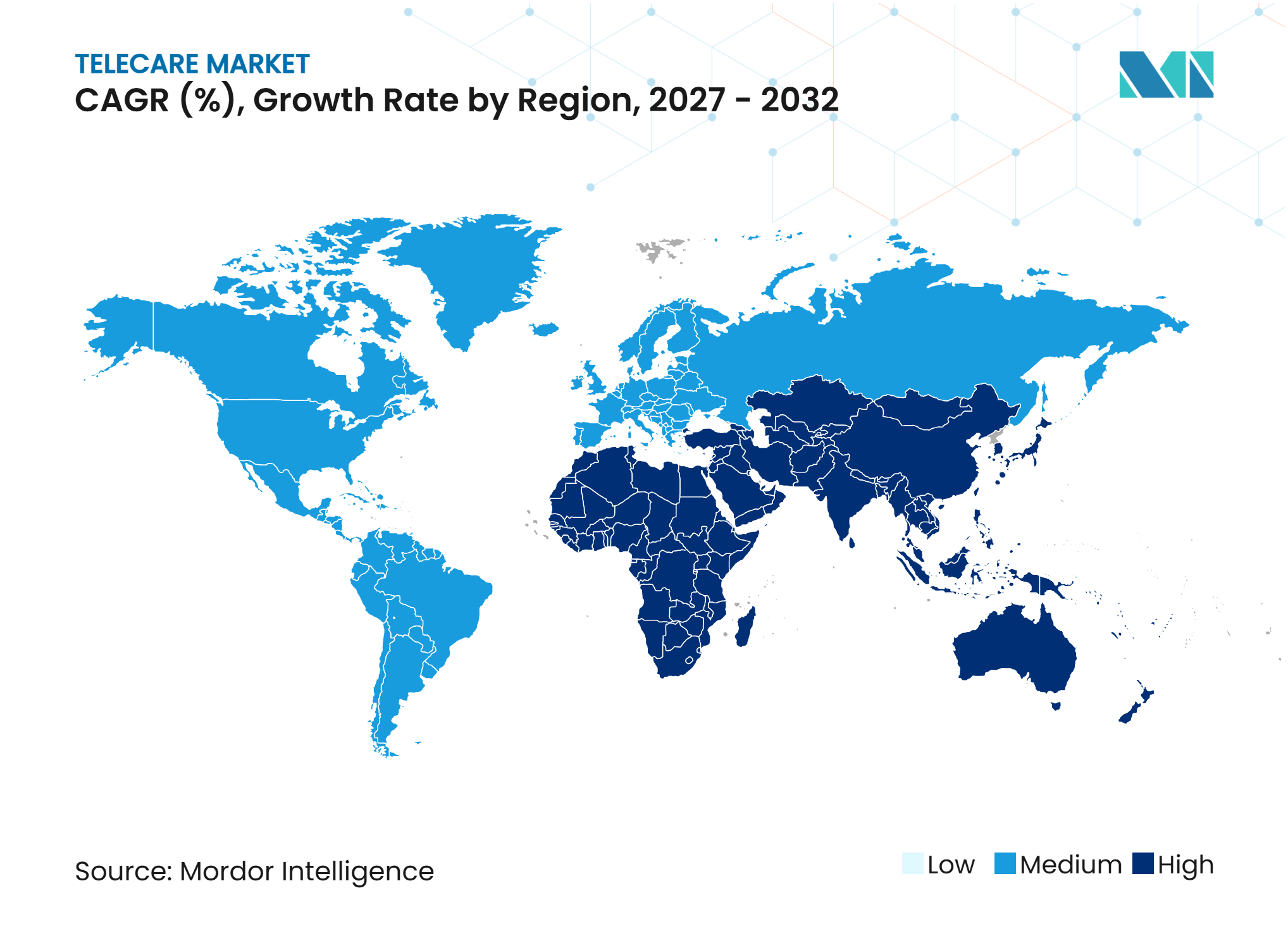
| Fastest Growing Market | Asia-Pacific |
| Largest Market | North America |
| Market Concentration | Low |
Major Players *Disclaimer: Major Players sorted in no particular order Image © Mordor Intelligence. Reuse requires attribution under CC BY 4.0. | |
Telecare Market Analysis by Mordor Intelligence
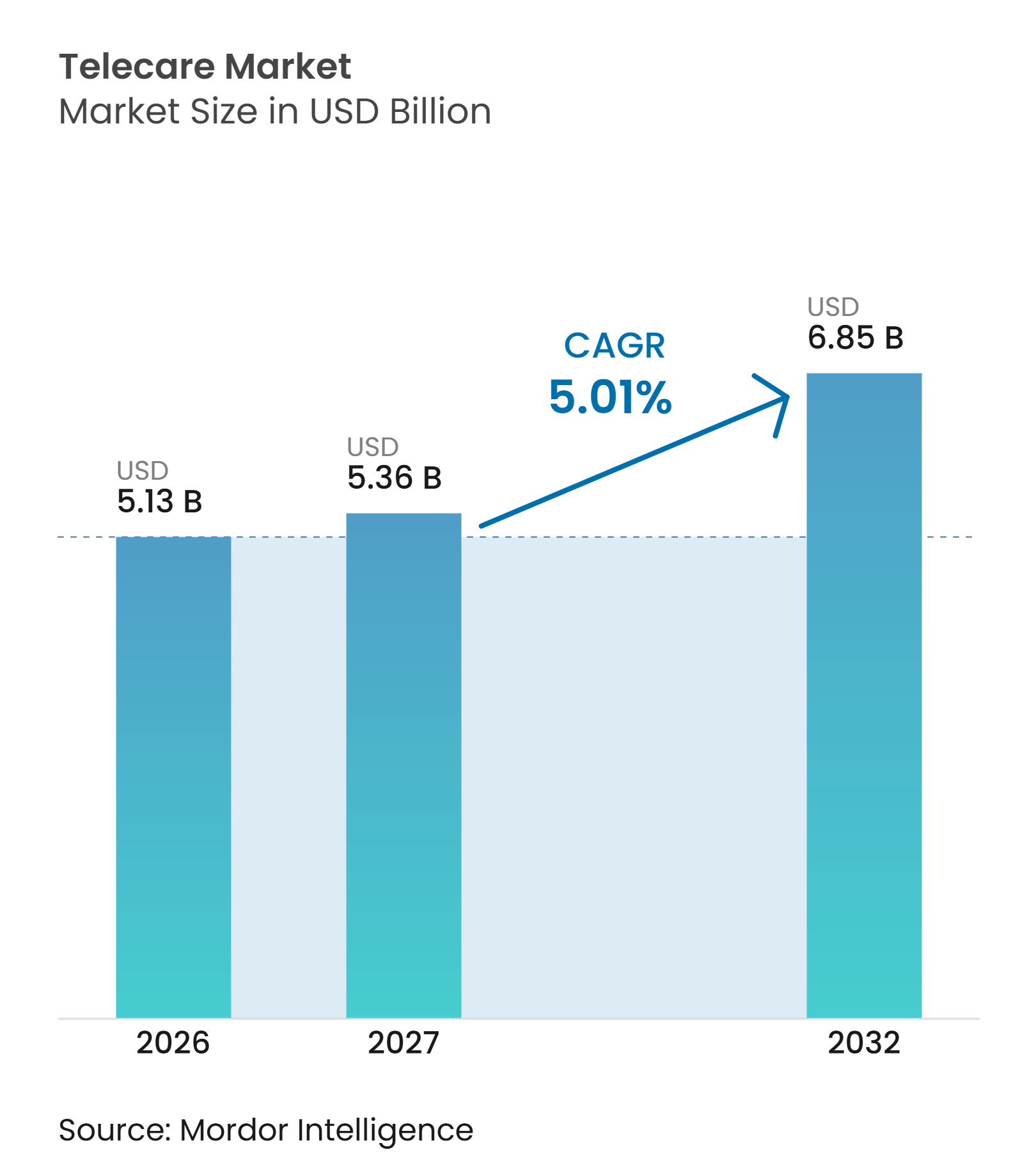
The Telecare Market size is projected to be USD 5.13 billion in 2026, USD 5.36 billion in 2027, and reach USD 6.85 billion by 2032, growing at a CAGR of 5.01% from 2027 to 2032.
The telecare market is supported by population aging, chronic disease management needs, and shortages of clinical staff. Demand is also moving toward home-based care because health systems need to maintain access while managing capacity constraints. Connected devices, cloud platforms, and ambient sensing are widening the role of telecare from emergency response to continuous observation. Providers are increasingly competing on managed services, interoperability, privacy controls, and the ability to support care delivery across hospital and home settings.
Key Report Takeaways
- By service type, remote monitoring held 34.82% of the telecare share in 2026, while the virtual consultation and telenursing segment is forecast to expand at a 7.44% CAGR through 2032.
- By offering, monitoring and response services held 42.56% of the telecare share in 2026, while the software and platforms segment is forecast to expand at a 7.82% CAGR through 2032.
- By technology, wireless telecare systems held 31.47% of the telecare share in 2026, while AI-enabled and smart telecare platforms are forecast to expand at a 10.28% CAGR through 2032.
- By deployment mode, cloud-based deployment held 48.63% of the telecare share in 2026 and is forecast to expand at a 7.15% CAGR through 2032.
- By application, elderly care and aging in place held 38.74% of the telecare share in 2026, while hospital-at-home and acute home care is forecast to expand at an 8.93% CAGR through 2032.
- By end user, healthcare consumers held 46.28% of the telecare share in 2026, while government and community care organizations are forecast to expand at a 6.84% CAGR through 2032.
- By region, North America held 36.42% of the telecare share in 2026, while Asia-Pacific is forecast to expand at a 7.64% CAGR through 2032.
Note: Market numbers in this report are based on Mordor Intelligence's proprietary estimation framework, which combines nine months of actuals with Q4 projections for base year 2026.
Market Trends and Insights
Drivers Impact Analysis of Telecare Market of Telecare Market*
| Driver | (~) % Impact on CAGR Forecast | Geographic Relevance | Impact Timeline |
|---|---|---|---|
| Aging Population and Chronic Disease Burden | +1.3% | Global, with early concentration in North America, Europe, and Japan | Long term (≥ 4 years) |
| Healthcare Workforce Shortages and Remote Care Capacity | +0.9% | North America, Europe, Australia, with spillover to Asia-Pacific | Medium term (2-4 years) |
| Government and Payer Support for Virtual and Home-Based Care | +0.8% | North America and core EU markets, with early development in GCC and Asia-Pacific | Medium term (2-4 years) |
| Connected Devices, Wearables, and Cloud Analytics | +0.7% | Global, led by North America and East Asia | Medium term (2-4 years) |
| PSTN Switch-Off and Digital Telecare Replacement | +0.5% | United Kingdom and broader Europe | Short term (≤ 2 years) |
| Non-Intrusive Monitoring for Aging in Place | +0.4% | Europe, North America, and Japan | Medium term (2-4 years) |
| Source: Mordor Intelligence | |||
Aging Population and Rising Chronic-Disease Burden
The telecare market is responding to older adults who want to remain at home while maintaining access to support. Aging and chronic conditions are increasing the need for ongoing observation outside institutional settings. Home-based monitoring can provide emergency support while reducing the need for repeated routine visits. Product design is shifting toward passive systems that require less frequent action by the user. Safety, comfort, and clear human escalation can be more relevant to adoption than automated clinical recommendations. This supports the use of ambient and non-wearable systems in suitable care settings.
Healthcare Workforce Shortages and Remote Care Capacity
Workforce shortages are increasing the need for tools that allow clinical teams to supervise more people without reducing care quality. A 2025 expert discussion on telehealth and staffing identified workforce pressure, uneven provider distribution, and burnout as continuing concerns for the U.S. health system. The telecare market can help providers move routine observation and follow-up work outside traditional clinical settings. Remote patient monitoring creates a distinct operating model with staff-to-patient ratios, care processes, and service measures. AI-supported workflows can reduce documentation work, prioritize alerts, and guide referrals when they are used within appropriate clinical oversight. This direction makes remote care capacity relevant to both provider strategy and payer-funded care models.
PSTN Switch-Off Accelerating Digital Telecare Replacement
The planned retirement of the United Kingdom's analog public switched telephone network by January 2027 requires many existing telecare users to move to digital services. The UK government established the Telecare National Action Plan in February 2025 to protect people who use telecare during the change. Openreach reported in 2025 that more than two-thirds of landlines had moved to digital services, while its Prove Telecare work migrated more than 1,000 customers using fixed-line telecare equipment without disruption. This change brings forward replacement decisions for analog devices and creates a near-term installation cycle across the existing telecare estate. The telecare market can therefore see higher hardware activity in the United Kingdom even when underlying demand changes more gradually. Digital migration also gives software providers an opening to work with local authorities and care providers on broader service redesign[1].
Connected Devices, Wearables, and Cloud Analytics
Connected wearables, ambient devices, and cloud analytics are extending telecare beyond emergency alerts into continuous health observation. A 2025 IEEE study described a multimodal smart-home platform for post-stroke care that combined wearable insoles, ambient cameras, and an embedded language model. The study reported 94% sensitivity for fall detection and a 37% reduction in emergency department visits. Teladoc Health introduced SoloVitals in October 2026 as a contactless capability that uses remote photoplethysmography to measure heart rate and respiration through a standard camera. This development reduces reliance on pendants and wrist-worn hardware for certain monitoring needs. It may also broaden competition because devices with cameras can become monitoring endpoints when they meet clinical, privacy, and regulatory requirements.
Restraints Impact Analysis of Telecare Market of Telecare Market*
| Restraint | (~) % Impact on CAGR Forecast | Geographic Relevance | Impact Timeline |
|---|---|---|---|
| Reimbursement and Cross-Border Regulatory Variation | -0.7% | Global, with greatest effects in Europe and emerging markets | Long term (≥ 4 years) |
| Cybersecurity, Privacy, and Data Governance Requirements | -0.5% | Global, with HIPAA focus in North America and GDPR focus in Europe | Medium term (2-4 years) |
| Interoperability and Legacy-Equipment Migration Complexity | -0.4% | North America and Europe, with spillover to Asia-Pacific | Medium term (2-4 years) |
| Alarm Fatigue, Digital Exclusion, and Low User Engagement | -0.3% | Global, with greater effects among older people with low digital literacy | Long term (≥ 4 years) |
| Source: Mordor Intelligence | |||
Cybersecurity, Privacy, and Data-Governance Requirements
Home-based telecare adds cybersecurity risks because medical devices may share networks with consumer equipment. NIST guidance published in December 2025 identified smart speakers and consumer internet-connected devices as possible entry points for attacks affecting healthcare systems. The guidance recommends separating medical equipment from consumer devices on home networks. That approach is easier to manage in a clinical facility than in varied household settings. The telecare market therefore needs managed service models that address security throughout installation, connectivity, device use, and support. Privacy compliance also requires encryption, audit trails, and clear agreements across technology providers and care organizations.
Reimbursement and Cross-Border Regulatory Variation
Reimbursement rules determine which groups can receive remote monitoring and how widely services can scale. In Fall 2025, 41 U.S. state Medicaid programs reimbursed remote patient monitoring, compared with 40 programs in 2024. Maryland removed prior authorization requirements, and California removed its minimum age requirement of 21 during 2025. Federal Medicare restrictions on home-based telehealth returned in part after certain pandemic-era waivers expired in October 2025. This difference creates uneven access because many older people who could benefit from telecare are Medicare-eligible. European markets also differ, with Germany providing a more structured statutory health insurance pathway while other countries rely on regional programs.
*Our forecasts treat driver/restraint impacts as directional, not additive. The impact forecasts reflect baseline growth, mix effects, and variable interactions.
Telecare Market Segment Analysis
By Service Type:
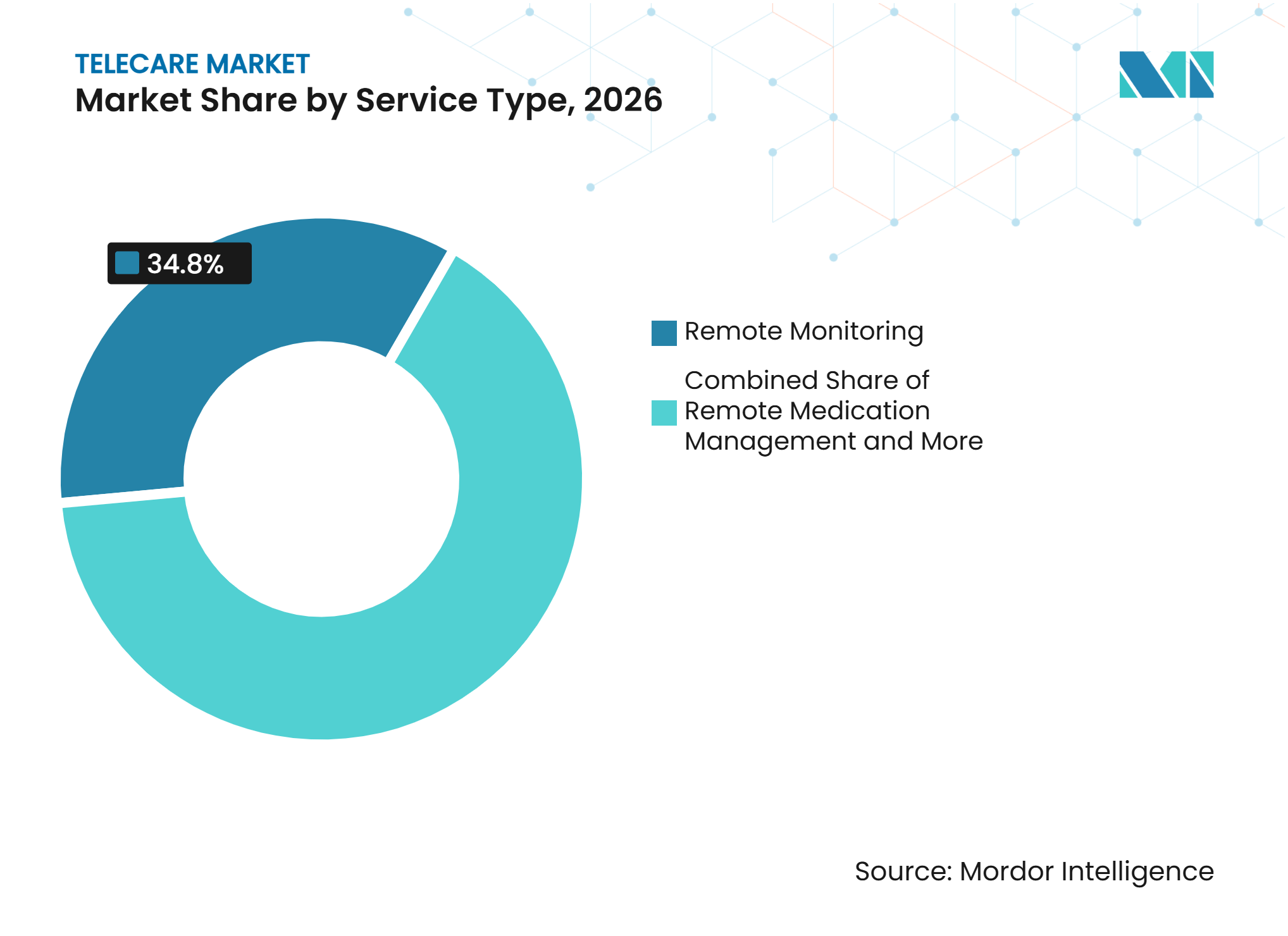
Remote Monitoring Anchors Revenue While Virtual Consultation AcceleratesRemote monitoring accounted for 34.82% of the telecare share in 2026, making it the leading service category. Its role is based on continuous observation of vital signs for people with chronic conditions. A 2025 study of a remote patient care program reported a 43% relative improvement in the number of patients reaching target blood pressure. The program also reduced inpatient admissions across 4 states. Emergency response and personal emergency response systems remain important because many people want to age in place. Medication management and care coordination also support people with complex treatment needs after hospital care.
Virtual consultation and telenursing are forecast to grow at a 7.44% CAGR through 2032, the highest rate within service types. Hospital-at-home programs depend on video-supported oversight between in-person nursing visits. Advocate Health reported 2.2 million virtual care encounters in 2025 across 47 service lines and 258 sites. This was a 30% increase from the previous year. The scale shows that virtual consultations are becoming part of established care pathways. Care coordination services can also combine health monitoring with social connection for older people who may be isolated.



By Offering:
Managed Services Lead as Platform Economics Reshape Revenue ModelsMonitoring and response services held 42.56% of the telecare share in 2026. The result shows the importance of recurring managed-service contracts over one-time device sales. These services can include monitoring, alert response, installation support, and ongoing care coordination. Public buyers and local authorities increasingly seek proof of service quality and measurable results per monitored person. This favors providers that can operate at scale and meet contract requirements. Hardware remains important, but lower-cost consumer devices can increase price pressure in some categories.
Software and platforms are forecast to grow at a 7.82% CAGR through 2032. Platform providers can combine health data, dashboards, clinical notes, and electronic health record connections in one environment. This can make a system harder to replace than a single item of hardware. Teladoc Health expanded its Solo platform in October 2026 with SoloVitals and SoloScribe. The company presented these functions as tools to help hospitals scale connected care. The telecare industry is therefore moving toward software layers that connect monitoring activity with clinical workflows[2].
By Technology:
Wireless Infrastructure Matures While AI Platforms Define the Next Value TierWireless telecare systems held 31.47% of the telecare share in 2026. The installed base includes personal emergency response systems and cellular-connected wearables. Wireless access supports mobility and gives users a familiar way to remain connected outside a fixed location. Mobile solutions also use smartphone applications and cellular networks to serve people who prefer consumer-style interfaces. Wired systems remain relevant in care homes where dependable local infrastructure can be more important than mobility. As connectivity becomes more widely available, basic wireless infrastructure is likely to offer less differentiation on its own.
AI-enabled and smart telecare platforms are forecast to grow at a 10.28% CAGR through 2032. A 2025 mixed-methods study across 12 sites found that integrated multimodal monitoring reduced fall-related injuries by 42%. The same study reported net savings of USD 15,311 per participant over 24 months compared with usual care. Non-wearable ambient sensing is a developing part of this technology group. Neteera received CE certification under EU Medical Device Regulation Class IIa for its 130H-Plus contactless monitoring system in March 2025. This certification supports commercial deployment in Germany and other European markets.
By Deployment Mode:
Cloud Architecture Supports Scalable and Interoperable TelecareCloud-based deployment accounted for 48.63% of the telecare market size in 2026. It is also forecast to grow at a 7.15% CAGR through 2032, making it both the leading and fastest-growing deployment mode. Cloud platforms can support remote access to monitoring data, software updates, and shared clinical dashboards. They can also help providers connect multiple sites under a common service model. A 2025 review found that HL7 FHIR and ISO/IEEE 11073 were the most frequently cited standards in telemonitoring. The review also found that there was no common standard for cross-device data exchange, which remains a barrier to multi-vendor deployment.
On-premises systems remain useful where data sovereignty requirements limit the use of external cloud infrastructure. This is particularly relevant for national health systems that apply strict controls to patient information. Hybrid models can keep latency-sensitive alerts close to the point of care while using the cloud for analytics and storage. This design can balance operational speed with governance needs. The telecare market also needs migration plans because providers often run older clinical and communications systems. The continued need for interoperability means that cloud adoption is linked to standards-based integration rather than infrastructure change alone.
By Application:
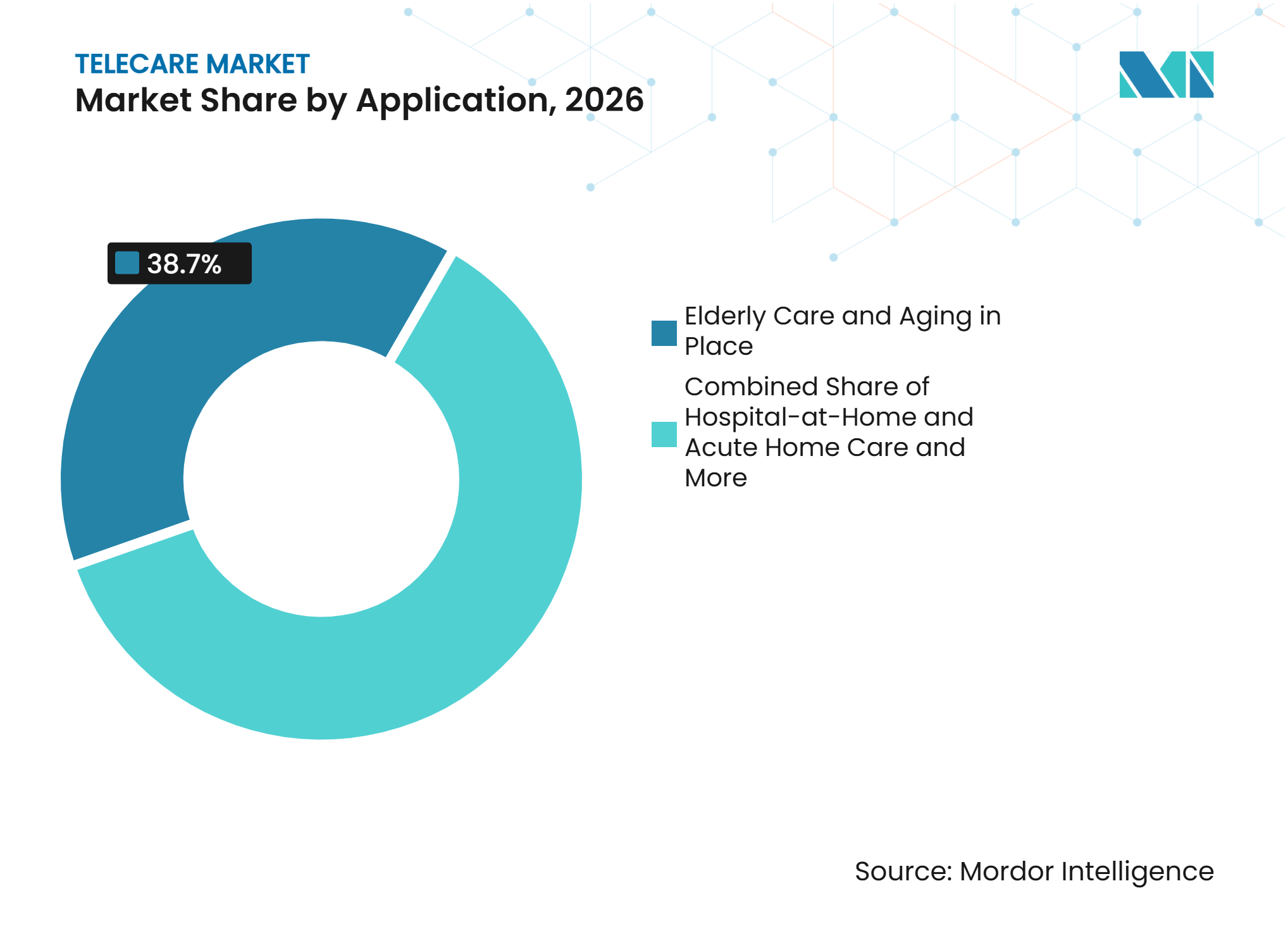
Elderly Care Anchors Volume While Hospital-at-Home Redefines Acute BoundariesElderly care and aging in place held 38.74% of the telecare share in 2026. The category benefits from the preference of many older adults to remain in their homes. Ambient safety monitoring and emergency support can help users retain independence while giving families and care teams a way to respond to concerns. Chronic disease management remains another major use case because people often need routine observation outside hospitals. Fall detection and emergency response remain important but can face price pressure from basic pendant and button technologies. Mental health monitoring is also emerging, although clinical validation pathways remain less developed.
Hospital-at-home and acute home care is forecast to grow at an 8.93% CAGR through 2032. The U.S. House passed legislation in 2026 to extend the Acute Hospital Care at Home waiver through 2030. The policy direction gives health systems a longer planning period for home-based acute care. myLaurel reported 400% growth in partners and 575% growth in patients served during 2025. Post-acute and rehabilitation services also benefit from home monitoring and therapy support. Medication management is developing through voice-enabled and AI-assisted tools that can make routine tasks easier for users.

By End User:
Consumers Sustain Volume While Governments Enable System-Level DeploymentHealthcare consumers held 46.28% of the telecare market size in 2026. Demand comes from personal emergency response subscriptions, employer-supported wellness monitoring, and self-managed chronic disease devices. Consumer familiarity with smartwatch health functions can make some forms of home monitoring easier to adopt. Healthcare providers are another important group because they operate hospital-at-home, virtual nursing, and chronic disease programs. Payers are also becoming more active purchasers of preventive monitoring services. Assisted living and long-term care operators are adding ambient monitoring to help manage staff capacity.
Government and community care organizations are forecast to grow at a 6.84% CAGR through 2032. Public procurement is making technology-enabled care a more formal part of social care strategy. Gloucestershire County Council awarded Careium a 5-year GBP 6 million contract in September 2025 to provide technology-enabled care for 2,500 older people. The contract covers items including falls detectors, door sensors, dementia clocks, and wellbeing applications. Such contracts can create predictable multi-year revenue for providers that can meet operational standards. They can also favor established companies with the capacity to support large local authority deployments.
Geography Analysis
North America
North America held 36.42% of the global telecare share in 2026. The region combines developed healthcare infrastructure, broad remote patient monitoring reimbursement, and a large population with chronic care needs. In Fall 2025, 41 U.S. state Medicaid programs reimbursed remote patient monitoring. Maryland removed prior authorization, and California removed its minimum age restriction during 2025. These changes provide a public payer base for further provider and commercial activity. The Acute Hospital Care at Home program had approved 419 facilities across 39 states by September 2025. Its planned extension through 2030 supports continued investment in hospital-level care at home. Regulatory influence in the region includes privacy obligations under HIPAA and payment rules that vary between Medicare and Medicaid. Canada and Mexico can add demand through virtual care funding and the need to reach communities with uneven access to care.
Asia-Pacific
Asia-Pacific is forecast to grow at a 7.64% CAGR through 2032, making it the fastest-growing regional telecare market. Aging populations, improving connectivity, and public digital health programs support adoption across the region. A 2025 case study in Hokkaido described remote multidisciplinary care for an 85-year-old person using Konica Minolta's HitomeQ Care Support system. The system used an AI image-analysis ceiling camera in a sparsely populated location. The report described improvements in psychological well-being and social engagement. Dentsu and its partners started a Wi-Fi 7 and Wi-Fi sensing pilot across 5 Japanese regions in October 2025. The project uses ambient activity information to detect falls and monitor the well-being of older people. Japan's experience shows how non-intrusive sensing can be used where distance and aging create service delivery challenges. India, China, South Korea, and Australia also have relevant opportunities through connected care, public telehealth infrastructure, and rural health programs.
Europe, Middle East and Africa, and South America
Europe is shaped by established programs in the United Kingdom and Nordic countries, as well as the move from analog to digital telecare. The United Kingdom's January 2027 PSTN retirement is increasing the need for safe digital migration. Germany has a more defined statutory health insurance pathway for certain AI-enabled devices. Essence SmartCare received reimbursement certification for its Care@Home Communicator 2.0 in October 2025. The telecare market in Europe also faces regulatory influence from the EU Medical Device Regulation and GDPR. In the Middle East, Saudi Arabia's virtual hospital programs show government-led deployment, while lower-income markets remain at an earlier stage. South America remains less developed because infrastructure and regulatory fragmentation can limit adoption. PAHO introduced an ultra-portable telehealth package for remote communities in the Americas in March 2025, supporting access to essential monitoring tools. This mixed regional group therefore includes mature replacement demand, government-led expansion, and early-stage infrastructure development.
Competitive Landscape
Market Concentration
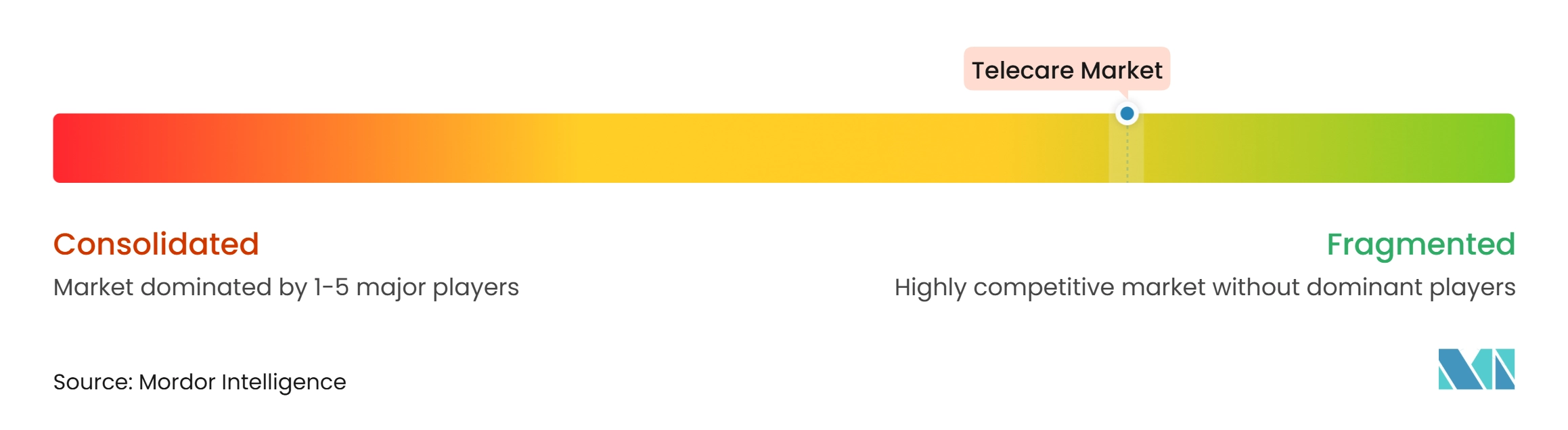
The telecare market includes large medical technology companies, regional managed-service specialists, and newer providers focused on AI-enabled monitoring. Medtronic and Philips renewed a strategic partnership in 2025 that combines Nellcor pulse oximetry, Microstream capnography, and BIS brain monitoring technology with Philips monitoring platforms. The partnership supports care continuity from acute settings to home monitoring. Philips also joined Optum Healthcare's preferred provider network in September 2025. Its Mobile Cardiac Telemetry and Extended Holter solutions became available to 3.4 million Optum members across 22 U.S. states. These actions show that leading companies are using partnerships and distribution relationships to widen clinical reach. They are also seeking to connect monitoring hardware with continuing care pathways.
Regional companies compete through local operating capability and public procurement relationships. Careium secured a fully managed contract with Gloucestershire Council in September 2025. The agreement covers a 5-year delivery program for technology-enabled care. Legrand Care acquired Finnish patient flow software provider Axel Health in May 2026. The acquisition adds software capability to its connected-care operations in the Nordic region. These moves show why companies with a hardware background are adding software and service assets. The telecare market increasingly rewards firms that can combine installation, monitoring, data handling, and long-term care support.
Ambient sensing and clinical-grade remote monitoring are important areas of competition. Neteera obtained CE certification for a contactless system in March 2025, which supports its entry into German and wider European care settings. Teladoc Health expanded the Solo connected care platform in October 2026 with contactless vital sign measurement and ambient documentation tools. These products reflect a shift away from devices that require continuous user engagement. The shift also raises the importance of privacy protection, clinical validation, and integration with existing care systems. The telecare industry has a mix of larger platform providers and specialist companies serving distinct geographic and technology niches.
Telecare Industry Leaders
-
Tunstall Healthcare Group Limited
-
Legrand Care
-
TeleAlarm Group
-
ConnectAmerica.com LLC
-
Careium AB
- *Disclaimer: Major Players sorted in no particular order
Telecare Market Companies Covered in this Report
- Abbott Laboratories
- Alarm.com Incorporated
- Ascom
- Biofourmis, Inc.
- Boston Scientific
- Careium AB
- Chubb Limited
- ConnectAmerica.com LLC
- Doro AB
- Enovation Group B.V.
- Essence SmartCare Ltd.
- Everon Group
- GE HealthCare Technologies Inc.
- Koninklijke Philips
- Legrand Care
- Medtronic
- OMRON Healthcare, Inc.
- Resideo Technologies, Inc.
- Skyresponse AB
- Teladoc Health
- TeleAlarm Group
- The Access Group Limited
- Tunstall Healthcare Group Limited
- Vayyar Imaging Ltd.
- Vivify Health, Inc.
Recent Industry Developments in Telecare Market
- October 2026: Teladoc Health launched SoloVitals, a contactless AI vital-sign measurement solution using rPPG via camera, and SoloScribe, an ambient AI documentation tool, within its Solo platform for hospitals and health systems. SoloVitals entered private preview, with full release expected in December 2026, marking a significant expansion of contactless monitoring into mainstream clinical telehealth.
- May 2026: Legrand Care acquired Axel Health, a leading Finnish provider of patient flow management software for health and social care organizations, expanding its platform presence in the Nordic connected-care market and accelerating its software revenue mix.
- February 2026: Medtronic announced exclusive U.S. distribution of Corsano Health's FDA-cleared multi-parameter wearable, adding continuous heart rate, SpO2, respiratory rate, skin temperature, and activity monitoring to its hospital-to-home monitoring portfolio, following the product's 2025 Western European launch.
Global Telecare Market Report Scope
As per the report's scope, telecare uses technology, sensors, and communication systems to enable older adults, people with disabilities, and individuals living alone to remain safe, independent, and secure in their homes.
The Telecare Market is segmented by service type, offering, technology, deployment mode, application, end user, and geography. By service type, the market is segmented into remote monitoring, emergency response and personal emergency response systems, remote medication management, virtual consultation and telenursing, and care coordination and social support. By offering, the market is segmented into hardware and devices, software and platforms, and monitoring and response services. By technology, the market is segmented into wired telecare systems, wireless telecare systems, mobile-based telecare solutions, AI-enabled and smart telecare platforms, non-wearable ambient sensing, and wearable and implantable monitoring. By deployment mode, the market is segmented into cloud-based, on-premises, and hybrid. By application, the market is segmented into elderly care and aging in place, chronic-disease management, post-acute and rehabilitation care, medication management, fall detection and emergency response, mental health monitoring, and hospital-at-home and acute home care. By end user, the market is segmented into healthcare consumers, healthcare providers, healthcare payers, government and community care organizations, and assisted living and long-term care providers. By geography, the market is segmented into North America, Europe, Asia-Pacific, the Middle East and Africa, and South America. The market report also covers estimated market sizes and trends for 17 countries across major regions worldwide. The report offers market size and forecasts in value (USD) for the above segments.
Segmentation Overview
| Remote Monitoring |
| Emergency Response and Personal Emergency Response Systems |
| Remote Medication Management |
| Virtual Consultation and Telenursing |
| Care Coordination and Social Support |
| Hardware and Devices |
| Software and Platforms |
| Monitoring and Response Services |
| Wired Telecare Systems |
| Wireless Telecare Systems |
| Mobile-Based Telecare Solutions |
| AI-Enabled and Smart Telecare Platforms |
| Non-Wearable Ambient Sensing |
| Wearable and Implantable Monitoring |
| Cloud-Based |
| On-Premises |
| Hybrid |
| Elderly Care and Aging in Place |
| Chronic-Disease Management |
| Post-Acute and Rehabilitation Care |
| Medication Management |
| Fall Detection and Emergency Response |
| Mental Health Monitoring |
| Hospital-at-Home and Acute Home Care |
| Healthcare Consumers |
| Healthcare Providers |
| Healthcare Payers |
| Government and Community Care Organizations |
| Assisted Living and Long-Term Care Providers |
| North America | United States |
| Canada | |
| Mexico | |
| Europe | Germany |
| United Kingdom | |
| France | |
| Italy | |
| Spain | |
| Rest of Europe | |
| Asia-Pacific | China |
| Japan | |
| India | |
| Australia | |
| South Korea | |
| Rest of Asia-Pacific | |
| Middle East and Africa | GCC |
| South Africa | |
| Rest of Middle East and Africa | |
| South America | Brazil |
| Argentina | |
| Rest of South America |
| By Service Type | Remote Monitoring | |
| Emergency Response and Personal Emergency Response Systems | ||
| Remote Medication Management | ||
| Virtual Consultation and Telenursing | ||
| Care Coordination and Social Support | ||
| By Offering | Hardware and Devices | |
| Software and Platforms | ||
| Monitoring and Response Services | ||
| By Technology | Wired Telecare Systems | |
| Wireless Telecare Systems | ||
| Mobile-Based Telecare Solutions | ||
| AI-Enabled and Smart Telecare Platforms | ||
| Non-Wearable Ambient Sensing | ||
| Wearable and Implantable Monitoring | ||
| By Deployment Mode | Cloud-Based | |
| On-Premises | ||
| Hybrid | ||
| By Application | Elderly Care and Aging in Place | |
| Chronic-Disease Management | ||
| Post-Acute and Rehabilitation Care | ||
| Medication Management | ||
| Fall Detection and Emergency Response | ||
| Mental Health Monitoring | ||
| Hospital-at-Home and Acute Home Care | ||
| By End User | Healthcare Consumers | |
| Healthcare Providers | ||
| Healthcare Payers | ||
| Government and Community Care Organizations | ||
| Assisted Living and Long-Term Care Providers | ||
| By Geography | North America | United States |
| Canada | ||
| Mexico | ||
| Europe | Germany | |
| United Kingdom | ||
| France | ||
| Italy | ||
| Spain | ||
| Rest of Europe | ||
| Asia-Pacific | China | |
| Japan | ||
| India | ||
| Australia | ||
| South Korea | ||
| Rest of Asia-Pacific | ||
| Middle East and Africa | GCC | |
| South Africa | ||
| Rest of Middle East and Africa | ||
| South America | Brazil | |
| Argentina | ||
| Rest of South America | ||
Key Questions Answered in the Report
What is the projected value of telecare by 2032?
The telecare market is forecast to reach USD 6.85 billion by 2032, growing at a 5.01% CAGR from 2027 to 2032.
Which telecare service has the largest share?
Remote monitoring led service types with a 34.82% share in 2026.
Which telecare technology is growing the fastest?
AI-enabled and smart telecare platforms are forecast to grow at a 10.28% CAGR through 2032.
Why is cloud deployment important for telecare providers?
Cloud-based deployment held a 48.63% share in 2026 and supports access to monitoring data, software updates, and connected clinical workflows.
What is driving hospital-at-home adoption?
The extension of the Acute Hospital Care at Home waiver through 2030 gives U.S. health systems a longer policy basis for home-based acute care investment.
Which region is growing fastest in telecare?
Asia-Pacific is forecast to grow at a 7.64% CAGR through 2032, supported by aging demographics, connectivity, and digital health programs.