
Technical Textile Manufacturing Market Size and Share
Market Overview
| Study Period | 2021 - 2032 |
|---|---|
| Market Size (2027) | USD 325 Billion |
| Market Size (2032) | USD 434.90 Billion |
| Growth Rate (2027 - 2032) | 6.00 % |
| Fastest Growing Market | Middle East and Africa |
| Largest Market | Asia-Pacific |
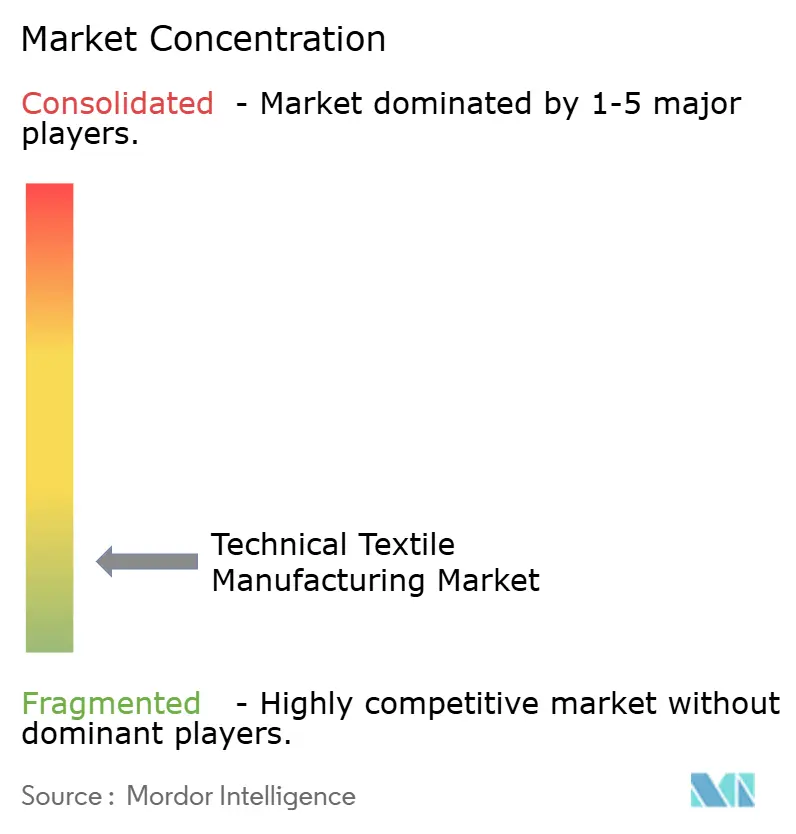
| Market Concentration | Low |
Major Players *Disclaimer: Major Players sorted in no particular order Image © Mordor Intelligence. Reuse requires attribution under CC BY 4.0. | |
Technical Textile Manufacturing Market Analysis by Mordor Intelligence
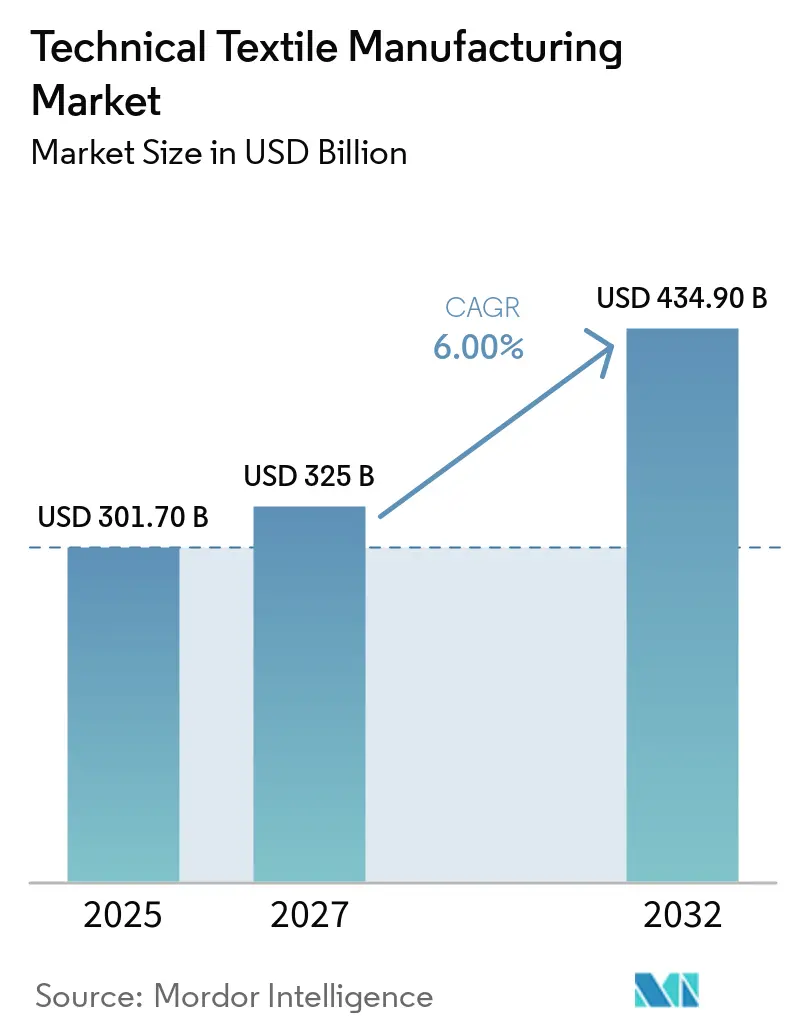
The Technical Textile Manufacturing Market size is expected to increase from USD 301.70 billion in 2026 to USD 325 billion in 2027 and reach USD 434.90 billion by 2032, growing at a CAGR of 6% over 2027-2032.
The technical textile manufacturing market is driven by demand for materials engineered to meet specific performance requirements, including high tensile strength, barrier protection, thermal resistance, filtration efficiency, and safety. Infrastructure development, vehicle lightweighting, expanding health care capacity, and increasingly stringent workplace safety requirements support demand across diverse end-use industries. Growing emphasis on durability, operational efficiency, and application-specific performance encourages manufacturers to invest in advanced materials, specialized production capabilities, and product development. These trends create opportunities to serve multiple customer segments through adaptable material platforms and specialized finishing processes. Competition increasingly depends on manufacturing expertise, consistent product quality, compliance with technical standards, and long-term customer relationships. Industry consolidation is also strengthening larger manufacturers with broader product portfolios and established supply networks. Diversification across infrastructure, mobility, health care, filtration, and protective applications enables suppliers to reduce dependence on individual end-use industries and manage demand fluctuations more effectively.
Key Report Takeaways
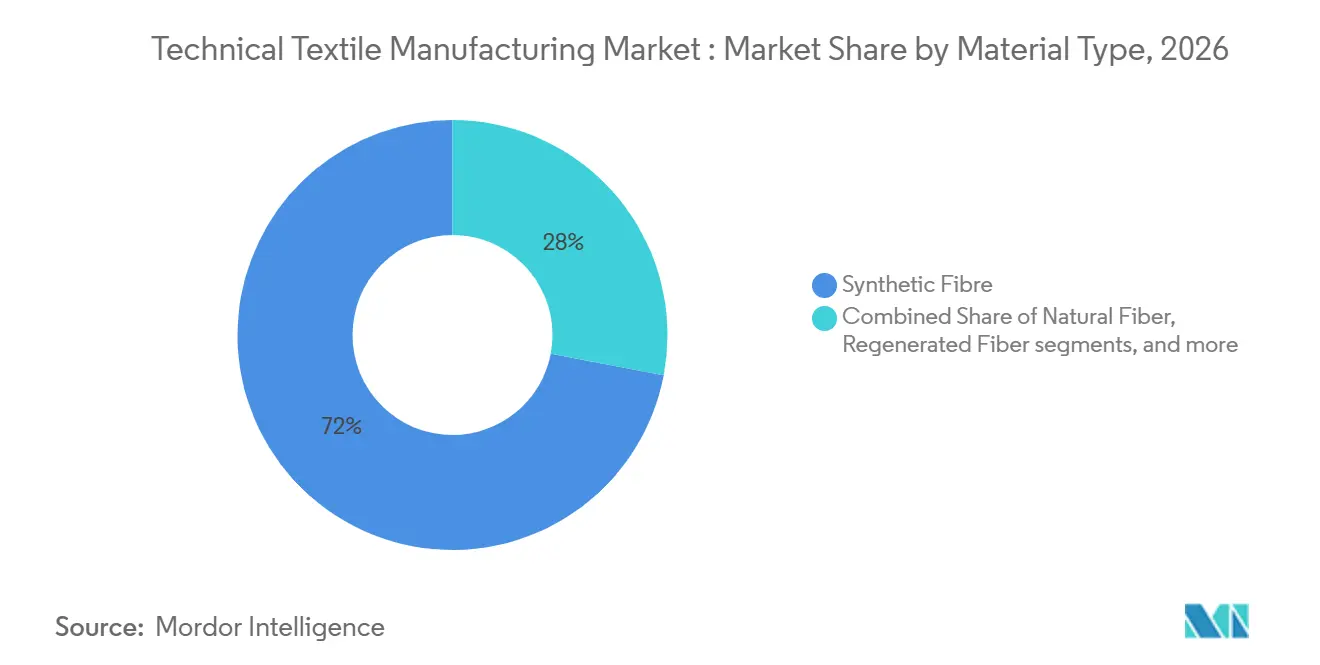
- By material type, synthetic fiber accounted for 72.00% of the technical textile manufacturing market share in 2026, while others (metallic, conductive, and other specialty fibers) are projected to be the fastest-growing, with a 9.00% CAGR through 2032.
- By form and structure, nonwoven technical textiles accounted for 38.00% of the technical textile manufacturing market size in 2026, while braided technical textiles are projected to be the fastest-growing, with a 7.00% CAGR through 2032.
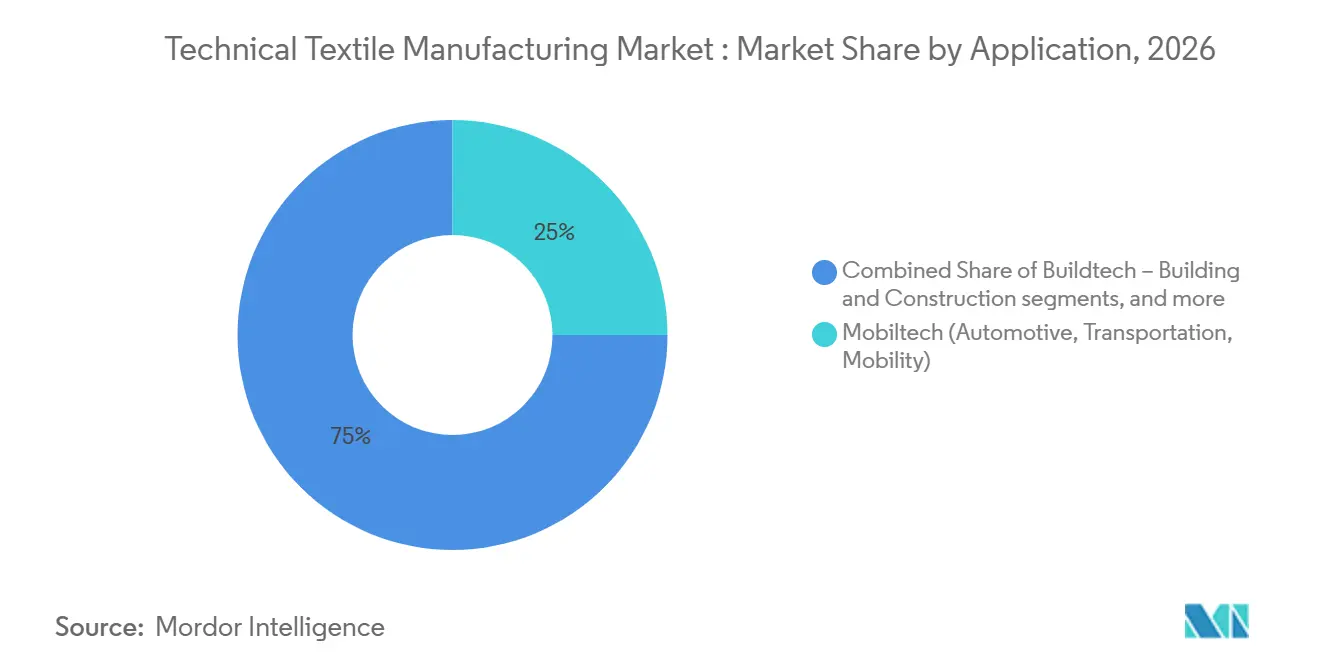
- By application, mobiltech (automotive, transportation, mobility) held 25.00% of the market share in 2026, while medtech (medical & hygiene) is projected to expand the fastest at an 8.50% CAGR through 2032.
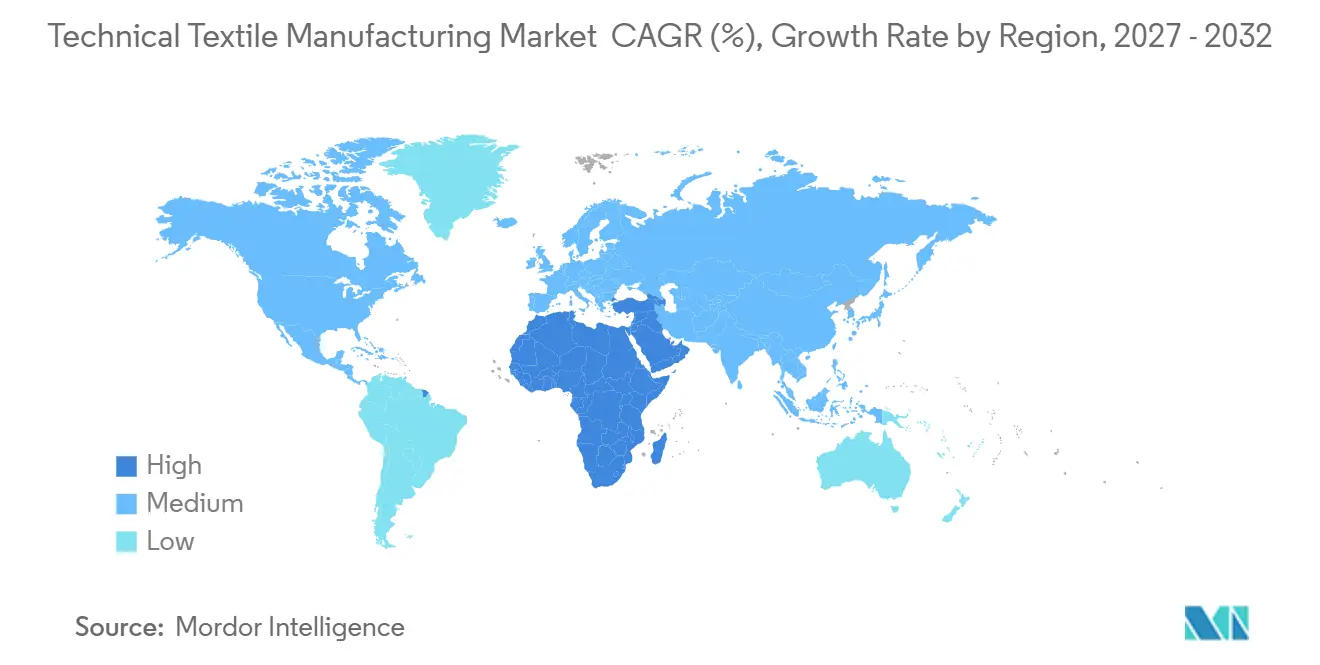
- By geography, Asia-Pacific held the leading position, accounting for 44.00% market share in 2025, while the Middle East and Africa are projected to be the fastest-growing, with a 9.50% CAGR through 2032.
Note: Market numbers in this report are based on Mordor Intelligence's proprietary estimation framework, which combines nine months of actuals with Q4 projections for base year 2026.
Global Technical Textile Manufacturing Market Trends and Insights
Drivers Impact Analysis*
| Driver | (~) % Impact on CAGR Forecast | Geographic Relevance | Impact Timeline |
|---|---|---|---|
| Industrialization and Infrastructure Development | +1.4% | Global, concentrated in Asia-Pacific, the Middle East and Africa, and South America | Long term (≥ 4 years) |
| Growing Medical, Hygiene, and Filtration Demand | +1.2% | Global, strongest in North America, Europe, and the Asia-Pacific | Medium term (2-4 years) |
| Lightweighting and Performance Needs in Automotive, EV, and Aerospace Applications | +1% | North America, Europe, and the Asia-Pacific | Medium term (2-4 years) |
| Demand for High-Performance and Multifunctional Textile Materials | +0.8% | Global, strongest in North America, Europe, and Japan | Long term (≥ 4 years) |
| Growth of Protective, Industrial, and Specialty Textile Applications | +0.7% | Global, concentrated in North America, Europe, and the Asia-Pacific | Medium term (2-4 years) |
| Shift Toward Sustainable and Recycled Textile Materials | +0.6% | Europe, with spillover to North America and Asia-Pacific | Long term (≥ 4 years) |
| Source: Mordor Intelligence | |||
Industrialization and Infrastructure Development
Public and private spending on roads, railways, housing, and water systems creates recurring demand for geotextiles, construction membranes, drainage fabrics, reinforcement textiles, and erosion-control nonwovens. Once these products are specified in a project, replacement with a different material is less likely because performance requirements have already been validated. India’s National Technical Textiles Mission was extended through March 2026 and had approved 168 research and development projects, while 74 applicants were approved under the production-linked incentive program for textiles. Modern road projects also use separation layers, drainage recomposites, and slope protection systems that were less common in earlier construction, increasing material use per kilometer. These programs support a longer order pipeline for the technical textile manufacturing market in Southeast Asia, the Gulf Cooperation Council, and sub-Saharan Africa.
Growing Medical, Hygiene, and Filtration Demand
Medical nonwovens, filtration media, and health care textiles must meet defined performance and compliance requirements, which limit substitution by lower-cost products. The United States Department of Health and Human Services has prioritized domestic production of essential nonwoven medical disposables, supporting investment in spunbond and meltblown capacity. Air filtration applications are also tied to documented performance requirements under standards such as ISO 16890 and EN 1822. Aging populations increase demand for disposable barrier, absorbent, and wound-care textiles in hospitals and long-term care settings. This demand helps the technical textile manufacturing market because specialty filtration and medical uses have higher requirements than commodity hygiene products.
Lightweighting and Performance Needs in Automotive, EV, and Aerospace Applications
Technical textiles and fiber composites help vehicle producers reduce weight while retaining the required structural performance. Their use becomes more important when vehicle makers must manage energy use, cabin comfort, structural requirements, and material durability within the same design. In May 2026, Trützschler stated that its TRUECYCLED yarn, made with 50% post-consumer textile waste and 50% recycled polyester, was used in Lotus Eletre and Emeya vehicles. Electric vehicles need acoustic management, thermal insulation, and battery enclosure materials that differ from those used in combustion vehicles. Aerospace adds another demand base because its structural composite, cabin-weight, and thermal-management requirements need engineered fiber structures.
Demand for High-Performance and Multifunctional Textile Materials
Materials that combine load-bearing ability with thermal management, or filtration with mechanical durability, can support higher-value applications. Conductive yarns and sensor-embedded fabrics are extending use into industrial condition monitoring, health care wearables, and defense equipment. Integrated textile systems can reduce the number of separate insulation, structural, and protective layers in a product. These capabilities expand the technical textile manufacturing market into applications where product value depends on both material performance and system functionality.
Restraints Impact Analysis*
| Restraint | (~) % Impact on CAGR Forecast | Geographic Relevance | Impact Timeline |
|---|---|---|---|
| High Manufacturing Costs and Capital Intensity | -0.4% | Global, most acute for emerging markets and new entrants | Long term (≥ 4 years) |
| Raw-Material Price Volatility and Trade Exposure | -0.3% | Global | Short term (≤ 2 years) |
| Complex Qualification, Certification, and Performance Requirements | -0.1% | North America, Europe, and Japan | Medium term (2-4 years) |
| Limited Textile-to-Textile Recycling and Multi-Material Product Challenges | -0.1% | Europe and North America | Long term (≥ 4 years) |
| Source: Mordor Intelligence | |||
High Manufacturing Costs and Capital Intensity
Specialty nonwoven lines, coating and lamination facilities, and advanced weaving or braiding plants need substantial upfront investment. The Ministry of Textiles stated in its 2025 review that technical textiles are more capital-intensive than artificial fiber apparel and fabrics, and 56.75% of the approved production-linked incentive companies operated in technical textiles. Material development, qualification, and standard-setting costs can also be difficult for a single producer to carry alone. Imported specialty inputs can add costs where domestic production is not available. These conditions slow new entry into the technical textile manufacturing market, especially in safety-critical product categories.
Raw-Material Price Volatility and Trade Exposure
Polyester accounted for 59% of global fiber production in 2024, or 77.7 million tons, which exposes textile producers to petroleum-based feedstock movements. The textile-to-textile inputs represented 2% of recycled polyester, while most recycled polyester came from PET bottles. This leaves producers dependent on virgin feedstocks and a contested bottle-recycling supply base. Tariff changes can add further pressure when suppliers have fixed-price commitments for specification-sensitive materials. Smaller producers have less ability to use forward purchasing or maintain large inventories, which can weaken margins during input-price swings.[1]
*Our forecasts treat driver/restraint impacts as directional, not additive. The impact forecasts reflect baseline growth, mix effects, and variable interactions.
Segment Analysis
By Material Type: Synthetic Fiber Leads the Market, While Specialty Fibers Grow Faster
Synthetic fiber held 72% of the technical textile manufacturing market share in 2026. Polyester, polypropylene, polyamide, and polyethylene support geotextiles, filtration media, automotive fabrics, tire cord, and hygiene nonwovens. Their position reflects consistent mechanical properties, cost competitiveness at volume, and broad feedstock availability. The technical textile manufacturing market uses these materials across both commodity-scale and specification-led applications, which gives synthetic fiber a wide customer base.
Others (metallic, conductive, and other specialty fibers) are forecast to grow at a 9% CAGR through 2032, supported by smart textiles, electromagnetic shielding, and electrically active composite structures. Glass, carbon, and basalt also support composite reinforcement in construction and mobility uses. Aramid and ultra-high-molecular-weight polyethylene fibers are used in protective and cut-resistant products, where their performance supports premium positioning. Natural fibers such as cotton and jute retain roles in agricultural textiles and shorter-life geotextiles. Regenerated fibers, including viscose, lyocell, and modal, are gaining attention in medical and hygiene products where cellulosic origin and biodegradability matter.

By Form and Structure: Nonwovens Lead Broad Applications, While Braids Serve Specialized Uses
Nonwoven technical textiles held 38% of the value in 2026. Their scale comes from uses in hygiene, medical barriers, industrial filtration, vehicle acoustics, and roofing. Producers can adjust nonwoven properties through spun bond, melt-blown, needle-punch, and hydroentanglement processes. Coatings and laminations extend their functional range further. These capabilities give nonwovens a larger set of uses than a single woven or knitted construction. Woven technical textiles continue to serve structural reinforcement and precision-filtration applications that need dimensional stability and established performance data. Knitted materials are used in medical compression garments and vehicle seat facings where stretch and fit are important.
Braided technical textiles are forecast to grow at a 7% CAGR through 2032 because they can create tubular and complex profiles for aerospace preforms, medical catheter sheathing, and high-pressure hose reinforcement. Technical yarns, cords, and rovings remain essential inputs for every structural format. The move toward higher-value medical and filtration nonwovens is also directing capacity decisions toward applications with stronger performance requirements, which requires producers to balance high-volume output with tighter quality control, documentation, customer validation, clean production conditions, reliable traceability, and repeatable material performance while serving narrower applications with more demanding specifications.
By Application: Mobiltech Has the Largest Base, While Medtech Has the Fastest Growth
Mobiltech held 25% of the market value in 2026. The category includes vehicle interiors, seating, carpeting, acoustic damping systems, airbag fabrics, and tire cord reinforcement. Electric vehicles are changing the mix of products through battery enclosures, thermal management, acoustic control, and lightweight composite panels. The larger value placed on material performance gives suppliers opportunities to serve automotive producers with more specialized products.
Medtech is forecast to grow at an 8.5% CAGR through 2032 as hospitals use more nonwovens in surgical and infection-prevention settings. Aging populations and the development of wearable and implantable medical devices also support demand. Indutech remains tied to industrial activity through conveyor belts, hoses, filtration products, ropes, and process textiles. Geotech and Buildtech depend on road, rail, dam, and flood-defense investments. Protech, Agrotech, Packtech, Oekotech, Hometech, Clothtech, and Sporttech each serve narrower needs, and together they reduce the technical textile manufacturing market’s exposure to a single application cycle.
Geography Analysis
Asia-Pacific held 44% of the market value in 2026 and led the technical textile manufacturing market. China benefits from an integrated synthetic-fiber supply base and demand from construction, automotive, and health care customers. India is expanding specialty production through the production-linked incentive program and the National Technical Textiles Mission, with 74 approved applicants under the textile incentive program. Vietnam, Indonesia, Thailand, and Malaysia are developing positions in geotextiles, agrotextiles, and construction fabrics. Japan and South Korea focus on higher-value composites, specialty fibers, and smart textile applications.
Europe and North America remain important markets for technically demanding applications in the technical textile manufacturing market. European automotive customers need lightweight composites, acoustic-management products, and functional interior fabrics, particularly in Germany, Italy, and France. The region’s ecodesign and producer-responsibility requirements are drawing increasing attention to material composition and recyclability. North America has strong demand from defense, medical nonwovens, and advanced composites. The National Council of Textile Organizations reported that the FY2025 National Defense Authorization Act expanded domestic defense textile stockpiling and increased transparency requirements for non-domestic procurement waivers.[2]
The Middle East and Africa are forecast to grow at a 9.5% CAGR through 2032, the fastest rate among the regions in the technical textile manufacturing market. Construction-led development and defense procurement in Gulf Cooperation Council countries support demand for geotextiles, construction membranes, erosion-control products, and industrial fabrics. Saudi Arabia and the United Arab Emirates are expanding construction and manufacturing activity, while domestic technical textile supply remains limited relative to demand. This makes the region an export opportunity for Asian and European suppliers in the near and medium term. South America, led by Brazil, uses agrotextiles, shading nets, protective agricultural films, and geotextiles in agriculture and infrastructure projects.
Competitive Landscape
The technical textile manufacturing market is fragmented because large suppliers coexist with specialists in many materials and applications. Scale matters more in commodity nonwovens, geosynthetics, and standard industrial fabrics, where feedstock purchasing and logistics can support cost competitiveness. In protective fabrics, precision filtration, smart textiles, and composite preforms, process know-how, testing history, and customer qualification are more important competitive barriers. Large suppliers are concentrating portfolios around specification-led products and reducing exposure to categories with lower differentiation. This creates room for smaller companies that have a focused technical capability or a strong position in a specific end use.
Michelin expanded its Polymer Composite Solutions business through the acquisition of Cooley Group in January 2026 and the completed acquisition of Tex Tech Industries in July 2026. The transactions added coated industrial fabrics and specialty textile systems to its materials portfolio. In March 2025, the German Federal Cartel Office cleared Freudenberg Performance Materials’ acquisition of the Heytex core business, leading to the MehlerHeytex brand. The authority found that sufficient competitive capacity remained in the European Economic Area. These moves show that larger players are pursuing specialized materials capabilities through acquisitions.
Arvind Advanced Materials acquired a 61% stake in United States-based needle-punched nonwoven producer Dalco-GFT in May 2026, giving it a qualified production base in the United States.[3] Arclin completed its acquisition of DuPont’s aramid business, including Kevlar and Nomex, in April 2026 for USD 1.8 billion. Companies are also focusing on PFAS-free finishing, recyclable material structures, and sensor-integrated textiles as customer requirements change. Digital quality inspection and digital-twin manufacturing can improve yield and help shorten product-development cycles. The technical textile manufacturing market is likely to retain both larger platform suppliers and specialists that serve narrow, high-requirement applications.
Technical Textile Manufacturing Industry Leaders
-
Ahlstrom
-
Asahi Kasei Corporation
-
Magnera Corporation
-
Toray Industries, Inc.
-
Freudenberg Performance Materials
- *Disclaimer: Major Players sorted in no particular order
Recent Industry Developments
- July 2026: Michelin completed the acquisition of Tex Tech Industries, a specialty textile and fabric designer with six production facilities across the United States and the United Kingdom, reinforcing its Polymer Composite Solutions business following the earlier acquisition of Cooley Group in January 2026. The third major acquisition in the segment within a single year signals an accelerated portfolio build-out in high-specification engineered materials.
- July 2026: Schouw & Co. agreed to acquire a 75% stake in Spectre, a specialty manufacturer of premium functional outdoor and sportswear fabrics, for USD 160 million. The transaction established a new platform business for Schouw in the premium performance textile segment.
- May 2026: Arvind Advanced Materials Limited, a wholly owned subsidiary of Arvind Limited, acquired a 61% stake in Dalco-GFT, a United States-based specialist in needle-punched nonwoven specialty fabrics. The acquisition gave Arvind an immediate qualified manufacturing platform in the United States. It signaled India-origin producers' intent to compete in the world’s largest technical textile market through capability acquisition rather than greenfield entry.
Global Technical Textile Manufacturing Market Report Scope
The Technical Textile Manufacturing Market Report is Segmented by Material Type (Natural Fiber, Synthetic Fiber, Inorganic Fibers, and More), by Form and Structure (Technical Yarns, Cords, and Rovings, Woven Technical Textiles, and More), by Application (Mobiltech, Indutech, Buildtech, and More), and by Geography (Asia-Pacific, Europe, and More). The Report Offers Market Size and Forecasts in Value (USD) for all the Above Segments.
| Natural Fiber | Cotton |
| Jute | |
| Others - Flex, Wool, Hemp, Coir, etc. | |
| Synthetic Fiber | Polyester |
| Polyamide / Nylon | |
| Polypropylene | |
| Polyethylene / UHMWPE | |
| Aramid and Other Specialty Synthetic Fibers | |
| Regenerated Fiber - Viscose, Lyocell, and Modal | |
| Inorganic Fibers (Glass, Carbon, Basalt, etc.) | |
| Others (Metallic, Conductive, and Other Specialty Fibers) |
| Technical Yarns, Cords, and Rovings |
| Woven Technical Textiles |
| Nonwoven Technical Textiles |
| Knitted Technical Textiles |
| Braided Technical Textiles |
| Other Engineered Textile Structures |
| Mobiltech - Automotive, Transportation, and Mobility |
| Indutech - Industrial and Manufacturing Applications |
| Buildtech - Building and Construction |
| Medtech - Medical and Hygiene |
| Protech - Personal and Property Protection |
| Agrotech - Agriculture, Horticulture, Forestry, and Fishing |
| Geotech - Geotextiles and Civil Engineering |
| Packtech - Packaging and Containment |
| Oekotech - Environmental Protection |
| Hometech - Furniture, Floor Coverings, and Domestic Technical Applications |
| Clothtech - Functional Components for Clothing and Footwear |
| Sporttech - Sports and Leisure Applications |
| North America | United States |
| Canada | |
| Mexico | |
| South America | Brazil |
| Rest of South America | |
| Europe | Germany |
| Italy | |
| France | |
| United Kingdom | |
| Rest of Europe | |
| Asia-Pacific | China |
| India | |
| Japan | |
| Australia | |
| South Korea | |
| ASEAN (Indonesia, Thailand, Philippines, Malaysia, Vietnam) | |
| Rest of Asia-Pacific | |
| Middle East and Africa | Saudi Arabia |
| United Arab Emirates | |
| South Africa | |
| Turkey | |
| Rest of Middle East and Africa |
| By Material Type | Natural Fiber | Cotton |
| Jute | ||
| Others - Flex, Wool, Hemp, Coir, etc. | ||
| Synthetic Fiber | Polyester | |
| Polyamide / Nylon | ||
| Polypropylene | ||
| Polyethylene / UHMWPE | ||
| Aramid and Other Specialty Synthetic Fibers | ||
| Regenerated Fiber - Viscose, Lyocell, and Modal | ||
| Inorganic Fibers (Glass, Carbon, Basalt, etc.) | ||
| Others (Metallic, Conductive, and Other Specialty Fibers) | ||
| By Form and Structure | Technical Yarns, Cords, and Rovings | |
| Woven Technical Textiles | ||
| Nonwoven Technical Textiles | ||
| Knitted Technical Textiles | ||
| Braided Technical Textiles | ||
| Other Engineered Textile Structures | ||
| By Application | Mobiltech - Automotive, Transportation, and Mobility | |
| Indutech - Industrial and Manufacturing Applications | ||
| Buildtech - Building and Construction | ||
| Medtech - Medical and Hygiene | ||
| Protech - Personal and Property Protection | ||
| Agrotech - Agriculture, Horticulture, Forestry, and Fishing | ||
| Geotech - Geotextiles and Civil Engineering | ||
| Packtech - Packaging and Containment | ||
| Oekotech - Environmental Protection | ||
| Hometech - Furniture, Floor Coverings, and Domestic Technical Applications | ||
| Clothtech - Functional Components for Clothing and Footwear | ||
| Sporttech - Sports and Leisure Applications | ||
| By Geography | North America | United States |
| Canada | ||
| Mexico | ||
| South America | Brazil | |
| Rest of South America | ||
| Europe | Germany | |
| Italy | ||
| France | ||
| United Kingdom | ||
| Rest of Europe | ||
| Asia-Pacific | China | |
| India | ||
| Japan | ||
| Australia | ||
| South Korea | ||
| ASEAN (Indonesia, Thailand, Philippines, Malaysia, Vietnam) | ||
| Rest of Asia-Pacific | ||
| Middle East and Africa | Saudi Arabia | |
| United Arab Emirates | ||
| South Africa | ||
| Turkey | ||
| Rest of Middle East and Africa | ||
Key Questions Answered in the Report
What is the projected value of the technical textile manufacturing market by 2032?
The technical textile manufacturing market is projected to reach USD 434.9 billion by 2032, growing at a 6% CAGR from USD 325 billion in 2027.
Which material type has the largest share in technical textile manufacturing?
Synthetic fibre led with 72% of value in 2026, supported by its use in filtration, geotextiles, automotive fabrics, tire cord, and hygiene nonwovens.
Which region leads global demand for technical textiles manufacturing?
Asia-Pacific led with 44% of value in 2026, supported by integrated fiber production and demand from construction, automotive, and health care applications.
Which region is expected to grow fastest through 2032?
The Middle East and Africa are forecast to grow at a 9.5% CAGR through 2032 as construction and defense-related demand increase.
What are the main barriers for manufacturers of technical textiles?
Capital-intensive production, feedstock-price volatility, long qualification cycles, and limited recovery options for multi-material products are the main barriers.