
Tax Advisory Services Market Size and Share
Market Overview
| Study Period | 2021 - 2032 |
|---|---|
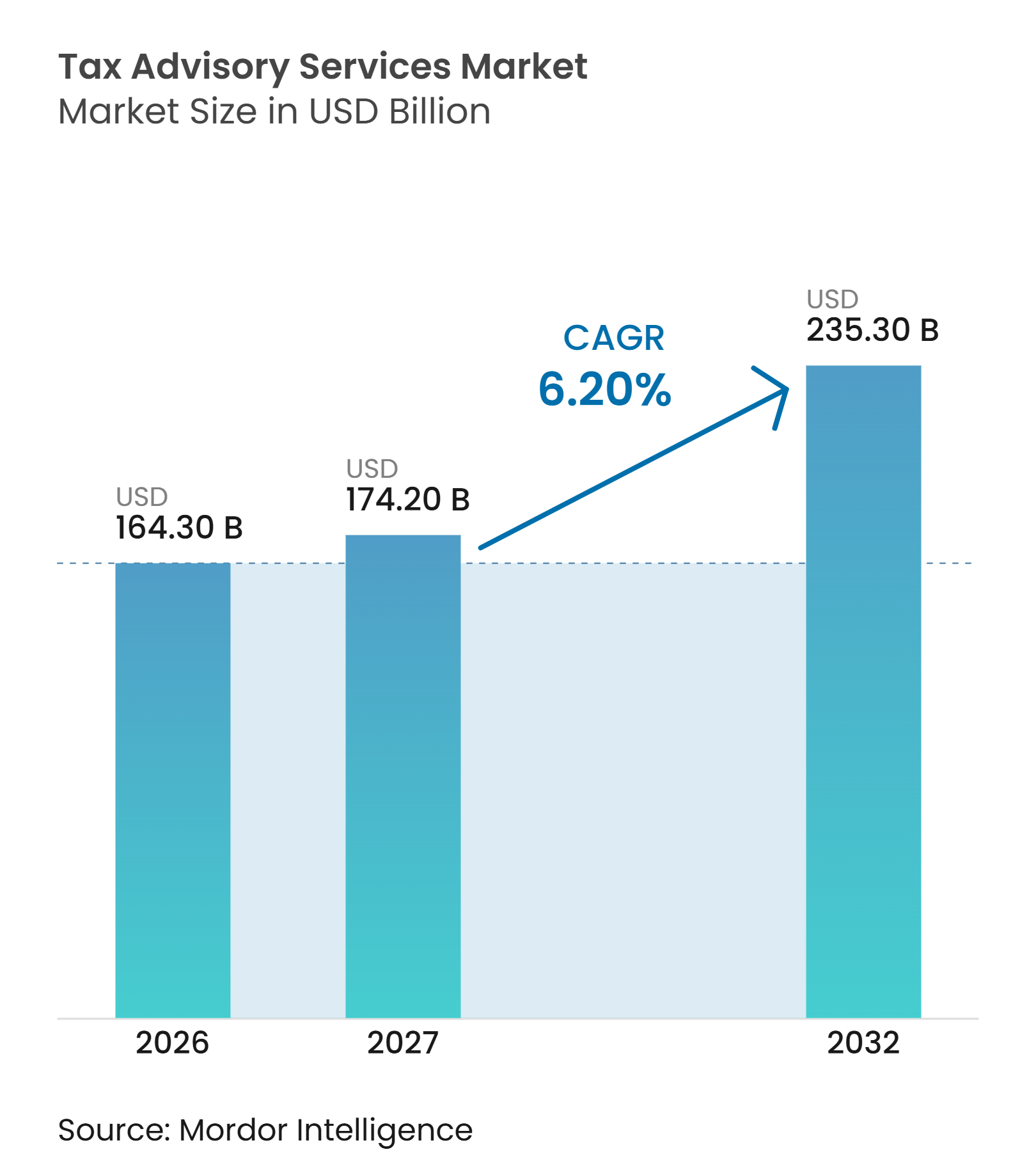
| Market Size (2027) | USD 174.20 Billion |
| Market Size (2032) | USD 235.30 Billion |
| Growth Rate (2027 - 2032) | 6.20 % |
| Fastest Growing Market | Asia-Pacific |
| Largest Market | North America |
| Market Concentration | Low |
Major Players *Disclaimer: Major Players sorted in no particular order Image © Mordor Intelligence. Reuse requires attribution under CC BY 4.0. | |
Tax Advisory Services Market Analysis by Mordor Intelligence
The Tax Advisory Services Market size is projected to expand from USD 164.30 billion in 2026 and USD 174.20 billion in 2027 to USD 235.30 billion by 2032, registering a CAGR of 6.20% between 2027 and 2032.
The tax advisory services market is being shaped by tax rule changes that are arriving across jurisdictions at the same time, including global minimum tax rules, digital reporting requirements, and broader country-by-country reporting obligations. This combination increases the need for recurring specialist support rather than isolated compliance assignments. It also favors firms that can combine technical tax expertise with implementation support for reporting systems and business records. Demand is widening beyond the largest multinational groups because regulatory changes now affect mid-sized businesses and smaller clients in several jurisdictions. The tax advisory services market is also moving toward outsourced and co-sourced operating models as clients address capability gaps, data integration needs, and the need for steady support across multiple tax regimes.
Key Report Takeaways
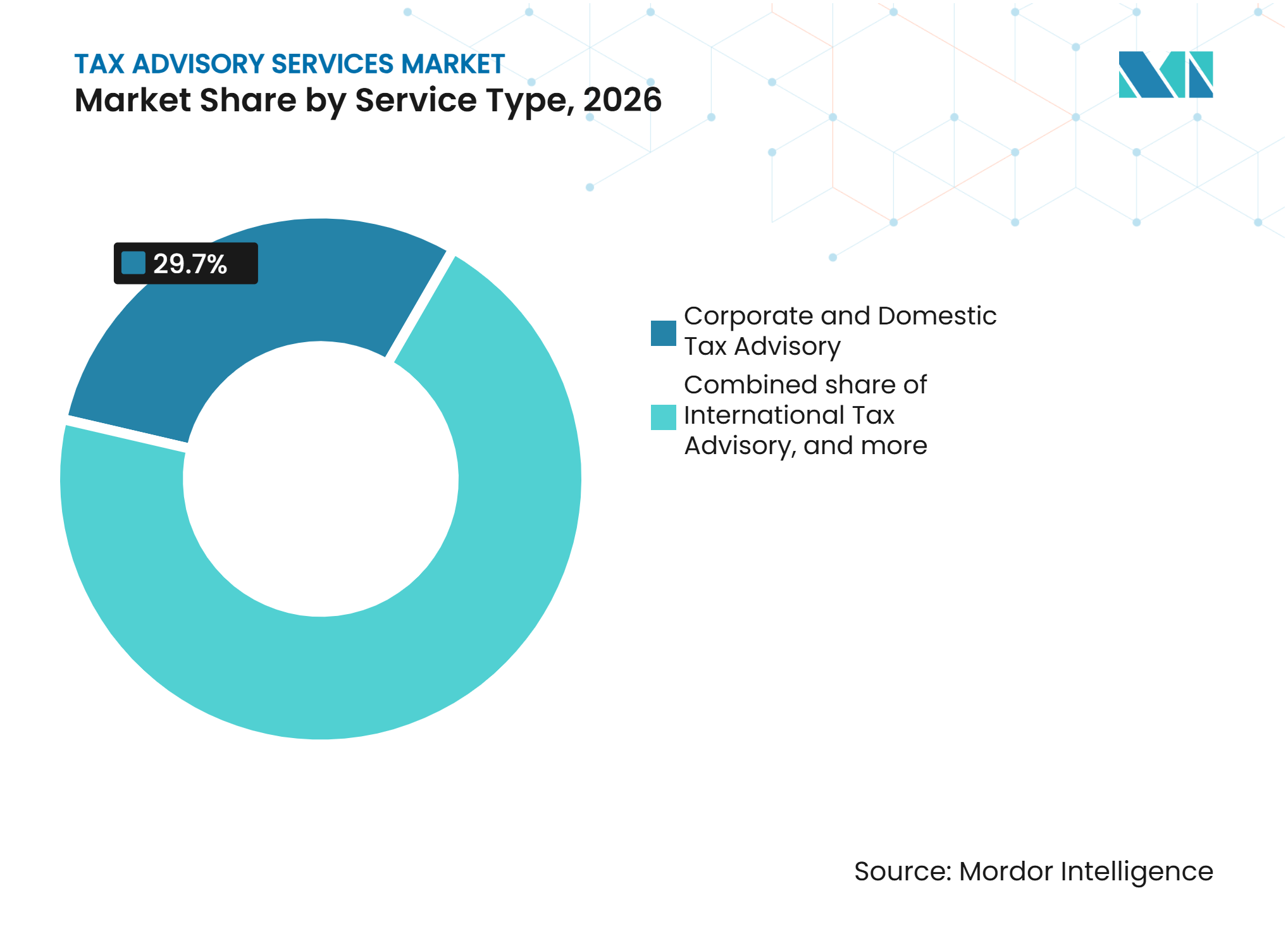
- By service type, corporate and domestic tax advisory captured 29.7% of the tax advisory services market share in 2026, while transfer pricing advisory is projected to grow at an 8.5% CAGR through 2032.
- By client type, large enterprises captured 40.3% of the tax advisory services market share in 2026, while small businesses are projected to grow at a 7.8% CAGR through 2032.
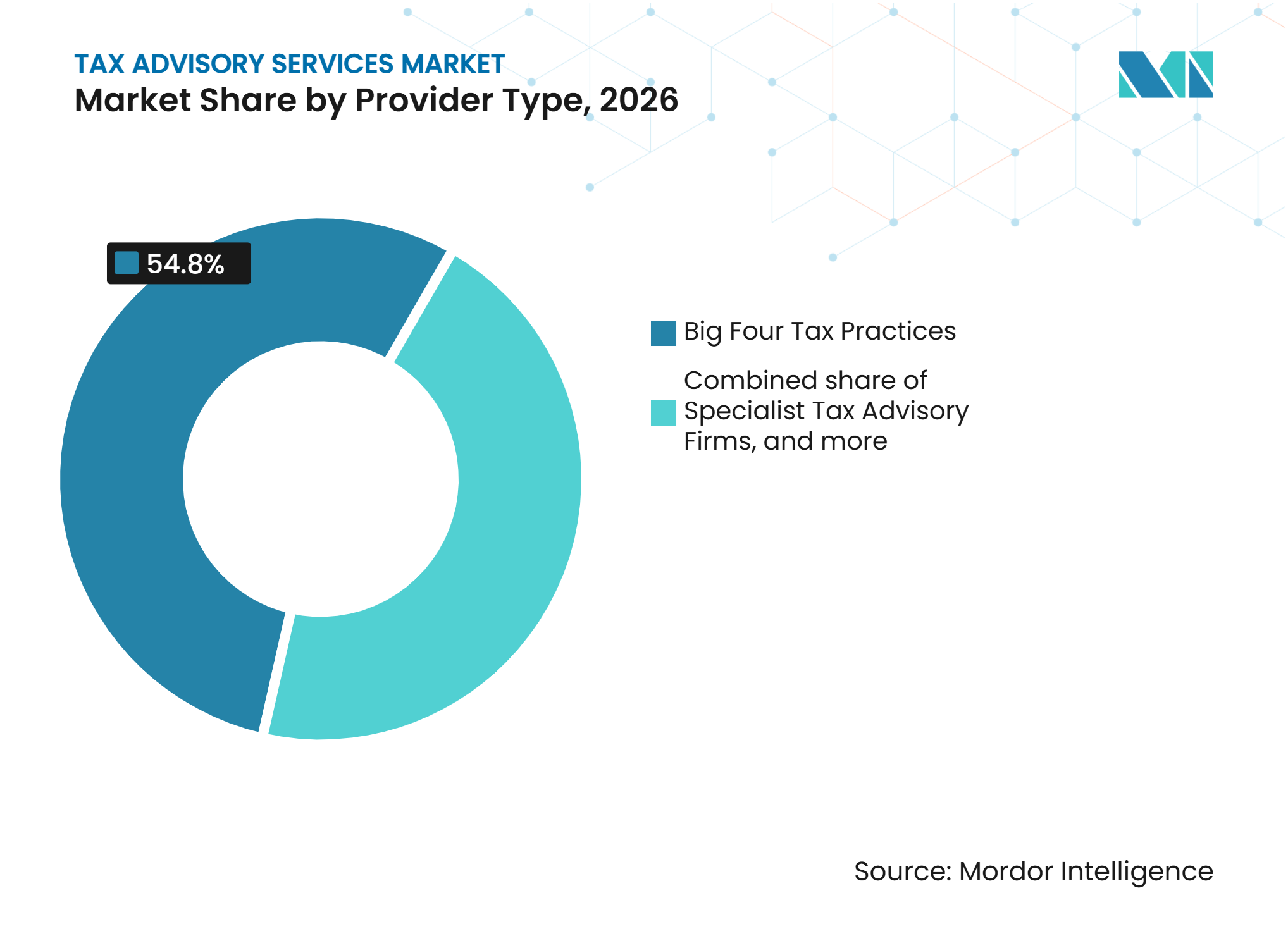
- By provider type, Big Four tax practices captured 54.8% of the tax advisory services market share in 2026, while tax technology and managed-service specialists are projected to grow at 8.9% CAGR through 2032.
- By industry vertical, banking, financial services and insurance captured 18.4% of the tax advisory services market share in 2026, while technology, media and telecommunications is projected to grow at an 8.5% CAGR through 2032.
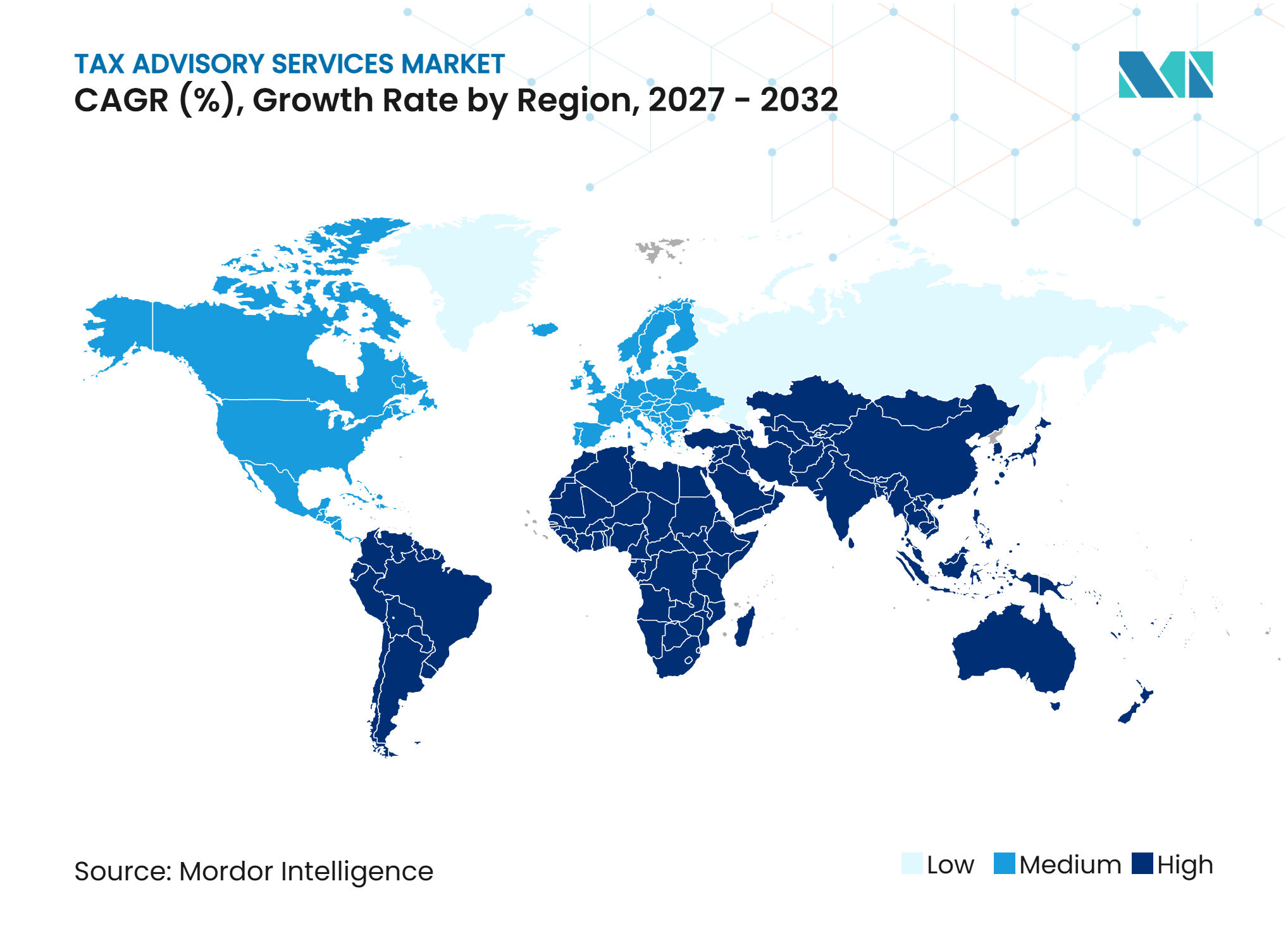
- By geography, North America captured 35.4% of the tax advisory services market share in 2026, while Asia-Pacific is projected to grow at an 8.3% CAGR through 2032.
Note: Market numbers in this report are based on Mordor Intelligence's proprietary estimation framework, which combines nine months of actuals with Q4 projections for base year 2026.
Market Trends and Insights
Drivers Impact Analysis of Tax Advisory Services Market*
| Driver | (~) % Impact on CAGR Forecast | Geographic Relevance | Impact Timeline |
|---|---|---|---|
| Increasing Complexity of Domestic and International Tax Compliance | +1.2% | Global | Short term (≤ 2 years) |
| OECD Pillar Two and Global Minimum Tax Requirements | +1.0% | Global, with primary relevance in the European Union, United Kingdom, Japan, South Korea, Australia, and Canada | Medium term (2-4 years) |
| Digital Tax Reporting and E-Invoicing Requirements | +0.8% | European Union core, India, Malaysia, Philippines, Belgium, France, and spillover to Middle East and Africa | Medium term (2-4 years) |
| Transfer Pricing and Cross-Border Structuring Demand | +0.9% | Global, concentrated in North America, European Union, and Asia-Pacific | Medium term (2-4 years) |
| Outsourced and Co-Sourced Tax Advisory Adoption | +0.7% | North America, Europe, and Asia-Pacific core markets | Short term (≤ 2 years) |
| Tax Technology Integration and Tax Data Transformation | +0.5% | North America, European Union, and Asia-Pacific | Medium term (2-4 years) |
| Source: Mordor Intelligence | |||
OECD Pillar Two Creates Durable Multi-Year Advisory Mandates
The tax advisory services market is gaining support from the continuing implementation of the OECD global anti-base erosion rules. The OECD reported in April 2026 that more than 65 jurisdictions had implemented or were actively implementing the rules or a qualified domestic minimum top-up tax[1]. The January 2026 side-by-side package added a simplified effective tax rate safe harbour, a substance-based tax incentives safe harbour, and parallel safe-harbour tracks for qualifying multinational groups. These additions require clients to interpret changing requirements while maintaining annual effective tax rate calculations and global anti-base erosion information return processes. The Tax advisory services market therefore benefits from engagements that can continue beyond the initial implementation stage. The OECD’s global minimum tax implementation toolkit also indicates demand from tax administrations that are building domestic compliance frameworks.
Digital Tax Reporting and E-Invoicing Generate Systemic Compliance Advisory Demand
The Tax advisory services market is affected by the European Union’s VAT in the Digital Age package, adopted through Directive (EU) 2025/516 on March 11, 2025, with measures effective from April 14, 2025[2]. Member States can now introduce e-invoicing requirements without seeking a European Commission derogation. The European Commission expects real-time digital reporting to reduce value-added tax fraud and administrative costs for European Union traders over a 10-year period. France requires e-reporting for large and mid-sized companies from September 1, 2026, with small and medium-sized enterprises following from September 1, 2027. India extended e-invoice reporting requirements from April 1, 2025. These mandates create demand for value-added tax advice, platform selection, and enterprise resource planning integration before long-term efficiency gains are realized.
Transfer Pricing Scrutiny Elevates Advisory into an Audit Defense Imperative
The Tax advisory services market is supported by a change in transfer pricing work from documentation preparation toward active audit defense. Tax authorities are seeking underlying analyses, internal materials, and support for functional interviews in addition to transfer pricing reports. This expands the scope of an engagement because advisers must connect a client’s commercial facts, internal records, and cross-border tax positions. Transfer pricing work is also becoming more closely linked to Pillar Two outcomes, which raises the value of integrated corporate tax and transfer pricing capabilities. The OECD/G20 Inclusive Framework continues to administer the baseline country-by-country reporting framework under Base Erosion and Profit Shifting Action 13[3]. Tariff-related supply chain changes can create new transfer pricing issues when companies alter legal entities, functions, or asset ownership across jurisdictions.
Outsourced and Co-Sourced Tax Models Reach a Structural Inflection
The Tax advisory services market is moving toward outsourced and co-sourced delivery as tax teams face broader compliance responsibilities. Clients increasingly need outside support to consolidate tax data from more than 1 enterprise resource planning system and to prepare information for recurring filings. Technology-enabled delivery also allows specialist providers to serve smaller clients where traditional project fees were previously uneconomic. This creates longer relationships than conventional one-time advisory projects because providers can operate selected parts of a tax function. The approach can support a later handback of a transformed internal capability when the client has built the needed people, processes, and systems. It also raises the importance of clear governance, access controls, and accountability between the client and the provider.
Restraints Impact Analysis of Tax Advisory Services Market*
| Restraint | (~) % Impact on CAGR Forecast | Geographic Relevance | Impact Timeline |
|---|---|---|---|
| Shortage of International Tax and Transfer Pricing Professionals | -0.5% | Global, with greatest pressure in North America, the European Union, and Asia-Pacific | Long term (≥ 4 years) |
| Cost of Specialized Advisory and Technology Implementation | -0.4% | North America and the European Union | Medium term (2-4 years) |
| Client Confidentiality and Cybersecurity Risks in Outsourced Engagements | -0.3% | Global | Short term (≤ 2 years) |
| Differences and Uncertainty in Tax Law Interpretation | -0.3% | Global | Long term (≥ 4 years) |
| Source: Mordor Intelligence | |||
Talent Scarcity Creates Binding Capacity Constraints
Talent scarcity limits the ability of the Tax advisory services market to expand capacity in international tax, transfer pricing, and global minimum tax advisory. The issue is more acute in work that depends on experienced professionals who can interpret rules across jurisdictions and explain their effects to clients. Limited specialist capacity can delay project delivery, restrict the number of engagements a firm can accept, and increase the cost of experienced staff. It also encourages firms to standardize repeatable processes and use managed-service delivery for routine compliance work. Smaller and mid-sized firms can face greater pressure because they have narrower specialist teams and fewer resources for recruitment. The resulting gap supports technology adoption, but technology does not remove the need for technical review and professional accountability.
Cybersecurity Exposure in Outsourced Engagements Challenges Client Confidence
Outsourced tax engagements handle sensitive financial, identity, and transaction information that requires strong confidentiality controls. EY disclosed unauthorized access to a third-party information technology service management platform used by its tax practice between March 28 and April 12, 2026. The firm notified state attorneys general in July 2026 and offered 24 months of identity monitoring to affected clients. The event shows how third-party platforms can create exposure even when the advisory firm itself has established controls. The Tax advisory services market must therefore treat vendor oversight, access management, and incident response as core requirements for technology-supported delivery. Clients in regulated sectors can place greater value on providers that demonstrate mature information security practices.
*Our forecasts treat driver/restraint impacts as directional, not additive. The impact forecasts reflect baseline growth, mix effects, and variable interactions.
Tax Advisory Services Market Segment Analysis
By Service Type:
Compliance Complexity Drives Consolidation Around Specialist AdvisoryCorporate and domestic tax advisory held 29.7% of the tax advisory services market size in 2026. The segment remains central because domestic tax obligations create recurring work across nearly every client type. Its scale also reflects the role of advisers in combining return preparation with effective tax rate analysis and statutory restructuring support. The service is changing as domestic minimum tax rules are increasingly connected to transfer pricing outcomes under Pillar Two. This connection requires corporate tax teams to understand transfer pricing implications within the same engagement.
Transfer pricing advisory is forecast to grow at 8.5% CAGR through 2032. The tax advisory services market gains from audit activity, Pillar Two-linked documentation, and supply chain changes that can alter cross-border profit allocation. Transfer pricing documentation is also a leading area for artificial intelligence use within tax and finance functions, reflecting the volume of underlying data and records involved. International tax advisory, transaction tax advisory, indirect tax and trade-related tax advisory, tax controversy and dispute resolution, global mobility and employment tax advisory, and private client and wealth tax advisory each retain distinct roles. Advisory firms also use ISO 27001 and SOC 2 credentials in client proposals as indicators of security and confidentiality standards.


By Client Type:
Regulatory Expansion Draws Smaller Clients Into Advisory CoverageLarge enterprises accounted for 40.3% of revenue in 2026. Their position is supported by multinational compliance obligations involving global base erosion reporting, country-by-country reporting, and multi-jurisdictional transfer pricing documentation. These assignments typically require coordination across tax, finance, legal, and operational functions. Large enterprises also have more complex legal entity structures, internal financing arrangements, and cross-border supply chains. Those features create demand for recurring advice that is broader than a domestic filing mandate.
Small businesses are projected to grow at 7.8% CAGR through 2032. The Tax advisory services market is extending to smaller businesses as e-invoicing requirements in France, Belgium, and India bring them into formal compliance processes that may require outside support. Technology-enabled service models can lower the minimum fee needed to provide professional support to this client group. Medium-sized businesses, high-net-worth individuals and families, government and public sector entities, and non-profit organizations remain distinct client groups with different compliance needs. Mid-market multinational businesses that cross the EUR 750 million (USD 882.23 million) global anti-base erosion threshold can require significant support without having the internal tax resources of the largest multinational groups.
By Provider Type:
Technology Specialists Disrupt the Provider HierarchyBig Four tax practices held a 54.8% share in 2026. Their scale is associated with broad global networks, specialist teams, and the ability to serve large multinational clients across several jurisdictions. Tax technology and managed-service specialists are projected to grow at an 8.9% CAGR through 2032. The Tax advisory services market retains meaningful room for mid-tier firms, law firms, independent specialists, and technology providers outside the Big Four. Those providers can compete in areas where deep subject expertise, industry knowledge, or software capability matters more than network scale.
Wolters Kluwer launched agentic tax preparation in CCH Axcess in October 2026, using Expert AI agents to prepare and calculate returns while retaining practitioner review and oversight. This model embeds technology more directly in workflows that were previously dependent on manual practitioner effort. Private equity investment has also supported consolidation among mid-tier accounting and advisory firms. KPMG Corporate Finance reported that 11 of the 30 largest United States accounting firms had accepted private equity investment as of the third quarter of 2025. The Tax advisory services market also accommodates specialist and law firm practices where technical depth is particularly important.

By Industry Vertical:
BFSI Anchors Demand While TMT Drives GrowthBanking, financial services, and insurance accounted for 18.4% of revenue in 2026. The Tax advisory services market draws continuing demand from this sector because it has complex cross-border structures, internal financing arrangements, and regulatory capital requirements that can interact with tax positions. Wealth management activities also create demand for advice on beneficial ownership, trust structures, and portfolio matters. The Global Anti-Base Erosion rules are relevant to financial institutions with multinational holding structures and operations across several jurisdictions. These businesses may need to reassess tax positions against the 15% global minimum effective tax rate.
Technology, media and telecommunications is forecast to grow at an 8.5% CAGR through 2032. The segment faces state and indirect tax issues as the taxability of software-as-a-service products and digital services changes. Companies in this vertical also need support with cross-border intellectual property structures and digital service tax exposure. KPMG found that 76% of surveyed Technology, media, and telecommunications companies were deploying or exploring generative artificial intelligence in tax, while 88% had automated less than half of their tax processes. Manufacturing and industrial products, retail and e-commerce, healthcare and life sciences, and energy and utilities have demand patterns shaped by supply chains, intellectual property structures, transaction activity, and sector-specific regulation.
Geography Analysis
North America held 35.4% of the tax advisory services market size in 2026. The tax advisory services market in the United States generates sustained demand because federal, state, and local tax obligations create a layered compliance environment. The One Big Beautiful Bill, signed in 2025, made permanent several provisions from the 2017 Tax Cuts and Jobs Act and changed research and experimental expenditure treatment. Canada and Mexico add cross-border demand through Canada-United States-Mexico Agreement-related transfer pricing, multilateral instrument analysis, and provincial tax structuring. Shared professional services networks support multinational clients operating across the 3 North American countries.
The tax advisory services market ranks Europe as the second-largest regional market. European Union value-added tax harmonization and the phased rollout of VAT in the Digital Age create multi-jurisdictional compliance needs. Germany’s audit and tax advisory market grew 6.1% in 2025 to EUR 22.6 billion (USD 26.5 billion). Big Four firms held 50.1% of the German market, while Forvis Mazars and RSM Ebner Stolz each recorded 11.2% growth in fiscal year 2025. The United Kingdom shows a similar pattern of competition between large firms and mid-market providers.
Asia-Pacific is projected to grow at 8.3% CAGR through 2032. China’s value-added tax law took effect on January 1, 2026, replacing the Interim Value-Added Tax Regulations, and Order No. 58 took effect on May 1, 2025, to regulate tax-related professional services. India continues to generate demand through its goods and services tax framework, e-invoice reporting requirements, and cross-border merger and acquisition activity, while Singapore, Japan, and South Korea remain important for global minimum tax readiness, regional treasury structures, and transfer pricing documentation. South America and the Middle East and Africa also offer potential as Brazil adopts domestic Global Minimum Tax legislation and Saudi Arabia expands e-invoicing requirements.
Competitive Landscape
Market Concentration
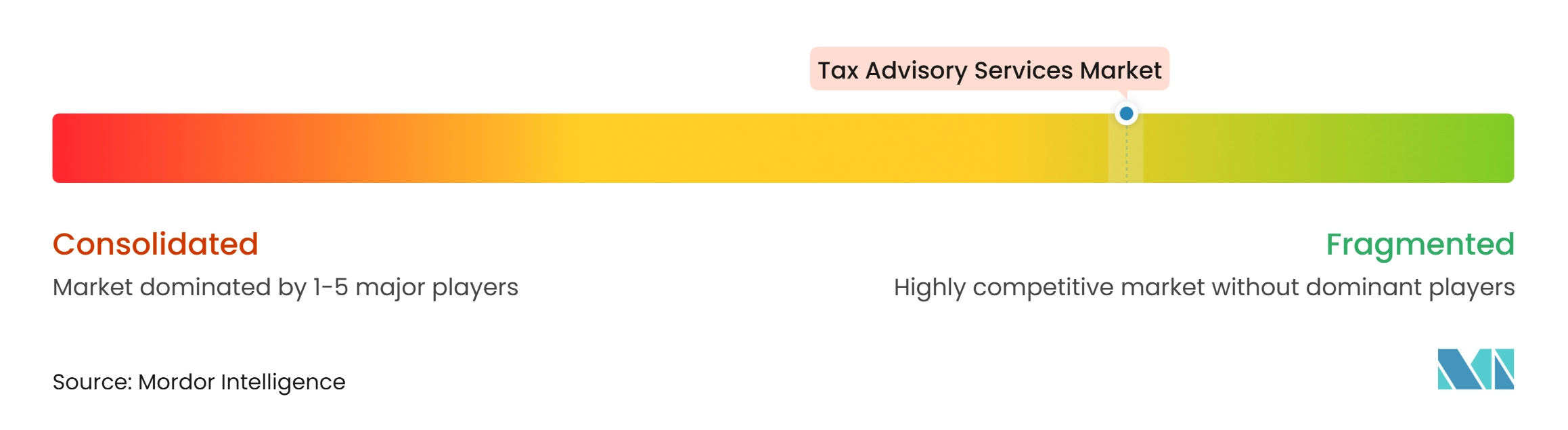
The tax advisory services market is fragmented, with competition spanning the Big Four accounting firms, mid-tier professional services networks, regional accounting practices, specialist tax law firms, and tax technology providers. Although the Big Four maintain significant scale through multinational client relationships and broad service portfolios, competition varies by geography, client size, and specialization. Independent firms and regional providers remain relevant in areas such as domestic tax compliance, transfer pricing, global mobility, indirect taxation, and cross-border structuring. Technology investment is also reshaping competition, as firms integrate artificial intelligence and automation into tax research, compliance, and advisory workflows. EY developed EY.ai for tax with IBM watsonx, while Deloitte has published a multi-report series on artificial intelligence transformation in tax. These investments reflect a shift toward technology-supported workflows and more integrated advisory delivery.
Mid-tier providers are using partnerships and acquisitions to improve geographic coverage, client access, and specialist capacity. RSM United States and RSM United Kingdom began their transatlantic partnership in January 2026, creating a partner-owned platform with 23,000 professionals and USD 5 billion in aggregate revenue. Andersen Global announced acquisitions in Ireland, New Zealand, Nigeria, and Uruguay during 2026, while also signing agreements for Switzerland and Canada. Andersen Global also entered a collaboration agreement with Lohr and Company in Germany in June 2026 to add global mobility, international tax law, country-by-country reporting, and Pillar Two capability. These moves show that cross-border delivery scale is an important competitive lever for firms outside the Big Four.
Competitive opportunities are concentrated in Global Anti-Base Erosion readiness for mid-market multinational groups, tax data remediation, and combined tax and supply chain restructuring work. Tax technology providers are entering workflows once delivered primarily by human practitioners, as shown by Wolters Kluwer’s October 2026 CCH Axcess launch. Security standards such as SOC 2 and ISO 27001 are increasingly relevant for outsourced mandates, particularly in regulated financial services. The Tax advisory services market is likely to reward providers that combine technical specialization, delivery technology, and credible information security controls.
Tax Advisory Services Industry Leaders
-
Deloitte Touche Tohmatsu Limited
-
PricewaterhouseCoopers International Limited
-
Ernst & Young Global Limited
-
KPMG International Limited
-
BDO International Limited
- *Disclaimer: Major Players sorted in no particular order
Tax Advisory Services Market Companies Covered in this Report
- Deloitte Touche Tohmatsu Limited
- PricewaterhouseCoopers International Limited (PwC)
- Ernst & Young Global Limited (EY)
- KPMG International Limited
- BDO International Limited
- Grant Thornton International Ltd.
- RSM International Ltd.
- Forvis Mazars
- Crowe Global
- Baker Tilly International
- Andersen Global
- WTS Global
- Taxand
- Vistra
- Alvarez & Marsal
- Baker McKenzie
- Ryan
- TMF Group
- HLB International
- Moore Global
Recent Industry Developments in Tax Advisory Services Market
- October 2026: Wolters Kluwer launched agentic tax preparation within the CCH Axcess platform, deploying Expert AI agents that autonomously prepare and calculate Form 1040 returns while keeping practitioners in a review and oversight role, marking a significant step toward AI-produced rather than AI-assisted tax compliance workflows.
- June 2026: Andersen Global entered a Collaboration Agreement with Lohr and Company (L+C) in Germany, adding capabilities in global mobility, international tax law, country-by-country reporting, and Pillar Two compliance advisory across large multinational and family-owned business client bases.
- May 2026: The OECD published the Consolidated Commentary to the Global Anti-Base Erosion Model Rules (2026), incorporating all Agreed Administrative Guidance released through May 2026, providing definitive technical interpretation of GloBE rules and further extending the mandatory advisory interpretation cycle for all MNEs in scope.
- October 2025: RSM United States and RSM United Kingdom’s transatlantic partnership took effect, creating a partner-owned platform with 23,000 professionals across the United States, United Kingdom, Canada, Ireland, India, and El Salvador and aggregate revenues of USD 5 billion, forming a credible mid-market alternative to Big Four global delivery on cross-border tax mandates.
Global Tax Advisory Services Market Report Scope
Segmentation Overview
| Corporate and Domestic Tax Advisory |
| International Tax Advisory |
| Transfer Pricing Advisory |
| Transaction Tax Advisory |
| Indirect Tax and Trade-Related Tax Advisory |
| Tax Controversy and Dispute Resolution |
| Global Mobility and Employment Tax Advisory |
| Private Client and Wealth Tax Advisory |
| Other Tax Advisory Services |
| Large Enterprises |
| Medium-Sized Businesses |
| Small Businesses |
| High-Net-Worth Individuals and Families |
| Government and Public Sector Entities |
| Non-Profit and Charitable Organizations |
| Other Clients |
| Big Four Tax Practices |
| Other Global Professional Services Networks |
| Specialist Tax Advisory Firms |
| Law Firms with Tax Practices |
| Tax Technology and Managed-Service Specialists |
| Other Tax Advisory Providers |
| Banking, Financial Services and Insurance |
| Technology, Media and Telecommunications |
| Manufacturing and Industrial Products |
| Retail, Consumer Goods and E-Commerce |
| Healthcare and Life Sciences |
| Energy and Utilities |
| Mining, Metals and Natural Resources |
| Real Estate and Construction |
| Transportation, Logistics and Automotive |
| Agriculture, Food and Agribusiness |
| Hospitality, Travel and Leisure |
| Professional and Business Services |
| Education |
| Public Administration and Government Services |
| Non-Profit and Charitable Activities |
| Other Industries |
| North America | United States |
| Canada | |
| Mexico | |
| South America | Brazil |
| Argentina | |
| Rest of South America | |
| Europe | United Kingdom |
| Germany | |
| France | |
| Italy | |
| Spain | |
| Rest of Europe | |
| Asia-Pacific | China |
| Japan | |
| India | |
| South Korea | |
| Australia | |
| Indonesia | |
| Thailand | |
| Malaysia | |
| Singapore | |
| Vietnam | |
| Rest of Asia-Pacific | |
| Middle East and Africa | Saudi Arabia |
| United Arab Emirates | |
| Turkey | |
| South Africa | |
| Egypt | |
| Rest of Middle East and Africa |
| By Service Type | Corporate and Domestic Tax Advisory | |
| International Tax Advisory | ||
| Transfer Pricing Advisory | ||
| Transaction Tax Advisory | ||
| Indirect Tax and Trade-Related Tax Advisory | ||
| Tax Controversy and Dispute Resolution | ||
| Global Mobility and Employment Tax Advisory | ||
| Private Client and Wealth Tax Advisory | ||
| Other Tax Advisory Services | ||
| By Client Type | Large Enterprises | |
| Medium-Sized Businesses | ||
| Small Businesses | ||
| High-Net-Worth Individuals and Families | ||
| Government and Public Sector Entities | ||
| Non-Profit and Charitable Organizations | ||
| Other Clients | ||
| By Provider Type | Big Four Tax Practices | |
| Other Global Professional Services Networks | ||
| Specialist Tax Advisory Firms | ||
| Law Firms with Tax Practices | ||
| Tax Technology and Managed-Service Specialists | ||
| Other Tax Advisory Providers | ||
| By Industry Vertical | Banking, Financial Services and Insurance | |
| Technology, Media and Telecommunications | ||
| Manufacturing and Industrial Products | ||
| Retail, Consumer Goods and E-Commerce | ||
| Healthcare and Life Sciences | ||
| Energy and Utilities | ||
| Mining, Metals and Natural Resources | ||
| Real Estate and Construction | ||
| Transportation, Logistics and Automotive | ||
| Agriculture, Food and Agribusiness | ||
| Hospitality, Travel and Leisure | ||
| Professional and Business Services | ||
| Education | ||
| Public Administration and Government Services | ||
| Non-Profit and Charitable Activities | ||
| Other Industries | ||
| By Geography | North America | United States |
| Canada | ||
| Mexico | ||
| South America | Brazil | |
| Argentina | ||
| Rest of South America | ||
| Europe | United Kingdom | |
| Germany | ||
| France | ||
| Italy | ||
| Spain | ||
| Rest of Europe | ||
| Asia-Pacific | China | |
| Japan | ||
| India | ||
| South Korea | ||
| Australia | ||
| Indonesia | ||
| Thailand | ||
| Malaysia | ||
| Singapore | ||
| Vietnam | ||
| Rest of Asia-Pacific | ||
| Middle East and Africa | Saudi Arabia | |
| United Arab Emirates | ||
| Turkey | ||
| South Africa | ||
| Egypt | ||
| Rest of Middle East and Africa | ||
Key Questions Answered in the Report
What is the projected growth rate for tax advisory services through 2032?
The Tax advisory services market is projected to grow at a 6.2% CAGR from 2027 to 2032, reaching USD 235.3 billion by 2032.
Which tax advisory service is growing fastest?
Transfer Pricing Advisory is projected to grow at 8.5% CAGR through 2032, supported by audit activity, documentation requirements, and supply chain changes.
Why is Pillar Two increasing demand for tax advisers?
More than 65 jurisdictions had implemented or were actively implementing Global Anti-Base Erosion rules or a Qualified Domestic Minimum Top-up Tax by April 2026.
Which client group accounts for the largest share of tax advisory revenue?
Large Enterprises accounted for 40.3% of revenue in 2026 because of their multi-jurisdictional compliance and transfer pricing needs.
Which region is expected to grow fastest for tax advisory services?
Asia-Pacific is projected to grow at 8.3% CAGR through 2032, supported by regulatory modernization in major regional economies.
How concentrated is the tax advisory services market?
The tax advisory services market is fragmented, with competition spanning the Big Four accounting firms, mid-tier professional services networks, regional accounting practices, specialist tax law firms, and tax technology providers.