
Tankless Water Heater Market Size and Share
Market Overview
| Study Period | 2021 - 2032 |
|---|---|
| Market Size (2027) | USD 12.11 Billion |
| Market Size (2032) | USD 16.05 Billion |
| Growth Rate (2027 - 2032) | 5.80 % |
| Fastest Growing Market | North America |
| Largest Market | Asia-Pacific |
| Market Concentration | Medium |
Major Players *Disclaimer: Major Players sorted in no particular order Image © Mordor Intelligence. Reuse requires attribution under CC BY 4.0. | |
Tankless Water Heater Market Analysis by Mordor Intelligence
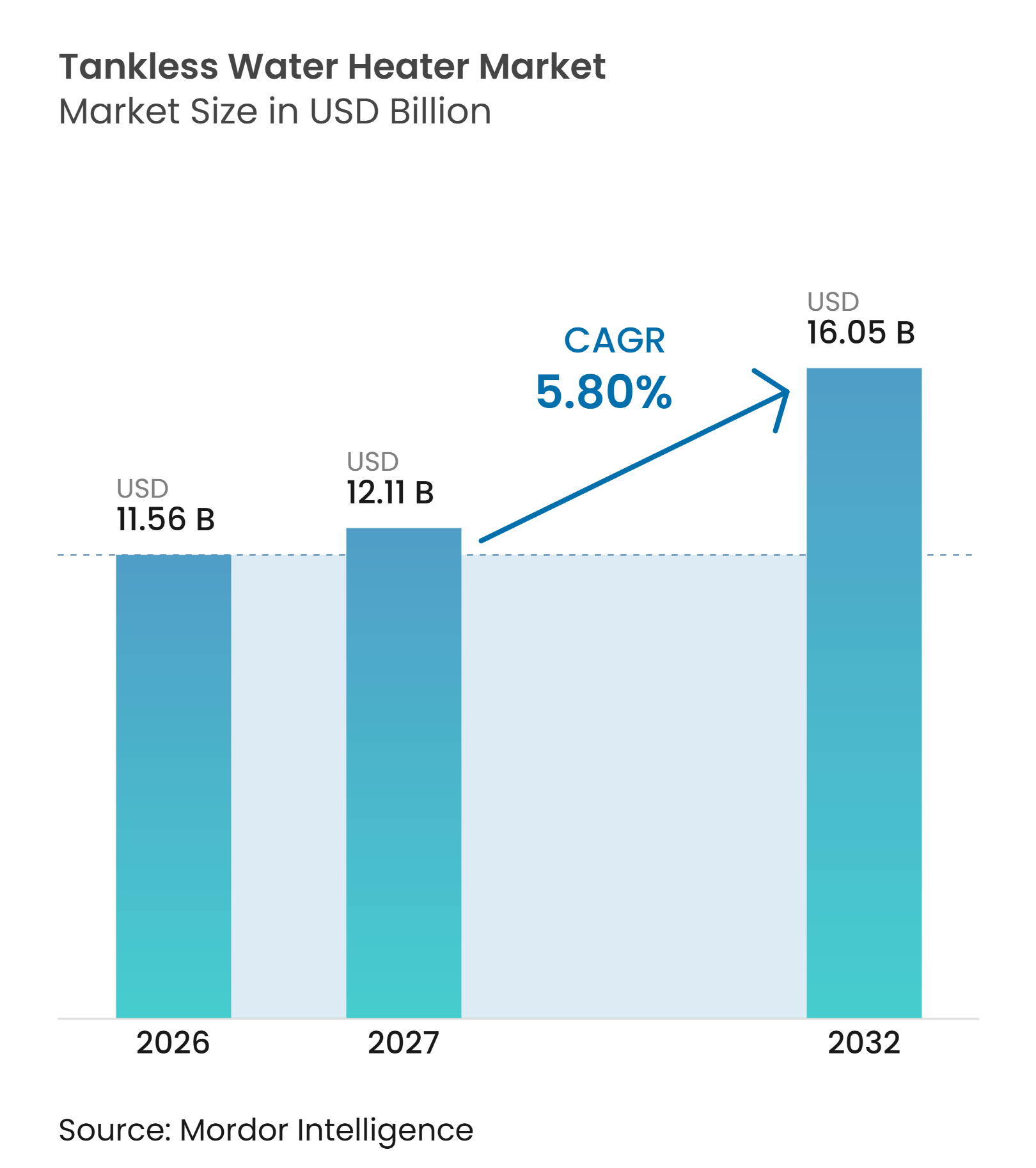
The tankless water heater market size is projected to expand from USD 11.56 billion in 2026 and USD 12.11 billion in 2027 to USD 16.05 billion by 2032, registering a CAGR of 5.8% between 2027 and 2032. The tankless water heater market is supported by electrification rules in new buildings and the need for compact equipment in dense urban housing. State building requirements are shifting some new residential projects away from fossil-fuel water heating, which gives electric units a stronger role in specification decisions. Product suppliers are also placing more value on remote monitoring, water-quality management, and scalable commercial systems. These changes make installation capability, digital service, and compliance knowledge more important in the tankless water heater market. The withdrawal of a federal efficiency rule for gas-fired instantaneous heaters keeps an installed-base opportunity for gas products, although state and local codes continue to favor electric options in several locations.
Key Report Takeaways
-
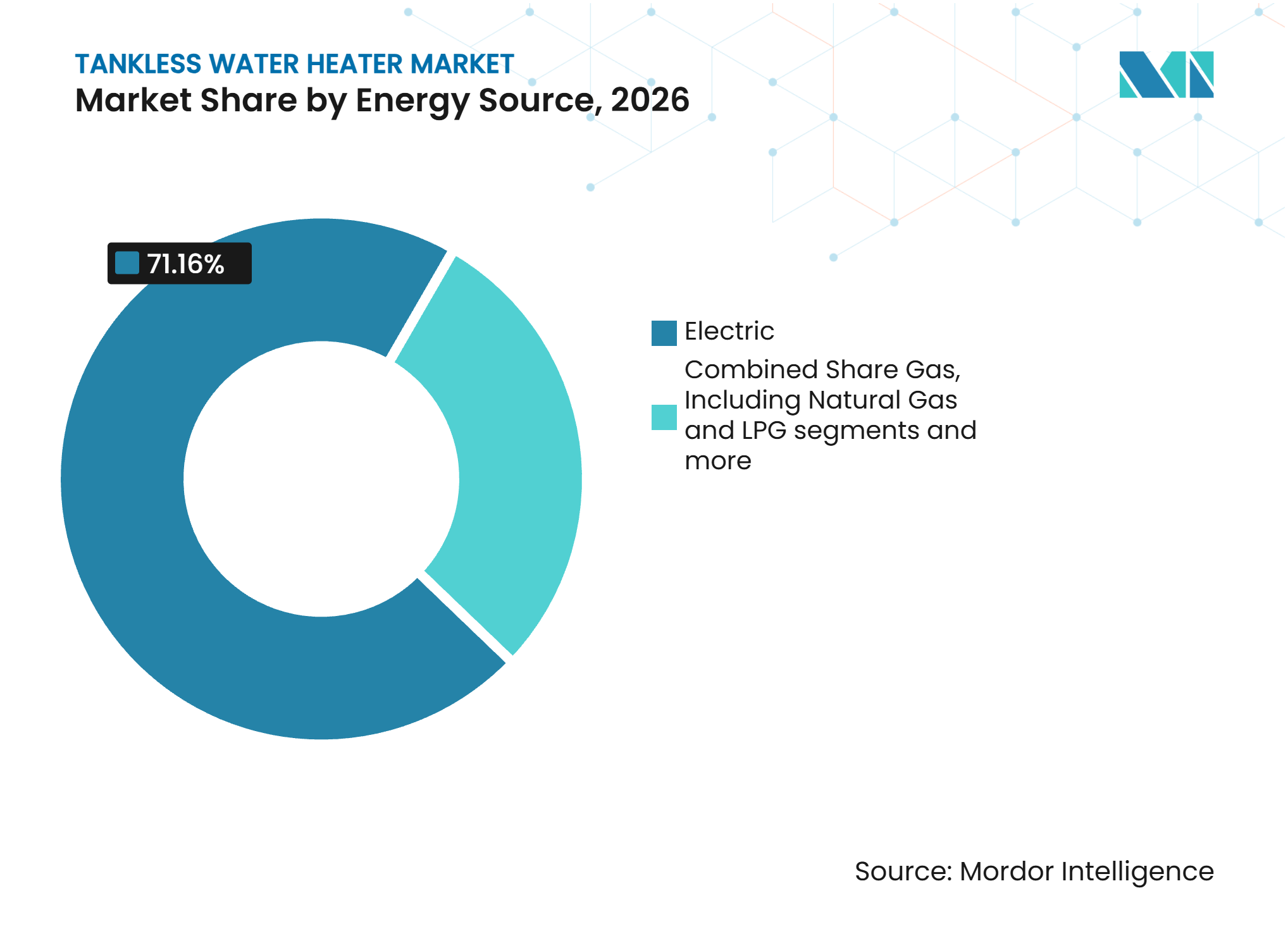
By energy source, electric units held 71.16% of the tankless water heater market share in 2026 and are forecast to grow at a 6.30% CAGR during 2027–2032.
-
By end user, residential held 72.86% of revenue in 2026, while commercial is forecast to expand at a 6.46% CAGR during 2027–2032.
-
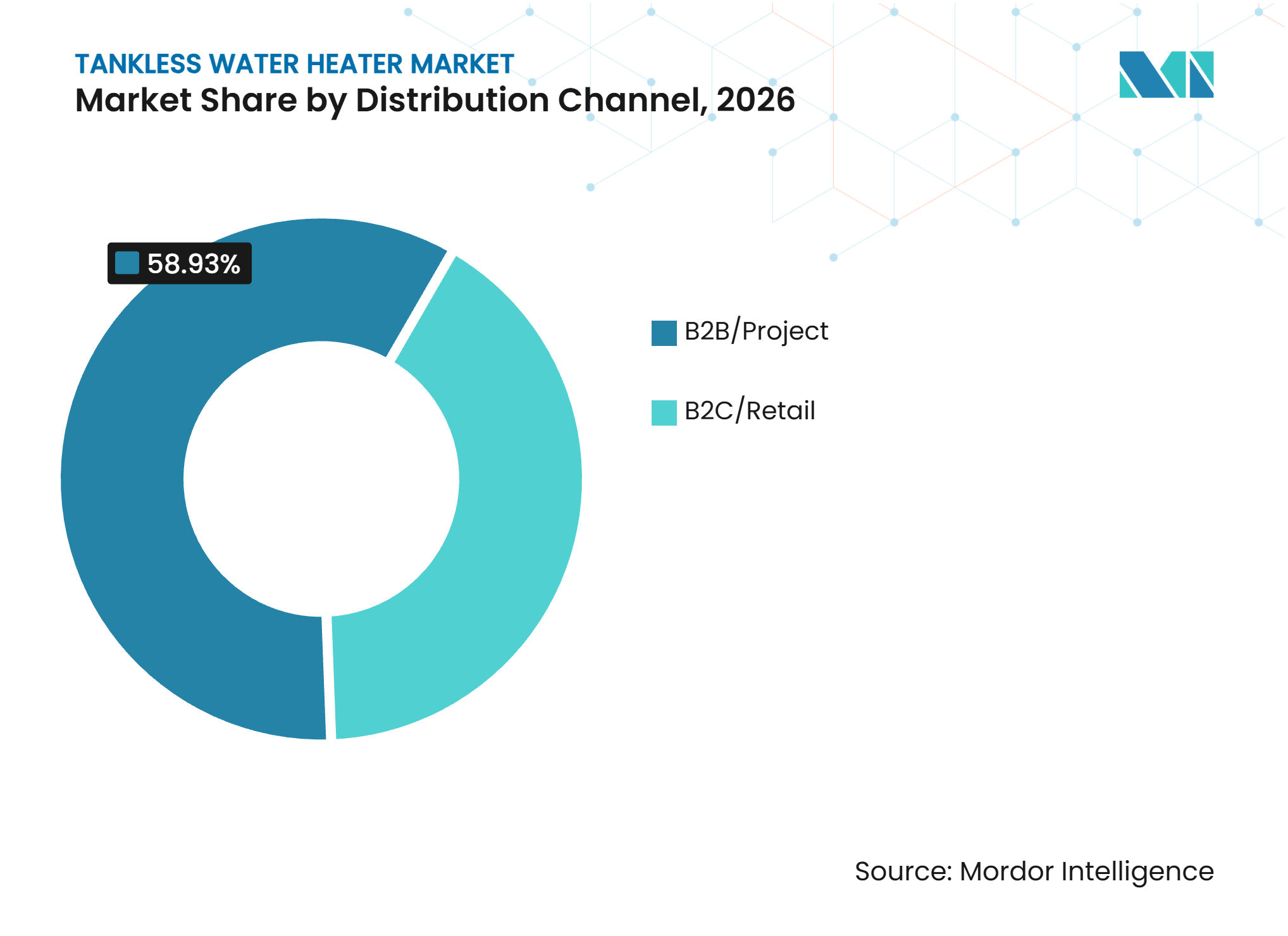
By distribution channel, B2B/Project held 58.93% of revenue in 2026, while B2C/Retail is forecast to grow at a 6.20% CAGR during 2027–2032.
-
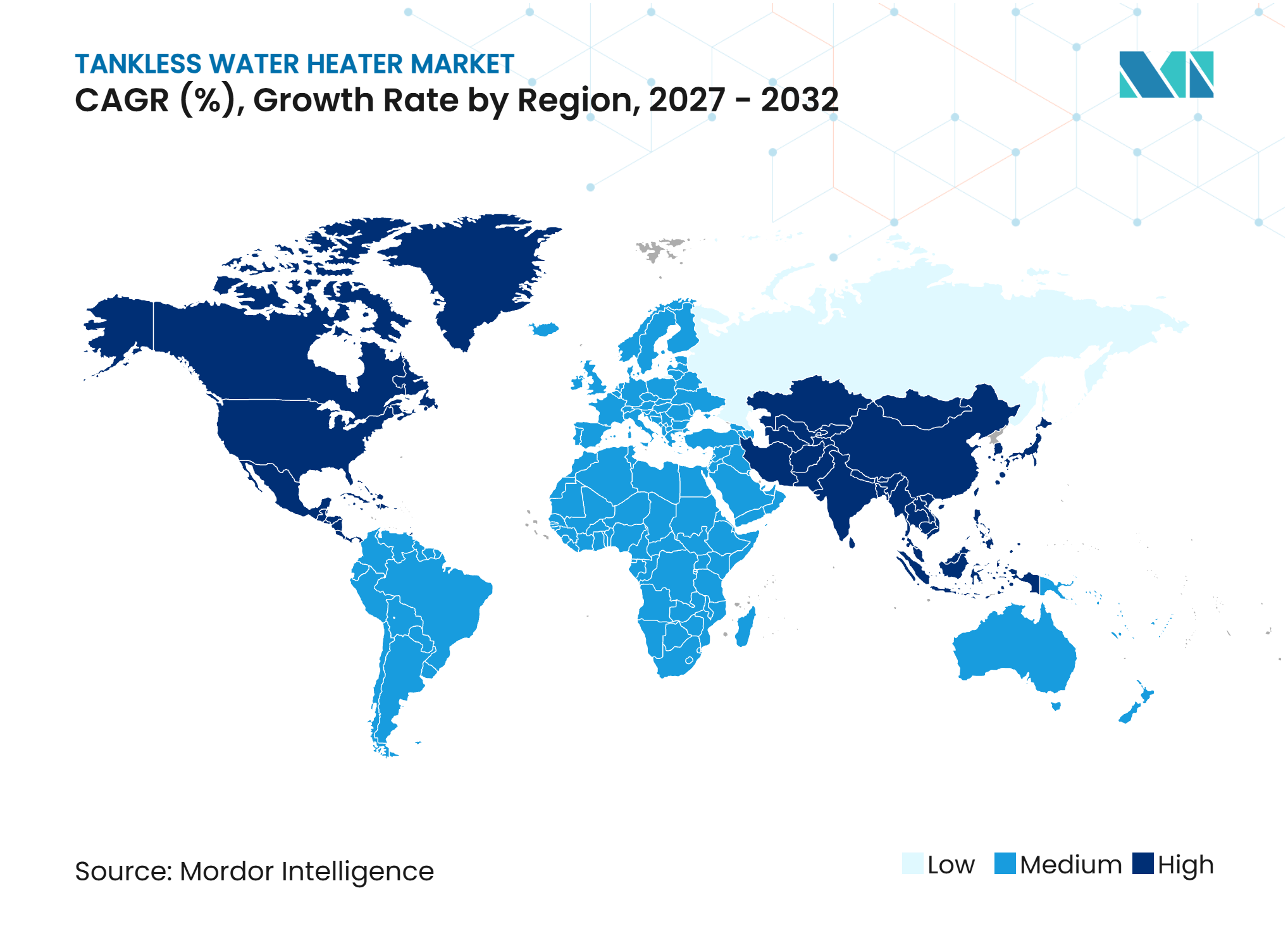
By geography, Asia-Pacific held 37.92% of revenue in 2026, while North America is forecast to grow at a 6.36% CAGR during 2027–2032.
Note: Market numbers in this report are based on Mordor Intelligence's proprietary estimation framework, which combines nine months of actuals with Q4 projections for base year 2026.
Market Trends and Insights
Drivers Impact Analysis of Tankless Water Heater Market*
| Driver | (~) % Impact on CAGR Forecast | Geographic Relevance | Impact Timeline |
|---|---|---|---|
| Electrification of Domestic Hot Water Systems | +1.5% | North America and Europe core, spill-over to Asia-Pacific | Long term (≥ 4 years) |
| Replacement of Aging Storage Water Heaters | +1.2% | Global, with early gains in North America and Europe | Short term (≤ 2 years) |
| Expansion of Hospitality And Multi-Unit Residential Construction | +1.0% | Asia-Pacific core, spill-over to Middle East and Africa | Medium term (2-4 years) |
| Space-Saving Demand in Urban Housing | +0.8% | Asia-Pacific and Europe | Medium term (2-4 years) |
| Digital Controls and Remote Energy Management | +0.7% | North America, Europe, and Asia-Pacific technology hubs | Long term (≥ 4 years) |
| Water Conservation and Reduced Standby Losses | +0.5% | Global, with early gains in water-scarce Middle East and Africa and Australia | Medium term (2-4 years) |
| Source: Mordor Intelligence | |||
Electrification of Domestic Hot Water Systems
The tankless water heater market benefits when building rules require alternatives to combustion-based equipment. New York’s All-Electric Buildings Act would restrict fossil-fuel equipment in new buildings of up to seven stories, but the state agreed in November 2025 to suspend implementation until the federal appeal is decided[1]. These rules favor wall-mounted electric systems where gas venting is unavailable or prohibited. Electric equipment also avoids standby losses associated with stored hot water, which supports its use in smaller homes and apartments. The tankless water heater market therefore gains a replacement route that is less dependent on discretionary consumer spending. U.S. federal policy remains mixed because the Department of Energy withdrew its gas-fired instantaneous water-heater standard in May 2025.
Replacement of Aging Storage Water Heaters
Many storage units installed during earlier construction cycles are reaching replacement age in mature housing markets. This gives the tankless water heater market access to homeowners and facility managers who must replace equipment rather than defer a purchase. New codes can make a direct replacement less straightforward when the old equipment does not meet current efficiency or fuel requirements. Rinnai stated that it continues to see conversion from tank systems to tankless units, with growing demand for electrical products in selected markets[2]. Its SENSEI RX line reported a 0.98 Uniform Energy Factor and combines setup, recirculation, and inventory simplification features for installers. This replacement activity increases the influence of licensed plumbers and installer programs in the tankless water heater market.
Expansion of Hospitality and Multi-Unit Residential Construction
Hotels, healthcare facilities, schools, and multi-unit buildings need a dependable hot-water supply without large equipment rooms. Modular tankless arrays provide redundancy and allow capacity to be scaled as building demand changes. This design is relevant in markets where new hospitality and multi-unit residential construction is increasing. Zurn Elkay completed its acquisition of Intellihot on 20 July 2026, expanding its commercial water-heating offering for health care, education, and hospitality customers[3]. The transaction indicates that commercial water heating is becoming more relevant to wider building-infrastructure portfolios. The tankless water heater market can benefit where building owners value compact equipment, redundancy, and reduced stored-water volume.
Space-Saving Demand in Urban Housing
Compact, wall-mounted equipment is well suited to apartments and other homes with limited utility space. This need is particularly relevant in dense cities across Asia-Pacific and Europe. Tankless systems avoid the floor area required for a storage tank and allow point-of-use placement where needed. The value of this layout grows when developers seek flexible mechanical-room designs in multi-unit projects. Electric models can be especially suitable where central gas venting is unavailable. Space efficiency therefore remains an important specification factor for the tankless water heater market.
Restraints Impact Analysis of Tankless Water Heater Market*
| Restraint | (~) % Impact on CAGR Forecast | Geographic Relevance | Impact Timeline |
|---|---|---|---|
| High Installation Cost and Electrical Upgrade Requirements | -1.4% | North America, Europe, and emerging Asia-Pacific markets | Short term (≤ 2 years) |
| Mineral Scaling and Service Complexity | -0.9% | Middle East and Africa, South Asia, and parts of North America and Europe | Medium term (2-4 years) |
| Flow-Rate and Simultaneous-Use Limitations | -0.7% | Global, amplified in large-household markets | Short term (≤ 2 years) |
| Fuel and Utility Infrastructure Dependence | -0.6% | Middle East and Africa, South America, and rural Asia-Pacific | Long term (≥ 4 years) |
| Source: Mordor Intelligence | |||
High Installation Cost and Electrical Upgrade Requirements
The tankless water heater market faces a cost barrier when electric units require panel upgrades, new circuits, or additional labor. These requirements can make an electric installation more complex than a direct replacement of a storage heater. The barrier is most pronounced in older homes with limited electrical capacity. State incentives and utility programs can reduce the initial cost, but their availability varies by location. The withdrawal of the federal gas-fired instantaneous heater standard also removed one regulatory factor that might have encouraged a faster shift to premium condensing equipment[4]. Suppliers in the tankless water heater market need simpler installation designs and strong contractor support to limit this constraint.
Mineral Scaling and Service Complexity
Hard water can create mineral buildup in heat exchangers, increasing service needs and affecting product performance. The tankless water heater market is exposed to this issue in regions where water treatment is limited or household water hardness is high. Navien introduced the WEC Series in July 2025 as a salt-free point-of-entry treatment system designed to address scale management, Z601-certified, with up to 94% scale reduction in testing. A.O. Smith’s Adapt product includes X3 Scale Prevention Technology and received a 2025 Silver Edison Award for this approach. Integrated water-treatment solutions can reduce maintenance concerns, but they also raise the importance of product education and service support. This shifts competition in the tankless water heater market toward durability and lifetime ownership costs.
*Our forecasts treat driver/restraint impacts as directional, not additive. The impact forecasts reflect baseline growth, mix effects, and variable interactions.
Tankless Water Heater Market Segment Analysis
By Energy Source:
Electric Leads Through Building CompatibilityElectric units held 71.16% of revenue in 2026 and are forecast to grow at a 6.30% CAGR through 2032. Their position reflects the value of compact, point-of-use installation in apartments and other dense residential settings. They are also suitable for buildings where natural-gas piping is unavailable or not approved for new construction. Electrification rules are reinforcing this advantage in some North American and European jurisdictions. Connected controls add another benefit by allowing equipment to respond to tariffs and demand-response signals. These factors make electrical products central to current tankless water heater market growth.
Gas units retain an installed-base advantage in locations with established natural-gas or LPG networks. Condensing systems remain relevant where cold conditions and high hot-water demand affect the choice of electric alternatives. Rinnai’s SENSEI RX reported a 0.98 Uniform Energy Factor, showing continued investment in high-efficiency gas products. The 2025 federal withdrawal of the stricter U.S. standard extends the near-term operating space for non-condensing gas equipment. Solar configurations remain more relevant as pre-heating components in hybrid systems than as a standalone mass-market category. The tankless water heater industry consequently retains a multi-fuel product base despite electric equipment’s leading position.



By End User:
Residential Scale Supports Commercial ExpansionResidential users held 72.86% of the tankless water heater market share in 2026. This position is supported by the large number of single-unit purchases in apartments, houses, and small renovation projects. Retail, e-commerce, and utility programs can reach these buyers at scale. Point-of-use electric products are particularly suited to smaller homes and apartments. The residential segment also benefits from replacement purchases as older storage systems reach the end of service. This broad installed base makes the residential segment the volume foundation of the tankless water heater market.
Commercial use is forecast to grow at a 6.46% CAGR through 2032. Hotels, health-care facilities, schools, and offices need reliable hot water and often value modular capacity. Multiple units can be connected to provide redundancy and accommodate changing demand. Zurn Elkay’s acquisition of Intellihot shows the strategic relevance of commercial tankless products for broader building-water platforms. A.O. Smith’s Adapt Commercial Premium supports cascade connections for up to 32 units, illustrating the focus on larger applications. Commercial procurement emphasizes reliability, technical support, and compliance as much as initial equipment cost.
By Distribution Channel:
Project Specification Holds While Retail GainsB2B/Project held 58.93% of the tankless water heater market revenue in 2026. Contractor and mechanical-engineering specifications shape many purchases in multi-unit and commercial buildings. Brand preference can become embedded through installer certification, distributor relationships, and project documentation. Switching equipment during construction can introduce cost and schedule risk. These factors preserve the importance of B2B distribution in the tankless water heater market.
B2C/Retail is forecast to grow at a 6.20% CAGR through 2032. Online channels make it easier for buyers to compare capacity, dimensions, warranties, and control features. Compact electric products are also more accessible to households considering a simple point-of-use installation. Suppliers are responding with digital product information and direct consumer options. A.O. Smith reported growth across priority dealer, e-commerce, and direct-to-consumer channels in its 2025 earnings commentary. Retail growth does not eliminate installer influence, but it gives consumers more visibility into product choice.

Geography Analysis
Asia-Pacific
Asia-Pacific held 37.92% of tankless water heater market revenue in 2026. China, India, Japan, South Korea, and Southeast Asian countries provide a large residential base and high urban density. Wall-mounted electric units fit apartment settings where centralized hot water or gas infrastructure is limited. Singapore introduced minimum energy-performance standards for household water heaters in 2025, creating a regulatory model for equipment specification in the region. Japan retains demand for condensing gas and heat-pump configurations where gas networks are well established. Noritz identified continued growth in North America and Australia within its V Plan 26 strategy, which reflects the geographic breadth of its product planning. The tankless water heater market in Asia-Pacific remains closely linked to urban construction and energy-efficiency standards.
North America
North America is forecast to grow at a 6.36% CAGR through 2032. The region has a divided regulatory setting, with several states encouraging electrification while federal policy has preserved a near-term path for gas equipment. New York’s code requirements create additional demand for electric water heating in new low-rise residential buildings. The Department of Energy’s 2025 withdrawal of the gas-fired instantaneous heater rule maintains demand for existing gas product designs. This regional mix supports both electric products in electrifying cities and condensing gas units in areas with mature gas infrastructure. Supplier strategies need to account for varying state codes, local rebates, and installer capabilities. These factors make North America the fastest-growing geography within the tankless water heater market.
Europe, South America, and Middle East and Africa
Efficiency-focused building rules and interest in compact systems for smaller apartments support Europe. Scientific research in 2025 found that electric tankless water heating can become cost-competitive with gas systems in European settings when electricity carbon intensity declines below a stated threshold. South America has a role for LPG-fed products where piped natural-gas networks are limited outside major cities. Haier is expanding its manufacturing, research, and sales networks in South America and Africa, reflecting supplier attention to these regions. Gulf construction projects can support commercial installation, although hard-water conditions increase the need for effective scale management. Navien’s certified water-treatment system provides one example of how manufacturers are addressing this operating issue. Together, these regions give the tankless water heater market opportunities tied to fuel availability, urban development, and local water conditions.
Competitive Landscape
Market Concentration
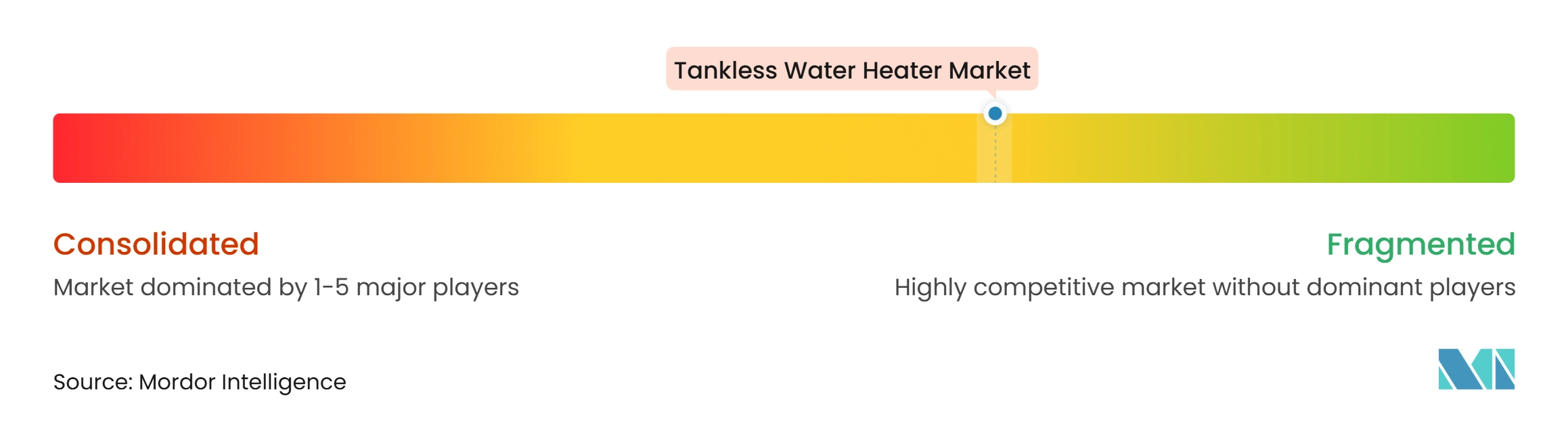
The tankless water heater market ismoderately concentrated. Rinnai, Rheem, A.O. Smith, Noritz, and Navien hold established positions across gas, electric, and commercial applications. Midea and Haier compete through manufacturing scale and price positioning in Asia-Pacific and other developing regions. European suppliers, including Stiebel Eltron, Bosch Home Comfort, and Ariston, focus on premium electric and hybrid offerings. Product performance, warranty coverage, installer service, and digital tools increasingly shape competition. The tankless water heater market does not show a single supplier with dominant control over all major regions and fuel types.
Manufacturers are using product design to address known adoption barriers. A.O. Smith launched its Adapt Commercial Premium Condensing Water Heater on 27th May 2026 with a patented stainless-steel helical heat exchanger and cascade capacity for up to 32 units. Noritz enhanced its EZ Series Pro on 21 April 2026 with a larger diagnostic control panel and a 16:1 turndown ratio. Navien’s WEC Series adds certified scale management and smart connectivity to the ownership proposition. Rinnai’s SENSEI RX combines high reported efficiency with mobile setup and recirculation features. These moves shift competitive attention from heat output alone toward reliability and lifetime operating experience.
Zurn Elkay acquired Intellihot for USD 109 million on 20th July 2026, adding commercial tankless technology to its building-water portfolio. The deal shows interest from building-infrastructure companies outside traditional appliance manufacturing. Ariston and Lennox also announced a North American water-heater joint venture, combining Ariston’s water-heating capabilities with Lennox’s dealer and distributor routes. Suppliers are building market access through distribution partnerships as well as product launches. Connected commercial equipment may also create opportunities with utility demand-response programs. The competitive position of each company will depend on its ability to support installers, meet regional codes, and offer systems that manage water-quality and energy-use requirements.
Tankless Water Heater Industry Leaders
-
Rinnai Corporation
-
Rheem Manufacturing Company
-
A. O. Smith Corporation
-
Bosch Home Comfort Group
-
Noritz Corporation
- *Disclaimer: Major Players sorted in no particular order
Tankless Water Heater Market Companies Covered in this Report
- Rinnai Corporation
- Rheem Manufacturing Company
- A.O. Smith Corporation
- Bosch Home Comfort Group
- Noritz Corporation
- Bradford White Corporation
- Navien, Inc.
- Stiebel Eltron Group
- Ariston Holding N.V.
- EcoSmart Green Energy Products, Inc.
- Eemax
- Paloma Co., Ltd.
- Midea Group Co., Ltd.
- Haier Smart Home Co., Ltd.
- Ferroli S.p.A.
- Bajaj Electricals Limited
- Havells India Limited
- Vatti Corporation
- V-Guard Industries Limited
Recent Industry Developments in Tankless Water Heater Market
- July 2026: Zurn Elkay Water Solutions completed its USD 109 million acquisition of Intellihot Inc. on July 20, 2026, gaining commercial tankless technology for health care, education, and hospitality customers. The transaction places connected commercial water heating inside a larger building-water portfolio. It also gives Zurn Elkay a route to customers that need modular hot-water systems, technical support, and integrated solutions for demanding facilities.
- May 2026: A.O. Smith added the Adapt Commercial Premium Condensing Water Heater to its Adapt family, with a patented stainless-steel helical heat exchanger, 199,000 BTU input, 0.95 UEF, cascade connection for up to 32 units, and common venting for up to 12 units. The product addresses larger facilities that need scalable capacity and equipment redundancy. The common-venting and cascade features are intended to simplify system design for contractors working on commercial installations.
- April 2026: Noritz America upgraded its EZ Series Pro residential condensing tankless line with a larger multi-function panel display. The EZ111 model offers up to 199,900 BTU/hour and a 16:1 turndown ratio. The update gives installers clearer information during installation and servicing. It also reflects the continued focus on wider modulation and simultaneous-draw performance in residential tankless products.
Global Tankless Water Heater Market Report Scope
Segmentation Overview
| Electric | By Heating Capacity | Below 6 kW |
| 6–12 kW | ||
| Above 12 kW | ||
| Gas, Including Natural Gas and LPG | By Flow Rate | Below 8 Liters/Minute |
| 8–15 Liters/Minute | ||
| Above 15 Liters/Minute | ||
| Solar | ||
| Other Energy Sources | ||
| Residential | |
| Commercial | Hospitality |
| Healthcare | |
| Education and Institutional | |
| Offices and Retail | |
| Rest of Commercial End Users |
| B2C/Retail | Multi-Brand Stores |
| Exclusive Brand Outlets | |
| Online | |
| Local Hardware Stores | |
| Other B2C/Retail | |
| B2B and Project | Wholesale and Plumbing-HVAC Distributors |
| Direct from Manufacturers |
| North America | Canada |
| United States | |
| Mexico | |
| South America | Brazil |
| Peru | |
| Chile | |
| Argentina | |
| Rest of South America | |
| Europe | United Kingdom |
| Germany | |
| France | |
| Spain | |
| Italy | |
| BENELUX (Belgium, Netherlands, Luxembourg) | |
| NORDICS (Denmark, Finland, Iceland, Norway, Sweden) | |
| Rest of Europe | |
| Asia-Pacific | India |
| China | |
| Japan | |
| Australia | |
| South Korea | |
| South-East Asia | |
| Rest of Asia-Pacific | |
| Middle East & Africa | United Arab Emirates |
| Saudi Arabia | |
| South Africa | |
| Nigeria | |
| Rest of Middle East & Africa |
| By Energy Source | Electric | By Heating Capacity | Below 6 kW |
| 6–12 kW | |||
| Above 12 kW | |||
| Gas, Including Natural Gas and LPG | By Flow Rate | Below 8 Liters/Minute | |
| 8–15 Liters/Minute | |||
| Above 15 Liters/Minute | |||
| Solar | |||
| Other Energy Sources | |||
| By End User | Residential | ||
| Commercial | Hospitality | ||
| Healthcare | |||
| Education and Institutional | |||
| Offices and Retail | |||
| Rest of Commercial End Users | |||
| By Distribution Channel | B2C/Retail | Multi-Brand Stores | |
| Exclusive Brand Outlets | |||
| Online | |||
| Local Hardware Stores | |||
| Other B2C/Retail | |||
| B2B and Project | Wholesale and Plumbing-HVAC Distributors | ||
| Direct from Manufacturers | |||
| By Geography | North America | Canada | |
| United States | |||
| Mexico | |||
| South America | Brazil | ||
| Peru | |||
| Chile | |||
| Argentina | |||
| Rest of South America | |||
| Europe | United Kingdom | ||
| Germany | |||
| France | |||
| Spain | |||
| Italy | |||
| BENELUX (Belgium, Netherlands, Luxembourg) | |||
| NORDICS (Denmark, Finland, Iceland, Norway, Sweden) | |||
| Rest of Europe | |||
| Asia-Pacific | India | ||
| China | |||
| Japan | |||
| Australia | |||
| South Korea | |||
| South-East Asia | |||
| Rest of Asia-Pacific | |||
| Middle East & Africa | United Arab Emirates | ||
| Saudi Arabia | |||
| South Africa | |||
| Nigeria | |||
| Rest of Middle East & Africa | |||
Key Questions Answered in the Report
What is the projected size of the tankless water heater sector?
It is projected to grow from USD 12.11 billion in 2027 to USD 16.05 billion by 2032 at a 5.8% CAGR. Demand is supported by replacement needs, compact urban installation, and the wider move toward electrified building equipment.
Which energy source leads tankless water heater sales?
Electric units held 71.16% of revenue in 2026 and are forecast to grow at a 6.3% CAGR through 2032. Their compact format fits apartment housing and buildings where new gas connections or venting are unavailable.
Why are electric tankless water heaters gaining adoption?
Building electrification requirements, compact installation, and digital energy-management features support electric unit demand. Connected products can also help operators manage water heating around tariffs and potential demand-response participation.
Which customer group is growing fastest for tankless water heaters?
Commercial users are forecast to grow at a 6.46% CAGR through 2032, supported by hotels, health care, education, and institutional projects. These users value modular capacity, redundancy, service support, and more efficient use of mechanical-room space.
What limits adoption of tankless water heaters?
Electrical upgrade costs, installation complexity, and mineral scaling can raise initial and lifetime ownership costs. These constraints increase the importance of qualified installers, water treatment, practical product sizing, and clear maintenance support.