
Tampon Fibers Market Size and Share
Market Overview
| Study Period | 2022 - 2032 |
|---|---|
| Market Size (2027) | USD 2.45 Billion |
| Market Size (2032) | USD 3.38 Billion |
| Growth Rate (2027 - 2032) | 6.69 % |
| Fastest Growing Market | Asia-Pacific |
| Largest Market | North America |
| Market Concentration | Medium |
Major Players *Disclaimer: Major Players sorted in no particular order Image © Mordor Intelligence. Reuse requires attribution under CC BY 4.0. | |
Tampon Fibers Market Analysis by Mordor Intelligence
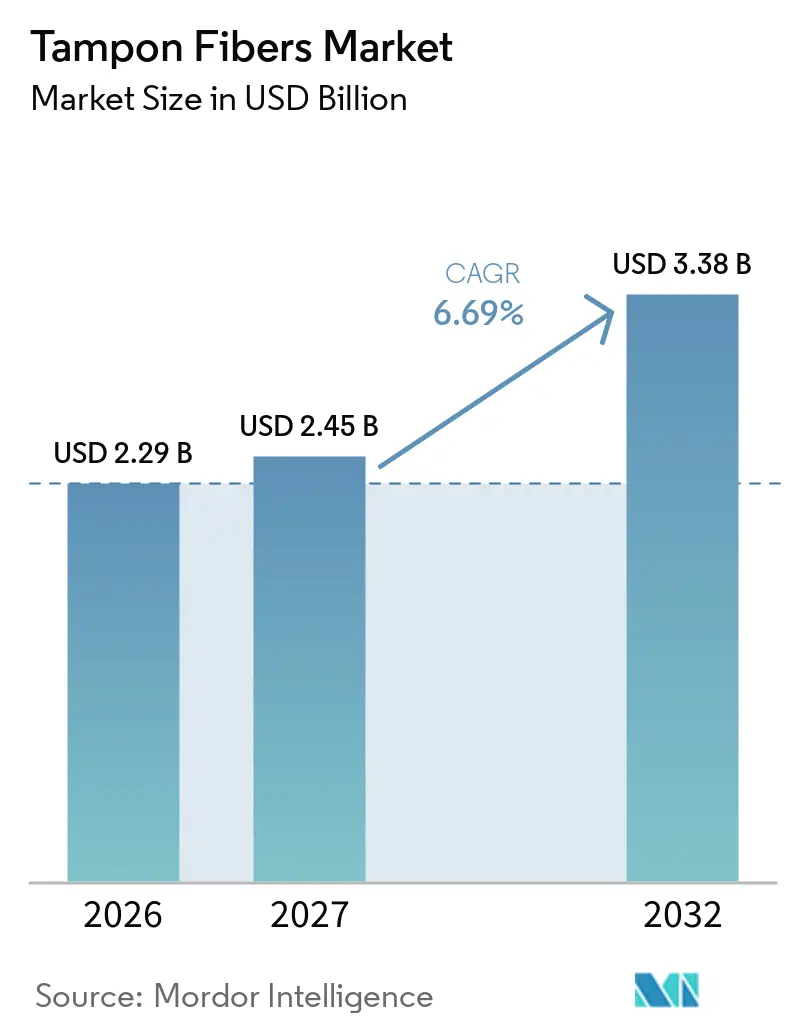
The Tampon Fibers Market size was valued at USD 2.29 billion in 2026 and is estimated to grow from USD 2.45 billion in 2027 to reach USD 3.38 billion by 2032, at a CAGR of 6.69% during the forecast period (2027-2032). The tampon fibers market is being shaped by greater menstrual health awareness, more detailed ingredient disclosure regulations, and changes in fiber design. Regulatory expectations are increasing the value of traceable inputs, particularly where manufacturers need documented sourcing and contaminant controls. Certified organic and specialty materials are becoming more prominent in premium products, while established cotton and viscose supply chains continue to support high-output production. The market is also shifting toward reusable products, although safety testing, labeling, and material transparency remain central concerns for conventional tampon manufacturers.
Key Report Takeaways
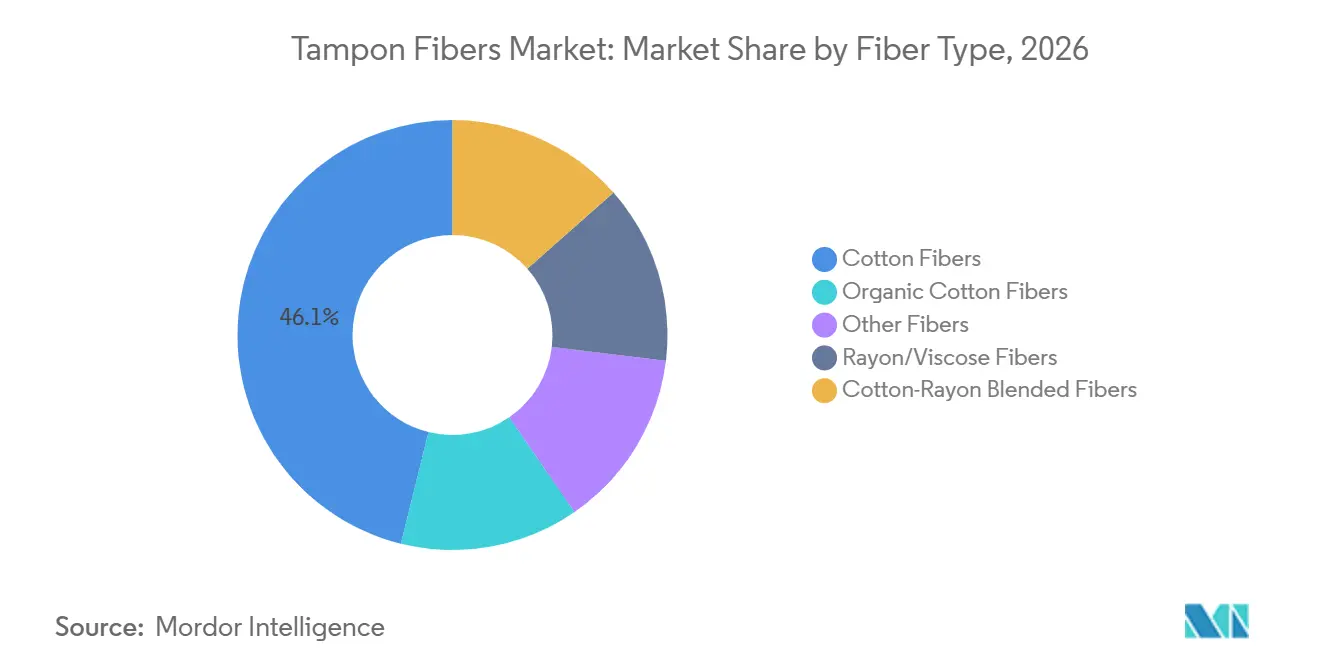
- By fiber type, Cotton Fibers held 46.14% of the tampon fibers market share in 2026, while Organic Cotton Fibers are forecast to grow at a 7.45% CAGR through 2032.
- By tampon type, Applicator Tampons held 65.26% market share in 2026, while Non-Applicator/Digital Tampons are forecast to grow at a 7.14% CAGR through 2032.
- By absorbency, Regular Tampons held 54.63% market share in 2026, while Super Plus is forecast to grow at a 7.85% CAGR through 2032.
- By fiber form, Staple Fibers held 62.18% market share in 2026, while Specialty and Modified Fibers are forecast to grow at an 8.17% CAGR through 2032.
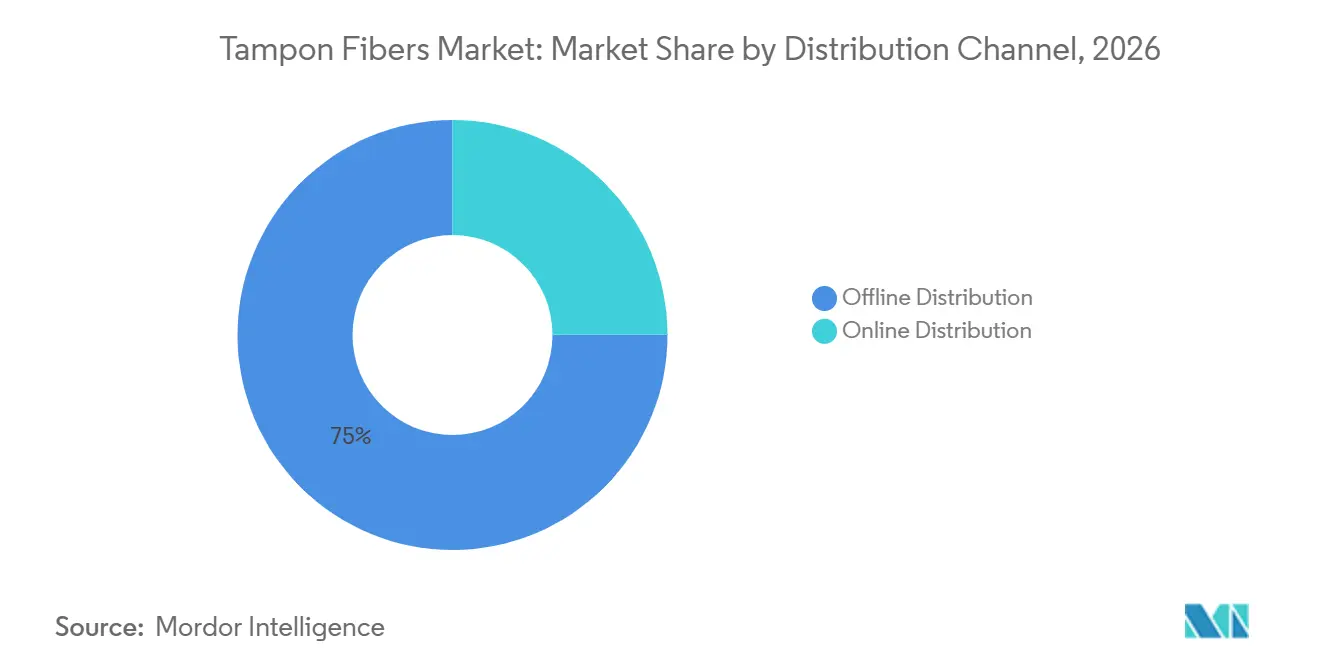
- By distribution channel, Offline Distribution held 75.04% market share in 2026, while Online Distribution is forecast to grow at a 7.41% CAGR through 2032.
- By geography, North America held 35.29% market share in 2026, while the Asia-Pacific is forecast to grow at a 7.83% CAGR through 2032.
Note: Market numbers in this report are based on Mordor Intelligence's proprietary estimation framework, which combines nine months of actuals with Q4 projections for base year 2026.
Global Tampon Fibers Market Trends and Insights
Drivers Impact Analysis*
| Drivers | (~) % Impact on CAGR Forecast | Geographic Relevance | Impact Timeline |
|---|---|---|---|
| Rising Menstrual-Hygiene Awareness and Product Adoption | +1.2% | Global, with early gains in South Asia and Southeast Asia | Medium term (2-4 years) |
| Premiumization of Organic and Natural-Fiber Tampons | +1.5% | North America and the EU core, with spillover to APAC | Medium term (2-4 years) |
| Expansion of E-Commerce and Subscription Replenishment | +1.0% | Global, accelerating in APAC and Latin America | Short term (≤ 2 years) |
| Increasing Female Workforce and Active-Lifestyle Participation | +0.8% | Global, with the highest impact in South Asia, the Middle East, and Africa (MEA) | Long term (≥ 4 years) |
| Fiber Engineering for Higher Absorbency and Leak Protection | +0.9% | Global, with R&D concentrated in the EU and North America | Medium term (2-4 years) |
| Source: Mordor Intelligence | |||
Rising Menstrual-Hygiene Awareness and Product Adoption
Menstrual health awareness and product access reinforce each other, as informed users are better positioned to choose and use suitable products. A P&G study conducted in May 2026 across 8 countries found that more than one in three girls understood their skin better than their menstrual cycle. The same study found that 56% of girls felt unprepared to manage their period. A 2025 study of female garment workers found a broad willingness to participate in workplace menstrual health programs and linked workplace support to practical product access. Government-supported access programs in India and Sub-Saharan Africa, including those supported by the United Nations Population Fund (UNFPA) and health ministries, are widening access beyond established urban income groups. These conditions support a broader user base for the tampon fibers market and increase the importance of dependable material supply.
Premiumization of Organic and Natural-Fiber Tampons
Premiumization in the tampon fibers market increasingly reflects both compliance requirements and consumer preferences. California AB 2515, enacted in September 2024 and effective as of January 2025, prohibits menstrual products containing intentionally added per- and polyfluoroalkyl substances (PFAS). The law introduces threshold-based limits based on total organic fluorine measurements, effective from January 2027. California Senate Bill 754 also requires monitoring and reporting of hazardous chemicals, including lead and arsenic, in tampons. These requirements favor sourcing systems that can document material origin, processing controls, and certification records. Global Organic Textile Standard (GOTS)-certified organic cotton offers a traceable documentation path, which can make certification an access requirement rather than only a brand attribute.
Expansion of E-Commerce and Subscription Replenishment
Online purchasing is changing the commercial mix of the tampon fibers market rather than simply adding another sales channel. The U.S. Census Bureau reported that e-commerce accounted for 16.2% of total U.S. retail sales in the first quarter of 2025[1]. Subscription brands are commonly associated with organic and specialty fiber formats, making recurring orders relevant to input selection. Recurring purchasing can provide more stable demand for premium inputs than one-time purchases, particularly when brand subscriptions emphasize certification. Cross-border e-commerce gives consumers in China and India access to organic tampon formats that may not yet be widely available in local retail. Regulation (EU) 2025/40 and France's Anti-Gaspillage pour une Économie Circulaire (AGEC) extended producer responsibility scheme are also affecting packaging decisions that interact with product assembly specifications.
Fiber Engineering for Higher Absorbency and Leak Protection
Fiber geometry is a material performance consideration in the tampon fibers market. Research presented by Kelheim Fibers showed that trilobal Galaxy viscose can form a more expansive network in a tampon pledget than a round viscose fiber with the same composition. A 2024 Cellulose study found that the cross-sectional geometry of viscose played a significant role in tampon absorbency. A 2025 Cellulose study used micro-computed tomography (micro-CT) analysis to examine void-space characteristics in porous cellulose materials. These findings give suppliers measurable evidence when discussing material specifications with manufacturers. They also support demand for engineered materials in higher-absorbency designs where additional capacity is needed without a proportional increase in pledget weight.
Restraints Impact Analysis*
| Restraints | (~) % Impact on CAGR Forecast | Geographic Relevance | Impact Timeline |
|---|---|---|---|
| Substitution by Menstrual Cups and Period Underwear | -0.7% | North America and EU, with early indicators in urban APAC | Long term (≥ 4 years) |
| Toxic Shock Syndrome Concerns and Product-Safety Scrutiny | -0.5% | Global, especially North America | Short term (≤ 2 years) |
| Persistent Plastic Waste from Applicators and Packaging | -0.4% | EU and North America, with pressure building in APAC | Medium term (2-4 years) |
| Source: Mordor Intelligence | |||
Substitution by Menstrual Cups and Period Underwear
Reusable menstrual products present a competitive threat to the tampon fibers market, particularly among urban consumers seeking lower-waste alternatives. Consumer research from 2025 found that menstrual cups were used by 60.30% of reusable-product users, compared with 27.08% for period underwear. The primary concern for tampon demand is product trial, as a single reusable product trial can replace a tampon-use occasion. The impact is not uniform across all products; certified organic offerings can compete on health and sustainability attributes that overlap with preferences for reusable products, while conventional rayon-blend products may face greater exposure when price-sensitive consumers test alternatives. This restraint is more relevant to product positioning and user retention than to an immediate displacement of the established tampon base.
Toxic Shock Syndrome Concerns and Product-Safety Scrutiny
Product safety has shifted from a periodic consumer concern to an active regulatory issue for the tampon fibers market. The FDA issued draft guidance in October 2025 recommending contaminant evaluation and ingredient disclosure on outer packaging for menstrual products. In July 2026, the FDA published a laboratory study in Toxicological Sciences reporting trace metals in tampons, but concluded that the quantities released during typical use were too small to cause harm. Existing FDA requirements also address absorbency labeling and toxic shock syndrome information for tampons. Regular contaminant testing and clearer ingredient disclosure may become standard practice across the category. These requirements favor suppliers that can meet tighter specifications and consistently document material processing.
*Our forecasts treat driver/restraint impacts as directional, not additive. The impact forecasts reflect baseline growth, mix effects, and variable interactions.
Segment Analysis
By Fiber Type: Organic Cotton Records Faster Growth While Cotton Dominates by Output Share
Cotton fibers held 46.14% of global revenue in 2026, supported by consumer familiarity, biocompatibility, and established supply relationships in the United States, India, and Brazil. Cotton remains the principal base material for products that emphasize recognizable ingredients. Rayon and viscose fibers continue to play an important role because their capillary behavior and cost profile suit mainstream absorbency designs. Their value position is under pressure in premium Western products, where ingredient transparency receives greater attention. Cotton-rayon blended fibers serve the middle tier by balancing cost and absorbency requirements. This mix allows private-label and mainstream brands to maintain accessible product formats while meeting performance expectations. Organic cotton fibers are forecast to expand at a 7.45% CAGR through 2032, supported by Per- and Polyfluoroalkyl Substances (PFAS)-related regulation and documentation requirements. As output increases, organic cotton can shift from a differentiated choice to a more routine sourcing option in regulated premium lines.
The tampon fibers market is therefore likely to see different value outcomes across materials, even where unit demand remains stable. Conventional rayon can retain output share in widely distributed products while losing value share in premium portfolios. This distinction matters because fiber suppliers compete on input value and technical specifications, not only on material tonnage. Organic cotton's chain-of-custody records may reduce the appeal of switching to unverified material. Other fibers, including bamboo lyocell and biobased covers, remain at pilot scale but are attracting development work in Germany, France, and the United Kingdom. A 2025 study reported that foam-formed, hydro-entangled cellulosic blends could match the absorbency of conventional viscose, supporting continued work on nontraditional cellulosic constructions. These materials will need to demonstrate consistent performance, safety, and scalable supply before they become substantial commercial inputs.

By Tampon Type: Applicator Products Lead While Digital Formats Gain Support
Applicator tampons held 65.26% of the tampon fibers market in 2026, reflecting their established use in North America. Cardboard and plastic applicator formats remain familiar to many consumers, particularly where ease of insertion is a central purchase consideration. Applicator products also support a broad range of absorbency tiers and retail price points. Their established consumer base gives manufacturers reason to continue improving both applicator and pledget design. Rael introduced an organic cotton tampon with a bisphenol A (BPA)-free slim applicator in U.S. mass retail in June 2026. The launch at Target and Amazon demonstrates that applicator products can support certified-organic positioning. This format remains commercially important where consumers value familiarity, convenience, and broad retail availability. Material suppliers must therefore support both conventional high-output inputs and differentiated organic formats.
Non-applicator or digital tampons are forecast to expand at a 7.14% CAGR through 2032. European demand supports this format because single-use plastic marking requirements can make plastic applicators less attractive to some buyers. The regulation requires a harmonized marking for covered single-use plastic products, including relevant tampon-applicator formats. At the pledget level, the basic fiber requirement is not inherently different between applicator and digital products. However, brands focused on digital formats often emphasize organic certification and narratives of lower waste. Natracare and Lil-Lets are examples of brands associated with Global Organic Textile Standard (GOTS)-certified positioning in this space. That brand mix can give certified organic suppliers a stronger role in the growing digital space. The tampon fibers market must therefore address a format shift that changes the product proposition more than the basic absorbent-material requirement.
By Absorbency: Regular Products Provide the Base, While Super Plus Grows Faster
Regular absorbency tampons held a 54.63% share in 2026 and remained the most widely used format for users managing moderate menstrual flow. Standardized labeling provides a common basis for users to compare absorbency levels across brands. Food and Drug Administration (FDA) requirements cover labeling information for tampons, including absorbency and toxic shock syndrome information. The regular tier benefits from its role as an accessible default product for established users. Super products serve users whose needs fall in the middle of the flow-intensity range. Mini products are particularly relevant for adolescent and first-time users. P&G introduced the Tampax Starter Kit in May 2026, featuring regular and super absorbencies and insertion guidance, to bring new users into the category while familiarizing them with standard absorbency formats.
Super Plus is forecast to grow at a 7.85% CAGR through 2032. Demand is linked to users managing heavy flow, endometriosis, or unpredictable periods. Higher-absorbency products require more fiber mass, more effective geometry, or both. Trilobal viscose is relevant because its geometry can increase liquid capacity without an equivalent increase in pledget weight, giving specialty material suppliers a performance-based route into the segment. Ultra tampons use the most fiber per unit among the described formats and can carry higher input costs. Even where output remains modest, those products can be important for suppliers of specialty viscose. The tampon fibers market benefits when materials can deliver higher capacity while retaining comfort and meeting product size expectations.
By Fiber Form: Staple Fibers Remain Core While Specialty Forms Grow Faster
Staple fibers held 62.18% of the tampon fibers market in 2026, supported by production lines designed for conventional carded and airlaid pledgets. This form aligns with the capital equipment and manufacturing methods used in mainstream tampon production. Regenerated cellulose fibers, principally viscose and rayon, support the cost-performance tier. Their share may gradually narrow where brands prioritize traceable and certified inputs. Other forms, such as kapok, bamboo-derived lyocell, and superabsorbent polymer blends, remain at pilot scale and are being assessed for specific performance or sustainability claims rather than widespread use. Scale-up depends on the ability to maintain consistent absorbency and run reliably on existing manufacturing equipment. For these reasons, staple fibers will continue to anchor the largest output base across the tampon fibers market.
Specialty and modified fibers are forecast to expand at an 8.17% CAGR through 2032, the highest rate among the fiber-form categories. Trilobal and star-shaped viscose variants are gaining attention because their cross-sectional designs can improve the pledget's internal structure. Published research on viscose geometry provides scientific support for these performance discussions. Foam-formed and hydro-entangled cellulosic blends also point to lighter constructions that can achieve conventional absorbency outcomes. Novel forms must meet biocompatibility requirements before broad adoption. ISO 10993 requirements remain relevant when new materials are introduced into products with intimate contact. These requirements can lengthen commercialization timelines without eliminating the potential of engineered forms. The segment's growth reflects a shift toward performance evidence and specification-based purchasing.
By Distribution Channel: Offline Retail Leads While Online Channels Shift Product Mix
Offline distribution accounted for 75.04% of the market in 2026, given the role of pharmacies and supermarkets in routine purchases. Physical retail gives consumers immediate access to products when needed, without planning. Store shelves can also place products alongside educational materials and related personal-care items, which is important for non-subscribed and first-time buyers. Pharmacy placement is particularly relevant in France and Germany, where a health-channel setting can bolster product credibility. Offline outlets also give established brands broad visibility across price tiers. This channel continues to provide the largest base for conventional cotton, rayon, and blended-fiber products. The tampon fibers market, therefore, remains linked to retail systems that favor reliable supply and familiar product formats.
Online distribution is forecast to grow at a 7.41% CAGR through 2032, supported by subscriptions, direct-to-consumer brands, and the ability to present detailed ingredient information. The U.S. Census Bureau's 16.2% share of e-commerce in total retail sales in the first quarter of 2025 provides a broader context for this shift in purchasing. Subscription brands commonly present certified organic products as a central part of their offerings. Online access also allows consumers to find products that may not yet be stocked in local stores. In China and India, cross-border purchasing can expose secondary-city consumers to premium tampon formats before local offline distribution expands. This can establish demand for specialty and organic fiber inputs earlier than conventional retail patterns would suggest. Channel growth is therefore relevant to both the material mix and total unit sales.
Geography Analysis
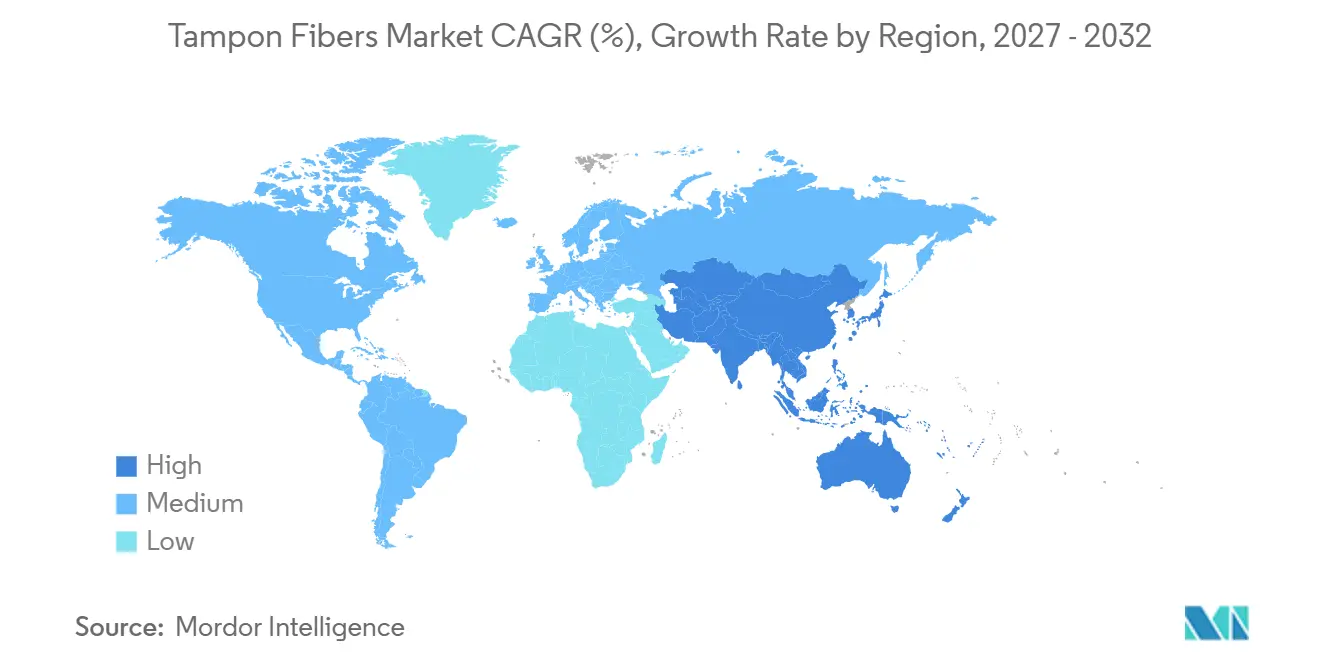
North America accounted for 35.29% of the tampon fibers market share in 2026, driven by high tampon usage in the United States. Procter & Gamble, Kimberly-Clark, and Essity are prominent brand owners in the region, and their product specifications influence material demand. California AB-2515 prohibits intentionally added per- and polyfluoroalkyl substances (PFAS) in menstrual products from January 2025, with total organic fluorine limits taking effect in January 2027. The FDA's July 2026 publication concludes that trace-metal quantities released during typical use are too small to cause harm, supporting continued attention to material testing and transparent communication. Canada and Mexico are adopting premium product features more gradually, while subscription purchasing is increasing interest in organic fiber credentials across the region.
Europe remains a highly regulated market for tampon fibers, as sustainability and packaging rules influence both materials and product design. Regulation (EU) 2025/40 addresses packaging and packaging waste, including recycled-content requirements for plastic packaging from 2030[2]. France's Anti-Waste for a Circular Economy (AGEC) extended producer responsibility scheme for single-use sanitary textiles began in July 2025 and aims to reduce tampon waste by 15% by 2030. Organic and certified-cotton tampons in the European Union grew by 8-12% annually, with Germany, the United Kingdom, and France leading adoption. The Nordic Swan Ecolabel assesses fiber content, chemical use, and packaging recyclability, giving documented materials greater relevance in procurement.
Asia-Pacific is the fastest-growing region, with a projected CAGR of 7.83% from 2027 to 2032. Urbanization, digital menstrual-health education, and cross-border e-commerce are raising awareness and expanding access to premium formats in China and India. India is the fastest-growing national market in the region. Unicharm began local production through its Sofy East Africa Limited joint venture in Kenya in January 2025. Brazil anchors South American demand, while Saudi Arabia and South Africa lead demand in the Middle East and Africa, where conventional cotton staple inputs present a longer-term opportunity in terms of quantity rather than an immediate premium-material opportunity.
Competitive Landscape
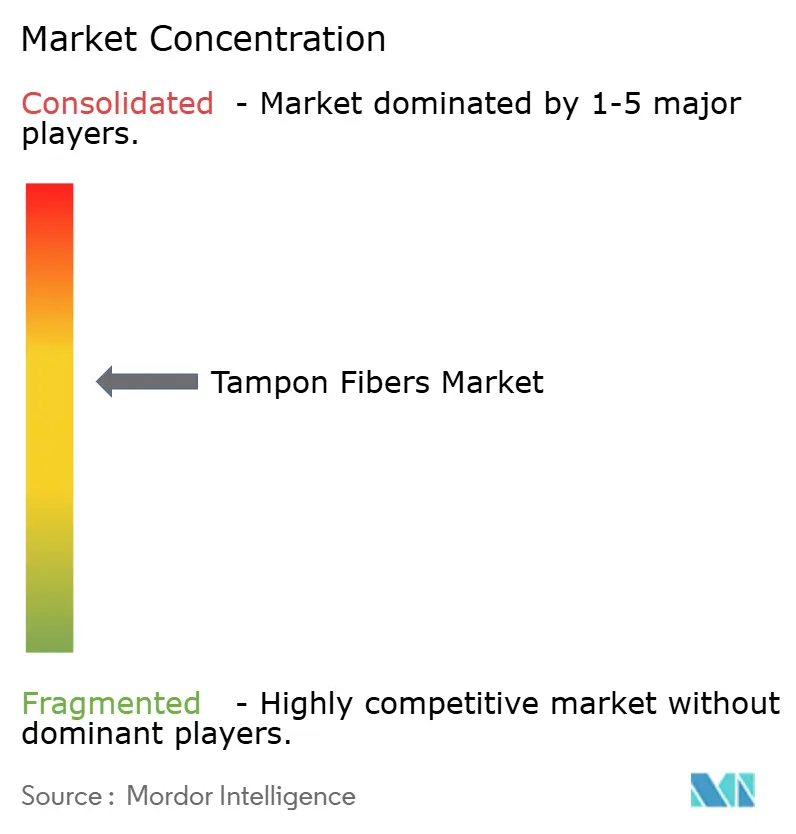
The tampon fibers market is moderately consolidated. Major brand owners influence product specifications, while specialty viscose producers, organic cotton merchants, and rayon suppliers compete for pledget contracts. Natracare, Corman through Organyc, and Lil-Lets compete in certified-organic products through Global Organic Textile Standard (GOTS) positioning, biodegradable applicators, and direct sales. TZMO SA and Ontex BV use private-label manufacturing scale to supply branded and retailer-label products in Europe. This structure makes material traceability, production capability, and support for different formats important to the tampon fibers market, while brands retain several fiber-sourcing options.
Product architecture is becoming a stronger part of competition as companies seek to link fiber choice with measurable performance. Kelheim Fibers has publicized its work on trilobal viscose absorption, positioning geometry as a differentiator for pledget design. Rael entered U.S. mass retail in June 2026 with an organic cotton core and bisphenol A (BPA)-free slim applicator, combining Korean-engineered design with availability at Target and Amazon. Procter & Gamble introduced its Tampax Starter Kit in May 2026, featuring Regular and Super products and usage instructions, targeting first-time users. These moves connect product design, user education, and channel placement with material demand.
Geographic expansion remains another competitive priority in the tampon fibers market. P&G launched Whisper Ultra Clean in India in July 2026, while Unicharm's East Africa joint venture produces Sofy locally, reflecting a push into emerging hygiene markets. Certified-organic specialists retain an advantage where consumers prioritize traceability and lower-waste claims, while larger companies retain advantages in distribution, manufacturing scale, and retailer relationships. GOTS certification, FDA requirements, and biocompatibility standards raise entry barriers for suppliers without documented processes, supporting moderate brand concentration alongside specialized fiber sourcing.
Tampon Fibers Industry Leaders
-
Procter & Gamble
-
Kimberly-Clark
-
Essity AB
-
Edgewell Personal Care
-
Unicharm Corporation
- *Disclaimer: Major Players sorted in no particular order
Recent Industry Developments
- June 2026: Rael launched the Rael Slim Applicator Tampon, the first Korean-engineered tampon in U.S. mass retail, featuring an organic cotton core and a BPA-free slim applicator. The product is available online at Target, at 1,000 Target stores, and on Amazon.
- May 2026: Procter & Gamble launched the Tampax Starter Kit, a 12-tampon entry pack available in Regular and Super absorbencies, with step-by-step insertion instructions. On World Menstrual Hygiene Day, the company distributed nearly 4.8 million tampons, by tampon fiber count, at youth sports venues and recreation centers nationwide.
Global Tampon Fibers Market Report Scope
Tampon fibers are compressed absorbent materials, primarily cotton, rayon, or a blend of both, used to absorb menstrual fluid inside the vaginal canal. These fibers are engineered to expand upon contact with fluid, providing effective absorption while maintaining structural integrity during use.
The tampon fibers market is segmented by reagent fiber type, tampon type, absorbency, fiber form, distribution channel, and geography. By fiber type, the market is segmented into cotton fibers, rayon/viscose fibers, cotton-rayon blended fibers, organic cotton fibers, and other fibers. By tampon type, the market is segmented into applicator tampons and non-applicator/digital tampons. By absorbency, the market is segmented into mini, regular, super, super plus, and ultra. By fiber form, the market is segmented into staple fibers, regenerated cellulose fibers, specialty and modified fibers, and others. By distribution channel, the market is segmented into online distribution and offline distribution. The report also covers the market size and forecasts for tampon fibers in 15 countries across major regions. The market sizes and forecasts are provided in terms of value (USD).
| Cotton Fibers |
| Rayon/Viscose Fibers |
| Cotton-Rayon Blended Fibers |
| Organic Cotton Fibers |
| Other Fibers |
| Applicator Tampons |
| Non-Applicator/Digital Tampons |
| Mini |
| Regular |
| Super |
| Super Plus |
| Ultra |
| Staple Fibers |
| Regenerated Cellulose Fibers |
| Specialty and Modified Fibers |
| Others |
| Online Distribution |
| Offline Distribution |
| Asia-Pacific | China |
| India | |
| Japan | |
| South Korea | |
| ASEAN Countries | |
| Rest of Asia-Pacific | |
| North America | United States |
| Canada | |
| Mexico | |
| Europe | Germany |
| United Kingdom | |
| France | |
| Italy | |
| NORDIC Countries | |
| Rest of Europe | |
| South America | Brazil |
| Argentina | |
| Rest of South America | |
| Middle East and Africa | Saudi Arabia |
| South Africa | |
| Rest of Middle East and Africa |
| By Fiber Type | Cotton Fibers | |
| Rayon/Viscose Fibers | ||
| Cotton-Rayon Blended Fibers | ||
| Organic Cotton Fibers | ||
| Other Fibers | ||
| By Tampon Type | Applicator Tampons | |
| Non-Applicator/Digital Tampons | ||
| By Absorbency | Mini | |
| Regular | ||
| Super | ||
| Super Plus | ||
| Ultra | ||
| By Fiber Form | Staple Fibers | |
| Regenerated Cellulose Fibers | ||
| Specialty and Modified Fibers | ||
| Others | ||
| By Distribution Channel | Online Distribution | |
| Offline Distribution | ||
| By Geography | Asia-Pacific | China |
| India | ||
| Japan | ||
| South Korea | ||
| ASEAN Countries | ||
| Rest of Asia-Pacific | ||
| North America | United States | |
| Canada | ||
| Mexico | ||
| Europe | Germany | |
| United Kingdom | ||
| France | ||
| Italy | ||
| NORDIC Countries | ||
| Rest of Europe | ||
| South America | Brazil | |
| Argentina | ||
| Rest of South America | ||
| Middle East and Africa | Saudi Arabia | |
| South Africa | ||
| Rest of Middle East and Africa | ||
Key Questions Answered in the Report
What is current market size of Tampon Fibers Market?
The Tampon Fibers Market size was valued at USD 2.29 billion in 2026 and is estimated to grow from USD 2.45 billion in 2027 to reach USD 3.38 billion by 2032, at a CAGR of 6.69% during the forecast period (2027-2032).
Which tampon fiber type is growing fastest?
Organic Cotton Fibers are forecast to expand at a 7.45% CAGR through 2032, supported by documentation and certification requirements.
Which region has the highest growth outlook for tampon fibers?
Asia-Pacific is forecast to grow at a 7.83% CAGR through 2032, supported by urbanization, awareness, and online access.
How do product safety rules affect fiber suppliers?
FDA guidance and California Per- and Polyfluoroalkyl Substances (PFAS) requirements increase the value of traceable inputs, contaminant testing, and documented material controls.