
Takaful Market Size and Share
Market Overview
| Study Period | 2021 - 2032 |
|---|---|
| Market Size (2027) | USD 35.5 Billion |
| Market Size (2032) | USD 49.30 Billion |
| Growth Rate (2027 - 2032) | 6.80 % |
| Fastest Growing Market | Asia-Pacific |
| Largest Market | Middle East and Africa |
| Market Concentration | Low |
Major Players *Disclaimer: Major Players sorted in no particular order Image © Mordor Intelligence. Reuse requires attribution under CC BY 4.0. | |
Takaful Market Analysis by Mordor Intelligence
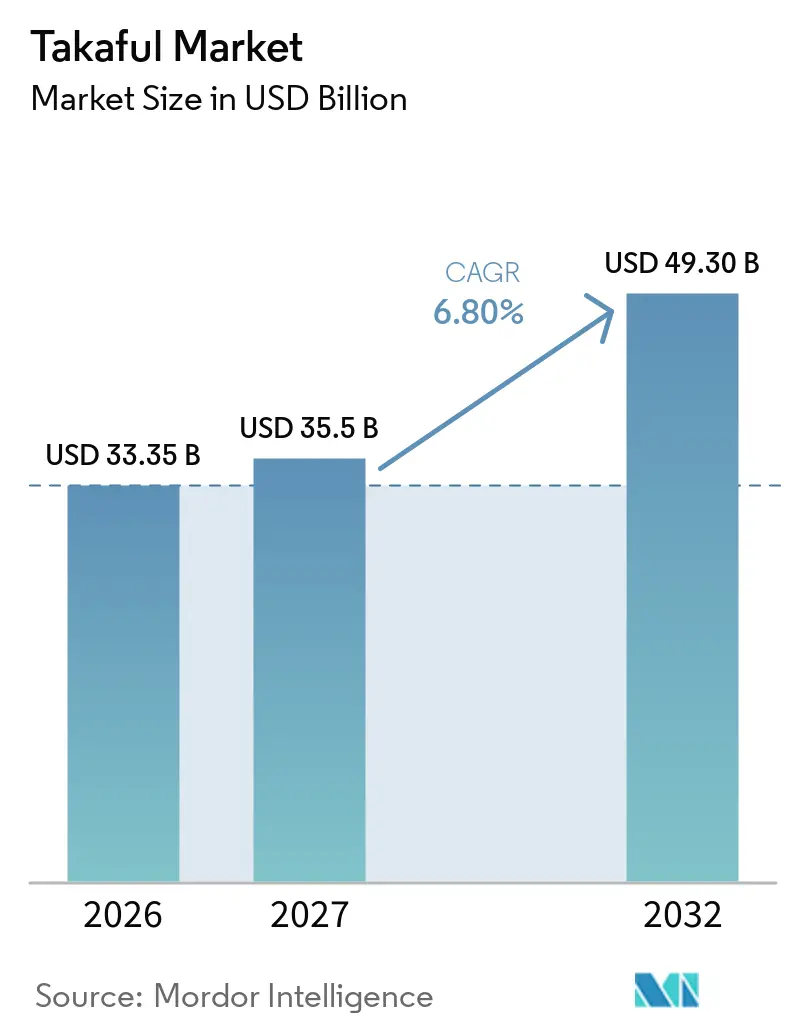
The Takaful Market size is projected to expand from USD 33.35 billion in 2026 and USD 35.5 billion in 2027 to USD 49.30 billion by 2032, registering a CAGR of 6.80% between 2027 and 2032.
Growth reflects deeper use of Shariah-compliant protection products, rather than only higher premiums. Mandatory motor and health coverage in Saudi Arabia and the United Arab Emirates has widened participation across the Gulf Cooperation Council. Insurance penetration in major takaful economies remained at 2% to 4% of GDP, compared with 11.8% in North America, leaving room for broader coverage. Digital identity systems and embedded distribution are also lowering acquisition costs for long-term savings products, which could support Family Takaful adoption in markets where face-to-face advice was previously central.
Key Report Takeaways
- By takaful type, general takaful captured 40.8% of the takaful market share in 2026, while family takaful is projected to grow at a 7.9% CAGR through 2032.
- By distribution channel, agents and brokers captured 52.6% of the takaful market share in 2026, while embedded, affinity, and other non-bank partnerships are projected to grow at a 10.6% CAGR through 2032.
- By customer type, individual and retail participants captured 43.9% of the takaful market share in 2026, while government and institutional participants are projected to grow at an 8.4% CAGR through 2032.
- By operating model, full-fledged and dedicated takaful operators captured 75.5% of the takaful market share in 2026, while takaful windows are projected to grow at an 8.1% CAGR through 2032.
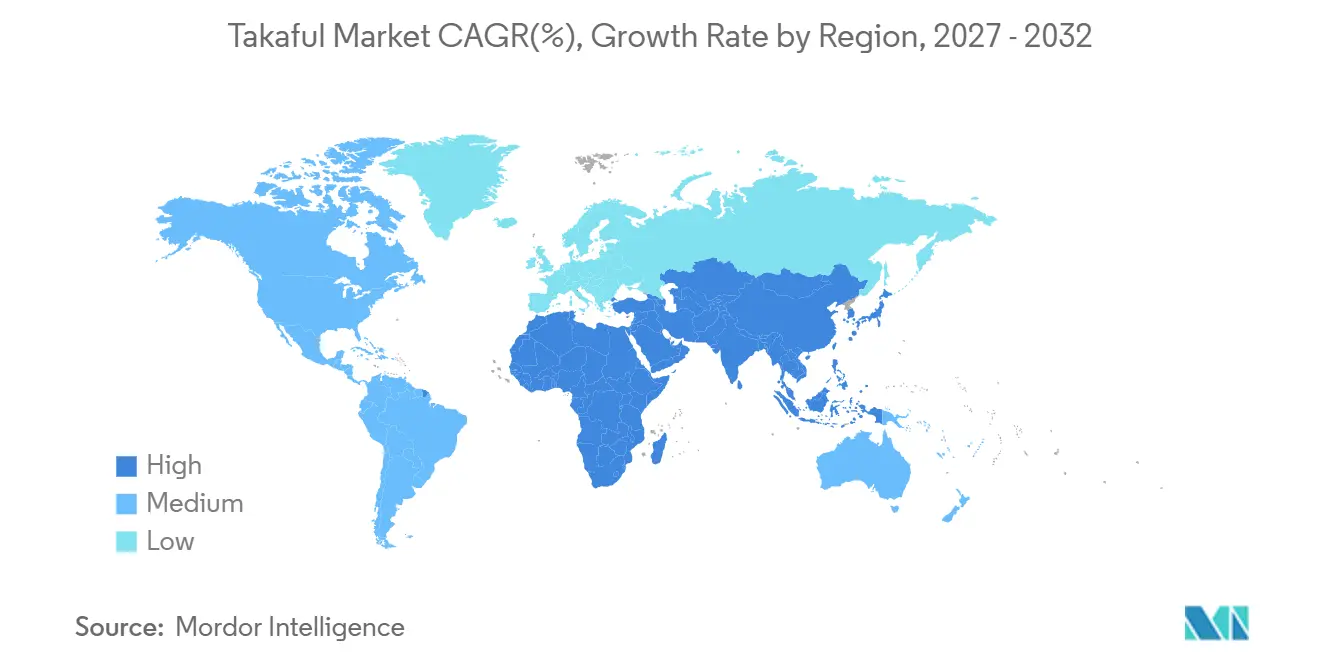
- By geography, the Middle East and Africa captured 68.3% of the takaful market share in 2026, while Asia-Pacific is projected to grow at an 8.8% CAGR through 2032.
Note: Market numbers in this report are based on Mordor Intelligence's proprietary estimation framework, which combines nine months of actuals with Q4 projections for base year 2026.
Market Trends and Insights
Drivers Impact Analysis of Takaful Market*
| Driver | (~) % Impact on CAGR Forecast | Geographic Relevance | Impact Timeline |
|---|---|---|---|
| Rising Demand for Shariah-Compliant Protection Products | +2.0% | Global, with peak impact in the Middle East, Africa, and Asia-Pacific | Long term (≥ 4 years) |
| Expansion of Mandatory Health and Motor Takaful Coverage | +1.5% | Middle East and Africa core, Saudi Arabia, United Arab Emirates, and Qatar, with spillover to Egypt and Türkiye | Short term (≤ 2 years) |
| Bancatakaful and Digital Distribution Expansion | +0.9% | Asia-Pacific, Malaysia, Indonesia, Pakistan, and the Middle East and Africa | Medium term (2-4 years) |
| Growth of Shariah-Compliant Commercial and Infrastructure Risk Protection | +0.7% | Gulf Cooperation Council and Malaysia, with early gains in Bangladesh and Egypt | Medium term (2-4 years) |
| Expansion of Family Takaful and Long-Term Savings Products | +0.6% | Southeast Asia, the Gulf Cooperation Council, and the United Kingdom | Long term (≥ 4 years) |
| Strengthening of Takaful Regulatory and Shariah-Governance Frameworks | +0.5% | Global, with the accelerating adoption of the Islamic Financial Services Board and AAOIFI standards | Medium term (2-4 years) |
| Source: Mordor Intelligence | |||
Rising Demand for Shariah-Compliant Protection Products
Takaful operators were present in 53 countries in 2025, and first-time products entered the Philippines in 2024[1]. Uganda and Kyrgyzstan also issued draft regulatory guidelines, which widened the potential operating base for the Takaful market. Rising incomes and a larger middle class in Indonesia, Bangladesh, and Egypt are increasing interest in Shariah-compliant financial services. This gives the Takaful market a wider base of potential participants than the established Gulf markets alone. In Malaysia, Islamic life insurance increased from 24% of the total life market in 2020 to 36% in 2025. Operators that establish distribution and local talent during the regulatory formation stage can secure an advantage once competitive conditions become more established.
Expansion of Mandatory Health and Motor Takaful Coverage
Mandatory coverage remains a central demand factor for the Takaful market in Saudi Arabia, which had more than 14 million insured health lives and 11 million insured vehicles in 2025. This compulsory base creates recurring demand across the Takaful market's health and motor lines. Listed Saudi insurers recorded a 34% combined increase in net profit to SAR 943 million (USD 251.2 million) in the first quarter of 2026[2]. Al Rajhi Takaful recorded a 25% increase to SAR 113.5 million (USD 30.3 million) during that period, supported by operational scale and investment income. Medical inflation raises claims pressure, but benefit redesign and tiered cover can bring more participants into formal protection pools. The Central Bank of the United Arab Emirates regulation, effective in September 2026, requires full separation of participant funds and operator assets, which improves policyholder safeguards while increasing capital demands.
Bancatakaful and Digital Distribution Expansion
Bancatakaful remains an efficient route to customers, especially for family products that require advice and support for larger case sizes. In August 2025, Syarikat Takaful Malaysia entered exclusive 20-year bancatakaful agreements with RHB Islamic Bank with a total access fee of MYR 1.6 billion (USD 390.9 million)[3]. By December 2025, bancatakaful contributed 75% of Takaful Malaysia's retail family contributions, while the KAOTIM digital platform contributed a further 15%. This combination gives the Takaful market access to both established and digitally active customers. In Pakistan, the partnership between Raqami Islamic Digital Bank and EFU window operators placed micro-takaful within mobile applications. Large exclusivity agreements can prevent competing operators from reaching established Islamic banking networks for extended periods.
Strengthening of Takaful Regulatory and Shariah-Governance Frameworks
The Islamic Financial Services Board adopted IFSB-31 on Shariah governance in July 2025. It also approved GN-10, which provides recovery and resolution guidance for takaful undertakings. GN-10 addresses fund separation and crisis preparedness issues that conventional insurance resolution tools do not fully address. AAOIFI planned a March 2026 public hearing on a governance standard covering circumstances in which takaful operators may cede risk to conventional reinsurers[4]. Convergence among the approaches taken in Malaysia, Saudi Arabia, and the United Arab Emirates supports a more consistent operating environment. This favors operators that already have strong compliance systems across several jurisdictions.
Restraints Impact Analysis of Takaful Market*
| Restraint | (~) % Impact on CAGR Forecast | Geographic Relevance | Impact Timeline |
|---|---|---|---|
| Limited Consumer Awareness and Understanding of Takaful Products | -0.8% | Asia-Pacific emerging markets, Indonesia and Bangladesh, Sub-Saharan Africa, and South America | Long term (≥ 4 years) |
| Underwriting and Claims-Cost Pressure in Motor and Medical Takaful | -0.5% | The Middle East and Africa core, Saudi Arabia and the United Arab Emirates, and Malaysia motor business | Short term (≤ 2 years) |
| Limited Retakaful Capacity for Large and Catastrophe Risks | -0.4% | Global, especially the Gulf Cooperation Council and emerging Middle East and African markets | Medium term (2-4 years) |
| Shariah Standardization and Product-Development Constraints | -0.3% | Cross-border operators in the Middle East and Africa, Asia-Pacific corridor, and Europe | Long term (≥ 4 years) |
| Source: Mordor Intelligence | |||
Limited Consumer Awareness and Understanding of Takaful Products
Consumer understanding of contributions, tabarru', and surplus participation remains limited outside core Muslim-majority markets. Indonesia's Shariah financial literacy remained below Malaysia's, despite Indonesia having the world's largest Muslim population. More than 18% of Malaysia's population held a takaful product, while urban and digitally active groups in Indonesia and Bangladesh were closer to adoption. Rural and lower-income communities need different products and distribution intermediaries, as shown by the Malaysian Takaful Association's Hijrah27 program that reached more than 120,000 people and exceeded 60% of its outreach target by 2025. Improving awareness is necessary for the Takaful market to reach participants beyond established urban customer groups. Broad literacy programs can support adoption, but their results depend on multi-year investment and public-sector cooperation.
Limited Retakaful Capacity for Large and Catastrophe Risks
Retakaful capacity has not kept pace with the expansion of the Takaful market. This forces some operators to place large commercial and catastrophe risks with conventional reinsurers, which raises Shariah compliance questions. Malaysia had 2 domestic retakaful providers, including Malaysia Re, according to an OECD publication issued in 2025. The April 2024 pluvial flood in the United Arab Emirates showed the need for improved catastrophe models and more capacity for property and engineering risks. More retakaful capacity would allow the Takaful market to support larger commercial risks on Shariah-compliant terms. The ARC WAQF ReTakaful Facility, launched in 2025, pools climate risks through a Waqf charitable trust across African Risk Capacity member states and offers a model for other regions with limited capacity.
*Our forecasts treat driver/restraint impacts as directional, not additive. The impact forecasts reflect baseline growth, mix effects, and variable interactions.
Takaful Market Segment Analysis
By Takaful Type:
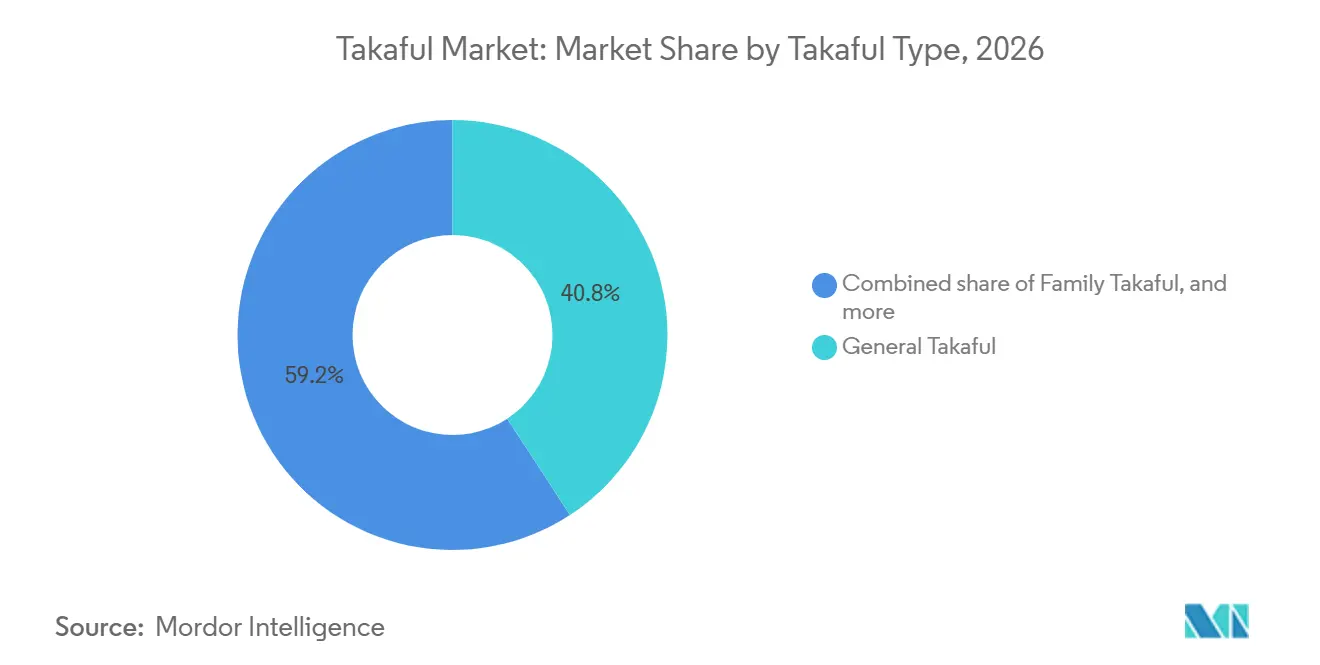
General Lines Lead Contributions While Family Products Support Long-Term GrowthGeneral Takaful held 40.8% of contributions in 2026, the largest share of the Takaful market. Mandatory motor and property lines across the Gulf Cooperation Council supported this position. In Malaysia, motor Takaful accounted for 69% of general Takaful gross written contributions. Motor Takaful reached MYR 4.59 billion (USD 1.12 billion) and increased by 12.57%. Motor claims represented 88.97% of total net claims, highlighting profitability pressures in a major line of business.
Family Takaful is forecast to expand at a 7.9% CAGR through 2032, the fastest rate among Takaful types in the Takaful market. Medical and health Takaful accounted for 68% of total Saudi premium growth in 2025. Malaysia's Islamic life insurance share rose from 24% in 2020 to 36% in 2025. The Malaysian Takaful Association identified hibah as a 2026 priority in its Hijrah27 program. This can extend family products from protection into wealth-transfer planning.
By Distribution Channel:
Agents Retain Scale While Embedded Partnerships Broaden AccessAgents and brokers captured 52.6% of contributions in 2026, the largest distribution share in the Takaful market. Their position reflects the value of trusted advice for family products and the need to explain Shariah compliance. Malaysia had 92,866 active family takaful agents in 2024. The country recruited 26,714 agents during that year, indicating that conventional advisory capacity continued to grow. Agent networks remain relevant where higher-value family products require ongoing customer engagement.
Embedded, affinity, and other non-bank partnerships are forecast to grow at a 10.6% CAGR through 2032. These arrangements use application programming interfaces to place cover within banking and payment journeys. Takaful Malaysia's bancatakaful channel accounted for 75% of its retail family new business contributions by December 2025. The Raqami Islamic Digital Bank and EFU partnership in Pakistan showed how mobile channels can reach participants with small premiums. The Takaful market can use agents, banks, and digital partners in parallel rather than replacing one channel with another.
By Customer Type:
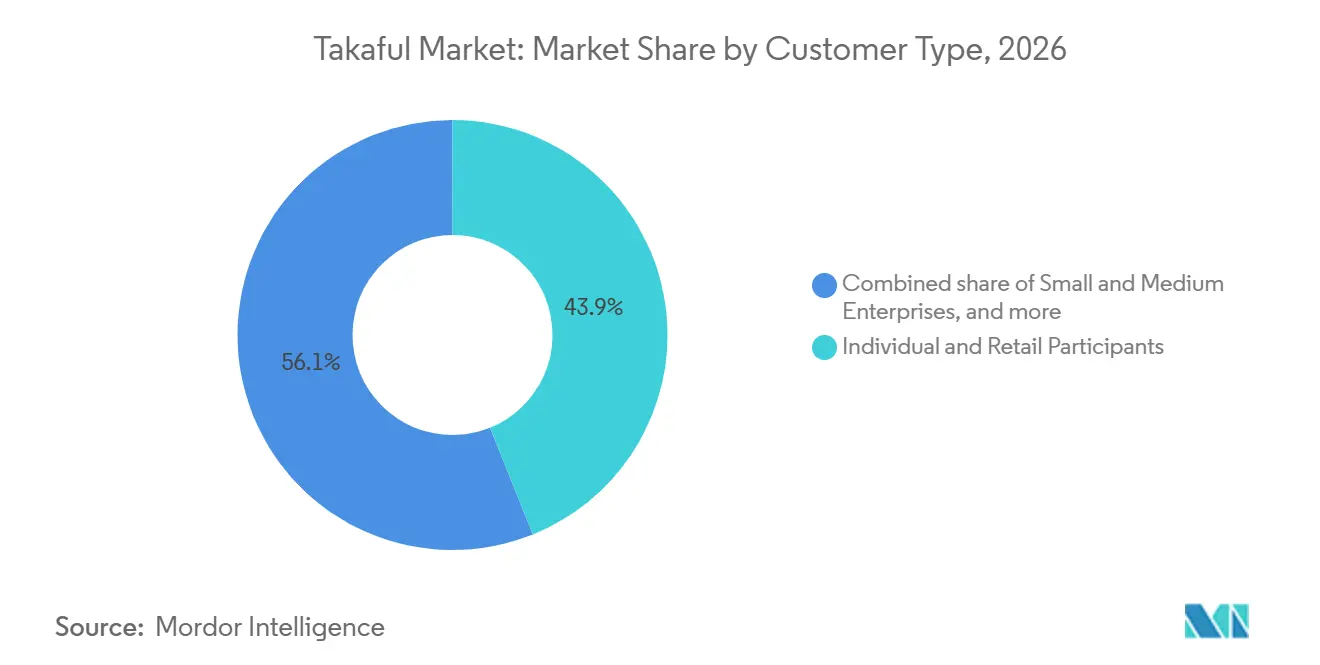
Retail Participants Lead While Institutional Demand AdvancesIndividual and retail participants represented 43.9% of contributions in 2026, giving this group the largest takaful market share among customer types. Personal motor, health, and family products supported demand. Mandatory coverage requirements and growing awareness also widened the retail customer base. Small and medium enterprises remain an underserved group. Government-led business formalization in Gulf Cooperation Council states can draw more small-business insurance purchases into regulated systems.
Government and institutional participants are projected to grow at an 8.4% CAGR through 2032. Sovereign wealth funds and public infrastructure sponsors are increasingly seeking Shariah-compliant risk transfer structures. Large corporations compete for capacity in engineering, construction, and liability mandates related to Gulf Cooperation Council infrastructure projects. Only a limited number of takaful market operators have the underwriting and retakaful capacity to serve institutional clients. This creates a strong position for operators that develop specialist talent and placement capabilities.
By Operating Model:
Dedicated Operators Hold the Largest Base While Windows Grow FasterFull-fledged and dedicated Takaful operators held 75.5% of contributions in 2026, the largest operating model in the Takaful market. This reflects established brands, regulatory standing, and customer preference for complete separation from conventional insurance operations. Purpose-built fund separation reduces audit and supervisory friction. IFSB-31 and national reforms have increased scrutiny of governance practices. Dedicated structures are well aligned with this closer regulatory focus.
Takaful windows are forecast to grow at an 8.1% CAGR through 2032. They allow conventional insurers to enter Islamic insurance markets without establishing a separate standalone operator. The United Arab Emirates rules, effective in September 2026, require dedicated Shariah committees, separate accounting for window funds, and approval before portfolio transfers. These rules increase compliance requirements for window operators. The Takaful market size for window operations depends on whether operators can meet these governance expectations.
Geography Analysis
MEA Takaful Market
The Middle East and Africa held 68.3% of the Takaful market share in 2026. Saudi Arabia accounted for 89% of Gulf Cooperation Council takaful revenue in 2025, and its revenue increased 14% year over year in the first half of 2026. Health takaful covered more than 14 million lives and accounted for 68% of Saudi premium growth in 2025. Motor takaful covered 11 million vehicles in the country. The United Arab Emirates implemented its updated takaful framework in September 2026, strengthening fund separation and governance requirements.
APAC Takaful Market
Asia-Pacific is projected to grow at an 8.8% CAGR through 2032, the fastest regional rate in the Takaful market. Malaysia's total gross contributions reached MYR 16.38 billion (USD 4.0 billion) in 2025. Indonesia's required spin-off of Shariah insurance units is changing the competitive environment as standalone operators rebuild their product and capital structures. Pakistan has potential for embedded micro-takaful through digital finance channels. Singapore became a distribution hub when Etiqa Insurance Singapore and AIA Singapore announced their March 2026 partnership for Family Takaful distribution through 6,300 AIA Financial Advisers representatives.
The Americas and EMEA Takaful Market
Europe, the United States, and South America account for a smaller but expanding part of the Takaful market. The United Kingdom is the most developed nontraditional geography, with a Muslim population above 3 million and digital and Islamic banking routes for home, life, and investment-linked takaful. The United States and South America do not have dedicated takaful regulatory frameworks, which limits near-term scale but leaves focused opportunities for digital operators serving Muslim diaspora communities. Qatar reported QAR 335 million (USD 92 million) in combined shareholder profit in 2025, up 2.7%, while Egypt, Türkiye, and Sub-Saharan Africa remain markets in formation.
Competitive Landscape
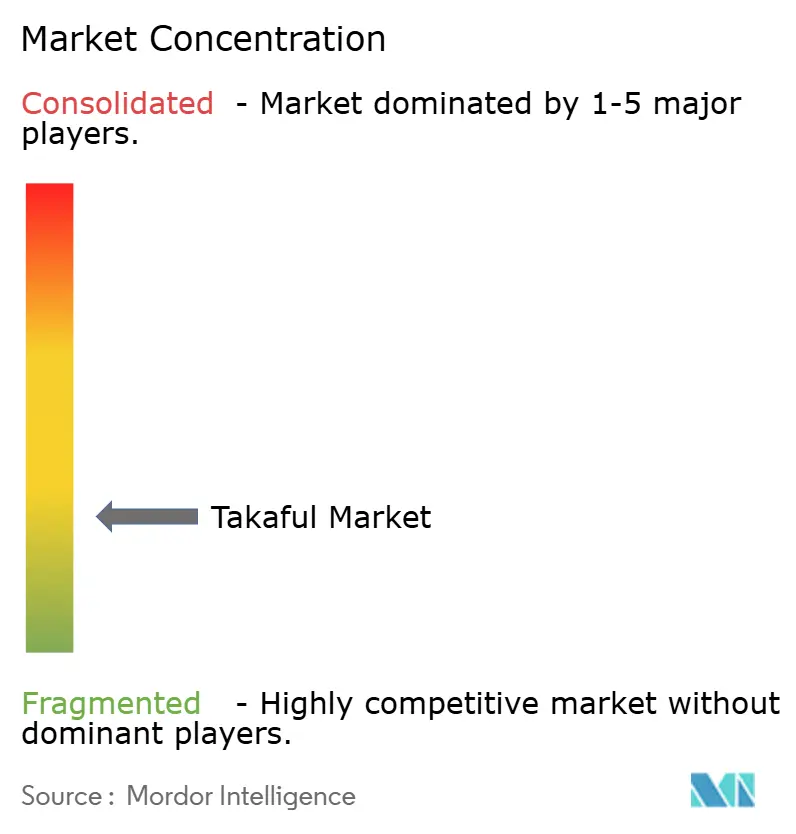
The global takaful market is fragmented across regions. No operator has a leading position across both the Gulf Cooperation Council and Southeast Asia. In Saudi Arabia, Tawuniya, Bupa Arabia, Al Rajhi Takaful, Medgulf, and Wataniya held 77% of insurance revenue as of June 2026. Mandatory lines and operating scale support these established businesses. Smaller operators pursue micro-takaful, climate-linked parametric products, and corporate engineering lines to build specialized positions.
Maybank agreed in August 2026 to acquire Ageas' remaining 30.95% stake in Maybank Ageas Holdings for RM 4.83 billion (USD 1.18 billion). The agreement gives Maybank full ownership of Etiqa's insurance and takaful operations in Malaysia and Singapore. Etiqa grew at 7.3% annually over the preceding decade, compared with 4.6% for the broader industry. The agreement shows the importance of bank-linked distribution in the takaful market. Syarikat Takaful Malaysia also secured 20-year bancatakaful arrangements with RHB Islamic Bank in August 2025.
Qatar Islamic Insurance Company obtained an International Financial Services Centres Authority license to operate from GIFT City in India. This gives a Gulf Cooperation Council operator an international financial center for reinsurance and capital-market activities. MNRB Holdings also proposed in May 2026 to acquire the remaining 80% of Labuan Reinsurance for USD 100.69 million, strengthening its risk capacity. Larger groups are strengthening distribution, capital, and reinsurance capabilities. The takaful market remains open to targeted entrants, although regulatory and retakaful constraints favor well-capitalized operators.
Takaful Industry Leaders
-
Syarikat Takaful Malaysia Keluarga Berhad
-
Islamic Arab Insurance Co. (SALAMA) PJSC
-
The Company for Cooperative Insurance (Tawuniya)
-
Al Rajhi Takaful
-
Etiqa Family Takaful Berhad
- *Disclaimer: Major Players sorted in no particular order
Takaful Market Companies Covered in this Report
- Syarikat Takaful Malaysia Keluarga Berhad
- Etiqa Family Takaful Berhad
- Prudential BSN Takaful Berhad
- Great Eastern Takaful Berhad
- AIA PUBLIC Takaful Berhad
- FWD Takaful Berhad
- Takaful Ikhlas Family Berhad
- Al Rajhi Takaful
- Islamic Arab Insurance Company (SALAMA)
- Abu Dhabi National Takaful Co. P.S.C.
- Takaful Emarat
- Qatar Islamic Insurance Company (QIIC)
- Al Khaleej Takaful Insurance Company
- Damaan Islamic Insurance Company (Beema)
- Takaful International Company B.S.C.
- Takaful Brunei Am Sdn Bhd
- Pak-Qatar Family Takaful Limited
- Amana Takaful PLC
- Sukoon Takaful
- Watania Takaful General P.J.S.C.
Recent Industry Developments in Takaful Market
- September 2026: Malayan Banking Berhad (Maybank) completed the acquisition of the remaining 30.95% interest in Maybank Ageas Holdings Berhad (MAHB) after signing a share purchase agreement (SPA) with Ageas Insurance International NV (Ageas) on 8 September 2026.
- August 2026: MNRB Holdings agreed to divest Takaful Ikhlas Family Berhad and Takaful Ikhlas General Berhad to Bank Kerjasama Rakyat Malaysia's nominee for MYR 1.64 billion (USD 400.7 million). The transaction enables MNRB to refocus on its core reinsurance and retakaful operations while allowing Bank Rakyat to extend Shariah-compliant financial services beyond banking into takaful.
- August 2026: Sukoon Insurance PJSC and Sukoon Takaful PJSC signed a strategic bancatakaful distribution partnership with Al Masraf Bank in the United Arab Emirates. The agreement allows the distribution of Shariah-compliant takaful solutions through Al Masraf Bank's retail and corporate banking network.
- March 2026: Etiqa Insurance Singapore and AIA Singapore announced a strategic distribution partnership. It makes Etiqa's Shariah-compliant Family Takaful products available through AIA Financial Advisers' network of more than 6,300 representatives. It was the first major cross-operator takaful distribution partnership in Singapore.
Global Takaful Market Report Scope
Segmentation Overview
| Family Takaful | Family Protection / Life Takaful |
| Savings and Investment-Linked Takaful | |
| Medical and Health Takaful | |
| General Takaful | Motor Takaful |
| Property and Fire Takaful | |
| Marine and Aviation Takaful | |
| Engineering and Construction Takaful | |
| Liability Takaful | |
| Travel and Personal Accident Takaful | |
| Credit and Other General Takaful |
| Agents and Brokers |
| Bancatakaful |
| Direct Distribution |
| Embedded, Affinity and Other Non-Bank Partnerships |
| Individual and Retail Participants |
| Small and Medium Enterprises |
| Large Corporates |
| Government and Institutional Participants |
| Full-Fledged / Dedicated Takaful Operators |
| Takaful Windows of Conventional Insurers |
| Middle East & Africa | Saudi Arabia |
| United Arab Emirates | |
| Bahrain | |
| Qatar | |
| Kuwait | |
| Oman | |
| Türkiye | |
| Egypt | |
| Rest of Middle East & Africa | |
| Asia-Pacific | Malaysia |
| Indonesia | |
| Pakistan | |
| Singapore | |
| Bangladesh | |
| Rest of Asia-Pacific | |
| Europe | United Kingdom |
| Rest of Europe | |
| North America | |
| South America |
| By Takaful Type | Family Takaful | Family Protection / Life Takaful |
| Savings and Investment-Linked Takaful | ||
| Medical and Health Takaful | ||
| General Takaful | Motor Takaful | |
| Property and Fire Takaful | ||
| Marine and Aviation Takaful | ||
| Engineering and Construction Takaful | ||
| Liability Takaful | ||
| Travel and Personal Accident Takaful | ||
| Credit and Other General Takaful | ||
| By Distribution Channel | Agents and Brokers | |
| Bancatakaful | ||
| Direct Distribution | ||
| Embedded, Affinity and Other Non-Bank Partnerships | ||
| By Customer Type | Individual and Retail Participants | |
| Small and Medium Enterprises | ||
| Large Corporates | ||
| Government and Institutional Participants | ||
| By Operating Model | Full-Fledged / Dedicated Takaful Operators | |
| Takaful Windows of Conventional Insurers | ||
| By Geography | Middle East & Africa | Saudi Arabia |
| United Arab Emirates | ||
| Bahrain | ||
| Qatar | ||
| Kuwait | ||
| Oman | ||
| Türkiye | ||
| Egypt | ||
| Rest of Middle East & Africa | ||
| Asia-Pacific | Malaysia | |
| Indonesia | ||
| Pakistan | ||
| Singapore | ||
| Bangladesh | ||
| Rest of Asia-Pacific | ||
| Europe | United Kingdom | |
| Rest of Europe | ||
| North America | ||
| South America | ||
Key Questions Answered in the Report
What is driving growth in the takaful sector?
The Takaful market is forecast to grow at a 6.8% CAGR through 2032, supported by mandatory health and motor coverage, expanding Family Takaful demand, and wider digital distribution.
Which takaful product type has the largest contribution base?
General Takaful held 40.8% of contributions in 2026, supported by compulsory motor and property coverage in Gulf Cooperation Council markets.
Which distribution channel is growing fastest for takaful products?
Embedded, Affinity and Other Non-Bank Partnerships are projected to grow at a 10.6% CAGR through 2032 as digital banks and payment applications broaden access.
Which region is expected to grow fastest through 2032?
Asia-Pacific is projected to grow at an 8.8% CAGR through 2032, supported by Malaysia, Indonesia, Pakistan, and Singapore distribution activity.
Why is retakaful capacity important for operators?
Limited retakaful capacity can constrain underwriting for large commercial and catastrophe risks and can require ceding risk to conventional reinsurers.
How concentrated is the takaful sector?
The takaful sector is regionally fragmented, although the 5 largest Saudi insurers held 77% of insurance revenue as of June 2026.