
Size and Share of Taiwan Solder Materials Market In Semiconductor Industry
Market Overview
| Study Period | 2021 - 2032 |
|---|---|
| Forecast Data Period | 2027 - 2032 |
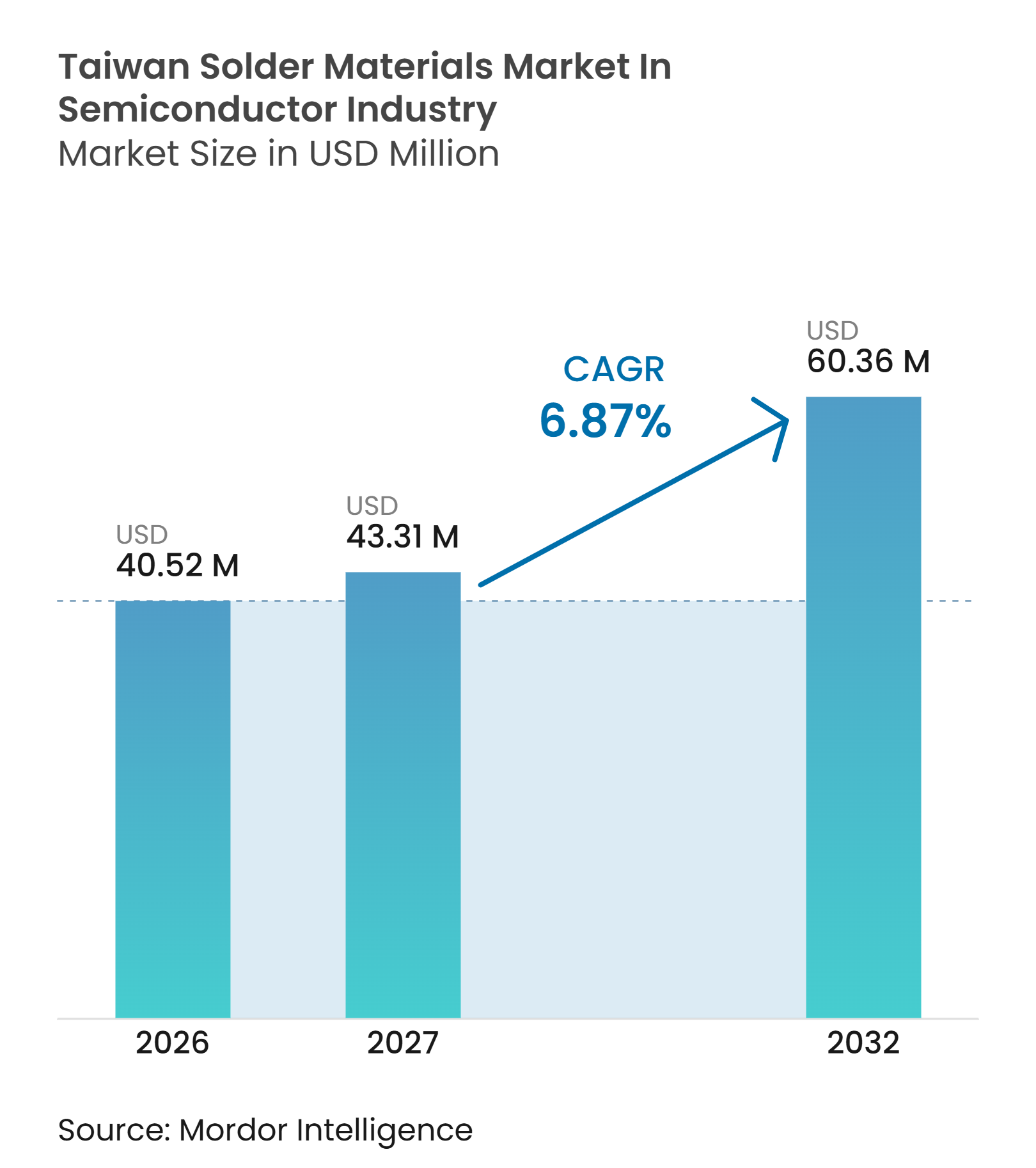
| Base Year Market Size (2026) | USD 40.52 Million |
| Market Size (2027) | USD 43.31 Million |
| Market Size (2032) | USD 60.36 Million |
| Growth Rate (2027 - 2032) | 6.87 % |
| Market Concentration | Medium |
Major Players *Disclaimer: Major Players sorted in no particular order Image © Mordor Intelligence. Reuse requires attribution under CC BY 4.0. | |
Analysis of Taiwan Solder Materials Market In Semiconductor Industry by Mordor Intelligence
The Taiwan solder materials market in semiconductor industry size is projected to expand from USD 40.52 million in 2026 to USD 60.36 million by 2032, registering a CAGR of 6.87% between 2027 to 2032. Taiwan’s established concentration of foundries, outsourced semiconductor assembly and test providers, and substrate suppliers supports recurring demand for solder paste, balls, powders, and fluxes. Advanced AI, high-performance computing, and high-bandwidth memory packages use more complex interconnect structures, which increases the number of process steps and material qualification requirements. Capacity additions for advanced packaging in Taiwan are likely to reinforce demand, particularly where wafer-level bumping and fine-pitch assembly are required. Suppliers with proven alloy systems, ultrafine powder capabilities, and customer-specific qualification records are positioned to compete for higher-value applications, while raw-material exposure and alternative bonding technologies remain important constraints.
Key Report Takeaways
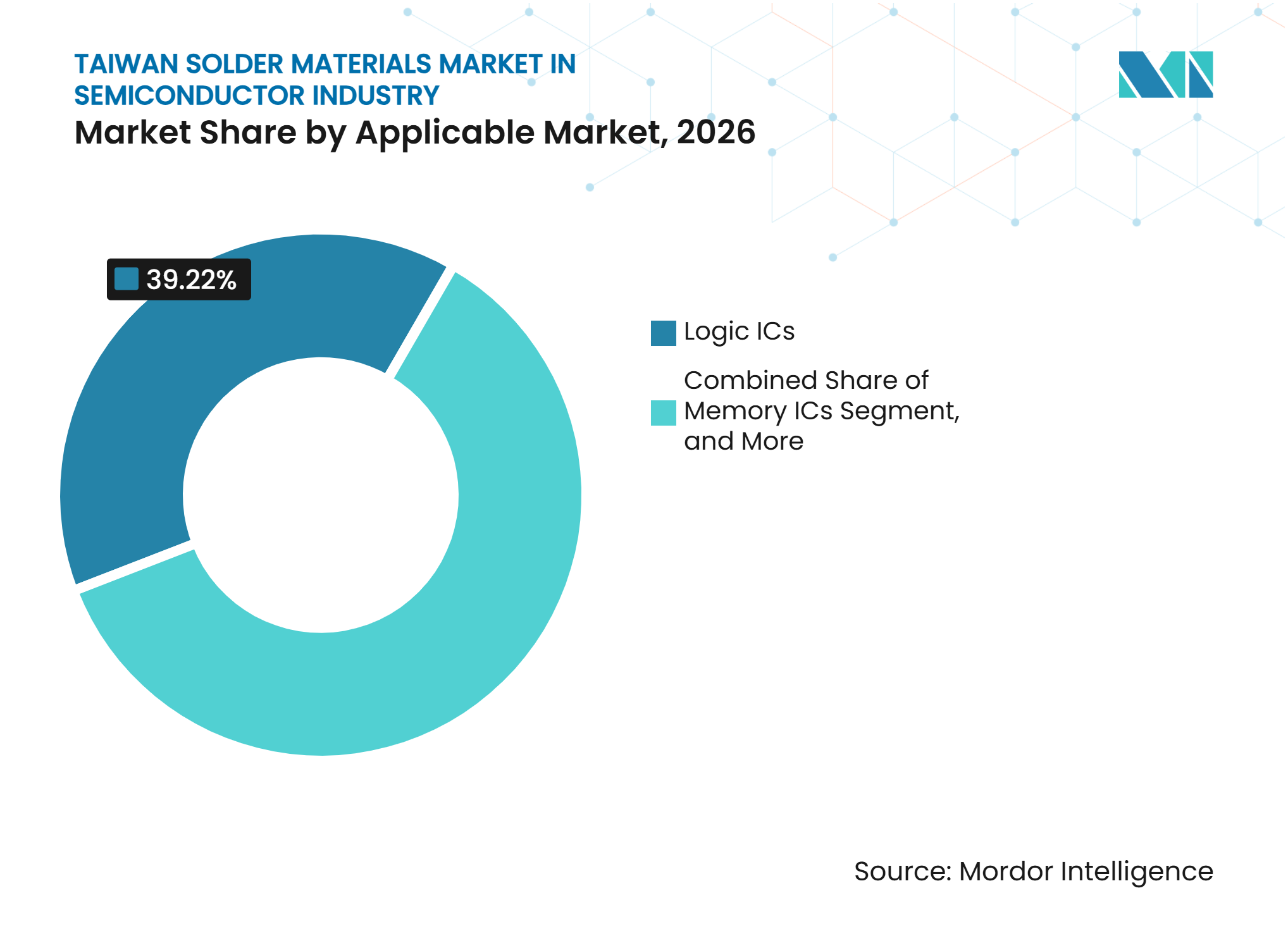
- By applicable market, logic ICs held a 39.22% share of the Taiwan Solder Materials Market in Semiconductor Industry in 2026, while memory ICs are projected to expand at a 7.24% CAGR through 2032.
- By product form, solder paste accounted for 35.67% of the Taiwan Solder Materials Market in Semiconductor Industry size in 2026, while externally sold solder powder is projected to expand at a 7.51% CAGR through 2032.
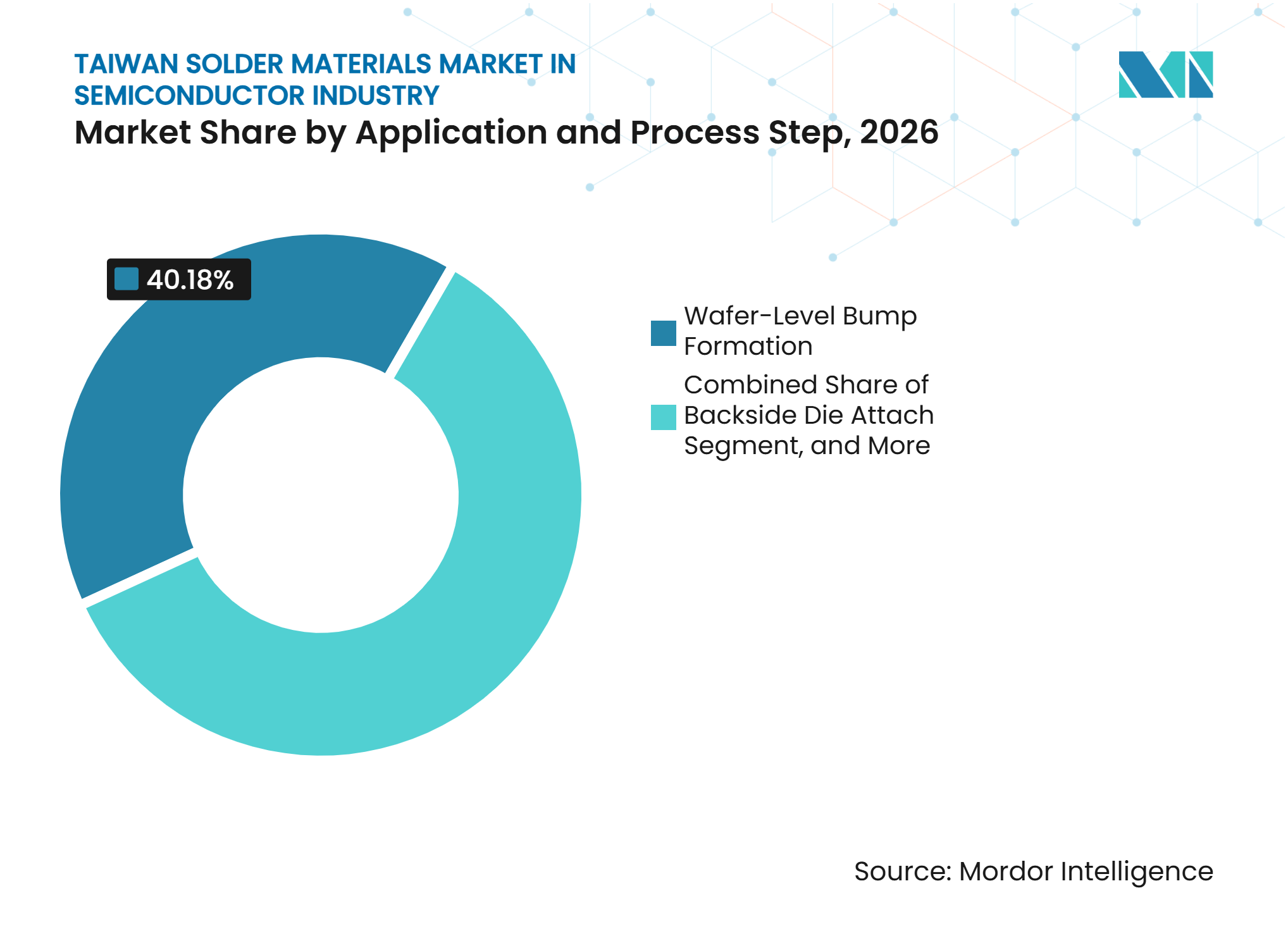
- By application and process step, wafer-level bump formation held a 40.18% share of the Taiwan Solder Materials Market in Semiconductor Industry in 2026 and is projected to expand at a 7.27% CAGR through 2032.
- By geography, Northern Taiwan held 58.29% of the Taiwan solder materials market in 2026, while Southern Taiwan is projected to expand at a 7.18% CAGR through 2032.
Note: Market numbers in this report are based on Mordor Intelligence's proprietary estimation framework, which combines nine months of actuals with Q4 projections for base year 2026.
Market Trends and Insights
Drivers Impact Analysis of Taiwan Solder Materials Market in Semiconductor Industry*
| Driver | (~) % Impact on CAGR Forecast | Geographic Relevance | Impact Timeline |
|---|---|---|---|
| AI, HPC, and HBM-Driven Advanced Packaging Expansion | +2.5% | Global, with Taiwan as the primary Asia-Pacific node | Medium term (2-4 years) |
| Growth of Chiplet and Heterogeneous Integration Architectures | +1.5% | Taiwan, South Korea, and North America | Medium term (2-4 years) |
| Expansion of Wafer-Level, Flip-Chip, BGA, and CSP Packaging | +0.9% | Global, with Taiwan and South Korea dominant | Short term (≤ 2 years) |
| Lead-Free Conversion and Environmental Compliance | +0.7% | Global, with EU and Asia-Pacific-led compliance | Long term (≥ 4 years) |
| Taiwan’s Concentration of Foundry, OSAT, and Substrate Capacity | +0.6% | Taiwan-specific | Medium term (2-4 years) |
| Fine-Pitch Qualification Demand for Low-Alpha and Ultrafine Materials | +0.4% | Taiwan, Japan, and South Korea | Short term (≤ 2 years) |
| Source: Mordor Intelligence | |||
AI, HPC, and HBM-Driven Advanced Packaging Expansion
AI and high-performance computing workloads require complex semiconductor packages with more interconnect layers and higher bump counts. Taiwan’s advanced packaging base places local solder material suppliers close to major assembly operations and their engineering teams. Invest Taiwan identifies advanced packaging as a major part of the country’s semiconductor development, with platforms such as CoWoS and InFO supporting heterogeneous integration and AI-related demand. These platforms require qualified materials for bump formation, chip attachment, and package assembly. As package designs incorporate multiple logic and memory elements, the Taiwan solder materials market in semiconductor industry benefits from additional material requirements at several interconnect layers. Capacity growth alone is not sufficient, because suppliers must also meet demanding reliability, purity, and process-control requirements.
Growth of Chiplet and Heterogeneous Integration Architectures
Chiplet architectures combine distinct semiconductor components into a single package and can use several types of interconnects. This creates demand for alloy systems and fluxes that can perform through sequential thermal processes. Research in the ASME Journal of Electronic Packaging describes manufacturing challenges in hybrid bonding for heterogeneous chiplet integration, including alignment, surface preparation, and process reliability requirements. Hybrid bonding can remove solder from selected interfaces, but other package layers continue to use solder-based bumping and attachment processes. Taiwan’s commercial advanced packaging platforms support continued demand for high-purity solder spheres and precision flux formulations. The Taiwan solder materials market in semiconductor industry consequently depends on suppliers that can support mixed bonding approaches within the same package design.
Expansion of Wafer-Level, Flip-Chip, BGA, and CSP Packaging
Wafer-level chip scale packaging, flip-chip packaging, ball grid array formats, and chip scale packages remain core assembly formats for logic, memory, mobile, networking, and server devices. These formats sustain broad demand for solder paste, solder balls, and fluxes across high-volume manufacturing lines. Wafer-level bump formation held a 40.18% share in 2026, reflecting its central role in advanced package construction. Panel-level packaging also increases the importance of controlled stencil printing and powder-size consistency. Invest Taiwan identifies advanced packaging as an area of active development in the domestic semiconductor ecosystem. These developments strengthen the Taiwan solder materials market in semiconductor industry for suppliers that can support qualification across wafer and panel formats.
Lead-Free Conversion and Environmental Compliance
Lead-free conversion continues to shape alloy selection for semiconductor packaging, although some specialized applications retain exemptions. European chemical and electronics compliance requirements influence material qualification decisions throughout global supply chains. Low-temperature lead-free alloys are also relevant for large and thin packages where thermal stress and warpage require careful management. Indium Corporation describes its low-temperature solder solutions as part of its thermal management and solder portfolio for electronics assembly applications. The Taiwan solder materials market in semiconductor industry therefore needs materials that balance lead-free compliance, reflow performance, and long-term reliability. Suppliers with proven alloy data and application support can reduce the qualification burden for assembly customers.
Restraints Impact Analysis of Taiwan Solder Materials Market in Semiconductor Industry*
| Restraint | (~) % Impact on CAGR Forecast | Geographic Relevance | Impact Timeline |
|---|---|---|---|
| Volatility in Tin, Silver, Copper, Indium, and Gold Prices | -1.8% | Global | Short term (≤ 2 years) |
| Higher Reflow Temperatures and Lengthy Lead-Free Qualification Cycles | -0.8% | Global, with Taiwan and Japan as primary hubs | Medium term (2-4 years) |
| Reliability Risks at Shrinking Bump Pitch and Higher Current Density | -0.6% | Global, with Taiwan, South Korea, and Japan most exposed | Long term (≥ 4 years) |
| Substitution by Copper Pillars, Hybrid Bonding, and Sintered Materials | -0.9% | Global, with Asia-Pacific and Taiwan accelerating adoption | Long term (≥ 4 years) |
| Source: Mordor Intelligence | |||
Volatility in Tin, Silver, Copper, Indium, and Gold Prices
Solder materials depend on several metal inputs, which creates exposure to shifts in tin, silver, copper, indium, and gold costs. Changes in input pricing can alter alloy economics and place pressure on supplier margins. Suppliers may respond by developing lower-silver or multi-component formulations, but such changes require testing and customer approval. This process can redirect research and development capacity away from new-product programs. The Taiwan solder materials market in semiconductor industry is particularly sensitive because advanced packaging customers require stable process behavior and cannot rapidly substitute approved materials. Smaller suppliers can face greater pressure because they have fewer resources to fund formulation work and extended qualification activity.
Higher Reflow Temperatures and Lengthy Lead-Free Qualification Cycles
The shift from tin-lead solders to lead-free alternatives can increase thermal stress on substrates and dies. Large and thin heterogeneous packages are especially sensitive to warpage during reflow. New alloys can address these issues, but each alloy and package combination needs extensive qualification by assembly providers and end customers. The MDPI Inorganics literature notes that lead-free solders for through-silicon via applications require continuing evaluation of mechanical behavior, electromigration, and thermal cycling performance.[1] Documentation requirements under IEC 61191 also increase the process burden for new soldering systems. These requirements lengthen the path from laboratory validation to commercial volume production.
*Our forecasts treat driver/restraint impacts as directional, not additive. The impact forecasts reflect baseline growth, mix effects, and variable interactions.
Taiwan Solder Materials Market In Semiconductor Industry Segment Analysis
By Applicable Market:
Logic ICs Lead Volume While Memory ICs AccelerateLogic ICs held 39.22% of the Taiwan solder materials market share in 2026, supported by AI processors, graphics chips, and network-switching device packaging. Their high share reflects the concentration of advanced logic manufacturing and assembly activity in Taiwan. Logic packages require solder paste, balls, and fluxes for bump formation, flip-chip interconnection, and package assembly. Their operating conditions place emphasis on reliable and consistent process control. Within the Taiwan solder materials market in semiconductor industry, advanced packaging connects foundry activity with local assembly and test operations, strengthening demand for qualified low-alpha and fine-pitch materials.
Memory ICs are projected to expand at a 7.24% CAGR through 2032, driven by increased use of stacked memory configurations in high-performance systems. Each additional die adds assembly complexity and increases the need for tightly controlled interconnect materials. HBM3E and HBM4 packages require control of coplanarity, thermal behavior, and reliability. Hybrid bonding can reduce solder use at selected interfaces, but remaining stacked-die interconnects continue to require solder materials. Compound semiconductors, power devices, analog ICs, sensors, MEMS, RF devices, and optical components add demand across specialized applications, while JEDEC JESD22 guides reliability testing.



By Product Form:
Solder Paste Leads While External Solder Powder Expands FastestSolder paste accounted for 35.67% of the Taiwan solder materials market size in 2026 because stencil printing remains central to wafer bumping and package assembly. It supports high-volume operations across a wide range of assembly steps. Customers evaluate paste performance through print definition, reflow behavior, voiding control, and reliability. Fine-pitch processes require careful matching of powder particle size and flux chemistry. The Taiwan solder materials market in semiconductor industry relies on customer qualification records for reliable paste performance.
Externally sold solder powder is projected to expand at a 7.51% CAGR through 2032 as advanced packaging adopts ultrafine powder grades. IEEE EPTC research reported consistent bump formation at 140 μm pitch using a Type 6 powder and an application-specific flux system, with 4-5 process steps compared with 8-9 steps for electroplating. This process approach can strengthen interest in fine-powder materials where customers seek controlled bump formation. Solder balls and spheres remain important for BGA, CSP, and wafer-level ball attach applications. Shenmao’s Daray Technology operations extend its presence in BGA solder balls, while preforms, wire, and standalone fluxes serve die attach, rework, and specialized assembly needs.[2]
By Application and Process Step:
Wafer-Level Bump Formation Leads Both MeasuresWafer-level bump formation held a 40.18% share in 2026 and is projected to expand at a 7.27% CAGR through 2032. This combination reflects the continuing importance of bump interconnects in advanced package assembly. CoWoS, InFO, and other advanced package formats depend on wafer-level processes before later assembly stages. More complex designs can add active layers and increase bumping operations per finished unit. The Taiwan solder materials market size for wafer-level processes therefore benefits from advanced package volume and greater interconnect density.
Die-to-substrate interconnection remains a large application because flip-chip assembly is widely used in logic and memory packages. Package-to-board interconnection through BGA and CSP formats is more mature and uses established supply chains and alloy systems. Backside die attach and package sealing are smaller in volume but often require specialized materials, including sintered silver in certain power-device applications. These alternatives create competitive pressure within the Taiwan solder materials market in semiconductor industry. MacDermid Alpha’s material portfolio includes die-attach solutions for power and advanced electronics applications.[3]

Geography Analysis
Northern Taiwan: Established Semiconductor Assembly Core
Northern Taiwan held 58.29% of the Taiwan solder materials market share in 2026 because it includes a dense group of semiconductor manufacturing, design, and assembly operations. Hsinchu and Taoyuan connect foundries, outsourced semiconductor assembly and test providers, and materials suppliers, supporting demand for high-purity solder pastes, low-alpha materials, solder balls, and precision fluxes. Shorter logistics routes can support faster engineering interaction during product qualification. Shenmao’s operations in Taoyuan and its research presence near Hsinchu illustrate the area’s local materials ecosystem. The Taiwan solder materials market in semiconductor industry depends on process-control capability and supply reliability in Northern Taiwan.
Southern Taiwan: Advanced Packaging Capacity Builds Demand
Southern Taiwan is projected to expand at a 7.18% CAGR through 2032 as Tainan and Kaohsiung attract additional semiconductor and packaging-related investment. Its growth is linked to expanding advanced manufacturing capacity, a larger local materials base, and science park infrastructure for supply-chain participants. Shenmao stated that Daray Technology operates a BGA solder ball facility in Kaohsiung, while a larger Taoyuan facility was under construction. Government-backed investment activity supports the Taiwan solder materials market in semiconductor industry through semiconductor materials infrastructure in southern science parks.
Central Taiwan and Emerging Nodes: Specialty Demand Broadens the Base
Central Taiwan’s Taichung Science Park supports MEMS, sensor, compound semiconductor, and specialty analog activity that can require specialized solder alloys. These applications can use gold-tin and indium-based materials instead of the high-volume SAC pastes used more widely in other regions, and their qualification requirements can be exacting. Eastern Taiwan remains a smaller potential demand node for specialty materials and related supply-chain activity. This changing mix can broaden the Taiwan solder materials market in semiconductor industry beyond high-volume commodity paste and ball demand, while precious-metal alloy suppliers address optical, photonic, RF, and compound semiconductor packaging.
Competitive Landscape
Market Concentration
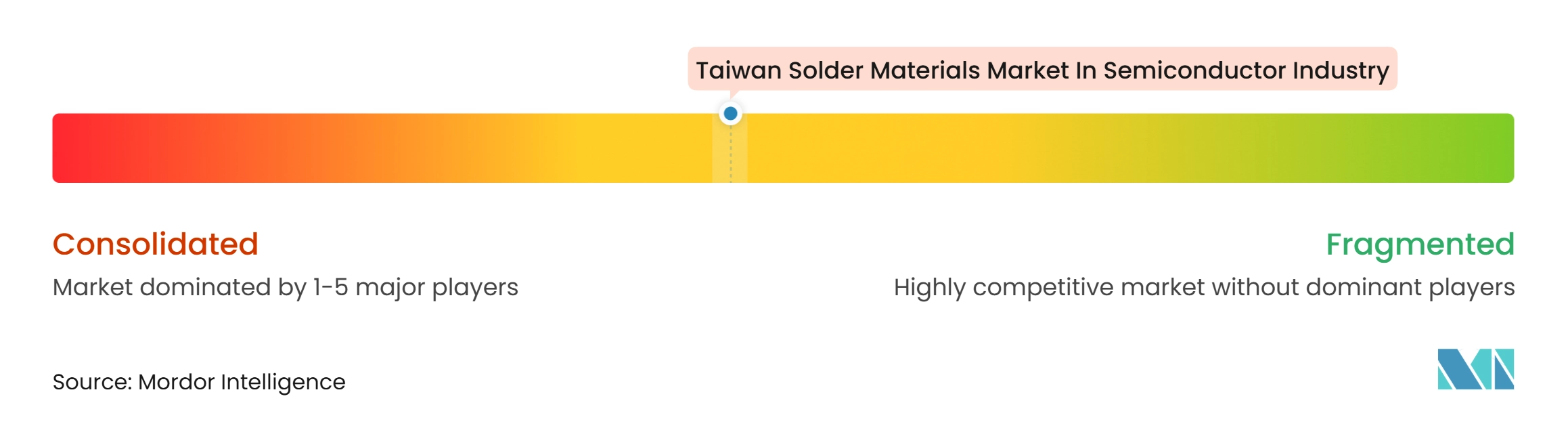
The Taiwan solder materials market in semiconductor industry has a moderately consolidated top tier that includes MacDermid Alpha Electronics Solutions, Heraeus Electronics, Senju Metal Industry, Indium Corporation, and Shenmao Technology. AIM Solder, KOKI Company, Nihon Superior, Harima Chemicals Group, DUKSAN Hi-Metal, and MK Electron also compete through technical capability, pricing, and regional proximity. Leading suppliers compete through alloy intellectual property, manufacturing integration, and direct engineering support for assembly customers. Qualification records can be as important as product pricing because customers require documented reliability and process performance.
MacDermid Alpha, Heraeus, and Henkel secured a legally binding outcome in German patent proceedings involving the M794 solder alloy and Senju entities in February 2025. The case shows that patent protection can shape supplier strategy in lead-free alloy systems. Shenmao completed the Daray Technology acquisition in 2025, extending its portfolio into precision BGA solder balls. Its acquisition of PMTC also added material development and application expertise for high-performance solder-ball applications.
Opportunity areas include ultrafine powder solder pastes for tight bump pitches and low-alpha materials for memory-intensive packages. Suppliers must combine alloy knowledge with controlled manufacturing, process support, and reliable documentation. Senju Semiconductors Taiwan received recognition in ASE Technology Holding’s supplier automation contest for automated guided vehicles, weighing, warehousing, labeling, and inspection activity. This indicates that production automation can influence supplier selection alongside alloy performance. JEDEC JESD22 and IPC J-STD-005 remain important reference frameworks for reliability and solder-paste qualification.
Leaders of Taiwan Solder Materials Market In Semiconductor Industry
-
MacDermid Alpha Electronics Solutions
-
Senju Metal Industry
-
Heraeus Electronics
-
Indium Corporation
-
Shenmao Technology, Inc.
- *Disclaimer: Major Players sorted in no particular order
Taiwan Solder Materials Market In Semiconductor Industry Companies Covered in this Report
- MacDermid Alpha Electronics Solutions
- Senju Metal Industry
- Heraeus Electronics
- Indium Corporation
- Shenmao Technology, Inc.
- Harima Chemicals Group, Inc.
- Tamura Corporation
- AIM Solder
- KOKI Company Limited
- Nihon Superior Co., Ltd.
- DUKSAN Hi-Metal Co., Ltd.
- MK Electron Co., Ltd.
- Nippon Micrometal Corporation
- Materion Corporation
- TANAKA Precious Metals
- Mitsui Kinzoku Co., Ltd.
- Inventec Performance Chemicals Co., Ltd.
- Shenzhen Vital New Material Co., Ltd.
- Tongfang Tech
- Asahi Chemical and Solder Industries Co., Ltd.
Recent Industry Developments in Taiwan Solder Materials Market In Semiconductor Industry
- November 2026: MacDermid Alpha Electronics Solutions announced its forthcoming BondPad technology, a silver sinter film laminated to a 50 μm copper foil for die-topside attachment in silicon carbide power packages. The company presented the product at electronica 2026, held November 10-13 in Munich. Under power-cycling test conditions, BondPad achieved more than 75,000 cycles, compared with 2,500 cycles for a conventional aluminum wirebond reference. The stated result represented 30 times longer life under equivalent conditions. The technology targets silicon carbide power modules used in AI data centers and electric-vehicle powertrains, where durable die-topside attachment supports demanding power-cycle conditions.
- September 2026: Shenmao Technology Inc. participated in SEMICON Taiwan 2026, exhibiting its semiconductor solder-material portfolio. Its participation provided a platform to showcase solder materials for semiconductor packaging and connect with regional chip manufacturers and packaging customers. The exhibitor listing confirms participation, but does not establish a new product launch at the event.
- September 2026: Dyfenco International Co., Ltd. participated in SEMICON Taiwan 2026, presenting semiconductor-grade soldering materials, including ultra-fine solder paste, solder preforms and related assembly materials. Its portfolio supports flip-chip packaging, system-in-package, MEMS and sensor packaging, and embedded-die applications. The event listing confirms its market presence but does not identify a newly launched product.
- August 2026: LG Chem participated in SEMICON Taiwan 2026 and presented dry film solder resist, photo-imageable dielectrics, die-attach films, and conductive silver and copper sintering pastes. The company directed these materials toward HBM and AI semiconductor applications. The product group placed LG Chem among suppliers seeking opportunities in advanced packaging and power semiconductor materials. The exhibition also showed the growing overlap between conventional solder materials, die-attach products, dielectric materials, and sintering pastes in the broader advanced-packaging supply chain.
Scope of Report on Taiwan Solder Materials Market In Semiconductor Industry
The Taiwan Solder Materials Market in the Semiconductor Industry refers to the national market for solder-based interconnect materials used in semiconductor packaging, wafer-level assembly, flip-chip bonding, and advanced IC packaging including solder balls, solder paste, solder wire, solder preforms, fluxes, and specialized alloys serving Taiwan’s semiconductor manufacturing ecosystem anchored by TSMC, ASE Group, Amkor Technology, and MediaTek, with demand concentrated in advanced packaging technologies such as BGA (ball grid array), fine-pitch CSP (chip-scale package), WLCSP (wafer-level chip-scale package), chiplet integration, and 3D interconnects.
The Taiwan Solder Materials Market in Semiconductor Industry Report is Segmented by Applicable Market (Logic ICs, Memory ICs, Compound Semiconductors and Power Devices, Analog ICs, Sensors, MEMS and RF Devices, and Optical and Photonic Devices), Product Form (Solder Paste, Solder Balls and Spheres, Solder Preforms, Solder Wire, Solder Fluxes, Standalone, and Solder Powder, Externally Sold), and Application and Process Step (Wafer-Level Bump Formation, Die-to-Substrate Interconnection, Conventional Flip-Chip, Package-to-Board Interconnection, BGA and CSP Ball Attach, Backside Die Attach, and Package Sealing and Component Attachment). The Market Forecasts Are Provided in Terms of Value (USD).
Segmentation Overview
| Logic ICs |
| Memory ICs |
| Compound Semiconductors and Power Devices |
| Analog ICs |
| Sensors, MEMS and RF Devices |
| Optical and Photonic Devices |
| Solder Paste |
| Solder Balls and Spheres |
| Solder Preforms |
| Solder Wire |
| Solder Fluxes, Standalone |
| Solder Powder, Externally Sold |
| Wafer-Level Bump Formation |
| Die-to-Substrate Interconnection, Conventional Flip-Chip |
| Package-to-Board Interconnection, BGA and CSP Ball Attach |
| Backside Die Attach |
| Package Sealing and Component Attachment |
| By Applicable Market | Logic ICs |
| Memory ICs | |
| Compound Semiconductors and Power Devices | |
| Analog ICs | |
| Sensors, MEMS and RF Devices | |
| Optical and Photonic Devices | |
| By Product Form | Solder Paste |
| Solder Balls and Spheres | |
| Solder Preforms | |
| Solder Wire | |
| Solder Fluxes, Standalone | |
| Solder Powder, Externally Sold | |
| By Application and Process Step | Wafer-Level Bump Formation |
| Die-to-Substrate Interconnection, Conventional Flip-Chip | |
| Package-to-Board Interconnection, BGA and CSP Ball Attach | |
| Backside Die Attach | |
| Package Sealing and Component Attachment |
Key Questions Answered in the Report
What is the size of the Taiwan solder materials market in semiconductor industry?
The Taiwan solder materials market in semiconductor industry is projected to expand from USD 40.52 million in 2026 to USD 60.36 million by 2032, at a 6.87% CAGR during 2027-2032.
Which applicable market holds the largest share of Taiwan semiconductor solder material demand?
Logic ICs held the largest share at 39.22% in 2026, supported by advanced logic, AI processor, graphics chip, and networking-device packaging.
What product form leads demand in Taiwan's semiconductor packaging supply chain?
Solder paste led product-form demand with a 35.67% share in 2026 because wafer bumping and package assembly commonly use stencil-printing processes.
Which application is expanding fastest for solder materials in Taiwan?
Wafer-level bump formation is projected to expand at a 7.27% CAGR through 2032 and also held a 40.18% share in 2026.
Why is Southern Taiwan gaining importance in semiconductor solder materials?
Southern Taiwan is projected to expand at a 7.18% CAGR through 2032 as advanced packaging and related semiconductor capacity develop in Tainan and Kaohsiung.
What are the main constraints facing material suppliers?
Input-metal volatility, lengthy lead-free alloy qualification cycles, reliability demands at fine pitch, and alternative bonding technologies can constrain supplier performance.