
Taiwan LTPS LCD Module In Automotive Market Size and Share
Market Overview
| Study Period | 2021 - 2032 |
|---|---|
| Forecast Data Period | 2027 - 2032 |
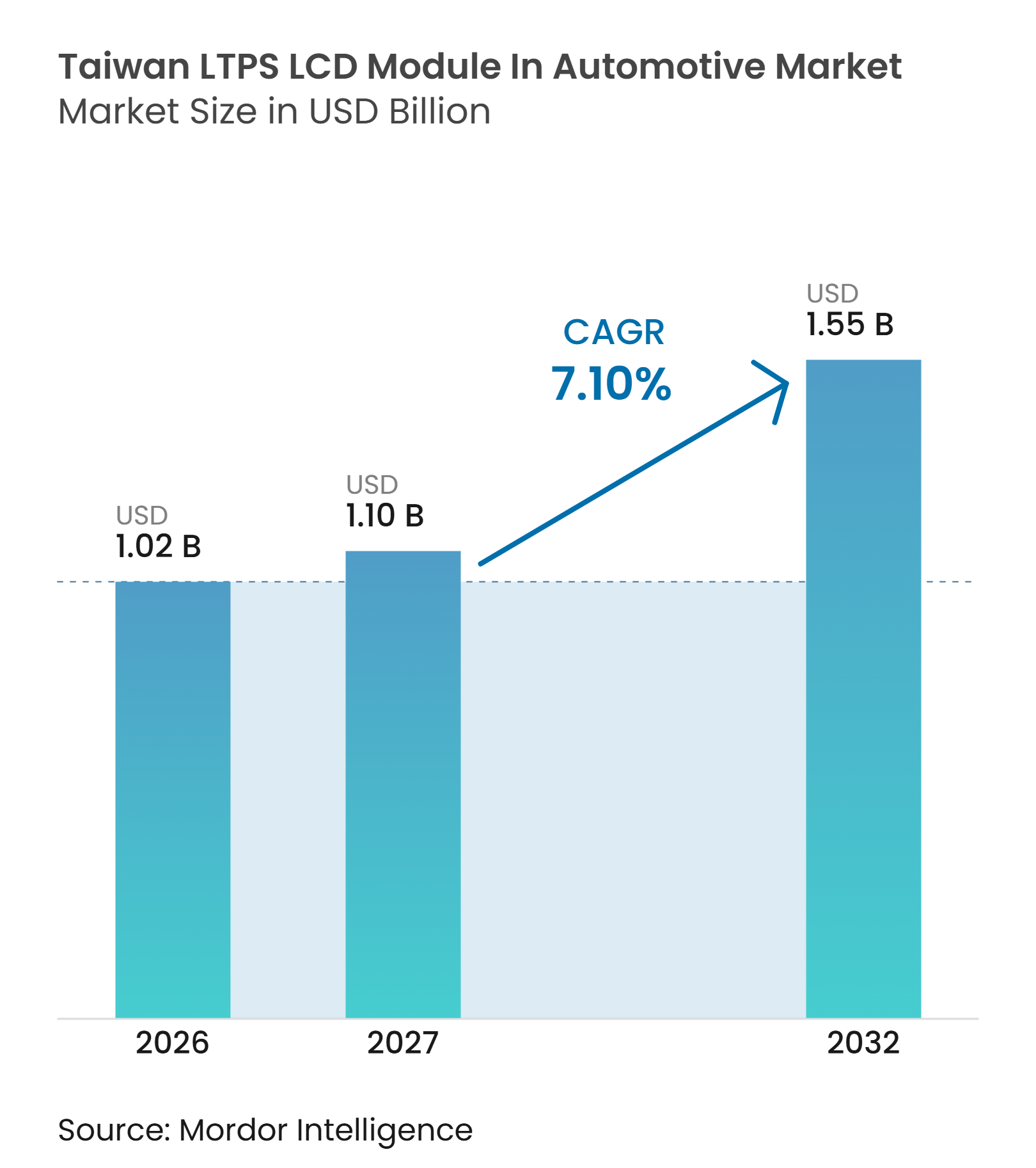
| Base Year Market Size (2026) | USD 1.02 Billion |
| Market Size (2027) | USD 1.10 Billion |
| Market Size (2032) | USD 1.55 Billion |
| Growth Rate (2027 - 2032) | 7.10 % |
| Market Concentration | Medium |
Major Players *Disclaimer: Major Players sorted in no particular order Image © Mordor Intelligence. Reuse requires attribution under CC BY 4.0. | |
Taiwan LTPS LCD Module In Automotive Market Analysis by Mordor Intelligence
The Taiwan LTPS LCD Module (LCM) in Automotive Market size was valued at USD 1.02 billion in 2026 and is estimated to reach USD 1.55 billion by 2032, at a CAGR of 7.10% during the forecast period 2027-2032. The Taiwan LTPS LCD Module (LCM) in Automotive Market benefits as capacity once used for shrinking smartphone programs is redirected to automotive programs with longer production lives and more stable unit margins. Vehicle makers are specifying larger and more integrated cockpit displays, which favors LTPS modules with in-cell touch, high resolution, and strong thermal performance. AUO’s creation of AUO Mobility Solutions in January 2026 indicates that automotive applications are a central part of its display strategy. Taiwan’s Gen 4.5 and Gen 6 production lines can address these applications without the capital requirements of new Gen 8.x lines. Price reductions in supply contracts and potential driver-distraction requirements remain constraints, although extended design-in and production cycles can support supplier revenue visibility after a program enters production.
Key Report Takeaways
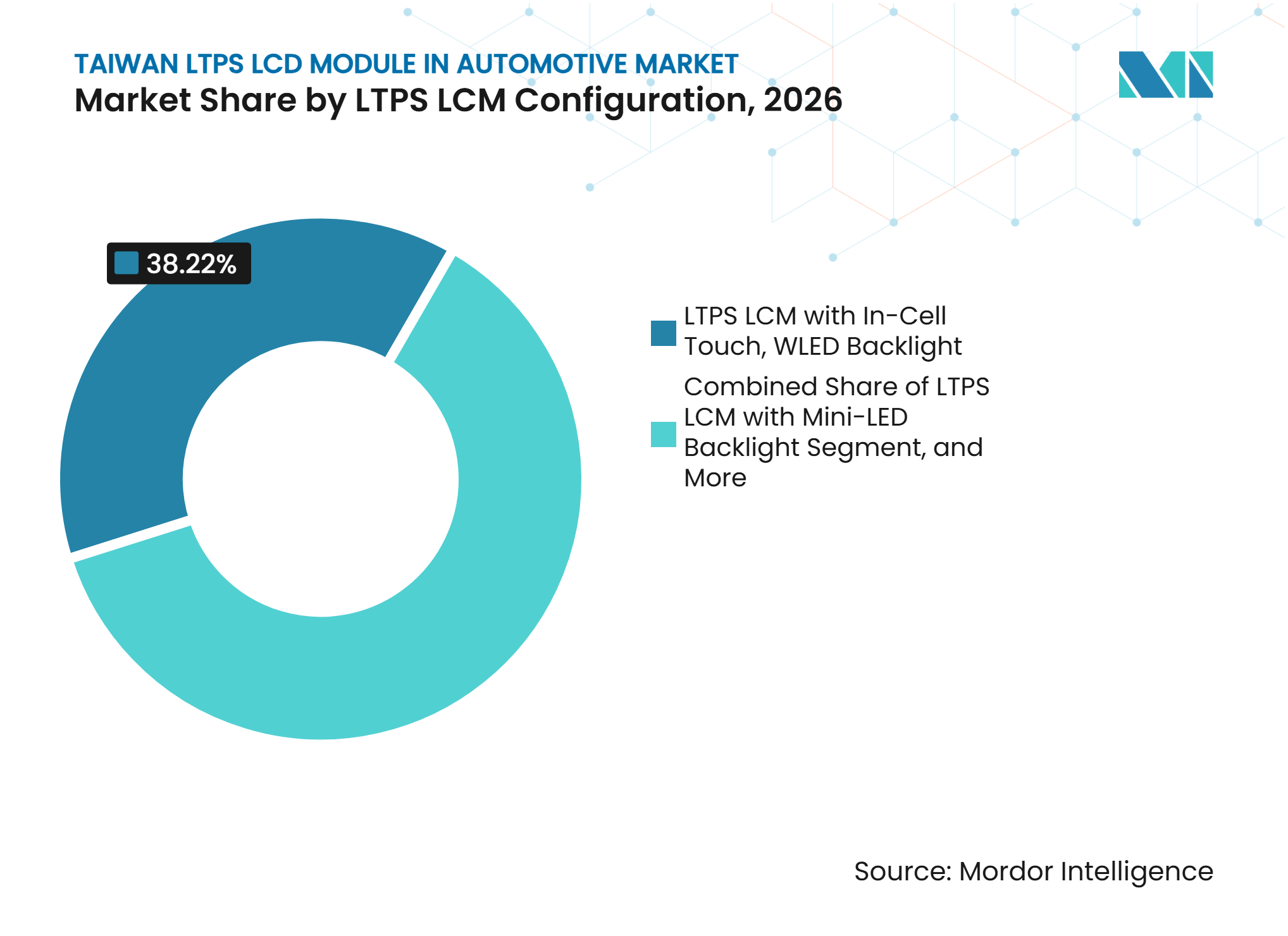
- By LTPS LCM configuration, LTPS LCM with In-Cell Touch and WLED Backlight held 38.22% of the Taiwan LTPS LCD Module (LCM) in Automotive Market share in 2026. LTPS LCM with Mini-LED Backlight and In-Cell Touch is projected to expand at an 8.78% CAGR through 2032.
- By application, Center Stack and Infotainment accounted for 42.27% of the Taiwan LTPS LCD Module (LCM) in Automotive Market size in 2026. Pillar-to-Pillar Center Console is projected to expand at an 8.42% CAGR through 2032.
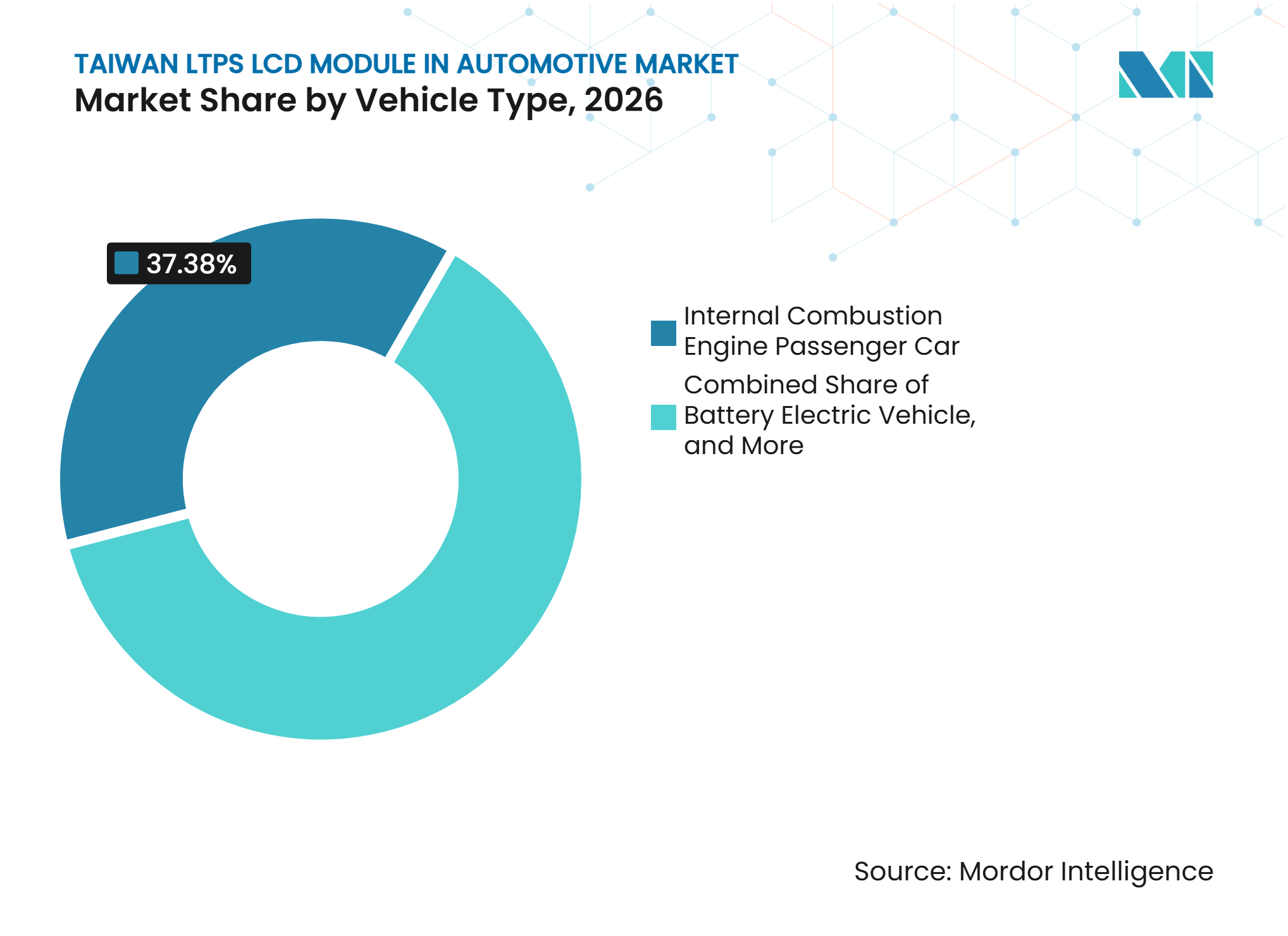
- By vehicle type, ICE Passenger Cars retained 37.38% of the Taiwan LTPS LCD Module (LCM) in Automotive Market share in 2026. Battery Electric Vehicles are projected to expand at an 8.67% CAGR through 2032.
- By bonding process, Film on Glass accounted for 60.85% of the Taiwan LTPS LCD Module (LCM) in Automotive Market size in 2026. Chip on Glass is projected to expand at an 8.81% CAGR through 2032.
Note: Market numbers in this report are based on Mordor Intelligence's proprietary estimation framework, which combines nine months of actuals with Q4 projections for base year 2026.
Market Trends and Insights
Drivers Impact Analysis of Taiwan LTPS LCD Module In Automotive Market*
| Driver | (~) % Impact on CAGR Forecast | Geographic Relevance | Impact Timeline |
|---|---|---|---|
| Increasing LTPS Adoption in Large Automotive Displays | +1.8% | Global, with acute demand in China, Japan, and Europe | Short term (≤ 2 years) |
| Growth of Software-Defined Vehicle Cockpits | +1.5% | Global, North America and Europe lead OEM program cadence | Medium term (2-4 years) |
| Expansion of Electric and Hybrid Vehicles | +1.2% | Asia-Pacific core, with spillover to North America and Europe | Medium term (2-4 years) |
| OEM Demand for High-Brightness and Low-Power Displays | +0.9% | Global, with premium programs concentrated in Europe and Japan | Short term (≤ 2 years) |
| Shift Toward Integrated Touch and Display Modules | +0.7% | Global | Medium term (2-4 years) |
| Taiwan’s Repositioning of LTPS Capacity Toward Automotive Programs | +0.5% | Taiwan, with early gains in Hsinchu and Tainan Science Parks | Long term (≥ 4 years) |
| Source: Mordor Intelligence | |||
Increasing LTPS Adoption in Large Automotive Displays
Cockpit display sizes are moving above 10 inches, increasing demand for LTPS backplanes that can support higher resolution and controlled power use. LTPS supports specifications of 1,920 × 720 and above at display sizes where a-Si designs face constraints. Himax and AUO demonstrated a 16-inch AmLED module at CES 2025 with up to 50% lower power use than a-Si reference designs. They also showed a 23-inch curved dual-display dashboard using automotive chip-on-film driver ICs.[1] Taiwan LTPS LCD Module (LCM) in Automotive Market suppliers can adapt lines built for smartphones without funding new Gen 8.x a-Si capacity. Chinese suppliers are also improving LTPS capacity, which makes prompt design-ins in the 10-20-inch range important for Taiwanese producers.
Growth of Software-Defined Vehicle Cockpits
Software-defined vehicle architectures place the display at the center of interaction among driver assistance, navigation, comfort, and entertainment functions. Visteon introduced its SmartCore HPC cockpit controller in 2026 with 700 trillion operations per second, support for up to 14 cameras, and several high-speed data connections.[2] A shared controller can support several displays without a separate processor for each screen. This approach increases demand for consistent pixel density and touch response across larger display surfaces. The Taiwan LTPS LCD Module (LCM) in Automotive Market is supported because in-cell touch modules can meet these requirements in a single assembly. Longer qualification periods, often 36 months or more, can also favor suppliers already listed on an OEM program.
Expansion of Electric and Hybrid Vehicles
Electric vehicles use more display area than comparable internal-combustion models because drivers need range, charging, thermal, and vehicle-status information. This requirement increases the opportunity for LTPS modules in cockpit programs. AUO Mobility Solutions worked with Sony Honda Mobility on the Micro LED Media Bar for the AFEELA 1 electric vehicle, showing how EV programs can include display functions outside conventional cockpit layouts.[3] Foxconn’s Model B electric crossover, which is produced for Mitsubishi and is in production for Australia and New Zealand, also reflects Taiwan’s broader position in EV supply chains. The Taiwan LTPS LCD Module (LCM) in Automotive Market can benefit when vehicle manufacturing activity supports domestic component sourcing. Hybrid programs can also use upgraded display specifications when OEMs share cockpit designs across powertrain variants.
OEM Demand for High-Brightness and Low-Power Displays
OEMs seek displays that remain readable in direct sunlight while limiting power use and thermal load. Center-stack displays often require 1,000 nits, while head-up display applications can exceed 1,500 nits. Instrument clusters can also face idle-state power budgets below 2 W. Mini-LED local dimming with in-cell touch helps LTPS modules address these requirements without adding a separate touch layer. AUO displayed a 12.4-inch Transparent Micro LED system in the PEUGEOT RCZ VISION concept at the 2026 Paris Motor Show, showing the role of brightness and form factor in cockpit design. The Taiwan LTPS LCD Module (LCM) in Automotive Market also gains as direct-lit and chip-scale Mini-LED backlights replace older edge-lit WLED designs in qualified automotive modules.
Restraints Impact Analysis of Taiwan LTPS LCD Module In Automotive Market*
| Restraint | (~) % Impact on CAGR Forecast | Geographic Relevance | Impact Timeline |
|---|---|---|---|
| Automotive Display Price Erosion and Module Margin Pressure | -1.5% | Global, most acute in China-sourced OEM programs | Short term (≤ 2 years) |
| Long Automotive Qualification Cycles and Design-In Concentration | -1.1% | Global | Long term (≥ 4 years) |
| Driver-Distraction Rules Limiting Touchscreen Proliferation | -0.7% | North America and Europe | Medium term (2-4 years) |
| Dependence on High-Yield Driver IC, Glass, and Optical-Bonding Supply | -0.5% | Taiwan, with upstream risk concentrated in Japan and South Korea | Medium term (2-4 years) |
| Source: Mordor Intelligence | |||
*Our forecasts treat driver/restraint impacts as directional, not additive. The impact forecasts reflect baseline growth, mix effects, and variable interactions.
Taiwan LTPS LCD Module In Automotive Market Segment Analysis
By LTPS LCM Configuration:
In-Cell Touch Leads Module PreferenceLTPS LCM with In-Cell Touch and WLED Backlight held 38.22% of the market in 2026, supported by compatibility with a broad range of driver IC and touch-controller systems. LTPS LCM with Mini-LED Backlight and In-Cell Touch is projected to record an 8.78% CAGR through 2032. The configuration pairs sunlight-readable brightness with in-cell touch integration. It removes a discrete touch-sensor layer and reduces module thickness. That design supports curved and free-form display programs. Standard LTPS LCM with WLED Backlight remains relevant for instrument clusters in ICE and entry-level hybrid vehicles, where cost constraints remain important. LTPS LCM with Mini-LED Backlight and No Touch is gaining relevance in head-up displays where local-dimming contrast aids daytime viewing without requiring a touch layer.
Himax’s third-generation automotive TDDI IC has AEC-Q100 certification and supports resolutions up to 3.2K × 2K with zero-latency touch response. This component supports the commercial use of in-cell touch in large LTPS modules. It also makes Mini-LED and in-cell touch a practical successor to WLED designs in new program nominations. AUO Mobility Solutions demonstrated a Gen 4 Pillar-to-Pillar Display with a single 48-inch, hot-formed LCD panel at the 2026 Vehicles and Displays Industry conference. The 8K × 1K display combined ambient-light, infrared, and touch sensors. This type of assembly consolidates functions that were previously divided among several modules. Taiwan LTPS LCD Module (LCM) in Automotive Market producers with integration capability are better positioned as these assemblies become more common.



By Application:
Cockpit Integration Reshapes Display Use CasesCenter Stack and Infotainment accounted for 42.27% of the Taiwan LTPS LCD Module (LCM) in Automotive Market size in 2026. The segment remains the main surface for touch-based control and media interaction. OEM cockpit programs are concentrating driver-assistance visualization, navigation, and comfort functions on high-luminance displays. This can reduce the use of separate screens for individual functions. Instrument Cluster applications are moving from stand-alone TFT-LCDs to digital LTPS panels that share a domain controller with the center stack. The arrangement can reduce the bill of materials while preserving a dedicated surface for safety-related information. Rear-Seat Entertainment and Passenger Screen systems create another source of demand, especially in premium EVs with higher expectations for passenger entertainment.
Pillar-to-Pillar Center Console applications are projected to post an 8.42% CAGR through 2032. The application reflects OEM demand to remove the visual and physical divide between the instrument cluster and center stack. This design favors suppliers that can provide optical bonding and hot-forming capability. Visteon showed pillar-to-pillar display concepts at CES 2026 and presented rear-passenger screens as extensions of the front cockpit display family. The approach requires coordinated display sets rather than isolated modules. It gives qualified Taiwan suppliers a route into broader cockpit assemblies. The Taiwan LTPS LCD Module (LCM) industry is therefore moving closer to system-level supply relationships with Tier 1 integrators.
By Vehicle Type:
Electric Platforms Accelerate Premium Display AdoptionICE Passenger Cars retained 37.38% of the market in 2026, reflecting the installed base of existing vehicle programs. Battery Electric Vehicles are projected to record an 8.67% CAGR through 2032. EV-native cockpits need displays for powertrain status, predicted range, charging, and thermal management. These functions can justify higher-specification LTPS modules compared with lower-specification a-Si alternatives. The lack of a central transmission tunnel can also allow wider and lower display spans in the instrument-panel area. Hybrid and plug-in hybrid models are following a similar path, although at a less rapid pace. OEMs can use common display specifications across ICE, hybrid, and BEV versions to reduce tooling complexity.
ICE passenger vehicles retain a large installed program base, but new design-in activity is shifting toward electric and hybrid platforms. ISO 26262 functional-safety requirements are relevant to instrument clusters and driver-assistance visualization. AEC-Q100 Grade 0 temperature qualification is also important when displays are used in safety-relevant functions. These requirements limit the supplier pool to companies that can demonstrate dependable performance under demanding thermal conditions. Taiwan LTPS LCD Module (LCM) in Automotive Market participants can benefit from their existing qualification record. Korean display makers remain established competitors for high-end programs. Light Commercial Vehicles are still an early opportunity, but logistics and ride-sharing electrification is bringing passenger-car-style multi-screen cockpits into this vehicle class.

By Bonding Process:
FOG Dominates as COG Gains on Thin-Form DemandFilm on Glass accounted for 60.85% of market revenue in 2026. The process works with a broad range of established assembly lines in Taiwan’s display manufacturing ecosystem. It does not require the glass-substrate precision associated with Chip on Glass configurations. Optical clear adhesive supply from Taiwanese and Japanese specialty chemical producers supports the established process base. WLED compatibility also makes Film on Glass suitable for applications from entry-level instrument clusters to mid-range center-stack displays. This flexibility helps it retain a leading role across current automotive programs. Its broad material base can offer resilience when more concentrated component supply chains face disruption.
Chip on Glass is projected to record an 8.81% CAGR through 2032. Direct attachment of driver ICs to the glass substrate removes the flexible printed-circuit carrier layer. This can reduce module thickness by 15%-20%, which is useful for curved and free-form designs. CarUX used Chip on Glass driver attachment in a 34-inch Active Mini-LED Backlight Automotive Display shown at Display Week 2025. The display combined a slim profile, 115% NTSC color saturation, and smart-cockpit integration. Pillar-to-pillar and curved-glass designs can increase use of this process in new vehicle programs. Taiwan LTPS LCD Module (LCM) in Automotive Market suppliers with glass and driver-attachment expertise can therefore gain from the shift toward thinner assemblies.
Geography Analysis
Japan and South Korea
Japanese and South Korean OEMs are important demand anchors for Taiwan’s LTPS LCM exports through established supply relationships with Toyota, Honda, Hyundai, and Kia. Japan Display operates LTPS lines that compete with AUO and Innolux in cockpit modules. Capacity constraints and financial restructuring at Japanese fabs have opened room for Taiwan-sourced modules. Hyundai Mobis sources high-end cluster displays from Samsung Display and LG Display within South Korea. Tier 1 suppliers serving Kia and Genesis also selectively qualify Taiwan modules for cost-competitive center-stack programs. Panasonic Automotive Systems introduced an OTA-enabled head-up display and instrument-cluster program for the Mazda CX-5 in Europe during December 2025. The program aligns with ISO/TS 20003:2026 requirements for OTA HMI updates. These software-defined cockpit functions can increase demand for premium LTPS module inputs. AEC-Q100 Grade 0 reliability qualification and local luminance requirements remain important compliance factors. The strict qualification process protects established suppliers but slows new program entry.
North America and Europe
European programs are a material source of demand for the Taiwan LTPS LCD Module (LCM) in Automotive Market, especially in premium cockpits. Automakers in the region use cockpit design to distinguish luxury and mass-market models. AUO developed a front-passenger display and a free-cut center information display for BMW’s new 7 Series generation. This work shows the engineering role that Taiwan suppliers can play in high-visibility cockpit programs. AUO’s 12.4-inch Transparent Micro LED display appeared in the PEUGEOT RCZ VISION concept at the 2026 Paris Motor Show. The concept reflects continuing European interest in transparent and free-form HMI systems. In North America, Visteon sources optically bonded pillar-to-pillar and curved-display modules from qualified suppliers. Its Entry Cockpit platform extends connected display functions to light commercial vehicles and two-wheelers. This broadens the potential use of smaller display formats beyond passenger cars.
China and Southeast Asia Reshape Taiwan Supply Ties
China is the most active demand-side geography for Taiwan’s LTPS LCM output. BYD, NIO, XPeng, and Li Auto specify larger and more advanced cockpit displays in new-energy vehicle programs. BOE Technology Group and TCL China Star Optoelectronics are also expanding mainland Chinese LTPS automotive-display capacity. This creates a substitution risk in mid-range Chinese OEM programs. Taiwan LTPS LCD Module (LCM) in Automotive Market suppliers can respond through higher-value modules and system integration rather than volume competition alone. Southeast Asia is developing an EV assembly base through projects connected to Taiwan suppliers. Foxconn’s partnership plans with ElectroMobility Poland include production of 400,000 electric SUVs annually, and Foxtron has introduced the Bria EV from Taiwan for Mitsubishi in Australia and New Zealand. India and Southeast Asia remain earlier-stage markets for advanced cockpit displays. Their future programs can offer an entry route for both value-tier LTPS modules and integrated display systems.
Competitive Landscape
Market Concentration
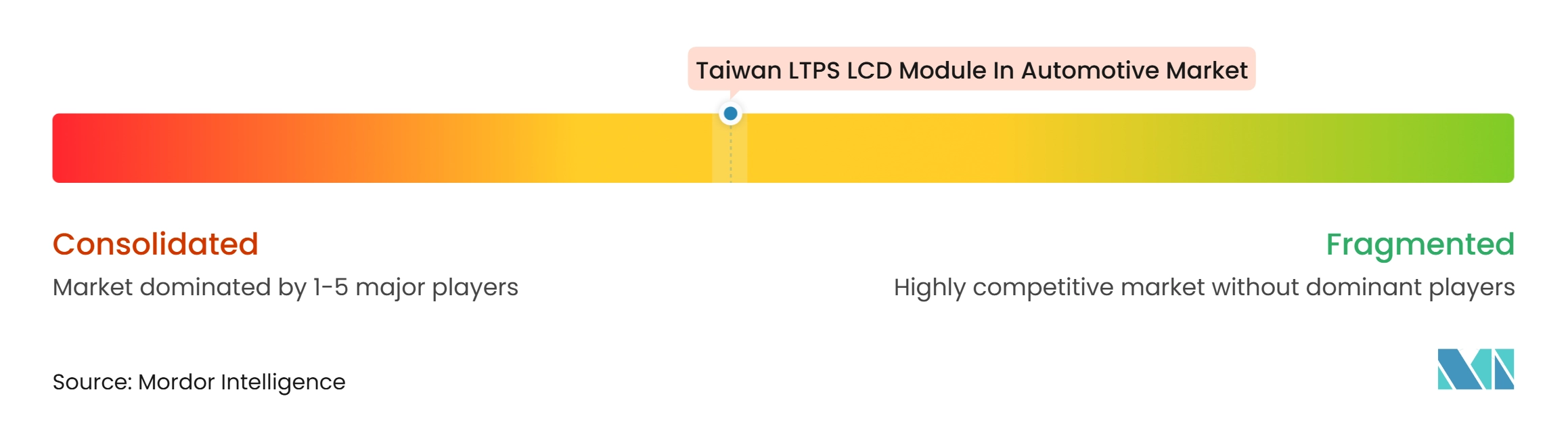
The Taiwan LTPS LCD Module (LCM) in Automotive Market is moderately concentrated at the panel-maker level. AUO and Innolux anchor the premium tier of automotive-qualified LTPS supply. They serve applications that require touch integration, high resolution, and demanding reliability performance. OEMs increasingly want a single supplier that can provide optical bonding, printed circuit board assembly, software integration, and qualified supply. This creates an opportunity between panel manufacturing and full Tier 1 cockpit-module integration. Automotive qualification requirements create barriers for consumer-grade competitors. JEDEC JESD-AEC-Q100 standards remain relevant to the reliability expectations that differentiate qualified module suppliers.
Specialized cockpit integrators and enabling-technology suppliers are changing the competitive field. Competition now includes Mini-LED local-dimming control ICs, in-cell TDDI integration, and optical bonding for free-form glass. Himax’s third-generation AEC-Q100-certified automotive TDDI ICs provide an example of how semiconductor capability can differentiate a display module. AUO’s AmLED control technology is another example of performance differentiation within LTPS designs. Ennostar introduced a Pixelated Automotive LED Lighting Platform at Touch Taiwan 2026 for Intelligent Signal Display and Dynamic Ground Projection uses. This development connects display functions with exterior-lighting systems and expands system-integration competition.
AUO established AUO Mobility Solutions at CES 2026 around Visual, Computing, and Connectivity capabilities. Innolux’s decision to dispose of Fab 2 and Fab 5, with Fab 5 ceasing production in Q2 2026, indicates a shift away from commodity LCD capacity toward automotive-qualified and advanced-packaging activity. Visteon’s SmartCore HPC supports a wider move toward centralized cockpit computing. These moves increase the value of module integration and software co-development. Panel resolution alone is becoming a less distinctive source of competition. Supplier differentiation depends more on integration depth, qualification speed, and program execution. No combined market-share figure for leading companies was provided, so the available information supports a moderately concentrated description but does not support a numerical concentration score.
Taiwan LTPS LCD Module In Automotive Industry Leaders
-
AUO Corporation
-
Innolux Corporation
-
LG Display Co., Ltd.
-
Japan Display Inc.
-
Tianma Microelectronics Co., Ltd.
- *Disclaimer: Major Players sorted in no particular order
Taiwan LTPS LCD Module In Automotive Market Companies Covered in this Report
- AUO Corporation
- Innolux Corporation
- CarUX Technology Inc.
- LG Display Co., Ltd.
- Japan Display Inc.
- Tianma Microelectronics Co., Ltd.
- BOE Technology Group Co., Ltd.
- TCL China Star Optoelectronics Technology Co., Ltd.
- Sharp Corporation
- Samsung Display Co., Ltd.
- Panasonic Automotive Systems Co., Ltd.
- Continental AG
- Visteon Corporation
- Robert Bosch GmbH
- DENSO Corporation
- Hyundai Mobis Co., Ltd.
- Valeo SE
- Nippon Seiki Co., Ltd.
- Garmin Ltd.
- Corning Incorporated
Recent Industry Developments in Taiwan LTPS LCD Module In Automotive Market
- October 2026: AUO Corporation, in collaboration with PEUGEOT's design teams, featured a 12.4-inch Transparent Micro LED Display HMI integrated into the PEUGEOT RCZ VISION concept car at the 2026 Paris Motor Show, demonstrating high-transparency and free-form cockpit design capabilities that advance beyond conventional HUD brightness limitations. The collaboration positions AUO as a technology partner in European OEM concept-to-production pipelines.
- August 2026: AUO Corporation and faytech Tech. Co., Ltd. signed a memorandum of understanding at AUO's Hsinchu corporate headquarters on August 7, 2026, covering joint development, optical bonding, touch integration, and go-to-market activities for transparent Micro LED displays across transportation and commercial applications. The MOU formalizes AUO's upstream strategy of co-developing turn-key optically bonded display solutions with integration partners.
- March 2026: Innolux Corporation's board of directors approved the disposal of Fab 2 and Fab 5 at its Tainan Science Park facilities, with Fab 5 ceasing production in Q2 2026, accelerating the company's shift from commodity LCD production toward automotive-qualified LTPS and advanced packaging lines aligned with its CarUX automotive integration strategy.
- January 2026: Visteon Corporation announced its SmartCore HPC cockpit domain controller at CES 2026, delivering 700 trillion operations per second with support for up to 14 cameras and multiple high-speed data connections, targeting a 2026 market launch and enabling multi-display experiences and ECU consolidation that directly increase per-vehicle LTPS display content in SDV programs.
Taiwan LTPS LCD Module In Automotive Market Report Scope
The Taiwan LTPS LCD Module (LCM) in Automotive Market encompasses the development, manufacturing, and supply of automotive-grade display modules using Low-Temperature Polycrystalline Silicon (LTPS) technology. These modules deliver high-resolution visuals, enhanced display performance, and power efficiency for advanced vehicle interfaces. Market growth is driven by increasing vehicle digitalization, adoption of sophisticated cockpit systems, and demand for high-quality automotive displays.
The Taiwan LTPS LCD Module (LCM) in Automotive Market Report is Segmented by LTPS LCM Configuration (Standard LTPS LCM (WLED Backlight, No Touch), LTPS LCM with In-Cell Touch (WLED Backlight), LTPS LCM with Mini-LED Backlight (No Touch), and LTPS LCM with Mini-LED Backlight and In-Cell Touch), Application (Center Stack/Infotainment, Instrument Cluster, Pillar-to-Pillar Center Console, and Rear Seat Entertainment and Passenger Screen), Vehicle Type (Battery Electric Vehicle (BEV), Hybrid / Plug-in Hybrid Electric Vehicle (HEV/PHEV), Internal Combustion Engine Passenger Car (ICE), and Light Commercial Vehicle (LCV)), and Bonding Process (Film on Glass (FOG), and Chip on Glass (COG)). The Market Forecasts are Provided in Terms of Value (USD).
Segmentation Overview
| Standard LTPS LCM, WLED Backlight, No Touch |
| LTPS LCM with In-Cell Touch, WLED Backlight |
| LTPS LCM with Mini-LED Backlight, No Touch |
| LTPS LCM with Mini-LED Backlight and In-Cell Touch |
| Center Stack and Infotainment |
| Instrument Cluster |
| Pillar-to-Pillar Center Console |
| Rear-Seat Entertainment and Passenger Screen |
| Battery Electric Vehicle |
| Hybrid and Plug-In Hybrid Electric Vehicle |
| Internal Combustion Engine Passenger Car |
| Light Commercial Vehicle |
| Film on Glass |
| Chip on Glass |
| By LTPS LCM Configuration | Standard LTPS LCM, WLED Backlight, No Touch |
| LTPS LCM with In-Cell Touch, WLED Backlight | |
| LTPS LCM with Mini-LED Backlight, No Touch | |
| LTPS LCM with Mini-LED Backlight and In-Cell Touch | |
| By Application | Center Stack and Infotainment |
| Instrument Cluster | |
| Pillar-to-Pillar Center Console | |
| Rear-Seat Entertainment and Passenger Screen | |
| By Vehicle Type | Battery Electric Vehicle |
| Hybrid and Plug-In Hybrid Electric Vehicle | |
| Internal Combustion Engine Passenger Car | |
| Light Commercial Vehicle | |
| By Bonding Process | Film on Glass |
| Chip on Glass |
Key Questions Answered in the Report
What is the size of the Taiwan LTPS LCD Module (LCM) in Automotive Market?
The Taiwan LTPS LCD Module (LCM) in Automotive Market was valued at USD 1.02 billion in 2026 and is estimated to reach USD 1.55 billion by 2032, at a CAGR of 7.10% during 2027-2032.
Which LTPS LCM configuration leads automotive demand in Taiwan?
LTPS LCM with In-Cell Touch and WLED Backlight held 38.22% share in 2026. Mini-LED Backlight and In-Cell Touch is the faster configuration, with an 8.78% projected CAGR through 2032.
Which automotive display application is expanding fastest in Taiwan?
Pillar-to-Pillar Center Console is projected to record an 8.42% CAGR through 2032, while Center Stack and Infotainment held 42.27% share in 2026.
Why are electric vehicles important for LTPS LCD modules?
BEVs need displays for range, charging, thermal management, and vehicle-status information. This vehicle type is projected to record an 8.67% CAGR through 2032.
What bonding process is used most widely for automotive LTPS LCMs?
Film on Glass held 60.85% share in 2026 because it fits a broad range of established assembly lines. Chip on Glass is expected to expand faster, at an 8.81% CAGR through 2032.
What factors constrain automotive LTPS LCM suppliers in Taiwan?
Annual supply-contract price reductions, long qualification cycles, driver-distraction rules, and dependence on driver IC, glass, and optical-bonding inputs can limit margins and program flexibility.