
Synthetic Gemstone Market Size and Share
Market Overview
| Study Period | 2022 - 2032 |
|---|---|
| Market Size (2027) | USD 16.41 Billion |
| Market Size (2032) | USD 21.73 Billion |
| Growth Rate (2027 - 2032) | 5.77 % |
| Fastest Growing Market | Asia-Pacific |
| Largest Market | North America |
| Market Concentration | Low |
Major Players *Disclaimer: Major Players sorted in no particular order Image © Mordor Intelligence. Reuse requires attribution under CC BY 4.0. | |
Synthetic Gemstone Market Analysis by Mordor Intelligence
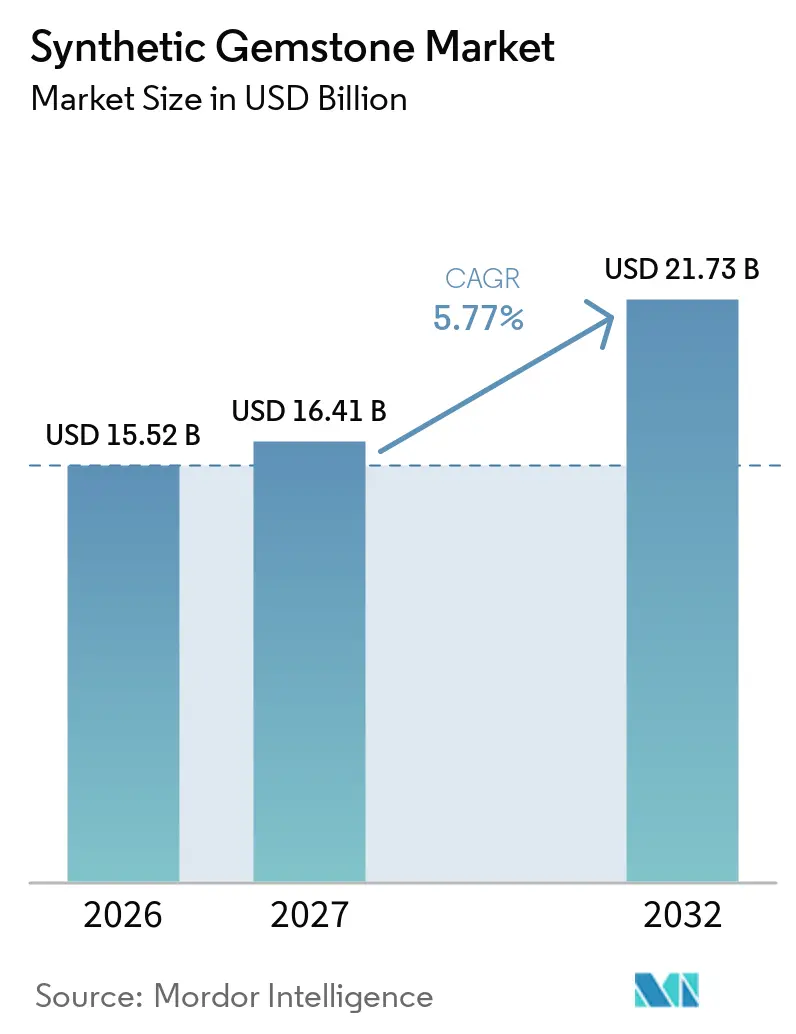
The Synthetic Gemstone Market size was valued at USD 15.52 billion in 2026 and is estimated to grow from USD 16.41 billion in 2027 to reach USD 21.73 billion by 2032, at a CAGR of 5.77% during the forecast period (2027-2032). Demand is no longer limited to decorative stones, as producers are also serving electronics, optics, precision instruments, and quantum technology applications. Jewelry remains the commercial base, while technical uses provide the synthetic gemstone market with an additional source of demand that is less dependent on consumer purchases. Provenance, environmental disclosure, and reliable grading are becoming important requirements for premium sales channels. Cost-efficient production in Asia-Pacific is widening access to colored stones and supporting trade with jewelry manufacturing centers. Competition, therefore, combines scale, process knowledge, and the ability to deliver consistent material quality.
Key Report Takeaways
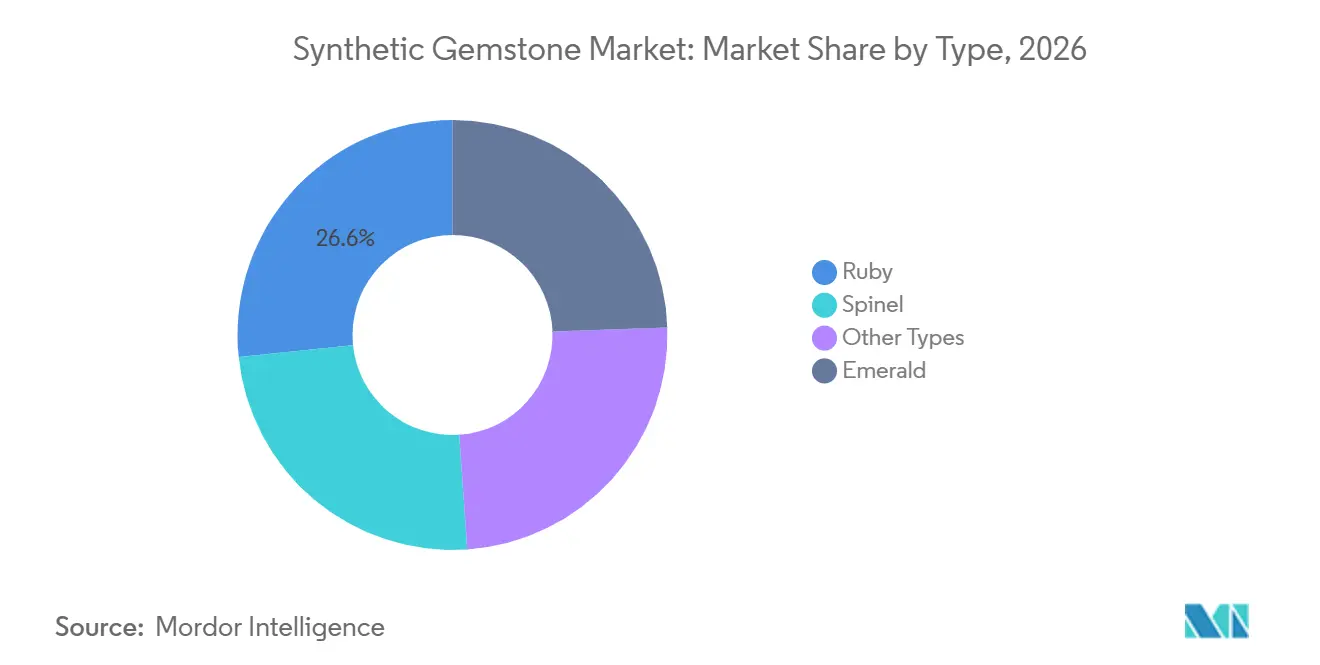
- By type, ruby led with 26.63% market share in 2026, while emerald is forecast to expand at a 6.32% CAGR through 2032.
- By form, cut and polished stones held 47.57% of the synthetic gemstone market share in 2026, while crystals and boules are forecast to expand at a CAGR of 6.45% through 2032.
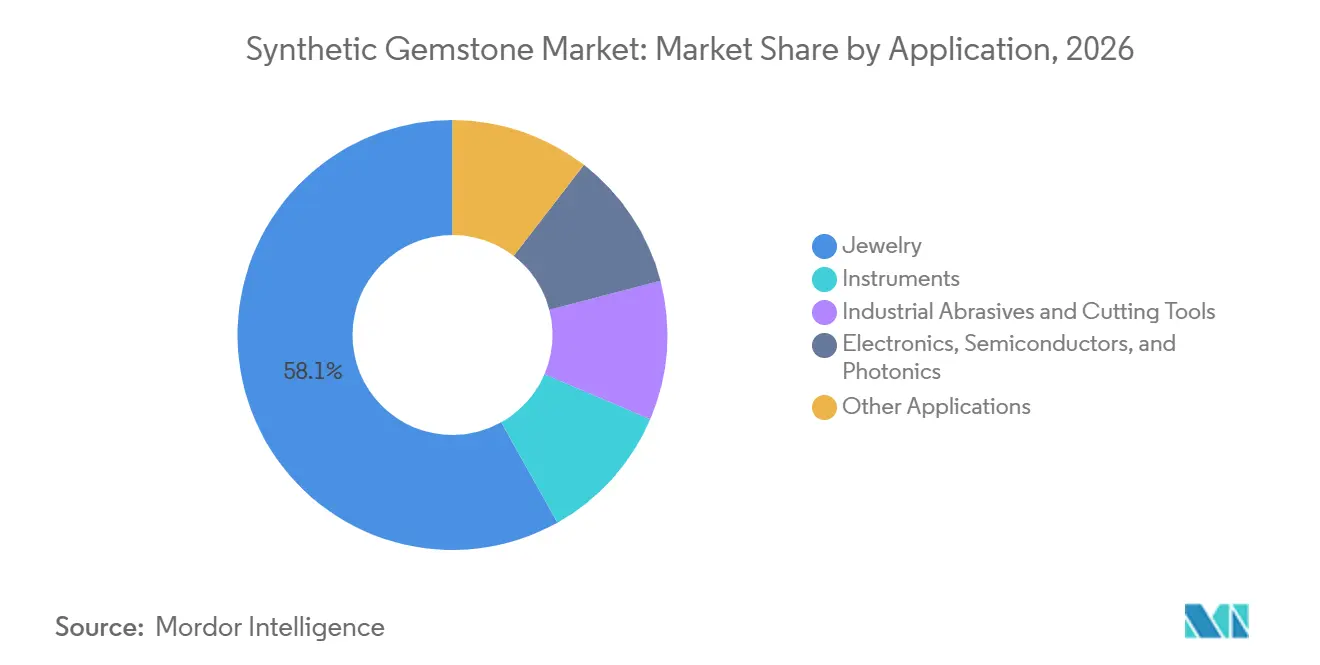
- By application, jewelry accounted for 58.11% of market share in 2026, while electronics, semiconductors, and photonics are forecast to grow at a 6.71% CAGR through 2032.
- By geography, North America held 31.38% market share in 2026, while Asia-Pacific is forecast to advance at 6.66% CAGR through 2032.
Note: Market numbers in this report are based on Mordor Intelligence's proprietary estimation framework, which combines nine months of actuals with Q4 projections for base year 2026.
Global Synthetic Gemstone Market Trends and Insights
Drivers Impact Analysis*
| Drivers | (~) % Impact on CAGR Forecast | Geographic Relevance | Impact Timeline |
|---|---|---|---|
| Ethical and Sustainable Alternative to Mined Gemstones | +1.3% | Global, with early gains in North America and Western Europe | Medium term (2-4 years) |
| Cost-Effective Access to Larger and More Consistent Stones | +1.2% | Global, strongest in Asia-Pacific and emerging markets | Short term (≤ 2 years) |
| Expansion of Industrial, Optical, and Precision-Instrument Demand | +1.0% | Global, particularly Asia-Pacific and North America | Long term (≥ 4 years) |
| AI-Enabled Quality Inspection and Automated Crystal Growth | +0.7% | Global, concentrated in Asia-Pacific and North American manufacturing hubs | Medium term (2-4 years) |
| Traceable Digital Commerce and Direct-To-Consumer Distribution | +0.6% | Global, with early gains in North America, Western Europe, and ASEAN | Short term (≤ 2 years) |
| Source: Mordor Intelligence | |||
Ethical and Sustainable Alternative to Mined Gemstones
Ethical positioning has become commercially important beyond conventional product marketing. SCS Global Services describes its SCS-007 framework as a certification that covers environmental, social, and governance criteria for laboratory-grown diamonds[1]. Producers that can substantiate origin, chemical management, and environmental claims are better positioned to support premium customer relationships. This matters as retailers and consumers seek clearer evidence behind sustainability statements. Traceable digital commerce can extend this advantage by linking product identity with supporting records through the sales process. The synthetic gemstone market, therefore, places greater value on documentation and credible third-party verification.
Cost-Effective Access to Larger and More Consistent Stones
Lower unit costs are expanding access to larger and more consistent stones across jewelry supply chains. Wuzhou, Guangxi, exported CNY 270 million (USD 37.5 million) in synthetic gemstones from January through September 2025, with exports rising 35% year over year. The local cluster included 957 enterprises, giving buyers a concentrated source for recurrent purchases and varied stone specifications. Input pricing for synthetic emerald rough at CNY 100 to CNY 200 (USD 14 to USD 28) per carat supports lower jewelry manufacturing costs. Consistency in color and clarity can reduce rejection rates during cutting and setting. These conditions are broadening the buyer base in India, Southeast Asia, and other price-sensitive jewelry markets.
Expansion of Industrial, Optical, and Precision-Instrument Demand
Industrial demand is expanding the synthetic gemstone market's role beyond finished jewelry. Synthetic crystals are used in laser media, precision bearings, optical windows, abrasive tools, semiconductor substrates, and photonic structures. Element Six and Orbray announced in June 2026 a reproducible manufacturing process for 3-inch wafer-scale single-crystal diamond substrates, with development of 4-inch substrates underway. The companies identified 6G radio-frequency components, power electronics, thermal management, and quantum technologies as prospective applications for this material. These applications depend on material purity, thermal performance, and dimensional consistency rather than gemstone appearance. The growing technical role gives producers an opportunity to balance jewelry demand with longer-cycle industrial contracts.
AI-Enabled Quality Inspection and Automated Crystal Growth
Automation is improving the way producers develop and assess synthetic crystals. A 2025 Nature Communications study described a multi-robot platform that combined automated handling, real-time spectroscopic feedback, and machine learning to optimize nanocrystal optical properties. A separate 2025 study introduced CrystalFlow, a model designed to improve the computational efficiency of crystal-structure generation. Such tools can shorten development cycles and help producers identify viable compositions more quickly. They can also support consistent quality control as production scales increase. For the synthetic gemstone market, the practical benefit is a closer link between process control, material performance, and production yield.
Restraints Impact Analysis*
| Restraints | (~) % Impact on CAGR Forecast | Geographic Relevance | Impact Timeline |
|---|---|---|---|
| Consumer Perception Gap Versus Natural Gemstones | -0.8% | North America and Western Europe, with spillover to premium Asia-Pacific segments | Medium term (2-4 years) |
| Energy Intensity and Carbon-Disclosure Pressure | -0.5% | Global, particularly Asia-Pacific manufacturing hubs, are relying on mixed-grid electricity | Long term (≥ 4 years) |
| Certification, Treatment Disclosure, and Provenance Fragmentation | -0.4% | Global | Medium term (2-4 years) |
| Source: Mordor Intelligence | |||
Consumer Perception Gap Versus Natural Gemstones
Consumer perceptions continue to distinguish natural stones from synthetic alternatives, particularly in higher-priced jewelry. This distinction is closely linked to expected resale value, rarity, disclosure practices, and buyer confidence in product records. Clear descriptions of treatment, origin, and laboratory growth can reduce uncertainty at the point of sale. However, inconsistent certification and terminology practices across markets make comparisons difficult for consumers and retailers. This creates a commercial advantage for producers that offer consistent documentation and reliable grading. Acceptance of synthetic gemstones in premium categories may remain slow until these practices are more widely understood.
Energy Intensity and Carbon-Disclosure Pressure
Energy use remains a material challenge for producers using Chemical Vapor Deposition (CVD) and High-Pressure High-Temperature (HPHT) processes. Environmental outcomes depend on reactor design, stone size, operating efficiency, and the local electricity mix. Pandora states that its laboratory-grown diamond suppliers are required to use 100% renewable electricity. The company also introduced carbon-footprint labels for its laboratory-grown diamonds in 2025[2]. These actions increase the importance of verifiable energy sources and product-level environmental information. Producers that rely on mixed or carbon-intensive grids may face higher compliance costs and greater scrutiny from premium brands.
*Our forecasts treat driver/restraint impacts as directional, not additive. The impact forecasts reflect baseline growth, mix effects, and variable interactions.
Segment Analysis
By Type: Ruby Leads Revenue While Emerald Supports Faster Growth
Ruby held 26.63% of the synthetic gemstone market share in 2026. Its position reflects demand for fine jewelry and its role in precision instruments, laser gain media, watch movement bearings, and optical gauges. This mix reduces dependence on a single consumer category, while spinel, synthetic alexandrite, moissanite, and silicon carbide variants serve smaller jewelry and specialized industrial niches. Their combined presence broadens the available portfolio. Ruby remains the principal type by revenue because its technical and decorative uses are both established.
Emerald is projected to be the fastest-growing type at a 6.32% CAGR through 2032. BIRON states that its hydrothermal process produces laboratory-grown emeralds with color characteristics modeled on Colombian emeralds. Controlled synthesis allows brands and jewelers to specify color and clarity more consistently than variable natural-supply conditions do. Accessible pricing, certification, and repeatable quality support branded colored-stone collections and adoption by fine jewelers that historically focused on mined stones. The synthetic gemstone market can use these characteristics to serve both premium and more accessible jewelry demand.

By Form: Finished Stones Lead While Crystals and Boules Gain Technical Demand
Cut and polished stones accounted for 47.57% of the synthetic gemstone market in 2026. Retail jewelry supply chains require ready-to-set stones for luxury brands, independent jewelers, and direct-to-consumer sellers, making finished stones the largest revenue stream. Rough and unworked stones support upstream wholesalers and industrial processors. Specialty optical elements and ceramic-bonded materials generate smaller revenue contributions but serve precision manufacturing, defense, and abrasive-tool procurement. This mix maintains a large commercial role for finished stones.
Crystals and boules are projected to grow at a 6.45% CAGR through 2032. Semiconductor and photonic customers increasingly source substrate material directly from crystal growers rather than through lapidary channels. The Czochralski and Kyropoulos processes remain relevant for producing large-diameter sapphire boules used in LEDs and semiconductor wafers. Element Six and Orbray reported progress toward larger wafer-scale single-crystal diamond substrates in June 2026. This supports the commercial path from boule production to wafer conversion, making this form increasingly important in the synthetic gemstone market.
By Application: Jewelry Holds the Largest Position While Electronics Advances
Jewelry accounted for 58.11% of the synthetic gemstone market's revenue in 2026. North American purchases and adoption among younger buyers in Asia-Pacific support this position. Price accessibility expands the addressable group of jewelry buyers. Finished stones are used in engagement rings, fashion jewelry, and colored-stone collections, while reliable color, cut, and clarity help retailers manage assortments. Jewelry, therefore, remains the largest application even as industrial uses expand.
Electronics, semiconductors, and photonics are projected to record the highest application CAGR at 6.71% through 2032. The application set includes diamond wafers for power electronics, sapphire substrates for LED and radio-frequency chips, optical windows, and quantum photonic structures. A 2026 paper reported diamond nanobeams with tin-vacancy centers on aluminum oxide waveguides for scalable quantum photonic chip applications. Precision bearings, laser components, and optical windows remain important related uses with procurement tied to manufacturing, aerospace, and research. This demand gives the synthetic gemstone market a wider set of end users.
Geography Analysis
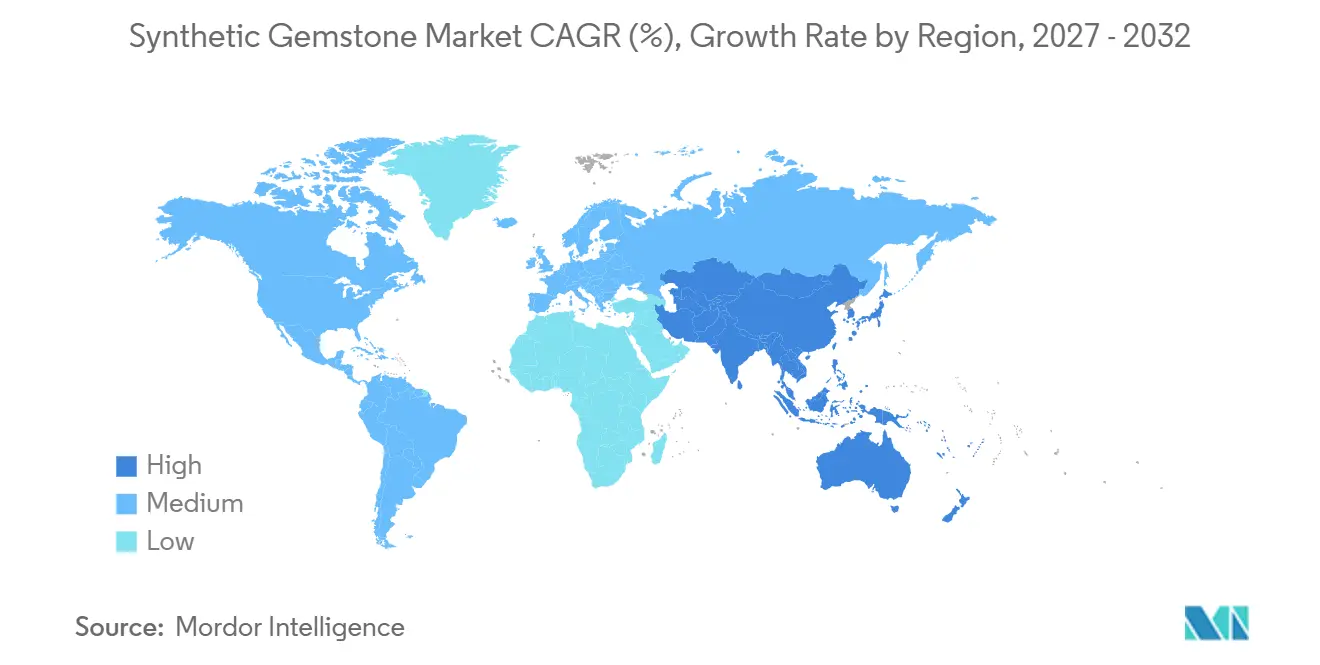
North America accounted for 31.38% of the synthetic gemstone market share in 2026. The United States served as the primary regional center for the consumption and production of high-value finished stones and specialty rough. Producers and distributors supply global cutting-and-polishing hubs, domestic jewelry channels, and industrial and technology-oriented buyers. Clear product disclosure and grading remain important for retailers serving premium customers.
Asia-Pacific is projected to grow at a CAGR of 6.66% through 2032. Wuzhou, Guangxi, exported CNY 270 million (~USD 37.5 million) in synthetic gemstones during the first nine months of 2025. Thailand and Malaysia accounted for 20% of the cluster's export value in the same period. China, Japan, India, South Korea, and ASEAN countries combine manufacturing capacity with growing consumer and industrial demand. India's cutting and polishing base supports demand for synthetic rough.
Europe supports demand for luxury jewelry, precision instruments, optical components, and advanced manufacturing. Germany, France, Italy, the United Kingdom, and Nordic countries represent key markets for finished jewelry and technical materials. South America is a smaller end market with growing online retail channels, largely supplied from Asia-Pacific. In the Middle East and Africa, the UAE serves as a hub for luxury retail and re-export, while South Africa uses synthetic alternatives in abrasive and industrial applications. These regions provide the synthetic gemstone market with channels for luxury, trade, and industrial sales.
Competitive Landscape
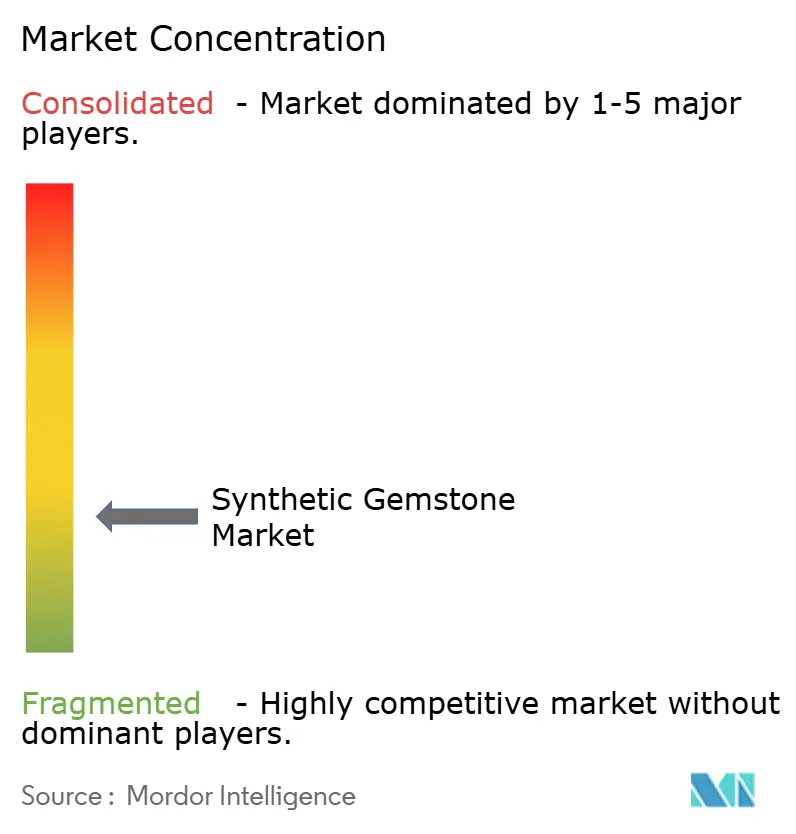
The synthetic gemstone market is fragmented. Element Six and Diamond Foundry are differentiated by their experience in CVD diamond production for technical and jewelry applications. In June 2026, Element Six and Orbray announced a reproducible process for 3-inch wafer-scale single-crystal diamond substrates. This development illustrates the importance of process control, material expertise, and high-cost manufacturing assets.
Chinese producers, including Henan Huanghe Whirlwind and manufacturers in Wuzhou, compete through scale and cost efficiency. The Wuzhou cluster's 957 enterprises and 2025 export growth illustrate the depth of its supply base. Niche laboratories such as BIRON, Chatham, ALTR, and TAIRUS compete on brand, design, and color-chemistry capabilities. BIRON's hydrothermal emerald positioning emphasizes controlled color characteristics rather than output. The market, therefore, contains both high-output suppliers and specialized producers.
Opportunities remain in semiconductor-grade purity, wafer-scale crystals, and authenticated product records for luxury channels. IIa Technologies serves the jewelry, semiconductor, laser, and quantum computing applications with high-purity Type IIa CVD diamonds. Sumitomo Electric Industries, KYOCERA, and Saint-Gobain participate in premium diamond, industrial, and precision-optical applications. Established producers are positioned to serve applications with long qualification cycles and demanding performance requirements. Smaller producers may face challenges where customers require traceable documentation, established grading, and repeatable specifications.
Synthetic Gemstone Industry Leaders
-
Element Six (UK) Ltd.
-
Henan Huanghe Whirlwind CO.,Ltd.
-
Sumitomo Electric Industries, Ltd.
-
KYOCERA Corporation
-
Swarovski
- *Disclaimer: Major Players sorted in no particular order
Recent Industry Developments
- June 2026: Element Six and Orbray announced a reproducible manufacturing process for 3-inch wafer-scale single-crystal diamond substrates at Element Six's CVD facility in Gresham, Oregon. Development of 4-inch substrates is underway, and 2-inch thermal-bonding wafers are entering the final production ramp. Intended applications include 6G radio-frequency components, power electronics, thermal management, and quantum technologies.
- May 2026: The Gemological Institute of America (GIA) acquired a 30% shareholding in Tracr, De Beers' blockchain diamond provenance platform, transitioning it into an independent, industry-wide transparency infrastructure. The partnership combines GIA's grading and identification expertise with Tracr's blockchain provenance records, establishing a verifiable source-to-consumer synthetic gemstone identity at a global scale. This development has material implications for lab-grown stone disclosure standards and premium market access requirements.
Global Synthetic Gemstone Market Report Scope
A synthetic gemstone is a man-made stone grown in a laboratory that shares the same chemical composition, crystal structure, and physical and optical properties as its natural counterpart. Unlike naturally occurring gemstones, which form over millions of years under specific geological conditions, synthetic gemstones are produced in controlled laboratory environments within a significantly shorter timeframe.
The synthetic gemstone market is segmented by type, form, application, and geography. By type, the market is segmented into ruby, emerald, spinel, and other types. By form, the market is segmented into rough and unworked stones, cut and polished stones, crystals and boules, and other forms. By application, the market is segmented into jewelry, instruments, industrial abrasives and cutting tools, electronics, semiconductors, photonics, and other applications. The report also covers the market size and forecasts for synthetic gemstones in 15 countries across major regions. The market sizes and forecasts are provided in terms of value (USD).
| Ruby |
| Emerald |
| Spinel |
| Other Types |
| Rough and Unworked Stones |
| Cut and Polished Stones |
| Crystals and Boules |
| Other Forms |
| Jewelry |
| Instruments |
| Industrial Abrasives and Cutting Tools |
| Electronics, Semiconductors, and Photonics |
| Other Applications |
| Asia-Pacific | China |
| India | |
| Japan | |
| South Korea | |
| ASEAN Countries | |
| Rest of Asia-Pacific | |
| North America | United States |
| Canada | |
| Mexico | |
| Europe | Germany |
| United Kingdom | |
| France | |
| Italy | |
| NORDIC Countries | |
| Rest of Europe | |
| South America | Brazil |
| Argentina | |
| Rest of South America | |
| Middle East and Africa | Saudi Arabia |
| South Africa | |
| Rest of Middle East and Africa |
| By Type | Ruby | |
| Emerald | ||
| Spinel | ||
| Other Types | ||
| By Form | Rough and Unworked Stones | |
| Cut and Polished Stones | ||
| Crystals and Boules | ||
| Other Forms | ||
| By Application | Jewelry | |
| Instruments | ||
| Industrial Abrasives and Cutting Tools | ||
| Electronics, Semiconductors, and Photonics | ||
| Other Applications | ||
| By Geography | Asia-Pacific | China |
| India | ||
| Japan | ||
| South Korea | ||
| ASEAN Countries | ||
| Rest of Asia-Pacific | ||
| North America | United States | |
| Canada | ||
| Mexico | ||
| Europe | Germany | |
| United Kingdom | ||
| France | ||
| Italy | ||
| NORDIC Countries | ||
| Rest of Europe | ||
| South America | Brazil | |
| Argentina | ||
| Rest of South America | ||
| Middle East and Africa | Saudi Arabia | |
| South Africa | ||
| Rest of Middle East and Africa | ||
Key Questions Answered in the Report
What is current market size of Synthetic Gemstone Market?
The Synthetic Gemstone Market size was valued at USD 15.52 billion in 2026 and is estimated to grow from USD 16.41 billion in 2027 to reach USD 21.73 billion by 2032, at a CAGR of 5.77% during the forecast period (2027-2032).
Which type is forecast to grow the fastest?
Emerald is projected to record the fastest type growth at a 6.32% CAGR through 2032.
Which application leads to synthetic gemstone demand?
Jewelry accounted for 58.11% of revenue in 2026, making it the largest application.
Which region is forecast to grow fastest?
Asia-Pacific is projected to expand at a 6.66% CAGR by 2032.