
Synchronous Condenser Market Size and Share
Market Overview
| Study Period | 2022 - 2032 |
|---|---|
| Market Size (2027) | USD 0.91 Billion |
| Market Size (2032) | USD 1.14 Billion |
| Growth Rate (2027 - 2032) | 4.61 % |
| Fastest Growing Market | Asia-Pacific |
| Largest Market | North America |
| Market Concentration | Medium |
Major Players *Disclaimer: Major Players sorted in no particular order Image © Mordor Intelligence. Reuse requires attribution under CC BY 4.0. | |
Synchronous Condenser Market Analysis by Mordor Intelligence
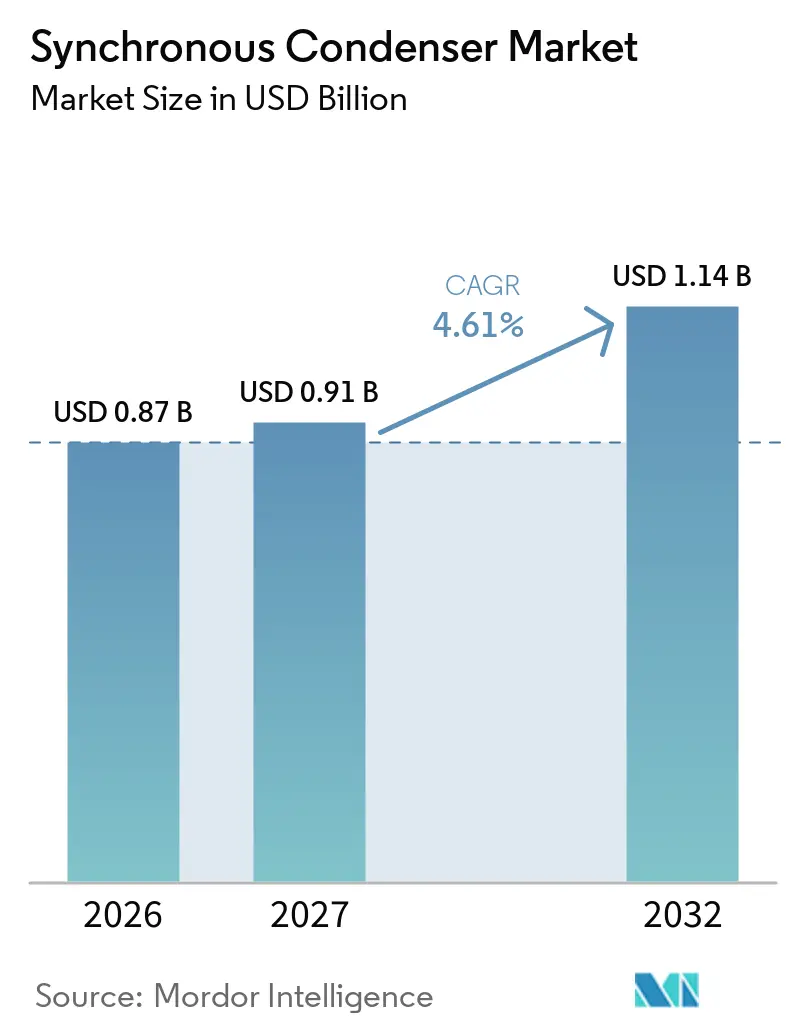
The Synchronous Condenser Market size is projected to expand from USD 0.87 billion in 2026 and USD 0.91 billion in 2027 to USD 1.14 billion by 2032, registering a CAGR of 4.61% between 2027 and 2032. The synchronous condenser market is supported by the retirement of thermal generation and the growing use of wind and solar assets that rely on power electronics, particularly in areas where transmission expansion and new connections are progressing at the same time. Grid operators need equipment that can provide physical inertia, reactive power, and fault current as conventional rotating machines leave the system. Requirements for short-circuit strength and fault ride-through are moving from technical guidance into procurement rules in several markets. Suppliers with engineering, procurement, and construction capability are positioned to address large utility projects, while modular packages are opening opportunities at data center connection points and other sites where grid stability must be managed close to demand. Cost pressure remains material because STATCOMs, grid-forming batteries, and other electronic alternatives can provide selected services at lower cost in applications without equipment-specific inertia requirements, so buyers will continue to compare technical performance against construction scope, delivery time, long-term operating needs, and available specialist resources.
Key Report Takeaways
- By product type, new units held 69.3% of the synchronous condenser market share in 2026, while the same segment is projected to grow at a 4.9% CAGR through 2032.
- By starting method, static frequency converters accounted for 61.3% of revenue in 2026 and are projected to record the highest CAGR of 5.1% through 2032.
- By cooling type, hydrogen-cooled units held 46.4% of revenue in 2026, while air-cooled units are forecast to grow at a 5.8% CAGR through 2032.
- By end user, electrical utilities accounted for 67.7% of revenue in 2026, while renewable energy developers are forecast to expand at an 8.1% CAGR through 2032.
- By geography, North America held 29.6% of revenue in 2026, while Asia-Pacific is forecast to grow at a 5.7% CAGR through 2032.
Note: Market numbers in this report are based on Mordor Intelligence's proprietary estimation framework, which combines nine months of actuals with Q4 projections for base year 2026.
Market Trends and Insights
Drivers Impact Analysis of Synchronous Condenser Market*
| Driver | (~) % Impact on CAGR Forecast | Geographic Relevance | Impact Timeline |
|---|---|---|---|
| Renewable integration and declining inherent grid inertia | +1.8% | Global | Short term (≤ 2 years) |
| HVDC expansion and weak-grid stabilization requirements | +0.9% | APAC core, spill-over to North America and Europe | Medium term (2–4 years) |
| Retirement of thermal generators and repurposing of existing assets | +0.7% | North America & Europe | Short term (≤ 2 years) |
| Grid-code requirements for short-circuit strength and fault ride-through | +0.8% | Global, with early gains in Australia, UK, and Germany | Medium term (2–4 years) |
| Hybrid synchronous condenser, flywheel, STATCOM, and BESS architectures | +0.5% | North America, Europe, APAC | Long term (≥ 4 years) |
| Renewable-zone connection bottlenecks and system-strength procurement | +0.5% | Australia, North America, Europe | Short to medium term (≤ 4 years) |
| Source: Mordor Intelligence | |||
Renewable Integration, Thermal Retirements, and Grid-Code Requirements
The synchronous condenser market is gaining support as wind and solar generation replace conventional thermal plants that once supplied rotating inertia. A 2025 study found that renewable energy bases can face low short-circuit ratios and transient overvoltage after AC and DC faults, which can limit transfer capacity.[1] Germany’s Federal Network Agency stated that the synchronous European grid requires a minimum kinetic-energy threshold of 75 gigawatt-seconds for frequency stability.[2] A synchronous condenser with a flywheel can contribute 1 to 4 gigawatt-seconds of inertia per unit, which makes inertia constants an important procurement parameter. Grid rules on short-circuit strength and fault ride-through are therefore creating a direct demand channel for the synchronous condenser market, especially where renewable connections are increasing quickly.
HVDC Expansion and Weak-Grid Stabilization
HVDC-connected grids need sufficient local short-circuit strength to avoid commutation failures and wider generation disconnections. Research on the Shanxi to Wuhan HVDC corridor found that optimized reactive-power output from synchronous condensers near receiving-end buses can reduce commutation failures. China has placed synchronous condensers at high-capacity receiving nodes, and the first of 10 planned 50-MVAr units at the Qingyu project entered service in July 2025. The synchronous condenser market also benefits when large renewable clusters need grid-strength reinforcement before they can operate at their planned output. IEC 62747 is helping formalize system-strength expectations in new HVDC transmission licenses across Asia, Europe, and the Middle East, which gives the synchronous condenser market a clearer role in transmission design.
Hybrid Synchronous Condenser and Storage Architectures
The synchronous condenser market is developing alongside flywheel, battery, STATCOM, and digital-control technologies rather than apart from them. Hybrid configurations can pair physical inertia and fault-current support with faster power-electronic control. This approach can help grid operators meet several stability requirements through a single project design and can widen the range of projects considered by the synchronous condenser market. Variable-speed designs using AC excitation and doubly fed machines can separate active and reactive power control and improve frequency regulation. Research on doubly fed condenser control also points to a broader range of operating options for new equipment than for a standard refurbished machine.
Renewable-Zone Connection Bottlenecks and System-Strength Procurement
The synchronous condenser market is supported when renewable projects face connection limits in weak parts of the transmission network. ERCOT identified a need for 2 175-MVAr units at the Bakersfield 345 kV substation after weak-grid events caused solar disconnections in 2021 and 2022. In the United Kingdom, Pathfinder contracts link revenue to the delivery of system-strength services instead of treating equipment as a one-time purchase. Quinbrook’s Cilfynydd and Sellindge projects obtained GBP 156 million in financing in April 2026 and are contracted to provide 2,531 MVA of combined short-circuit level. Ireland’s LCIS program has also created successive procurement rounds, including 2 additional Elecnor awards in February 2026, which give the synchronous condenser market repeat project opportunities.
Restraints Impact Analysis of Synchronous Condenser Market*
| Restraint | (~) % Impact on CAGR Forecast | Geographic Relevance | Impact Timelin |
|---|---|---|---|
| High capital cost and civil-works requirements | -0.5% | Global | Short term (≤ 2 years) |
| Competition from STATCOMs, SVCs, BESS, and grid-forming inverters | -0.4% | North America & Europe | Medium term (2–4 years) |
| Long procurement, commissioning, and grid-connection timelines | -0.3% | Global | Short term (≤ 2 years) |
| Scarcity of specialist maintenance and commissioning personnel | -0.2% | Global, particularly APAC | Medium term (2–4 years) |
| Source: Mordor Intelligence | |||
High Capital Cost, Civil Works, and Long Delivery Timelines
The synchronous condenser market faces a cost barrier in projects that require foundations, cooling systems, hydrogen handling, and specialized commissioning. The LCRA Bakersfield project involves 2 175-MVAr units and a USD 144.5 million engineering, procurement, and construction award. Large rotating equipment can require 12 to 18 months of work before commissioning, which extends the delivery schedule relative to electronic alternatives. Specialist personnel are also needed to tune speed controls and grid-synchronization functions on installations using static frequency converters. These conditions can be especially difficult for first-time buyers and rapidly expanding grids in the Asia-Pacific region, where the synchronous condenser market depends on timely project execution.
Competition from STATCOMs, SVCs, BESS, and Grid-Forming Inverters
The synchronous condenser market competes with STATCOMs, SVCs, battery systems, and grid-forming inverters when the required service does not specify physical inertia. In Australia, contracted grid-forming battery system-strength services were priced at USD 6,995 per MVA per year, compared with AUD 54,276 per MVA per year for synchronous condensers. Siemens Energy and TenneT commissioned a supercapacitor-based E-STATCOM in Germany in December 2025, showing that electronic solutions can provide immediate reserve. Synchronous condensers still have an advantage where fault current and inherent inertia are essential to the system design. The practical choice depends on the network’s fault level, frequency needs, connection rules, and ability to fund complex civil works, which can limit addressable demand in the synchronous condenser market.
*Our forecasts treat driver/restraint impacts as directional, not additive. The impact forecasts reflect baseline growth, mix effects, and variable interactions.
Synchronous Condenser Market Segment Analysis
By Product Type:
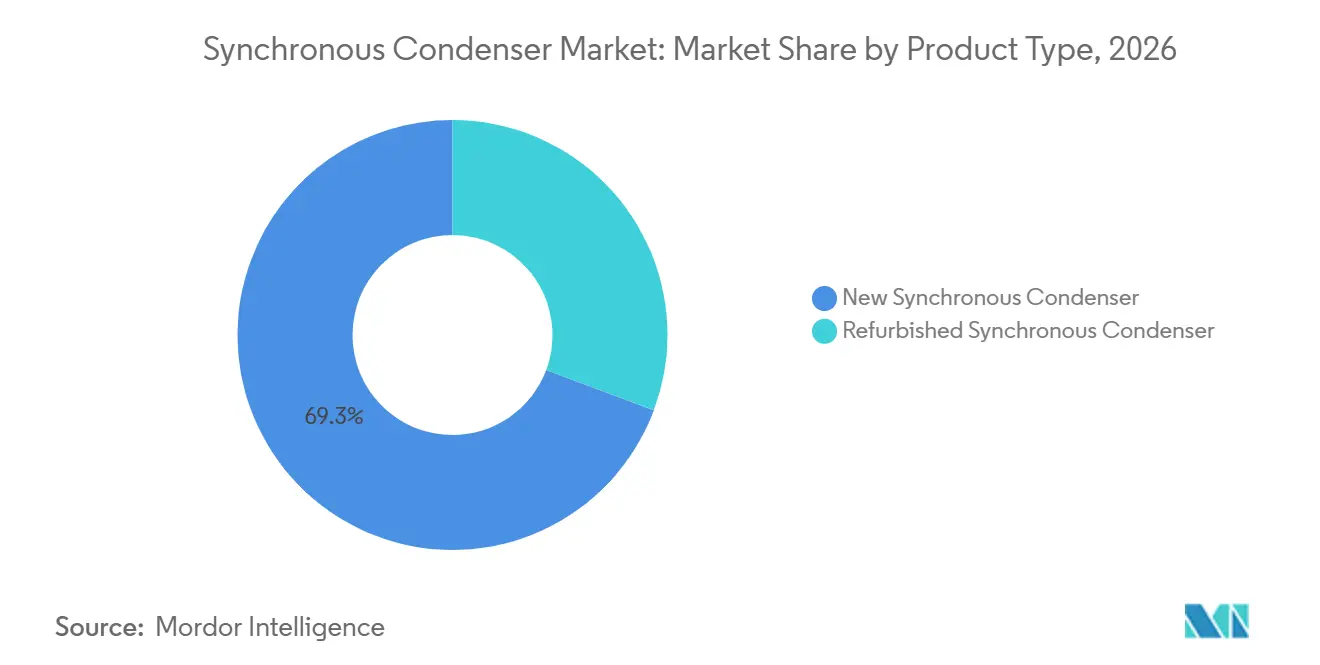
New Equipment Leads While Refurbished Assets Lower Project CostNew units held 69.3% of revenue in 2026 and are projected to grow at a 4.9% CAGR through 2032. This part of the synchronous condenser market is supported by greenfield transmission programs in North America, Asia-Pacific, and the Middle East. These regions often lack suitable retiring thermal assets that can be converted for grid support. Powerlink awarded Hitachi Energy a contract in April 2026 for 4 purpose-built +161-MVAr units in Central Queensland. Each unit includes flywheel technology that manages 1,442 MWs of inertia.
Refurbished units represented the remaining 30.7% of revenue in 2026. They give grid operators a way to retain rotating machinery and existing substation infrastructure. Eaton began converting TVA’s retired 865 MW Bull Run Fossil Plant into 2 605-MVAr synchronous condensers in June 2025. Siemens Energy has stated that brownfield conversions can reduce capital investment by up to 50% compared with greenfield projects. The product decision in the synchronous condenser market, therefore, depends on asset availability, required performance, and project timing.
By Starting Method:
Static Frequency Converters Support Controlled EnergizationStatic frequency converters accounted for 61.3% of starting-method revenue in 2026 and are forecast to grow at a 5.1% CAGR through 2032. They allow current-limited, controlled ramp-up in weak grids where a transient can affect nearby inverter-based plants. This requirement makes them important in HVDC and renewable connection projects. ANDRITZ’s July 2026 contract for 5 condensers in Colombia includes static frequency converters as part of the complete supply package. The synchronous condenser market, therefore, increasingly uses starting equipment as part of integrated engineering packages.
Pony motors remain relevant in smaller installations and some brownfield conversions. They are useful where grid stiffness is sufficient, and existing auxiliary systems can be reused. Direct-on-line and variable-frequency-drive approaches also serve industrial applications with lower ratings. Static frequency converter systems require vendor-certified personnel for speed-control tuning and synchronization calibration. In the synchronous condenser market, a limited supply of those specialists can lengthen commissioning in India and Southeast Asia.
By Cooling Type:
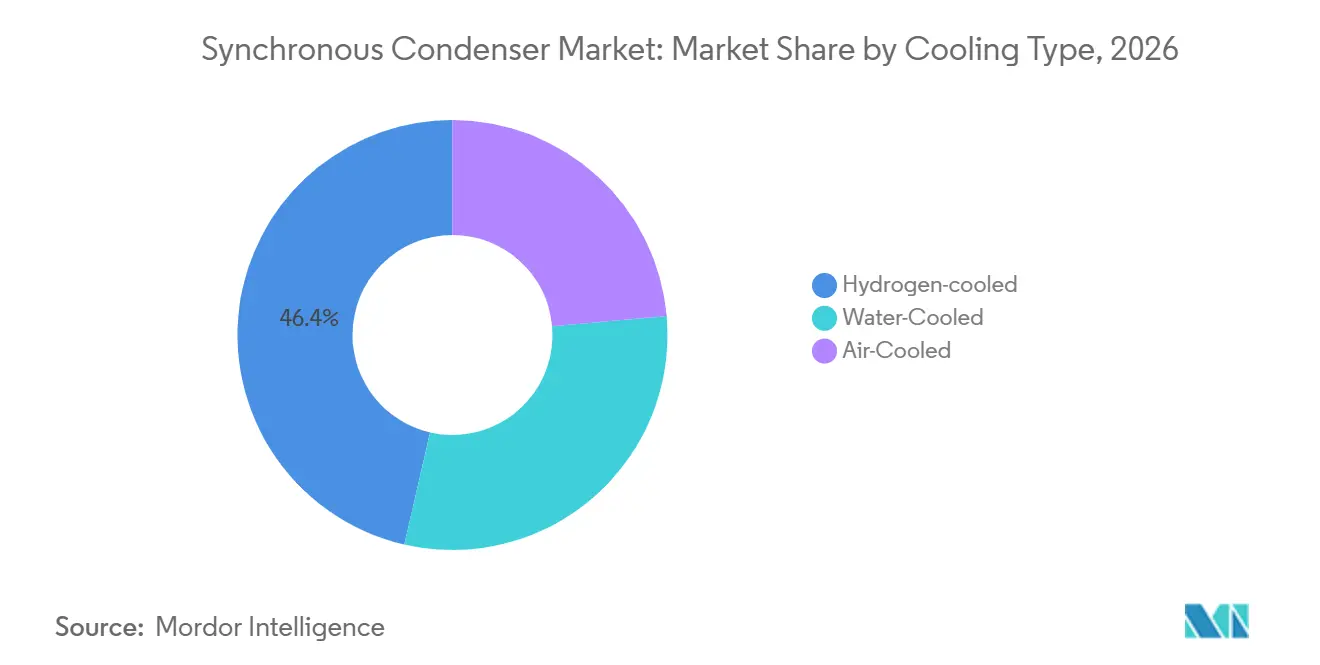
Air Cooling Gains Use in Distributed ApplicationsHydrogen-cooled units held 46.4% of cooling-type revenue in 2026. They are commonly used in high-capacity transmission applications, often above 200 MVAr, because strong thermal performance can reduce windage losses. This configuration remains important where equipment operates continuously at high reactive-power demand. Hydrogen handling adds operating and regulatory requirements that are less attractive at smaller sites. Cooling choice in the synchronous condenser market is therefore closely linked to site capability and equipment scale.
Air-cooled units are projected to grow at a 5.8% CAGR through 2032. Their growth reflects demand for simpler deployment where water supply is limited or hydrogen handling is impractical. ABB’s 2026 package for data centers combines air-cooled condensers with prefabricated eHouse units and flywheel technology. ANDRITZ also secured a January 2026 order for 6 300-MVAr units in Brazil, showing that air cooling can serve transmission-scale projects. Water-cooled units remain suited to industrial facilities where thermal management is already part of the site infrastructure.

By End User:
Renewable Developers Create a Faster-Growing Demand BaseElectrical utilities accounted for 67.7% of end-user revenue in 2026. Their purchases are linked to regulated transmission investment, reliability obligations, and system-strength planning. Utilities remain the largest buyers because they operate the transmission assets that set many technical requirements. The synchronous condenser industry also serves industrial users that need voltage stability and power quality at remote or weak-grid facilities. Steel, cement, mining, refining, and primary metals operations are relevant users in the synchronous condenser market across Chile, South Africa, and Western Australia.
Renewable energy developers are forecast to grow at an 8.1% CAGR through 2032. Their demand rises when grid-connection approvals require project owners to fund system-strength measures. In West Texas, inverter-based resource capacity reached 42 GW by the end of 2025, which raised the importance of short-circuit strength in project planning. Data centers are another growing user group, and ABB’s global agreement with VoltaGrid covers 35 condensers with flywheel technology for AI data center applications.[3] This expands the synchronous condenser market beyond its established utility customer base, while a 2025 study reported that gigawatt-scale AI data centers can produce aggregate 1.5 GW load drops during transmission faults.
Geography Analysis
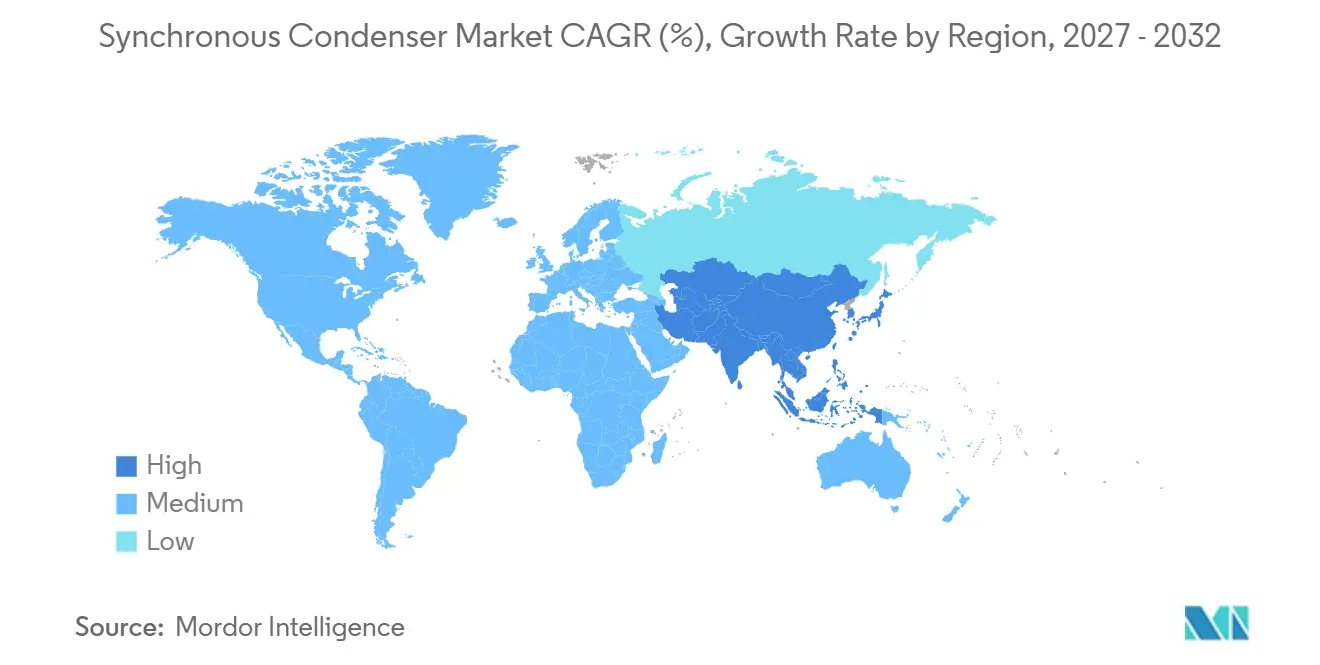
North America held 29.6% of revenue in 2026. The synchronous condenser market size in the region reflects formal reliability requirements and the scale of grid change in the United States. ERCOT’s response to weak-grid conditions supported the USD 144.5 million LCRA Bakersfield award in May 2025 for 2 175-MVAr units.[4] Eaton’s Bull Run conversion in Tennessee shows that repurposing is another route for serving transmission needs, while clean-energy mandates and data center load growth are widening the project pipeline across several service territories.
Asia-Pacific is forecast to expand at a 5.7% CAGR through 2032. China’s UHVDC system is a major source of volume because large receiving nodes need short-circuit strength and voltage support. India entered a new procurement phase in January 2026 when PGCIL received a letter of intent for 2 units at the Fatehgarh-II Pooling Station in Rajasthan. Australia has a detailed system-strength framework, and Powerlink’s contract for 4 units in Central Queensland gives the region multi-year project visibility. These conditions make the Asia-Pacific an important source of growth for the synchronous condenser market.
Europe held the second-largest regional position in 2026. The United Kingdom, Ireland, and Germany are key demand centers because their procurement systems address inertia and short-circuit strength. Quinbrook’s portfolio includes 7 assets in Scotland, Wales, and England, while the Neilston project reached commercial operation in April 2026. Elecnor’s 2 additional Irish projects took its LCIS portfolio to 4 sites in February 2026. South America is also gaining projects in the synchronous condenser market, as shown by ANDRITZ’s 2026 contracts in Brazil and Colombia.
Competitive Landscape
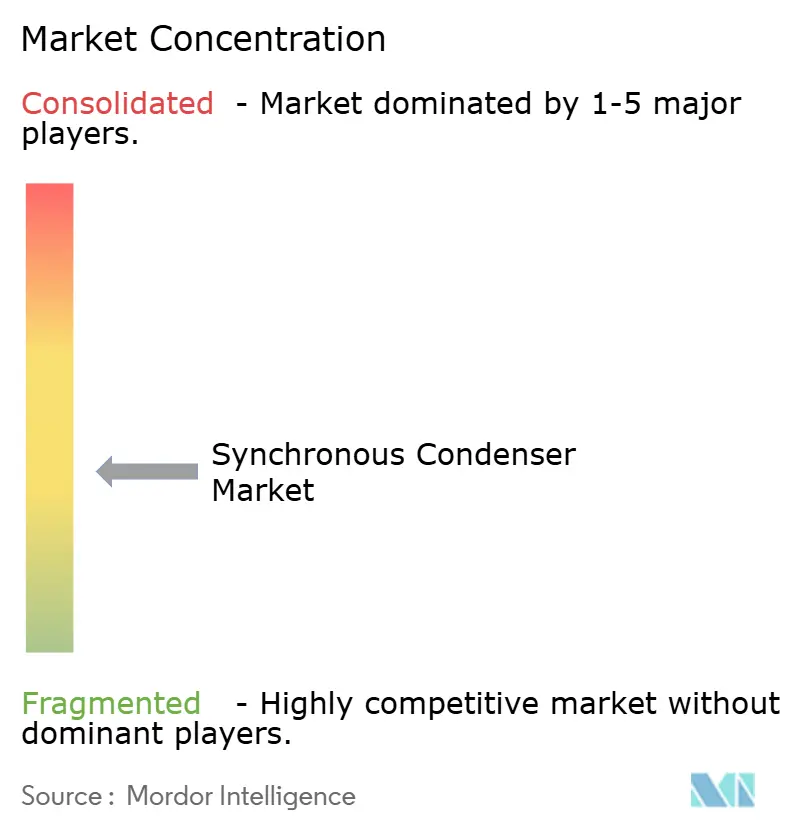
The synchronous condenser market is moderately consolidated. Large projects are more concentrated because few suppliers can combine rotating-machine manufacturing, high-voltage integration, and full engineering, procurement, and construction delivery. Siemens Energy is active in European utility projects and also develops E-STATCOM technology, while GE Vernova combines high-inertia rotor capability with turn-key delivery for projects including LCRA West Texas and Transgrid New South Wales.
ABB competes through grid integration, substation automation, and modular packages for data center connections. Its agreement with VoltaGrid for 35 additional condensers illustrates a direct move into power infrastructure for AI data centers. Hitachi Energy’s Central Queensland contract shows the value of combining flywheel-based inertia with a system-strength program. ANDRITZ strengthened its position in 2026 with 6-unit and 5-unit orders in Brazil and Colombia. These orders indicate that complete supply packages are important in newer markets.
Competition in the synchronous condenser market also centers on hybrid systems, predictive maintenance, and modular designs for industrial and behind-the-meter applications. Research on doubly fed machines indicates that advanced excitation control can expand active-power regulation options for new equipment. Regional manufacturers, including Harbin Electric, Dongfang Electric, Shanghai Electric, BHEL, and WEG, benefit when local-content rules influence large grid projects. Ingeteam is more directly positioned as a supplier of power converters, variable frequency drives, and static frequency converters than as a full condenser original equipment manufacturer. Baker Hughes and Doosan Škoda Power offer relevant coverage of rotating-machine supply and European original equipment manufacturing, and competitive standing depends on technical scope, local manufacturing, and the ability to manage lengthy grid-connection processes.
Synchronous Condenser Industry Leaders
-
Siemens Energy AG
-
GE Vernova Inc.
-
ABB Ltd.
-
Eaton Corporation plc
-
Hitachi Energy Ltd.
- *Disclaimer: Major Players sorted in no particular order
Synchronous Condenser Market Companies Covered in this Report
- ABB Ltd.
- ANDRITZ AG
- Ansaldo Energia S.p.A.
- Bharat Heavy Electricals Limited
- BRUSH Group Ltd.
- Dongfang Electric Corporation
- Eaton Corporation plc
- Fuji Electric Co., Ltd.
- GE Vernova Inc.
- Harbin Electric Corporation
- Hitachi Energy Ltd.
- IDEAL ELECTRIC POWER CO.
- Ingeteam, S.A.
- Mitsubishi Electric Corporation
- Shanghai Electric Group Co., Ltd.
- Siemens Energy AG
- Toshiba Energy Systems & Solutions Corporation
- Voith GmbH & Co. KGaA
- WEG S.A.
Recent Industry Developments in Synchronous Condenser Market
- July 2026: ANDRITZ received an order from Enlaza (Grupo Energía Bogotá) for five synchronous condensers rated +50/−25 MVAr each for Colombia's Caribbean region, the first of their kind in Colombia, aimed at strengthening grid stability and enabling renewable integration. The contract is in the mid-double-digit million-euro range and enters ANDRITZ's Q2 2026 order intake.
- April 2026: itachi Energy was awarded a contract by Powerlink for four +161-MVAr synchronous condensers with flywheel, each managing 1,442 MWs of inertia, for Central Queensland under the Queensland Energy Roadmap system-strength program. Baker Hughes supplies the rotating machines.
- March 2026: ABB and VoltaGrid finalized a global agreement for ABB to supply 35 additional synchronous condensers with flywheel technology and prefabricated eHouse units for VoltaGrid's AI data center power platform. Orders booked in ABB's Q2 2026 intake.
Global Synchronous Condenser Market Report Scope
A synchronous condenser is an uncoupled, DC-excited synchronous motor that operates without a mechanical load to support grid voltage stability, improve power factor, and provide inertia to an electric power grid. It is also known as a synchronous capacitor or synchronous compensator.
The global synchronous condenser market is segmented by product type, starting method, cooling type, end user, and geography. By product type, the market is segmented into new synchronous condensers and refurbished synchronous condensers. By starting method, the market is segmented into static frequency converter, pony motor, and other starting methods. By cooling type, the market is segmented into hydrogen-cooled, air-cooled, and water-cooled. By end-user, the market is segmented into electrical utilities, renewable energy developers, industrial sector, mining and metals, data centers and critical infrastructure, and other end users. The report also covers the market size and forecasts for the global synchronous condenser market across 26 countries in the key regions. For each segment, market sizing and forecasts are provided in terms of value (USD).
Segmentation Overview
| New Synchronous Condenser |
| Refurbished Synchronous Condenser |
| Static Frequency Converter |
| Pony Motor |
| Other Starting Methods |
| Hydrogen-cooled |
| Air-Cooled |
| Water-Cooled |
| Electrical Utilities |
| Renewable Energy Developers |
| Industrial Sector |
| Mining and Metals |
| Data Centers and Critical Infrastructure |
| Other End Users |
| North America | United States |
| Canada | |
| Mexico | |
| Europe | Germany |
| France | |
| Italy | |
| Spain | |
| United Kingdom | |
| Poland | |
| Russia | |
| Rest of Europe | |
| Asia-Pacific | China |
| India | |
| Japan | |
| South Korea | |
| Australia | |
| Indonesia | |
| Vietnam | |
| Thailand | |
| Rest of Asia-Pacific | |
| South America | Brazil |
| Argentina | |
| Chile | |
| Rest of South America | |
| Middle East and Africa | Saudi Arabia |
| United Arab Emirates | |
| Egypt | |
| South Africa | |
| Morocco | |
| Rest of Middle East and Africa |
| By Product Type | New Synchronous Condenser | |
| Refurbished Synchronous Condenser | ||
| By Starting Method | Static Frequency Converter | |
| Pony Motor | ||
| Other Starting Methods | ||
| By Cooling Type | Hydrogen-cooled | |
| Air-Cooled | ||
| Water-Cooled | ||
| By End User | Electrical Utilities | |
| Renewable Energy Developers | ||
| Industrial Sector | ||
| Mining and Metals | ||
| Data Centers and Critical Infrastructure | ||
| Other End Users | ||
| By Geography | North America | United States |
| Canada | ||
| Mexico | ||
| Europe | Germany | |
| France | ||
| Italy | ||
| Spain | ||
| United Kingdom | ||
| Poland | ||
| Russia | ||
| Rest of Europe | ||
| Asia-Pacific | China | |
| India | ||
| Japan | ||
| South Korea | ||
| Australia | ||
| Indonesia | ||
| Vietnam | ||
| Thailand | ||
| Rest of Asia-Pacific | ||
| South America | Brazil | |
| Argentina | ||
| Chile | ||
| Rest of South America | ||
| Middle East and Africa | Saudi Arabia | |
| United Arab Emirates | ||
| Egypt | ||
| South Africa | ||
| Morocco | ||
| Rest of Middle East and Africa | ||
Key Questions Answered in the Report
What is driving demand for synchronous condensers?
Retiring thermal plants and higher wind and solar penetration reduce available grid inertia and short-circuit strength. Grid operators use condensers to provide inertia, reactive power, and fault current.
How large is the global synchronous condenser market?
The Synchronous Condenser Market size is projected to expand from USD 0.87 billion in 2026 and USD 0.91 billion in 2027 to USD 1.14 billion by 2032, registering a CAGR of 4.61% between 2027 and 2032.
Which synchronous condenser product type leads revenue?
New units held 69.3% of revenue in 2026 because greenfield grid programs often lack assets suitable for conversion.
Which end users are expanding demand most quickly?
Renewable energy developers are projected to grow at an 8.1% CAGR through 2032 as connection approvals increasingly include system-strength obligations.
Why are air-cooled synchronous condensers growing?
Air-cooled systems are forecast to grow at a 5.8% CAGR because they avoid hydrogen handling and fit distributed and water-constrained sites.
Which region is forecast to grow most quickly?
Asia-Pacific is projected to grow at a 5.7% CAGR through 2032, supported by UHVDC investment, Indian procurement, and Australian system-strength programs.