
Switch Market Size and Share
Market Overview
| Study Period | 2021 - 2032 |
|---|---|
| Market Size (2027) | USD 16.97 Billion |
| Market Size (2032) | USD 22.12 Billion |
| Growth Rate (2027 - 2032) | 5.44 % |
| Fastest Growing Market | Asia-Pacific |
| Largest Market | Asia-Pacific |
| Market Concentration | Medium |
Major Players *Disclaimer: Major Players sorted in no particular order Image © Mordor Intelligence. Reuse requires attribution under CC BY 4.0. | |
Switch Market Analysis by Mordor Intelligence
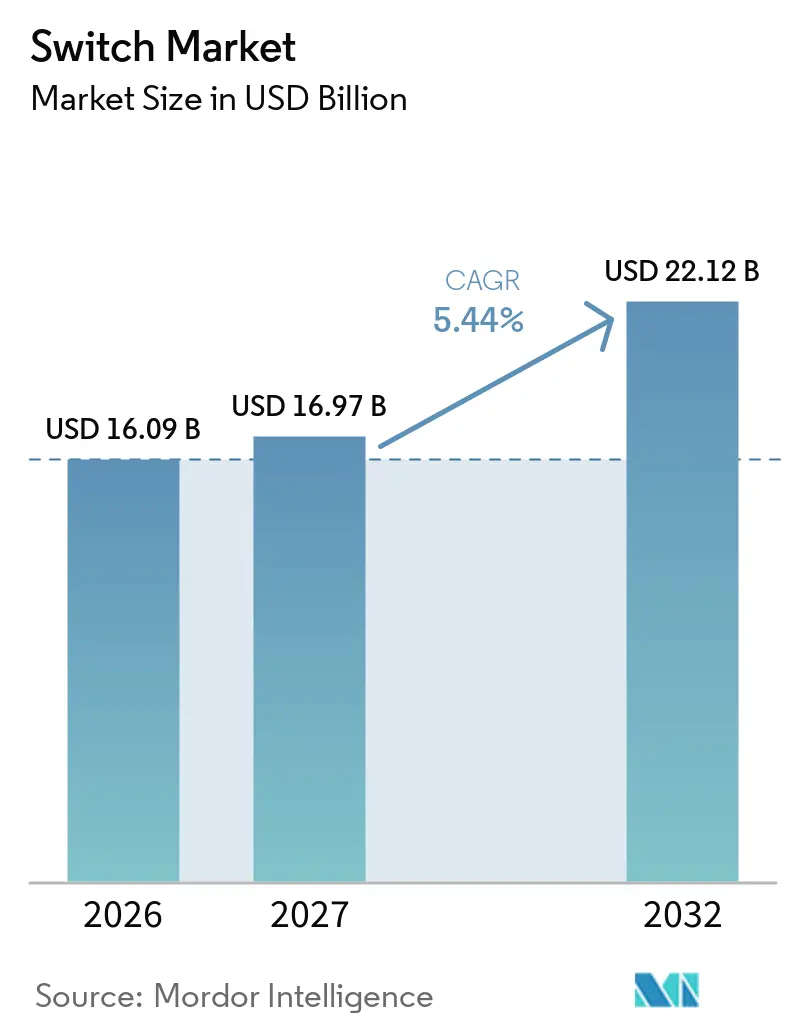
The Switch Market size is expected to increase from USD 16.09 billion in 2026 to USD 16.97 billion in 2027 and reach USD 22.12 billion by 2032, at a CAGR of 5.44% over 2027-2032. The Global switch market is supported by residential and commercial construction in emerging economies, grid modernization in mature economies, and wider use of connected controls in new projects and renovations. Smart switches are changing the value mix because their higher selling prices offset pressure on conventional product margins. Every new, renovated, or electrified building needs switching devices, which gives the Global switch market a stable underlying source of demand. Manufacturers are concentrating on connected products, premium modular ranges, and compliance documentation to protect margins and improve their position in specification-led projects. Copper, engineering resin, cybersecurity, and low-cost informal competition remain material constraints on the Global switch market.
Key Report Takeaways
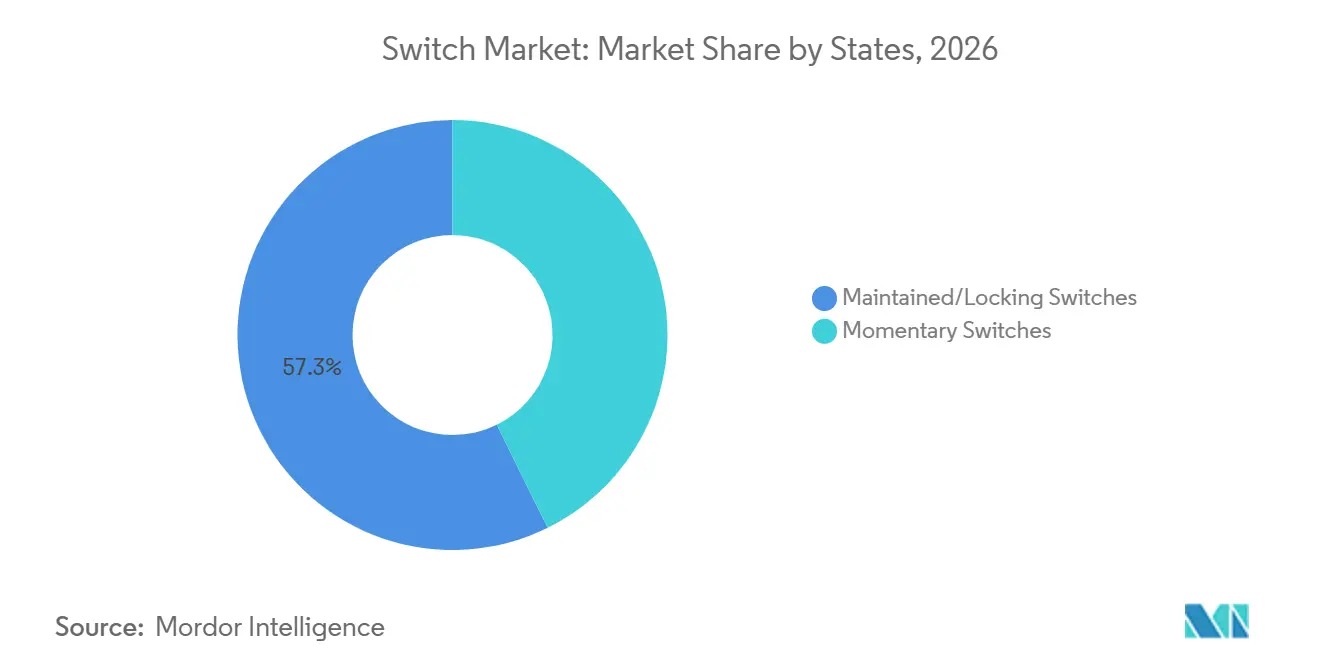
- By state, maintained and locking switches held 57.3% of the Global switch market share in 2026, while momentary switches are forecast to grow at a 6.3% CAGR through 2032.
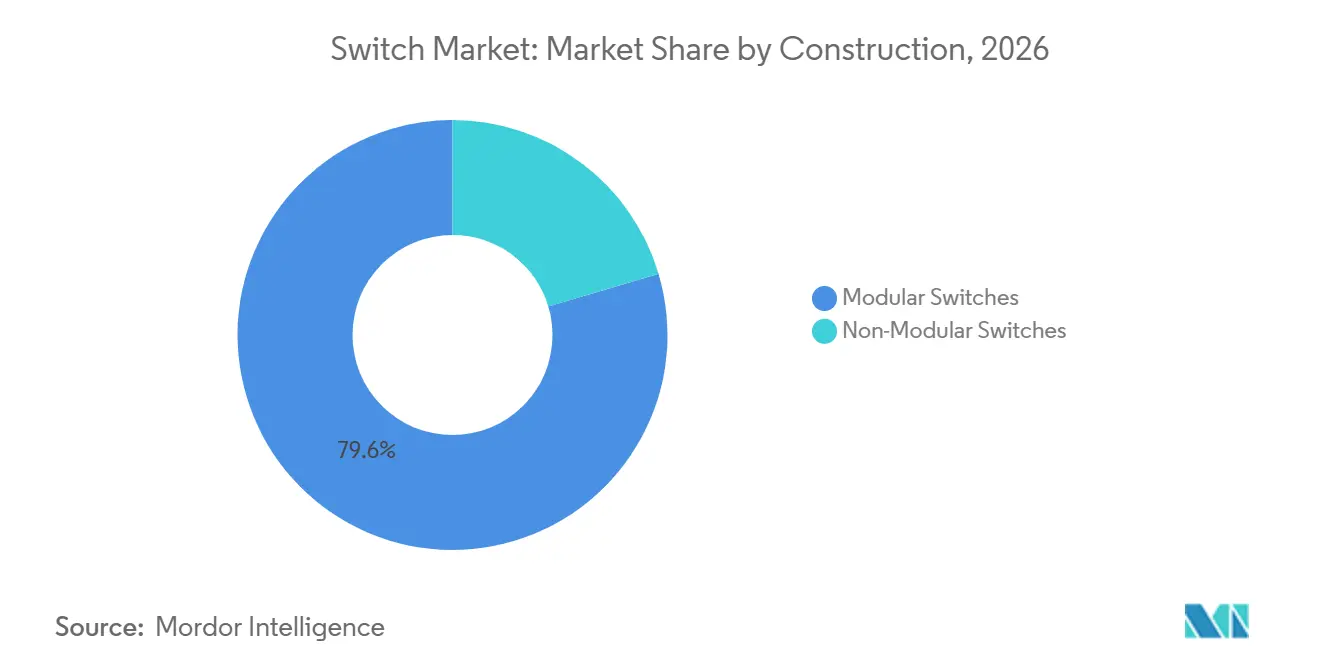
- By construction, modular switches held 79.6% revenue share in 2026, while non-modular switches are forecast to grow at a 5.7% CAGR through 2032.
- By technology, mechanical switches held 87.5% revenue share in 2026, while smart and connected switches are forecast to grow at a 7.3% CAGR through 2032.
- By application, residential applications held 39.4% revenue share in 2026, while infrastructure and utilities are forecast to grow at a 6.5% CAGR through 2032.
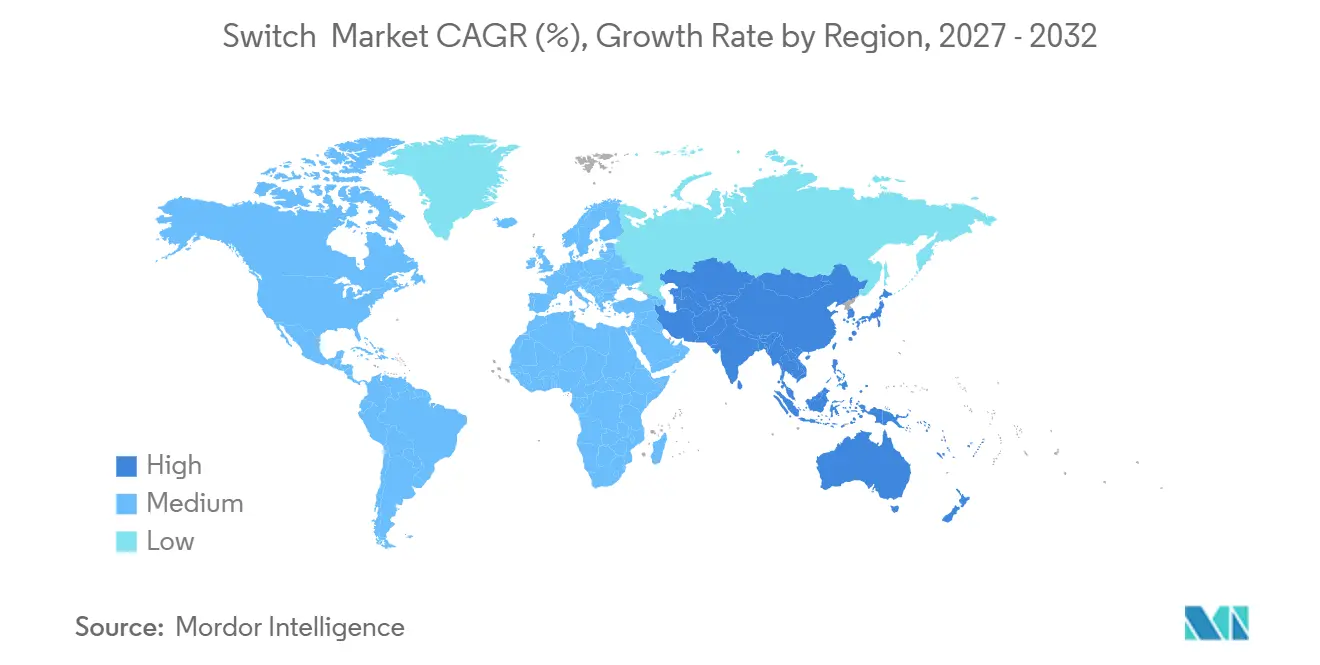
- By geography, Asia-Pacific held 42.1% revenue share in 2026 and is forecast to grow at a 7.2% CAGR through 2032.
Note: Market numbers in this report are based on Mordor Intelligence's proprietary estimation framework, which combines nine months of actuals with Q4 projections for base year 2026.
Market Trends and Insights
Drivers Impact Analysis of Switch Market*
| Driver | % Impact on CAGR Forecast | Geographic Relevance | Impact Timeline |
|---|---|---|---|
| Smart-Home and Building-Automation Adoption | +1.40% | Global; highest in North America, Europe, APAC | Medium term (2–4 years) |
| Urban Infrastructure and Electrification Expansion | +1.20% | APAC, MEA, South America | Short term (≤ 2 years) |
| Industrial Automation and Safety-Critical Control Demand | +0.70% | Global; APAC, North America, Europe | Medium term (2–4 years) |
| Energy-Efficiency and Green-Building Compliance | +0.60% | North America, Europe | Medium term (2–4 years) |
| Retrofit-Compatible Smart Switches for Existing Buildings | +0.40% | North America, Europe, mature APAC | Short term (≤ 2 years) |
| Interoperable, Low-Neutral and Battery-Free Switching Architectures | +0.40% | Global; early adoption in Europe, North America | Long term (≥ 4 years) |
| Source: Mordor Intelligence | |||
Smart-Home Adoption and Retrofit-Compatible Architectures
Smart-home platforms are a major source of demand for connected switches in homes and light-commercial buildings. The German Federal Ministry for Economic Affairs reported global B2C smart-living revenue of EUR 142 billion in 2024 and EUR 159 billion in 2025, with Europe accounting for EUR 41 billion in 2025[1]. Matter-compatible products reduce the barrier created by separate control ecosystems because they can work across Apple Home, Google Home, and Amazon Alexa. This makes interoperability more important in product specification and gives suppliers a clearer reason to develop connected ranges. The Global switch market also benefits when kinetic energy harvesting removes the need for a neutral wire or a battery in older buildings. EnOcean describes Matter-compatible building technology that supports this route for retrofit installations. As a result, manufacturers can address renovation projects where conventional smart-switch installation has been more difficult.
Urban Infrastructure and Electrification Expansion
Infrastructure investment creates direct demand for control and distribution switching across substations, feeder extensions, renewable energy connections, and transport projects. India combines housing programs, metro development, and data-center investment, which supports demand for modular accessories, industrial safety switches, and infrastructure equipment. The Global switch market, therefore, receives demand from several construction and electrification streams at the same time. Prefabricated smart panels can integrate switching functions and reduce the number of separate devices within a board. This can limit unit growth in some installations, even while the value of each installation rises. The International Energy Agency stated that copper supply concentration and tightening smelting capacity can create material risks for electrical infrastructure investment[2]. These supply pressures make purchasing decisions more sensitive to material efficiency and total installed cost.
Industrial Automation and Safety-Critical Control Demand
Industrial users need switches that can withstand repeated use, vibration, demanding environmental conditions, and safety requirements. These requirements make product performance and certification more important than the lowest purchase price. The Global switch market gains from greater use of safety-rated momentary pushbuttons and selector switches in collaborative robotics and light-curtain safety circuits. This demand supports the supplied 6.3% CAGR for momentary switches through 2032. Factory investment in electronics, semiconductors, and electric vehicle batteries can also support new demand in North America and Europe. Such facilities need control devices across production panels, isolation systems, and machine-guarding applications. The demand profile favors suppliers that can meet industrial safety expectations and supply reliable products over long operating cycles.
Energy-Efficiency and Green-Building Compliance
Building rating systems increasingly recognize controllable and occupancy-sensing switching within energy and sustainability frameworks. LEED provides a rating system used to evaluate sustainable building practices[3]. BREEAM also certifies sustainable buildings and supports specification decisions in construction projects[4]. This connection makes controls more relevant to projects seeking higher building ratings. ABB published an environmental product declaration for electrical switches and outlets in 2025, giving project teams lifecycle information for material assessments. The Global switch market can benefit when documented products qualify for certified building submissions. Suppliers with lifecycle documentation can preserve a premium where basic products have fewer compliance credentials.
Restraints Impact Analysis of Switch Market*
| Restraint | % Impact on CAGR Forecast | Geographic Relevance | Impact Timeline |
|---|---|---|---|
| Smart-Switch Cybersecurity and Privacy Exposure | -0.50% | Global; pronounced in Europe, North America | Medium term (2–4 years) |
| Low-Cost Informal Competition and Margin Compression | -0.60% | APAC, MEA, South America | Short term (≤ 2 years) |
| Copper, Resin and Electronic-Module Cost Volatility | -0.50% | Global | Short term (≤ 2 years) |
| Terminal-Configuration Mismatch and Retrofit Installation Friction | -0.30% | Europe, North America | Medium term (2–4 years) |
| Source: Mordor Intelligence | |||
Smart-Switch Cybersecurity and Retrofit Installation Friction
Connected switches add a digital attack surface to building and home-automation networks. NIST recorded CVE-2024-48871, a stack-based buffer-overflow vulnerability affecting Planet Technology industrial switches, with a CVSS score of 9.8. NIST also recorded CVE-2025-21062, which concerned a broken or risky cryptographic algorithm in smart-switch software. Such cases lengthen vendor evaluation and add security obligations for suppliers serving institutional buyers. Existing terminal configurations can also make retrofit installation harder in older buildings. The Global switch market faces slower adoption, where installation teams must solve wiring, neutral-wire, and compatibility issues before a connected device can be installed. Larger suppliers have an advantage when they can offer compliance support, product documentation, and retrofit-ready options.
Low-Cost Competition and Input-Cost Volatility
Unbranded and non-certified products compete strongly where buyers place greater weight on upfront price than compliance or lifecycle performance. This pressure is most visible in price-sensitive residential markets across parts of Asia-Pacific, the Middle East and Africa, and South America. The Global switch market has a large, organized supplier base, but local producers can suppress selling prices in rural and semi-urban channels. Certification standards remain relevant, including BIS IS 3854 in India and IEC 60669-1 internationally, although enforcement gaps can limit their near-term effect. Copper, resin, and electronic module costs also create uncertainty for manufacturers and large procurement programs. Suppliers must balance price actions, material sourcing, and product redesign without weakening channel competitiveness.
*Our forecasts treat driver/restraint impacts as directional, not additive. The impact forecasts reflect baseline growth, mix effects, and variable interactions.
Switch Market Segment Analysis
By State:
Maintained Switches Anchor Volume, Momentary Accelerates in ControlsMaintained and locking switches accounted for 57.3% of global revenue in 2026. Their leading position reflects use in residential wiring, commercial distribution boards, and industrial control panels that require a stable on or off state. These switches avoid the need for continuous operator input and remain a practical baseline across many installations. European modular wiring accessories still rely heavily on maintained rocker-switch arrangements. Industrial applications also use locking selector switches for motor isolation and machine-guarding functions. The Global switch market industry continues to rely on this format, where a latched state is central to the intended function.
Momentary switches are forecast to grow at a 6.3% CAGR through 2032. They serve industrial pushbutton panels that need tactile operation and safety-rated performance under IEC 60947-5-1. They also fit smart-home interfaces because a controller can define the maintained state while the button provides the physical input. EnOcean’s energy-harvesting approach makes kinetic momentary switches suitable for retrofits by using the energy created by a button press to transmit a wireless signal. This arrangement removes a historic neutral-wire barrier in older properties. It also fits momentary operation because a single press can supply the energy needed to send a control signal.

By Construction:
Modular Dominance Persists While Non-Modular Captures Infrastructure DemandModular switches accounted for 79.6% of construction revenue in 2026. Their position is supported by flush-mount wiring-accessory practices in Europe and the Asia-Pacific. Standardized back boxes allow owners and installers to improve a room’s appearance or add connectivity without changing the wall structure. This makes modular products useful in renovation projects as well as new construction. ABB India launched its LIORA modular range at ELECRAMA 2025 with dual USB Type-A/C sockets, RoHS-compliant materials, and finishes designed for residential, commercial, and hospitality applications. The Global switch market uses this familiar construction format as a platform for higher-value features rather than replacing the format itself.
Non-modular switches are forecast to grow at a 5.7% CAGR through 2032. Infrastructure, industrial panels, and transportation projects need heavy-duty integrated units that do not have to follow residential modular standards. This allows a smaller construction category to grow faster than the larger modular category. Its expansion is linked to the same infrastructure spending that supports the fastest-growing application group. Heavy-duty products serve demanding locations where durability and protection matter more than visual integration. The Global switch market therefore retains a split construction profile, with modular products supporting broad building demand and non-modular products meeting specialized project needs.
By Technology:
Mechanical Base Stable as Smart Switches Redefine Value CaptureMechanical switches held 87.5% of technology revenue in 2026. This share reflects the installed base in existing buildings, where like-for-like replacement remains common. Mechanical products retain volume because they are familiar, widely available, and practical for routine maintenance. Electronic products occupy a middle position by offering dimming, soft-start, and two-wire compatibility. These functions can justify a premium in renovation work across Europe and North America. Mechanical replacement continues to provide the volume base for the Global switch market industry, even as the product mix changes.
Smart and connected switches are forecast to grow at a 7.3% CAGR through 2032. Matter protocol standardization, voice-assistant use, and energy harvesting support this growth by lowering ecosystem and installation barriers. Signify’s Zigbee GreenPower switch uses energy from the mechanical button press to transmit a control signal without a battery. This design can expand use in both new and existing buildings without the complexity of a mains-connected alternative. Renovation, hospitality, and commercial management projects are important outlets because end users can directly value convenience and control. The Global switch market is moving toward a higher-value technology mix even though conventional mechanical devices remain dominant in unit demand.
By Application:
Infrastructure Surfaces as the Structural Growth CatalystResidential applications accounted for 39.4% of revenue in 2026 and were the largest application group. Housing activity in India, Southeast Asia, the Gulf Cooperation Council, and Sub-Saharan Africa supports this scale. Price competition and the high use of basic products constrain average values in many large-volume markets. Commercial projects form the next demand tier across offices, retail properties, and hospitality buildings. Premium modular designs and building-certification requirements can support higher selling prices in these settings. Industrial applications are smaller but earn higher per-unit values because of safety certification and performance requirements.
Infrastructure and utilities are forecast to grow at a 6.5% CAGR through 2032. The Global switch market size for this application is supported by grid distribution, data-center power management, transport terminal electrification, and renewable-energy plant control. These areas receive sustained capital investment and often require ruggedized, reliable products. Transportation adds demand through railway, metro, and airport development in Asia, the Middle East, and Europe. These applications need low-maintenance switching devices that can meet railway-grade expectations such as EN 50155 and IEC 61373. This application mix gives suppliers an avenue for growth beyond basic residential replacement demand.
Geography Analysis
APAC Switch Market
Asia-Pacific held 42.1% of the Global switch market share in 2026 and is forecast to expand at a 7.2% CAGR through 2032. The region combines a large construction base with growing smart-home use in urban China and South Korea. China’s grid modernization and carbon-neutrality agenda support control and distribution demand across network tiers. India’s housing programs, metro projects, and data-center development create demand across residential, industrial, and infrastructure applications. Vietnam, Indonesia, and Thailand benefit from manufacturing investment and tourism infrastructure activity. ABB extended its LIORA range for Indian residential and hospitality interiors, showing the importance of tailored premium offerings within the region.
North America and Europe Switch Market
North America and Europe are mature demand bases where renovation, building certification, and smart-home upgrades support steady sales. North American commercial building decisions are influenced by energy-efficiency requirements and demand for controllable, occupancy-sensing products. Data-center electrification and utility grid modernization also strengthen demand for higher-specification wiring products. Europe benefits from replacement demand linked to renovation activity and smart-switch-compatible modular accessories. Its new residential construction slowdown in Germany and France limits part of the unit opportunity. The German SmartLivingNEXT study recorded European smart-living revenue of EUR 41 billion in 2025, supporting the region’s importance for premium building-automation products.
MEA and South America Switch Market
South America, the Middle East, and Africa have smaller but distinct demand patterns. Brazil provides much of South American volume through construction and grid-related investment, although affordability and currency conditions limit value growth. Gulf markets support premium modular accessories through hospitality, commercial, and residential projects. Egypt and Morocco support industrial and infrastructure switching through solar facilities and industrial-zone development. Sub-Saharan Africa remains focused on basic modular and non-modular devices, where informal supply chains intensify price pressure. The Global switch market has early smart-switch potential in South Africa and Kenya as broadband availability expands among higher-income consumers.
Competitive Landscape
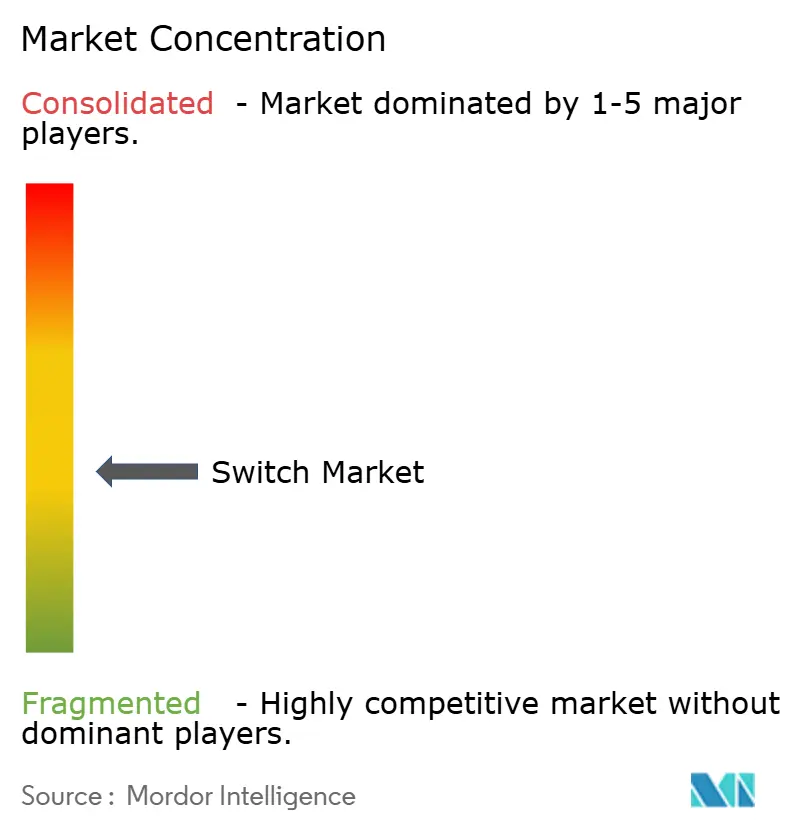
The Global switch market has moderate concentration in premium and technology-led categories. Schneider Electric, Legrand, ABB, and Siemens hold strong positions across residential, commercial, and industrial uses. The broader volume tier remains fragmented because regional and unbranded producers compete mainly on price. This structure creates different competitive conditions across countries and applications. Large suppliers differentiate through design, connected functionality, certification, and service. Smaller producers tend to focus on lower-cost products and local distribution reach.
Legrand reported EUR 5.4 billion in first-half 2026 sales, a 17% increase excluding currency effects, and seven acquisitions in energy and digital-transition businesses. The acquisitions included positions linked to data-center power management and energy-transition infrastructure. ABB’s Busch-art linear range uses 92-98% recycled polycarbonate and works with ABB-free@home and i-bus KNX building automation. These moves show how suppliers combine adjacent electrification exposure, design, sustainability, and connectivity. The Global switch market also rewards products supported by environmental declarations and certification evidence. These tools help manufacturers qualify for building projects where documentation is part of the selection process.
A major opening remains in retrofit smart-switch products that do not require a neutral wire. Older homes in Europe and North America can be costly to rewire, which makes battery-free kinetic products relevant. EnOcean’s technology offers a route to wireless control that can address this installation issue. Industrial safety-rated momentary switches offer another protected area because they must meet functional-safety requirements. The Global switch market also includes lower-priced Matter-compatible offerings from IoT-focused suppliers such as Shelly Group SE. Cybersecurity requirements under the EU Radio Equipment Directive can favor larger suppliers that have internal testing and compliance capabilities.
Switch Industry Leaders
-
Schneider Electric SE
-
Legrand SA
-
Siemens AG
-
ABB Ltd.
-
Eaton Corporation plc
- *Disclaimer: Major Players sorted in no particular order
Switch Market Companies Covered in this Report
- ABB Ltd.
- Eaton Corporation plc
- Gewiss S.p.A.
- Hager Group
- Havells India Limited
- Honeywell International Inc.
- Hubbell Incorporated
- JUNG
- Legrand SA
- Leviton Manufacturing Co., Inc.
- Lutron Electronics
- OMRON Corporation
- Panasonic Corporation
- Rockwell Automation, Inc.
- Schneider Electric SE
- Shelly Group SE
- Siemens AG
- Signify N.V.
- Simon S.A.
- Vimar S.p.A.
Recent Industry Developments in Switch Market
- September 2026: Schneider Electric unveiled fully software-defined medium-voltage switchgear at YOTTA 2026 in Las Vegas. Pilot programs continue through 2027, with broader commercial availability planned from 2028.
- June 2026: Schneider Electric launched the ASCO 300 SERIES Multi-Voltage Transfer Switch, a field-configurable automatic transfer switch with a 208-480V range and up to 600A capacity. The product replaces up to 10 voltage-specific models with a single UL 1008-listed unit and incorporates Predictive Outage Detection for commercial backup-power applications.
- March 2026: ABB launched the DS301C M IcN 10kA electromechanical residual current circuit breaker at Light + Building 2026 in Frankfurt. ABB stated that the voltage-independent product protects against overcurrent, short-circuit, and residual faults for commercial and industrial retrofit projects.
- February 2025: ABB India launched the LIORA modular switch range at ELECRAMA 2025 in New Delhi. The range combined dual USB Type-A/C sockets, Moon White and Stone Grey finishes, and RoHS-compliant materials for residential, commercial, and hospitality uses.
Global Switch Market Report Scope
Switches are electrical devices used to make, break, or control the flow of electrical current within a circuit. They enable users or automated systems to turn electrical equipment and lighting on or off, or to select between different circuit paths.
The Global Switch Market Report is segmented by state, construction, technology, application, and geography. By state, the market is segmented into momentary switches and maintained/locking switches. By construction, the market is segmented into modular and non-modular switches. By technology, the market is segmented into mechanical, electronic, and smart and connected switches. By application, the market is segmented into residential, commercial, industrial, infrastructure and utilities, transportation, and other applications. The report also covers the market size and forecasts for the global switch market across 26 countries in key regions. For each segment, the market sizing and forecasts have been provided on the basis of value (USD).
Segmentation Overview
| Momentary Switches |
| Maintained/Locking Switches |
| Modular Switches |
| Non-Modular Switches |
| Mechanical Switches |
| Electronic Switches |
| Smart and Connected Switches |
| Residential |
| Commercial |
| Industrial |
| Infrastructure and Utilities |
| Transportation |
| Other Applications |
| North America | United States |
| Canada | |
| Mexico | |
| Europe | Germany |
| France | |
| Italy | |
| Spain | |
| United Kingdom | |
| Poland | |
| Russia | |
| Rest of Europe | |
| Asia-Pacific | China |
| India | |
| Japan | |
| South Korea | |
| Australia | |
| Indonesia | |
| Vietnam | |
| Thailand | |
| Rest of Asia-Pacific | |
| South America | Brazil |
| Argentina | |
| Chile | |
| Rest of South America | |
| Middle East and Africa | Saudi Arabia |
| United Arab Emirates | |
| Egypt | |
| South Africa | |
| Morocco | |
| Rest of Middle East and Africa |
| By State | Momentary Switches | |
| Maintained/Locking Switches | ||
| By Construction | Modular Switches | |
| Non-Modular Switches | ||
| By Technology | Mechanical Switches | |
| Electronic Switches | ||
| Smart and Connected Switches | ||
| By Application | Residential | |
| Commercial | ||
| Industrial | ||
| Infrastructure and Utilities | ||
| Transportation | ||
| Other Applications | ||
| By Geography | North America | United States |
| Canada | ||
| Mexico | ||
| Europe | Germany | |
| France | ||
| Italy | ||
| Spain | ||
| United Kingdom | ||
| Poland | ||
| Russia | ||
| Rest of Europe | ||
| Asia-Pacific | China | |
| India | ||
| Japan | ||
| South Korea | ||
| Australia | ||
| Indonesia | ||
| Vietnam | ||
| Thailand | ||
| Rest of Asia-Pacific | ||
| South America | Brazil | |
| Argentina | ||
| Chile | ||
| Rest of South America | ||
| Middle East and Africa | Saudi Arabia | |
| United Arab Emirates | ||
| Egypt | ||
| South Africa | ||
| Morocco | ||
| Rest of Middle East and Africa | ||
Key Questions Answered in the Report
What is the projected value of the global switch sector by 2032?
The sector is projected to reach USD 22.12 billion by 2032, growing at a 5.44% CAGR from 2027 to 2032.
Which switch technology is growing fastest?
Smart and connected switches are forecast to grow at a 7.3% CAGR through 2032, supported by Matter compatibility and retrofit-friendly designs.
Which application has the highest growth outlook?
Infrastructure and utilities are forecast to grow at a 6.5% CAGR through 2032, driven by grid, data-center, transport, and renewable-energy projects.
Why does Asia-Pacific lead global demand?
Asia-Pacific held 42.1% of revenue in 2026 and is forecast to grow at a 7.2% CAGR through 2032 because of construction, infrastructure, and smart-home demand.
What is limiting adoption of connected switches?
Cybersecurity risks, retrofit wiring friction, and the need for vendor compliance documentation can slow adoption in institutional and older-building projects.
How concentrated is the global switch sector?
Market concentration score: 5 out of 10 because leading premium suppliers are influential, but regional and unbranded manufacturers keep the overall volume tier fragmented.