
Sweden Robotic Lawn Mower Market Size and Share
Market Overview
| Study Period | 2021 - 2031 |
|---|---|
| Forecast Data Period | 2026 - 2031 |
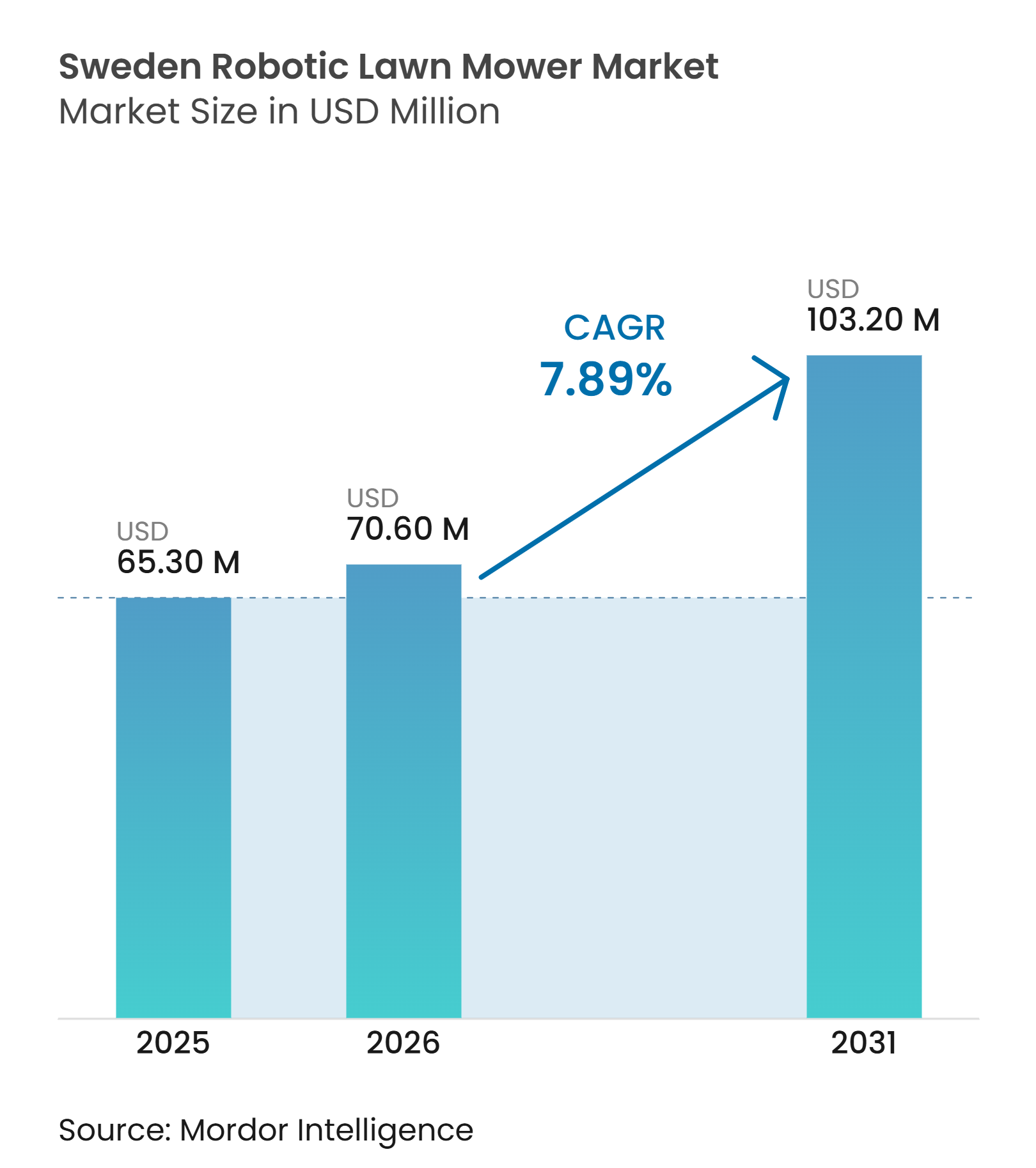
| Base Year Market Size (2025) | USD 65.30 Million |
| Market Size (2026) | USD 70.60 Million |
| Market Size (2031) | USD 103.20 Million |
| Growth Rate (2026 - 2031) | 7.89 % |
| Market Concentration | Medium |
Major Players *Disclaimer: Major Players sorted in no particular order Image © Mordor Intelligence. Reuse requires attribution under CC BY 4.0. | |
Sweden Robotic Lawn Mower Market Analysis by Mordor Intelligence
The Sweden robotic lawn mower market size was valued at USD 65.3 million in 2025 and is estimated to grow from USD 70.6 million in 2026 to reach USD 103.2 million by 2031, at a CAGR of 7.9% during the forecast period (2026-2031). The Sweden robotic lawn mower market has a mature installed base, so replacement purchases increasingly contribute to revenue alongside sales to first-time buyers. Higher labor costs make automated mowing more relevant for repeated work on larger properties and managed grounds. Wire-free navigation is changing the buying process by removing a major installation step for suitable sites. This also shifts demand toward products with camera, satellite, and connected operating features. Competition is likely to center on practical reliability, service coverage, and product suitability across residential and professional sites.
Key Report Takeaways
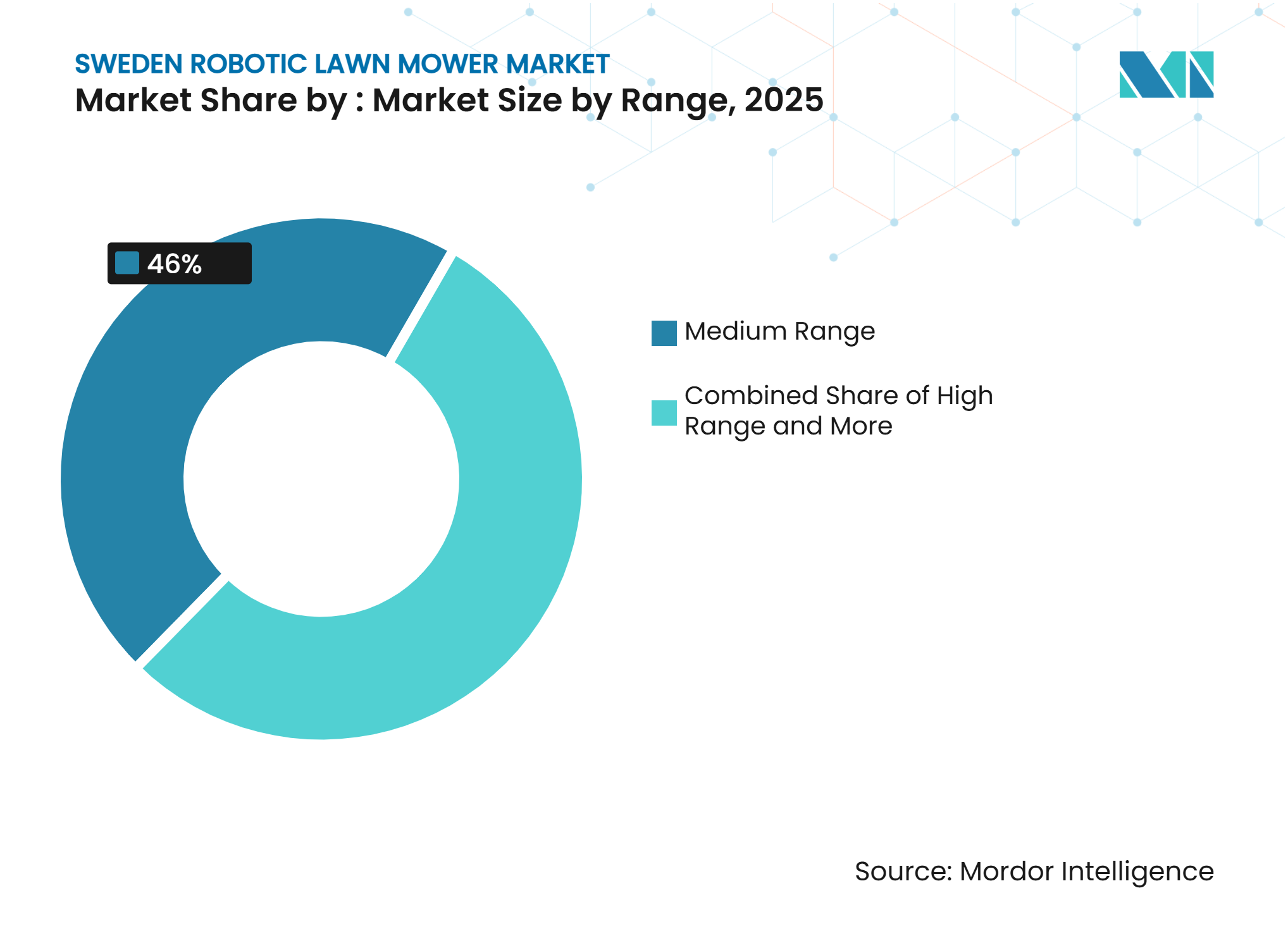
- By range, medium-range mowers held 46% of the Sweden robotic lawn mower market share in 2025, while high-range mowers are forecast to grow at a CAGR of 9.5% from 2026 to 2031.
- By battery capacity, 20 to 30 V systems held 48% of the Sweden robotic lawn mower market size in 2025, while systems above 30 V are forecast to grow at a CAGR of 10.8% from 2026 to 2031.
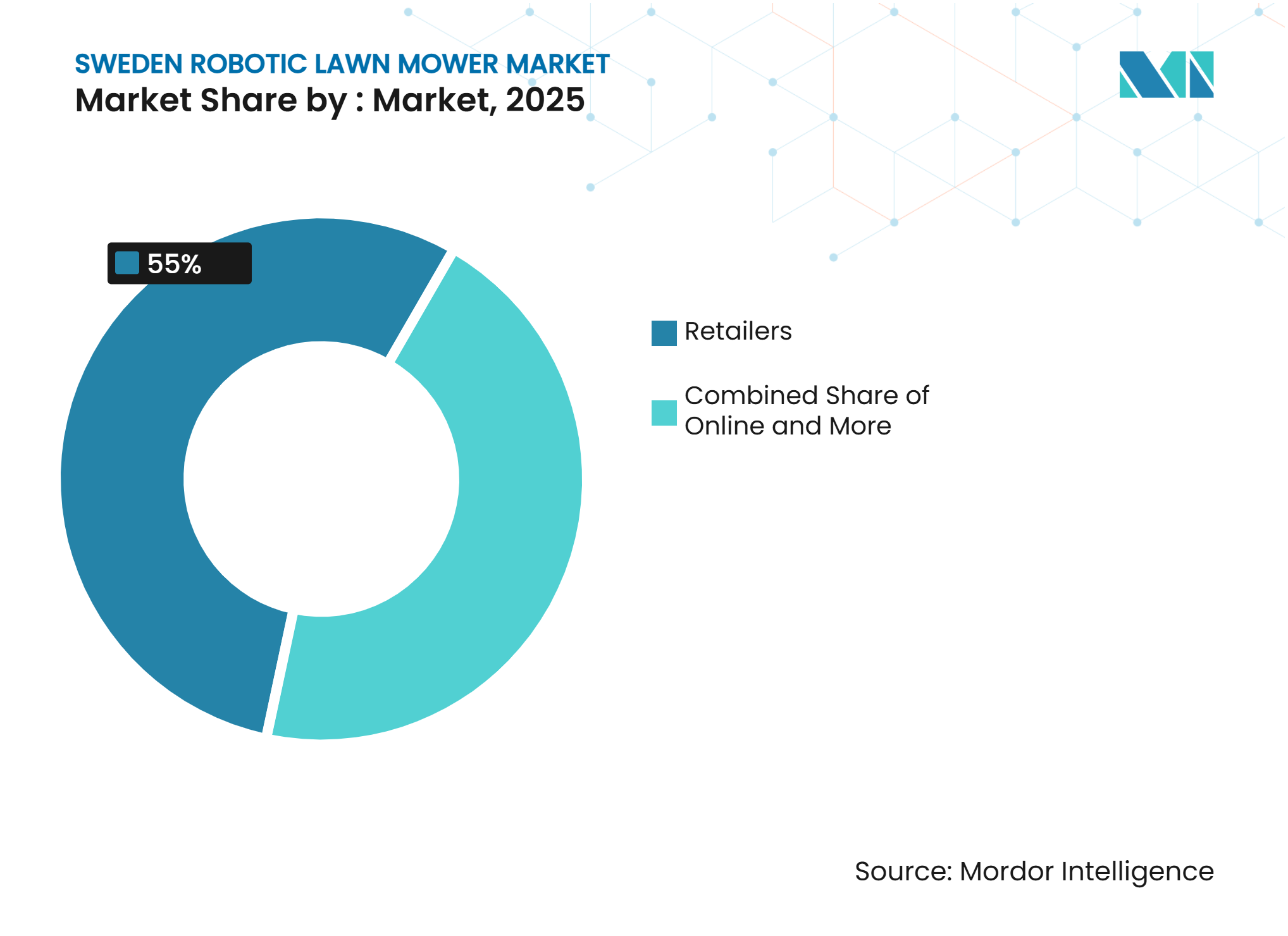
- By sales channel, retailers held 55% of the Sweden robotic lawn mower market share in 2025, while online sales are forecast to grow at a CAGR of 11.5% from 2026 to 2031.
- By application, residential use held 72% of the Sweden robotic lawn mower market size in 2025, while commercial use is forecast to grow at a CAGR of 12.4% from 2026 to 2031.
- By end user, homeowners held 68% of the market value in 2025, while landscaping companies are forecast to grow at a CAGR of 10.3% from 2026 to 2031.
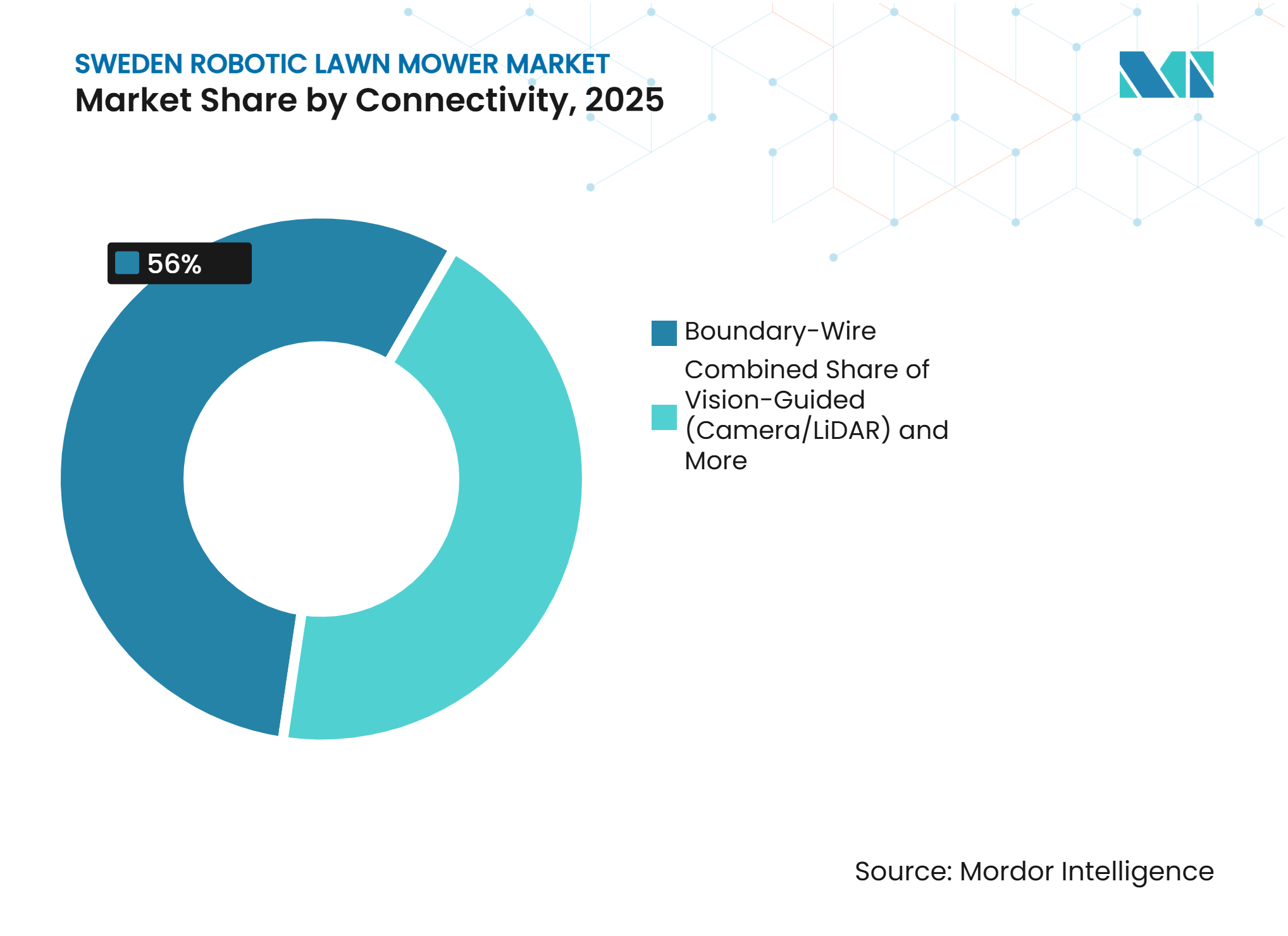
- By connectivity, boundary-wire systems held 56% of market value in 2025, while vision-guided systems are forecast to grow at the fastest CAGR of 13.5% from 2026 to 2031.
Note: Market size and forecast figures in this report are generated using Mordor Intelligence’s proprietary estimation framework, updated with the latest available data and insights as of January 2026.
Market Trends and Insights
Drivers Impact Analysis of Sweden Robotic Lawn Mower Market*
| Driver | (~) % Impact on CAGR Forecast | Geographic Relevance | Impact Timeline |
|---|---|---|---|
| High Swedish Landscaping Labor Costs Strengthen Automation Economics | +2.3% | National, strongest in Stockholm, Gothenburg, and Malmö metropolitan areas | Medium term (2-4 years) |
| Large Detached-Home Base and Convenience-Oriented Lawn Care | +1.9% | National, with higher penetration in suburban municipalities | Short term (≤ 2 years) |
| Expansion of Wire-Free Navigation and Multi-Zone Product Capability | +1.6% | National, following product availability | Medium term (2-4 years) |
| Municipal and Sports-Ground Adoption Validates Professional Robotic Mowing | +1.3% | National, with early activity in Ale, Älvkarleby, Eskilstuna, and Lidköping | Medium term (2-4 years) |
| Wildlife-Safe Mowing Becomes a Differentiation and Replacement-Cycle Driver | +0.7% | National | Long term (≥ 4 years) |
| Winter-Ready Scheduling and Frost Management Create Demand for Smarter Connected Models | +0.5% | National, with a stronger effect in northern Sweden | Long term (≥ 4 years) |
| Source: Mordor Intelligence | |||
High Swedish Landscaping Labor Costs Strengthen Automation Economics
Landscaping labor costs support the case for automation, where mowing requires repeated work over large areas. This effect in the Sweden robotic lawn mower market is strongest for parks, sports fields, golf facilities, and landscaping contractors that manage frequent mowing schedules. A robotic mower can reduce the time staff spend on routine cutting and allow them to focus on maintenance work that requires direct attention. The Swedish robotic lawn mower market, therefore, has a stronger commercial case, where labor is a recurring operating expense, especially for operators managing several repeat-mowing locations. The benefit is less immediate for households with small lawns, irregular mowing needs, or properties where manual work remains manageable over the short operating season. Commercial buyers can also spread equipment costs across several sites through service contracts, leasing, or fleet use.
Large Detached-Home Base and Convenience-Oriented Lawn Care
Statistics Sweden recorded 2,136,854 dwellings in one- or two-dwelling buildings at the end of 2024, providing a large residential base for robotic mowing products[1]. Detached homes commonly have outdoor areas that need regular maintenance during the mowing season. For many owners, the value proposition combines time savings with more consistent lawn care. Existing owners also create demand for replacement machines as batteries age and navigation systems improve. The Sweden robotic lawn mower market benefits when buyers treat the product as a long-term household appliance rather than a discretionary purchase during the active mowing season. Retail availability and simpler setup can make the upgrade decision more accessible for homes with compatible lawns, particularly when established owners can compare familiar product alternatives.
Expansion of Wire-Free Navigation and Multi-Zone Product Capability
Wire-free navigation in the Sweden robotic lawn mower market reduces the need to install and maintain a physical boundary wire. Husqvarna Group expanded its wire-free range in 2025 with products covering gardens from 600 m² to more than 50,000 m², according to the company. Husqvarna Group also introduced AI Vision-enabled models in 2026 with infrared cameras for operation in lower-light conditions. These options can reduce the installation barrier for buyers with multiple lawn zones or irregular garden boundaries. They can also favor higher-value product configurations because buyers place more value on easier setup and navigation capability. Performance in the Sweden robotic lawn mower market still depends on site conditions, including tree cover, terrain, reliable positioning signals, and the practical ability of owners to maintain a clear operating area.
Municipal and Sports-Ground Adoption Validates Professional Robotic Mowing
Municipal deployments provide visible use cases for professional robotic mowing. Älvkarleby Municipality deployed 2 GPS-RTK robotic mowers at Skutskärs Idrottsplats in 2024 to maintain nearly 30,000 m² across 4 pitches. Eskilstuna Municipality operates 12 larger-format robotic mowers across nearly 50,000 m² of parkland, while staff complete other maintenance tasks. These installations show how fleet use differs from a typical household purchase. Public operators evaluate coverage, scheduling, service, and the ability to deploy staff elsewhere, rather than treating the mower as a simple replacement for every grounds-maintenance task. Reference cases can lower procurement uncertainty for nearby municipalities and managed-surface operators.
Restraints Impact Analysis of Sweden Robotic Lawn Mower Market*
| Restraint | (~) % Impact on CAGR Forecast | Geographic Relevance | Impact Timeline |
|---|---|---|---|
| High Upfront Purchase and Installation Cost | -2.20% | National | Short term (≤ 2 years) |
| Lawn-Layout, Terrain, Signal, and Connectivity Constraints | -1.60% | National, with a stronger effect in northern and rural Sweden | Medium term (2-4 years) |
| Hedgehog and Nocturnal-Wildlife Safety Risk | -0.70% | National | Long term (≥ 4 years) |
| RUT-Subsidized Manual Lawn Mowing Creates a Lower-Cost Substitute | -0.80% | National | Short term (≤ 2 years) |
| Source: Mordor Intelligence | |||
High Upfront Purchase and Installation Cost
Upfront cost remains a barrier in the Sweden robotic lawn mower market for households comparing robotic mowing with manual equipment or occasional paid lawn care. Premium wire-free configurations can command materially higher prices than basic boundary-wire models. Complex gardens can also require professional installation, which adds to the initial outlay. Municipal and commercial purchasers have more options to use procurement frameworks, leases, or service agreements. Smaller operators and households may not have the same access to these funding structures. Seasonal rental and service models can reduce the ownership threshold, although their reach remains narrower than direct retail sales.
RUT-Subsidized Manual Lawn Mowing Creates a Lower-Cost Substitute
Tax relief for eligible household services can reduce the cost of manual lawn work for Swedish consumers. The Swedish Tax Agency describes the RUT deduction framework for household services[2]. This gives some households an alternative to purchasing and maintaining a robotic mower. The substitute is most relevant where lawns are small, complex, or used only seasonally. It may also appeal to customers who prefer personal oversight of garden maintenance and do not wish to store or service a machine between mowing seasons, especially when lawn work is irregular. Robotic mowing must therefore compete on convenience, consistency, and reduced coordination rather than on equipment cost alone.
*Our forecasts treat driver/restraint impacts as directional, not additive. The impact forecasts reflect baseline growth, mix effects, and variable interactions.
Sweden Robotic Lawn Mower Market Segment Analysis
By Range:
Medium Range Anchors Revenue, High Range Leads GrowthMedium-range robotic mowers in the Sweden robotic lawn mower market held 46% of value in 2025. This segment suits many suburban gardens because it balances coverage, connected features, and purchase cost. It also serves replacement buyers who want more capability without switching to a professional product or incurring the cost of a larger commercial machine. Low-range equipment remains relevant for smaller and simpler lawns. Its role is limited when customers require multiple zones, longer runtime, or more advanced navigation.
High-range mowers are forecast to grow at a CAGR of 9.5% from 2026 to 2031. Demand is tied to larger properties, municipalities, sports grounds, and other managed sites. These buyers place greater value on operating capacity and fleet use than on the lowest purchase price. STIGA introduced its Vista Technology range in 2026 for areas up to 14,000 m², with Swedish prices from SEK 11,990 (USD 1,142) to SEK 84,990 (USD 8,094)[3]. Higher transaction values and service agreements can make this range important to revenue growth.



By Battery Capacity:
Mainstream Systems Lead, Higher-Voltage Products Gain GroundThe 20 to 30 V segment held 48% of the value in 2025. It supports mainstream residential products that need a practical balance of runtime, recharge behavior, and mower size. These systems fit the needs of many household lawns without the cost of larger professional equipment. Products below 20 V remain relevant at the entry level, where buyers are willing to accept a shorter runtime in exchange for a lower-cost, more compact product. Their appeal is strongest where coverage needs are modest, the lawn layout is uncomplicated, and buyers place greater weight on the initial purchase cost.
Systems above 30 V are forecast to grow at a CAGR of 10.8% from 2026 to 2031. Greater daily coverage needs make higher-capacity power systems more relevant for premium residential and commercial use. Husqvarna's EPOS product offering serves professional facilities requiring large-area operation. The shift in battery mix also reflects the rising value of longer operation between charging cycles. Demand for this category is driven by machines capable of handling larger, more demanding sites.
By Sales Channel:
Retailers Lead Sales, Online Changes the Buying JourneyRetailers held 55% of value in 2025. Physical dealers and retail networks remain important where buyers require installation, maintenance, repairs, or product demonstrations. Specialty stores serve first-time buyers who want advice before choosing a navigation system, comparing product specifications, or deciding whether their lawn suits a wire-free configuration. They also support customers who need a site-specific recommendation. This service role is especially relevant for boundary-wire products and difficult garden layouts.
Online sales are forecast to grow at a CAGR of 11.5% from 2026 to 2031. Wire-free models make online purchasing more practical by reducing the need for professional boundary installation. STIGA made its A 4 and A 8 models available through STIGA.com and authorized online retailers in 2025. Digital channels can give challengers more direct control over product presentation and pricing. Retailers will remain relevant when buyers prioritize ongoing support, access to in-person service, and an informed assessment of local installation needs.

By Application:
Residential Use Leads, Commercial Demand ExpandsResidential applications held 72% of value in 2025. The installed household base supports repeat purchases as buyers replace older equipment or upgrade navigation features. Detached housing gives the segment a broad pool of potential customers. Convenience remains central because homeowners can reduce the effort required for routine mowing. Product reliability and simple setup will determine how far this demand extends beyond experienced users who already understand routine maintenance and seasonal storage requirements.
Commercial applications are forecast to grow at a CAGR of 12.4% from 2026 to 2031. Commercial installations often involve larger equipment, multiple units, and service arrangements. Husqvarna's Automower 540 EPOS was introduced in 2025 for small-scale commercial facilities up to 8,000 m². Visible public and professional use can make the technology more familiar to residential buyers. The Sweden robotic lawn mower market has an opportunity to increase value as larger managed sites move from pilot use to regular fleet operation over successive mowing seasons.
By End User:
Homeowners Dominate, Professional Buyers Alter the Value MixHomeowners held 68% of the value in 2025. Their purchasing decisions depend on garden size, setup requirements, convenience, and confidence in product performance. Wire-free installation can be particularly appealing for homeowners who do not want to manage a buried boundary wire. Existing users may replace products as new connectivity and vision features become available, particularly when an older boundary-wire system no longer meets current needs. This makes household demand less dependent on new construction than in a purely first-time-buyer category.
Landscaping companies are forecast to grow at a CAGR of 10.3% from 2026 to 2031. These operators can use robotic systems to manage routine cutting while allocating staff to other work. Sports grounds, parks, municipalities, and golf courses use different procurement and service approaches than households. Each can require larger machines, longer sales cycles, and stronger technical support. Other users, including schools, corporate sites, and hospitality properties, add demand for lawns with defined, repeatable maintenance needs across clearly managed outdoor spaces.
By Connectivity:
Boundary-Wire Systems Lead, Vision-Guided Models Grow FastestBoundary-wire systems held 56% of value in 2025. Their position reflects a large installed base and a lower entry price for buyers with suitable lawns. These systems still offer a practical option where a defined perimeter and professional installation are acceptable. Smart Global Positioning System (GPS) and Wi-Fi products sit between traditional wire systems and advanced camera-led machines. They appeal to buyers seeking an easier setup without opting for the highest-feature configuration, especially when basic wire-free operation is more important than advanced vision features.
Vision-guided systems are forecast to grow at the fastest CAGR of 13.5% from 2026 to 2031. Husqvarna's 2025 NERA models introduced camera-based intelligence for obstacle recognition and hedgehog detection. STIGA introduced AI-driven camera navigation across its new autonomous range in 2026. Better sensing can expand suitability for complex gardens and increase the value of replacement purchases. Demand for vision-guided products will depend on whether these systems prove dependable in varied outdoor conditions.
Geography Analysis
Sweden is a defined geography, with the market forecast to grow at a CAGR of 7.9% from 2026 to 2031. Demand is concentrated around Stockholm, Gothenburg, and Malmö, where suburban housing, access to services, and higher landscaping costs support adoption. These metropolitan areas also have established retail and dealer networks. Separate local-area shares are not reported. City references, therefore, illustrate demand conditions rather than separate market segments.
Smaller municipalities provide a separate source of professional demand. Ale, Älvkarleby, Eskilstuna, Lidköping, Växjö, and Oskarshamn have used robotic mowing programs for public spaces and sports grounds. Älvkarleby's 2024 deployment shows use across 4 pitches at a municipal facility. These programs create operating references for other public buyers. They can support broader consideration of fleet-based mowing when procurement conditions are suitable, and operators can organize maintenance support across several managed areas.
Northern Sweden has a shorter mowing season, which can reduce annual equipment utilization. At the same time, seasonal scheduling, frost awareness, remote diagnostics, and battery protection may be more valuable in these locations. Product suitability depends on local terrain, connectivity, and weather exposure, which can vary considerably between dense urban gardens and larger rural or northern properties. Golf courses, especially in southern and coastal areas, remain a potential professional use case. National suppliers need product and service offers that work across these different operating conditions.
Competitive Landscape
Market Concentration
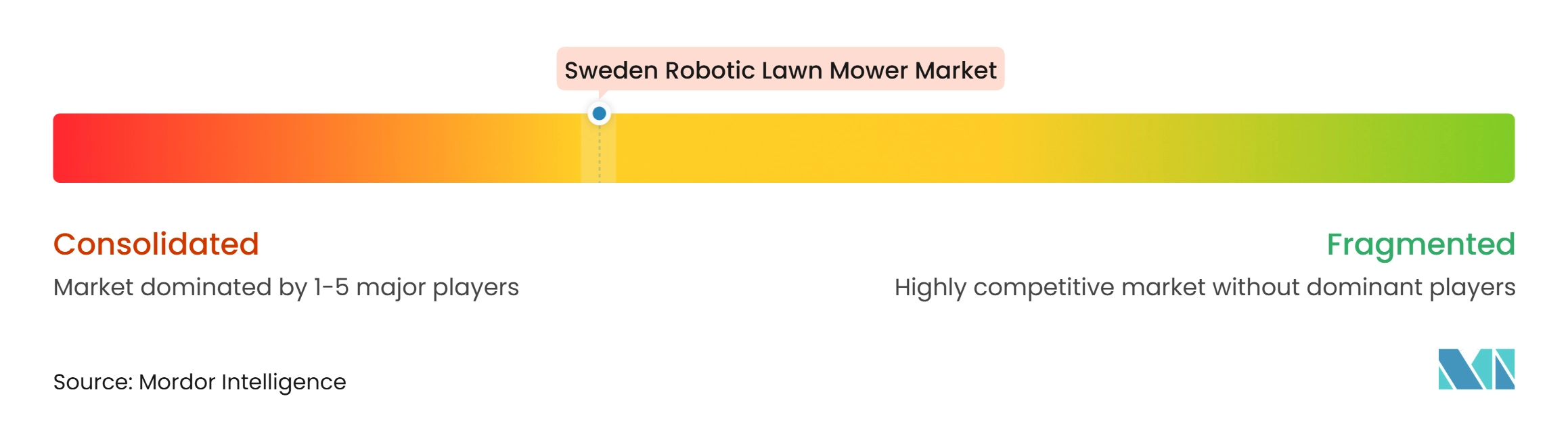
The Sweden robotic lawn mower market is concentrated around established suppliers, with Husqvarna AB in the leading position and a clear advantage in existing market familiarity. Husqvarna's range and dealer network are central competitive advantages in a category that can require installation and servicing. STIHL Pty Ltd, STIGA AB, Positec Group Ltd., and Navimow form an important next tier. Their positions reflect differences in product design, wire-free navigation, customer reach, and the degree of support they can provide after a sale. Husqvarna Group expanded its wire-free product offering in 2025 and continued to introduce AI Vision technology in 2026. STIGA launched 8 Vista Technology models in March 2026, spanning residential and larger managed areas. STIGA also used direct online distribution for its A4 and A8 models in 2025. These moves show competition across technology, product breadth, and channel control. Service capability remains a practical point of difference when site design or repair requirements exceed what self-installation can handle, particularly for buyers with complex lawns or multiple mowing zones.
Professional applications create a distinct area of competition because buyers need reliable fleet operations, coverage capacity, and support. Husqvarna's 540 EPOS launch in 2025 addressed small-scale commercial facilities with a machine designed for areas up to 8,000 m². Smaller approved suppliers can focus on specialist opportunities in sports grounds, parks, and golf courses, where buyers may prioritize site expertise and tailored service over broad retail reach. The market does not include individual company share figures, so positions should not be read as quantified rankings beyond Husqvarna's stated lead. A concentration score of 7 out of 10 reflects an oligopolistic core led by Husqvarna AB, with several established competitors and growing competitive pressure from newer entrants.
Sweden Robotic Lawn Mower Industry Leaders
-
Husqvarna AB
-
STIHL Pty Ltd
-
STIGA S.p.A.
-
Positec Group Ltd.
-
Navimow
- *Disclaimer: Major Players sorted in no particular order
Sweden Robotic Lawn Mower Market Companies Covered in this Report
- Husqvarna AB
- STIHL Pty Ltd
- Navimow
- MAMMOTION
- Positec Group Ltd.
- STIGA S.p.A.
- AL-KO Geräte GmbH
- Einhell Nordic A/S
- Honda Motor Co., Ltd.
- YAMABIKO Corporation (Belrobotics)
- Zucchetti Centro Sistemi S.p.a. (Ambrogio Robot )
- Robomow Ltd.
- EcoFlow Inc.
- Greenworks Tools EU.
- Robotgarden
Recent Industry Developments in Sweden Robotic Lawn Mower Market
- March 2026: STIGA AB introduces 8 autonomous robotic lawn mowers under the STIGA Vista Technology platform, incorporating an AI-driven HDR camera, quad-band RTK-GNSS with Antenna-Free Setup, and the STIGA.GO app. The range covers 600 m² to 14,000 m² with Swedish retail pricing from SEK 11,990 (USD 1,142) to SEK 84,990 (USD 8,094).
- February 2026: Husqvarna AB introduces the Automower Aspire R6V, 308V, and 312V wire-free residential robotic mowers. The models cover gardens up to 600 m², 800 m², and 1,200 m² and include AI Vision technology.
- October 2025: Husqvarna AB launches the Automower NERA series, including 405VE, 410VE, 430V, and 450V models with built-in AI vision technology, obstacle recognition, and hedgehog detection. The announcement also introduces the Automower 540 EPOS for commercial facilities up to 8,000 m².
Sweden Robotic Lawn Mower Market Report Scope
A robotic lawn mower is an autonomous device equipped with sensors and programming to perform grass-cutting tasks without human intervention. These are used for residential and commercial purposes by homeowners, apartment owners, in parks and playgrounds, and in other places.
The Sweden Robotic Lawn Mower Market Report is Segmented by Range (Low Range, Medium Range, and High Range), by Battery Capacity (Less Than 20 V, 20 to 30 V, and More Than 30 V), by Sales Channel (Retailers, Specialty Stores and Online), by Application (Residential and Commercial), by End-User (Homeowners, Landscaping Companies, Sports Grounds and Parks, Municipalities, Golf Courses and Others), and by Connectivity (Boundary-Wire, Smart-GPS / Wi-Fi and Vision-Guided). The Market Forecasts are Provided in Terms of Value (USD).
Segmentation Overview
| Low Range |
| Medium Range |
| High Range |
| Less Than 20 V |
| 20 to 30 V |
| More Than 30 V |
| Retailers |
| Specialty Stores |
| Online |
| Residential |
| Commercial |
| Homeowners |
| Landscaping Companies |
| Sports Grounds and Parks |
| Municipalities |
| Golf Courses |
| Others |
| Boundary-Wire |
| Smart-GPS / Wi-Fi |
| Vision-Guided (Camera/LiDAR) |
| By Range | Low Range |
| Medium Range | |
| High Range | |
| By Battery Capacity | Less Than 20 V |
| 20 to 30 V | |
| More Than 30 V | |
| By Sales Channel | Retailers |
| Specialty Stores | |
| Online | |
| By Application | Residential |
| Commercial | |
| By End-User | Homeowners |
| Landscaping Companies | |
| Sports Grounds and Parks | |
| Municipalities | |
| Golf Courses | |
| Others | |
| By Connectivity | Boundary-Wire |
| Smart-GPS / Wi-Fi | |
| Vision-Guided (Camera/LiDAR) |
Key Questions Answered in the Report
What is the size of Sweden's robotic lawn mower category?
Sweden's robotic lawn mower category is estimated at USD 70.6 million in 2026.
What growth rate is forecast for robotic lawn mowers in Sweden?
Robotic lawn mower sales in Sweden are forecast to grow at a CAGR of 7.9% from 2026 to 2031.
Which application accounts for the largest share of robotic mower sales in Sweden?
Residential use accounted for the largest share of robotic mower sales in Sweden, with 72% of value in 2025.
Which sales channel leads purchases of robotic lawn mowers in Sweden?
Retailers led purchases of robotic lawn mowers in Sweden with 55% of value in 2025.