
Sustainable Fertilizers Market Size and Share
Market Overview
| Study Period | 2022 - 2032 |
|---|---|
| Market Size (2027) | USD 21.22 Billion |
| Market Size (2032) | USD 32.34 Billion |
| Growth Rate (2027 - 2032) | 8.79 % |
| Fastest Growing Market | Asia-Pacific |
| Largest Market | Europe |
| Market Concentration | Medium |
Major Players *Disclaimer: Major Players sorted in no particular order Image © Mordor Intelligence. Reuse requires attribution under CC BY 4.0. | |
Sustainable Fertilizers Market Analysis by Mordor Intelligence
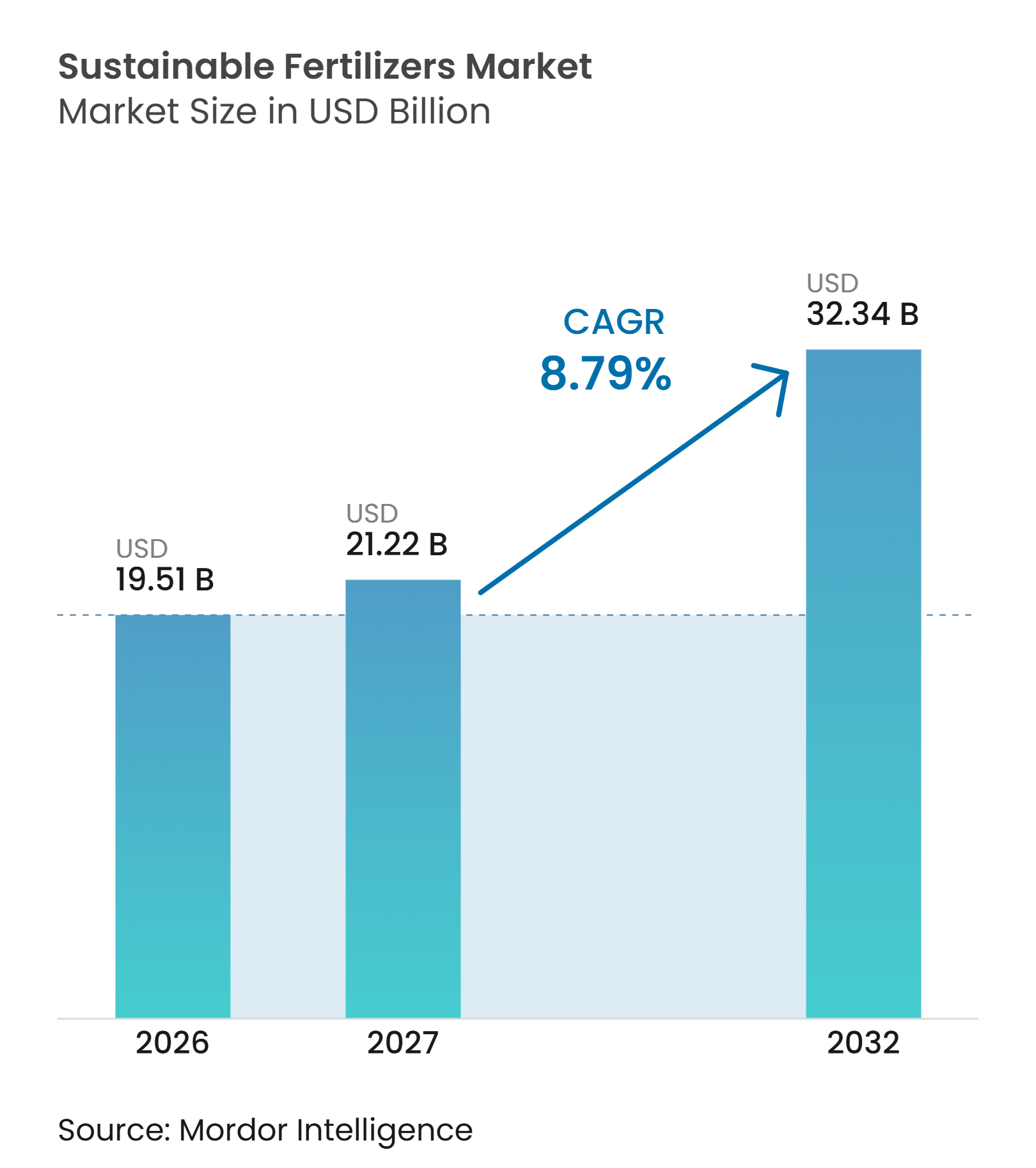
The sustainable fertilizers market size was valued at USD 19.51 billion in 2026 and is forecast to grow from USD 21.22 billion in 2027 to USD 32.34 billion by 2032, at a CAGR of 8.79% from 2027 to 2032. Market growth is supported by carbon disclosure requirements across food supply chains, the expansion of certified organic and regenerative farming, and the commercialization of green ammonia. The adoption of biological and recovered-nutrient products also creates opportunities to improve nutrient-use efficiency and reduce reliance on conventional fertilizer production methods. Green ammonia projects offer a pathway to lower-emission nitrogen fertilizer production, although their commercial viability depends on renewable electricity costs, project financing, and long-term offtake agreements. Despite these opportunities, adoption remains constrained by price premiums, certification requirements, inconsistent field performance, and limited farmer awareness. These barriers are particularly relevant in emerging markets, where access to credit, distribution networks, and agronomic advisory services can influence purchasing decisions. Continued investment in sustainable fertilizer production, nutrient recovery infrastructure, and application technologies is expected to influence market development as growers and agricultural supply chains place greater emphasis on resource efficiency and emissions reduction.
Key Report Takeaways
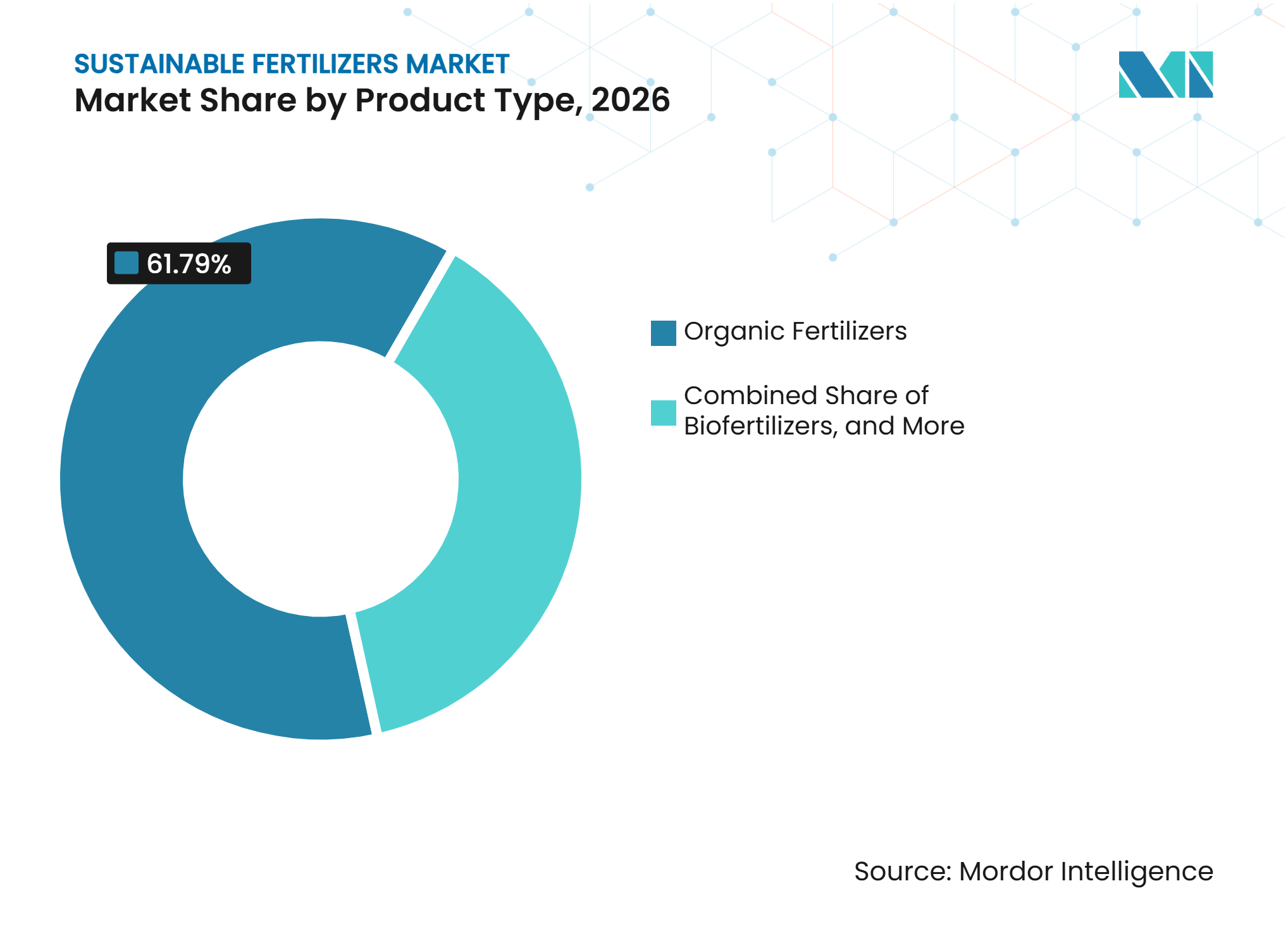
- By product type, organic fertilizers accounted for 61.79% of the sustainable fertilizers market share in 2026 and are forecast to grow at a CAGR of 9.2% from 2027 to 2032.
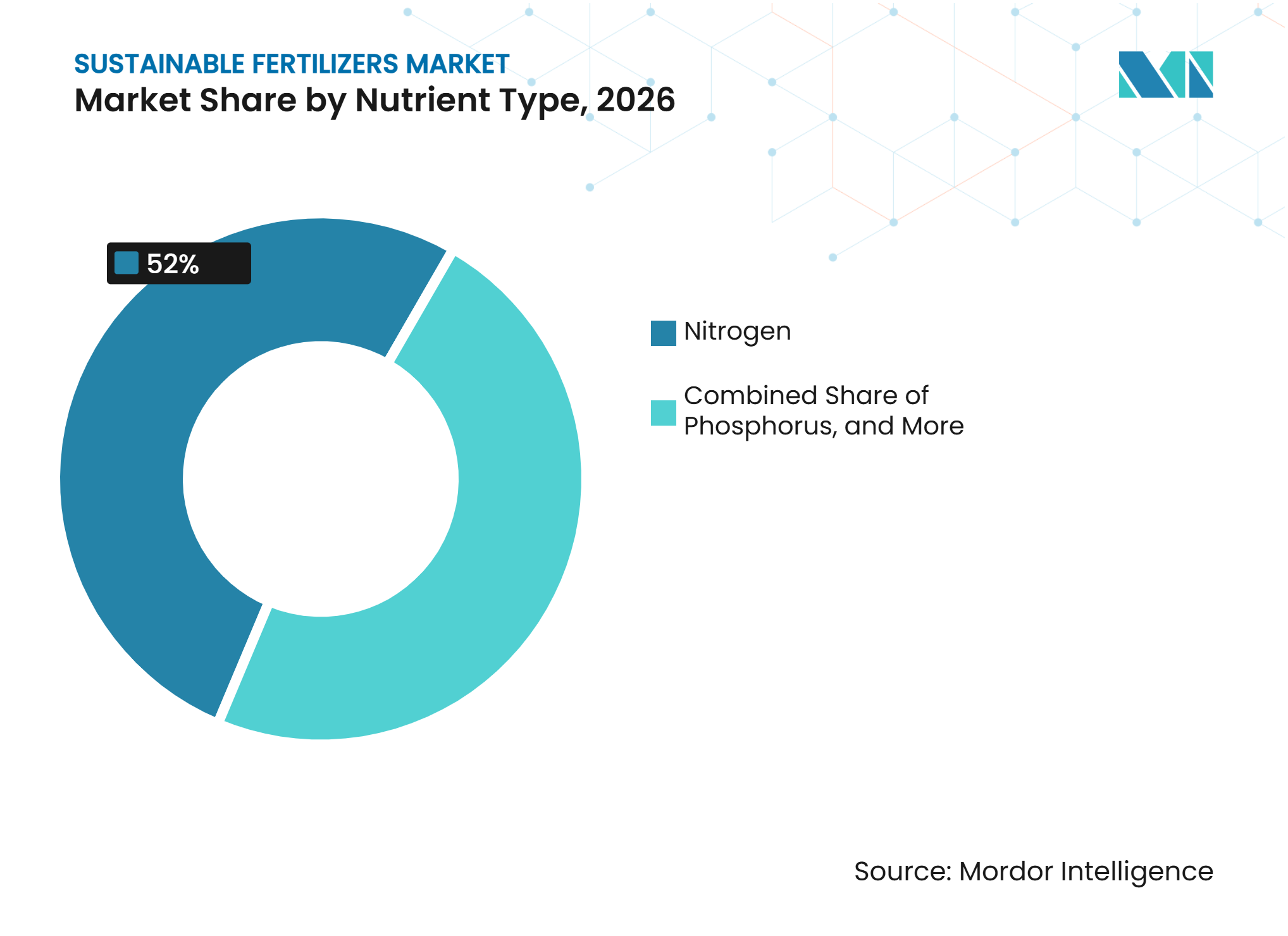
- By nutrient type, nitrogen accounted for 52% of the sustainable fertilizers market size in 2026, while phosphorus is forecast to grow at a CAGR of 9.6% from 2027 to 2032.
- By geography, Europe accounted for 34% of the market share in 2026, while Asia-Pacific is forecast to grow at a CAGR of 9.4% from 2027 to 2032.
Note: Market numbers in this report are based on Mordor Intelligence's proprietary estimation framework, which combines nine months of actuals with Q4 projections for base year 2026.
Market Trends and Insights
Drivers Impact Analysis of Sustainable Fertilizers Market*
| Driver | (~) % Impact on CAGR Forecast | Geographic Relevance | Impact Timeline |
|---|---|---|---|
| Climate-Smart Nutrient-Management Incentives | +1.8% | Global, with concentrated policy intensity in the United States, Germany, France, India, China, and Brazil | Medium term (2-4 years) |
| Expansion of Certified Organic and Regenerative Farming | +2.1% | North America and Europe primarily, with spillover to India, Australia, and Brazil | Long term (≥ 4 years) |
| Green Ammonia Project Commercialization | +1.5% | Asia-Pacific and the Middle East, with early-stage activity in Africa and Europe | Long term (≥ 4 years) |
| Precision Agriculture and Variable-Rate Nutrient Delivery | +1.2% | North America and Europe, with advancing adoption in Japan, South Korea, and Brazil | Medium term (2-4 years) |
| Residual-Biomass and Wastewater Nutrient Recovery | +0.9% | Global, with concentration in the United States, Netherlands, Germany, China, India, and Brazil | Medium term (2-4 years) |
| Specialty Fertilizer Adoption in High-Value Crops | +0.8% | North America, Europe, and Asia-Pacific, with Gulf markets gaining traction | Short term (≤ 2 years) |
| Source: Mordor Intelligence | |||
Climate-Smart Nutrient-Management Incentives
Carbon disclosure in food procurement makes the emissions profile of farm fertilizer a measurable supply chain consideration for buyers tracking agricultural inputs more closely. This creates demand in the sustainable fertilizers market that is not solely dependent on direct subsidies and can influence purchasing expectations across the food value chain. The United States National Security Commission on Emerging Biotechnology (NSCEB) recommended a coordinated biotechnology strategy to secure the biofertilizer supply chain in an October 2026 issue paper, building on the broader biomanufacturing recommendations it delivered to Congress in its April 2025 final report[1]. Japan and South Korea are using long-term green ammonia offtake arrangements to support national hydrogen objectives. These arrangements can give developers clearer visibility into demand before project financing is finalized and make investment decisions less dependent on short-term fertilizer prices. Together, procurement requirements and policy support can strengthen incentives for suppliers to develop lower-emission fertilizer options and improve nutrient-use efficiency across agricultural supply chains.
Expansion of Certified Organic and Regenerative Farming
Certified organic acreage creates demand for nutrient inputs that meet organic production requirements. Organic operators cannot switch to conventional fertilizers when input costs rise, making compliant nutrient supplies important to their production systems. The European Union's Farm to Fork Strategy sets a target of at least 25% of agricultural land under organic farming by 2030[2]. Regulation 2019/1009 harmonized requirements for EU fertilizing products and supports cross-border access for qualifying organic and organo-mineral products. Regenerative farming programs led by food brands are also driving demand for sustainable inputs beyond certified organic systems, thereby supporting adoption in markets with less-developed certification infrastructure. As organic acreage expands and regenerative agriculture commitments spread across food supply chains, demand for compliant and resource-efficient nutrient inputs is likely to broaden.
Green Ammonia Project Commercialization
Green ammonia can use existing ammonia-handling and fertilizer-production infrastructure while lowering the emissions profile of nitrogen supply. This provides the sustainable fertilizers market with a potentially large-scale source of lower-emission nitrogen that can integrate with established production and distribution assets. In October 2026, JICA and the Asian Development Bank committed up to USD 100 million to the AM Green Ammonia project in India, which aims to convert a conventional ammonia plant into a renewable-energy-powered facility with an annual capacity of 1.1 million metric tons[3]. Long-term fertilizer purchase commitments are important because developers need dependable revenue streams to support project financing. India's National Green Hydrogen Mission and the EU Hydrogen Delegated Act provide policy frameworks that can help align offtake arrangements, compliance requirements, and investment decisions.
Precision Agriculture and Variable-Rate Nutrient Delivery
Precision agriculture tools help farmers assess the value of applying higher-cost nutrient products in specific field zones. A 2026 meta-analysis published in Precision Agriculture found that optical sensor-based variable-rate nitrogen application in maize reduced total nitrogen applied by 18%, increased partial factor productivity by 22%, and improved profit by 6% without reducing grain yield. A 2026 evidence synthesis published in Discover Soil reported that enhanced-efficiency fertilizers increased nutrient-use efficiency by 10% to 40% relative to conventional application. These findings support the role of precision application and enhanced-efficiency products in improving nutrient management, particularly in commercially intensive farming systems. Suppliers that combine sustainable fertilizer products with digital agronomy services can help growers assess application outcomes and optimize nutrient use, supporting wider adoption of these products.
Restraints Impact Analysis of Sustainable Fertilizers Market*
| Restraint | (~) % Impact on CAGR Forecast | Geographic Relevance | Impact Timeline |
|---|---|---|---|
| Sustainable Product Price Premium | -2.1% | Asia-Pacific, Africa, and South America, with concentration in India, Nigeria, Kenya, Brazil, and Mexico | Short term (≤ 2 years) |
| Renewable Power and Electrolyzer Cost Exposure | -1.2% | Global for green ammonia, with concentration in Australia, India, China, Saudi Arabia, Morocco, and the United States | Long term (≥ 4 years) |
| Inconsistent Field Performance and Farmer Awareness | -1.4% | Asia-Pacific and Africa, particularly India, China, Nigeria, Kenya, and Brazil | Medium term (2-4 years) |
| Certification, Traceability, and Polymer-Coating Compliance Burden | -0.8% | Europe and North America, with secondary exposure in China and Japan | Medium term (2-4 years) |
| Source: Mordor Intelligence | |||
Sustainable Product Price Premium
The price difference between sustainable and conventional bulk fertilizers reflects the costs of renewable feedstocks, the complexity of biological manufacturing, certification expenses, and smaller production volumes. For smallholder farmers, a 20% to 40% price premium can make adoption difficult unless the products deliver clear yield or economic benefits. This challenge is particularly relevant in sub-Saharan Africa and parts of South Asia, where access to credit and agronomic advisory services is limited. Sustainable products may also reach these farmers through higher-cost retail channels rather than the cooperative and government-linked distribution networks used for conventional fertilizers. Brazil's plans to expand organic and organomineral fertilizer production address some supply and distribution gaps, but comparable logistics networks remain underdeveloped in many emerging markets. These cost and distribution barriers can limit affordability and slow the adoption of sustainable fertilizers, particularly among farmers operating with tight input budgets.
Renewable Power and Electrolyzer Cost Exposure
Renewable electricity represents 70% to 80% of green ammonia's variable production costs, making power pricing central to project economics. Although electrolyzer costs declined between 2020 and 2025, the cost difference between green and conventional ammonia remains substantial in many locations without policy support. Grid congestion and seasonal variability in renewable energy generation can further reduce project margins. In January 2026, Yara stated that it would reconsider a planned low-carbon ammonia project in the United States if the EU suspended its carbon border levy on fertilizers. Hybrid structures that combine electrolysis with existing gas-based plants can reduce some project risks, but do not eliminate exposure to electricity costs. These economic uncertainties can delay investment decisions and constrain the expansion of green ammonia-based fertilizers, where production costs remain difficult to recover.
*Our forecasts treat driver/restraint impacts as directional, not additive. The impact forecasts reflect baseline growth, mix effects, and variable interactions.
Sustainable Fertilizers Market Segment Analysis
By Product Type:
Organic Fertilizer Scale Supports RevenueOrganic fertilizers accounted for 61.79% of the sustainable fertilizers market share in 2026 and are forecast to grow at a CAGR of 9.2% from 2027 to 2032. Their scale reflects long-standing use in certified organic supply chains and established distribution across North America, Europe, and parts of Asia-Pacific. Compost, manure-derived materials, and plant-derived nutrient products form a mature supply base for this category, allowing suppliers to serve farms of varying sizes and crop systems. Single-ingredient products such as blood meal face margin pressure where offerings are less differentiated and buyers can compare similar nutrient sources. Proprietary blends that include biological inoculants can command a premium and grow faster than the broader organic category when their positioning is linked to measurable nutrient management needs.
Biofertilizers are gaining traction as commercial farming systems increasingly adopt microbial formulations to address multiple agronomic requirements. Multi-strain microbial consortia are gaining ground over single-organism products as suppliers develop formulations that support a broader range of nutrient management needs. Enhanced-efficiency fertilizers benefit from greater farmer awareness, access to agronomic advisory services, and the availability of precision application tools. Recycled and waste-derived fertilizers are also gaining traction as investment in wastewater treatment and struvite production expands in regions with the necessary collection and processing infrastructure. Other sustainable fertilizers, including green ammonia-derived nitrogen products, may gain adoption as commercial projects begin delivering volumes from 2028.



By Nutrient Type:
Nitrogen Retains Scale While Phosphorus AdvancesNitrogen accounted for 52% of the sustainable fertilizers market share in 2026. Nitrogen-fixation biologicals, enhanced-efficiency nitrogen products, and low-carbon ammonia all contribute to its leading position across different production models and farm applications. According to CF Industries and 3Degrees, fertilizer production accounts for approximately 2.6 gigatons of carbon dioxide-equivalent emissions annually, with nitrogen fertilizer manufacturing representing the largest share of these emissions. This explains why nitrogen decarbonization receives substantial policy attention and private capital within the sustainable fertilizers market. As low-carbon ammonia becomes available, it can replace conventional nitrogen in sustainable product offerings without requiring a proportional increase in fertilizer application rates.
Phosphorus is forecast to grow at a CAGR of 9.6% from 2027 to 2032. Struvite-recovery projects, phosphate-solubilizing biofertilizers, and concerns about phosphate reserve concentration support this expansion and increase attention to recovery-based supply options. Potassium adoption is supported by potassium-mobilizing biological products and lower-carbon potash processing for growers seeking more efficient nutrient programs. K+S has introduced its C carbon dioxide-reduced potassium and magnesium fertilizer line as an example of lower-carbon potash processing. Secondary macronutrients, including calcium, magnesium, and sulfur, are relevant to soil-health programs that address nutrient needs alongside primary nutrients and promote more balanced nutrient application.

Geography Analysis
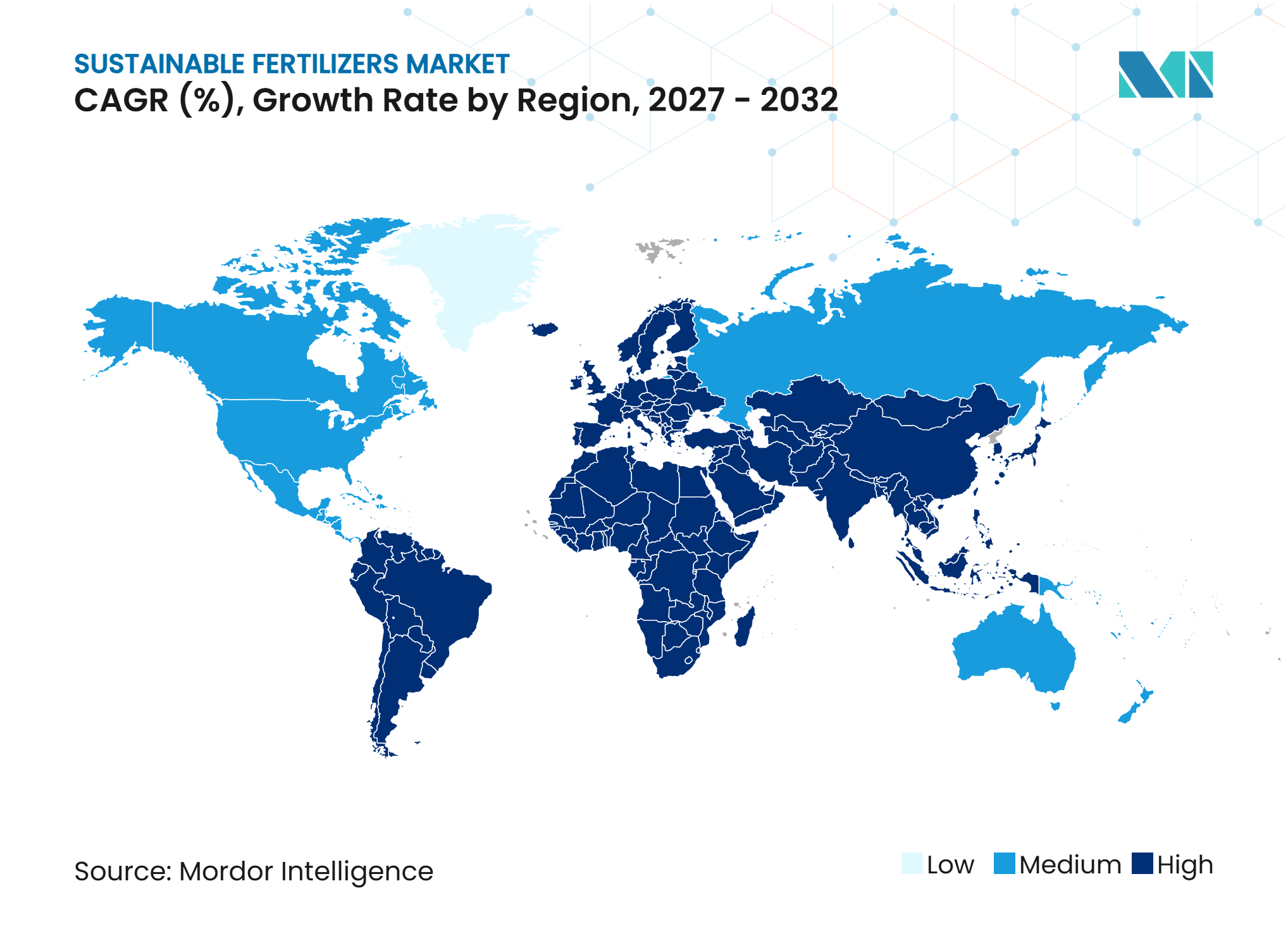
Europe accounted for 34% of the sustainable fertilizers market share in 2026, making it the largest region. Its established regulatory framework for sustainable inputs emphasizes compliance, product quality, and labeling, shaping supplier strategies across the region. Regulation 2019/1009 harmonized standards for organic-based and recycled-nutrient products across the European Union, supporting the development and commercialization of sustainable fertilizer products across member states.
Asia-Pacific is the fastest-growing region, with a forecast CAGR of 9.4% from 2027 to 2032. The region combines a large agricultural base with policy support for biofertilizers and green ammonia, particularly in India, creating opportunities across commercial and smallholder farming systems. India's National Mission on Natural Farming and green hydrogen procurement framework are encouraging investment in domestic supply chains, including projects that link renewable energy with fertilizer production. In October 2026, JICA and the Asian Development Bank committed up to USD 100 million to the AM Green Ammonia project in India.
North America benefits from the commercialization of low-carbon nitrogen and precision agriculture infrastructure that supports the adoption of sustainable fertilizers. South America's market is supported by demand across Brazil's large-scale row-crop systems and interest in biological inputs. In Africa, the need for soil fertility restoration and investment in sustainable fertilizer production supports market development. In November 2025, Kenya began construction of a USD 800 million green ammonia and fertilizer plant in Olkaria, powered by geothermal energy and designed to produce 480,000 metric tons annually. The Middle East has the potential to serve as a production hub, supported by renewable energy resources and ammonia shipping infrastructure, while Turkey and the United Arab Emirates contribute to regional demand.
Competitive Landscape
Market Concentration
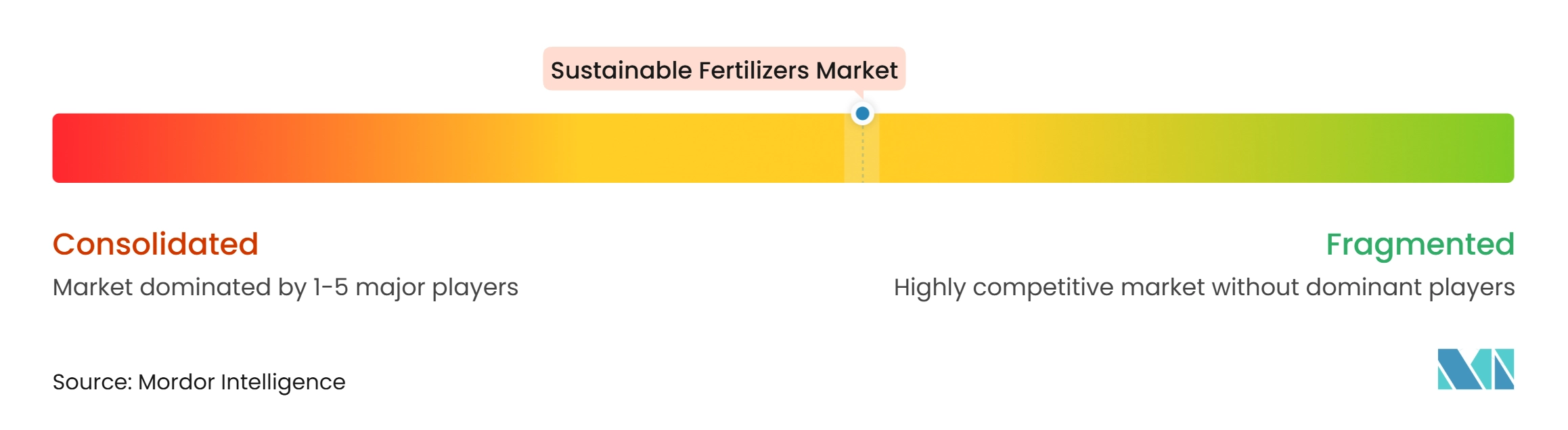
The sustainable fertilizers market was moderately concentrated in 2026. Competition includes regional biofertilizer companies, organic-input specialists, and nutrient-recovery technology firms that compete through localized distribution, formulation, and technical support. This structure keeps product competition active while allowing regional firms to address specific crop and soil needs. Yara supports its position through its Yara Climate Choice Fertilizers range. In January 2026, the company stated that it was targeting more than USD 600 million in free cash flow expansion between 2024 and 2030.
Nutrien has focused on enhanced-efficiency nitrogen while reviewing strategic alternatives for its phosphate business, reflecting how integrated suppliers are directing capital toward areas with sustainable fertilizer growth potential and reassessing assets that may not align with this direction. ICL uses acquisition-led geographic expansion and its biodegradable eqo.x coating technology to differentiate its offerings. CF Industries is developing certification and traceability through the Low Carbon Fertilizer Alliance with Mars and other food companies, creating infrastructure that smaller suppliers may find difficult to build independently.
Low-cost biological products for smallholder and staple-crop systems remain an opportunity in Africa and South Asia, where pricing and higher-cost distribution channels can limit adoption. Verified recycled-phosphorus supply chains outside Europe also remain limited as struvite and digestate infrastructure develops and suppliers work to establish reliable collection, processing, product quality, and customer access. In October 2026, Switch Bioworks entered a strategic collaboration with Bayer Crop Science to develop and commercialize switchable nitrogen-fixing biofertilizer technology. This arrangement illustrates how biological specialists and established agricultural companies can combine technical expertise, field testing, and commercialization resources to develop products for higher-value crop applications.
Sustainable Fertilizers Industry Leaders
-
Yara International ASA
-
Nutrien Ltd.
-
ICL Group Ltd.
-
CF Industries Holdings, Inc.
-
The Mosaic Company
- *Disclaimer: Major Players sorted in no particular order
Sustainable Fertilizers Market Companies Covered in this Report
- Yara International ASA
- Nutrien Ltd.
- CF Industries Holdings, Inc.
- ICL Group Ltd.
- The Mosaic Company
- Greenstar Fertilizers Limited
- OCP S.A.
- K+S Aktiengesellschaft
- Coromandel International Limited
- Lallemand Inc.
- Bioceres Crop Solutions Corp.
- Kingenta Ecological Engineering Group Co., Ltd.
- Suståne Natural Fertilizer, Inc.
- Fertiberia, S.A.
- COMPO EXPERT GmbH
Recent Industry Developments in Sustainable Fertilizers Market
- October 2026: The Asian Development Bank (ADB) signed a financing agreement with AM Green Ammonia (India) Private Limited to support the conversion of an existing natural gas-based ammonia and urea facility in India into a renewable-energy-powered green ammonia plant. The financing includes up to USD 100 million through Japan International Cooperation Agency (JICA)-funded LEAP2, and the facility is planned to produce approximately 1.1 million tons of green ammonia annually
- October 2026: Switch Bioworks entered a strategic collaboration with Bayer Crop Science to develop and commercialize nitrogen-fixing biofertilizer technology. The technology uses engineered microbes that colonize plant roots and begin producing ammonia several weeks into the growing season, with Bayer contributing capabilities in product development, formulation, field testing, and commercialization.
- April 2026: CF Industries Holdings, Inc. and PepsiCo entered a commercial agreement to supply certified low-carbon urea ammonium nitrate (UAN) fertilizer to farmers growing potatoes for PepsiCo’s Frito-Lay brands in the United States. The fertilizer uses carbon capture and sequestration, along with other emissions-reduction technologies, and is certified under the Verified Ammonia Carbon Intensity Program.
Global Sustainable Fertilizers Market Report Scope
The sustainable fertilizers market covers fertilizer products that support crop nutrient requirements while promoting efficient nutrient use and reducing the environmental impact of agricultural fertilization. These products address nutrient management through alternative nutrient sources, biological processes, and formulations designed to improve nutrient availability and limit nutrient losses.
The Sustainable Fertilizers Market is Segmented by Product Type (Organic Fertilizers, Biofertilizers, Enhanced-Efficiency Fertilizers, Recycled and Waste-Derived Fertilizers, and Other Sustainable Fertilizers), by Nutrient Type (Nitrogen, Phosphorus, Potassium, and Secondary Macronutrients), and by Geography (North America, South America, Europe, Asia-Pacific, Middle East, and Africa). The Market Forecasts are Provided in Terms of Value (USD) and Volume (Metric Tons).
Segmentation Overview
| Organic Fertilizers |
| Biofertilizers |
| Enhanced-Efficiency Fertilizers |
| Recycled and Waste-Derived Fertilizers |
| Other Sustainable Fertilizers |
| Nitrogen |
| Phosphorus |
| Potassium |
| Secondary Macronutrients |
| North America | United States |
| Canada | |
| Mexico | |
| Rest of North America | |
| South America | Brazil |
| Argentina | |
| Rest of South America | |
| Europe | Germany |
| France | |
| United Kingdom | |
| Italy | |
| Spain | |
| Netherlands | |
| Russia | |
| Rest of Europe | |
| Asia-Pacific | China |
| India | |
| Japan | |
| South Korea | |
| Australia | |
| Indonesia | |
| Rest of Asia-Pacific | |
| Middle East | Turkey |
| Saudi Arabia | |
| United Arab Emirates | |
| Rest of Middle East | |
| Africa | South Africa |
| Nigeria | |
| Egypt | |
| Kenya | |
| Morocco | |
| Rest of Africa |
| By Product Type | Organic Fertilizers | |
| Biofertilizers | ||
| Enhanced-Efficiency Fertilizers | ||
| Recycled and Waste-Derived Fertilizers | ||
| Other Sustainable Fertilizers | ||
| By Nutrient Type | Nitrogen | |
| Phosphorus | ||
| Potassium | ||
| Secondary Macronutrients | ||
| By Geography | North America | United States |
| Canada | ||
| Mexico | ||
| Rest of North America | ||
| South America | Brazil | |
| Argentina | ||
| Rest of South America | ||
| Europe | Germany | |
| France | ||
| United Kingdom | ||
| Italy | ||
| Spain | ||
| Netherlands | ||
| Russia | ||
| Rest of Europe | ||
| Asia-Pacific | China | |
| India | ||
| Japan | ||
| South Korea | ||
| Australia | ||
| Indonesia | ||
| Rest of Asia-Pacific | ||
| Middle East | Turkey | |
| Saudi Arabia | ||
| United Arab Emirates | ||
| Rest of Middle East | ||
| Africa | South Africa | |
| Nigeria | ||
| Egypt | ||
| Kenya | ||
| Morocco | ||
| Rest of Africa | ||
Key Questions Answered in the Report
What is the forecast growth rate for the sustainable fertilizers market?
The sustainable fertilizers market is forecast to grow from USD 21.22 billion in 2027 to USD 32.34 billion by 2032, at a CAGR of 8.79% from 2027 to 2032.
Which product type holds the largest share of the sustainable fertilizers market?
Organic fertilizers accounted for 61.79% of the sustainable fertilizers market share in 2026
Which nutrient segment is forecast to grow fastest in the sustainable fertilizers market?
Phosphorus is forecast to grow at a CAGR of 9.6% from 2027 to 2032.
Which region holds the largest share of the sustainable fertilizers market, and which is forecast to grow fastest?
Europe accounted for 34% of the sustainable fertilizers market share in 2026, while Asia-Pacific is forecast to grow at a CAGR of 9.4% from 2027 to 2032.
What are the key factors limiting the adoption of sustainable fertilizers?
Key constraints include higher product costs, variable field performance of microbial inoculants, green ammonia production costs, and regulatory compliance requirements.