
Superfood Powders Market Size and Share
Market Overview
| Study Period | 2027 - 2032 |
|---|---|
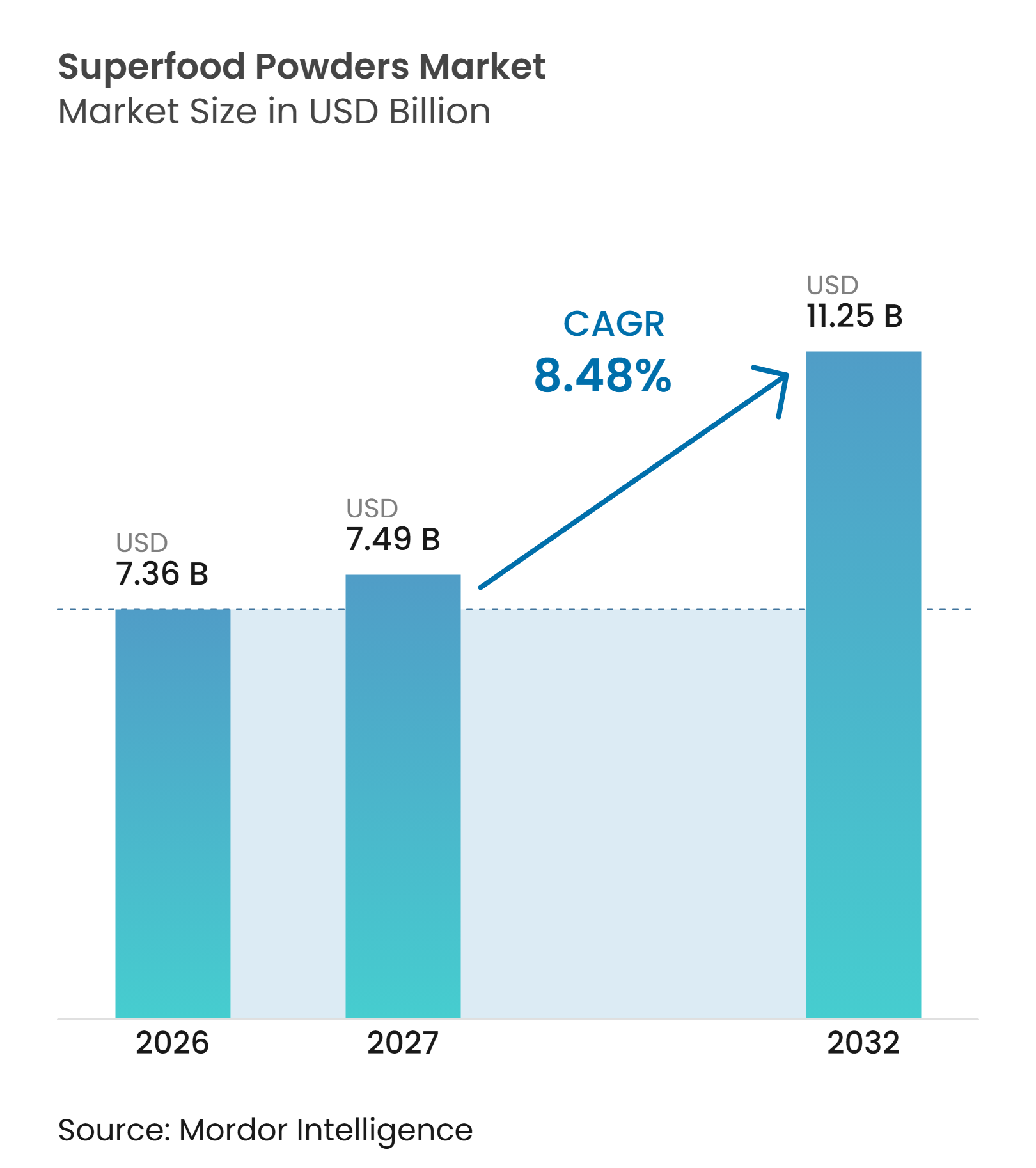
| Market Size (2027) | USD 7.49 Billion |
| Market Size (2032) | USD 11.25 Billion |
| Growth Rate (2027 - 2032) | 8.48 % |
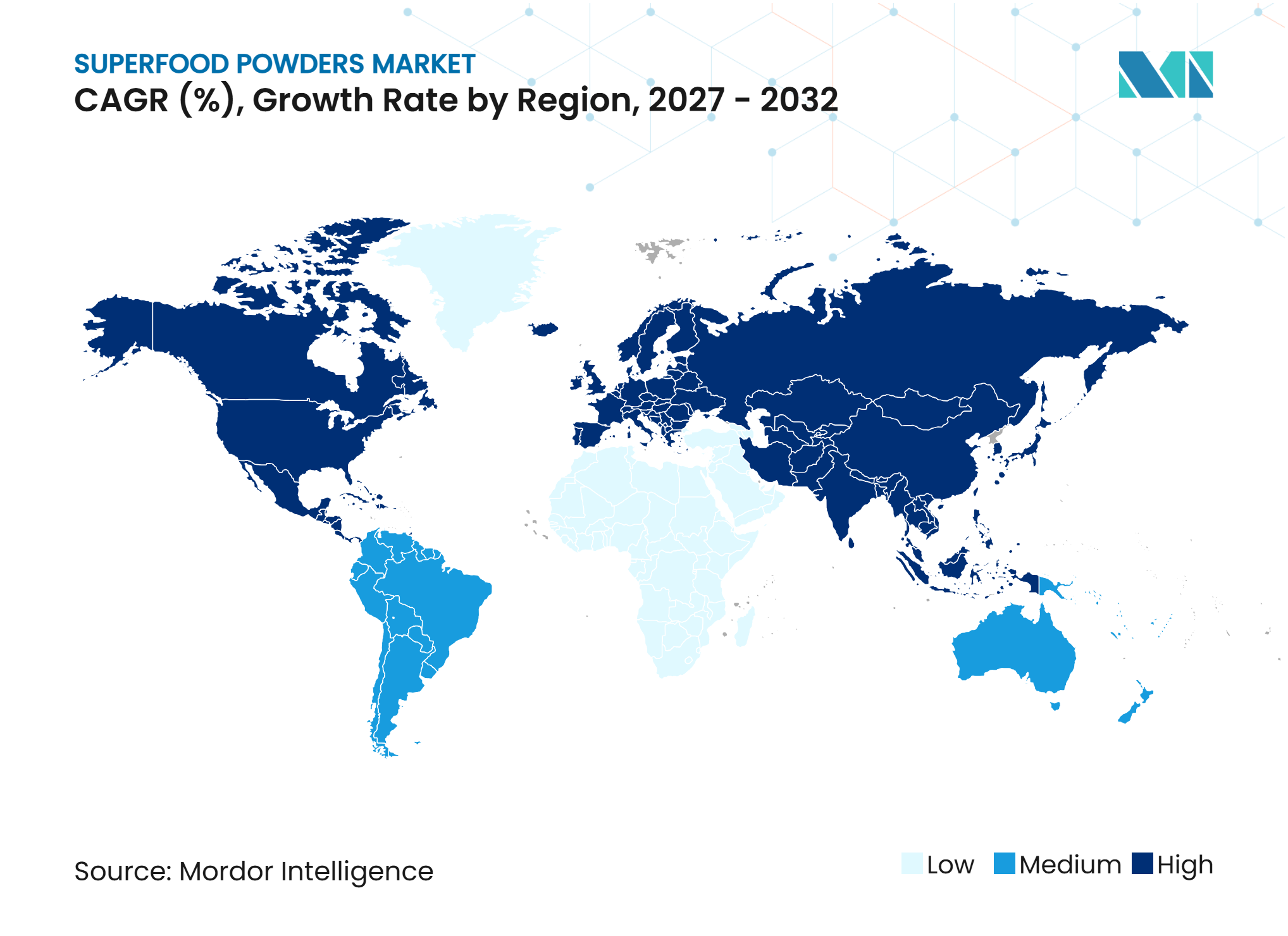
| Fastest Growing Market | Asia-Pacific |
| Largest Market | North America |
| Market Concentration | Medium |
Major Players *Disclaimer: Major Players sorted in no particular order Image © Mordor Intelligence. Reuse requires attribution under CC BY 4.0. | |
Superfood Powders Market Analysis by Mordor Intelligence
The global superfood powders market size is expected to increase from USD 7.36 billion in 2026 to USD 7.49 billion in 2027 and reach USD 11.25 billion by 2032, growing at a CAGR of 8.48% over 2027–2032. Growth is supported by increasing consumer preference for natural and nutrient-rich foods, rising popularity of plant-based and vegan diets, and growing demand for convenient, ready-to-use nutritional solutions. Increasing focus on preventive healthcare, wellness, and functional beverages further supports the adoption of superfood powders. Fruit-based powders represent the largest product type segment, accounting for 31.25% of the market in 2026, while algae-based powders are expected to be the fastest-growing category, registering a CAGR of 10.21%. Organic products dominate the market by nature, with a 62.82% share, reflecting consumer interest in naturally sourced and clean-label ingredients. Supermarkets and hypermarkets account for the largest distribution channel share at 32.53%, while online retail stores are projected to grow at the fastest CAGR of 10.32%. Geographically, North America holds the largest market share at 35.57%, whereas Asia-Pacific is expected to be the fastest-growing region, with a CAGR of 9.54%. However, high product prices, fluctuations in raw material availability and costs, intense competition, and concerns regarding shelf life and nutrient stability may restrict market expansion.
Key Report Takeaways
- By product type, fruit-based powders led with a 31.25% share of the superfood powders market size in 2026, while algae-based powders are forecast to grow fastest at a 10.21% CAGR over 2027–2032.
- By nature, organic superfood powders accounted for the largest share at 62.82% in 2026 and are forecast to grow at a 8.52% CAGR over 2027–2032.
- By distribution channel, supermarkets/hypermarkets dominated with a 32.53% market share in 2026, while online retail stores are projected to record the fastest growth at a 10.32% CAGR over 2027–2032.
- Among geographies, North America led with a 35.57% share of the superfood powders market in 2026, while Asia-Pacific is forecast to grow fastest at a 9.54% CAGR over 2027–2032.
Note: Market numbers in this report are based on Mordor Intelligence's proprietary estimation framework, which combines nine months of actuals with Q4 projections for base year 2026.
Market Trends and Insights
Drivers Impact Analysis of Superfood Powders Market*
| Driver | (~) % Impact on CAGR Forecast | Geographic Relevance | Impact Timeline |
|---|---|---|---|
| Growing consumer preference for natural and nutrient-rich foods | +1.0% | Global, particularly North America and Europe, where demand for nutrient-dense and health-oriented food products is well established | Medium term (2–4 years) |
| Surging popularity of plant-based and vegan diets | +0.8% | Global, particularly North America, Europe, and Asia-Pacific, supported by increasing adoption of plant-based dietary patterns | Medium term (2–4 years) |
| Growing demand for convenient and ready-to-use nutritional solutions | +0.7% | Global, particularly urban markets across North America, Europe, and Asia-Pacific, where convenience-oriented food consumption is increasing | Short term (Less than 2 years) |
| Increasing focus on preventive healthcare and wellness | +0.6% | Global, particularly North America and Europe, with growing health and wellness awareness across Asia-Pacific | Long term (More than 4 years) |
| Growing popularity of smoothies and functional beverages | +0.5% | Global, particularly North America and Europe, with expanding consumption opportunities across urban Asia-Pacific markets | Medium term (2–4 years) |
| Growing influence of social media and wellness influencers | +0.4% | Global, particularly North America, Europe, and Asia-Pacific, where digital platforms increasingly influence food discovery and purchasing decisions | Short term (Less than 2 years) |
| Source: Mordor Intelligence | |||
Growing Consumer Preference for Natural and Nutrient-Rich Foods
Increasing consumer awareness of nutritional quality is supporting demand for superfood powders made from fruits, vegetables, grains, seeds, and algae. Consumers are increasingly looking for food products that provide nutritional benefits through ingredients such as vitamins, minerals, dietary fiber, antioxidants, and plant-based nutrients. NielsenIQ's Global State of Health and Wellness 2025 report found that 53% of surveyed consumers across 19 countries planned to purchase more high-fiber foods, while approximately 40% intended to increase purchases of superfoods, high-protein plant-based foods, or probiotic foods [1]. This shift toward nutrient-dense food choices creates opportunities for manufacturers to position superfood powders as convenient ingredients for improving the nutritional composition of everyday diets.
Surging Popularity of Plant-Based and Vegan Diets
The increasing adoption of plant-based and vegan dietary patterns is creating opportunities for superfood powders derived from plant ingredients, including fruits, vegetables, grains, seeds, and algae. These ingredients provide manufacturers with options to develop plant-derived nutritional formulations that can be incorporated into smoothies, beverages, meal replacements, and other food products. The EAT-GlobeScan Grains of Truth 2024 report, published in January 2025, found that 68% of consumers across 31 markets expressed a desire to consume more plant-based foods, highlighting growing interest in plant-forward dietary choices [2].
Growing Demand for Convenient and Ready-to-Use Nutritional Solutions
Busy lifestyles and changing food consumption habits are increasing demand for convenient nutritional products that require limited preparation. Superfood powders offer a practical format because they can be mixed into water, milk, smoothies, yogurt, breakfast preparations, and other foods without requiring consumers to purchase and prepare multiple fresh ingredients separately. Tetra Pak's 2025 research on food supplements and nutrition identified convenience, functionality, nutrition, and overall well-being as important factors influencing consumer choices. Its survey found that 27% of Australian consumers considered convenience important when selecting functional food and drink products, compared with a global average of 21% [3].
Increasing Focus on Preventive Healthcare and Wellness
Growing awareness of the relationship between dietary habits and long-term health is encouraging consumers to incorporate nutrient-rich ingredients into their daily diets. Consumers are increasingly considering food choices that support nutritional adequacy, digestive health, energy levels, and overall well-being, creating opportunities for products containing naturally derived functional ingredients. NielsenIQ's India findings from its Global State of Health & Wellness 2025 report indicated that 53% of Indian consumers proactively take steps to improve their health and wellness, while 64% prioritize transparency through detailed product information and performance claims [4].
Growing Popularity of Smoothies and Functional Beverages
The increasing use of smoothies and functional beverages as convenient formats for incorporating fruits, vegetables, and other nutrient-rich ingredients is creating additional applications for superfood powders. Ingredients such as acai, spirulina, wheatgrass, beetroot, spinach, and berry powders can be blended into beverages to provide color, flavor, and nutritional characteristics while allowing manufacturers to develop differentiated formulations. Tetra Pak's 2025 research on the food supplements and nutrition category identified functionality, nutritional value, convenience, and overall well-being as important considerations influencing consumer choices in functional food and drink products.
Restraints Impact Analysis of Superfood Powders Market*
| Restraint | (~) % Impact on CAGR Forecast | Geographic Relevance | Impact Timeline |
|---|---|---|---|
| High product prices and affordability constraints | −0.8% | Global, particularly price-sensitive markets across Asia-Pacific, South America, and the Middle East and Africa, where premium nutritional products may face affordability barriers | Medium term (2–4 years) |
| Fluctuations in raw material availability and prices | −0.7% | Global, particularly regions dependent on seasonal agricultural production and imports of specialty fruits, vegetables, grains, seeds, and algae-based ingredients | Long term (More than 4 years) |
| Intense competition and product differentiation challenges | −0.5% | Global, particularly North America and Europe, where established superfood brands and expanding private-label offerings increase competitive pressure | Medium term (2–4 years) |
| Shorter shelf life and nutrient stability concerns | −0.4% | Global, especially markets with longer distribution routes, challenging storage conditions, and limited access to advanced processing and packaging technologies | Medium term (2–4 years) |
| Source: Mordor Intelligence | |||
High Product Prices and Affordability Constraints
Superfood powder production can involve higher raw-material, processing, and packaging costs than conventional powdered food ingredients, particularly when manufacturers use organic fruits, specialty vegetables, exotic berries, or algae-based ingredients. Sourcing ingredients such as spirulina, chlorella, acai, moringa, and other specialty botanicals may require specific cultivation conditions, specialised harvesting practices, and additional quality-control procedures. Organic certification, testing for contaminants, drying, milling, and moisture-controlled packaging can further increase production costs. These expenses can translate into premium retail prices, limiting accessibility among price-sensitive consumers, particularly in developing markets where superfood powders compete with conventional nutritional products and fresh food alternatives
Fluctuations in Raw Material Availability and Prices
Superfood powder manufacturing depends on the availability and consistent quality of agricultural and botanical raw materials, including fruits, vegetables, grains, seeds, and algae. Several ingredients are influenced by seasonal harvesting cycles, regional growing conditions, climatic variability, and geographic concentration of cultivation. For example, the availability of acai and other tropical fruits depends on production conditions in specific growing regions, while algae-based ingredients require controlled cultivation and processing conditions. Adverse weather events, changing agricultural yields, transportation disruptions, and fluctuations in input costs can affect procurement schedules and increase manufacturers' operating expenses.
*Our forecasts treat driver/restraint impacts as directional, not additive. The impact forecasts reflect baseline growth, mix effects, and variable interactions.
Superfood Powders Market Segment Analysis
By Product Type:
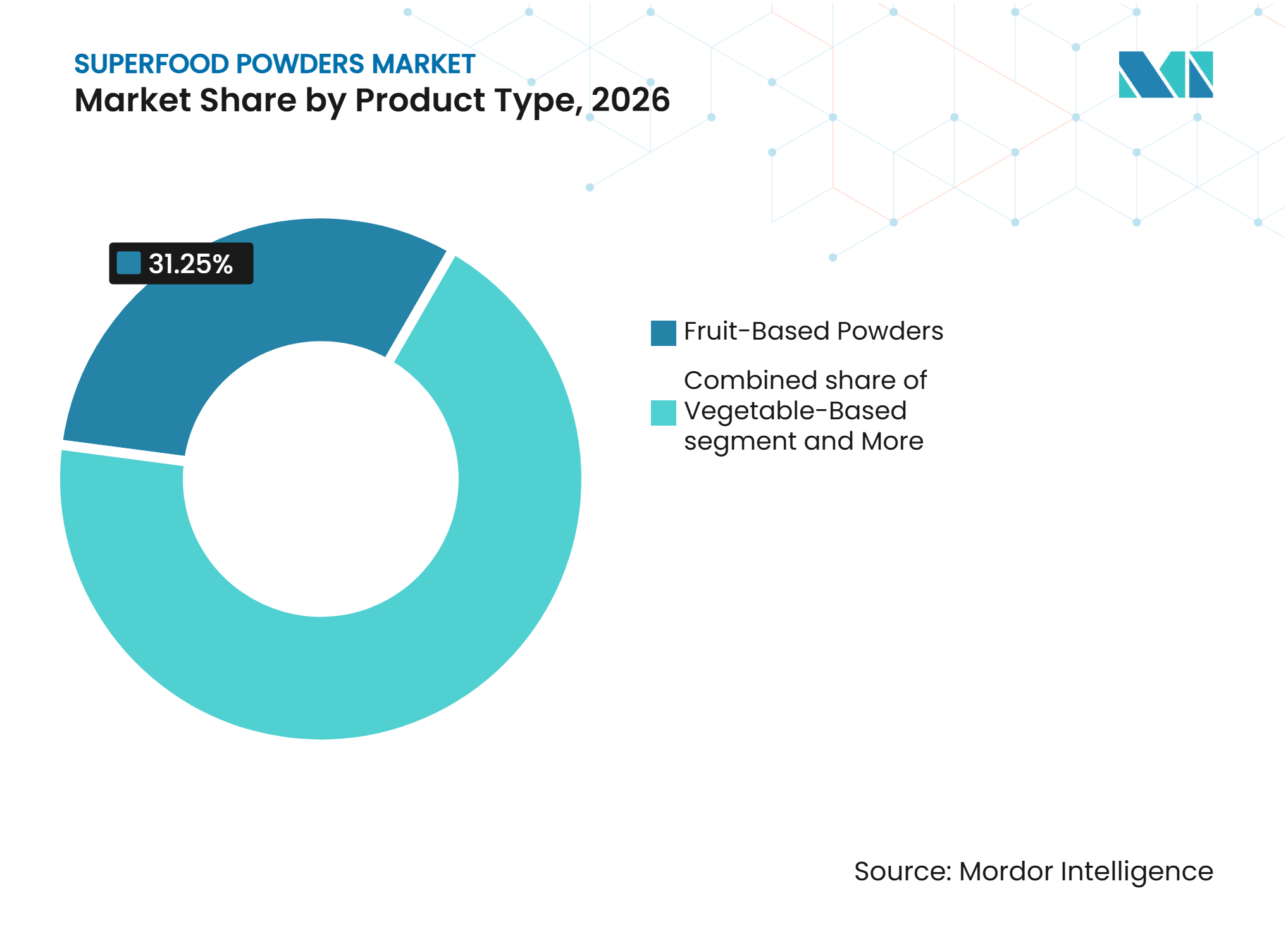
Fruit-Based Powders Lead While Algae-Based Powders Expand FasterIn 2026, fruit-based powders accounted for 31.25% of the Superfood Powders Market, making them the leading product type. Their position reflects demand for convenient fruit-derived ingredients that can be incorporated into smoothies, beverages, breakfast mixes, and nutritional products. Meanwhile, algae-based powders are projected to record the fastest growth, at a CAGR of 10.21% over 2027–2032. Ingredients such as spirulina and chlorella offer plant-based nutritional properties and support their use in functional food and beverage formulations.
Vegetable-based powders, grain and seed-based powders, and other product types serve additional applications across food, beverage, and nutritional formulations. Manufacturers can differentiate their offerings through ingredient quality, nutritional positioning, flavour, and formulation versatility. Consistent sourcing and processing will remain important for maintaining product quality across categories.



By Nature:
Organic Powders Lead and Maintain Growth MomentumIn 2026, organic superfood powders accounted for 62.82% of the Superfood Powders Market, making them the leading segment by nature. Their position reflects consumer interest in organically sourced ingredients and products aligned with clean-label and natural food preferences. Organic superfood powders include fruit, vegetable, grain, seed, and algae ingredients produced under organic certification requirements. The segment is also projected to grow at a CAGR of 8.52% over 2027–2032, supported by continued interest in organic food and wellness-oriented products.
Conventional superfood powders continue to serve consumers seeking a wider range of ingredient options and potentially more accessible price points. However, manufacturers across both categories need to maintain ingredient traceability, product quality, and nutritional consistency. For organic products, certification compliance and reliable sourcing remain particularly important.
By Distribution Channel:
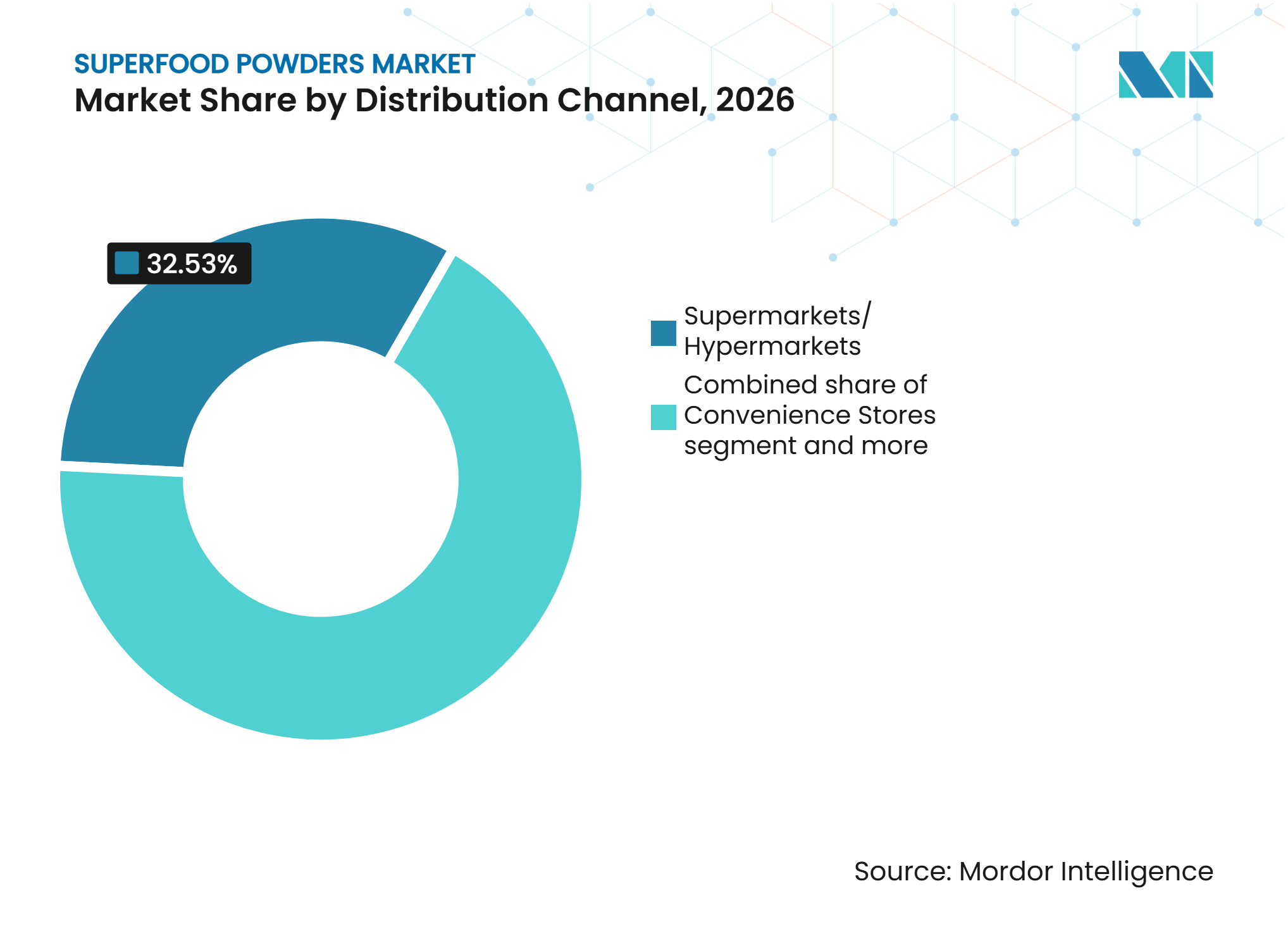
Supermarkets and Hypermarkets Lead While Online Retail Stores Expand FasterIn 2026, supermarkets and hypermarkets accounted for 32.53% of the Superfood Powders Market, making them the leading distribution channel. Their position reflects the availability of packaged nutritional products within established grocery retail networks, where consumers can compare brands, ingredients, and product formats. Meanwhile, online retail stores are projected to record the fastest growth, at a CAGR of 10.32% over 2027–2032. E-commerce platforms provide access to a wider product range, niche brands, subscription options, and detailed product information.
Convenience stores and specialty stores provide additional access through smaller retail formats and health-focused product assortments. Other distribution channels also contribute to market reach. Manufacturers are increasingly required to maintain consistent product availability, clear product information, and suitable packaging across online and offline retail channels.

Geography Analysis
North America Superfood Powders Market
North America accounted for 35.57% of the Superfood Powders Market in 2026, making it the largest regional market. The United States and Canada represent important markets for fruit-based, vegetable-based, and algae-based powders, supported by consumer interest in nutrient-rich foods, plant-based diets, and convenient nutritional products. Superfood powders made from ingredients such as berries, acai, spirulina, and wheatgrass can be incorporated into smoothies, functional beverages, breakfast mixes, and dietary products. Established specialty food retailers, supermarkets, and online platforms also provide manufacturers with multiple routes to reach consumers.
Asia-Pacific Superfood Powders Market
Asia-Pacific is projected to be the fastest-growing regional market, with a CAGR of 9.54% over 2027–2032. Increasing health awareness, growing interest in plant-based nutrition, and expanding access to packaged wellness products are supporting opportunities across China, India, Japan, Australia, and other regional markets. Ingredients such as moringa, turmeric, matcha, spirulina, and fruit powders offer opportunities for manufacturers to develop products that combine nutritional positioning with familiar regional ingredients. However, companies need to adapt formulations, flavour profiles, pack sizes, and pricing to varied country-level preferences.
Europe, South America, and Middle East and Africa
Europe offers opportunities through demand for organic, plant-based, and clean-label nutritional products, supporting the use of fruit, vegetable, grain, seed, and algae-based powders. South America benefits from the availability of diverse botanical and fruit ingredients, including acai, which can support local processing and the development of superfood powder products. In the Middle East and Africa, growing interest in health-oriented foods and wider retail availability create opportunities for packaged nutritional ingredients and functional food applications. Across these regions, manufacturers need to manage raw-material sourcing, organic certification, product affordability, and distribution requirements while adapting formulations to local consumer preferences.
Competitive Landscape
Market Concentration

The Superfood Powders Market includes specialist superfood brands, organic food companies, nutritional supplement manufacturers, and diversified food ingredient businesses competing through product innovation, ingredient sourcing, brand positioning, and distribution reach. Companies such as Sunfood Superfoods, Navitas Organics, Nature's Superfoods, OMG Superfoods, and Terrasoul Superfoods focus on superfood-oriented product portfolios, while larger businesses such as Glanbia and GNC participate through broader nutrition and supplement offerings. Their competitive positions vary according to product range, ingredient specialisation, brand recognition, and access to retail and online distribution channels.
Competitive strategies in the Superfood Powders Market focus on expanding ingredient portfolios, introducing blended formulations, strengthening organic positioning, and developing products for specific nutritional applications. For example, Navitas Organics offers powders such as acai, cacao, camu, goji, maca, and chia seed, alongside blends targeting different nutritional applications. Sunfood Superfoods markets individual powders, including beet, maca, moringa, and acai, as well as superfood smoothie and greens blends. Terrasoul Superfoods offers fruit, vegetable, algae, and plant-based powders, including acai, beet, spirulina, chlorella, and barley grass. These portfolios illustrate how specialist brands differentiate through ingredient variety, organic positioning, and convenient blended formats.
Ingredient sourcing and distribution remain important competitive considerations. Companies with access to reliable agricultural suppliers, organic-certified inputs, and suitable processing capabilities can support product consistency and maintain quality across their portfolios. Established online platforms, supermarkets, and specialty health retailers also help brands reach consumers seeking specific ingredients and nutritional formats. However, seasonal raw-material availability, price fluctuations, certification requirements, and nutrient stability during processing and storage can affect operating costs and product quality. Manufacturers must also ensure that product labelling, nutritional claims, and organic certifications comply with regulations in their target markets. These factors make reliable sourcing, quality control, product differentiation, and efficient distribution important areas of competition.
Superfood Powders Industry Leaders
-
Sunfood Superfoods
-
Navitas Organics
-
Glanbia PLC (Amazing Grass)
-
Terrasoul Superfoods
-
Nutiva
- *Disclaimer: Major Players sorted in no particular order
Superfood Powders Market Companies Covered in this Report
- Sunfood Superfoods
- Navitas Organics
- Nature's Superfoods LLP
- OMG Superfoods
- Aduna Ltd.
- Impact Foods International Ltd.
- Nutrisure Ltd T/A Naturya
- Mannatech Inc
- Glanbia PLC (Amazing Grass)
- Terrasoul Superfoods
- Healthy Truth
- GNC Holdings
- Iovate Health Sciences International Inc.
- Kuli Kuli Foods.
- Morlife Healthcare Pvt. Ltd.
- Del Monte Pacific Ltd.
- Laird Superfood, Inc.
- BoKU Superfood
- Creative Nature Ltd.
- Nutiva
Recent Industry Developments in Superfood Powders Market
- October 2026: Greenspace Herbs launched Morimin, a Moringa-based ingredient combining whole-leaf Moringa oleifera powder with a standardized leaf extract. Unveiled at Nutraverse in India, the formulation is available to nutraceutical and food brands in India and the United States, expanding the application of Moringa in mineral-focused nutritional products.
- August 2026: Rapid Organic Pvt. Ltd. launched Organic Psyllium Husk and Organic Moringa Powder at the BIOFACH event on August 6, 2026. The launches expanded the company's organic ingredient portfolio and strengthened its presence in the market for plant-based and organically sourced powdered ingredients.
- July 2026: Plexus Worldwide introduced Superfoods, a greens powder combining more than 40 superfoods, functional mushrooms, and over 70 trace minerals. The formulation includes organic kale, broccoli, spinach, fermented fruits and vegetables, and prebiotic fiber, extending the company's portfolio into multi-ingredient greens powders positioned around everyday nutrition and wellness.
- February 2026: Marico Limited signed definitive agreements to acquire a 60% stake in Cosmix Wellness Private Limited, the owner of the digital-first functional wellness brand Cosmix. Its portfolio includes plant-based protein powders, fermented yeast protein powders, and functional superfood blend
Global Superfood Powders Market Report Scope
For this study, the Superfood Powders Market is defined as the sales value of commercially produced powdered food ingredients derived from nutrient-rich fruits, vegetables, grains, seeds, algae, and other plant-based sources, marketed for their nutritional and functional properties. The market covers fruit-based powders, vegetable-based powders, grain and seed-based powders, algae-based powders, and other product types, segmented by nature into conventional and organic products. Distribution channels include supermarkets and hypermarkets, convenience stores, specialty stores, online retail stores, and other distribution channels. The market is analyzed across North America, Europe, Asia-Pacific, South America, and the Middle East and Africa, with country-level coverage as specified in the report. Market sizing and forecasts are presented in terms of value (USD) and volume (units) across the defined segments and geographies.
Segmentation Overview
| Fruit-Based Powders |
| Vegetable-Based Powders |
| Grain and Seed-Based Powders |
| Algae-Based Powders |
| Other Product Types |
| Conventional |
| Organic |
| Supermarkets/Hypermarkets |
| Convenience Stores |
| Specialty Stores |
| Online Retail Stores |
| Other Distribution Channels |
| North America | United States |
| Canada | |
| Mexico | |
| Rest of North America | |
| Europe | Germany |
| United Kingdom | |
| Italy | |
| France | |
| Spain | |
| Netherlands | |
| Poland | |
| Belgium | |
| Sweden | |
| Rest of Europe | |
| Asia-Pacific | China |
| India | |
| Japan | |
| Australia | |
| Indonesia | |
| South Korea | |
| Thailand | |
| Singapore | |
| Rest of Asia-Pacific | |
| South America | Brazil |
| Argentina | |
| Colombia | |
| Chile | |
| Peru | |
| Rest of South America | |
| Middle East and Africa | South Africa |
| Saudi Arabia | |
| United Arab Emirates | |
| Nigeria | |
| Egypt | |
| Morocco | |
| Turkey | |
| Rest of Middle East and Africa |
| By Product Type | Fruit-Based Powders | |
| Vegetable-Based Powders | ||
| Grain and Seed-Based Powders | ||
| Algae-Based Powders | ||
| Other Product Types | ||
| By Nature | Conventional | |
| Organic | ||
| By Distribution Channel | Supermarkets/Hypermarkets | |
| Convenience Stores | ||
| Specialty Stores | ||
| Online Retail Stores | ||
| Other Distribution Channels | ||
| By Geography | North America | United States |
| Canada | ||
| Mexico | ||
| Rest of North America | ||
| Europe | Germany | |
| United Kingdom | ||
| Italy | ||
| France | ||
| Spain | ||
| Netherlands | ||
| Poland | ||
| Belgium | ||
| Sweden | ||
| Rest of Europe | ||
| Asia-Pacific | China | |
| India | ||
| Japan | ||
| Australia | ||
| Indonesia | ||
| South Korea | ||
| Thailand | ||
| Singapore | ||
| Rest of Asia-Pacific | ||
| South America | Brazil | |
| Argentina | ||
| Colombia | ||
| Chile | ||
| Peru | ||
| Rest of South America | ||
| Middle East and Africa | South Africa | |
| Saudi Arabia | ||
| United Arab Emirates | ||
| Nigeria | ||
| Egypt | ||
| Morocco | ||
| Turkey | ||
| Rest of Middle East and Africa | ||
Key Questions Answered in the Report
What is the current size of the Superfood Powders Market?
The Superfood Powders Market is estimated at USD 7.36 billion in 2026 and is projected to reach USD 11.25 billion by 2032, growing at a CAGR of 8.48% over 2027–2032.
Which product type holds the largest share of the Superfood Powders Market?
Fruit-based powders hold the largest share, accounting for 31.25% of the market in 2026.
Which product type is expected to grow the fastest?
Algae-based powders are projected to record the fastest growth, with a CAGR of 10.21% over 2027–2032.
Which region dominates the Superfood Powders Market, and which is expected to grow fastest?
North America holds the largest share, accounting for 35.57% in 2026, while Asia-Pacific is projected to be the fastest-growing region, with a CAGR of 9.54% over 2027–2032.