
Sulfur-Based Micronutrients Market Size and Share
Market Overview
| Study Period | 2022 - 2032 |
|---|---|
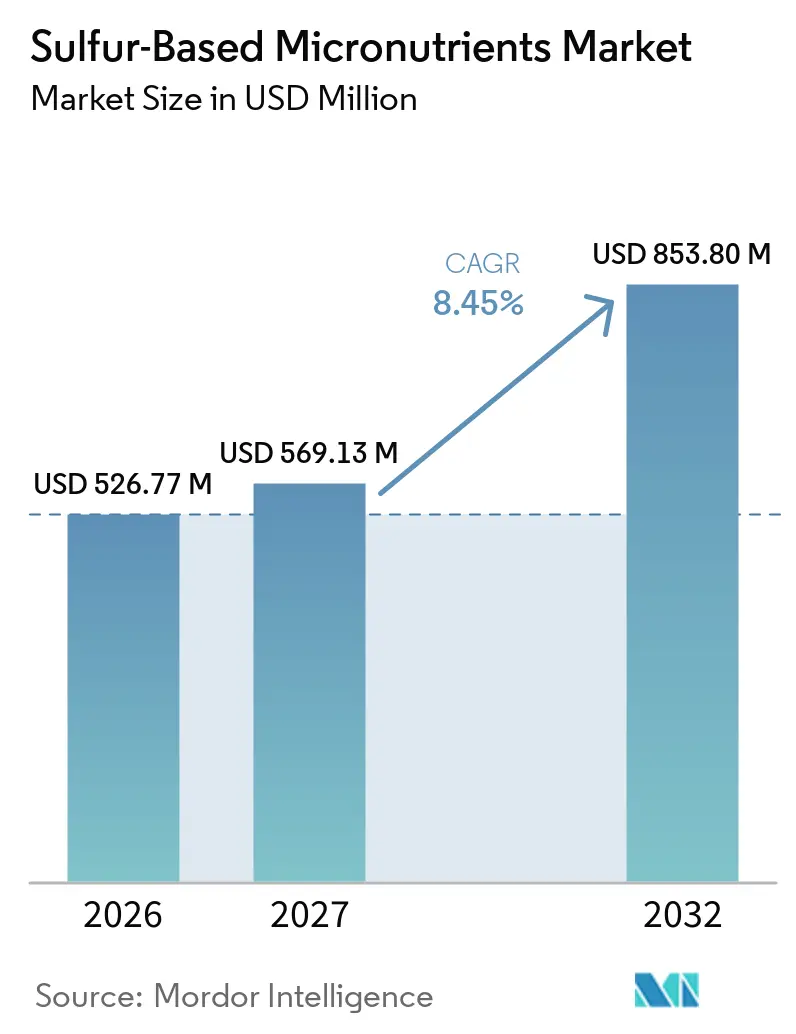
| Market Size (2027) | USD 569.13 Million |
| Market Size (2032) | USD 853.80 Million |
| Growth Rate (2027 - 2032) | 8.45 % |
| Fastest Growing Market | Asia-Pacific |
| Largest Market | Asia-Pacific |
| Market Concentration | Medium |
Major Players *Disclaimer: Major Players sorted in no particular order Image © Mordor Intelligence. Reuse requires attribution under CC BY 4.0. | |
Sulfur-Based Micronutrients Market Analysis by Mordor Intelligence
The Sulfur-Based Micronutrients Market size was valued at USD 526.77 million in 2026 and is estimated to grow from USD 569.13 million in 2027 to USD 853.80 million by 2032, at a CAGR of 8.45% during the forecast period (2027-2032). Declining atmospheric sulfur deposition has reduced a formerly significant source of plant-available sulfur across major farming regions, making deliberate sulfur management more important for growers. Oilseed and pulse cultivation is increasing demand for sulfur, as it affects protein formation and oil development in crops such as soybean, canola, and mustard. Soil testing and variable-rate application are making nutrient programs more specific to field conditions, which favors products designed for controlled release. Producers are responding through multi-nutrient formulations, capacity additions, and efforts to secure sulfur feedstock, while supply dependence on the Middle East remains an operational risk for Asian buyers. The sulfur-based micronutrients market, therefore, depends on both agronomic need and the ability of suppliers to deliver reliable granules when sulfur supply is constrained.
Key Report Takeaways
- By product type, Sulfur-Bentonite held 38.36% of the Sulfur-Based Micronutrients Market share in 2026, while Sulfur-Bentonite-Zinc is forecast to grow at a CAGR of 9.13% through 2032.
- By crop application, Oilseeds and Pulses accounted for 41.14% of the Sulfur-Based Micronutrients Market size in 2026 and are forecast to grow at a CAGR of 9.58% through 2032.
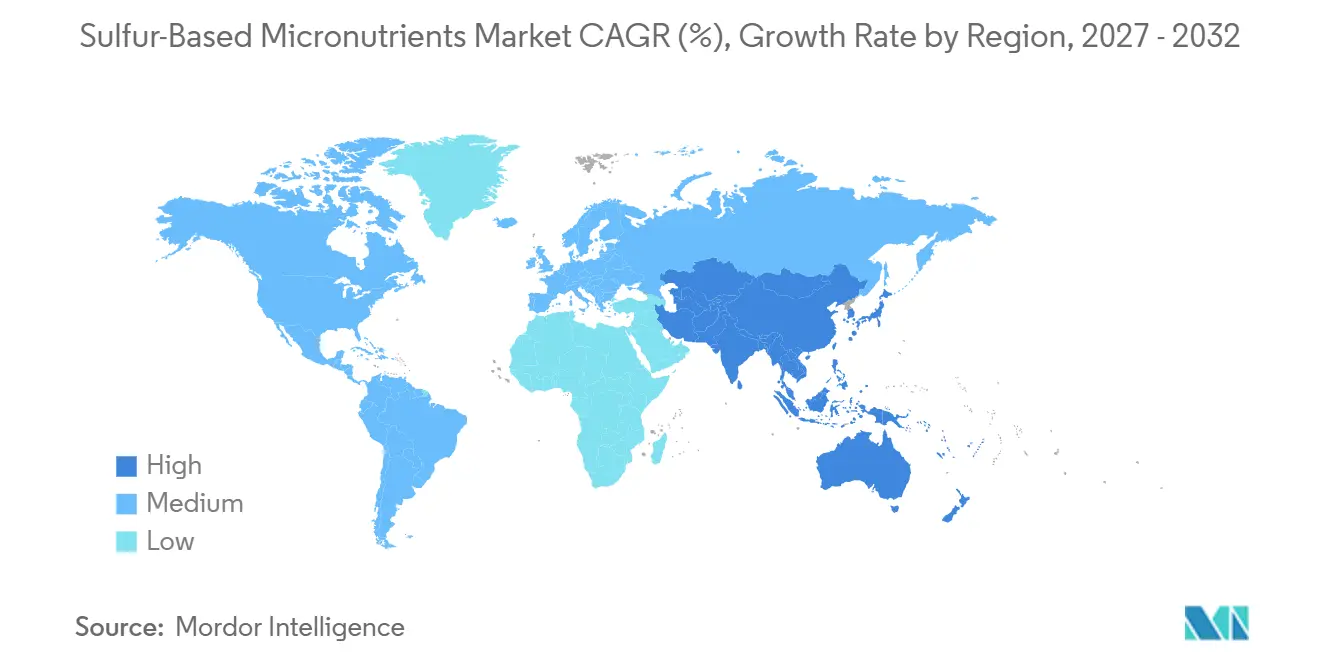
- By geography, Asia-Pacific held 35.58% of the Sulfur-Based Micronutrients Market share in 2026 and is forecast to grow at a CAGR of 9.44% through 2032.
Note: Market numbers in this report are based on Mordor Intelligence's proprietary estimation framework, which combines nine months of actuals with Q4 projections for base year 2026.
Market Trends and Insights
Drivers Impact Analysis of Sulfur-Based Micronutrients Market*
| Drivers | (~) % Impact on CAGR Forecast | Geographic Relevance | Impact Timeline |
|---|---|---|---|
| Declining Atmospheric Sulfur Deposition | +2.6% | Global, highest in North America, Western Europe, and Northern China | Medium term (2-4 years) |
| Expansion of High-Sulfur Oilseed and Pulse Cultivation | +1.9% | APAC core, India, and China, with spillover to South America, the Middle East, and Africa | Short term (≤ 2 years) |
| Intensification of Cropping and Higher Nutrient Removal | +0.9% | Global, with APAC dominant and North America secondary | Long term (≥ 4 years) |
| Balanced Nutrition and Nitrogen-Use Efficiency Programs | +1.2% | North America, Europe, South Asia, and East Asia | Medium term (2-4 years) |
| Soil-Test-Led and Variable-Rate Nutrient Management | +0.7% | North America, Australia, and Western Europe | Medium term (2-4 years) |
| Source: Mordor Intelligence | |||
Declining Atmospheric Sulfur Deposition
Emission controls that reduced industrial sulfur emissions also removed a long-standing source of sulfur reaching agricultural soils. UK sulfur deposition fell from 50-60 kg/ha/year in the 1970s to below 5 kg/ha/year. China recorded a decline of more than 50% in wet sulfur deposition across 95% of monitoring grids between 2013 and 2023, while Guizhou, Hunan, and Jiangxi remained persistent hotspots. This change means farmers must address sulfur needs more actively instead of relying on atmospheric deposition. Canola and cruciferous vegetables face yield deficits when deposition falls below 10 kg/ha/year, a condition reported across northern Europe, parts of the US Corn Belt, and key Chinese grain regions. The sulfur-based micronutrients market benefits where growers need a longer nutrient supply window than sulfate fertilizers can provide, and bentonite sulfur is positioned around that release profile.
Expansion of High-Sulfur Oilseed and Pulse Cultivation
Sulfur is the fourth major nutrient for oilseed crops after nitrogen, phosphorus, and potassium, which links oilseed acreage directly to demand for sulfur-containing fertilizers. India's National Food Security Mission supports oilseed self-sufficiency and provides an institutional basis for the use of sulfur-enhanced fertilizer in South Asian farming systems. A 2025 rice-groundnut study reported the highest net return from 40 kg/ha of bentonite sulfur in rice and 60 kg/ha of sulfur in groundnut. The reported system net return reached INR 113,640/ha (USD 1,360/ha), representing a 106.96% increase over the no-sulfur control. Renewable-fuel demand is expanding soybean and canola cultivation, which also broadens the addressable use of these products in Brazil and Indonesia. This crop pattern supports the sulfur-based micronutrients market because sulfur requirements are tied to both yield and oil quality in these systems.
Balanced Nutrition and Nitrogen-Use Efficiency Programs
Sulfur supports nitrogen assimilation, which has moved it closer to the center of balanced nutrition programs. A 2025 wheat trial found that the 120 kg nitrogen plus 30 kg sulfur treatment delivered a nitrogen-use efficiency of 91.31% and sulfur-use efficiency of 84.10%, the highest values among the tested treatments. Sulfur-nanoparticle-coated urea increased nitrogen recovery efficiency in wheat by 34%, supporting interest in formulations that combine sulfur with slow-release nitrogen[1]. Research also found that combined sulfur and nitrogen fertilization can improve zinc biofortification by 30-40% through rhizosphere acidification and higher zinc solubility. Products that combine nitrogen, phosphorus, potassium, sulfur, and zinc illustrate how suppliers can reduce the need for separate nutrient applications. This approach supports the sulfur-based micronutrients market, in which growers seek a practical way to manage multiple nutrients in a single application.
Soil-Test-Led and Variable-Rate Nutrient Management
Precision soil sampling is replacing uniform sulfur applications with prescriptions based on field variability. A 2025 study found that 0.4-hectare grid sampling produced the most accurate variable-rate prescription maps and reduced both under-application and over-application compared with coarser sampling grids. Work in semi-arid Indian conditions found that management zones based on principal component analysis and fuzzy c-means clustering delivered the highest grain yield in the most responsive zones while reducing total fertilizer cost. A separate 2025 study in Jhansi-Bundelkhand developed nutrient management zones specifically for the use of sulfur and micronutrients. These approaches make sulfur recommendations more location-specific and can increase interest in products matched to a field's nutrient needs. The sulfur-based micronutrients market benefits from this shift because the slower release of bentonite sulfur can suit crops that need sulfur over a longer growing period.
Restraints Impact Analysis of Sulfur-Based Micronutrients Market*
| Restraints | (~) % Impact on CAGR Forecast | Geographic Relevance | Impact Timeline |
|---|---|---|---|
| Slow Microbial Oxidation of Elemental Sulfur | -1.6% | Global, most acute in cold-climate and low-organic-matter soils | Short term (≤ 2 years) |
| Site-Specific Yield Response and Weak Soil-Test Predictability | -1.0% | North America and Europe | Medium term (2-4 years) |
| Acidification and Nutrient-Imbalance Risk from Misapplication | -0.7% | APAC and Sub-Saharan Africa | Long term (≥ 4 years) |
| Source: Mordor Intelligence | |||
Slow Microbial Oxidation of Elemental Sulfur
Elemental sulfur in bentonite granules must first be converted by soil bacteria into sulfate before crops can absorb it. A 2025 tropical soil study found that elemental sulfur pastilles oxidized by only 3-9% over 180 days of incubation, whereas micronized elemental sulfur products oxidized by only 22-32% over the same period. Cold soil, low organic matter, and low pH slow sulfur-oxidizing bacteria, which can delay the availability of plant-available sulfur beyond the needs of short-season crops. This creates hesitation among growers using annual oilseeds, as sulfur shortages during the first 6-8 weeks after germination can limit yields. The sulfur-based micronutrients market must therefore compete with sulfate sources such as gypsum and ammonium sulfate, which provide sulfur immediately.
Site-Specific Yield Response and Weak Soil-Test Predictability
Sulfur fertilization does not consistently produce a yield response across all commercial fields, making prescriptions more difficult in mature agricultural regions. A 12-site central Iowa trial published in 2025 found that sulfur fertilization increased corn grain yield in only 17% of trials. The study also found that extractable soil sulfur, soil organic matter, and tissue sulfur at V5 or mid-silk did not reliably identify sites likely to respond. This differs from nitrogen and phosphorus programs, where agronomists can apply more established soil-test thresholds. As a result, agronomists consider soil type, leaching exposure, and cropping history when making sulfur recommendations. This uncertainty slows the shift from reactive use toward routine sulfur management within the sulfur-based micronutrients market.
*Our forecasts treat driver/restraint impacts as directional, not additive. The impact forecasts reflect baseline growth, mix effects, and variable interactions.
Sulfur-Based Micronutrients Market Segment Analysis
By Product Type:
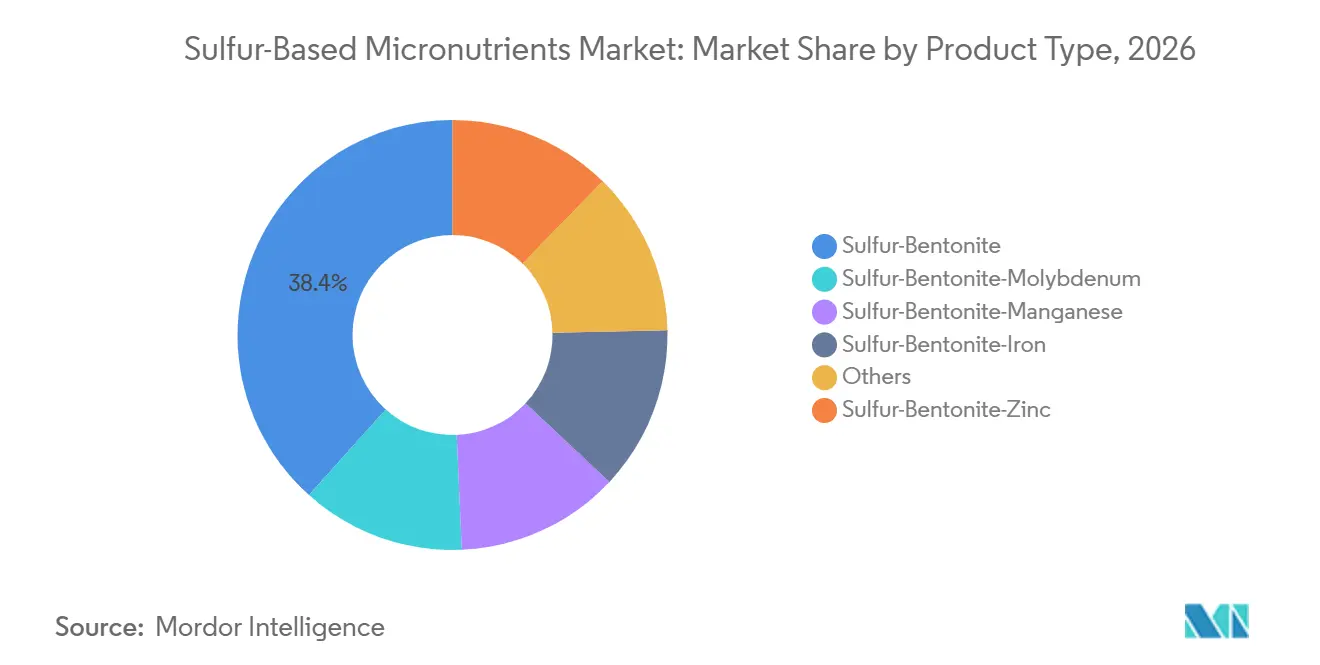
Multi-Micronutrient Variants Support Premium DemandSulfur-Bentonite held 38.36% of the Sulfur-Based Micronutrients Market share in 2026, making it the largest product category. It has established commercial infrastructure in India, the Asia-Pacific, and North America. The formulation serves oilseed, cereal, and pulse production systems, giving it broad agronomic relevance. Supplier capacity from Tiger-Sul, Coromandel, and Deepak Fertilizers and Petrochemicals Corporation Limited (DFPCL) has helped establish its market presence in India and North America. This established availability is important in markets where growers and distributors prefer familiar application formats. A 2025 study found that sulfur fertilization improves nitrogen use efficiency in wheat by enhancing nitrogen uptake, supporting the use of the core Sulfur-Bentonite format in cereal-led farming areas.
Sulfur-Bentonite-Molybdenum, Sulfur-Bentonite-Manganese, and Sulfur-Bentonite-Iron serve smaller but meaningful product niches. Molybdenum combinations are relevant for pulse crops where the nutrient can affect nitrogen fixation. Manganese and iron combinations are used in acidic lowland rice systems, where multiple nutrient deficiencies may occur simultaneously. These products allow suppliers to match a sulfur carrier with specific local nutrient constraints. Sulfur-Bentonite-Zinc is the fastest-growing product category, with a projected CAGR of 9.13% from 2027 to 2032. A global meta-analysis found that combined sulfur and zinc fertilization improved cereal yields more consistently than either nutrient applied alone. The Sulfur-Based Micronutrients Market size for these multi-nutrient products is driven by the ability to address sulfur and zinc needs in a single application.

By Crop Application:
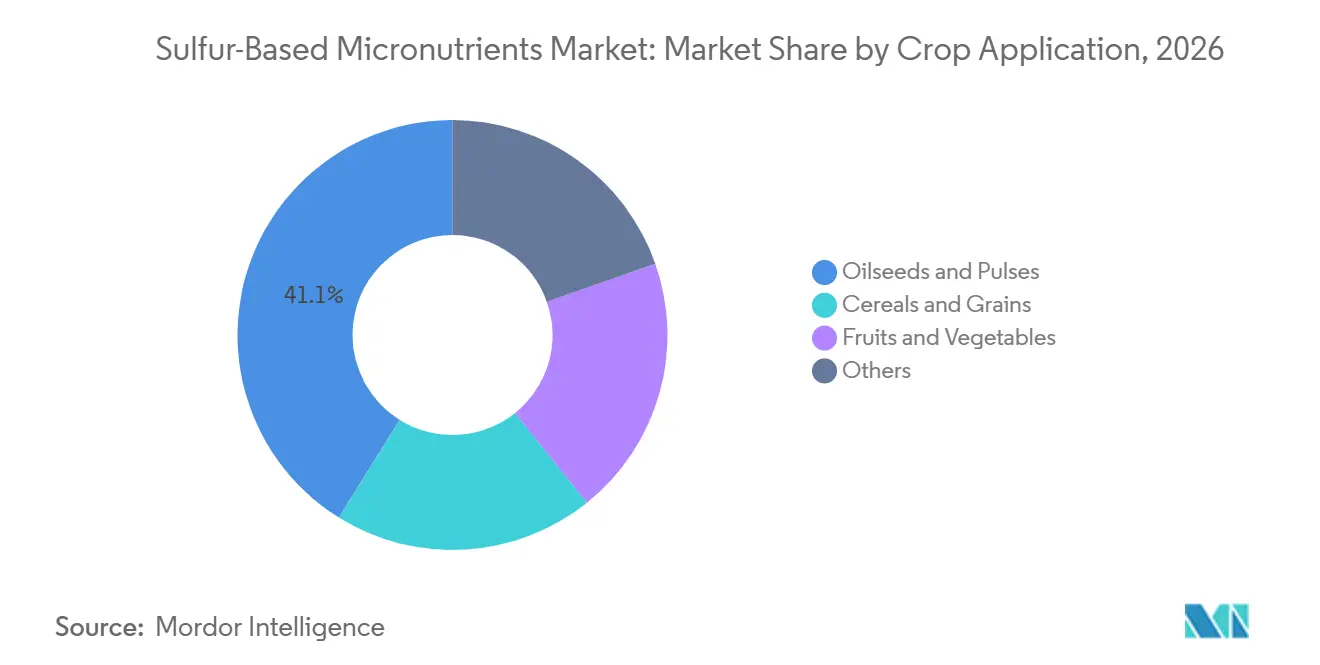
Oilseeds and Pulses Lead Revenue and GrowthOilseeds and Pulses accounted for 41.14% of the Sulfur-Based Micronutrients Market size in 2026 and are projected to expand at a CAGR of 9.58% through 2032. Sulfur contributes to the formation of cysteine and methionine, which affect protein and oil content in canola, soybean, mustard, and sunflower. This biological role links sulfur application to both crop yield and the quality attributes sought by processors. In India, sulfur deficiency affects an estimated 44% of soils, making sulfur management important for oilseed production systems. A rice-groundnut field study found that sulfur treatments generated a system return 106.96% above the no-sulfur control. India's crop-production priorities and the Nutrient-Based Subsidy scheme create sustained demand for sulfur-containing fertilizer purchases.
The Soil Health Card scheme has extended soil-testing and nutrient recommendations, including sulfur, to a broader group of farmers. This is particularly relevant for Rabi oilseed cycles, where nutrient decisions are increasingly based on soil conditions. Cereals and Grains represent the second-largest crop group, supported by the planted area and routine use of pre-plant balanced fertilization in North America, Europe, and East Asia. A 2025 meta-analysis of 65 Chinese crop trials found that sulfur fertilization improved nitrogen use efficiency and grain yield in wheat and rice, giving cereal producers a clearer agronomic case for including sulfur in standard nutrient programs. Fruits and Vegetables and the Others category are smaller segments but can support higher price realization, as growers of high-value crops seek to reduce nutrient risk at sensitive crop stages. The Sulfur-Based Micronutrients Market also presents an opportunity in fertigation-compatible sulfur formulations, which several producers in Asia-Pacific, the Middle East, and Africa are currently developing.
Geography Analysis
APAC Sulfur-Based Micronutrients Market
Asia-Pacific held 35.58% of the sulfur-based micronutrients market share in 2026 and is forecast to grow at a CAGR of 9.44% through 2032. China's large fertilizer consumption base supports demand in grain-producing areas where the 14th Five-Year Plan emphasizes grain security. The country's shift away from lower-analysis single superphosphate supports the use of sulfur-containing nitrogen, phosphorus, and potassium (NPK) complexes. India's sulfur deficit affects an estimated 44% of soils and supports a sizeable demand base for sulfur products. The Soil Health Card scheme, oilseed and pulse expansion, and domestic capacity additions all reinforce demand, linking public farm programs with the need for more balanced nutrient application. Southeast Asia adds demand through palm oil, rubber, and double-cropped rice systems in Indonesia and Vietnam, which have high sulfur requirements.
India, North America and the Middle East Sulfur-Based Micronutrients Market
India's reliance on imports from the Middle East for 84% of its sulfur supply creates significant supply-side exposure for regional producers. Supply disruptions during 2025 and 2026 tightened the market and pushed spot prices to USD 320-340/t Cost and Freight (CFR) on India's east coast. This raises finished fertilizer prices and increases the value of secure sulfur supply arrangements, making consistent access to feedstock a commercial consideration alongside product performance. In North America, long-term reductions in sulfur deposition following the US Clean Air Act controls on sulfur dioxide have reduced sulfur availability in the Midwest. The 4R Nutrient Stewardship program recognizes sulfur as an essential secondary nutrient requiring site-specific management.
EMEA and the Americas Sulfur-Based Micronutrients Market
Europe is similarly affected by lower atmospheric sulfur deposition and by the EU Fertilizing Products Regulation 2019/1009, which provides certification pathways for elemental sulfur-containing fertilizers. Both North America and Europe are shifting toward including sulfur in NPK blends, which can reduce field passes and strengthen the case for sulfur supplementation. South America, led by Brazil and Argentina, benefits from soybean, corn, and sugarcane production, all of which have higher sulfur needs. Brazil's soil sulfur supply gap is estimated at 35%, while investments in local production support the use of sulfur-bentonite formulations. This crop mix creates demand across broad-acre systems and in areas where nutrient replacement is becoming increasingly important. The Middle East and Africa remain smaller in market share but represent an emerging base of adoption, as infrastructure improvements and food-security programs support balanced nutrient use. A 2025 systematic review found that sulfur nutrition remains underused in smallholder systems in Sub-Saharan Africa.
Competitive Landscape
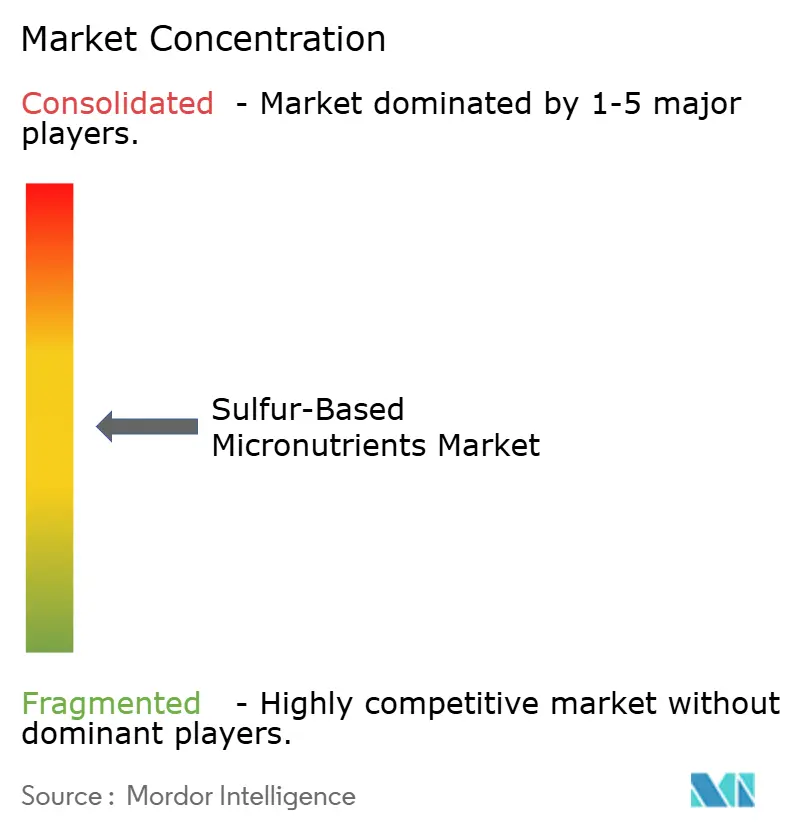
The sulfur-based micronutrients market is moderately fragmented, with Yara International, ICL, Nutrien, The Mosaic Company, and Tessenderlo Kerley among the leading global suppliers. These companies compete on agronomic performance, product formulation, manufacturing coverage, and distribution reach. Regional manufacturers compete more directly on price and local access. This creates different competitive positions across mature farm-input markets and regions where capacity is still developing. In November 2024, Tessenderlo Kerley acquired Tiger-Sul Products LLC, bringing two recognized North American sulfur-bentonite platforms together. The transaction expanded the combined production footprint across the United States and Canada and altered the competitive landscape for suppliers serving North American oilseed, cereal, and pulse growers.
ICL invested BRL 50 million (USD 8.5 million) in a spherical granule production line in Brazil, which became operational in May 2025. The investment reflects a strategy to differentiate products by granule shape, distribution efficiency, and sulfur availability, and increased plant capacity by 50%. A spherical format supports more even field distribution, which is the central product benefit cited for the investment. In July 2026, Tessenderlo Group filed a U.S. patent application for sulfur granules with a crush strength of at least 3.0 kgf and rapid degradation characteristics. The filing addresses the need to combine granule durability with faster breakdown in soil. Product engineering and intellectual property protection are therefore becoming increasingly important competitive tools in the sulfur-based micronutrients market.
Indian producers are expanding capacity as local demand grows and supply security becomes more important. In March 2025, Coromandel International doubled its bentonite sulfur capacity to 50,000 tons using German granulation technology[2]. In February 2026, National Fertilizers Ltd. approved a 25,000 t/a bentonite-sulfur plant at Vijaipur. These additions reflect efforts to reduce dependence on imported specialty fertilizers following China's temporary curtailment of exports in 2025, which led to a 40% increase in domestic prices. The capacity additions also strengthen domestic suppliers' role in determining service levels and product availability for local distributors. Precision-compatible small-particle formulations for fertigation remain a less-developed product area, as granular products dominate the current range. This leaves room for suppliers that can meet application requirements without sacrificing the handling advantages of conventional granules.
Sulfur-Based Micronutrients Industry Leaders
-
Yara
-
Coromandel International Ltd.
-
IFFCO
-
Tessenderlo Kerley
-
DFPCL
- *Disclaimer: Major Players sorted in no particular order
Sulfur-Based Micronutrients Market Companies Covered in this Report
- Aries Agro Limited
- Compass Minerals
- Coromandel International Ltd.
- DFPCL
- Helena Agri-Enterprises, LLC
- ICL
- IFFCO
- K+S Aktiengesellschaft
- Koch Agronomic Services, LLC
- Neufarm
- Nutrien Ltd.
- SQM
- Tessenderlo Kerley
- The Mosaic Company
- Yara
Recent Industry Developments in Sulfur-Based Micronutrients Market
- February 2026: National Fertilizers Ltd (NFL) approved a 25,000 t/a bentonite sulfur plant at Vijaipur, with a capital cost of INR 1.04 billion (USD 11.5 million), following board approval on 13 February 2026. The Vijaipur site currently has no bentonite sulfur capacity, and the project is at the initial financing stage. The decision supports the NFL's goal of fertilizer self-reliance and its expansion of sulfur-based micronutrients in its non-urea product mix, which accounted for 33% of FY2024-25 revenues.
- July 2025: ICL launched Sulfurball in Brazil and Latin America, a spherical sulfur fertilizer combining elemental sulfur with specialty additives, backed by a BRL 50 million (approximately USD 8.5 million) investment at its Jacareí, São Paulo facility. The launch increased production capacity by 50% and targeted soybean and corn markets during the 2025 growing season. The spherical format offers better field-distribution efficiency and sulfur bioavailability than conventional pellets, thereby supporting the adoption of sulfur-based micronutrients in the region.
Global Sulfur-Based Micronutrients Market Report Scope
Sulfur-based micronutrients are agricultural fertilizer blends and chemical compounds that combine elemental sulfur or sulfate with essential trace minerals, such as zinc, boron, iron, manganese, or molybdenum. These products are applied to crops to address nutrient deficiencies and improve soil health. Sulfur supports protein synthesis and enzyme activity in plants, while the accompanying trace minerals contribute to functions such as photosynthesis, nitrogen fixation, and root development.
The sulfur-based micronutrients market is segmented by product type, crop application, and geography. By product type, the market is segmented into sulfur-bentonite, sulfur-bentonite-zinc, sulfur-bentonite-molybdenum, sulfur-bentonite-manganese, sulfur-bentonite-iron, and others. By crop application, the market is segmented into oilseeds and pulses, cereals and grains, fruits and vegetables, and others. The report also covers market sizes and forecasts for the global sulfur-based micronutrients across 15 countries in major regions. The market sizes and forecasts are provided in terms of value (USD).
Segmentation Overview
| Sulfur-Bentonite |
| Sulfur-Bentonite-Zinc |
| Sulfur-Bentonite-Molybdenum |
| Sulfur-Bentonite-Manganese |
| Sulfur-Bentonite-Iron |
| Others |
| Oilseeds and Pulses |
| Cereals and Grains |
| Fruits and Vegetables |
| Others |
| Asia-Pacific | China |
| India | |
| Japan | |
| South Korea | |
| ASEAN Countries | |
| Rest of Asia-Pacific | |
| North America | United States |
| Canada | |
| Mexico | |
| Europe | Germany |
| United Kingdom | |
| France | |
| Italy | |
| NORDIC Countries | |
| Rest of Europe | |
| South America | Brazil |
| Argentina | |
| Rest of South America | |
| Middle East and Africa | Saudi Arabia |
| South Africa | |
| Rest of Middle East and Africa |
| By Product Type | Sulfur-Bentonite | |
| Sulfur-Bentonite-Zinc | ||
| Sulfur-Bentonite-Molybdenum | ||
| Sulfur-Bentonite-Manganese | ||
| Sulfur-Bentonite-Iron | ||
| Others | ||
| By Crop Application | Oilseeds and Pulses | |
| Cereals and Grains | ||
| Fruits and Vegetables | ||
| Others | ||
| By Geography | Asia-Pacific | China |
| India | ||
| Japan | ||
| South Korea | ||
| ASEAN Countries | ||
| Rest of Asia-Pacific | ||
| North America | United States | |
| Canada | ||
| Mexico | ||
| Europe | Germany | |
| United Kingdom | ||
| France | ||
| Italy | ||
| NORDIC Countries | ||
| Rest of Europe | ||
| South America | Brazil | |
| Argentina | ||
| Rest of South America | ||
| Middle East and Africa | Saudi Arabia | |
| South Africa | ||
| Rest of Middle East and Africa | ||
Key Questions Answered in the Report
What is current market size of Sulfur-Based Micronutrients Market?
The Sulfur-Based Micronutrients Market size was valued at USD 526.77 million in 2026 and is estimated to grow from USD 569.13 million in 2027 to USD 853.80 million by 2032, at a CAGR of 8.45% during the forecast period (2027-2032).
Which sulfur-based formulation is growing fastest?
Sulfur-Bentonite-Zinc is forecast to record the highest product CAGR in the Sulfur-Based Micronutrients Market at 9.13% through 2032. The formulation addresses sulfur and zinc in 1 application, and a 2025 meta-analysis found that combined sulfur and zinc fertilization improved cereal yields more consistently than either nutrient alone.
Why are oilseeds and pulses important for sulfur fertilizer demand?
Oilseeds and Pulses represented 41.14% of the Sulfur-Based Micronutrients Market revenue in 2026 and are forecast to grow at a CAGR of 9.58%. Sulfur supports the formation of amino acids that influence protein and oil content in canola, soybean, mustard, and sunflower, connecting nutrient management with crop value.
Which region leads demand for sulfur-based micronutrients?
Asia-Pacific led the Sulfur-Based Micronutrients Market with a 35.58% revenue share in 2026 and is forecast to grow at a CAGR of 9.44% through 2032. Demand is supported by large grain and oilseed systems, soil sulfur deficiency in India, and sulfur requirements in palm oil, rubber, and double-cropped rice systems.