
Sukuk Market Size and Share
Market Overview
| Study Period | 2020 - 2031 |
|---|---|
| Market Size (2026) | USD 1.11 Billion |
| Market Size (2031) | USD 1.77 Billion |
| Growth Rate (2026 - 2031) | 9.80 % |
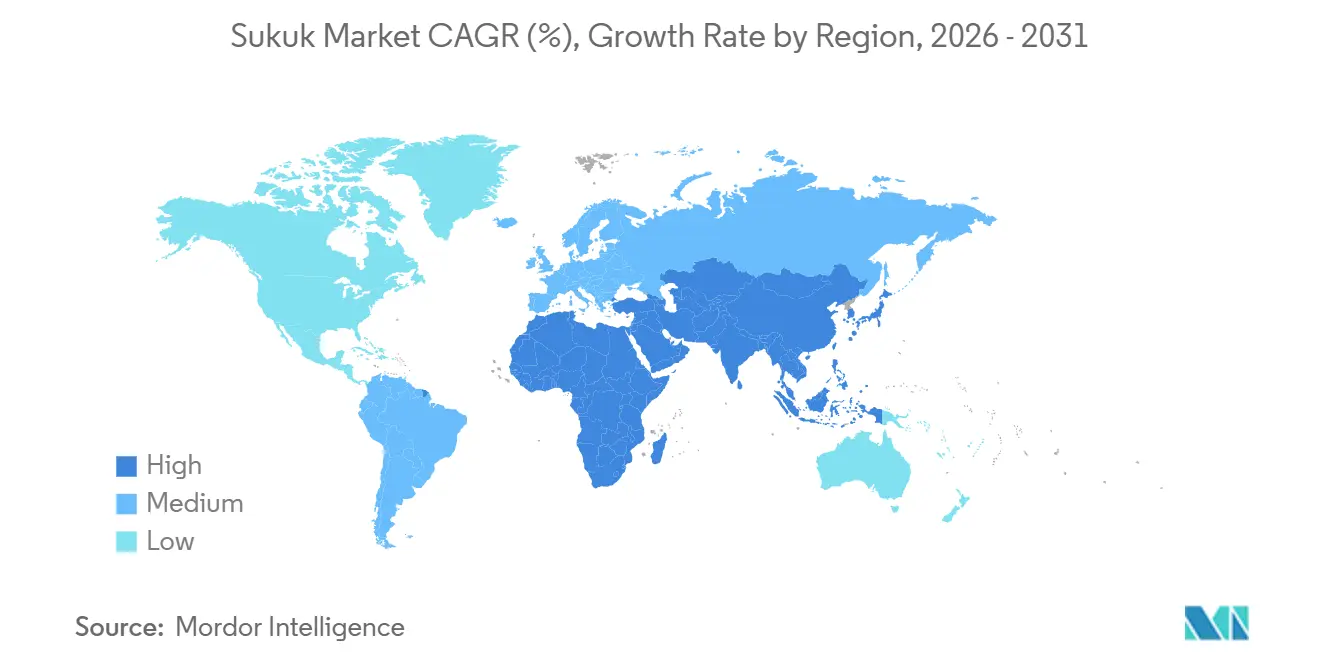
| Fastest Growing Market | Middle East and Africa |
| Largest Market | Asia-Pacific |
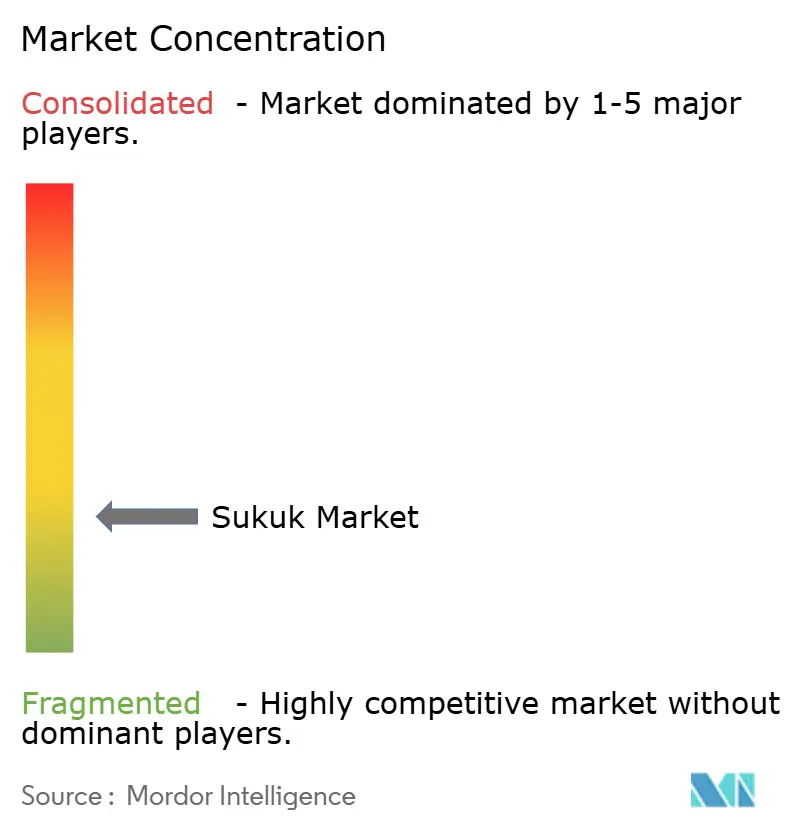
| Market Concentration | Low |
Major Players *Disclaimer: Major Players sorted in no particular order Image © Mordor Intelligence. Reuse requires attribution under CC BY 4.0. | |
Sukuk Market Analysis by Mordor Intelligence
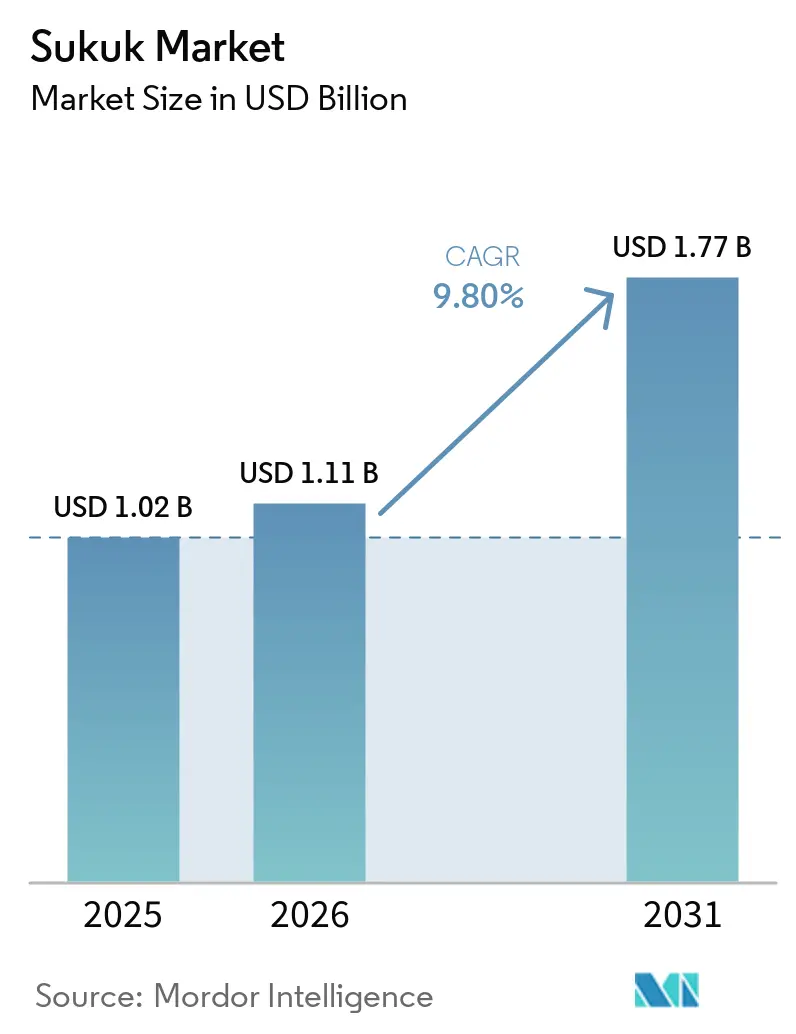
The Sukuk Market size is expected to increase from USD 1.02 billion in 2025 to USD 1.11 billion in 2026 and reach USD 1.77 billion by 2031, growing at a CAGR of 9.80% over 2026-2031.
The sukuk market is being shaped by sovereign borrowing programs, infrastructure funding requirements, and wider institutional demand for Shariah-compliant fixed-income instruments. Saudi Arabia’s Vision 2030 financing program and Indonesia’s public infrastructure agenda are increasing the use of sukuk within debt-management plans. The sukuk market also benefits from a larger international investor base as issuers seek longer-dated and more diversified funding. Sustainability labels and tokenized issuance are adding new routes for issuers that need clearer use-of-proceeds reporting or more efficient settlement. Market activity remains sensitive to sovereign issuance schedules, regional conditions, and differences in legal and Shariah standards.
Key Report Takeaways
- By sukuk type, Wakalah captured 28.3% of the sukuk market share in 2025 and is projected to grow at a CAGR of 12.1% through 2031.
- By issuer type, sovereign issuers accounted for 54.5% of the sukuk market share in 2025, while sovereign-related and quasi-sovereign issuers are projected to grow at a CAGR of 12.7% through 2031.
- By market type, domestic sukuk accounted for 72.4% of the sukuk market share in 2025, while international sukuk is projected to grow at a CAGR of 11.7% through 2031.
- By maturity, medium-term sukuk accounted for 47.6% of the sukuk market share in 2025, while long-term sukuk is projected to grow at a CAGR of 10.6% through 2031.
- By label, plain sukuk accounted for 93.3% of the sukuk market share in 2025, while sustainability-labeled sukuk is projected to grow at a CAGR of 14.2% through 2031.
- By geography, Asia-Pacific accounted for 47.7% of the sukuk market share in 2025, while the Middle East and Africa are projected to grow at a CAGR of 11.3% through 2031.
Note: Market size and forecast figures in this report are generated using Mordor Intelligence’s proprietary estimation framework, updated with the latest available data and insights as of January 2026.
Market Trends and Insights
Drivers Impact Analysis of Sukuk Market*
| Driver | (~) % Impact on CAGR Forecast | Geographic Relevance | Impact Timeline |
|---|---|---|---|
| Sovereign Refinancing and Fiscal Funding Needs | +1.9% | Global, concentrated in the Gulf Cooperation Council, the Association of Southeast Asian Nations, the Middle East, and North Africa | Short term (≤ 2 years) |
| Infrastructure Investment and Economic Diversification Financing | +1.6% | Gulf Cooperation Council, Association of Southeast Asian Nations, and Africa | Medium term (2-4 years) |
| Expansion of Islamic Banking and Institutional Investor Demand | +1.3% | Global | Medium term (2-4 years) |
| Growth of Green and Sustainable Sukuk Issuance | +1.5% | Gulf Cooperation Council, Association of Southeast Asian Nations, Europe | Long term (≥ 4 years) |
| Growing Integration of Sukuk into Global Fixed-Income Markets | +0.9% | Global, with early gains in the United Kingdom and Luxembourg | Medium term (2-4 years) |
| Digital and Tokenized Sukuk Issuance Infrastructure | +0.8% | Malaysia, Singapore, Gulf Cooperation Council | Long term (≥ 4 years) |
| Source: Mordor Intelligence | |||
Sovereign Refinancing and Fiscal Funding Needs
Sovereign refinancing needs a steady pipeline for the sukuk market because governments can use these instruments for budget financing and debt maturity management. Saudi Arabia’s 2026 borrowing plan identified SAR 217 billion (USD 57.9 billion) in financing needs, including SAR 165 billion (USD 44 billion) for the projected budget deficit. Its September 2026 international Ijarah sukuk raised USD 3.25 billion and attracted USD 16.5 billion in orders, showing continued access to a diversified global investor base[1]. Indonesia’s fiscal deficit projection of 2.9% of gross domestic product in 2026 and Malaysia’s 3.5% fiscal deficit target support recurring sovereign issuance. Saudi Arabia’s August 2026 domestic issue allocated 42.7% of SAR 9.518 billion (USD 2.54 billion) to the 2039 maturity, showing a preference for longer-duration financing. Algeria and Benin entered the sovereign sukuk market in January 2026, broadening the base of public issuers.
Infrastructure Investment and Economic Diversification Financing
The sukuk market provides an asset-linked route for financing infrastructure, energy, transport, and economic diversification programs. Saudi Arabia’s fixed-income debt maturing from 2026 through 2030 was estimated at USD 174.5 billion, with USD 85.4 billion of refinancing-driven issuance associated with Vision 2030-related investment programs. Uganda has been preparing an inaugural sovereign sukuk to finance 15% of a USD 3.17 billion standard gauge railway, which illustrates the use of sukuk for long-lived public assets. Long-term sukuk is forecast to expand at 10.6% CAGR through 2031 because infrastructure assets often require financing periods that extend beyond standard bank tenors. The United Arab Emirates recorded 33.1% growth in first-quarter 2026 issuance, while Bahrain recorded 37.2% growth, supported by corporate and quasi-sovereign funding needs. Ijarah remains important in these transactions because its ownership structure is easier to link to identified physical assets.
Growth of Green and Sustainable Sukuk Issuance
Green and sustainability-labelled structures are expanding the sukuk market by linking Islamic financing with climate and social funding mandates. ESG sukuk issuance reached USD 18.5 billion in 2025, while ESG sukuk reached USD 58 billion at year-end[2]. The asset-linked approach can make use-of-proceeds reporting easier to align with green finance frameworks. Saudi Arabia, Malaysia, the United Arab Emirates, and Indonesia were the leading issuers of ESG sukuk in 2025. The Islamic Financial Services Board issued guidance in July 2026 on sustainability-related and climate-related financial risks for sukuk, which may support more consistent reporting practices. Turkey’s Green Finance Strategy and Action Plan for 2026 to 2029 also positions sukuk as a climate-transition financing tool.
Digital and Tokenized Sukuk Issuance Infrastructure
Tokenized issuance is addressing operational constraints in the sukuk market, particularly in settlement processes, ownership records, and smaller investment denominations. Khazanah Nasional issued Malaysia’s first tokenized sukuk in April 2026, a MYR 100 million (USD 25 million) instrument, in collaboration with the Securities Commission Malaysia[3]. CIMB Islamic Bank completed a tokenized deposit settlement pilot in August 2026 for MYR 1.38 billion (USD 342 million) of a tokenized sukuk issuance. These projects demonstrate that tokenized payment and securities systems can operate within established Wakalah structures. Smart contracts could support profit distributions, compliance checks, and asset transfer procedures, although these applications remain at an early stage. Malaysia’s Capital Market Masterplan 2026 to 2030 provides a regulatory framework for these pilots.
Restraints Impact Analysis of Sukuk Market*
| Restraint | (~) % Impact on CAGR Forecast | Geographic Relevance | Impact Timeline |
|---|---|---|---|
| Cross-Border Shariah and Regulatory Fragmentation | -0.8% | Global | Long term (≥ 4 years) |
| Limited Secondary-Market Liquidity and Price Discovery | -0.5% | Global | Medium term (2-4 years) |
| Geographic Concentration of Sukuk Issuance and Investor Demand | -0.6% | Global | Long term (≥ 4 years) |
| Legal Uncertainty Around Asset Ownership, Recourse and Insolvency | -0.4% | Gulf Cooperation Council and cross-border markets | Long term (≥ 4 years) |
| Source: Mordor Intelligence | |||
Cross-Border Shariah and Regulatory Fragmentation
Cross-border differences in Shariah interpretation can increase structuring costs and delay issuance in the sukuk market. AAOIFI Sharia Standard No. 62 remained in form as of April 2025 and could require a shift from beneficial ownership structures to true asset ownership. This change could affect the credit treatment and documentation of more than 200 existing instruments. Middle Eastern scholars often place greater weight on formal legal structure, while Malaysian scholars may place more emphasis on economic outcomes and public benefit. Issuers entering multiple markets may need separate legal opinions, Shariah board reviews, and documentation. Algeria, Tunisia, and the Philippines introduced sukuk regulations in 2025, widening the potential issuer base but also adding further national compliance requirements.
Limited Secondary-Market Liquidity, Geographic Concentration, and Legal Recourse
The sukuk market has less consistent secondary-market liquidity than comparable conventional bond markets because many investors buy instruments to hold until maturity. Limited reopening provisions in corporate transactions reduce fungibility and make price discovery more difficult during periods of stress. The concentration of issuance in the Gulf Cooperation Council and Asia-Pacific can also increase sensitivity to regional geopolitical events and policy changes. Legal questions around asset ownership, investor recourse, and insolvency remain important where transactions cross several jurisdictions. Tokenized issuance may improve post-trade efficiency over time, but it does not remove the need for consistent legal recognition of digital ownership records. These factors can make portfolio rebalancing more difficult for institutional investors that require reliable exit options.
*Our forecasts treat driver/restraint impacts as directional, not additive. The impact forecasts reflect baseline growth, mix effects, and variable interactions.
Sukuk Market Segment Analysis
By Sukuk Type:
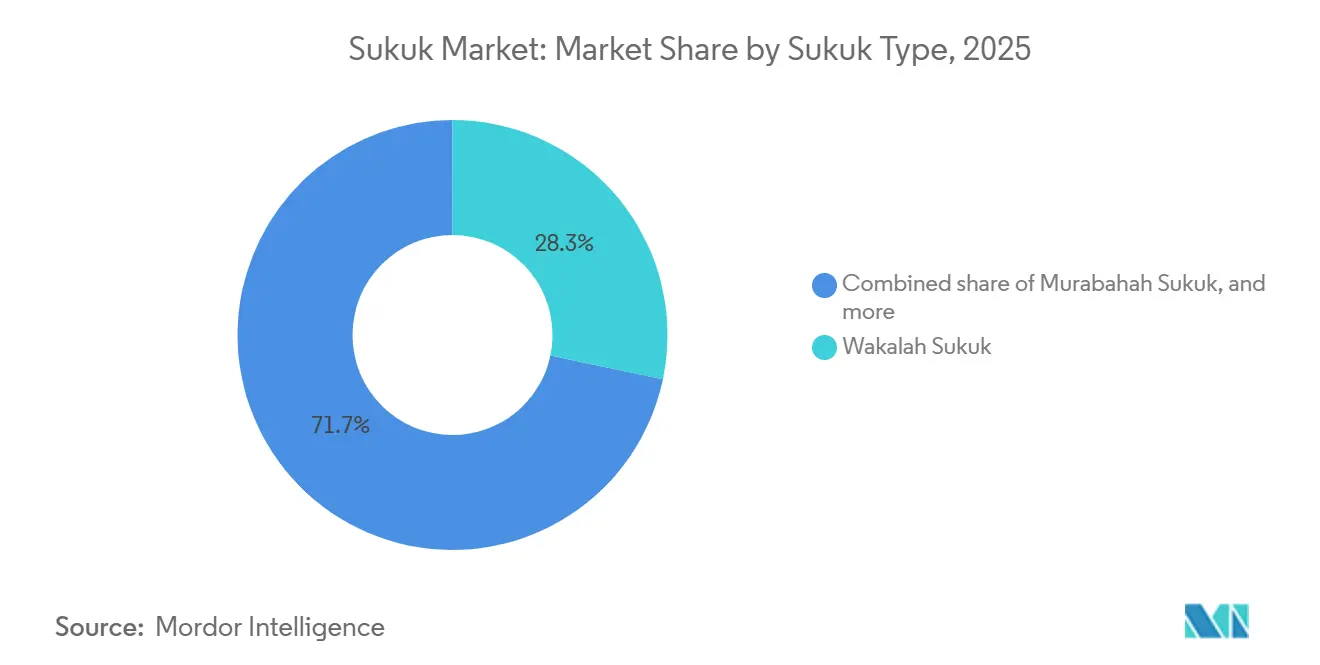
Agency Structures Lead While Asset-Based Formats Remain ImportantWakalah held 28.3% of the sukuk market share in 2025 and is projected to grow at a 12.1% CAGR through 2031. Its agency structure allows an investment agent to manage an asset pool while providing regular reporting on asset composition and performance. This approach has been well-suited to sovereign and cross-border transactions that require clear governance procedures. Malaysia’s USD 1.5 billion global sukuk issued in July 2026 used the Manafae concept and followed AAOIFI guidelines. The sukuk market uses Wakalah, where issuers need flexibility across mixed assets or financing purposes. Ijarah remains a leading alternative for road, power, and real estate financing because it can link returns to identified leased assets.
Murabahah structures continue to support corporate financing and short-term liquidity management. The International Islamic Liquidity Management Corporation uses short-term instruments to meet interbank demand for Shariah-compliant cash placement. Musharakah and Mudarabah remain relevant for profit-and-loss-sharing transactions, though they face more complex documentation and regulatory treatment. Hybrid or composite structures are used when issuers need to combine different asset types within a single transaction. CIMB Islamic Bank’s August 2026 tokenized settlement pilot used a senior sukuk Wakalah structure, showing that agency-based formats are also being used in digital issuance. This mix of structures allows the sukuk market to serve both standardized sovereign financing and more tailored corporate transactions.
By Issuer Type:
Sovereigns Provide the Market Base While State-Linked Issuers ExpandSovereign issuers accounted for 54.5% of the sukuk market share in 2025, making them the largest issuer group in the sukuk market. Regular government issuance has created benchmark curves and reference pricing that private issuers can use. Sovereign and supranational sukuk exceeded USD 600 billion at the end of 2025. The Islamic Development Bank remains a regular international issuer with annual issuance of USD 5 billion. Sovereign-related and quasi-sovereign entities are forecast to grow at 12.7% CAGR through 2031 as public development programs use state-linked vehicles. This pattern broadens supply without placing every financing requirement directly on government balance sheets.
The Saudi Real Estate Refinancing Company increased the ceiling of its international sukuk program to USD 10 billion in September 2026 after completing a USD 2.75 billion third tranche. Financial institutions remain another significant issuer group because they use sukuk for capital management and liquidity. Saudi banks issued more than USD 15 billion in sukuk in 2025, including nearly USD 12 billion in foreign currency. Non-financial corporates and multilateral issuers are important users of green and sustainability-linked labels. The Islamic Development Bank issued a EUR 500 million (USD 541 million) green sukuk in October 2025 under its enhanced Sustainable Finance Framework. This issuer mix supports a broader range of credit exposures for investors.
By Market Type:
Domestic Markets Lead While International Issuance Grows FasterDomestic sukuk captured 72.4% of the sukuk market share in 2025, supported by established local-currency markets in Malaysia, Saudi Arabia, and Indonesia. These markets are supported by regular government issuance and domestic bank demand. International sukuk is forecast to grow at 11.7% CAGR through 2031 as issuers seek access to a wider investor base. Malaysia issued MYR 284.48 billion (USD 71.1 billion) of domestic sukuk in 2025. Non-sovereign domestic issuance increased 17% year over year during the first 5 months of 2026. Domestic programs remain important because they build local yield curves and provide consistent funding channels.
International transactions help issuers establish pricing benchmarks and demonstrate credit quality to foreign investors. International sukuk issuance reached nearly USD 28 billion in 2025, accounting for 24% of gross sovereign and supranational issuance. Saudi Arabia’s September 2025 USD 5.5 billion international Ijarah sukuk created a benchmark for comparable cross-border structures. In the first half of 2026, local-currency international issuance reached USD 87.6 billion, while foreign-currency international issuance reached USD 41.4 billion. Malaysia made a major contribution to issuance growth through demand for short-term Shariah-compliant liquidity instruments. The sukuk market therefore relies on domestic depth for size and international issuance for global price discovery.
By Maturity:
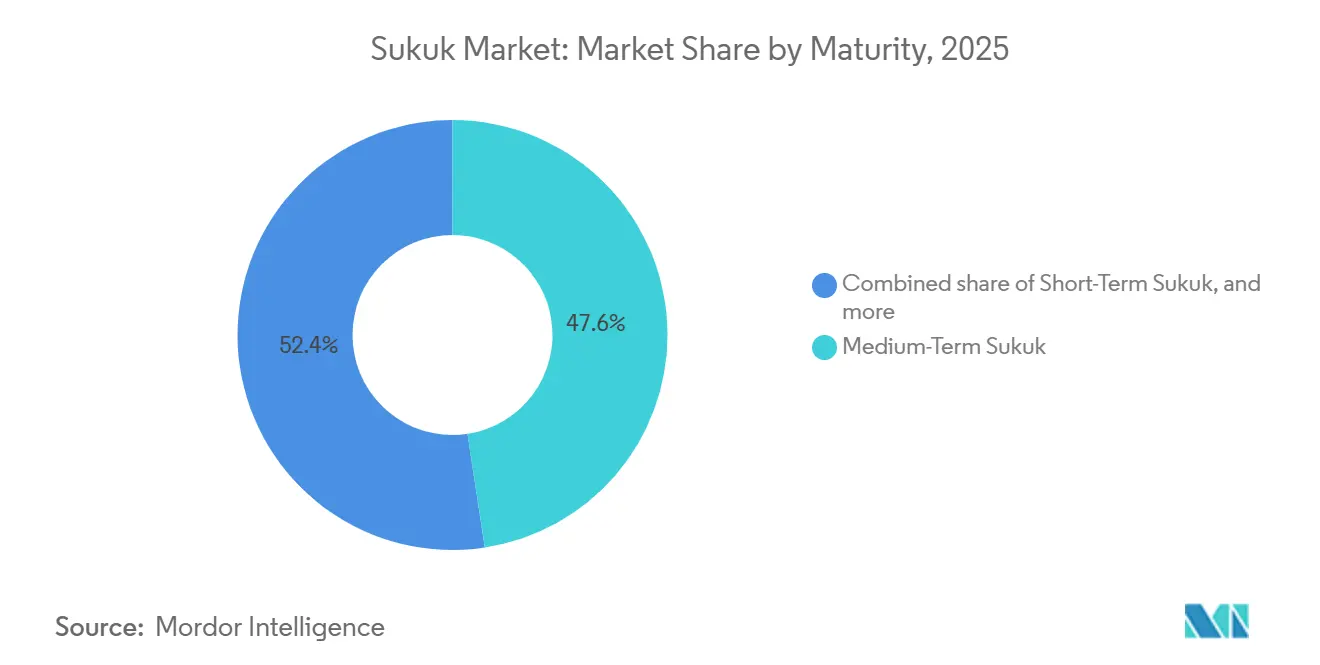
Medium-Term Instruments Form the Core While Long-Term Demand RisesMedium-term sukuk captured 47.6% of the sukuk market share in 2025, reflecting the preference of sovereigns and financial institutions for 3-to-7-year maturities. These tenors match common asset-liability management needs and benchmark curve objectives. Short-term instruments remain important for bank liquidity management and interbank placement. Long-term sukuk is projected to grow at 10.6% CAGR through 2031 as issuers seek to reduce refinancing frequency. Saudi Arabia allocated 42.7% of its August 2026 domestic issuance to a 2039 maturity. This decision supports the move toward longer-duration public financing.
Malaysia’s July 2026 global sukuk included a 5.75-year tranche and a 10-year tranche, with the shorter tranche priced at 15 basis points above the relevant benchmark. Perpetual sukuk continue to serve Islamic banks that need Additional Tier 1 capital while meeting Shariah and Basel III requirements. Their complexity limits issuance size, but they remain relevant for specialized capital needs. Infrastructure financing also encourages longer maturities because project cash flows extend over many years. Issuers are increasingly aligning sukuk maturities with infrastructure investment cycles of 10 to 30 years. This approach is shifting some issuance from short-term refinancing toward longer-term fiscal planning.
By Label:
Plain Sukuk Retain Share Leadership While Sustainability Labels ExpandPlain or unlabelled instruments held 93.3% of the sukuk market share in 2025. They remain the standard financing tool for sovereign and corporate borrowers that do not require a dedicated sustainability framework. Sustainability-labelled sukuk is projected to grow at 14.2% CAGR through 2031 from a smaller base. Growth is supported by net-zero commitments, institutional screening requirements, and green finance guidelines. Saudi Arabia, Qatar, and the United Arab Emirates have introduced relevant policy frameworks. The sukuk market can use these labels to direct capital toward environmental and social projects while retaining Shariah-compliant structures.
Green sukuk remains the main ESG sub-label, while social sukuk has particular relevance in African development financing. Sustainability-linked financing sukuk introduced in 2025 tie profit rates to performance indicators rather than limiting the instrument to specified use of proceeds. New Pantai Expressway issued the first sustainability-linked sukuk for a highway project in July 2026. Malakoff Power issued the Association of Southeast Asian Nations’ first SRI Sukuk Murabahah in April 2026, raising RM 450 million (USD 112.5 million). These transactions indicate growing demand for instruments with measurable sustainability outcomes. The Islamic Financial Services Board guidance may further formalize how issuers assess and report climate-related risks.
Geography Analysis
APAC Sukuk Market
Asia-Pacific captured 47.7% of the sukuk market share in 2025 and remains the largest regional base. Malaysia accounted for 48% of Asian share, while Indonesia accounted for 9.5% of regional size. Sukuk represented 63% of Malaysia’s debt capital market through mid-2026. Malaysia’s debt capital market is projected to reach USD 640 billion by the end of 2026. Indonesia issued USD 21.3 billion of government sukuk in 2025 and is expected to issue USD 21 billion in 2026. Malaysia’s July 2026 USD 1.5 billion global sukuk attracted orders exceeding USD 9.5 billion.
MEA Sukuk Market
The Middle East and Africa is projected to expand at 11.3% CAGR through 2031, the fastest regional rate in the sukuk market. Gulf Cooperation Council issuers accounted for 45% of global issuance in 2025. Saudi Arabia raised USD 72.5 billion in sukuk during 2025, while the United Arab Emirates raised USD 22.1 billion. Africa’s sukuk crossed USD 7 billion in August 2026, with Egypt, Nigeria, South Africa, and Benin as major sources of activity. Benin’s USD 500 million debut sovereign sukuk and Algeria’s program of up to USD 2.3 billion showed stronger frontier-market participation. Kenya plans a KES 65 billion (USD 500 million) sovereign sukuk for the 2026 to 2027 financial year, while Uganda is preparing railway-related issuance.
Europe, APAC and North America Sukuk Market
Europe remains a smaller but strategically important location for listings and investor access. The United Kingdom has the most developed Western listing and regulatory infrastructure for sukuk, while Luxembourg and Germany support secondary listing activity. Turkey issued USD 8.8 billion of sukuk in 2025 and is expected to issue USD 9 billion in 2026. Its 2026 to 2029 Green Finance Strategy and Action Plan identifies sukuk as a climate-transition instrument. Singapore provides a regional listing hub, and Brunei, Bangladesh, and the Philippines are developing further market readiness. The links between Asia-Pacific, the Middle East, Europe, and the United States are widening the investor base for the sukuk market.
Competitive Landscape
The sukuk market includes arrangers, issuers, investors, legal advisers, Shariah boards, and market infrastructure providers. Competitive intensity is higher among bookrunners than among sovereign issuers, which generally do not compete primarily on price. HSBC Amanah, Standard Chartered Saadiq, and CIMB Group are major bookrunners for cross-border and foreign-currency transactions. Emirates NBD Capital is active in United Arab Emirates and Gulf Cooperation Council mandates. Al Rajhi Bank, Abu Dhabi Islamic Bank, and Dubai Islamic Bank increasingly arrange their own capital-management transactions. This self-arrangement can reduce arranger fee pools in domestic Gulf Cooperation Council deals.
The Islamic Development Bank issued a EUR 500 million (USD 541 million) green sukuk in October 2025 under its enhanced sustainable finance framework. The transaction followed the 2025 Green Bond Principles and Social Bond Principles and established a public reporting reference for subsequent ESG issuers. Saudi Arabia’s National Debt Management Center also provides program documentation and investor reporting that other regional issuers can use as a reference. CIMB’s August 2026 tokenized settlement pilot is an example of how arrangers can build capacity in digital infrastructure. First Abu Dhabi Bank and Kuwait Finance House are competing for sustainability-linked mandates in the Gulf Cooperation Council.
The Saudi Real Estate Refinancing Company’s USD 10 billion international program is another example of a state-linked entity developing an independent capital-market position. Such programs compete for investor allocations that might otherwise be directed toward bank-issued paper. Türkiye Finans joined the International Islamic Financial Market in January 2026, gaining access to standard documentation and master agreement frameworks.
Sukuk Industry Leaders
-
Standard Chartered
-
HSBC
-
Kuwait Finance House
-
CIMB Group
-
First Abu Dhabi Bank
- *Disclaimer: Major Players sorted in no particular order
Sukuk Market Companies Covered in this Report
- HSBC
- Standard Chartered
- CIMB Group
- Kuwait Finance House
- First Abu Dhabi Bank
- Maybank Islamic
- Dubai Islamic Bank
- Abu Dhabi Islamic Bank
- Al Rajhi Bank
- Islamic Development Bank
- International Islamic Liquidity Management Corporation
- Saudi National Debt Management Center
- Public Investment Fund
- Saudi Aramco
- Qatar Islamic Bank
- Bank Islam Malaysia
- Türkiye Finans
- BNP Paribas
- Emirates NBD Capital
- Nomura
Recent Industry Developments in Sukuk Market
- September 2026: Saudi Arabia’s National Debt Management Center completed a USD 3.25 billion two-tranche international Ijarah sukuk, attracting an order book of USD 16.5 billion. The transaction comprised a USD 1.25 billion 5-year tranche maturing in 2031 and a USD 2 billion 10-year tranche maturing in 2036. The deal was Saudi Arabia’s second international issuance under the KSA Ijarah Sukuk program. It reinforced the country’s access to diversified long-dated capital.
- September 2026: The Saudi Real Estate Refinancing Company raised its international sukuk program ceiling to USD 10 billion. It completed a third tranche of USD 2.75 billion across 5.5-year and 10-year maturities. The structure was government-guaranteed. The program positions the company as a recurring quasi-sovereign issuer.
- August 2026: CIMB Islamic Bank completed Malaysia’s first pilot settlement of tokenized sukuk using tokenized deposits. MYR 1.38 billion (USD 342 million) of a MYR 1.68 billion (USD 416 million) issuance was tokenized. Twelve institutional investors subscribed to the transaction. The pilot demonstrated institutional-scale on-chain settlement.
- July 2026: Malaysia’s Ministry of Finance priced a USD 1.5 billion global sukuk. It attracted orders exceeding USD 9.5 billion. The 5.75-year tranche priced at 15 basis points above the relevant benchmark, and the 10-year tranche priced at 25 basis points. The instrument followed the Manafae concept and AAOIFI guidelines.
Global Sukuk Market Report Scope
Segmentation Overview
| Murabahah Sukuk |
| Ijarah Sukuk |
| Wakalah Sukuk |
| Musharakah Sukuk |
| Mudarabah Sukuk |
| Salam Sukuk |
| Istisna Sukuk |
| Hybrid / Composite Sukuk |
| Other Sukuk Types |
| Sovereign |
| Sovereign-Related / Quasi-Sovereign |
| Financial Institution |
| Non-Financial Corporate |
| Multilateral / Supranational |
| Domestic Sukuk |
| International Sukuk |
| Short-Term Sukuk |
| Medium-Term Sukuk |
| Long-Term Sukuk |
| Perpetual Sukuk |
| Plain / Unlabelled Sukuk |
| Green Sukuk |
| Sustainability / Sustainability-Linked / Social / Other labelled Sukuk |
| Middle East & Africa | Saudi Arabia |
| United Arab Emirates | |
| Bahrain | |
| Qatar | |
| Kuwait | |
| Oman | |
| Türkiye | |
| Egypt | |
| Rest of Middle East & Africa | |
| Asia-Pacific | Malaysia |
| Indonesia | |
| Pakistan | |
| Singapore | |
| Bangladesh | |
| Brunei | |
| Rest of Asia-Pacific | |
| Europe | United Kingdom |
| Germany | |
| France | |
| Rest of Europe | |
| Rest of the World |
| By Sukuk Type | Murabahah Sukuk | |
| Ijarah Sukuk | ||
| Wakalah Sukuk | ||
| Musharakah Sukuk | ||
| Mudarabah Sukuk | ||
| Salam Sukuk | ||
| Istisna Sukuk | ||
| Hybrid / Composite Sukuk | ||
| Other Sukuk Types | ||
| By Issuer Type | Sovereign | |
| Sovereign-Related / Quasi-Sovereign | ||
| Financial Institution | ||
| Non-Financial Corporate | ||
| Multilateral / Supranational | ||
| By Market Type | Domestic Sukuk | |
| International Sukuk | ||
| By Maturity | Short-Term Sukuk | |
| Medium-Term Sukuk | ||
| Long-Term Sukuk | ||
| Perpetual Sukuk | ||
| By Label | Plain / Unlabelled Sukuk | |
| Green Sukuk | ||
| Sustainability / Sustainability-Linked / Social / Other labelled Sukuk | ||
| By Geography | Middle East & Africa | Saudi Arabia |
| United Arab Emirates | ||
| Bahrain | ||
| Qatar | ||
| Kuwait | ||
| Oman | ||
| Türkiye | ||
| Egypt | ||
| Rest of Middle East & Africa | ||
| Asia-Pacific | Malaysia | |
| Indonesia | ||
| Pakistan | ||
| Singapore | ||
| Bangladesh | ||
| Brunei | ||
| Rest of Asia-Pacific | ||
| Europe | United Kingdom | |
| Germany | ||
| France | ||
| Rest of Europe | ||
| Rest of the World | ||
Key Questions Answered in the Report
What is driving sukuk issuance through 2031?
Sovereign refinancing, infrastructure investment, wider institutional demand, and sustainability financing are the main factors supporting a 9.8% CAGR from 2026 to 2031.
Which sukuk structure leads by share?
Wakalah led with a 28.3% share in 2025 and is forecast to grow at a CAGR of 12.1% through 2031.
Why are sustainability-labelled sukuk growing quickly?
They are forecast to grow at 14.2% CAGR through 2031 as issuers respond to net-zero commitments, investor mandates, and expanding disclosure standards.
Which region has the largest sukuk base?
Asia-Pacific held 47.7% of the sukuk market share in 2025, supported by deep Malaysian and Indonesian issuance programs.
Which region will grow the fastest?
The Middle East and Africa is forecast to grow at 11.3% CAGR through 2031, with Gulf Cooperation Council issuance and African sovereign entrants supporting activity.
How is tokenization changing sukuk issuance?
Malaysian pilots by Khazanah Nasional and CIMB show how tokenized securities and deposits can support issuance and settlement within existing Shariah-compliant structures.