
Sugar Free Confectionery Market Size and Share
Market Overview
| Study Period | 2022 - 2032 |
|---|---|
| Market Size (2027) | USD 2.64 Billion |
| Market Size (2032) | USD 4.12 Billion |
| Growth Rate (2027 - 2032) | 5.23 % |
| Fastest Growing Market | Asia-Pacific |
| Largest Market | North America |
| Market Concentration | Medium |
Major Players *Disclaimer: Major Players sorted in no particular order Image © Mordor Intelligence. Reuse requires attribution under CC BY 4.0. | |
Sugar Free Confectionery Market Analysis by Mordor Intelligence
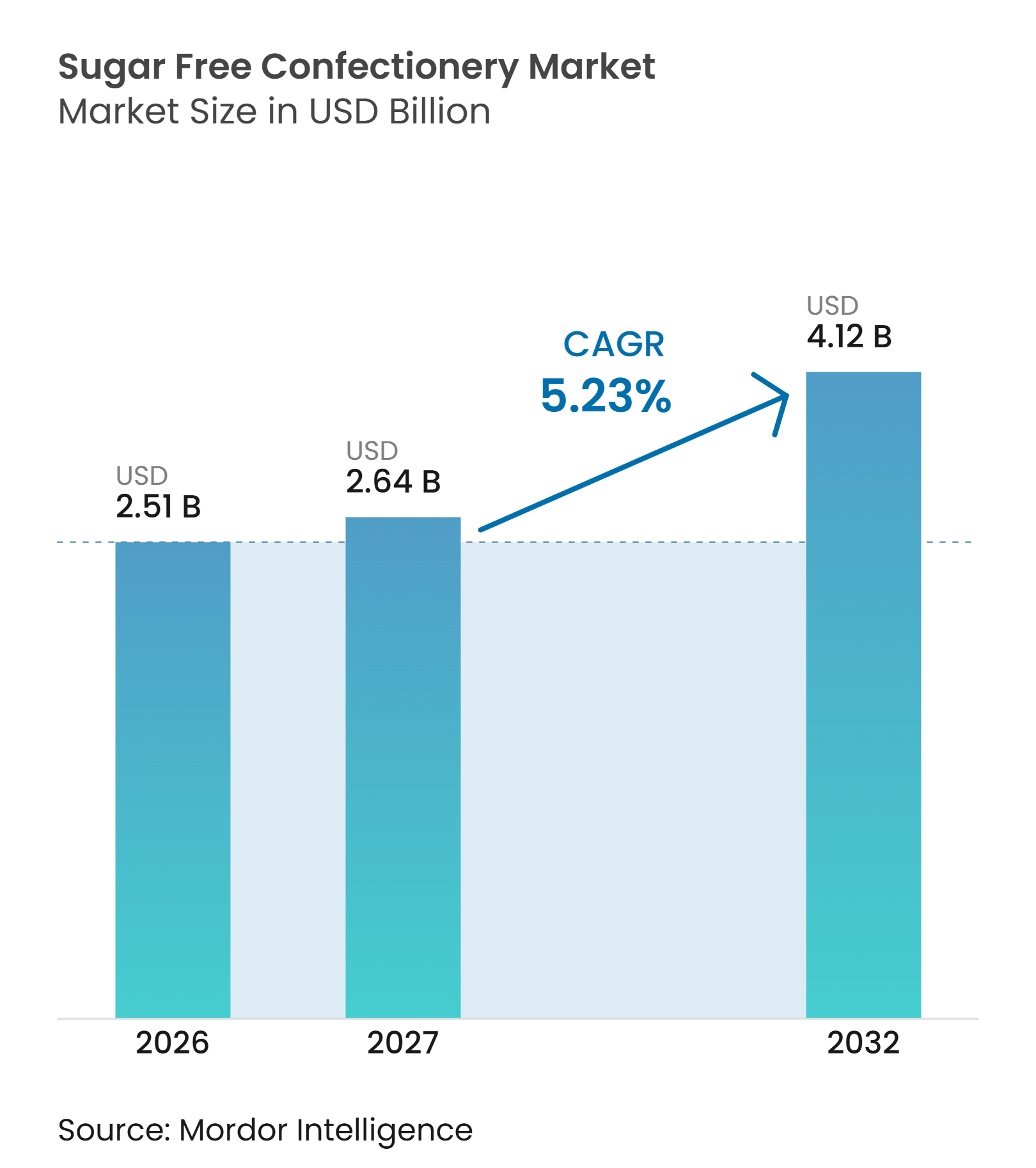
The sugar free confectionery market size is expected to grow from USD 2.51 billion in 2026 to USD 2.64 billion in 2027 and is forecast to reach USD 4.12 billion by 2032 at a 5.23% CAGR over 2027-2032. Demand is expanding beyond medically directed diets as consumers increasingly seek lower-sugar confectionery that delivers familiar taste and texture while fitting into everyday snacking and traditional confectionery occasions. This shift is encouraging manufacturers to invest in improved sweetener systems and formulations that maintain sweetness, bulk, mouthfeel, and product stability. Established brands are expanding their product portfolios, while specialist brands are strengthening their market position through ingredient transparency, digital retail, and product innovation. Advances in formulation and manufacturing are also creating opportunities to improve product quality, affordability, and accessibility.
Key Report Takeaways
• By product type, chocolate held 44.71% of the sugar free confectionery market share in 2026, while other product types are forecast to expand at a CAGR of 6.61% through 2032.
• By packaging type, single-serve held 61.12% of the sugar free confectionery market share in 2026, while multipacks are projected to expand at a CAGR of 6.24% through 2032.
• By category, mass held 62.11% of the sugar free confectionery market share in 2026, while premium is projected to expand at a CAGR of 7.01% through 2032.
• By distribution channel, off-trade held 80.12% of the sugar free confectionery market share in 2026, while on-trade is projected to expand at a CAGR of 6.11% through 2032.
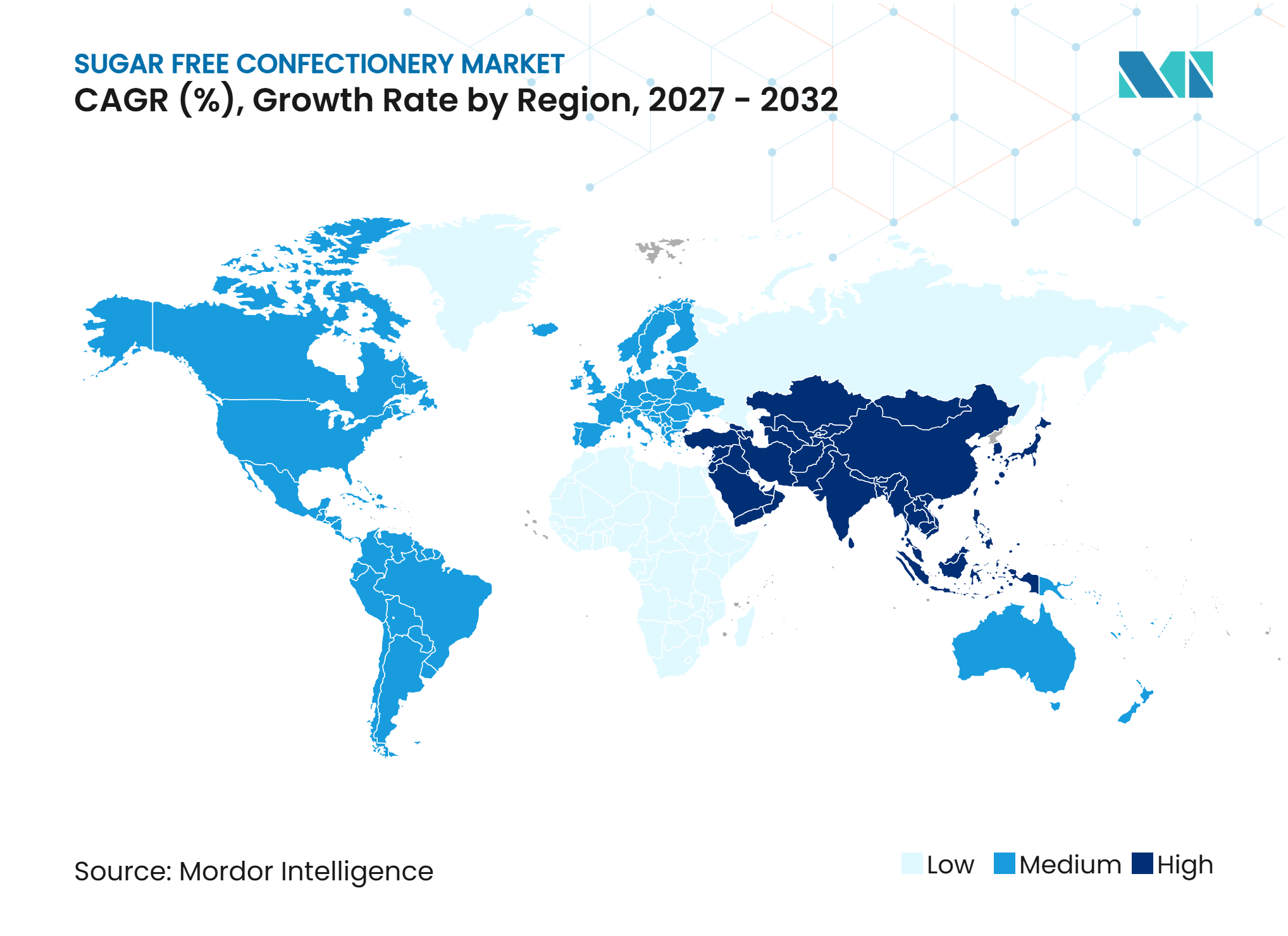
• By geography, North America held 45.17% of the sugar free confectionery market share in 2026, while Asia-Pacific is forecast to expand at a CAGR of 7.12% through 2032.
Note: Market numbers in this report are based on Mordor Intelligence's proprietary estimation framework, which combines nine months of actuals with Q4 projections for base year 2026.
Market Trends and Insights
Drivers Impact Analysis of Sugar Free Confectionery Market*
| Driver | (~) % Impact on CAGR Forecast | Geographic Relevance | Impact Timeline |
|---|---|---|---|
| Health-driven sugar reduction and managed indulgence | +1.5% | Global, strongest in North America and Western Europe | Medium term (2–4 years) |
| Growing awareness of diabetes, obesity and metabolic health | +1.1% | Global, concentrated in North America and Asia-Pacific | Long term (≥ 4 years) |
| Advancements in natural sweetener and polyol systems | +0.9% | Global | Medium term (2–4 years) |
| Growing demand for sugar-free chocolate and confectionery innovation | +0.8% | North America, Europe, and Asia-Pacific | Short term (≤ 2 years) |
| Sweetener blends improving taste, texture and sensory parity | +0.7% | Global, particularly North America and Europe | Medium term (2–4 years) |
| Increasing adoption of sugar-free products among younger consumers | +0.5% | Global, particularly North America and Asia-Pacific | Long term (≥ 4 years) |
| Source: Mordor Intelligence | |||
Health-Driven Sugar Reduction and Managed Indulgence
Consumers are increasingly seeking to reduce sugar consumption while retaining the enjoyment of sweet foods, creating opportunities for sugar-free confectionery products. For instance, in November 2026, according to the International Food Information Council, 76% of Americans were trying to limit or avoid sugar, including 17% who were attempting to avoid it entirely. Additionally, 62% specifically focused on reducing added sugars, highlighting the importance of sugar content in everyday food choices, creating opportunities for manufacturers to develop sugar-free alternatives that retain appealing flavors and sensory experiences [1]. For instance, in June 2026, ITC launched Ultra Mintz, a premium sugar-free mint range in Strong Peppermint and Sensational Strawberry variants, expanding its confectionery portfolio with flavor-led products for convenient, everyday consumption.
Growing Awareness of Diabetes, Obesity and Metabolic Health
Growing awareness of diabetes, obesity, and metabolic health is encouraging consumers to seek confectionery alternatives with reduced or no sugar. For instance, in April 2025, according to the International Diabetes Federation (IDF), approximately 589 million adults worldwide were living with diabetes in 2024, a figure projected to reach 853 million by 2050 [2]. This rising prevalence is increasing awareness of dietary management and sugar consumption, creating opportunities for manufacturers to expand their sugar-free confectionery offerings. For instance, in January 2026, Codeage launched Miracle Candy Sugar-Free soft chews in Salted Caramel and Mixed Berry flavors, formulated with allulose and chicory root prebiotic fiber, with zero grams of sugar and 15 calories per serving.
Advancements in Natural Sweetener and Polyol Systems
Advancements in natural sweetener and polyol systems are helping manufacturers improve the taste, texture, and overall quality of sugar-free confectionery. The development of alternative sweeteners, improved polyol ingredients, and blended formulations provides greater flexibility in replacing sugar while maintaining sweetness, bulk, mouthfeel, and product stability. These ingredients also help address the functional challenges associated with sugar reduction, including sweetness balance, moisture retention, texture, and aftertaste, which are important for delivering a satisfying confectionery experience. Manufacturers are increasingly exploring combinations of high-intensity sweeteners and polyols to achieve more balanced formulations across different product categories.
Growing Demand for Sugar-Free Chocolate and Confectionery Innovation
Growing demand for sugar-free chocolate is encouraging manufacturers to introduce new flavors, formats, and formulations that retain an indulgent eating experience. For instance, in February 2026, according to the Government of the Netherlands, over 70% of European consumers prefer milk chocolate with more cocoa and less sugar [3]. In response, in February 2026, Chocolates Torras expanded its sugar-free ZERO range with White Chocolate with Pistachio and Fleur de Sel, and launched HeyGo!, a no-added-sugar chocolate snack range featuring Crunchy Rice, Roasted Pistachios, and Hazelnuts. The company also added a dark chocolate variant with lemon and lime to its 0% Added Sugars range. These launches reflect how manufacturers are broadening sugar-free chocolate offerings through flavor and format innovation to meet consumer demand for reduced-sugar alternatives.
Restraints Impact Analysis of Sugar Free Confectionery Market*
| Restraint | (~) % Impact on CAGR Forecast | Geographic Relevance | Impact Timeline |
|---|---|---|---|
| Sensory, texture and shelf-life challenges in sugar replacement | -0.6% | Global | Medium term (2–4 years) |
| High formulation costs of specialty sweeteners and sugar-free chocolate | -0.5% | Global, particularly price-sensitive Asia-Pacific and South American markets | Short term (≤ 2 years) |
| Polyol tolerance concerns and mandatory warning labels | -0.4% | Global, particularly Europe and North America | Short to medium term (1–3 years) |
| Limited supplier base for specialty sweeteners | -0.3% | Global, particularly emerging markets dependent on imported ingredients | Medium term (2–4 years) |
| Source: Mordor Intelligence | |||
Sensory, Texture and Shelf-Life Challenges in Sugar Replacement
Replacing sugar in confectionery products presents challenges in maintaining taste, texture, and overall sensory quality. Sugar contributes to sweetness, bulk, moisture retention, and mouthfeel, making it difficult to replicate these product characteristics with alternative sweeteners. Differences in sweetness intensity and aftertaste can affect consumer acceptance. For instance, high-intensity sweeteners such as stevia or sucralose may deliver sweetness at lower concentrations but often lack the bulk and textural properties that sugar provides, requiring the addition of bulking agents such as maltodextrin or polydextrose to compensate. Reformulation may also impact product stability and shelf life, requiring manufacturers to adjust ingredient combinations and processing methods. Sugar-free confectionery products that rely on polyols, for example, may be more susceptible to moisture absorption, which can affect texture and shelf stability over time.
High Formulation Costs of Specialty Sweeteners and Sugar-Free Chocolate
Specialty sweeteners and sugar-free chocolate formulations typically involve higher production costs than conventional confectionery, due to the price of alternative sweeteners, specialized ingredients, and formulation requirements. Alternative sweeteners such as stevia, monk fruit extract, and sugar alcohols are often significantly more expensive than sugar on a per-unit basis, thereby increasing manufacturers' input costs. Replacing sugar while maintaining sweetness, texture, and product stability may require more complex ingredient combinations and processing adjustments, which increase research, development, and manufacturing expenses. For example, sugar contributes not only sweetness but also bulk, moisture retention, and mouthfeel, all of which must be replicated through alternative means in sugar-free formulations.
*Our forecasts treat driver/restraint impacts as directional, not additive. The impact forecasts reflect baseline growth, mix effects, and variable interactions.
Sugar Free Confectionery Market Segment Analysis
By Product Type:
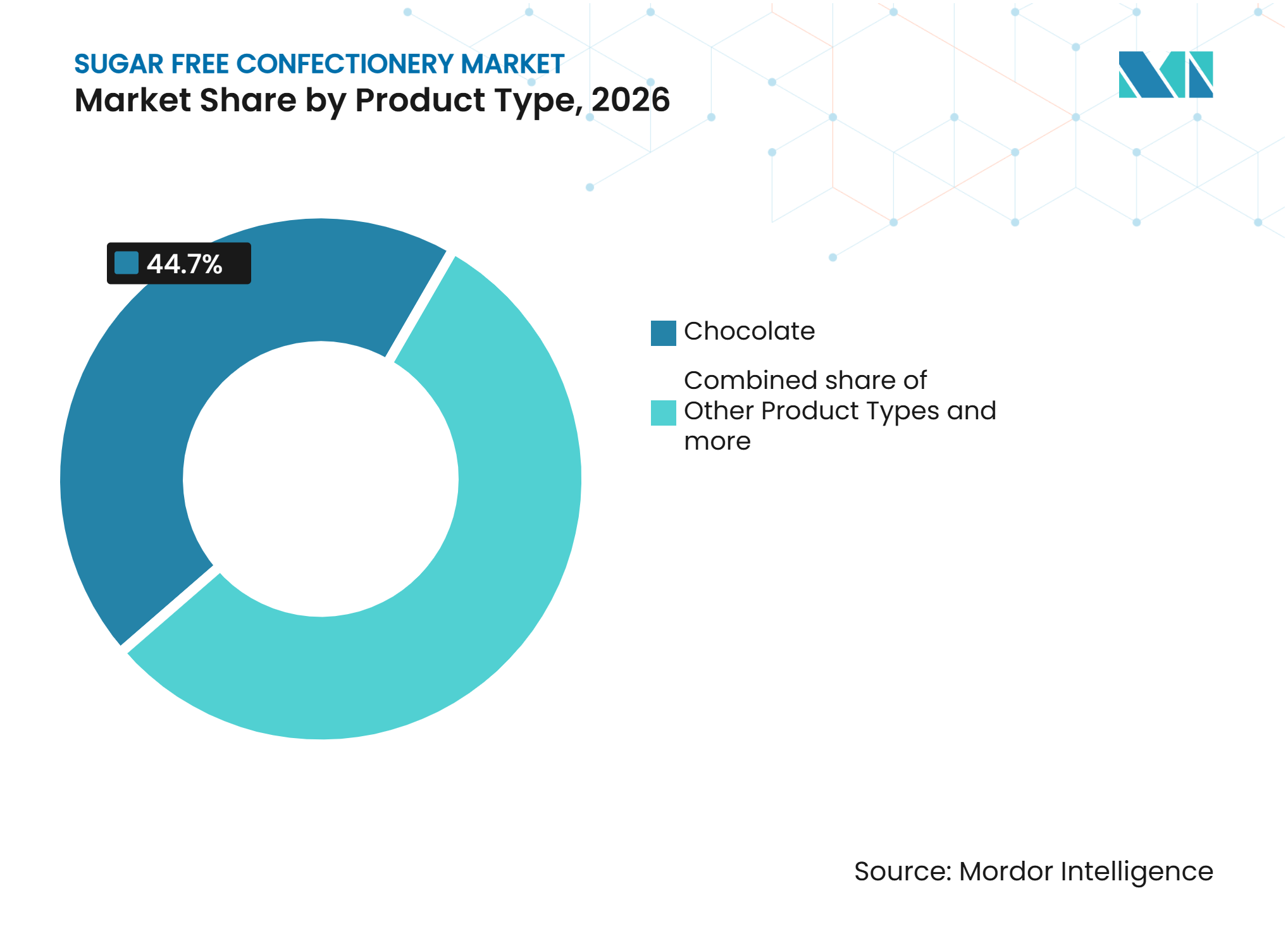
Chocolate Anchors Volume While Other Formats ExpandChocolate held 44.71% of the sugar free confectionery market share in 2026, making it the largest product segment. Chocolate is a key segment in the sugar-free confectionery market, as consumers expect alternatives to deliver the same indulgence, flavor, and texture as conventional chocolate. Reformulating chocolate without sugar is particularly challenging because sugar contributes to sweetness, flavor balance, bulk, texture, and processing characteristics. Replacing sugar requires carefully selected sweeteners and supporting ingredients to maintain product consistency, melting behavior, mouthfeel, and shelf stability. Manufacturers must also manage differences in sweetness intensity, cooling sensations, and aftertaste to ensure the finished product meets consumer expectations.
Other product types are forecast to expand at a CAGR of 6.61% through 2032. Non-chocolate confectionery represents a growing segment within the sugar-free confectionery market, supported by opportunities to introduce alternative sweeteners, new flavors, and differentiated product formats. Products such as gummies, hard candies, chewing gum, and mints allow manufacturers to offer reduced-sugar alternatives while retaining familiar consumption experiences. Reformulation also provides scope to incorporate functional positioning and product attributes that appeal to consumers seeking convenient confectionery options. However, replacing sugar requires careful formulation to maintain sweetness, texture, appearance, chewiness, and overall product consistency. Differences in sweetener profiles can influence aftertaste and sensory quality, making consumer acceptance and repeat purchases dependent on how closely sugar-free products match conventional alternatives.



By Packaging Type:
Single-Serve Retains Reach While Multipacks Build Household DemandSingle-serve held 61.12% of the sugar free confectionery market share in 2026. Small packs represent the largest packaging segment in the sugar-free confectionery market due to their convenience, portability, and suitability for frequent, on-the-go consumption. Their compact format supports distribution across convenience stores, checkout counters, vending locations, and other retail environments where impulse purchases are common. Smaller pack sizes also support better portion control, allowing consumers to manage their intake of sugar-free confectionery and polyol-based products. This format enables manufacturers to offer a wide range of products while maintaining accessibility and convenience across different confectionery categories. It also helps retailers optimize shelf space and accommodate a broader product assortment.
Multipacks are forecast to expand at a CAGR of 6.24% through 2032. Multipacks support the growth of sugar-free confectionery by catering to planned household purchases and regular at-home consumption. Unlike smaller packs that are often associated with impulse buying, multipacks encourage consumers to purchase products in larger quantities for repeated consumption and household replenishment. This format also provides manufacturers with opportunities to strengthen product visibility and encourage brand loyalty through bundled offerings and differentiated product combinations. The growth of digital retail further supports multipack sales through promotional bundles, subscription options, and recurring purchases. Manufacturers can also use exclusive flavor combinations and product assortments to differentiate multipacks and maintain perceived value.
By Category:
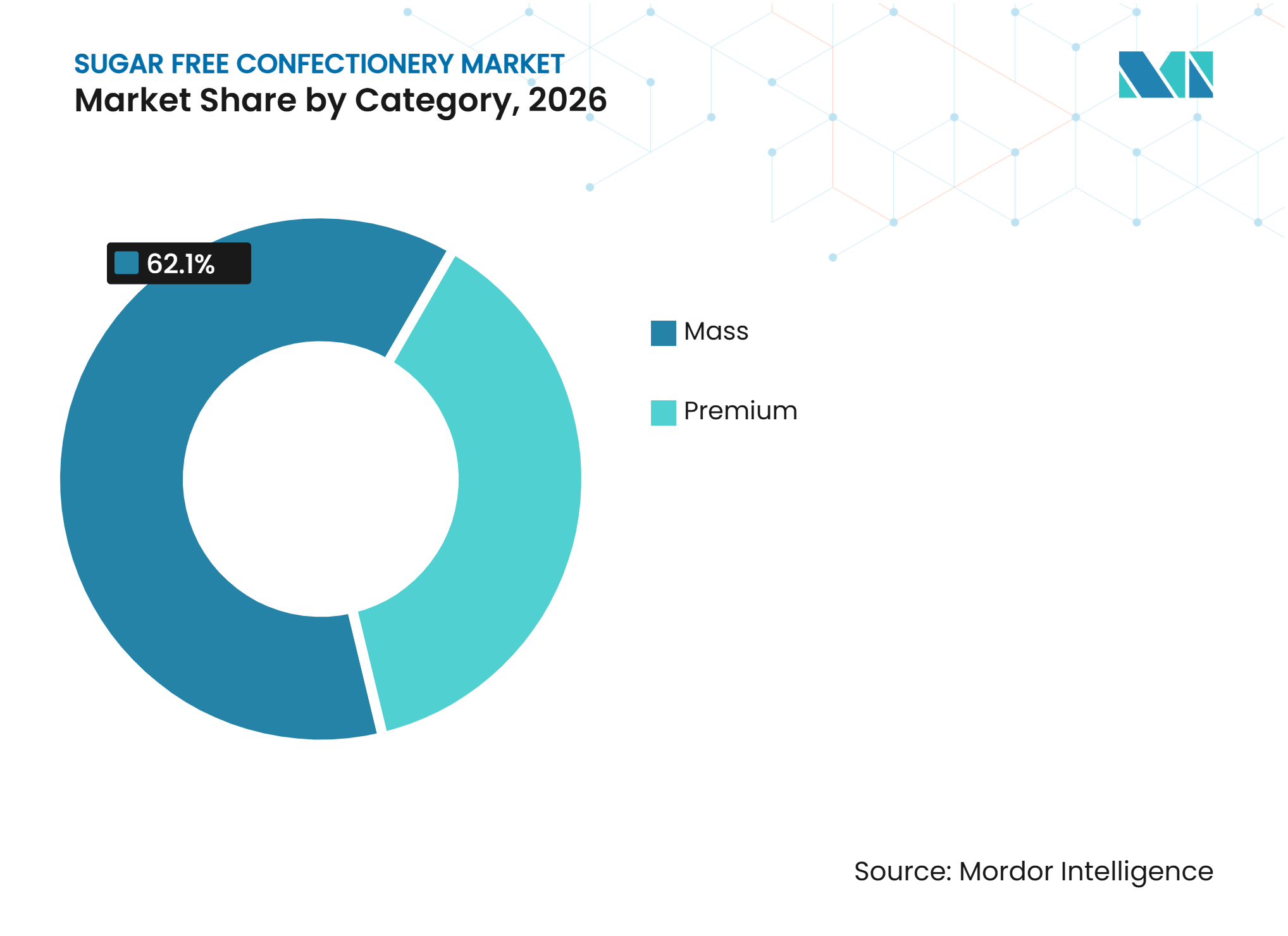
Mass Products Lead While Premium Products Grow FasterMass held 62.11% of the sugar free confectionery market share in 2026. Supermarkets and hypermarkets play an important role in distributing sugar-free confectionery through their broad product assortments, established retail networks, and extensive consumer reach. Established manufacturers can extend recognized confectionery brands into sugar-free variants, making them widely accessible across grocery and mainstream retail outlets. The availability of familiar brands encourages consumer trial and supports the adoption of sugar-free alternatives. Well-organized shelf displays help shoppers compare product varieties, ingredients, and prices, supporting informed purchasing decisions. Private-label offerings further expand the range of accessible products, while established brands reinforce consumer preference through consistent taste, attractive packaging, and reliable availability.
Premium is projected to expand at a CAGR of 7.01% through 2032. Premium sugar-free confectionery is gaining traction as consumers increasingly prioritize ingredient transparency, product quality, and distinctive sensory experiences. This segment allows manufacturers to strengthen brand positioning through clean-label formulations, alternative sweeteners, and high-quality ingredients. Premium offerings can also incorporate functional attributes and innovative flavor profiles that align with consumer preferences and product requirements. These characteristics help brands differentiate their products and create greater perceived value. Continued improvements in taste, texture, and formulation quality further support consumer acceptance and brand loyalty.

By Distribution Channel:
Off-Trade Provides Scale While On-Trade Develops New OccasionsOff-trade held 80.12% of the sugar free confectionery market share in 2026. Off-trade channels remain the primary route to consumers in the sugar-free confectionery market, supported by the extensive reach of supermarkets, hypermarkets, convenience stores, pharmacies, and specialist retailers. These outlets provide convenient access to a broad range of products and allow consumers to compare brands, flavors, ingredients, and packaging options. Pharmacies and specialist health retailers also offer opportunities to reach consumers who actively seek products aligned with their dietary preferences. The expansion of digital retail further strengthens off-trade distribution by enabling manufacturers to offer wider product assortments, communicate ingredient and nutritional information, and reach consumers beyond the locations served by their physical retail networks.
On-trade is forecast to expand at a CAGR of 6.11% through 2032. On-trade channels offer growth opportunities for sugar-free confectionery as foodservice operators expand their product offerings across cafés, restaurants, gifting, and specialty consumption occasions. These settings allow manufacturers to introduce sugar-free products to consumers through ready-to-consume formats and curated product selections. Partnerships with foodservice operators also create opportunities to develop professional pack sizes and products suited to display, serving, and delivery requirements. Product availability in cafés and other foodservice outlets can strengthen brand visibility, encourage product discovery, and support subsequent retail purchases.
Geography Analysis
North America
North America held 45.17% of the sugar free confectionery market share in 2026. North America holds a strong position in the sugar-free confectionery market, supported by established retail infrastructure, broad product availability, and growing access to lower-sugar food choices. The United States offers manufacturers multiple distribution channels, including supermarkets, pharmacy chains, specialty retailers, and online platforms. Established confectionery brands can extend their product portfolios with sugar-free alternatives, while specialist brands can reach consumers through health-focused retail channels and direct-to-consumer platforms. Consumer familiarity with low-carb and keto-oriented products also supports awareness of and interest in sugar-free confectionery. The expansion of e-commerce further improves market accessibility by allowing brands to offer wider product assortments, communicate ingredient information, and engage directly with consumers.
Asia-Pacific
Asia-Pacific is projected to expand at a CAGR of 7.12% through 2032. Asia-Pacific is a high-growth region in the sugar-free confectionery market, supported by rising consumer awareness of sugar intake, expanding retail infrastructure, and evolving product preferences. Markets such as China, India, Japan, South Korea and Southeast Asian countries offer opportunities for manufacturers to expand their product presence through different retail channels and product positioning strategies. Growing awareness of diabetes and dietary management is strengthening interest in lower-sugar alternatives, while rising demand for premium confectionery is encouraging the introduction of innovative flavors and formulations. The expansion of modern retail, pharmacy networks, and e-commerce is also improving product accessibility and broadening consumer reach. Increasing regulatory attention to sugar-alcohol labeling further encourages manufacturers to strengthen formulation expertise, ingredient transparency, and packaging information.
Europe, South America, and Middle East and Africa
Europe's sugar-free confectionery market is supported by consumer familiarity with reduced-sugar products, established retail networks, and a well-defined food labeling framework. Clear food information requirements encourage manufacturers to maintain transparent ingredient declarations and communicate product characteristics effectively. South America presents opportunities through growing health awareness among urban consumers and the expanding availability of alternative confectionery products. In the Middle East and Africa, premium, vegan, halal-certified, and lower-sugar offerings provide opportunities to address diverse consumer preferences and strengthen product differentiation. Across these regions, manufacturers can expand their presence by adapting product formats, pricing strategies, flavors, and packaging to local market requirements.
Competitive Landscape
Market Concentration
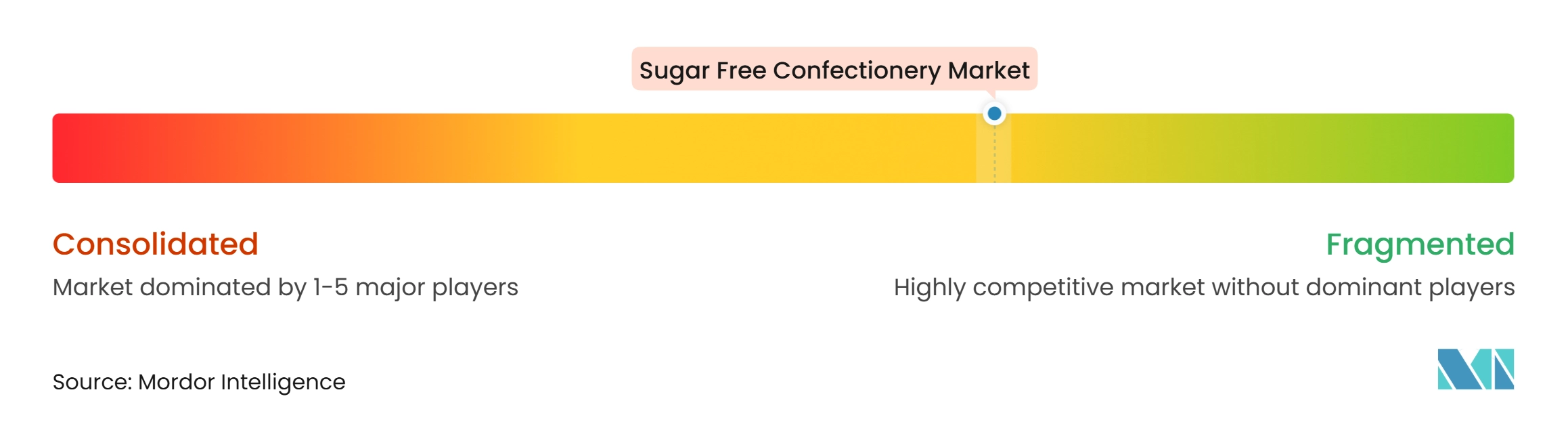
The sugar-free confectionery market is moderately consolidated, with established multinational manufacturers maintaining a strong presence through recognised brands, broad distribution networks and extensive product portfolios. These companies are expanding their sugar-free offerings across familiar confectionery formats while strengthening their focus on product innovation and changing consumer preferences. Specialist brands also contribute to market competition through differentiated formulations, ingredient transparency and premium product positioning. Strategic acquisitions and portfolio expansions further strengthen companies' market presence and provide opportunities to access new product categories, manufacturing capabilities and consumer segments.
Ingredient sourcing and formulation expertise remain important competitive factors, as manufacturers seek to deliver appealing taste, texture and product stability while reducing sugar content. Developments in alternative sweeteners, including stevia-based ingredients, monk fruit and polyol systems, provide manufacturers with greater flexibility in product formulation. Ingredient suppliers also support confectionery producers through specialised sweetener solutions that help balance sweetness, sensory quality and formulation costs. Product innovation across established and specialist brands further encourages competition through new flavours, improved formulations and differentiated product offerings.
Strategic partnerships, acquisitions and regional expansion continue to influence the competitive landscape by strengthening manufacturing capabilities, distribution reach and product development expertise. Established companies benefit from their existing market presence, while smaller brands create opportunities through specialised product portfolios and direct-to-consumer channels. Growing attention to ingredient transparency, nutritional information and food labelling requirements also encourages manufacturers to strengthen product communication and regulatory compliance. Overall, competition is shaped by brand recognition, formulation capabilities, product innovation, distribution networks and the ability to respond to evolving consumer preferences.
Sugar Free Confectionery Industry Leaders
-
The Hershey Company
-
Mars, Incorporated
-
Perfetti Van Melle Group B.V.
-
August Storck KG
-
Chocoladefabriken Lindt & Sprüngli AG (Russell Stover Chocolates, LLC)
- *Disclaimer: Major Players sorted in no particular order
Sugar Free Confectionery Market Companies Covered in this Report
- The Hershey Company
- Mars, Incorporated
- Perfetti Van Melle Group B.V.
- August Storck KG
- Chocoladefabriken Lindt & Sprüngli AG (Russell Stover Chocolates, LLC)
- Albanese Confectionery Group, Inc.
- The Hershey Company (Lily's Sweets, LLC)
- ChocZero Inc.
- Zolli Candy
- Dr. John's Healthy Sweets LLC
- Abdallah Candies Inc.
- Berkshire Hathaway Inc. (See's Candies, Inc.)
- Atkinson Candy Company
- Sugarlean Pty Ltd (Sugarless Confectionery)
- Asher's Chocolate Co.
- Diabetic Candy.com, LLC
- ROY chocolatier
- Artici Artisanal Foods Pvt Ltd (Artinci)
- Taffy Town, Inc.
- Xlear, Inc. (Spry)
Recent Industry Developments in Sugar Free Confectionery Market
- June 2026: ITC launched Ultra Mintz, a premium sugar-free mint range in Strong Peppermint and Sensational Strawberry variants. The products are positioned for convenient, on-the-go freshness and are available through quick-commerce platforms and select retail stores.
- February 2026: Nestlé expanded its POLO Sugar-Free range with Extra Strong Mint and Berry Mint flavors. Both variants are zero-sugar and vegan-friendly, adding new flavor options to its sugar-free mint portfolio
- May 2025: Perfetti Van Melle introduced Trident Vibes Cotton Candy, a sugar-free chewing gum with a cotton candy flavor. The product was made available to U.S. retailers following an exclusive launch at a major mass retail chain
Global Sugar Free Confectionery Market Report Scope
The sugar free confectionery market comprises confectionery products formulated without sugar, using alternative sweeteners to maintain sweetness, flavor, and texture while offering alternatives to conventional sweets. The market is segmented by Product Type, Packaging Type, Category, Distribution Channel, and Geography. By Product Type, the market is divided into Chocolate, Chewing Gum, Mints, and Other Product Types. By Packaging Type, the market is divided into Single-serve and Multipacks. By Category, the market is divided into Mass and Premium. By Distribution Channel, the market is divided into On-trade and Off-trade, with Off-trade further divided into Supermarkets and Hypermarkets, Convenience Stores, Pharmacies/Drug Stores, and Other Distribution Channels. By Geography, the market is divided into North America, Europe, Asia-Pacific, South America, and the Middle East and Africa, with further country-level segmentation. Market forecasts are provided in value terms (USD) for each segment.
Segmentation Overview
| Chocolate |
| Chewing Gum |
| Mints |
| Other Product Types |
| Single-serve |
| Multipacks |
| Mass |
| Premium |
| On-trade | |
| Off-trade | Supermarkets and Hypermarkets |
| Convenince Store | |
| Pharmacies/Drug Stores | |
| Other Distribution Channels |
| North America | United States |
| Canada | |
| Mexico | |
| Rest of North America | |
| Europe | United Kingdom |
| Germany | |
| France | |
| Italy | |
| Spain | |
| Netherlands | |
| Poland | |
| Belgium | |
| Sweden | |
| Rest of Europe | |
| Asia-Pacific | China |
| Japan | |
| India | |
| Australia | |
| Indonesia | |
| South Korea | |
| Thailand | |
| Singapore | |
| Rest of Asia-Pacific | |
| South America | Brazil |
| Argentina | |
| Colombia | |
| Chile | |
| Peru | |
| Rest of South America | |
| Middle East and Africa | South Africa |
| Saudi Arabia | |
| United Arab Emirates | |
| Nigeria | |
| Egypt | |
| Morocco | |
| Turkey | |
| Rest of Middle East and Africa |
| By Product Type | Chocolate | |
| Chewing Gum | ||
| Mints | ||
| Other Product Types | ||
| By Packaging Type | Single-serve | |
| Multipacks | ||
| By Category | Mass | |
| Premium | ||
| By Distribution Channel | On-trade | |
| Off-trade | Supermarkets and Hypermarkets | |
| Convenince Store | ||
| Pharmacies/Drug Stores | ||
| Other Distribution Channels | ||
| By Geography | North America | United States |
| Canada | ||
| Mexico | ||
| Rest of North America | ||
| Europe | United Kingdom | |
| Germany | ||
| France | ||
| Italy | ||
| Spain | ||
| Netherlands | ||
| Poland | ||
| Belgium | ||
| Sweden | ||
| Rest of Europe | ||
| Asia-Pacific | China | |
| Japan | ||
| India | ||
| Australia | ||
| Indonesia | ||
| South Korea | ||
| Thailand | ||
| Singapore | ||
| Rest of Asia-Pacific | ||
| South America | Brazil | |
| Argentina | ||
| Colombia | ||
| Chile | ||
| Peru | ||
| Rest of South America | ||
| Middle East and Africa | South Africa | |
| Saudi Arabia | ||
| United Arab Emirates | ||
| Nigeria | ||
| Egypt | ||
| Morocco | ||
| Turkey | ||
| Rest of Middle East and Africa | ||
Key Questions Answered in the Report
What is the market size of sugar free confectionery?
The sugar free confectionery market is estimated to reach USD 2.51 billion in 2026, increasing to USD 2.64 billion in 2027. The market is projected to reach USD 4.12 billion by 2032, registering a CAGR of 5.23% during 2027–2032.
Which product type leads sugar-free confectionery sales?
Chocolate led 44.71% share in 2026 as it combines familiar indulgence with a lower-sugar proposition.
What is driving demand for sugar free confectionery?
Demand is supported by sugar-reduction goals, greater awareness of metabolic health, and improvements in sweetener systems.
Which region is growing fastest for sugar free confectionery?
Asia Pacific is forecast to expand at a CAGR of 7.12% through 2032, supported by health awareness, modern retail, and large consumer markets.