
Sucralose Market Size and Share
Market Overview
| Study Period | 2027 - 2032 |
|---|---|
| Market Size (2027) | USD 1.21 Billion |
| Market Size (2032) | USD 1.66 Billion |
| Growth Rate (2027 - 2032) | 6.59 % |
| Fastest Growing Market | Asia-Pacific |
| Largest Market | Europe |
| Market Concentration | Medium |
Major Players *Disclaimer: Major Players sorted in no particular order Image © Mordor Intelligence. Reuse requires attribution under CC BY 4.0. | |
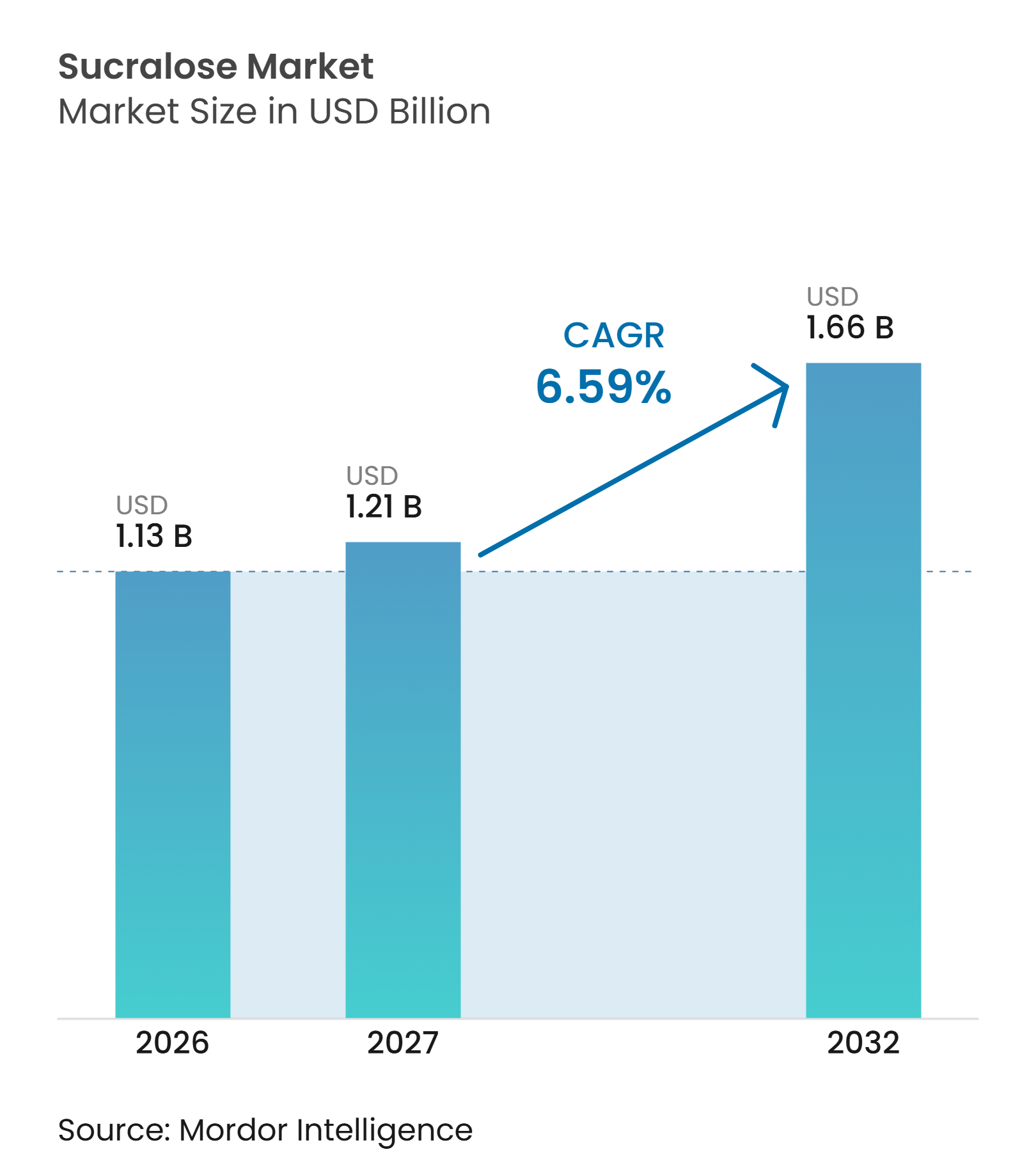
Sucralose Market Analysis by Mordor Intelligence
The sucralose market size is expected to increase from USD 1.13 billion in 2026 to USD 1.21 billion in 2027 and reach USD 1.66 billion by 2032, growing at a CAGR of 6.59% over 2027–2032. Market growth is supported by rising demand for sugar reduction across food and beverage formulations, increasing prevalence of diabetes and obesity, and expanding applications in pharmaceutical products. Powder remains the leading form, accounting for 62.37% of the market in 2026, owing to its established use in food processing and formulation applications, while liquid sucralose is projected to grow at the fastest CAGR of 8.22% through 2032. Food grade dominates by grade with a 71.58% share, whereas pharmaceutical grade is expected to record the fastest growth at 7.35%. Food and beverages represent the largest application segment, accounting for 71.87% of the market, supported by demand for sugar-free and reduced-sugar beverages, bakery products, confectionery, and tabletop sweeteners. Pharmaceuticals are projected to be the fastest-growing application, with a CAGR of 7.91%, driven by the use of sucralose in oral drug formulations. Geographically, Europe holds the largest market share at 38.92% in 2026, while Asia-Pacific is expected to register the fastest growth at 8.62% through 2032. However, regulatory scrutiny of artificial sweeteners, competition from natural alternatives, raw material and manufacturing cost volatility, and growing clean-label preferences may influence market expansion. Competitive positioning therefore depends on regulatory compliance, product quality, manufacturing capabilities, and the ability to serve diverse food, pharmaceutical, and personal care applications.
Key Report Takeaways
- By form, powder accounted for the largest share of the sucralose market at 62.37% in 2026, while liquid sucralose is projected to record the fastest growth at an 8.22% CAGR over 2027–2032.
- By grade, food grade dominated with a 71.58% market share in 2026, while pharmaceutical grade is forecast to grow fastest at a 7.35% CAGR over 2027–2032.
- By application, food and beverages accounted for the largest share at 71.87% in 2026, while pharmaceuticals are expected to register the fastest growth at a 7.91% CAGR over 2027–2032.
- Among geographies, Europe led with a 38.92% share of the sucralose market in 2026, while Asia-Pacific is projected to grow fastest at an 8.62% CAGR over 2027–2032.
Note: Market numbers in this report are based on Mordor Intelligence's proprietary estimation framework, which combines nine months of actuals with Q4 projections for base year 2026.
Market Trends and Insights
Drivers of Sucralose Market*
| Driver | (~) % Impact on CAGR Forecast | Geographic Relevance | Impact Timeline |
|---|---|---|---|
| Rising prevalence of diabetes and obesity supporting sugar reduction | +1.1% | Global, particularly North America and Europe, where demand for sugar-reduced food and beverage products is established, with growing opportunities across Asia-Pacific | Medium term (2–4 years) |
| Increasing demand for sugar-free and reduced-sugar beverages and packaged foods | +0.9% | Global, particularly North America, Europe and Asia-Pacific, supported by product reformulation and expanding sugar-reduction initiatives | Short term (Less than 2 years) |
| Functional advantages driving sucralose adoption in food and beverage formulations | +0.8% | Global, particularly North America and Europe, where sucralose is used across beverages, bakery, confectionery and tabletop sweetener applications | Medium term (2–4 years) |
| Expansion of functional and specialized nutrition products | +0.7% | Global, particularly North America, Europe and Asia-Pacific, where manufacturers are expanding sugar-free and specialized nutrition product portfolios | Medium term (2–4 years) |
| Growing pharmaceutical applications of sucralose in oral drug formulations | +0.5% | Global, particularly North America, Europe and Asia-Pacific, supported by demand for palatable oral pharmaceutical formulations | Long term (More than 4 years) |
| Source: Mordor Intelligence | |||
Rising Prevalence of Diabetes and Obesity Supporting Sugar Reduction
The increasing focus on managing obesity, diabetes, and other diet-related health conditions is encouraging food and beverage manufacturers to explore sugar-reduction solutions. The World Health Organization (WHO) recommends limiting free sugar intake to less than 10% of total daily energy intake for adults and children, with a further reduction to below 5% suggested for additional health benefits. Higher free sugar consumption is associated with unhealthy weight gain and increased risks of noncommunicable diseases. Sucralose provides manufacturers with a high-intensity sweetening alternative, as it is more sweeter than table sugar and can deliver sweetness using substantially smaller quantities. Its use in reduced-sugar formulations allows manufacturers to develop products targeting consumers seeking lower-sugar alternatives while retaining sweetness. These factors support demand for sucralose across beverages, packaged foods, and other food applications.[1]
Functional Advantages Driving Sucralose Adoption in Food and Beverage Formulations
Sucralose's high sweetness intensity, low-calorie contribution, and heat stability support its adoption across different food and beverage formulations. According to the United States Food and Drug Administration (FDA), sucralose is approximately 600 times sweeter than table sugar and remains sweet at high temperatures, making it suitable for applications such as baked goods. The FDA also recognizes its use across several food categories, including beverages, chewing gum, gelatins, and frozen dairy desserts.[2]These functional properties allow manufacturers to incorporate sucralose into products requiring sweetness without relying entirely on conventional sugar. Its versatility across processing conditions and product categories provides opportunities for ingredient suppliers to serve a broader range of food manufacturers. Consequently, established formulation capabilities and compatibility with multiple applications support the commercial adoption of sucralose.
Expansion of Functional and Specialized Nutrition Products
The expansion of reduced-calorie, sugar-free, and specialized nutrition products is creating additional opportunities for sucralose suppliers. Food manufacturers are increasingly using high-intensity sweeteners in formulations designed to reduce added sugar and calorie content while maintaining the desired sweetness profile. The FDA identifies sucralose among the high-intensity sweeteners used as sugar alternatives and notes that these ingredients can contribute few or no calories to foods and beverages. The agency also indicates that high-intensity sweeteners generally do not raise blood glucose levels. These characteristics make sucralose relevant to manufacturers developing specialized food formulations, including reduced-calorie products and products targeting consumers monitoring their sugar intake. The continued development of specialized nutrition portfolios therefore provides opportunities for sucralose adoption across food processing applications.[3]
Increasing Demand for Sugar-Free and Reduced-Sugar Beverages and Packaged Foods
The growing emphasis on reducing sugar content in packaged foods and beverages is encouraging manufacturers to reformulate existing products using alternative sweetening ingredients. The WHO recommends reducing free sugar consumption and identifies food labelling, consumer education, and regulatory measures targeting products high in free sugars as potential public health interventions. Sucralose is already permitted by the FDA for use as a general-purpose sweetener across various food categories, including beverages, baked goods, and frozen dairy desserts.[4] Its high sweetness intensity enables manufacturers to achieve the desired sweetness with smaller quantities compared with conventional sugar. This makes it a relevant ingredient for developing sugar-free and reduced-sugar soft drinks, ready-to-drink beverages, confectionery, and packaged food products. Continued product reformulation and the introduction of reduced-sugar product variants are expected to support demand for sucralose across food and beverage manufacturing.
Growing Pharmaceutical Applications of Sucralose in Oral Drug Formulations
The use of sucralose in pharmaceutical formulations provides an additional avenue for market expansion, particularly in oral medicines where taste and palatability influence product acceptability. Certain active pharmaceutical ingredients have bitter or unpleasant tastes, creating formulation challenges for manufacturers developing oral liquids, chewable tablets, and dispersible dosage forms. Research available through the National Institutes of Health's PubMed Central database identifies sucralose among the sweeteners traditionally incorporated into medicinal formulations to help mask the bitter taste of pharmaceutical ingredients. Its sweetening properties make it a useful formulation component in products designed for pediatric and other patient groups requiring palatable oral dosage forms. Growing attention to patient-friendly drug delivery and the development of flavored oral formulations therefore provide opportunities for pharmaceutical-grade sucralose suppliers. However, its suitability in individual medicinal products remains dependent on formulation requirements and applicable pharmaceutical quality standards.[5]
Restraints of Sucralose Market*
| Restraint | (~) % Impact on CAGR Forecast | Geographic Relevance | Impact Timeline |
|---|---|---|---|
| Regulatory scrutiny and health-related concerns regarding artificial sweeteners | −0.9% | Global, particularly Europe and North America, where regulatory assessments and consumer scrutiny of artificial sweeteners influence product formulation and adoption | Medium term (2–4 years) |
| Competition from natural and alternative sweeteners | −0.7% | Global, particularly North America and Europe, with increasing competition across Asia-Pacific from stevia, monk fruit and other alternative sweeteners | Medium term (2–4 years) |
| Volatility in raw material and manufacturing costs | −0.5% | Global, particularly manufacturing hubs in Asia-Pacific and export-dependent markets across Europe and North America | Short term (Less than 2 years) |
| Consumer preference for clean-label ingredients | −0.4% | Global, particularly North America and Europe, where demand for recognizable, naturally derived and minimally processed ingredients influences food and beverage reformulation | Long term (More than 4 years) |
| Source: Mordor Intelligence | |||
Regulatory Scrutiny and Health-Related Concerns Regarding Artificial Sweeteners
Regulatory scrutiny surrounding artificial sweeteners and evolving assessments of their long-term health effects may create uncertainty for sucralose manufacturers and food and beverage companies. Regulatory authorities periodically review scientific evidence concerning sweetener safety, acceptable daily intake levels, and permitted applications. The World Health Organization's 2023 guideline on non-sugar sweeteners recommends against using these ingredients for weight control or reducing the risk of noncommunicable diseases, reflecting concerns about their long-term health benefits. Although this recommendation does not constitute a prohibition on sucralose use, it may influence consumer perceptions and product formulation strategies. Manufacturers must therefore monitor regulatory developments, maintain compliance with food safety requirements, and substantiate product-related claims. Such scrutiny can increase regulatory compliance requirements and create challenges for companies seeking to expand sucralose applications across food, beverage, and pharmaceutical products.
Competition from Natural and Alternative Sweeteners
The growing availability of alternative sweetening ingredients creates competitive pressure for sucralose manufacturers across food and beverage applications. Natural-origin sweeteners such as stevia and monk fruit, alongside other high-intensity sweeteners, provide manufacturers with alternatives for developing reduced-sugar and sugar-free formulations. The United States Food and Drug Administration (FDA) recognizes several high-intensity sweeteners, including steviol glycosides, aspartame, saccharin, and sucralose, for use in permitted food applications. Increasing interest in plant-derived ingredients and clean-label product positioning may encourage manufacturers to evaluate alternatives based on consumer preferences, formulation requirements, and regulatory considerations. This competition can limit sucralose adoption in certain product categories, particularly where natural-origin sweeteners align more closely with brand positioning. Consequently, sucralose suppliers need to maintain competitive pricing, consistent quality, and formulation advantages to retain their position in the sweetener market.
*Our forecasts treat driver/restraint impacts as directional, not additive. The impact forecasts reflect baseline growth, mix effects, and variable interactions.
Sucralose Market Segment Analysis
By Form:
Powder Dominates While Liquid Sucralose Expands FasterIn 2026, powder accounted for an estimated 62.37% of the sucralose market, making it the leading form. Its dominance reflects established demand from food and beverage manufacturers, where powdered sucralose is used in applications such as bakery products, confectionery, tabletop sweeteners, and dry beverage mixes. Its ease of handling, storage, transportation, and incorporation into dry ingredient blends supports its widespread commercial use. Meanwhile, liquid sucralose is projected to record the fastest growth, at an estimated CAGR of 8.22% through 2032. Liquid formulations offer convenient dosing, easier incorporation into liquid products, and flexibility for applications requiring precise sweetener concentrations. These characteristics support their use in beverages, liquid food preparations, and pharmaceutical formulations.
Powdered sucralose remains important for manufacturers requiring stable, easy-to-handle sweetening ingredients for large-scale processing. However, liquid formulations provide opportunities in applications where rapid dissolution, uniform distribution, and precise dosage control are important. Producers across both forms need to maintain sweetness consistency, product purity, and formulation compatibility. The ability to serve different processing requirements across food, beverage, and pharmaceutical applications will remain important for expanding sucralose consumption.



By Grade:
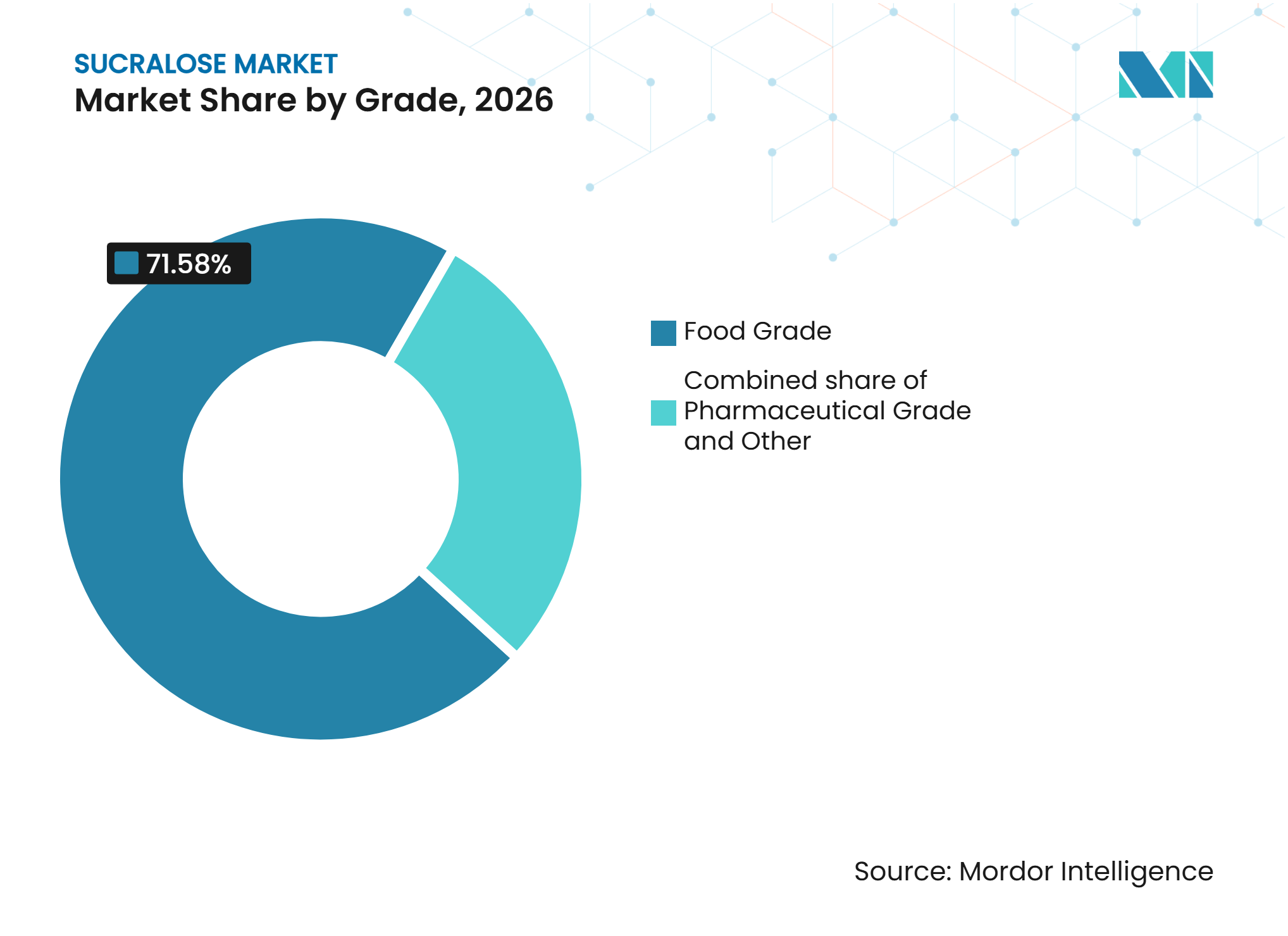
Food Grade Leads While Pharmaceutical Grade Records Faster GrowthIn 2026, food grade accounted for an estimated 71.58% of the sucralose market, making it the leading grade. Its dominance reflects extensive use across food and beverage applications, including beverages, bakery and confectionery products, dairy and frozen desserts, and tabletop sweeteners. Food-grade sucralose enables manufacturers to develop sugar-free and reduced-sugar products while maintaining the desired sweetness profile. Meanwhile, pharmaceutical grade is projected to record the fastest growth, at an estimated CAGR of 7.35% through 2032. Its growth is supported by the use of sucralose as a sweetening excipient in oral pharmaceutical formulations, including syrups, suspensions, chewable tablets, and other medicinal products where taste masking is important.
Other grades serve specialized requirements across applications with different purity, quality, and formulation specifications. However, food-grade products remain the primary commercial category because of their broad applicability across processed foods and beverages. Manufacturers supplying pharmaceutical-grade sucralose need to meet relevant quality and documentation requirements to serve pharmaceutical customers. Maintaining consistent purity, regulatory compliance, and application-specific quality standards will remain important across the different grade categories.
By Application:
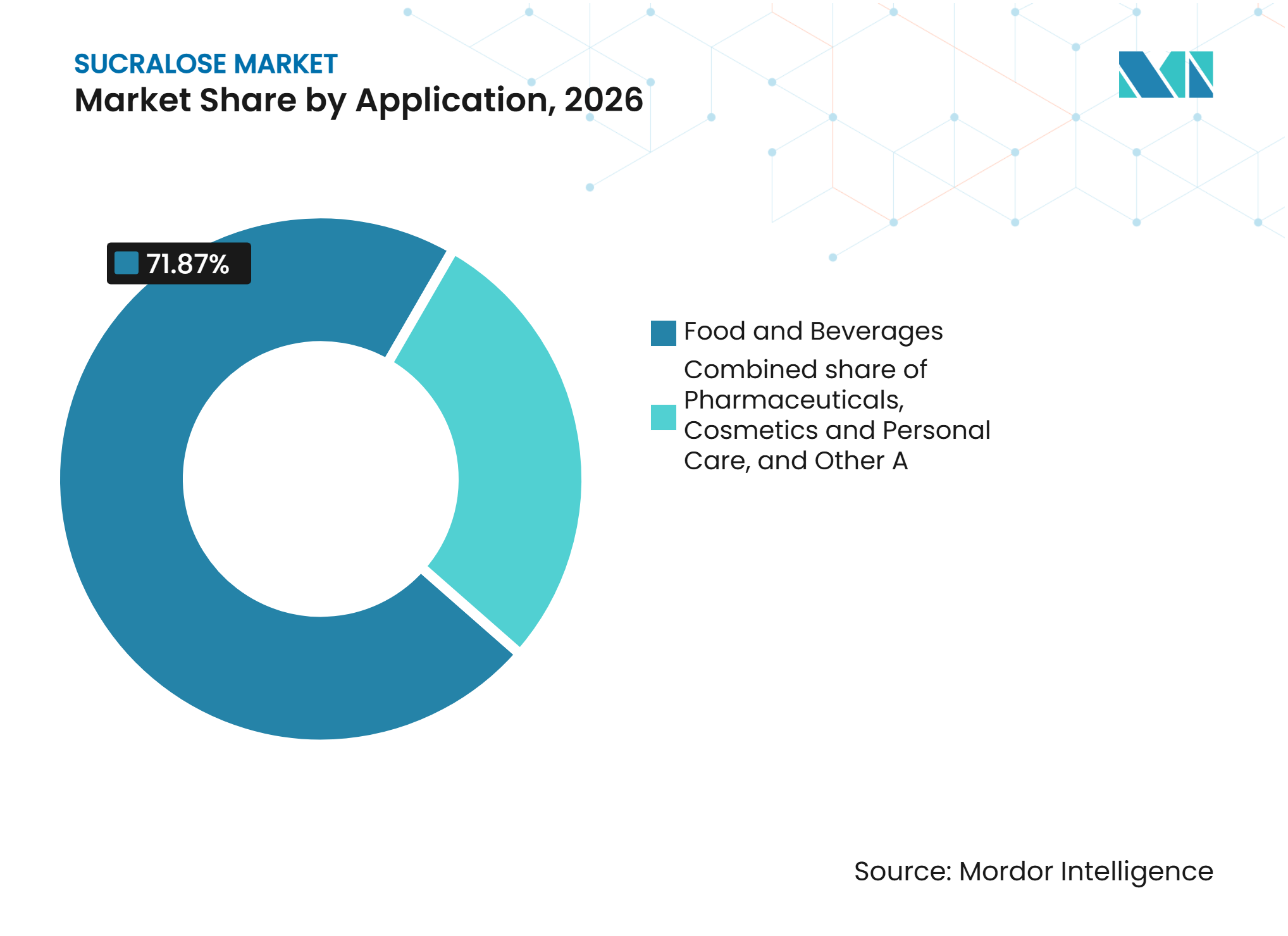
Food and Beverages Dominate While Pharmaceuticals Expand FasterIn 2026, food and beverages accounted for an estimated 71.87% of the sucralose market, making it the largest application segment. Its dominance reflects widespread use of sucralose in beverages, bakery and confectionery products, dairy and frozen desserts, and tabletop sweeteners. Food manufacturers incorporate sucralose into sugar-free and reduced-sugar formulations to achieve the desired sweetness while reducing conventional sugar content. Meanwhile, pharmaceuticals are projected to record the fastest growth, at an estimated CAGR of 7.91% through 2032. This growth is supported by the use of sucralose in oral drug formulations, where sweetening properties help improve the palatability of syrups, suspensions, and other medicinal preparations.
Cosmetics and personal care represent additional application areas, where sucralose may be used in selected formulations depending on product requirements. Other applications contribute to specialized demand across industrial and consumer product categories. However, food and beverage manufacturers remain the primary demand base because of the ingredient's established use across multiple processed food categories. Suppliers capable of meeting different formulation, purity, and regulatory requirements will be better positioned to serve expanding applications across food, beverage, and pharmaceutical industries.

Geography Analysis
Europe Sucralose Market
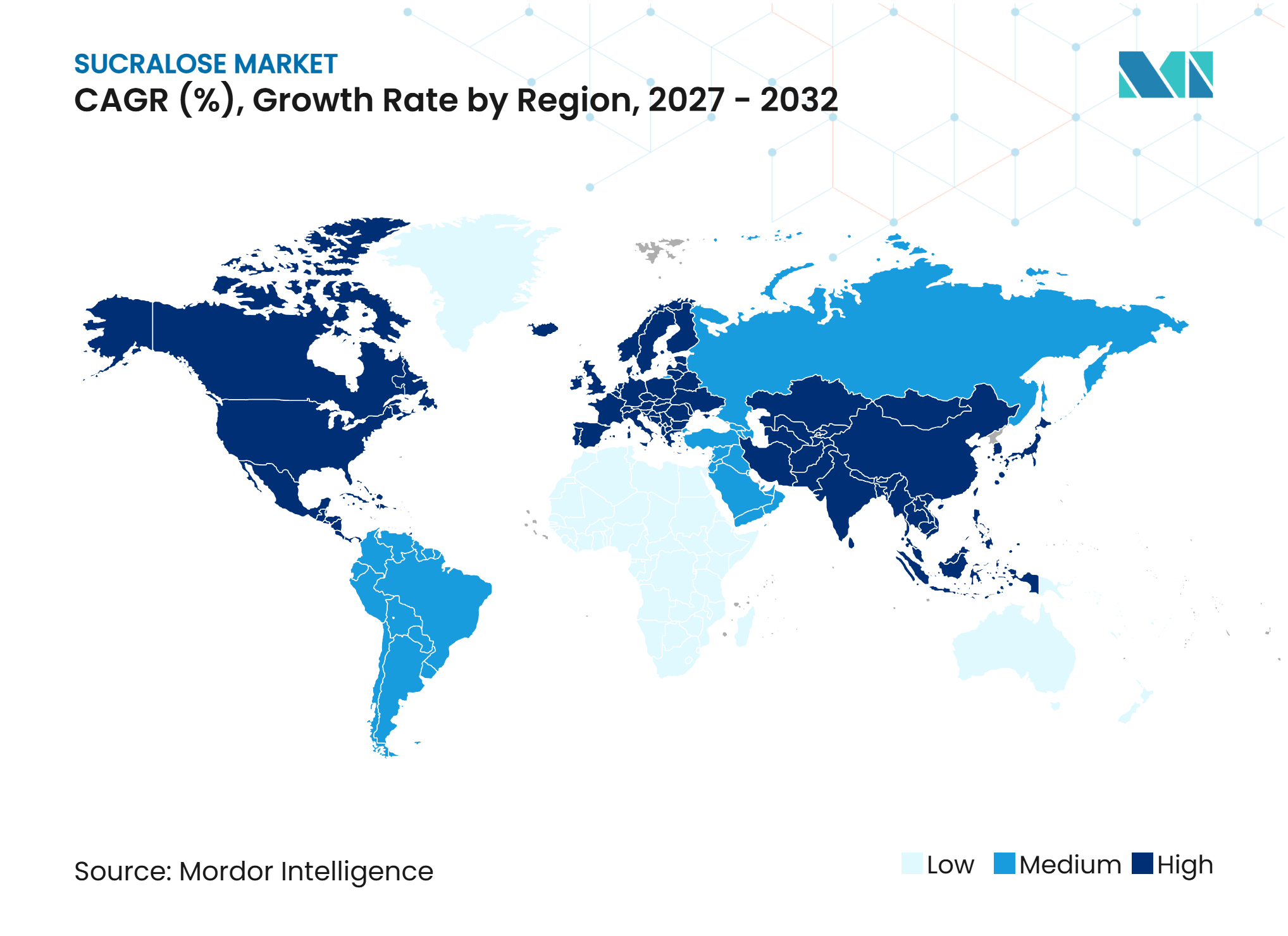
Europe accounted for an estimated 38.90% of the global Sucralose Market in 2026, making it the largest regional market. Demand is supported by the region's established food and beverage manufacturing industry, increasing adoption of reduced-sugar formulations, and applications of high-intensity sweeteners in processed foods, beverages, and pharmaceutical products. Sucralose is authorised as food additive E955 in the European Union across specified food categories, including reduced-sugar beverages, flavoured dairy products, and certain confectionery applications. In February 2026, the European Food Safety Authority (EFSA) completed its re-evaluation of sucralose and confirmed that it remains safe for currently authorised uses, retaining the acceptable daily intake of 15 mg/kg body weight per day.
Asia-Pacific Sucralose Market
Asia-Pacific is projected to be one of the fastest-growing regional markets, with an estimated CAGR of 8.60% during 2026–2032. China plays a particularly important role in the regional market because of its established sucralose manufacturing base and exports to international food ingredient markets. Companies such as Anhui Jinhe Industrial Co., Ltd., Niutang Chemical Ltd., JK Sucralose Inc., Nantong Changhai Food Additive Co., Ltd., and L&P Food Ingredient Co., Ltd. contribute to the region's manufacturing and supply capabilities. India, Japan, South Korea, and Southeast Asian countries provide additional demand opportunities through food processing, beverage manufacturing, pharmaceutical formulations, and sugar-reduction initiatives. BioPlus Life Sciences Pvt. Ltd. also participates in the Indian market through its pharmaceutical ingredient portfolio. China's established production infrastructure and regional demand from food, beverage, and pharmaceutical manufacturers support the development of Asia-Pacific as an important production and consumption centre.
North America, South America, and Middle East and Africa
North America represents an established market for sucralose, supported by its processed food, beverage, pharmaceutical, and tabletop sweetener industries. Demand is driven by the widespread use of high-intensity sweeteners in reduced-sugar and sugar-free product formulations, alongside growing interest in calorie-conscious food and beverage options. The US Food and Drug Administration (FDA) permits sucralose as a general-purpose sweetener in foods under specified conditions of use, including beverages, baked goods, chewing gum, and frozen dairy desserts.
Competitive Landscape
Market Concentration
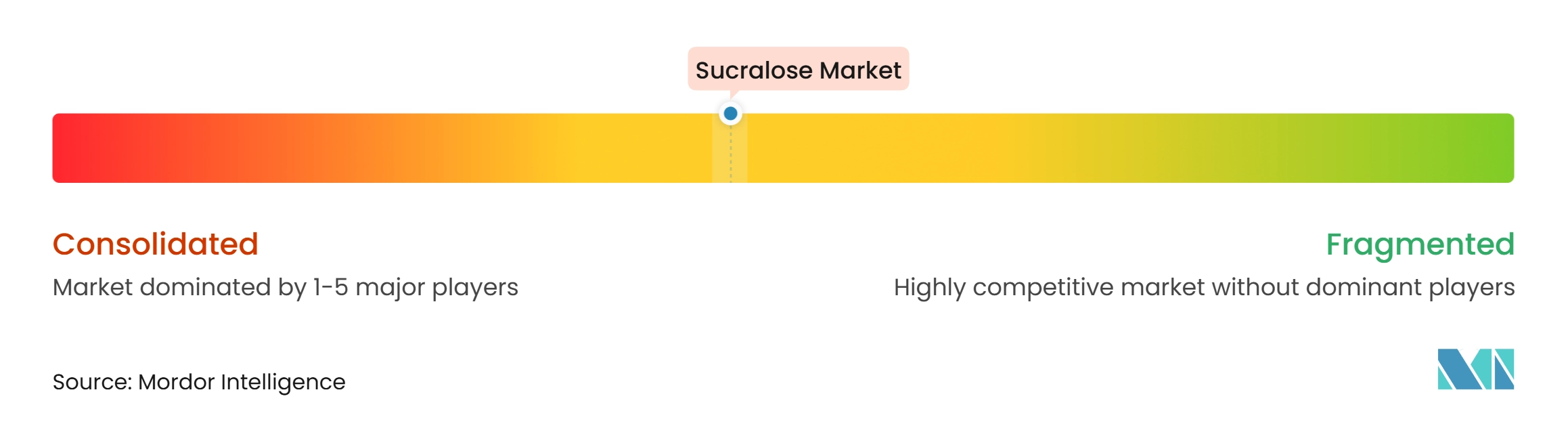
The Sucralose Market includes multinational ingredient companies, specialized high-intensity sweetener manufacturers, pharmaceutical ingredient suppliers, and regional producers competing through manufacturing capabilities, product quality, regulatory compliance, pricing, and distribution networks. The competitive landscape includes companies such as Tate & Lyle PLC, JK Sucralose Inc., Niutang Chemical Ltd., Anhui Jinhe Industrial Co., Ltd., Techno Sucralose Co., Ltd., BioPlus Life Sciences Pvt. Ltd., and L&P Food Ingredient Co., Ltd. These companies have varying levels of exposure to the market through sucralose manufacturing, ingredient supply, pharmaceutical-grade products, and branded tabletop sweeteners. While established ingredient companies leverage technical expertise and international customer relationships, specialized manufacturers compete through production capacity, product specifications, and cost-efficient supply.
Competitive strategies in the Sucralose Market focus on expanding sweetener portfolios, strengthening manufacturing capabilities, developing application-specific formulations, and meeting international quality standards. For example, Tate & Lyle markets SPLENDA Sucralose as a high-intensity sweetener for food and beverage formulations, highlighting its sugar-like taste, stability, and compatibility with different processing conditions. Niutang Chemical Ltd. offers sucralose in powder, granule, fine powder, superfine powder, and liquid forms for applications across beverages, dairy products, bakery, confectionery, nutritional supplements, and pharmaceuticals. Similarly, Anhui Jinhe Industrial Co., Ltd. supplies sucralose in different particle sizes and aqueous solution concentrations, supporting its use across processed foods, beverages, healthcare products, and pharmaceutical applications. L&P Food Ingredient Co., Ltd. is also strengthening its pharmaceutical-grade sucralose portfolio, with its pharmaceutical excipient receiving Class A review status from China's National Medical Products Administration in April 2026. These developments demonstrate how manufacturers differentiate through product specifications, application coverage, and regulatory qualifications.
Manufacturing scale, sourcing, quality assurance, and distribution remain important competitive considerations. Chinese manufacturers, including Niutang, Anhui Jinhe, and other specialized producers, benefit from established sweetener manufacturing capabilities and access to international ingredient markets. Meanwhile, JK Sucralose Inc. serves food, beverage, pharmaceutical, and personal-care applications through its sucralose products, while BioPlus Life Sciences offers sucralose within its pharmaceutical ingredient portfolio. Heartland Food Products Group competes further downstream through its Splenda-branded tabletop sweeteners, coffee creamers, and other reduced-sugar consumer products. Companies must maintain consistent product purity, comply with applicable food and pharmaceutical standards, and manage manufacturing costs and supply reliability. Competition is therefore shaped by production efficiency, regulatory compliance, application-specific product development, and the ability to establish long-term relationships with food, beverage, pharmaceutical, and personal-care manufacturers.
Sucralose Industry Leaders
-
Tate & Lyle PLC
-
Niutang Chemical Ltd.
-
Anhui Jinhe Industrial Co., Ltd.
-
BioPlus Life Sciences Pvt. Ltd.
-
L&P Food Ingredient Co., Ltd.
- *Disclaimer: Major Players sorted in no particular order
Sucralose Market Companies Covered in this Report
- COMPANY PROFILES
- Tate & Lyle PLC
- JK Sucralose Inc.
- Niutang Chemical Ltd.
- Anhui Jinhe Industrial Co., Ltd.
- Techno Sucralose Co., Ltd.
- Nantong Changhai Food Additive Co., Ltd.
- Newtrend Group Co., Ltd.
- BioPlus Life Sciences Pvt. Ltd.
- Vitasweet Co., Ltd.
- Unitech Sweet (Zibo) Ltd.
- Hubei Yitai Pharmaceutical Co., Ltd.
- Jiangxi Bentian Food Technology Co., Ltd.
- L&P Food Ingredient Co., Ltd.
- Changzhou Hanbang Food Co., Ltd.
- Xiamen Boao Technology Co., Ltd.
- Shandong Kangbao Biochemical Technology Co., Ltd.
- Shandong Runde Biotechnology Co., Ltd.
- Jiangsu Jubang Pharmaceutical Co., Ltd.
- HYET Sweet S.A.S.
- Heartland Food Products Group
Recent Industry Developments in Sucralose Market
- May 2025: Tate & Lyle PLC reported robust demand for its sucralose business in its FY2025 results, with sucralose revenue increasing by 16% and adjusted EBITDA rising by 18%. The performance highlighted continued demand for the ingredient within the company's specialty sweetener portfolio.
- September 2024: Tate & Lyle PLC signed a renewable electricity agreement with Alabama Power to source renewable electricity for its sucralose manufacturing facility in McIntosh, Alabama, through the utility's Renewable Energy Certificates programme. The agreement is expected to reduce the carbon footprint of its sucralose ingredient by more than 20%, supporting the company's operational sustainability targets.
- September 2024: Newtrend Group Holding Co., Ltd. commenced commercial sales of sucralose produced at its Thailand facility, which has a designed annual production capacity of approximately 500 metric tons. The overseas production facility supports the company's strategy to expand international sales and diversify its manufacturing footprint beyond China.
- November 2023: Tate & Lyle Sugars introduced sucralose to its retail sweetener portfolio, expanding its range of low-calorie sweetening options. The launch provided consumers with an aspartame-free alternative for applications such as hot beverages and marked a shift in the company's retail sweetener offering following its rebranding from Zucro.
Global Sucralose Market Report Scope
For this study, the Sucralose Market is defined as the sales value of commercially produced sucralose, a high-intensity artificial sweetener used as a sugar substitute across food and beverages, pharmaceuticals, cosmetics and personal care, and other industrial applications. The market covers sucralose supplied in powder and liquid forms, segmented by grade into food grade, pharmaceutical grade, and other application-specific grades. By application, the market includes food and beverages, pharmaceuticals, cosmetics and personal care, and other applications. Food and beverages are further segmented into beverages, bakery and confectionery, dairy and frozen desserts, tabletop sweeteners, and other food and beverage applications. The market is analyzed across North America, Europe, Asia-Pacific, South America, and the Middle East and Africa, with country-level coverage as specified in the report. Market sizing and forecasts are presented in value terms (USD) across the defined segments and geographies.
Segmentation Overview
| Powder |
| Liquid |
| Food Grade |
| Pharmaceutical Grade |
| Other |
| Food and Beverages | Beverages |
| Bakery and Confectionery | |
| Dairy and Frozen Desserts | |
| Tabletop Sweeteners | |
| Other | |
| Pharmaceuticals | |
| Cosmetics and Personal Care | |
| Other Applications |
| North America | United States |
| Canada | |
| Mexico | |
| Rest of North America | |
| Europe | United Kingdom |
| Germany | |
| France | |
| Italy | |
| Spain | |
| Sweden | |
| Belgium | |
| Poland | |
| Netherlands | |
| Rest of Europe | |
| Asia-Pacific | China |
| Japan | |
| India | |
| Thailand | |
| Singapore | |
| Indonesia | |
| South Korea | |
| Australia | |
| Rest of Asia-Pacific | |
| South America | Brazil |
| Argentina | |
| Colombia | |
| Peru | |
| Chile | |
| Rest of South America | |
| Middle East and Africa | South Africa |
| Saudi Arabia | |
| United Arab Emirates | |
| Turkey | |
| Rest of Middle East and Africa |
| By Form | Powder | |
| Liquid | ||
| By Grade | Food Grade | |
| Pharmaceutical Grade | ||
| Other | ||
| By Application | Food and Beverages | Beverages |
| Bakery and Confectionery | ||
| Dairy and Frozen Desserts | ||
| Tabletop Sweeteners | ||
| Other | ||
| Pharmaceuticals | ||
| Cosmetics and Personal Care | ||
| Other Applications | ||
| By Geography | North America | United States |
| Canada | ||
| Mexico | ||
| Rest of North America | ||
| Europe | United Kingdom | |
| Germany | ||
| France | ||
| Italy | ||
| Spain | ||
| Sweden | ||
| Belgium | ||
| Poland | ||
| Netherlands | ||
| Rest of Europe | ||
| Asia-Pacific | China | |
| Japan | ||
| India | ||
| Thailand | ||
| Singapore | ||
| Indonesia | ||
| South Korea | ||
| Australia | ||
| Rest of Asia-Pacific | ||
| South America | Brazil | |
| Argentina | ||
| Colombia | ||
| Peru | ||
| Chile | ||
| Rest of South America | ||
| Middle East and Africa | South Africa | |
| Saudi Arabia | ||
| United Arab Emirates | ||
| Turkey | ||
| Rest of Middle East and Africa | ||
Key Questions Answered in the Report
What is the size of the sucralose market?
The sucralose market is estimated at USD 1.13 billion in 2026 and is projected to reach USD 1.66 billion by 2032.
What is the CAGR of the sucralose market?
The sucralose market is expected to register a CAGR of 6.59% during the forecast period of 2027–2032.
Which segment holds the largest share of the sucralose market?
The food grade segment holds the largest share of the sucralose market, accounting for 71.58% in 2026, followed by food and beverages in the application category at 71.87%.
Which region is expected to witness the fastest growth in the sucralose market?
Asia-Pacific is expected to be the fastest-growing region in the sucralose market, registering a CAGR of 8.62% during 2027–2032.