
Subsea Manifolds Market Size and Share
Market Overview
| Study Period | 2022 - 2032 |
|---|---|
| Market Size (2027) | USD 5.89 Billion |
| Market Size (2032) | USD 8.12 Billion |
| Growth Rate (2027 - 2032) | 6.62 % |
| Fastest Growing Market | Asia-Pacific |
| Largest Market | North America |
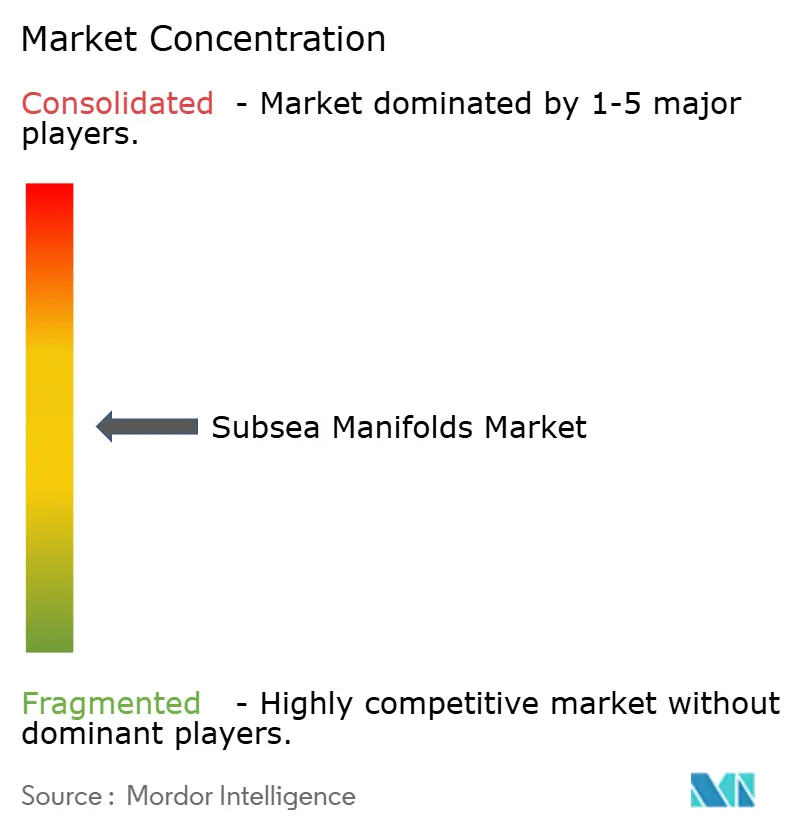
| Market Concentration | Medium |
Major Players *Disclaimer: Major Players sorted in no particular order Image © Mordor Intelligence. Reuse requires attribution under CC BY 4.0. | |
Subsea Manifolds Market Analysis by Mordor Intelligence
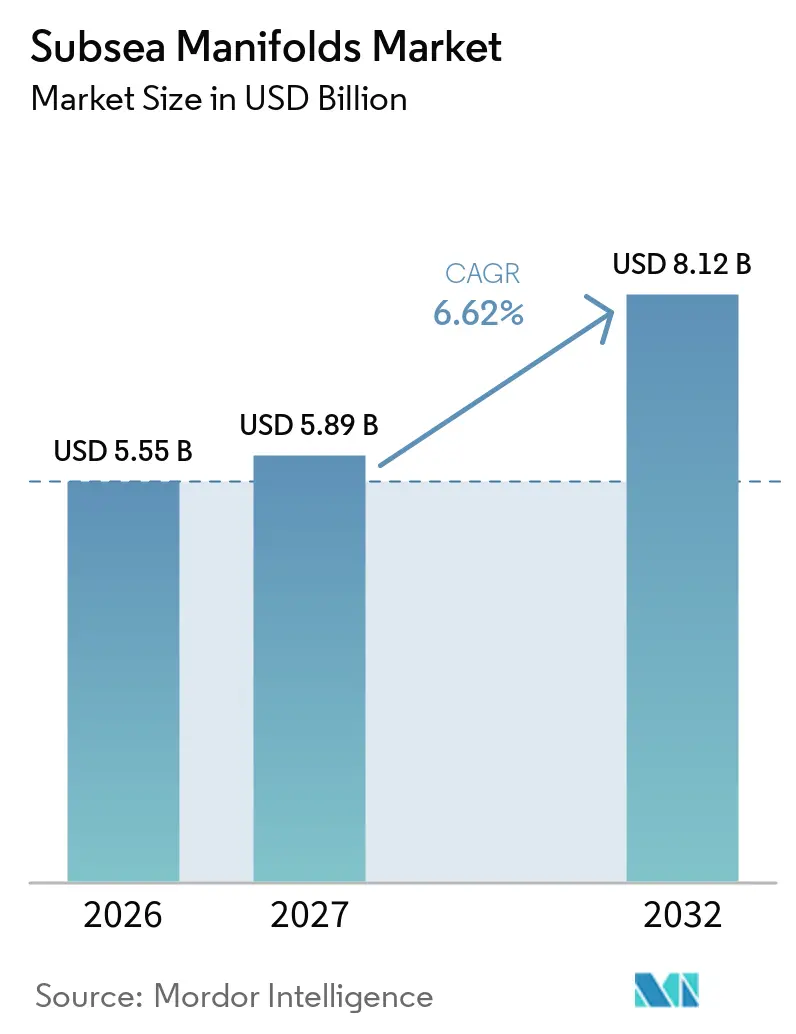
The Subsea Manifolds Market size is expected to increase from USD 5.55 billion in 2026 to USD 5.89 billion in 2027 and reach USD 8.12 billion by 2032, growing at a CAGR of 6.62% over 2027-2032. The subsea manifolds market is supported by deeper offshore developments, where operators need equipment that can link several wells and manage production, injection, and control functions from the seabed. Integrated subsea contracts are changing procurement because manifold supply is increasingly bundled with trees, controls, flowlines, and installation services. Water injections are widening the role of these systems because operators need to sustain reservoir pressure without adding topside constraints. All-electric controls and embedded monitoring are moving manifold design toward more digital operating models, although qualification work and vessel availability can slow adoption. The subsea manifolds market also remains exposed to offshore investment decisions, since delays before final investment decisions can postpone long-lead equipment orders.
Key Report Takeaways
- By type, template manifolds held 43.7% share in 2026, while cluster manifolds recorded the highest projected CAGR at 7.2% through 2032.
- By application, oil production held 64.6% share in 2026, while water injection recorded the highest projected CAGR at 7.6% through 2032.
- By water depth, deepwater held 42.3% share in 2026, while ultra-deepwater recorded the highest projected CAGR at 8.1% through 2032.
- By configuration, horizontal manifolds held 39.2% share in 2026, while multi-spool manifolds recorded the highest projected CAGR at 7.5% through 2032.
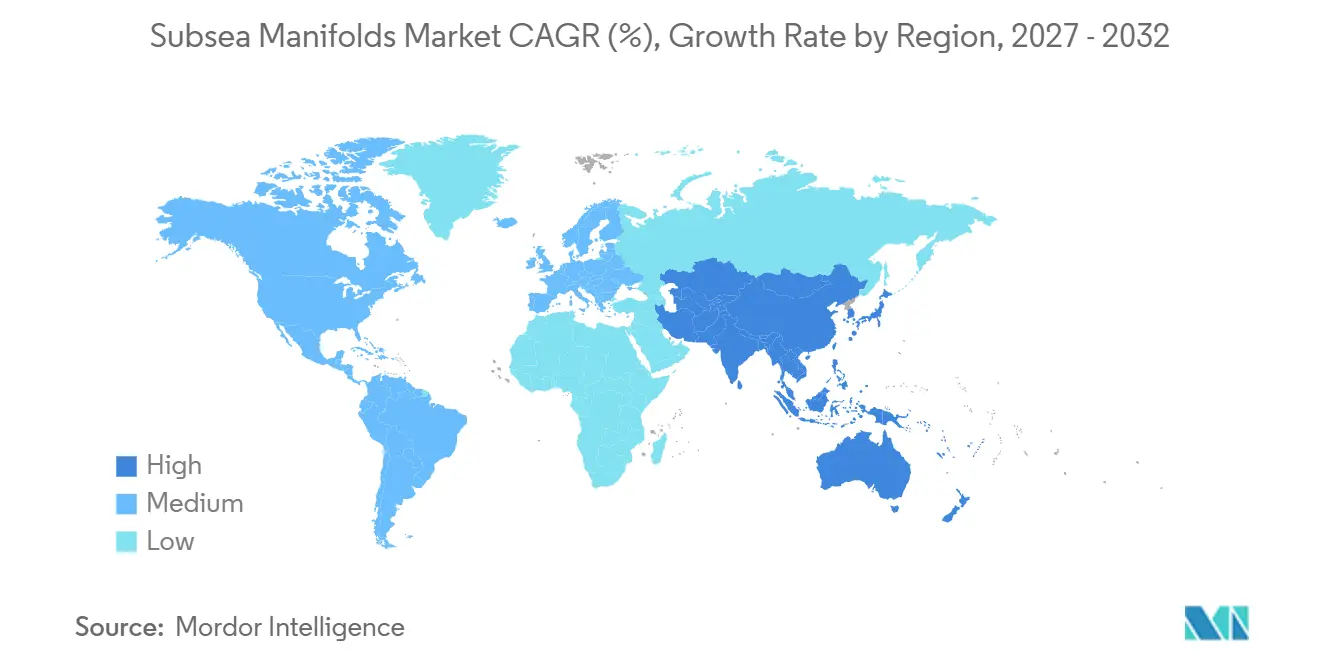
- By geography, North America held 31.8% share in 2026, while Asia-Pacific recorded the highest projected CAGR at 7.9% through 2032.
Note: Market numbers in this report are based on Mordor Intelligence's proprietary estimation framework, which combines nine months of actuals with Q4 projections for base year 2026.
Market Trends and Insights
Drivers Impact Analysis of Subsea Manifolds Market*
| Driver | (~) % Impact on CAGR Forecast | Geographic Relevance | Impact Timeline |
|---|---|---|---|
| Expansion of Deepwater and Ultra-Deepwater Developments | +2.1% | Global, concentrated in the Gulf of Mexico, Brazil pre-salt, West Africa, and Southeast Asia | Long term (≥ 4 years) |
| Increasing Subsea Tieback and Brownfield Reuse Projects | +1.6% | North America, Western Europe, and Asia-Pacific | Medium term (2-4 years) |
| Demand for Improved Recovery From Complex Offshore Reservoirs | +1.0% | Brazil, the Gulf of Mexico, and Middle East transition zones | Medium term (2-4 years) |
| Modularization and Standardization of Subsea Architectures | +0.8% | Global, with early gains in Brazil and West Africa | Short term (≤ 2 years) |
| Compact Robotic and Electrically Actuated Manifolds | +0.6% | Western Europe, Asia-Pacific, and ultra-deepwater projects | Long term (≥ 4 years) |
| Digital Monitoring for Intervention-Avoidance Decisions | +0.5% | Gulf of Mexico, North Sea, and Southeast Asia | Medium term (2-4 years) |
| Source: Mordor Intelligence | |||
Expansion of Deepwater and Ultra-Deepwater Developments
Deepwater project sanctions in 2025 and 2026 expanded the pipeline for complex subsea equipment across major offshore basins. TechnipFMC received an award for ExxonMobil Guyana’s Hammerhead project in September 2025, including Subsea 2.0 production systems and manifolds, which marked its seventh consecutive greenfield award from ExxonMobil Guyana.[1] The repeat award pattern shows how standardized equipment can support a consistent development model across related projects in the subsea manifolds market. TechnipFMC also received an Engineering, Procurement, Construction, and Installation (EPCI) award for Eni’s Coral North Floating Liquefied Natural Gas (FLNG) development offshore Mozambique in December 2025, with a scope that included subsea manifolds and infrastructure at water depths near 2,000 meters.[2] These developments raise the technical requirements for suppliers, while creating a larger base of projects for the subsea manifolds market. The move into deeper water also favors suppliers that can integrate engineering, fabrication, controls, and installation within one delivery model.
Increasing Subsea Tieback and Brownfield Reuse Projects
Tieback projects are increasingly important in mature offshore basins because they use existing host infrastructure and reduce the need for new surface facilities. Equinor’s Fram Sør development includes 12 wells tied back to the Troll C platform, and Subsea7 received the related offshore Norway contract in July 2025.[3] Worley Rosenberg later received a fabrication contract for 34 subsea structures, including pipeline end terminations, for the same development.[4] These projects support demand for cluster modules that can connect satellite wells to active production networks without interrupting operations in the subsea manifolds market. In the North Sea, bp started production from the Murlach tieback to the Eastern Trough Area Project (ETAP) hub in October 2025, showing how existing facilities can support incremental output. The subsea manifolds market benefits when operators choose these lower-footprint development paths, although the equipment mix is often different from large greenfield projects.
Compact Robotic and Electrically Actuated Manifolds
All-electric controls are changing the design requirements of subsea manifold systems. A 2025 OTC Brasil paper described a validated all-electric multi-turn actuator for manifold production valves that operated at torque levels up to 2,700 Nm within existing subsea electronic module power limits. The approach removes part of the hydraulic infrastructure and supports condition data collection through embedded sensing in the subsea manifolds market. Equinor’s Fram Sør project selected electric extended-reach tree technology, with qualification work focused on valve control and condition monitoring. Baker Hughes has also introduced an all-electric subsea production system that uses a single electrical line in place of several hydraulic lines. For the subsea manifolds market, this shift makes control-system integration a more central part of a supplier’s offering rather than a separate support activity.
Digital Monitoring for Intervention-Avoidance Decisions
Digital monitoring helps operators move from planned intervention schedules toward maintenance decisions based on equipment condition. Baker Hughes included Cordant asset protection and condition monitoring technology in its 2026 Kutei Northern Hub award in Indonesia. The system is intended to identify equipment issues before they cause unplanned downtime across the subsea manifolds market. SLB OneSubsea’s raw water injection work for pre-salt floating production units also incorporates live monitoring capabilities for subsea equipment. A peer-reviewed 2025 study reported that a Chinese 500-meter manifold with integrated control and monitoring achieved a localization rate above 91%, indicating that digital integration capabilities are expanding beyond established suppliers. This capability is valuable where intervention costs are high and system uptime has a direct effect on field economics.
Restraints Impact Analysis of Subsea Manifolds Market*
| Restraint | (~) % Impact on CAGR Forecast | Geographic Relevance | Impact Timeline |
|---|---|---|---|
| High Capital and Installation Costs | -1.2% | Global, with the strongest effect in ultra-deepwater developments | Long term (≥ 4 years) |
| Volatility in Offshore Exploration and Production Investment | -0.9% | Global, especially frontier regions with limited infrastructure | Short term (≤ 2 years) |
| Limited Availability of Specialized Installation Capacity | -0.5% | Gulf of Mexico, West Africa, and Southeast Asia | Medium term (2-4 years) |
| Qualification and Cybersecurity Risks in Digitally Integrated Manifolds | -0.3% | Global, especially the North Sea and Gulf of Mexico | Medium term (2-4 years) |
| Source: Mordor Intelligence | |||
High Capital and Installation Costs
Ultra-deepwater manifold systems require engineering, qualification, fabrication, and specialized installation, which increases total project costs. The cost burden is more pronounced for smaller developments because subsea equipment can represent a large share of the overall production system budget. Modular platforms can lower engineering repetition and shorten delivery schedules, but they do not remove the expense of deepwater installation. Remotely operated vehicle work and specialist vessel deployment remain necessary for complex installations at greater water depths. This can limit participation by smaller operators and make short-duration projects harder to justify in the subsea manifolds market. The subsea manifolds market therefore depends on designs that preserve reliability while reducing installation time and lifecycle cost.
Volatility in Offshore Exploration and Production Investment
Oil price sensitivity continues to influence offshore capital planning, particularly for projects that have not reached a final investment decision. Petrobras adjusted its capital plan in late 2025 amid lower oil-price expectations, while it confirmed the final investment decision for SEAP II in January 2026. This difference between sanctioned projects and early-stage developments creates an uneven order outlook for long-lead equipment in the subsea manifolds market. Approved projects can proceed through procurement with greater certainty, while pre-sanction projects may be delayed when capital discipline tightens. The effect is most visible where operators lack existing infrastructure or have limited project portfolios. Suppliers must balance manufacturing capacity against the risk that prospective awards will shift into later periods.
*Our forecasts treat driver/restraint impacts as directional, not additive. The impact forecasts reflect baseline growth, mix effects, and variable interactions.
Subsea Manifolds Market Segment Analysis
By Type:
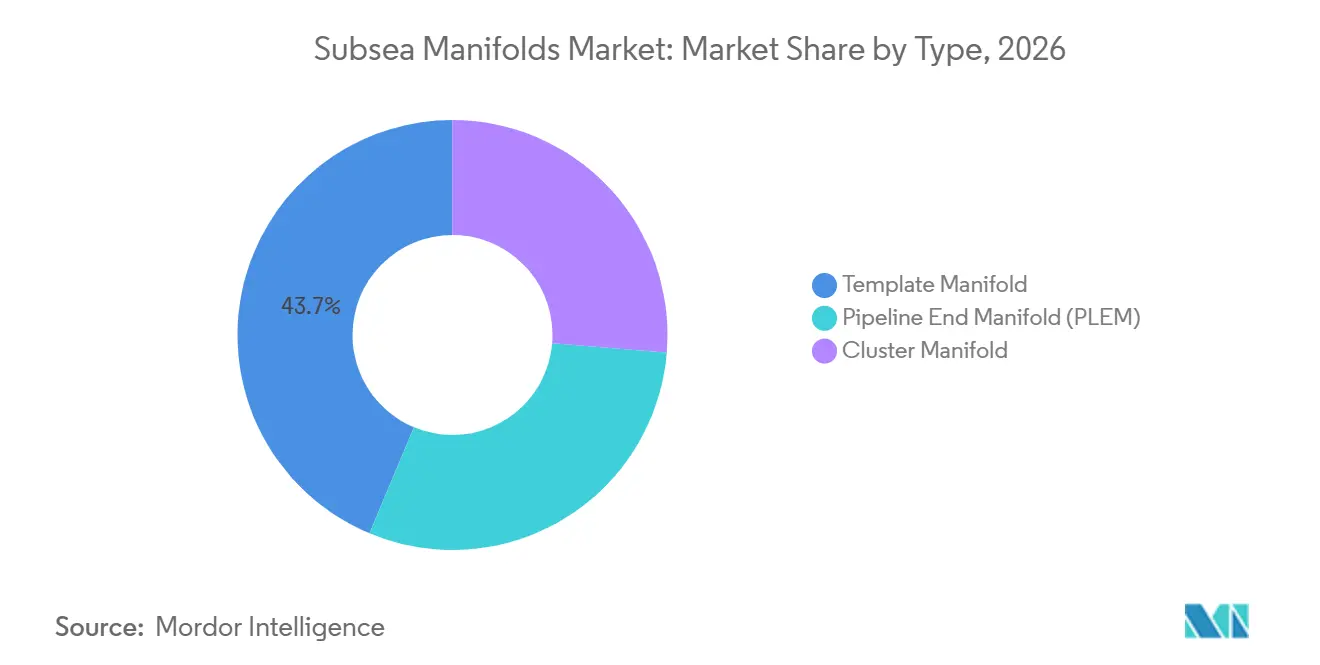
Configure-to-Order Platforms Reshape Procurement EconomicsTemplate manifolds held 43.7% of the subsea manifolds market share in 2026 because large greenfield developments need centralized control over production from several wells. A single template manifold can aggregate output from 4–6 wells, which supports the scale of large pre-salt and Guyana developments. This role is difficult to replace where field layouts require several wells to connect to one central production system. Template designs also suit projects that need common interfaces across trees, controls, and flowlines. Their established engineering base can reduce execution risk for large developments. The subsea manifolds industry relies on these systems where operators prioritize high-volume production and long field lives. Their position remains strong even as alternative designs become more common in smaller projects.
Cluster manifolds are forecast to grow at 7.2% through 2032 as tieback projects require compact modules that fit into existing umbilical and flowline networks. These modules can support satellite wells without disrupting nearby production. Pipeline end manifolds (PLEMs) serve a separate role at field boundaries and export pipeline connections. Worley Rosenberg’s Fram Sør scope includes 34 subsea structures with PLEMs and pipeline end terminations, with delivery planned for the first half of 2027. Standardized component libraries are narrowing the cost difference between template and cluster designs. This supports configure-to-order procurement for mid-tier deepwater projects. It also allows suppliers to apply common components across several manifold types. The subsea manifolds market gains from this approach because operators can select modules that suit the scale and timing of individual tieback wells.

By Application:
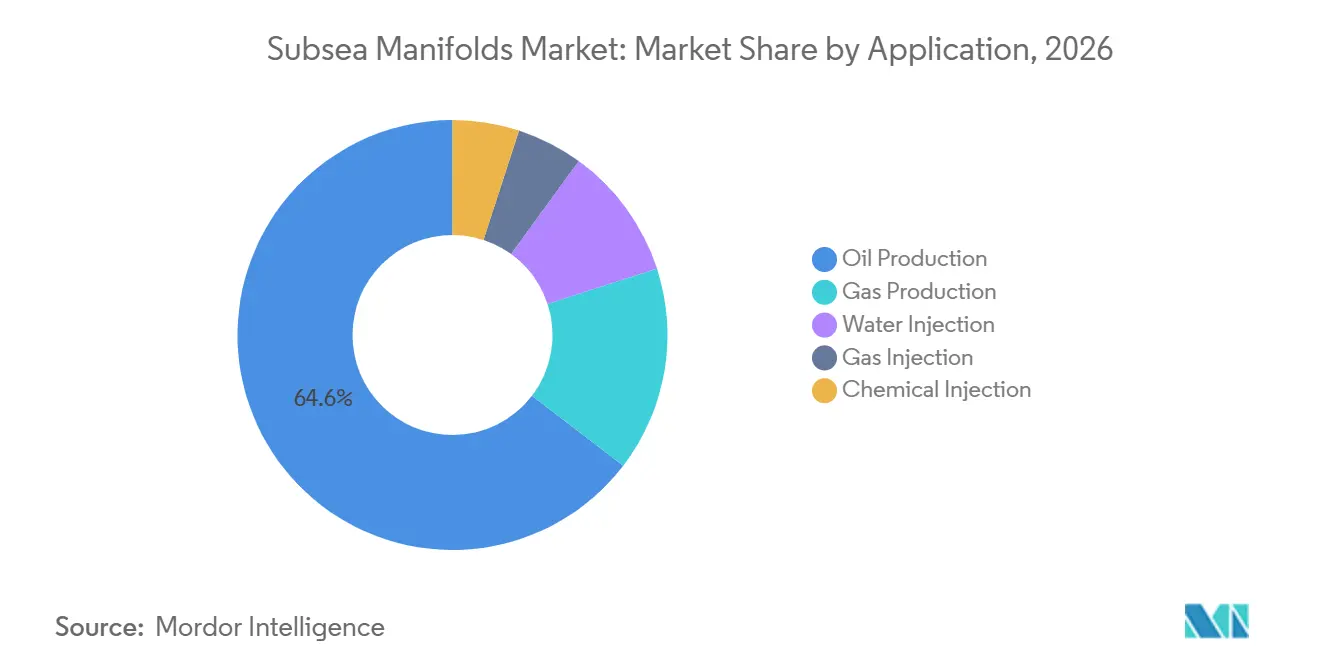
Water Injection Expands the Manifold’s Functional ScopeOil production accounted for 64.6% of the subsea manifolds market size in 2026 because manifolds remain core infrastructure for gathering hydrocarbons from multiple subsea wells. Gas production provides a secondary demand base, particularly in deepwater LNG projects in Mozambique, Indonesia, and Malaysia. Gas-focused systems require designs suited to their operating conditions and project interfaces. Oil production applications continue to anchor demand for template and cluster designs. Their importance reflects the central role of subsea systems in offshore production layouts. The segment also benefits from projects that combine production and injection requirements in one development plan.
Water injection is forecast to grow at 7.6% through 2032, making it the fastest-growing application in the subsea manifolds market. Subsea raw water injection for pre-salt floating production units can deliver up to 11,000 cubic meters per day at 255 bar overpressure directly from the seabed. The approach can reduce topside energy consumption by 10-25% and move injection capacity away from surface constraints. bp’s Atlantis Major Facility Expansion added 2 subsea water injection wells in July 2026 and extended reservoir management capacity. Chemical injection supports flow assurance, while gas injection supports pressure maintenance. Both applications require attention to corrosion resistance, chemical compatibility, and valve design. These uses broaden the range of technical requirements placed on manifold suppliers.
By Water Depth:
Ultra-Deepwater Redefines the Technical CeilingDeepwater held 42.3% share in 2026, supported by activity in the Gulf of Mexico, the Norwegian Continental Shelf, and Brazil’s Santos Basin. These regions have established deepwater infrastructure and experienced supply chains. Their installed base supports continued use of conventional deepwater production systems. Shallow water remains relevant in mature fields, especially in the Middle East and Southeast Asia. Its share is declining as new greenfield investment moves into deeper areas. Deepwater projects remain important because they combine proven development approaches with substantial resource potential.
Ultra-deepwater is forecast to grow at 8.1% through 2032 as projects move into more demanding water depths. Coral North offshore Mozambique involves subsea infrastructure at water depths near 2,000 meters. Petrobras approved SEAP II in the Sergipe-Alagoas basin in January 2026, adding another large subsea development to the project pipeline. Systems deployed at these depths must meet American Petroleum Institute (API) 17D pressure requirements and the updated ISO 13628-1:2025 design baseline. Intervention at these depths can require specialized diving support vessels and complex logistics. Digital condition monitoring can therefore have greater value when it helps avoid an intervention. The subsea manifolds industry faces higher entry barriers as equipment specifications become more demanding.
By Manifold Configuration:
Multi-Spool Architecture Enables Incremental Capacity AdditionHorizontal manifolds held 39.2% of the subsea manifolds market size in 2026 due to their installation simplicity and established use with conventional subsea umbilicals, risers, and flowlines. Their valve arrangement suits high-production-rate applications where flow symmetry and access are important. The design is familiar to operators and installation teams. Horizontal systems are also compatible with many established deepwater layouts. This supports their role in large production developments across the subsea manifolds market. Their installed base provides a practical advantage where operators prefer established operating methods.
Multi-spool manifolds are forecast to grow at 7.5% through 2032 because they can connect additional wells without replacing the main manifold structure. This supports phased field development and makes capital deployment more flexible for the subsea manifolds market. Vertical manifolds can reduce the seabed footprint at constrained tieback locations. Single-spool designs serve simpler satellite applications in shallow water and marginal fields. TechnipFMC’s Subsea 2.0 architecture uses pre-designed component blocks with common elements across horizontal and vertical configurations. This approach can shorten delivery time and support a configure-to-order model. It strengthens the position of integrated suppliers that can offer compatible equipment across several configuration choices.
Geography Analysis
North America Subsea Manifolds Market
North America held 31.8% share in 2026, supported by ongoing deepwater activity in the U.S. Gulf of Mexico. Tieback structures are changing local demand toward cluster configurations and equipment that can connect to existing hubs. bp’s Atlantis Major Facility Expansion added 2 subsea water injection wells in July 2026 and added 10,000 barrels of oil equivalent per day (boe/d) of gross peak production capacity. The region combines large greenfield opportunities with brownfield upgrades that extend the life of existing infrastructure.
Europe and South America Subsea Manifolds Market
Europe is a technically advanced and tieback-focused part of the subsea manifolds market. Norway leads regional activity through developments such as Fram Sør, which involves capital investment exceeding NOK 21 billion, or USD 2.2 billion. The development supports demand for manifolds, PLEMs, and subsea umbilicals, risers, and flowlines. The United Kingdom has commercially viable tieback prospects, although fiscal and regulatory uncertainty can constrain new project sanctions. South America remains closely tied to Petrobras’ pre-salt program, and the Sergipe Deepwater project includes procurement for manifolds, 32 PLEMs, 13 electro-hydraulic distribution units, and related equipment.
APAC and MEA Subsea Manifolds Market
Asia-Pacific is projected to grow at 7.9% through 2032, the fastest rate among regions in the subsea manifolds market. Baker Hughes received an August 2026 award to supply 17 deepwater horizontal tree systems and associated manifolds for the Kutei Northern Hub offshore Indonesia. SLB OneSubsea secured a contract for the Kikeh 3B second-phase development offshore Malaysia in March 2026, covering 1 manifold, 3 subsea trees, a distribution unit, and integrated controls. Middle East and Africa contribute through brownfield work and deepwater projects. These locations create demand for suppliers with local execution capability and deepwater engineering experience.
Competitive Landscape
The subsea manifolds market is moderately concentrated around TechnipFMC, SLB OneSubsea, and Baker Hughes, which are active across major deepwater Engineering, Procurement, Construction, and Installation (EPCI) awards. Integrated contracting favors companies that can provide engineering, equipment, controls, and support installation within one scope. This structure reduces the role of standalone manifold procurement in large projects. TechnipFMC delivered its 100th Subsea 2.0 tree in May 2025, showing broad use of its standardized equipment platform. Standardized platforms can support repeatable design choices across manifold and tree packages.
SLB OneSubsea’s work in Malaysia shows its ability to compete for integrated deepwater system contracts. Baker Hughes’ Kutei Northern Hub award combines trees, manifolds, connection systems, controls, and condition monitoring technology. These examples show that digital monitoring is becoming part of the commercial offer rather than an added service. Opportunities remain in all-electric system integration, where full-scale field deployment is still emerging. NOV participates through subsea water treatment and injection capabilities that extend into reservoir management applications.
Standards and qualification requirements provide another competitive advantage for incumbent suppliers. ISO 13628-1:2025 sets updated general requirements for the design and operation of subsea production systems. API 17D and API 17H also shape manifold and actuator design requirements. Cybersecurity expectations can add further qualification work as operational and information technologies become more connected.
Subsea Manifolds Industry Leaders
-
TechnipFMC plc
-
Baker Hughes Company
-
SLB
-
Aker Solutions ASA
-
Subsea 7 S.A.
- *Disclaimer: Major Players sorted in no particular order
Subsea Manifolds Market Companies Covered in this Report
- Aker Solutions ASA
- Allseas Group S.A.
- Aquaterra Energy Limited
- Baker Hughes Company
- Dril-Quip, Inc.
- Forum Energy Technologies, Inc.
- Halliburton Company
- Intecsea Pty Ltd
- John Wood Group plc
- Kongsberg Gruppen ASA
- Larsen & Toubro Limited
- McDermott International, Ltd.
- NOV Inc.
- Oceaneering International, Inc.
- Petrofac Limited
- Saipem S.p.A.
- SLB
- Subsea 7 S.A.
- TechnipFMC plc
- Weatherford International plc
Recent Industry Developments in Subsea Manifolds Market
- August 2026: Baker Hughes secured a substantial award (USD 500 million+) from Searah North Ganal (Eni-PETRONAS JV) to supply 17 deepwater horizontal tree systems, associated manifolds, connection and control systems, and Cordant condition monitoring technology for the Kutei Northern Hub development offshore Indonesia.
- July 2026: SLB OneSubsea was awarded an EPC contract by Eni for Baleine Phase 3 offshore Côte d’Ivoire, covering 13 wells with full SPS scope including manifolds, subsea trees, umbilicals, multiphase flowmeters, control systems, and life-of-field support.
- May 2026: Worley Rosenberg was awarded a subsea fabrication contract by Subsea7 for the Fram Sør development, covering 34 subsea structures including PLEMs and pipeline end terminations at its Stavanger yard, with delivery scheduled for first-half 2027.
- March 2026: SLB OneSubsea secured its third EPC contract from PTTEP in 12 months for the Kikeh 3B second-phase development offshore Malaysia, covering one manifold, three subsea trees, a subsea distribution unit, and integrated control systems.
Global Subsea Manifolds Market Report Scope
A subsea manifold is a heavy steel seabed assembly of pipes, valves, and control systems designed to combine, distribute, monitor, and control the flow of oil, gas, or injection fluids across multiple underwater wells.
The global subsea manifolds market is segmented by type, application, water depth, manifold configuration, and geography. By type, the market is segmented into template manifolds, cluster manifolds, and pipeline end manifolds (PLEMs). By application, the market is segmented into oil production, gas production, water injection, gas injection, and chemical injection. By water depth, the market is segmented into shallow water, deepwater, and ultra-deepwater. By manifold configuration, the market is segmented into horizontal manifolds, vertical manifolds, single-spool manifolds, and multi-spool manifolds. The report also covers the market size and forecasts for the global subsea manifolds market across 29 countries in key regions. For each segment, the market sizing and forecasts have been provided on the basis of value (USD).
Segmentation Overview
| Template Manifold |
| Cluster Manifold |
| Pipeline End Manifold (PLEM) |
| Oil Production |
| Gas Production |
| Water Injection |
| Gas Injection |
| Chemical Injection |
| Shallow Water |
| Deepwater |
| Ultra-Deepwater |
| Horizontal Manifold |
| Vertical Manifold |
| Single-Spool Manifold |
| Multi-Spool Manifold |
| North America | United States |
| Canada | |
| Mexico | |
| Europe | Germany |
| France | |
| Italy | |
| Spain | |
| United Kingdom | |
| Norway | |
| Netherlands | |
| Russia | |
| Rest of Europe | |
| Asia-Pacific | China |
| India | |
| Japan | |
| South Korea | |
| Australia | |
| Indonesia | |
| Malaysia | |
| Rest of Asia-Pacific | |
| South America | Brazil |
| Argentina | |
| Colombia | |
| Ecuador | |
| Rest of South America | |
| Middle East and Africa | Saudi Arabia |
| United Arab Emirates | |
| Qatar | |
| Kuwait | |
| Oman | |
| Egypt | |
| Nigeria | |
| Rest of Middle East and Africa |
| By Type | Template Manifold | |
| Cluster Manifold | ||
| Pipeline End Manifold (PLEM) | ||
| By Application | Oil Production | |
| Gas Production | ||
| Water Injection | ||
| Gas Injection | ||
| Chemical Injection | ||
| By Water Depth | Shallow Water | |
| Deepwater | ||
| Ultra-Deepwater | ||
| By Manifold Configuration | Horizontal Manifold | |
| Vertical Manifold | ||
| Single-Spool Manifold | ||
| Multi-Spool Manifold | ||
| By Geography | North America | United States |
| Canada | ||
| Mexico | ||
| Europe | Germany | |
| France | ||
| Italy | ||
| Spain | ||
| United Kingdom | ||
| Norway | ||
| Netherlands | ||
| Russia | ||
| Rest of Europe | ||
| Asia-Pacific | China | |
| India | ||
| Japan | ||
| South Korea | ||
| Australia | ||
| Indonesia | ||
| Malaysia | ||
| Rest of Asia-Pacific | ||
| South America | Brazil | |
| Argentina | ||
| Colombia | ||
| Ecuador | ||
| Rest of South America | ||
| Middle East and Africa | Saudi Arabia | |
| United Arab Emirates | ||
| Qatar | ||
| Kuwait | ||
| Oman | ||
| Egypt | ||
| Nigeria | ||
| Rest of Middle East and Africa | ||
Key Questions Answered in the Report
What is the projected growth rate for subsea manifolds through 2032?
The sector is forecast to grow at a 6.62% CAGR from 2027 to 2032, reaching USD 8.12 billion in 2032.
Which subsea manifold type has the largest share?
Template manifolds lead with 43.7% share in 2026 because they support centralized control of several wells in large greenfield developments.
Why is water injection gaining importance in offshore fields?
Water injection is forecast to grow at 7.6% through 2032 because it supports reservoir pressure management and can reduce topside energy needs.
Which water-depth segment is expanding fastest?
Ultra-deepwater is forecast to grow at 8.1% through 2032 as operators sanction projects in deeper and more complex offshore areas.
Which region is expected to grow fastest?
Asia-Pacific is forecast to expand at 7.9% through 2032, supported by deepwater projects in Indonesia and Malaysia.
What capabilities matter most for subsea manifold suppliers?
Integrated engineering, controls, installation support, digital monitoring, and demonstrated qualification capability are central to competing for large EPCI scopes.