
Subscription Key Management Services Market Size and Share
Market Overview
| Study Period | 2021 - 2032 |
|---|---|
| Market Size (2027) | USD 0.89 Billion |
| Market Size (2032) | USD 1.64 Billion |
| Growth Rate (2027 - 2032) | 12.98 % |
| Fastest Growing Market | Asia-Pacific |
| Largest Market | North America |
| Market Concentration | Medium |
Major Players *Disclaimer: Major Players sorted in no particular order Image © Mordor Intelligence. Reuse requires attribution under CC BY 4.0. | |
Subscription Key Management Services Market Analysis by Mordor Intelligence
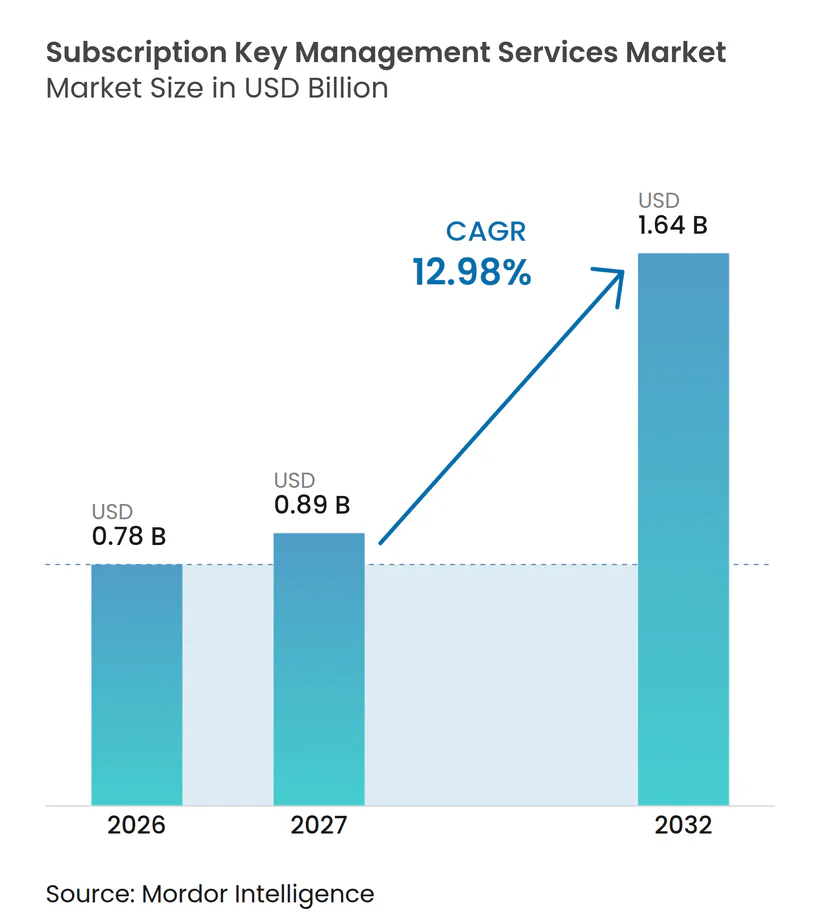
The subscription key management services market size was valued at USD 0.78 billion in 2026 and is forecast to reach USD 1.64 billion by 2032, at a CAGR of 12.98% from 2027 to 2032. The shift from perpetual licenses toward recurring software revenue is increasing the need to issue, renew, change, and revoke entitlements reliably. Software publishers increasingly combine seat-based subscriptions, metered application programming interfaces, and time-bound enterprise agreements within the same product portfolio. This mix makes centralized entitlement control more important because disconnected tools can lead to incorrect provisioning and unused access. Vendors are responding by adding usage analytics, security controls, and integrations that connect product access with commercial processes. The subscription key management services market also has an opportunity to serve smaller publishers as cloud-based platforms reduce implementation costs and simplify administration effectively for lean product teams.
Key Report Takeaways
- By licensing model, subscription-based licensing held 34.00% of revenue in 2026, while usage-based and consumption-based licensing is projected to expand at a 14.57% CAGR through 2032.
- By enterprise size, large enterprises accounted for 68.00% of the subscription key management services market size in 2026. SMEs are projected to expand at a 14.51% CAGR through 2032.
- By end user, ISVs and SaaS publishers held 38.00% of revenue in 2026 and are projected to expand at a 14.57% CAGR through 2032.
- By geography, North America held 42.00% of revenue in 2026, while Asia-Pacific is projected to expand at a 14.34% CAGR through 2032.
Note: Market numbers in this report are based on Mordor Intelligence's proprietary estimation framework, which combines nine months of actuals with Q4 projections for base year 2026.
Market Trends and Insights
Drivers Impact Analysis of Subscription Key Management Services Market*
| Driver | (~) % Impact on CAGR Forecast | Geographic Relevance | Impact Timeline |
|---|---|---|---|
| Transition to Recurring Monetization | +4.5% | Global, with North America and Europe leading the transition | Short term (≤ 2 years) |
| Multi-Cloud and Hybrid Delivery Complexity | +3.2% | Global, with Asia-Pacific and North America as core markets | Short term (≤ 2 years) |
| Usage-Based and AI Inference Monetization | +2.8% | North America and Asia-Pacific are core markets, with spillover to Europe | Medium term (2-4 years) |
| Entitlement and Usage-Control Revenue Leakage | +2.0% | Global, with North America and Europe most exposed | Short term (≤ 2 years) |
| Identity-Centric and Zero-Trust Enforcement | +1.5% | North America and the European Union, with increasing relevance in Asia-Pacific | Medium term (2-4 years) |
| Offline and Air-Gapped Enforcement Requirements | +0.8% | European and Asia-Pacific industrial markets, plus North American defense | Long term (≥ 4 years) |
| Source: Mordor Intelligence | |||
Transition From Perpetual Licenses to Recurring Monetization
The move away from perpetual licenses is a major force behind the subscription key management services market. Revenera reported that 88% of software companies use subscription strategies in at least part of their portfolios.[1] Subscription and term models ranked first among the models respondents expected to support revenue expansion. ATOSS Software SE reported that cloud and subscription revenue reached EUR 27.0 million, or USD 30.5 million, in the first quarter of 2026, while one-off software license revenue declined 40%. Publishers therefore need systems that handle expiration, renewal, and plan changes without manual intervention. The transition is more demanding when perpetual and subscription contracts coexist within the same product catalog. Central entitlement platforms can reduce over-provisioning and improve visibility across that mixed environment.
Multi-Cloud and Hybrid Software Delivery Complexity
Multi-cloud and hybrid deployments are making entitlement enforcement more difficult for the subscription key management services market. Revenera found that 33% of respondents used private cloud extensively, compared with 20% in the prior year. The same source reported that 61% of respondents expected software as a service adoption to expand over the following 12 months. A product can now run in a public cloud, a private environment, and customer premises at the same time. Wibu-Systems updated CodeMeter License Central for Kubernetes-based deployment across cloud, data center, and hybrid environments, including automatic failover support.[2] This delivery mix can create conflicting entitlement records when publishers use different licensing tools for separate environments. Platforms that apply the same policy across deployment models can help reduce renewal disputes and compliance gaps.
Revenue Leakage from Entitlement and Usage-Control Gaps
Revenue leakage is strengthening the business case for the subscription key management services market. Revenera states that its platform protects USD 75 billion in annual licensing revenue and has delivered 100 million software licenses. These figures show the scale of financial exposure associated with licensing and entitlement control. Inactive accounts and incomplete usage records can leave publishers unable to identify access that should be renewed, changed, or removed. The problem is often linked to limited visibility and disconnected license administration rather than deliberate customer misuse. Better entitlement records can help commercial teams match access rights with contract terms before renewal discussions. This makes the value proposition relevant to finance and sales operations as well as information technology teams.
Demand for Usage-Based and AI Inference Monetization
Usage-based pricing is expanding the functional requirements of the subscription key management services market. Revenera found that 59% of software suppliers expected usage-based models to become a larger portion of revenue over the next 12 to 18 months. Publishers offering artificial intelligence services may charge by application programming interface call, token, model use, or another measurable unit. Those models need entitlement services that can meter activity, apply limits, and rotate credentials in near real time. Cryptlex added sandbox environments and activation events in August 2026, which allow publishers to test licensing processes before production use.[3] This direction supports developers that need to test consumption-based workflows without affecting live licensing records. Vendors that link flexible pricing rules with reliable enforcement are likely to be relevant as artificial intelligence software offerings mature.
Restraints Impact Analysis of Subscription Key Management Services Market*
| Restraint | (~) % Impact on CAGR Forecast | Geographic Relevance | Impact Timeline |
|---|---|---|---|
| Integration Across Billing, CRM, ERP, and Product Systems | -1.2% | Global, most acute in large enterprises in North America and Europe | Medium term (2-4 years) |
| Cryptographic and Data-Sovereignty Concerns | -0.8% | European Union, China, India, and the Middle East | Medium term (2-4 years) |
| Resistance to Vendor-Locked Entitlement Infrastructure | -0.5% | North America and Europe | Long term (≥ 4 years) |
| License-Key Bypass, Reverse Engineering, and Credential Abuse | -0.3% | Global | Short term (≤ 2 years) |
| Source: Mordor Intelligence | |||
Integration Complexity Across Billing, CRM, ERP, and Product Systems
Integration requirements can delay adoption in the subscription key management services market, especially among mid-sized and large buyers. Revenera reported that 46% of software companies needed more than 6 months to introduce a new monetization model. Entitlement platforms must often exchange information with billing systems, customer relationship management tools, enterprise resource planning systems, and product applications. The licensing platform is not always the financial system of record, yet finance teams need its data to align access rights with revenue recognition and renewals. Reprise Software launched Activation Pro for Salesforce in January 2025 to connect activation workflows with customer relationship management records. 10Duke introduced a HubSpot Connector in June 2026 to synchronize licensing records with customer relationship management workflows. Custom connectors can increase implementation costs and weaken the return on investment for mid-sized publishers.
Cryptographic and Data-Sovereignty Concerns in Managed Services
Cryptographic control and data sovereignty can restrict the use of managed subscription key management services. The European Union Cyber Resilience Act becomes fully applicable in December 2027 and requires manufacturers to manage software security and corrective action responsibilities. Customers in regulated sectors may require control of cryptographic keys while using a managed service interface. Thales offers Bring Your Own Key and Hold Your Own Key configurations through CipherTrust Cloud Key Management. Wibu-Systems highlighted post-quantum readiness in its February 2026 product communications.Such capabilities matter to buyers in defense, healthcare, and financial services that have long contract periods and strict security requirements. Data residency rules in the European Union, China, India, and the Middle East can favor private or on-premises deployments over a shared managed service.
*Our forecasts treat driver/restraint impacts as directional, not additive. The impact forecasts reflect baseline growth, mix effects, and variable interactions.
Subscription Key Management Services Market Segment Analysis
By Licensing Model:
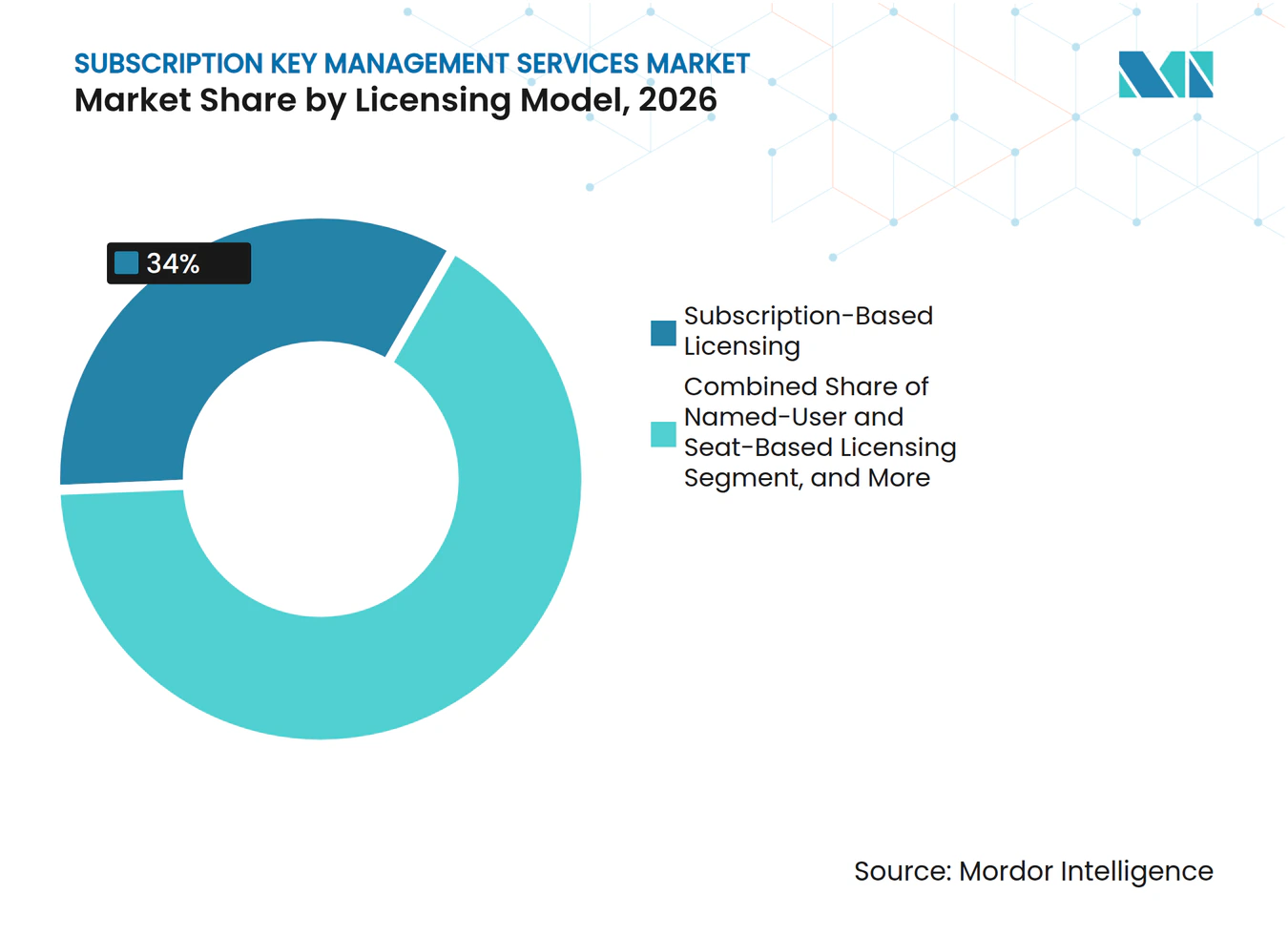
Subscription Licensing Leads Revenue While Usage-Based Models Set the PaceSubscription-based licensing held 34.00% of the subscription key management services market share in 2026. It is the default commercial model for many independent software vendors and enterprise software publishers. Revenera reported that subscription and term models ranked first for expected revenue expansion among surveyed companies. These contracts require reliable records of dates, product tiers, renewals, and changes in access rights. Usage-based and consumption-based licensing is projected to expand at a 14.57% CAGR through 2032.
Artificial intelligence inference pricing, application programming interface monetization, and outcome-based contracts require detailed metering. Named-user and seat-based licensing remains important where individual auditability is required. Floating licensing helps engineering and high-performance computing users allocate costly software efficiently. Feature, tier, device, and node-locked models serve publishers with varied commercial and technical needs. SLASCONE added individual feature-level floating limitations in version 10.0 during September 2026, while Cryptlex added feature-level trial controls in May 2025.



By Enterprise Size:
Large Enterprises Hold Revenue While SMEs Expand FasterLarge enterprises accounted for 68.00% of the subscription key management services market size in 2026. Their portfolios can span products, regions, sales channels, and entitlement policies. That complexity increases the need for centralized control and formal audit records. Large publishers also face greater exposure when contract terms are inconsistently enforced. Revenera reported that 54% of respondents used the same monetization technology across all product lines.
SMEs are projected to expand at a 14.51% CAGR through 2032. Cloud-based, application programming interface-first platforms reduce the need for large implementation teams and hardware security modules. LicenseSpring introduced a startup program in May 2025 to expand access to licensing infrastructure. Keygen.sh achieved SOC 2 Type II compliance in January 2026, giving smaller vendors a recognized security assurance. Simpler integration, transparent pricing, and dependable controls can help vendors address smaller publishers that previously relied on internal key-generation processes.
By End User:
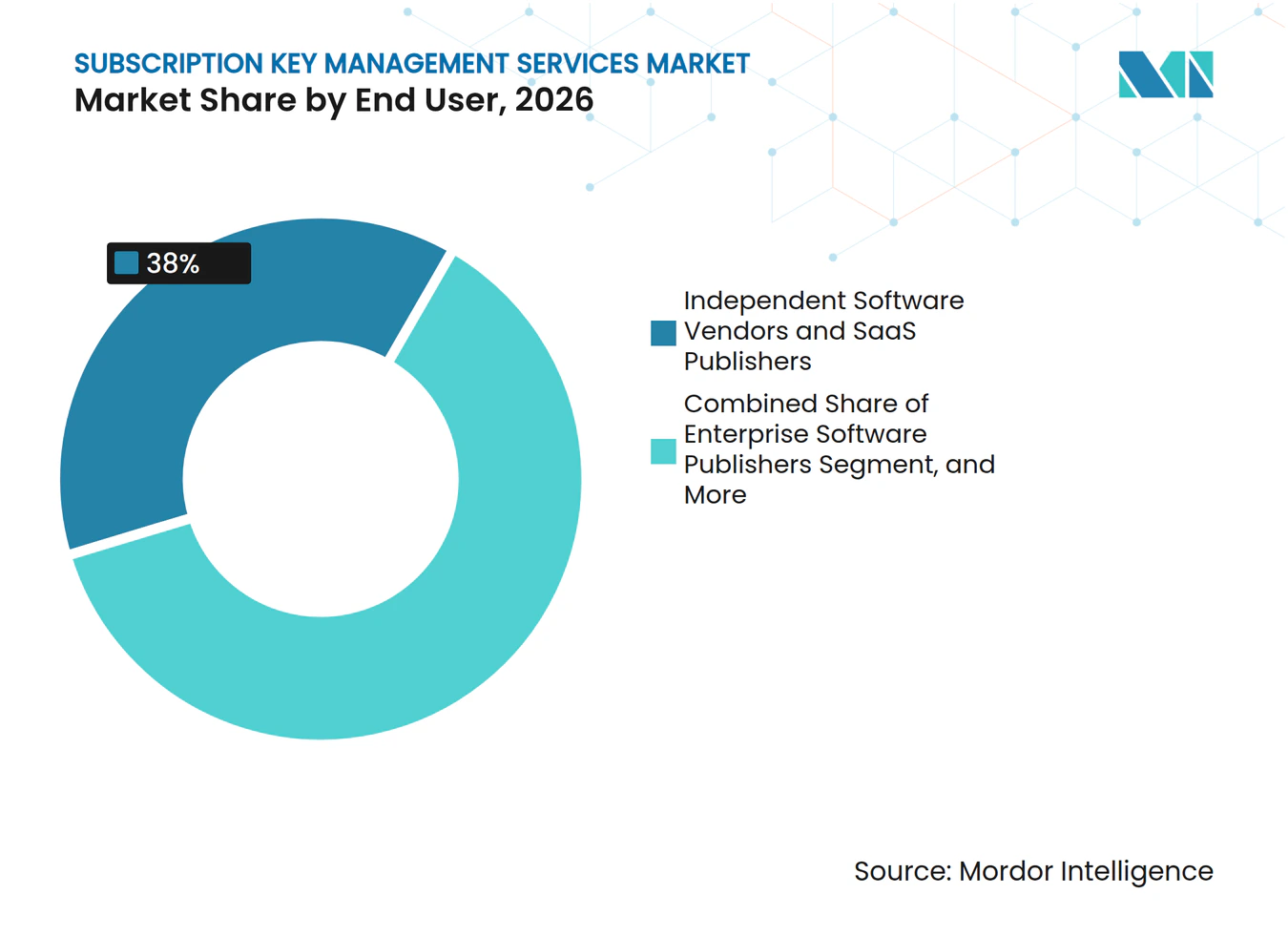
ISVs and SaaS Publishers Remain the Main Demand BaseISVs and SaaS publishers held 38.00% of subscription key management services market share in 2026 and are projected to expand at a 14.57% CAGR through 2032. They use entitlement tools to control product access, support recurring contracts, and manage renewals. Artificial intelligence product developers also need to handle model access, application programming interface quotas, and feature tiers. Older key servers that only validate a static key have limited ability to support these requirements. Enterprise software publishers also prioritize audit trails, customer relationship management integration, and high-volume global provisioning.
Embedded and industrial manufacturers need offline enforcement, hardware-bound keys, and lifecycle management for long-lived equipment. Wibu-Systems presented licensing and security capabilities across embedded hardware and enterprise environments at Automate 2026. Gaming, media, and digital content providers manage access windows, regional rights, and pricing tiers. Engineering users are moving toward hosted tools that preserve concurrency control. Government, defense, and telecommunications users need strong key custody, offline options, or measured-use controls.

Geography Analysis
North America Subscription Key Management Services Market
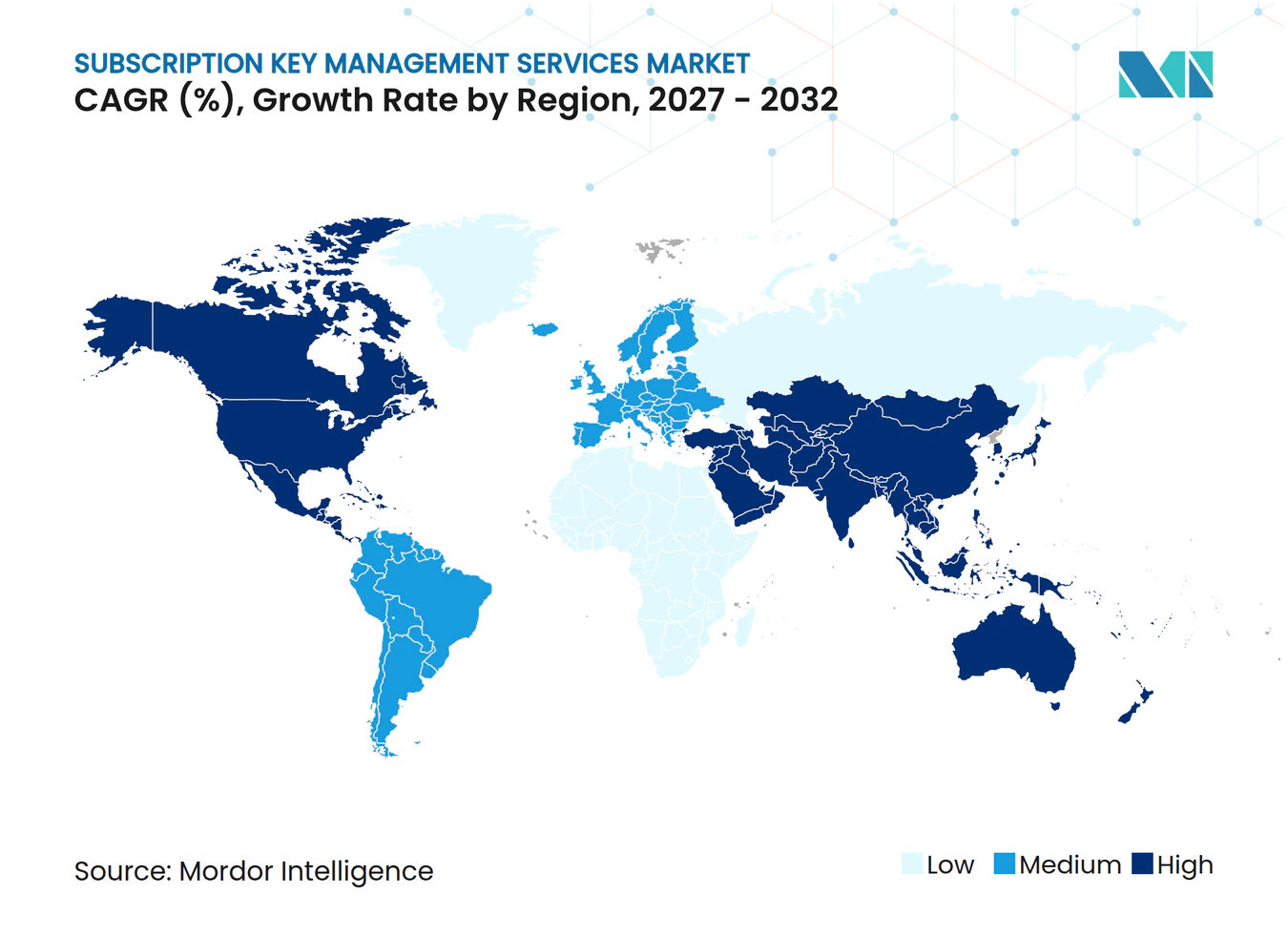
North America held 42.00% of revenue in 2026. The subscription key management services market in the region benefits from a dense base of ISVs, SaaS publishers, and enterprise software companies. The United States includes major providers such as Revenera, Nalpeiron, Reprise Software, and Cryptlex, while Canada contributes through its growing artificial intelligence and enterprise software ecosystem. Usage-based offerings are increasing the need for systems that meter and enforce consumption. This supplier base supports local product development and customer demand.
APAC Subscription Key Management Services Market
Asia-Pacific is projected to expand at a 14.34% CAGR through 2032. The subscription key management services market is supported by digitization programs, wider software use by SMEs, and regional SaaS vendors. India and Southeast Asia are expanding developer communities and software export activity. South Korea, Australia, and Singapore need advanced controls because cross-border distribution brings additional compliance requirements.
EMEA and South America Subscription Key Management Services Market
Europe is the second-largest regional revenue contributor to the subscription key management services market. Germany, the United Kingdom, France, and Nordic countries have established enterprise software sectors. ATOSS Software SE reported a shift toward cloud and subscription revenue in the first quarter of 2026. The European Union Cyber Resilience Act is encouraging stronger control over deployed versions and corrective actions, while South America, the Middle East, and Africa remain earlier-stage areas where demand is tied to global vendor subsidiaries, public digitization projects, and local SaaS companies.
Competitive Landscape
Market Concentration
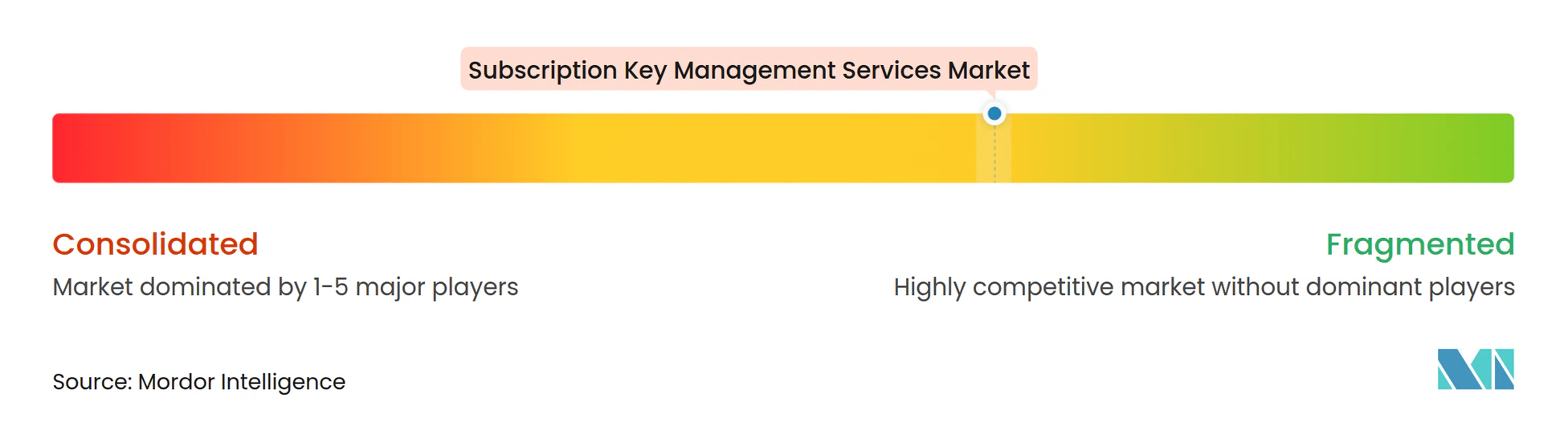
The subscription key management services market is moderately fragmented. Revenera, Thales Sentinel, and Wibu-Systems have broad enterprise and industrial capabilities, whereas Cryptlex, Keygen.sh, SLASCONE, 10Duke, and Nalpeiron provide cloud-based platforms for ISVs and SaaS publishers. Embedded and defense applications are more concentrated around hardware-backed providers. Cloud software buyers can choose from several application programming interface-first platforms. Wibu-Systems released CodeMeter 9.00 in June 2026 with a universal runtime architecture, cryptographic agility, automated protection, and secure code execution.
Thales combines Sentinel licensing with CipherTrust cloud key management capabilities for enterprise and public sector buyers. Wibu-Systems launched the ENFORCERS project in March 2026 to support coordinated European software supply chain security. These actions link entitlement management with security and compliance requirements and can broaden a vendor’s addressable customer base across cloud and offline use cases.
Emerging providers use application programming interface-first design and security certifications to build buyer confidence. Keygen.sh achieved SOC 2 Type II compliance in January 2026, while 10Duke completed its SOC 2 Type II audit in March 2026. SLASCONE obtained ISO/IEC 27001:2022 certification in October 2025. Security credentials are increasingly expected in procurement, so competitive differences depend more on integration depth, useful analytics, and hybrid licensing support. No provider is identified as dominant in offline or edge-deployed artificial intelligence entitlement control.
Subscription Key Management Services Industry Leaders
-
Revenera, Inc.
-
Nalpeiron, Inc.
-
Reprise Software, Inc.
-
10Duke Software Ltd.
-
LicenseSpring LLC
- *Disclaimer: Major Players sorted in no particular order
Subscription Key Management Services Market Companies Covered in this Report
- Revenera, Inc.
- Nalpeiron, Inc.
- Reprise Software, Inc.
- 10Duke Software Ltd.
- LicenseSpring LLC
- Wibu-Systems AG
- Thales Digital Identity and Security Netherlands B.V.
- Cryptlex, LLC
- Inish Technology Ventures, Inc.
- Keygen.sh, Inc.
- SLASCONE GmbH
- Thales S.A.
- Flexera Software, LLC
- SafeNet, Inc.
- Thales e-Security, Inc.
- Unikey Technologies, Inc.
- WIBU-SYSTEMS USA, Inc.
- Agilis Management, Inc.
- License4J GmbH
- CrypKey, Inc.
- Labs64 GmbH
Recent Industry Developments in Subscription Key Management Services Market
- October 2026: Wibu-Systems established a dedicated India-based organization to extend its software protection and licensing expertise to India’s rapidly expanding ISV and OEM ecosystem, reflecting a strategy to deepen presence in one of Asia-Pacific’s highest-growth software markets. The move positions CodeMeter for accelerated adoption among Indian engineering software vendors pursuing global distribution.
- September 2026: Wibu-Systems joined the CVE Program as a CVE Numbering Authority (CNA), enabling direct assignment of CVE IDs across its product portfolio. This designation strengthens vulnerability transparency across CodeMeter’s global deployment base and signals the company’s intent to assume an active standards-governance role within the software security and licensing ecosystem.
- September 2026: SLASCONE released version 10.0, introducing granular floating license control at the individual feature level. Industrial and enterprise software vendors can now limit concurrent access to specific capabilities independently from overall session counts, addressing a longstanding gap in feature-level entitlement governance for concurrent licensing deployments.
- August 2026: Cryptlex introduced sandbox environments in its platform, providing isolated testing spaces with separate products, licenses, users, and activations to enable publishers to validate licensing workflows end to end without affecting production data. The release also added configurable two-factor authentication enforcement and comprehensive activation event logging for full audit traceability.
Global Subscription Key Management Services Market Report Scope
The Subscription Key Management Services Market refers to the worldwide industry focused on the delivery of cloud-based, subscription-driven services that manage the complete lifecycle of cryptographic keys, encryption certificates, and digital signing credentials used to protect sensitive data, applications, networks, databases, IoT ecosystems, and cloud workloads.
The Subscription Key Management Services Market Report is Segmented by Licensing Model (Subscription-Based Licensing, Usage-Based and Consumption-Based Licensing, Named-User and Seat-Based Licensing, Floating and Concurrent Licensing, Feature-Based and Tier-Based Licensing, Device-Based and Node-Locked Licensing, Perpetual and Maintenance Licensing, and Trial and Evaluation Licensing), Enterprise Size (Large Enterprises and Small and Medium-Sized Enterprises), End User (Independent Software Vendors and SaaS Publishers, Enterprise Software Publishers, Embedded and Industrial Software Manufacturers, Gaming, Media and Digital Content Providers, Engineering, Scientific and Design Software Providers, Government, Defense and Regulated Industries, Telecommunications and Digital Infrastructure Providers, and Other End Users), and Geography (North America [United States, Canada, and Mexico], South America [Brazil, Argentina, Chile, and Rest of South America], Europe [Germany, United Kingdom, France, Italy, Spain, Russia, and Rest of Europe], Asia-Pacific [China, Japan, India, South Korea, Australia, Singapore, and Rest of Asia-Pacific], Middle East [United Arab Emirates, Saudi Arabia, Israel, Turkey, and Rest of Middle East], and Africa [South Africa, Nigeria, Egypt, and Rest of Africa]). The Market Forecasts are Provided in Terms of Value (USD).
Segmentation Overview
| Subscription-Based Licensing |
| Usage-Based and Consumption-Based Licensing |
| Named-User and Seat-Based Licensing |
| Floating and Concurrent Licensing |
| Feature-Based and Tier-Based Licensing |
| Device-Based and Node-Locked Licensing |
| Perpetual and Maintenance Licensing |
| Trial and Evaluation Licensing |
| Large Enterprises |
| Small and Medium-Sized Enterprises |
| Independent Software Vendors and SaaS Publishers |
| Enterprise Software Publishers |
| Embedded and Industrial Software Manufacturers |
| Gaming, Media and Digital Content Providers |
| Engineering, Scientific and Design Software Providers |
| Government, Defense and Regulated Industries |
| Telecommunications and Digital Infrastructure Providers |
| Other End Users |
| North America | United States |
| Canada | |
| Mexico | |
| South America | Brazil |
| Argentina | |
| Chile | |
| Rest of South America | |
| Europe | Germany |
| United Kingdom | |
| France | |
| Italy | |
| Spain | |
| Russia | |
| Rest of Europe | |
| Asia-Pacific | China |
| Japan | |
| India | |
| South Korea | |
| Australia | |
| Singapore | |
| Rest of Asia-Pacific | |
| Middle East | United Arab Emirates |
| Saudi Arabia | |
| Israel | |
| Turkey | |
| Rest of Middle East | |
| Africa | South Africa |
| Nigeria | |
| Egypt | |
| Rest of Africa |
| By Licensing Model | Subscription-Based Licensing | |
| Usage-Based and Consumption-Based Licensing | ||
| Named-User and Seat-Based Licensing | ||
| Floating and Concurrent Licensing | ||
| Feature-Based and Tier-Based Licensing | ||
| Device-Based and Node-Locked Licensing | ||
| Perpetual and Maintenance Licensing | ||
| Trial and Evaluation Licensing | ||
| By Enterprise Size | Large Enterprises | |
| Small and Medium-Sized Enterprises | ||
| By End User | Independent Software Vendors and SaaS Publishers | |
| Enterprise Software Publishers | ||
| Embedded and Industrial Software Manufacturers | ||
| Gaming, Media and Digital Content Providers | ||
| Engineering, Scientific and Design Software Providers | ||
| Government, Defense and Regulated Industries | ||
| Telecommunications and Digital Infrastructure Providers | ||
| Other End Users | ||
| By Geography | North America | United States |
| Canada | ||
| Mexico | ||
| South America | Brazil | |
| Argentina | ||
| Chile | ||
| Rest of South America | ||
| Europe | Germany | |
| United Kingdom | ||
| France | ||
| Italy | ||
| Spain | ||
| Russia | ||
| Rest of Europe | ||
| Asia-Pacific | China | |
| Japan | ||
| India | ||
| South Korea | ||
| Australia | ||
| Singapore | ||
| Rest of Asia-Pacific | ||
| Middle East | United Arab Emirates | |
| Saudi Arabia | ||
| Israel | ||
| Turkey | ||
| Rest of Middle East | ||
| Africa | South Africa | |
| Nigeria | ||
| Egypt | ||
| Rest of Africa | ||
Key Questions Answered in the Report
What is the size of the subscription key management services market?
The subscription key management services market was valued at USD 0.78 billion in 2026 and is projected to reach USD 1.64 billion by 2032, growing at a CAGR of 12.98% from 2027 to 2032. Growth is driven by increasing adoption of recurring software business models that require robust entitlement and access management capabilities.
What is driving demand for subscription key management services?
Demand is driven by the expansion of recurring software subscriptions, hybrid deployment models, usage-based pricing structures, and the growing necessity to manage renewals, product tiers, user entitlements, and access rights. These requirements are particularly important for publishers supporting cloud, on-premises, and embedded software environments.
Which licensing model holds the largest revenue share?
Subscription-based licensing accounts for the largest share, representing 34.00% of market revenue in 2026. Meanwhile, usage-based and consumption-based licensing is expected to record the fastest growth, with a 14.57% CAGR through 2032, supported by the need for tracking service consumption, enforcing usage limits, and managing customer entitlements.
Which companies use subscription key management platforms?
Subscription key management platforms are widely adopted by independent software vendors (ISVs), SaaS providers, enterprise software companies, embedded software manufacturers, digital content providers, and telecommunications firms. These organizations use the platforms for functions such as license compliance, auditability, offline licensing, usage tracking, and regional access control.
Which region leads revenue and which region expands fastest?
North America leads the market with 42.00% revenue share in 2026. Asia-Pacific is anticipated to be the fastest-growing region, registering a 14.34% CAGR through 2032, driven by increasing software publishing activity, SME digitalization, and government-led digital transformation initiatives.
What should buyers assess when selecting a subscription key management provider?
Buyers should evaluate factors including integration capabilities, support for multiple licensing models, security and compliance controls, offline license enforcement, data residency requirements, and usage analytics functionality. Selection should also align with the software delivery environment, whether cloud-based, private infrastructure, or embedded systems.