
Submarine Battery Market Size and Share
Market Overview
| Study Period | 2020 - 2032 |
|---|---|
| Market Size (2027) | USD 1.42 Billion |
| Market Size (2032) | USD 1.88 Billion |
| Growth Rate (2027 - 2032) | 5.77 % |
| Fastest Growing Market | Asia-Pacific |
| Largest Market | North America |
| Market Concentration | Medium |
Major Players *Disclaimer: Major Players sorted in no particular order Image © Mordor Intelligence. Reuse requires attribution under CC BY 4.0. | |
Submarine Battery Market Analysis by Mordor Intelligence
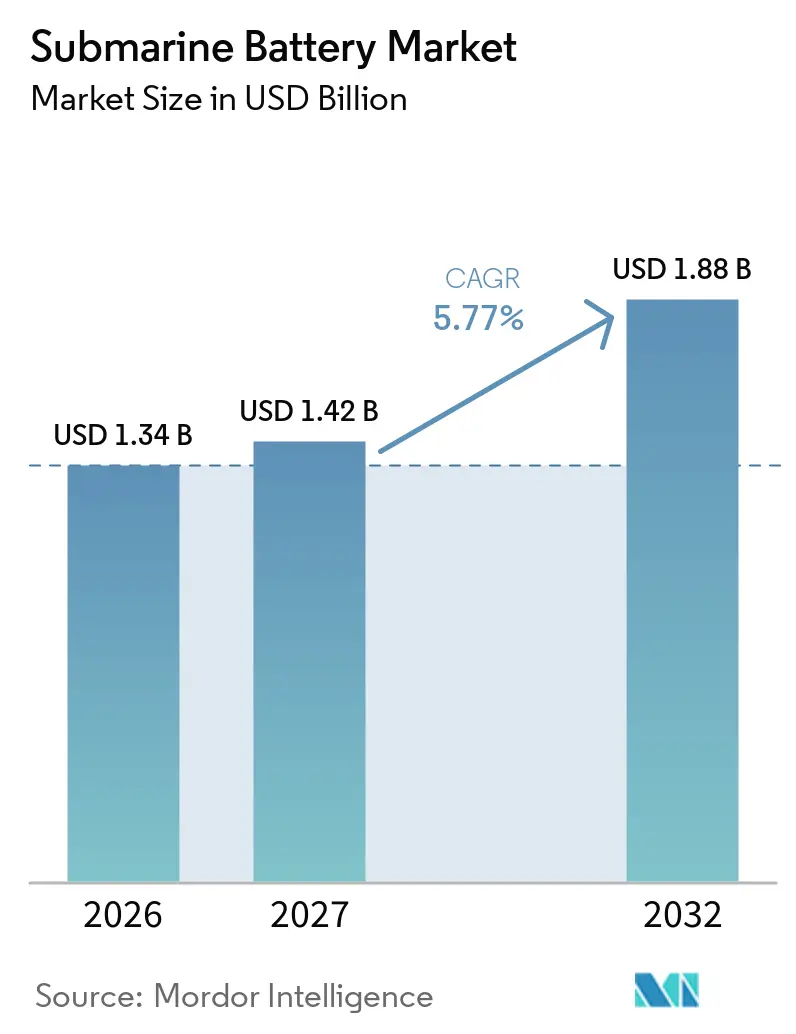
The submarine battery market size was valued at USD 1.34 billion in 2026 and is expected to grow from USD 1.42 billion in 2027 to USD 1.88 billion by 2032, at a CAGR of 5.77% during 2027-2032. The submarine battery market is shifting from lead-acid systems to lithium-ion designs as navies require longer underwater endurance and lower acoustic signatures. New submarine programs provide the initial revenue base, while replacement work on older diesel-electric fleets creates a separate route to demand. Qualification requirements and export controls encourage countries to build domestic supply capacity, which can favor suppliers with local partners. The addressable opportunity also includes pressure-tolerant batteries for unmanned underwater vehicles, although these products have different duty cycles and technical requirements. The submarine battery market remains shaped by long procurement schedules, safety validation, and the ability to support a platform through its operating life.
Key Report Takeaways
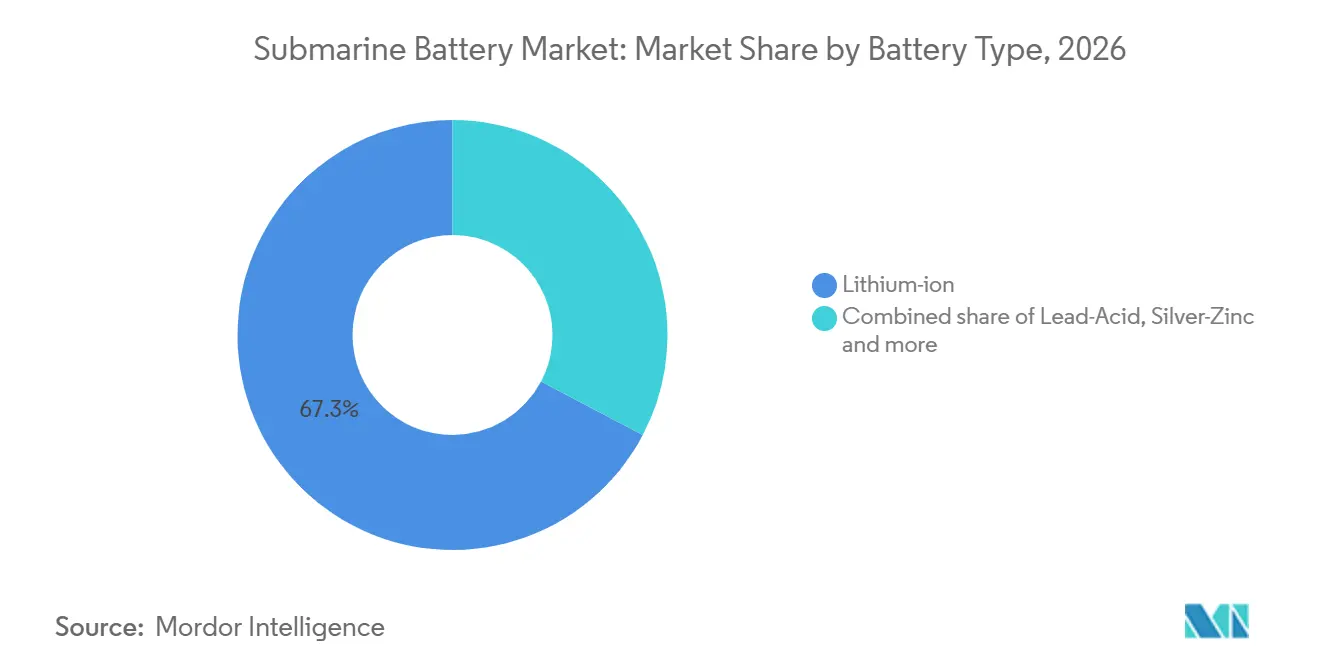
- By battery type, lithium-ion batteries held 67.26% of revenue in 2026 and are forecast to expand at a 6.01% CAGR through 2032.
- By submarine type, diesel-electric platforms held 58.75% of revenue in 2026 and are forecast to expand at a 6.14% CAGR through 2032.
- By capacity, medium systems held 61.27% of revenue in 2026, while large systems are forecast to expand at a 6.28% CAGR through 2032.
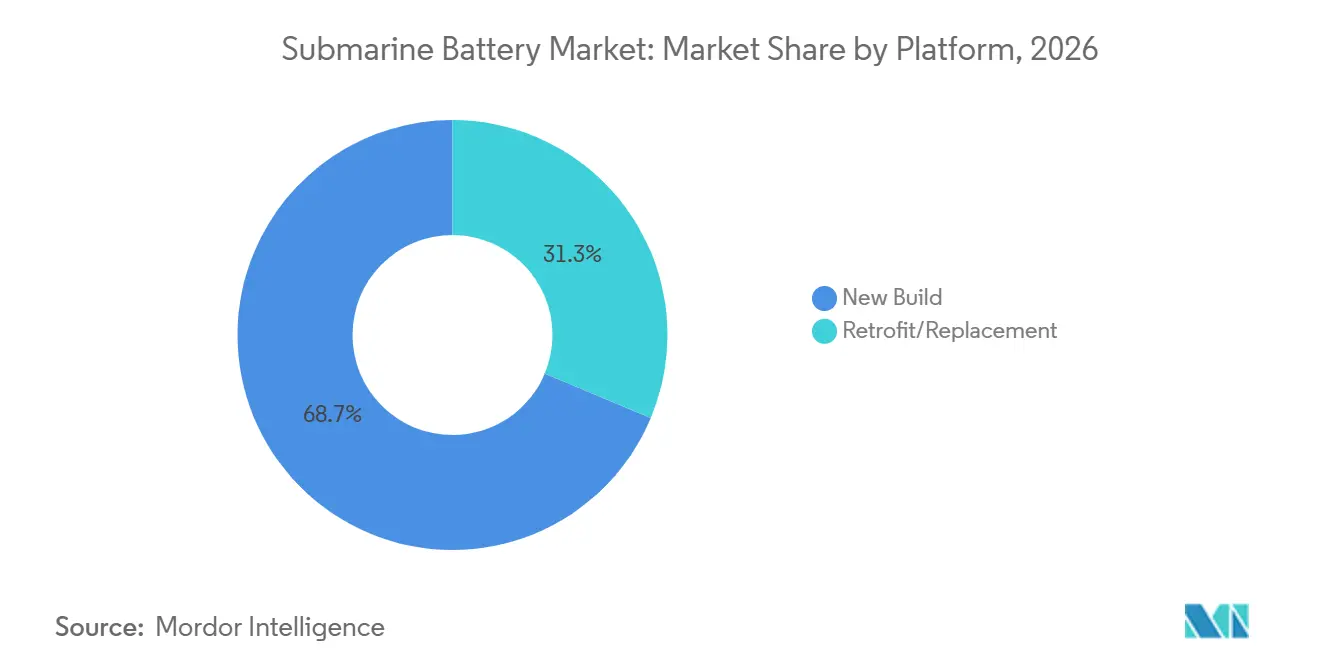
- By platform, new-build installations held 68.71% of revenue in 2026, while retrofit and replacement are forecast to expand at a 6.31% CAGR through 2032.
- By end user, navy and defense held 83.26% of revenue in 2026 and are forecast to expand at a 5.62% CAGR through 2032.
- By geography, North America held 37.57% of revenue in 2026, while Asia-Pacific is forecast to expand at a 7.05% CAGR through 2032.
Note: Market numbers in this report are based on Mordor Intelligence's proprietary estimation framework, which combines nine months of actuals with Q4 projections for base year 2026.
Market Trends and Insights
Drivers Impact Analysis of Submarine Battery Market*
| Driver | (~) % Impact on CAGR Forecast | Geographic Relevance | Impact Timeline |
|---|---|---|---|
| Naval Fleet Modernization and Submarine Replacement Programs | +1.6% | Global, led by North America, Europe, and core Asia-Pacific | Long term (≥ 4 years) |
| Replacement of Aging Lead-Acid Battery Banks | +1.3% | Global, concentrated in Europe, Asia-Pacific, and South America | Medium term (2–4 years) |
| Lithium-ion Energy-Density Adoption for Longer Submerged Endurance | +1.0% | Global, pioneered in Japan and South Korea, expanding to Europe | Long term (≥ 4 years) |
| Expansion of Unmanned Underwater Vehicle Missions | +0.6% | North America, Asia-Pacific, Nordic, and Middle East and Africa navies | Medium term (2–4 years) |
| Localization of Qualified Naval Battery Supply Chains | +0.4% | Australia, India, South Korea, United States | Long term (≥ 4 years) |
| Pressure-Tolerant Modular Battery Architectures for Compact Underwater Platforms | +0.3% | North America and Asia-Pacific, with spillover to Nordic countries | Medium term (2–4 years) |
| Source: Mordor Intelligence | |||
Naval Fleet Modernization and Submarine Replacement Programs
Fleet renewal programs give the submarine battery market a pipeline that is more visible than many other defense categories. South Korea launched ROKS Jang Yeong-sil, its first 3,600-ton KSS-III Batch-II submarine, in October 2025, and Yonhap reported that the boat uses a lithium-ion battery system. Japan also launched the sixth Taigei-class submarine, Sōgei, in October 2025, continuing a class built around lithium-ion propulsion batteries. These programs make battery selection part of platform design rather than a later maintenance decision. The submarine battery market benefits because each delivered vessel creates recurring replacement and support work across a long service life. Canada’s Canadian Patrol Submarine Project remains a significant potential procurement program, which keeps advanced conventional submarine capability central to supplier planning.
Replacement of Aging Lead-Acid Battery Banks
Older diesel-electric fleets require periodic battery replacement, making maintenance windows an important route into the submarine battery market. Replacing a lead-acid bank on a large conventional submarine can require several months of dockyard time and extensive labor. That operating burden makes conversion to a qualified lithium-ion configuration relevant when fleets plan deep refits. Australia’s Department of Defence stated in February 2026 that its long-running battery work had advanced safer, stronger lithium-ion technology toward industrial production with Australian manufacturers. The transition is not automatic because legacy battery rooms have fixed geometry and safety constraints. Still, the renewal cycle creates a practical opportunity for modular systems that reduce disruption during scheduled maintenance.
Lithium-ion Energy-Density Adoption for Longer Submerged Endurance
Lithium-ion technology supports longer underwater operations within the limited volume available inside a conventional submarine. The submarine battery market is therefore increasingly tied to endurance, charging performance, and acoustic discretion rather than battery capacity alone. OCCAR closed the critical design review for the U212 NFS propulsion lithium battery system in October 2025, which marked a major engineering step for Italy’s program. [1] A peer-reviewed study published in 2025 also reviewed the safety and technical development needed for lithium-ion batteries in submarine applications. [2] These efforts show that the technology shift depends on system integration and safety assurance, not cell performance alone. Suppliers that can demonstrate both functions are better positioned for long qualification cycles.
Expansion of Unmanned Underwater Vehicle Missions
Unmanned underwater missions add a faster replacement cycle to the submarine battery market, especially for mine countermeasures, surveillance, and inspection activities. Kraken Robotics reported CAD 34 million in SeaPower battery orders in February 2025 and a further CAD 11 million in April 2025, taking its year-to-date orders to CAD 45 million. Pressure-tolerant products are distinct from large propulsion batteries because they can operate at depth without the same pressure housing approach. A 2025 scientific review identified energy-system limitations as a central constraint on unmanned underwater vehicle mission duration. Governments are also seeking domestic battery capabilities because export-controlled components can complicate defense supply chains. This creates room for local production, compact modules, and designs that fit the constraints of existing underwater platforms.
Restraints Impact Analysis of Submarine Battery Market*
| Restraint | (~) % Impact on CAGR Forecast | Geographic Relevance | Impact Timeline |
|---|---|---|---|
| Stringent Naval Lithium-ion Safety Certification Requirements | -0.5% | Global, most constraining in the United States, Europe, and emerging naval markets | Long term (≥ 4 years) |
| Long Procurement, Qualification, and Acceptance Cycles | -0.4% | Global, most acute in North American and European procurement systems | Long term (≥ 4 years) |
| Battery-Room Geometry Constrains High-Energy Repowering | -0.3% | Concentrated in legacy conventional (SSK) fleets in Europe and South America | Medium term (2–4 years) |
| Limited Qualified-Cell Traceability for Defense Spares | -0.2% | Most acute in export-control-restricted supply chains | Medium term (2–4 years) |
| Source: Mordor Intelligence | |||
Stringent Naval Lithium-ion Safety Certification Requirements
Naval lithium-ion batteries face a much more demanding approval process than commercial marine systems. The American Bureau of Shipping updated its requirements for lithium-ion batteries in marine and offshore uses in December 2025. The submarine battery market must also address navy-specific testing for cycling, saltwater exposure, pressure, and thermal propagation. A 2025 journal study based on airworthiness and seaworthiness requirements identified the need for a clearer safety assurance framework for submarine lithium-ion batteries. Certification from one navy does not necessarily transfer to another, which increases the burden on suppliers. Fixed battery-room dimensions in older boats can further limit high-energy repowering even after a battery design is approved.
Long Procurement, Qualification, and Acceptance Cycles
Procurement for submarine battery systems can take years from the initial requirement to the first accepted delivery. That timing delays the movement of new chemistries from testing into operational fleets. The submarine battery market is also affected by class requirements and classified navy criteria, which reduce visibility for upstream cell suppliers. Export controls, including United States International Traffic in Arms Regulations and the European Union dual-use framework, can restrict the transfer of qualified technologies. A supplier without a prior naval qualification record may face a prolonged period between first samples and a production order. These constraints favor established suppliers but also encourage countries to seek traceable, domestic sources of defense spares.
*Our forecasts treat driver/restraint impacts as directional, not additive. The impact forecasts reflect baseline growth, mix effects, and variable interactions.
Submarine Battery Market Segment Analysis
By Battery Type:
Lithium-ion Widens Its Lead Across Submarine ClassesLithium-ion batteries held 67.26% of the submarine battery market share in 2026 and are forecast to grow at a 6.01% CAGR through 2032. Their position reflects the need for higher energy density, longer submerged endurance, and lower acoustic signatures in modern conventional submarines. GS Yuasa supplies lithium-ion batteries for Japan’s Taigei-class program, where committed deliveries and replacement schedules support demand. The submarine battery market is therefore shifting toward suppliers that can combine cell production with system-level validation. Lithium-ion does not remove the need for strict thermal management and safety controls.
Lead-acid batteries retain a substantial installed base in older diesel-electric fleets, especially where refit budgets or vessel architecture make conversion difficult. Silver-zinc systems remain relevant in selected nuclear-submarine auxiliary uses where energy density can justify higher cost. Nickel-based chemistries also continue in some legacy applications with established maintenance routines. OCCAR’s 2025 U212 NFS design-review milestone indicates that Western programs are moving toward purpose-designed lithium propulsion systems. The submarine battery industry remains multi-chemistry because submarine classes, mission profiles, and qualification histories differ. The overall direction, however, favors lithium-ion in new construction and in technically feasible conversions.

By Submarine Type:
Diesel-Electric Platforms Anchor Demand, UUVs Add a New Growth LayerDiesel-electric submarines held 58.75% of revenue in 2026 and are forecast to grow at a 6.14% CAGR through 2032. These vessels depend directly on large battery systems for underwater propulsion, making them the core source of demand. Their large installed base also provides a broad conversion opportunity as older lead-acid banks reach renewal points. Indonesia’s Scorpène Evolved program, which includes full lithium-ion propulsion, illustrates how battery choice is becoming integral to export submarine programs. The KSS-III Batch-II program provides another example of a larger conventional platform using lithium-ion technology.
Air-independent propulsion submarines represent a smaller but more complex application because battery systems must work with fuel-cell or Stirling-cycle architectures. Nuclear submarines require auxiliary and emergency batteries, where specialized lithium or silver-zinc configurations can be relevant. Unmanned underwater vehicles have lower system values than crewed propulsion platforms but often have shorter replacement intervals. Kraken Robotics’ 2025 orders indicate that defense users are placing meaningful orders for pressure-tolerant UUV battery systems. The submarine battery market thus contains both long-cycle crewed programs and more frequent replenishment demand from unmanned systems. This mix gives suppliers a reason to develop separate product and service approaches for each submarine type.
By Capacity:
Medium Systems Dominate, Large Tier Claims Fastest GrowthMedium systems of 5 to 15 MWh accounted for 61.27% of the submarine battery market share in 2026. They match the propulsion requirements of common diesel-electric submarine displacement classes. Large systems above 15 MWh are projected to grow at a 6.28% CAGR through 2032 as new submarines allocate more volume to stored energy. Larger boats, including the 3,600-ton KSS-III Batch-II, show why capacity planning is becoming part of platform capability planning. The submarine battery market gains value when larger platforms need more advanced battery rooms, control systems, and validation work.
Small systems below 5 MWh serve unmanned underwater vehicles, research submersibles, and compact mission platforms. They are lower in average value but can create repeated orders because mission equipment is refreshed more often than crewed propulsion systems. ABS’s December 2025 requirements apply in full to lithium-ion systems of 20 kWh and above and add reduced requirements for systems of 2–20 kWh, which places small marine applications inside a recognized compliance framework. Capacity decisions are not driven by energy volume alone. They also reflect hull space, pressure tolerance, safety arrangements, and the mission duration expected of each platform. This makes the capacity segment closely linked to the design choices of shipbuilders and naval customers.
By Platform:
New Build Sets Revenue Base, Retrofit Claims Fastest GrowthNew-build installations accounted for 68.71% of the submarine battery market share in 2026. Contracted construction programs allow battery suppliers to plan deliveries alongside shipbuilders and naval procurement agencies. This route gives suppliers the opportunity to design the battery system around the vessel rather than work within a legacy compartment. The submarine battery market is supported by planned construction across Asia-Pacific, Europe, and allied programs in North America. Japan’s Taigei program demonstrates how serial construction can sustain demand for qualified lithium-ion systems.
Retrofit and replacement is forecast to grow at a 6.31% CAGR through 2032, faster than the overall forecast. Submarines commissioned during the late 1990s and 2000s are entering maintenance periods when conversion decisions can be made. Australia’s defense battery program shows that sovereign supply strategies can support both new equipment and replacement needs. Retrofit projects remain difficult where battery rooms are too small, or layouts cannot support new safety systems. Suppliers that offer modular configurations and qualified integration services are therefore important to this part of the submarine battery industry. Replacement demand can also extend the commercial life of suppliers after construction activity slows.
By End User:
Defense Consolidates, Research and Commercial Tracks UUV ProliferationNavy and defense held 83.26% of the submarine battery market in 2026 and are forecast to grow at a 5.62% CAGR through 2032. Defense programs command the highest value because crewed submarines require specialized, qualified propulsion systems. Longer support contracts and higher energy-storage specifications also support sustained demand. The submarine battery market is influenced by defense budgets in AUKUS countries, NATO members, and Indo-Pacific naval powers. The Australian government’s 2025 announcement on PMB Defence indicates how a specialist battery supplier can be embedded in AUKUS-related submarine supply chains.
Research and commercial users include scientific submersibles, inspection platforms, and some remotely operated vehicles. They generally purchase smaller systems and have less predictable procurement timing than defense customers. However, these applications help test compact, pressure-tolerant designs that can later serve demanding underwater missions. The Innovation Energy review describes how energy limitations constrain unmanned underwater vehicle operations, which keeps battery performance central to these applications. The commercial side does not match naval spending, but it broadens the technical base of the sector. Suppliers serving both groups can balance large, infrequent naval orders with smaller and more frequent underwater-system demand.
Geography Analysis
North America: Defense Programs Support Volume and Local Production
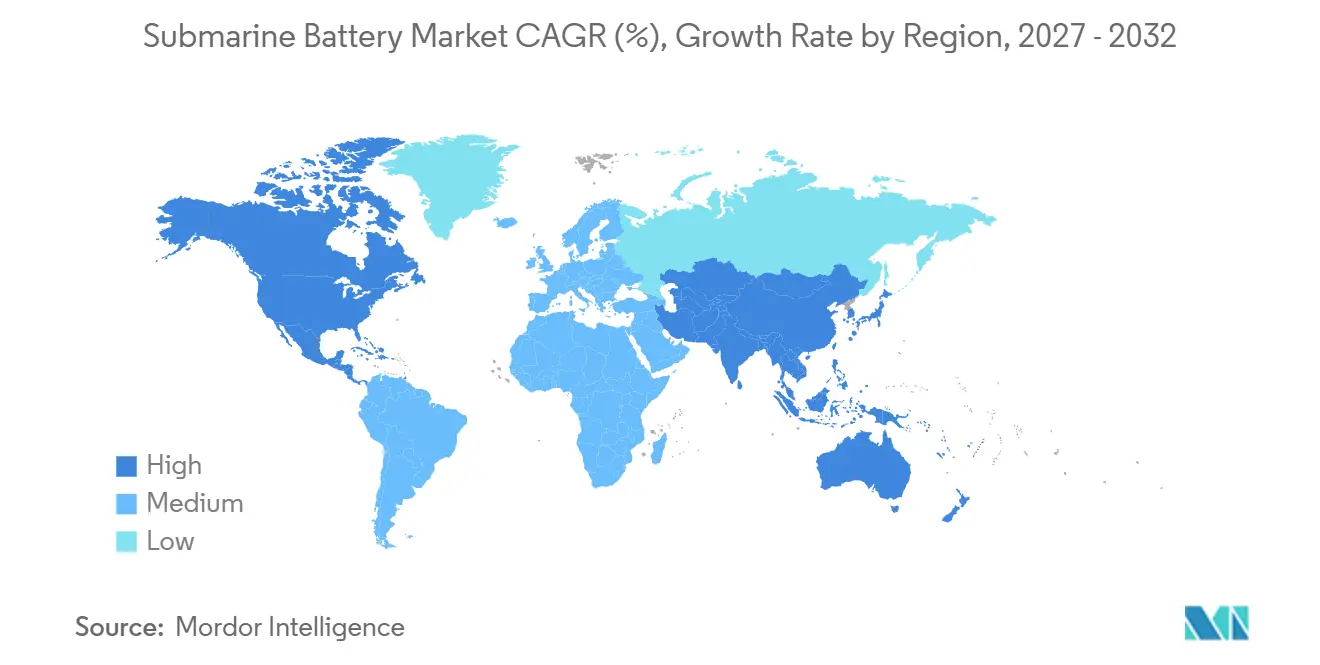
North America held 37.57% of the submarine battery market share in 2026. Regional demand is tied to United States undersea programs and the broader industrial activity surrounding AUKUS. Physical Sciences Inc. acquired a Methuen, Massachusetts facility in October 2025 with up to 200 MWh of annual military-qualified lithium-ion capacity, up from 2 MWh at its existing site, to support several United States Navy undersea programs. This production expansion shows that domestic capacity is becoming a procurement consideration as well as an industrial goal. The submarine battery market in the region is also shaped by compliance expectations associated with NAVSEA guidance and class-society requirements. Canada’s future submarine procurement keeps lithium-ion capability visible in supplier strategies. Local cell sourcing and traceable manufacturing are becoming important factors for suppliers pursuing defense work.
Asia-Pacific: Operational Programs Establish Lithium-Ion Experience
Asia-Pacific is forecast to grow at a 7.05% CAGR through 2032, making it the fastest-growing regional part of the submarine battery market. Japan has a serial-production fleet of lithium-ion diesel-electric submarines, and Kawasaki Heavy Industries launched Sōgei, the sixth Taigei-class vessel, in October 2025. GS Yuasa, the lithium-ion battery supplier for Japan’s submarines, supports these continuing delivery requirements. South Korea is combining domestic submarine construction with lithium-ion battery development, as seen in the KSS-III Batch-II launch. India and Australia are also seeking more localized defense battery capability. The regional pattern favors suppliers that can provide technology, manufacturing support, and long-term qualification evidence.
Europe, South America, and Middle East and Africa: Replacement Need Meets Export Strategy
Europe combines major programs that are moving toward lithium-ion propulsion with smaller fleets managing older lead-acid assets. In July 2026, Naval Group announced that Saft would provide next-generation lithium-ion batteries for future Barracuda and Scorpène submarines. Italy’s U212 NFS battery-system design review also demonstrates formal progress toward a lithium-powered conventional submarine. South American demand remains closely linked to scheduled replacement needs in legacy conventional fleets. In the Middle East and Africa, submarine acquisition plans may eventually create opportunities for European and Asian suppliers connected to relevant export programs. Compliance with European dual-use controls can affect technology transfer and supplier selection. These regions offer different demand profiles, but all depend on suppliers with credible safety and lifecycle support capabilities.
Competitive Landscape
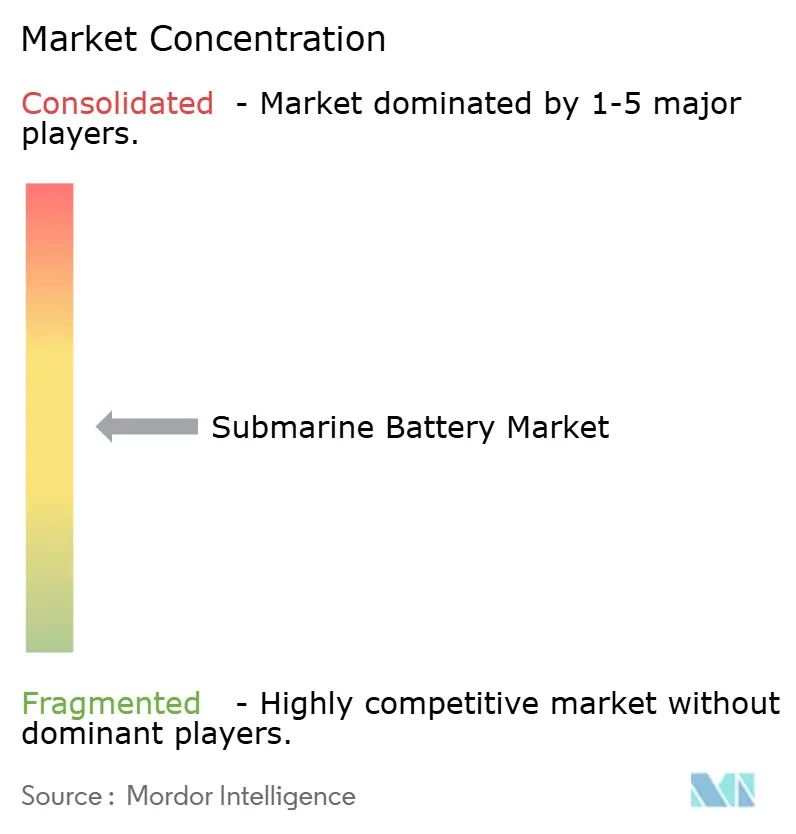
The submarine battery market is moderately consolidated because qualification records, safety testing, and lifecycle support create barriers for new suppliers. EnerSys, GS Yuasa Corporation, HOPPECKE Batterien, and Saft are among the established participants with relevant marine or defense battery capabilities. The leading firms compete through qualified technology, program relationships, and the ability to meet country-specific requirements. This structure limits immediate substitution even when a new chemistry has promising technical features. The submarine battery market rewards suppliers that can support a system from design review through acceptance and service. Smaller specialists can still gain positions when they offer a distinct chemistry or a platform-specific module.
Saft and Naval Group signed a contract in July 2026 for next-generation lithium-ion batteries for the Barracuda and Scorpène submarine families, extending their long-running relationship into future production. [3] GS Yuasa’s role as lithium-ion supplier to Japan’s submarine programs positions the company to support planned Japanese deliveries. PMB Defence also secured contracts worth more than AUD 34 million with BAE Systems in November 2025 to integrate its nickel-zinc battery into the SSN-AUKUS design. These moves show how companies use early program integration to protect a long-term role. They also show that lithium-ion is not the only chemistry that can secure a strategic position.
The main open area is retrofit-ready equipment for submarines with legacy battery rooms that cannot accept a direct lithium-ion replacement. Suppliers must resolve integration, thermal management, and certification issues before such conversions can proceed. Domestic-content requirements can create advantages for firms that partner with local manufacturers. The December 2025 ABS update increases the importance of sustaining compliance investment across marine lithium-ion applications. The submarine battery market does not show a single company with dominant control, because procurement decisions are fragmented by navy, platform, and national security rules. This pattern is consistent with a moderately consolidated competitive structure.
Submarine Battery Industry Leaders
-
EnerSys
-
Exide Technologies, Inc.
-
GS Yuasa Corporation
-
Saft (TotalEnergies SE)
-
EAS Batteries GmbH
- *Disclaimer: Major Players sorted in no particular order
Submarine Battery Market Companies Covered in this Report
- EnerSys
- Exide Technologies, Inc.
- GS Yuasa Corporation
- Saft (TotalEnergies SE)
- EAS Batteries GmbH
- HOPPECKE Batterien GmbH & Co. KG
- Korea Special Battery Co., Ltd.
- Hanwha Aerospace Co., Ltd.
- Exide Industries Limited
- Ultralife Corporation
- HBL Engineering Limited
- Stryten Energy LLC
- Sunlight Group Energy Storage Systems S.A.
- Epsilor Electric Fuel Ltd.
- Zibo Torch Energy Co., Ltd.
- EaglePicher Technologies, LLC
- PMB Defence Pty Ltd.
- Denchi Power Ltd.
- Leclanché SA
- Panasonic Energy Co., Ltd.
- Samsung SDI Co., Ltd.
- Hagen Batterie AG
Recent Industry Developments in Submarine Battery Market
- July 2026: Saft (TotalEnergies) won a Naval Group contract to supply next-generation lithium-ion battery systems for the Barracuda and Scorpène submarine families.
- March 2026: Japan commissioned JS Chōgei, its fifth Taigei-class submarine, built by Mitsubishi Heavy Industries and powered by lithium-ion batteries.
- February 2026: Australia’s Defence Science and Technology Group confirmed that its sovereign lithium-ion battery technology was progressing into industrial production with Australian manufacturers.
- November 2025: PMB Defence secured contracts worth more than AUD 34 million with BAE Systems to integrate its nickel-zinc battery technology into the SSN-AUKUS submarine design.
- October 2025: Hanwha Ocean launched ROKS Jang Yeong-sil, South Korea’s first 3,600-ton KSS-III Batch-II submarine, powered by lithium-ion batteries.
Global Submarine Battery Market Report Scope
The submarine battery market report is segmented by battery type (lead-acid, lithium-ion, silver-zinc, nickel-based, and other battery types), submarine type (diesel-electric, air-independent propulsion, nuclear, and unmanned underwater vehicles), capacity (small, medium, and large), platform (new build and retrofit/replacement), end user (navy/defense and research and commercial), and geography (North America, Europe, Asia-Pacific, South America, and Middle East and Africa). The market forecasts are provided in terms of value (USD).
Segmentation Overview
| Lead-Acid |
| Lithium-ion |
| Silver-Zinc |
| Nickel-Based |
| Other Battery Types |
| Diesel-Electric (SSK) |
| Air-Independent Propulsion (AIP) |
| Nuclear (Auxiliary/Emergency) |
| Unmanned Underwater Vehicles (UUVs) |
| Small (Less than 5 MWh) |
| Medium (5–15 MWh) |
| Large (More than 15 MWh) |
| New Build |
| Retrofit/Replacement |
| Navy/Defense |
| Research and Commercial |
| North America | United States |
| Canada | |
| Mexico | |
| Europe | United Kingdom |
| France | |
| Germany | |
| Italy | |
| Spain | |
| Russia | |
| Norway | |
| Rest of Europe | |
| Asia-Pacific | China |
| Japan | |
| India | |
| South Korea | |
| Australia | |
| Rest of Asia-Pacific | |
| South America | Brazil |
| Argentina | |
| Chile | |
| Rest of South America | |
| Middle East and Africa | Turkey |
| Saudi Arabia | |
| United Arab Emirates | |
| South Africa | |
| Egypt | |
| Rest of Middle East and Africa |
| By Battery Type | Lead-Acid | |
| Lithium-ion | ||
| Silver-Zinc | ||
| Nickel-Based | ||
| Other Battery Types | ||
| By Submarine Type | Diesel-Electric (SSK) | |
| Air-Independent Propulsion (AIP) | ||
| Nuclear (Auxiliary/Emergency) | ||
| Unmanned Underwater Vehicles (UUVs) | ||
| By Capacity | Small (Less than 5 MWh) | |
| Medium (5–15 MWh) | ||
| Large (More than 15 MWh) | ||
| By Platform | New Build | |
| Retrofit/Replacement | ||
| By End User | Navy/Defense | |
| Research and Commercial | ||
| By Geography | North America | United States |
| Canada | ||
| Mexico | ||
| Europe | United Kingdom | |
| France | ||
| Germany | ||
| Italy | ||
| Spain | ||
| Russia | ||
| Norway | ||
| Rest of Europe | ||
| Asia-Pacific | China | |
| Japan | ||
| India | ||
| South Korea | ||
| Australia | ||
| Rest of Asia-Pacific | ||
| South America | Brazil | |
| Argentina | ||
| Chile | ||
| Rest of South America | ||
| Middle East and Africa | Turkey | |
| Saudi Arabia | ||
| United Arab Emirates | ||
| South Africa | ||
| Egypt | ||
| Rest of Middle East and Africa | ||
Key Questions Answered in the Report
What is the forecast growth rate for submarine batteries?
The sector is forecast to grow at a 5.77% CAGR from 2027 to 2032, reaching USD 1.88 billion by 2032.
Why are navies moving from lead-acid to lithium-ion batteries?
Lithium-ion systems support longer submerged endurance, higher energy density, and lower acoustic signatures when they meet naval safety requirements.
Which battery chemistry leads submarine propulsion demand?
Lithium-ion held 67.26% of revenue in 2026 and is forecast to grow at a 6.01% CAGR through 2032.
What submarine type creates the most battery demand?
Diesel-electric submarines held 58.75% of revenue in 2026 because their underwater propulsion depends directly on stored electrical energy.
Why are retrofit projects important for battery suppliers?
Older conventional submarines need replacement battery banks, but successful conversion depends on battery-room geometry, integration work, and certification.
Which region is expected to grow fastest through 2032?
Asia-Pacific is forecast to expand at a 7.05% CAGR, supported by active programs in Japan, South Korea, India, and Australia.