
Structural Adhesive Tapes Market Size and Share
Market Overview
| Study Period | 2022 - 2032 |
|---|---|
| Market Size (2027) | USD 12.73 Billion |
| Market Size (2032) | USD 16.03 Billion |
| Growth Rate (2027 - 2032) | 4.71 % |
| Fastest Growing Market | Asia-Pacific |
| Largest Market | Asia-Pacific |
| Market Concentration | Medium |
Major Players *Disclaimer: Major Players sorted in no particular order Image © Mordor Intelligence. Reuse requires attribution under CC BY 4.0. | |
Structural Adhesive Tapes Market Analysis by Mordor Intelligence
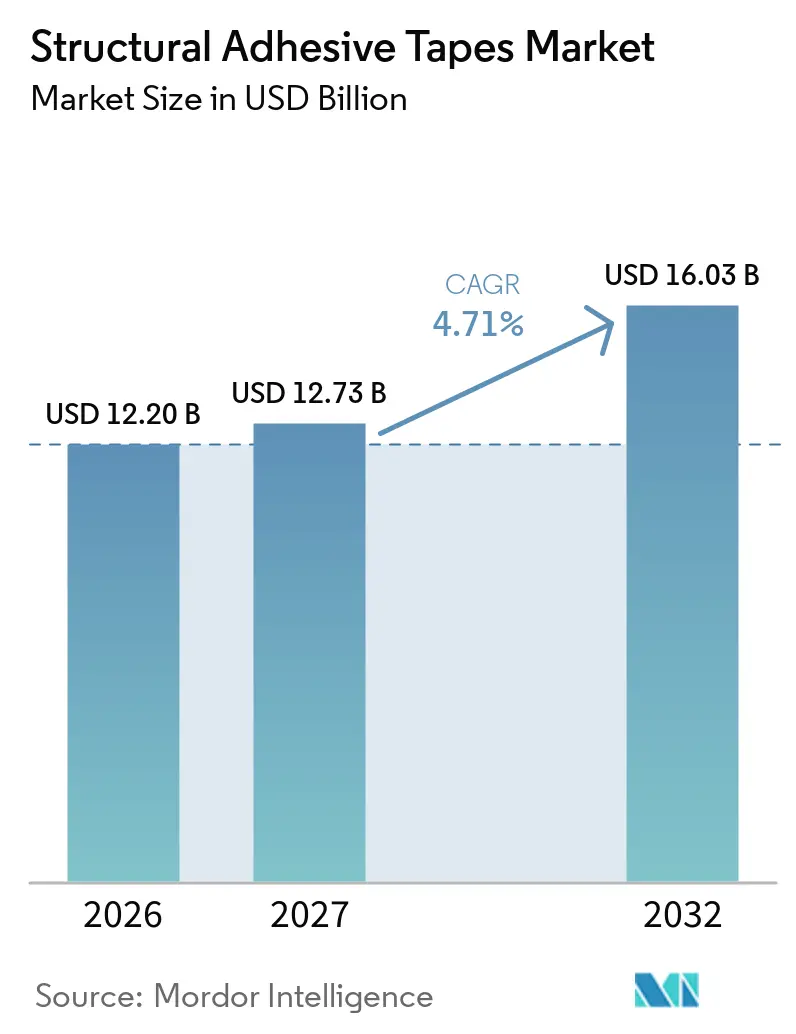
The Structural Adhesive Tapes Market size was valued at USD 12.20 billion in 2026 and is estimated to grow from USD 12.73 billion in 2027 to reach USD 16.03 billion by 2032, at a CAGR of 4.71% during the forecast period (2027-2032). The structural adhesive tapes market is expanding as manufacturers replace rivets, welds, and liquid adhesives in vehicle, electronics, building, and industrial assembly. Electric vehicle battery production, denser semiconductor packaging, and demand for lighter corrosion-resistant structures are broadening the addressable use cases. Producers are shortening development cycles as vehicle platforms change and electronics requirements become more specialized. The structural adhesive tapes market also faces raw-material cost exposure and lengthy validation requirements, which favor suppliers with established chemistry platforms and original equipment manufacturer qualifications. Repairable, electrically debondable products are becoming more relevant as battery disassembly and repair needs shape material selection.
Key Report Takeaways
- By resin type, acrylic held 48.06% of the structural adhesive tapes market share in 2026, while silicone is forecast to advance at a 5.21% CAGR through 2032.
- By backing material, foam held 30.58% of the structural adhesive tapes market share in 2026, while woven and non-woven are forecast to advance at a 5.57% CAGR through 2032.
- By product type, double-sided bonding held 57.13% of the structural adhesive tapes market share in 2026 and is forecast to advance at a 5.79% CAGR through 2032.
- By technology, hot-melt held 37.67% of the structural adhesive tapes market share in 2026 and is forecast to advance at a 5.98% CAGR through 2032.
- By end-use industry, automotive held 28.91% of the structural adhesive tapes market share in 2026, while electrical and electronics are forecast to advance at a 6.14% CAGR through 2032.
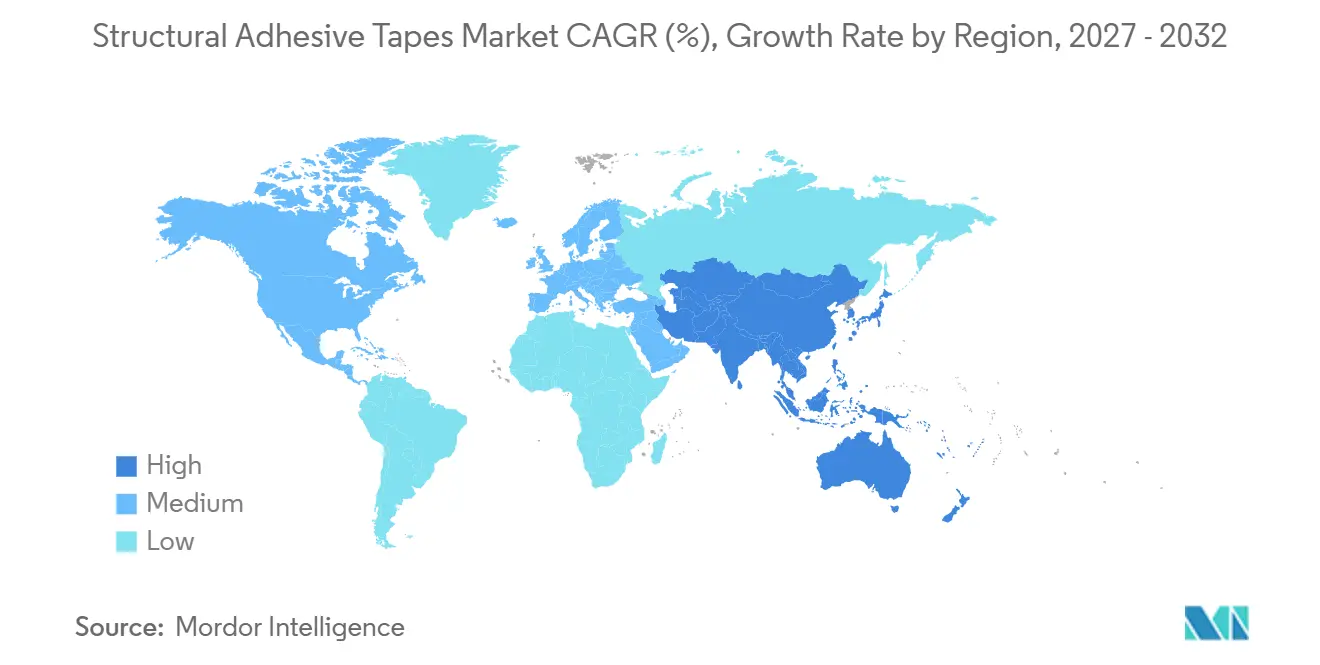
- By geography, Asia-Pacific held 36.49% of the structural adhesive tapes market share in 2026 and is forecast to advance at a 6.02% CAGR through 2032.
Note: Market numbers in this report are based on Mordor Intelligence's proprietary estimation framework, which combines nine months of actuals with Q4 projections for base year 2026.
Market Trends and Insights
Drivers Impact Analysis of Structural Adhesive Tapes Market*
| Driver | (~) % Impact on CAGR Forecast | Geographic Relevance | Impact Timeline |
|---|---|---|---|
| Lightweighting and EV Battery-Pack Assembly | +1.4% | Asia-Pacific core, spillover to Europe and North America | Medium term (2-4 years) |
| Miniaturization and High-Density Electronics Assembly | +1.1% | Asia-Pacific core, secondary gains in North America | Long term (≥ 4 years) |
| Faster, Cleaner, and More Automatable Factory Bonding | +0.8% | Global | Short term (≤ 2 years) |
| Pre-Applied Tapes for Solar, Wind, and Energy-Storage Components | +0.7% | Global, with early gains in China, India, and Germany | Medium term (2-4 years) |
| Reactive Tape Activation at Lower Temperatures and Shorter Cycle Times | +0.5% | Europe and North America | Long term (≥ 4 years) |
| Source: Mordor Intelligence | |||
Lightweighting and EV Battery-Pack Assembly
The movement from mechanical fastening to adhesive bonding in battery enclosures is increasing tape use in electric vehicle assembly. A typical electric vehicle battery pack contains 3 to 5 square meters of pressure-sensitive adhesive tape, and cell-to-pack designs can increase the tape requirement. Structural adhesive tapes used for aluminum enclosure bonding can exceed 30 MPa in shear strength while spreading crash loads more evenly than weld lines. Battery trim operations often have limited capacity for localized heating, which supports demand for heat-activated products that cure within existing production steps. This makes tape selection relevant to wider body shop process design rather than merely a substitution decision. TESA SE introduced 4 single-sided designs for electric vehicle and battery energy storage applications in September and October 2025, covering uses from cell wrapping to metal-part protection.
Miniaturization and High-Density Electronics Assembly
Consumer electronics and artificial intelligence device assembly require thin tapes that can bond across small clearances without adding unnecessary mass. SEKISUI CHEMICAL CO., LTD. offers its 5200 Series waterproof and shock-absorbing foam tapes for smartphones and in-vehicle displays that operate in high-temperature and complex-geometry conditions. 3M launched VHB 47700 Tape for electronics and artificial intelligence device applications in March 2026. The structural adhesive tapes market benefits because a single tape can provide structural bonding, electrical insulation, and thermal-management support in one assembly. Suppliers with broad material portfolios can respond more readily when customers need several performance functions in a limited space. This requirement raises the importance of product qualification and application expertise in electronics programs.
Faster, Cleaner, and More Automatable Factory Bonding
Manufacturers seeking shorter production cycles are replacing some two-component liquid adhesive processes with tapes that provide immediate handling strength. Liquid application requires metered mixing, pot-life control, and bead-width management, while tape application can be integrated into automated lines. Sika AG reported that adhesive bonding can deliver up to 65% higher productivity and 80% lower costs than welding in relevant assembly settings. Lohmann's UV-LUX technology allows repositioning during robotic placement before ultraviolet activation develops the final bond. Regulations on volatile organic compounds are also supporting tape specifications where solvent-based liquid systems had been used. L&L Products presented isocyanate-free ambient-cure structural adhesive tapes for body shop applications at the European Adhesive and Sealant Conference in September 2025.
Pre-Applied Tapes for Solar, Wind, and Energy-Storage Components
Solar modules require bonding systems that can tolerate ultraviolet exposure, thermal cycling, and mechanical stress over long operating periods. Avery Dennison Corporation launched its Solar Panel Bonding Portfolio in April 2025 for frame mounting, cell fixation, dielectric insulation, busbar bonding, and cable fixation. The portfolio is designed for direct integration into automated manufacturing lines. Wind turbine blade bonding and battery energy storage assembly add related opportunities for the structural adhesive tapes market. Lohmann published application guidance in September 2026 covering ultraviolet stability, thermal cycling, wind uplift resistance, and hydrolytic degradation in solar module assembly. These applications can provide multi-year demand programs that reduce the sector's dependence on automotive production cycles.
Restraints Impact Analysis of Structural Adhesive Tapes Market*
| Restraint | (~) % Impact on CAGR Forecast | Geographic Relevance | Impact Timeline |
|---|---|---|---|
| Petroleum-Derived Raw-Material Cost Volatility | -0.8% | Global | Short term (≤ 2 years) |
| Qualification, Surface-Preparation, and Durability Validation Burden | -0.5% | North America and Europe | Long term (≥ 4 years) |
| Limited Field-Serviceability of Permanent Structural Bonds | -0.3% | Global | Long term (≥ 4 years) |
| Source: Mordor Intelligence | |||
Petroleum-Derived Raw-Material Cost Volatility
Acrylic monomers, synthetic rubbers, and polypropylene film are derived from petroleum feedstocks, exposing tape producers to changes in crude oil pricing. Feedstock movements can reach tape manufacturers with a 3- to 6-month lag. This can narrow the margins of regional producers that have less purchasing scale and fewer long-term supply arrangements. Compliance costs further limit the resources available for research and development during periods of higher input prices. Larger suppliers can use long-term original equipment manufacturer contracts to manage some of this pressure and may strengthen their position as smaller competitors defer investment. SEKISUI CHEMICAL CO., LTD. has developed Bio Tape with up to 73% bio-based content, providing an alternative route for reducing reliance on petroleum-derived inputs.
Qualification, Surface-Preparation, and Durability Validation Burden
Structural adhesive tapes require substrate preparation that can include solvent wiping, abrasion, primer application, or plasma treatment. Each step adds time and complexity for production engineers evaluating a new bonding process. ISO 21368:2022 sets out fabrication and documentation guidance for adhesively bonded structures, including personnel training and risk evaluation requirements[1]. Aerospace, medical device, and automotive applications can require 18- to 36-month qualification cycles before commercial adoption. The NEN-EN-ISO 29862:2025 update on peel adhesion measurement may require products to undergo additional evaluation when test methods change. These requirements give suppliers with dedicated testing capacity an advantage in safety-critical applications.
*Our forecasts treat driver/restraint impacts as directional, not additive. The impact forecasts reflect baseline growth, mix effects, and variable interactions.
Structural Adhesive Tapes Market Segment Analysis
By Resin Type:
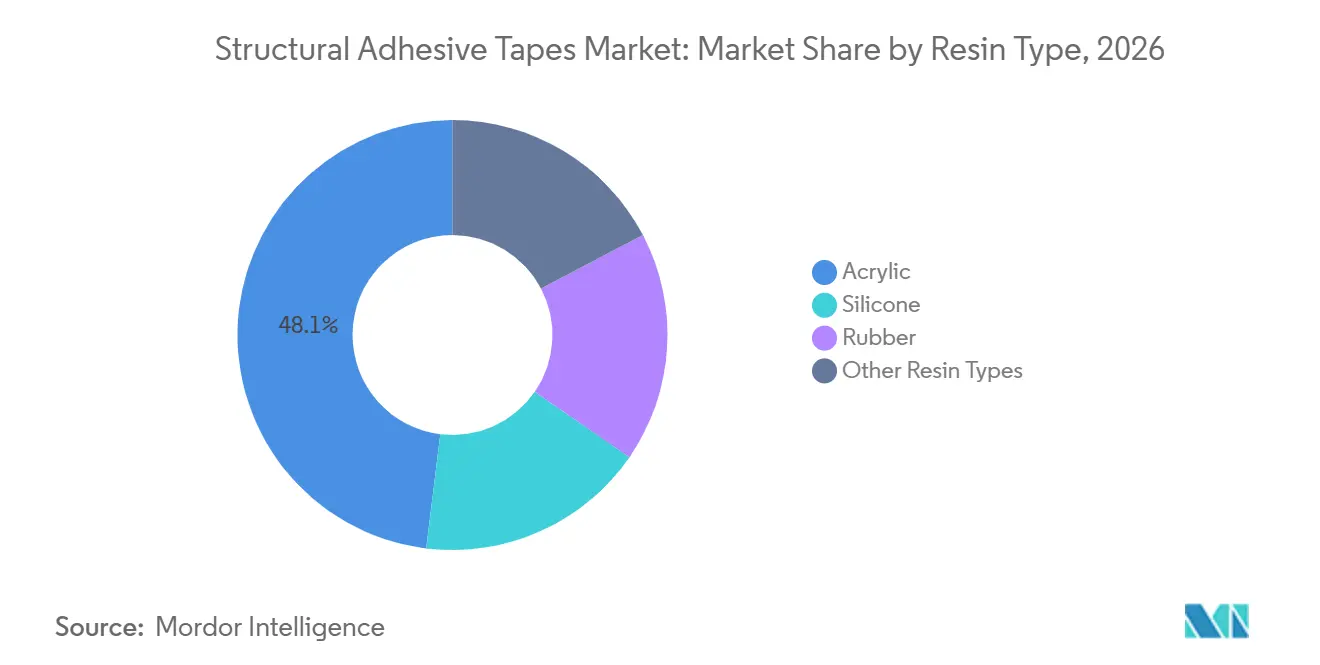
Acrylic Leads, While Silicone Supports High-Temperature ApplicationsAcrylic held 48.06% of the structural adhesive tapes market share in 2026, while silicone is projected to advance at a 5.21% CAGR through 2032. Acrylic remains widely used because it balances durability, ultraviolet resistance, and cost across automotive trim, building facades, and electronics assembly. Silicone demand is supported by electric vehicle battery thermal management and aerospace applications where service temperatures can exceed 150 °C. The resin offers performance reliability where acrylic formulations may be less suitable. Avery Dennison Corporation offers silicone-acrylic hybrid tape constructions for electric vehicle battery applications, including flame-retardant and dielectric functions. This development reflects more frequent use of multi-chemistry designs for defined performance requirements.
Rubber-based systems continue to serve applications that require high initial tack and flexibility at low temperatures. Their use faces pressure from acrylic formulations that combine suitable adhesion with stronger weathering performance. Polyurethane and other resin systems are used where elastic deformation tolerance is necessary. The strong position of acrylic also creates exposure to acrylic monomer supply constraints and input-cost inflation. Producers are, therefore, exploring renewable and recycled-content materials as part of a product-development strategy. SEKISUI CHEMICAL CO., LTD. introduced bio-based polyethylene terephthalate and foam tape constructions in 2025, showing how resin selection is also becoming a supply-chain consideration.

By Backing Material:
Foam Supports Conformability While Woven and Non-Woven Materials Gain UseFoam held 30.58% of the structural adhesive tapes market share in 2026, while woven and non-woven are projected to advance at a 5.57% CAGR through 2032. Foam is used because it conforms to uneven surfaces, reduces vibration, and distributes stress through a viscoelastic bond layer. These properties support its use in automotive, appliance, and industrial assemblies. Woven and non-woven materials are gaining use in aerospace interiors and medical devices, where fiber-reinforced carriers combine tensile strength with flexibility. Nitto Denko Corporation's 5790 Series Per- and Polyfluoroalkyl Substances (PFAS)-Free Foam Double Coated Tapes use modified acrylic adhesive and have been tested to ISO 29862 for peel adhesion. The product shows how foam products are being updated for changing material and compliance expectations.
Polyethylene terephthalate and polypropylene backings are used where dimensional stability and chemical resistance are important. These requirements are common in electronics and industrial assembly. Paper backings remain relevant for applications that do not require high structural performance. Polyvinyl chloride backings are receiving greater attention as European policy discussions examine restrictions related to polyvinyl chloride and its additives. Some European buyers are qualifying polyethylene terephthalate and polypropylene alternatives before compliance requirements change. The structural adhesive tapes market is, therefore, moving toward backing materials that can meet both functional and regulatory needs.
By Product Type:
Double-Sided Bonding Leads Structural Joining ApplicationsDouble-sided bonding held 57.13% of the structural adhesive tapes market share in 2026 and is projected to advance at a 5.79% CAGR through 2032. The format joins 2 substrates without visible mechanical fasteners, localized stress points, or galvanic corrosion paths. Its broad use across electric vehicle production, electronics assembly, and architectural glazing supports both current demand and forecast growth. Manufacturers are also specifying double-sided tapes as engineered assemblies that can be die-cut to defined geometries. Nitto Denko Corporation received US Patent 12,398,295 in August 2025 for a double-sided pressure-sensitive adhesive tape with a wide-temperature storage modulus profile. The patent addresses impact-absorption requirements in low-temperature assembly settings.
Single-sided bonding remains useful for surface protection, cable wrapping, and wire-harness applications. It supports designs where bonding is needed on only 1 surface. Double-sided systems typically face more demanding original equipment manufacturer qualification requirements because they are used in structural joints. Those requirements can create switching costs once a product is validated. This can support stronger pricing for application-specific double-sided products than for broad, commodity-oriented tape formats. TESA SE's product range for battery energy storage shows the continued development of products for insulation and protection alongside structural joining.
By Technology:
Hot-Melt Combines Solvent-Free Processing with Automated ProductionHot-melt held 37.67% of the structural adhesive tapes market share in 2026 and is projected to advance at a 5.98% CAGR through 2032. The technology combines solvent-free processing, bond formation after cooling, and compatibility with high-speed coating lines. These features support its use across several industrial applications. Solvent-based systems remain relevant where high shear strength and chemical resistance are required. Their use is declining in some applications as volatile organic compound restrictions become more stringent. Water-based technology serves paper and light-board bonding applications that require environmental performance and practical processing.
Reactive tapes include thermally activated, ultraviolet-cured, and electrically debondable products. Lohmann's DuploTEC SBF epoxy tapes can cure from 130 °C and provide structural bonding with tape-based handling. Tesa SE heat-activated films activate above 110 °C and produce irreversible cross-linking for demanding industrial bonds. Reactive products can face longer qualification cycles, but they offer performance needed for automotive lightweighting programs. The structural adhesive tapes industry is adopting these products where production processes can accommodate controlled activation. Their use is likely to expand as manufacturers place more weight on precise bonding performance and end-of-life disassembly options.
By End-Use Industry:
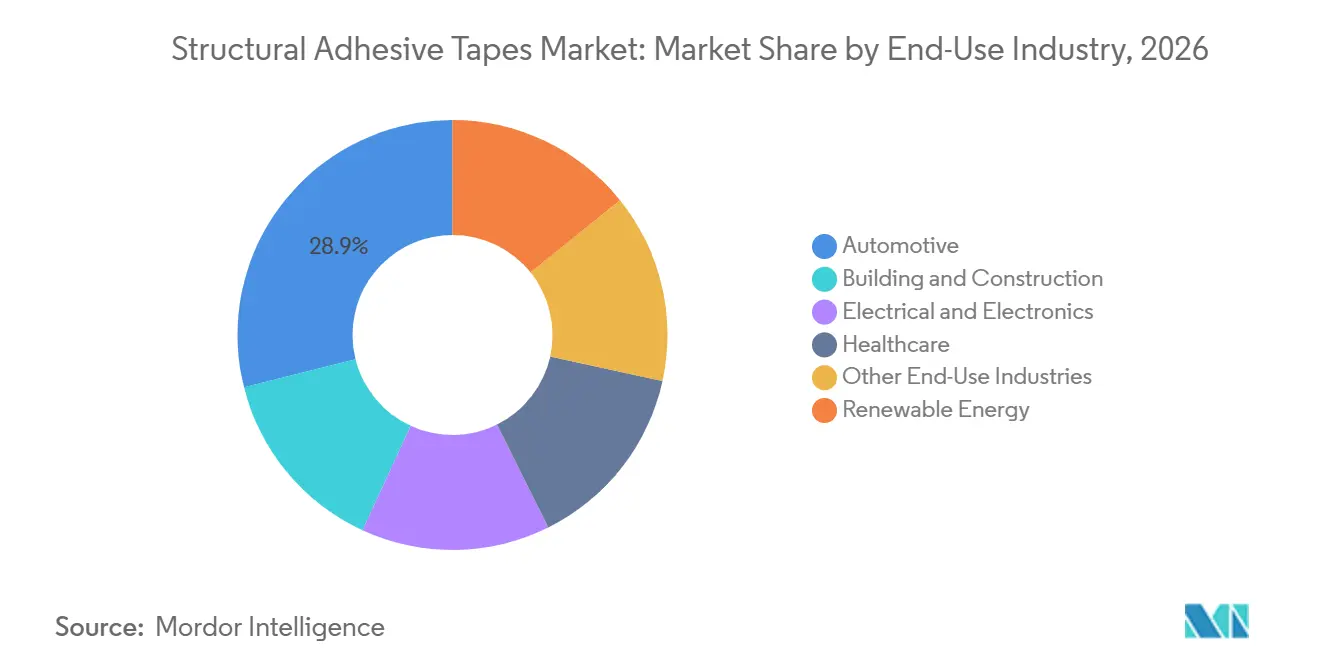
Automotive Provides Scale While Electrical and Electronics Records Faster GrowthAutomotive held 28.91% of the structural adhesive tapes market share in 2026, while electrical and electronics are projected to advance at a 6.14% CAGR through 2032. Automotive demand is based on replacing mechanical fasteners to reduce weight, improve noise-vibration-harshness performance, and limit corrosion in body structures. Electric vehicle battery assembly has widened the number of bonding, insulation, and protection applications in each vehicle. Electrical and electronics are growing faster as devices become smaller and require more tape functions for displays, batteries, and heat management. LINTEC Corporation reported that its semiconductor-related adhesive tape sales volume grew faster than global semiconductor wafer shipments in the year ended March 31, 2025. Demand for high-bandwidth memory linked to generative artificial intelligence contributed to this pattern.
Building and construction are an important demand base for structural glazing and prefabricated construction. Tapes can replace wet sealants and mechanical fasteners on exterior building surfaces. Healthcare and renewable energy have specialized needs for biocompatibility and ultraviolet durability, respectively. These conditions raise the entry requirements for commodity suppliers. General industrial assembly and consumer appliances provide a broader base of demand across the structural adhesive tapes market.
Geography Analysis
Asia-Pacific
Asia-Pacific held 36.49% of the structural adhesive tapes market share in 2026 and is projected to advance at a 6.02% CAGR through 2032. China supports regional demand through its electric vehicle, consumer electronics, and photovoltaic manufacturing base. India is expanding electronics assembly capacity, while South Korea contributes semiconductor and display production. Vietnam and Thailand are increasing their role as electronics manufacturing locations as brands diversify supply chains. SEKISUI CHEMICAL CO., LTD. presented EV Protect 4006SFR and EV Seal Series at Japan's Automotive Engineering Exposition 2026 for battery protection, performance evaluation, and thermal insulation uses. Japan also remains important for semiconductor process tapes, supported by the production and research presence of LINTEC Corporation and Nitto Denko Corporation.
North America
North American demand is supported by automotive reshoring, solar and battery manufacturing, and aerospace and defense programs that use high-performance reactive tapes. The region also has a large base of building and construction applications where tape systems can replace wet sealants. Vybond became an independent company in February 2025 following Nautic Partners' acquisition of the Specialty Tapes business from Berry Global Group, Inc. The company operates more than 1,500 stock-keeping units for aerospace, automotive, medical, and construction customers. Canada and Mexico support regional automotive supply chains, while Mexico is also active in electronics assembly. Modular and prefabricated construction creates additional demand where dissimilar materials make welding and mechanical fastening less suitable.
Europe, South America, and Middle East and Africa
Europe is a significant demand center because of Germany's automotive manufacturing base, Nordic industrial applications, and building renovation activity. Lohmann presented UV-LUX structural bonding technology for electric vehicle batteries at Battery Show Europe 2026 in Stuttgart. DVS 3320-3, published in Germany in November 2025, establishes quality requirements for permanent pressure-sensitive adhesive tape bonds in structural joints. France, the United Kingdom, and Italy also contribute through industrial and construction applications. Brazil supports South American demand through industrial manufacturing and automotive production, while Argentina provides assembly activity. Saudi Arabia's industrial diversification and South Africa's commercial construction activity are creating early-stage opportunities in the Middle East and Africa, particularly in facade applications.
Competitive Landscape
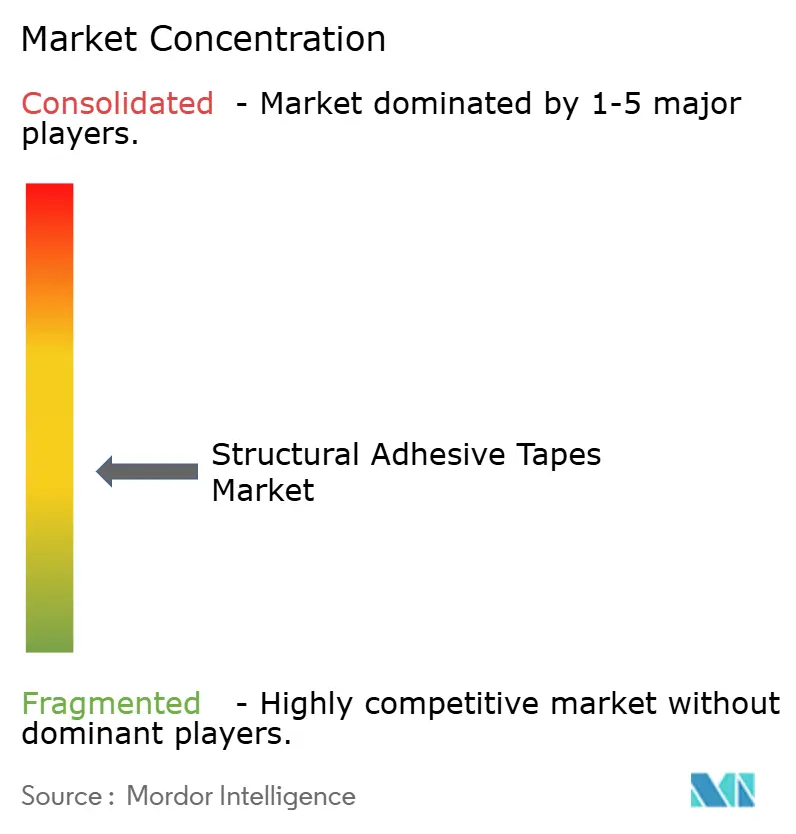
The structural adhesive tapes market is moderately concentrated, with the top five players including 3M, Nitto Denko Corporation, tesa SE, Avery Dennison Corporation, and LINTEC Corporation. These companies have broad product portfolios and long qualification histories in automotive and electronics uses. Lohmann, LINTEC Corporation, and Sika AG compete through application-specific offerings such as reactive bonding films, semiconductor processing tapes, and heat-expandable structural tapes. The market structure also leaves room for producers that can provide rapid customization in defined regional applications. Product qualification, process knowledge, and intellectual property remain important barriers to entry. The structural adhesive tapes market is becoming more focused on products that deliver several functions within one assembly step.
Avery Dennison Corporation completed the acquisition of W.F. Taylor Holdings, Inc. in October 2025 for USD 390 million, expanding its specialty adhesives portfolio. Henkel AG & Co. KGaA demonstrated structural adhesive debonding up to 12 MPa at Battery Show Europe 2025, addressing repair and recycling needs for battery applications. Nitto Denko Corporation's work on electrically debondable adhesive compositions also reflects the growing interest in repairable bonding systems[2]. These moves show that performance requirements now include planned disassembly as well as bond strength. Suppliers with electrochemical debonding, thermal management, and electrical insulation capabilities can address a wider range of battery applications.
3M launched the VHB Max Series in 2025 and 2026 with overlap shear strength up to 3.24 MPa, targeting transportation, construction, appliances, and electronics as alternatives to rivets, welds, and liquid structural adhesives. Tesa SE expanded its wire-harness protection portfolio in August 2025 with products for crash, abrasion, and fire protection in electric vehicles. Vybond's 2025 separation from Berry Global Group, Inc. created an independent specialty tape supplier with a broad portfolio across several end-use sectors. These examples show two parallel strategies, such as broader scale through acquisition and focused growth through standalone specialization. Leading companies are investing in products that improve process speed, meet stricter material requirements, and solve battery disassembly challenges. Competition will remain centered on application performance, qualification support, and the capacity to develop products for changing production methods.
Structural Adhesive Tapes Industry Leaders
-
3M
-
Nitto Denko Corporation
-
tesa SE
-
Avery Dennison Corporation
-
LINTEC Corporation
- *Disclaimer: Major Players sorted in no particular order
Structural Adhesive Tapes Market Companies Covered in this Report
- 3M
- Avery Dennison Corporation
- Henkel AG & Co. KGaA
- IPG
- L&L Products
- LINTEC Corporation
- Lohmann
- Nitto Denko Corporation
- Saint-Gobain
- Scapa
- SEKISUI CHEMICAL CO., LTD.
- Sika AG
- Teraoka Seisakusho co.,Ltd.
- tesa SE
- Vybond
Recent Industry Developments in Structural Adhesive Tapes Market
- January 2026: Henkel AG & Co. KGaA completed the acquisition of ATP Adhesive Systems, strengthening its Adhesive Technologies business and expanding its portfolio of high-performance specialty tapes. The acquisition adds water-based, hot-melt, and solvent-based tape technologies serving automotive, electronics, medical, and construction applications, supporting the structural adhesive tapes market through broader bonding solutions and expanded product development capabilities.
- February 2025: Nautic Partners completed its acquisition of Berry Global Group's Specialty Tapes business and launched the standalone business under the Vybond name. Vybond's portfolio includes more than 1,500 products across automotive, aerospace, medical, Heating, Ventilation, and Air Conditioning (HVAC), and building applications, supporting the structural adhesive tapes market by expanding specialized pressure-sensitive bonding solutions and manufacturing capabilities.
Global Structural Adhesive Tapes Market Report Scope
Structural adhesive tapes are high-performance bonding materials designed to join substrates while providing strength, durability, and resistance to mechanical stress. They offer an alternative to conventional fastening methods and support bonding across materials with different surface properties.
The Structural Adhesive Tapes Market is segmented by resin type, backing material, product type, technology, end-use industry, and geography. By resin type, the market is segmented into acrylic, rubber, silicone, and other resin types. By backing material, the market is segmented into polyvinyl chloride (PVC), paper, woven and non-woven, polyethylene terephthalate (PET), foam, polypropylene (PP), and other backing materials. By product type, the market is segmented into single-sided bonding and double-sided bonding. By technology, the market is segmented into solvent-based, water-based, hot-melt, and reactive. By end-use industry, the market is segmented into automotive, building and construction, electrical and electronics, healthcare, renewable energy, and other end-use industries. The report also covers the market size and forecasts for structural adhesive tapes across 15 countries. For each segment, the market sizing and forecasts have been done on the basis of value (USD).
Segmentation Overview
| Acrylic |
| Rubber |
| Silicone |
| Other Resin Types |
| Polyvinyl Chloride (PVC) |
| Paper |
| Woven and Non-Woven |
| Polyethylene Terephthalate (PET) |
| Foam |
| Polypropylene (PP) |
| Other Backing Materials |
| Single-Sided Bonding |
| Double-Sided Bonding |
| Solvent-Based |
| Water-Based |
| Hot-Melt |
| Reactive |
| Automotive |
| Building and Construction |
| Electrical and Electronics |
| Healthcare |
| Renewable Energy |
| Other End-Use Industries |
| Asia-Pacific | China |
| India | |
| Japan | |
| South Korea | |
| ASEAN Countries | |
| Rest of Asia-Pacific | |
| North America | United States |
| Canada | |
| Mexico | |
| Europe | Germany |
| United Kingdom | |
| France | |
| Italy | |
| NORDIC Countries | |
| Rest of Europe | |
| South America | Brazil |
| Argentina | |
| Rest of South America | |
| Middle East and Africa | Saudi Arabia |
| South Africa | |
| Rest of Middle East and Africa |
| By Resin Type | Acrylic | |
| Rubber | ||
| Silicone | ||
| Other Resin Types | ||
| By Backing Material | Polyvinyl Chloride (PVC) | |
| Paper | ||
| Woven and Non-Woven | ||
| Polyethylene Terephthalate (PET) | ||
| Foam | ||
| Polypropylene (PP) | ||
| Other Backing Materials | ||
| By Product Type | Single-Sided Bonding | |
| Double-Sided Bonding | ||
| By Technology | Solvent-Based | |
| Water-Based | ||
| Hot-Melt | ||
| Reactive | ||
| By End-Use Industry | Automotive | |
| Building and Construction | ||
| Electrical and Electronics | ||
| Healthcare | ||
| Renewable Energy | ||
| Other End-Use Industries | ||
| By Geography | Asia-Pacific | China |
| India | ||
| Japan | ||
| South Korea | ||
| ASEAN Countries | ||
| Rest of Asia-Pacific | ||
| North America | United States | |
| Canada | ||
| Mexico | ||
| Europe | Germany | |
| United Kingdom | ||
| France | ||
| Italy | ||
| NORDIC Countries | ||
| Rest of Europe | ||
| South America | Brazil | |
| Argentina | ||
| Rest of South America | ||
| Middle East and Africa | Saudi Arabia | |
| South Africa | ||
| Rest of Middle East and Africa | ||
Key Questions Answered in the Report
What is the size of the structural adhesive tapes market?
The structural adhesive tapes market size was valued at USD 12.20 billion in 2026 and is estimated to grow from USD 12.73 billion in 2027 to reach USD 16.03 billion by 2032, at a CAGR of 4.71% during the forecast period (2027-2032).
What is driving demand for structural adhesive tapes?
Demand is supported by electric vehicle battery assembly, electronics miniaturization, automated bonding, and solar and energy-storage component production.
Which product type held the largest share in 2026?
Double-sided bonding held a 57.13% share in 2026.
Which end-use industry is projected to advance fastest through 2032?
Electrical and electronics are projected to advance at a 6.14% CAGR through 2032 as devices require bonding, insulation, and thermal-management functions.