
Storage Tank Market Size and Share
Market Overview
| Study Period | 2022 - 2032 |
|---|---|
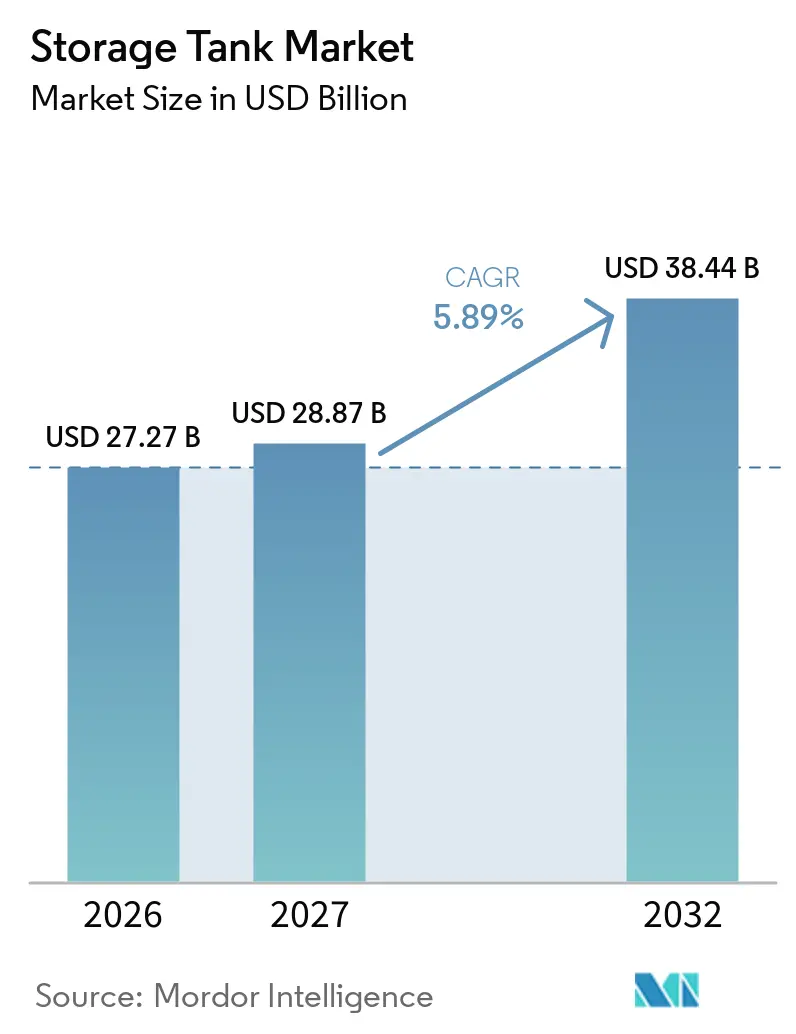
| Market Size (2027) | USD 28.87 Billion |
| Market Size (2032) | USD 38.44 Billion |
| Growth Rate (2027 - 2032) | 5.89 % |
| Fastest Growing Market | North America |
| Largest Market | Asia-Pacific |
| Market Concentration | Low |
Major Players *Disclaimer: Major Players sorted in no particular order Image © Mordor Intelligence. Reuse requires attribution under CC BY 4.0. | |
Storage Tank Market Analysis by Mordor Intelligence
The Storage Tank Market size is expected to grow from USD 27.27 billion in 2026 to USD 28.87 billion in 2027 and is forecast to reach USD 38.44 billion by 2032 at 5.89% CAGR over 2027-2032. Investment in oil, gas, industrial water, and clean-energy storage is supporting demand across several asset classes. Energy security has increased the importance of storage infrastructure for governments and terminal operators. At the same time, water reuse, food processing, and pharmaceutical production are widening the customer base for the storage tank market. Large Engineering, Procurement, and Construction (EPC) contractors continue to serve Liquefied Natural Gas (LNG) and petroleum projects, while regional fabricators compete in bolted, shop-welled, and specialized tanks. Material cost volatility, installation costs, and lengthy approvals remain important limits on project execution.
Key Report Takeaways
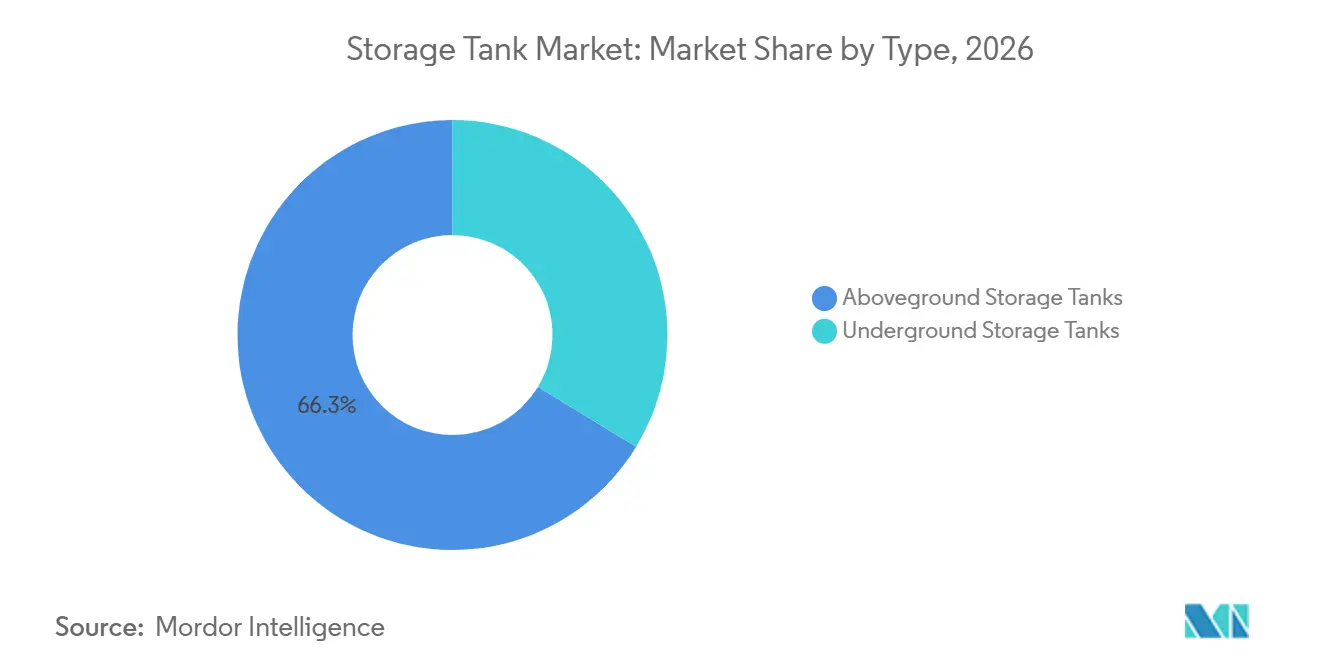
- By type, aboveground tanks held 66.3% of storage tank market share in 2026, while underground tanks are forecast to grow at a 6.8% CAGR through 2032.
- By product hazard class, hazardous tanks held 62.3% of storage tank market share in 2026, while non-hazardous tanks are forecast to grow at a 6.9% CAGR through 2032.
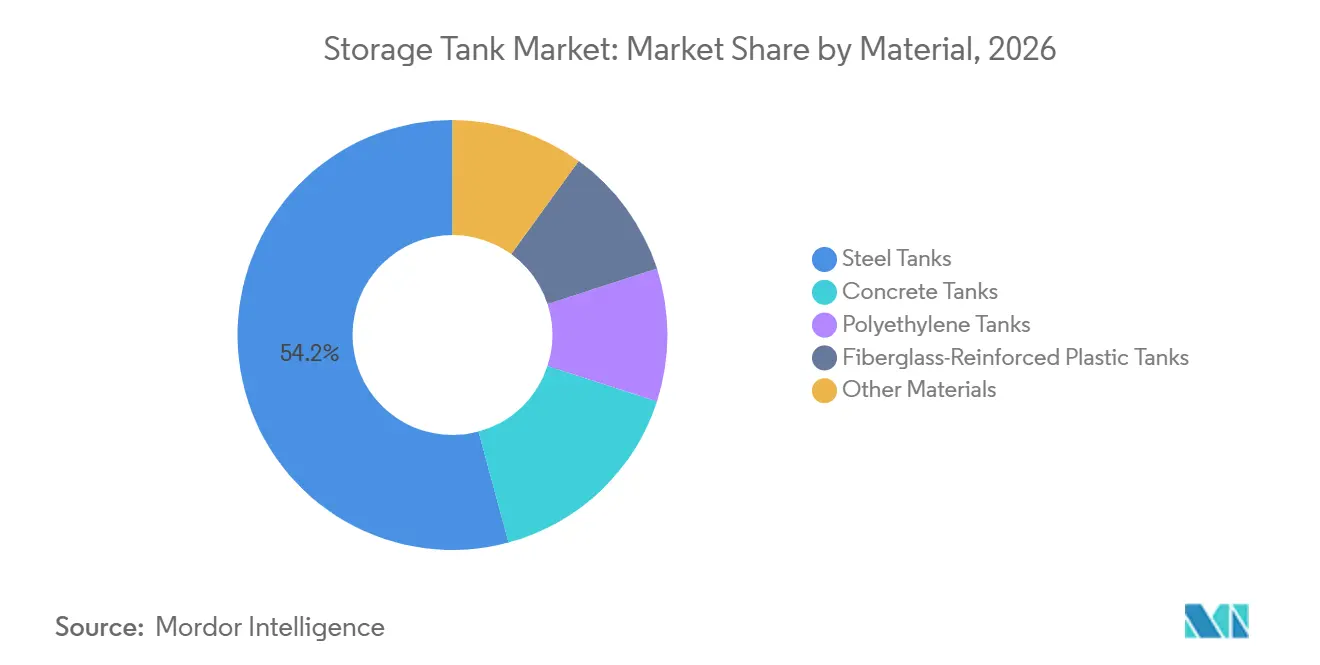
- By material, steel tanks held 54.2% of the storage tank market size in 2026, while polyethylene tanks are forecast to grow at a 7.1% CAGR through 2032.
- By capacity, large tanks accounted for 45.6% of the storage tank market size in 2026, while medium-capacity tanks are forecast to grow at a 6.5% CAGR through 2032.
- By end-use industry, oil and gas held 35.1% of global value in 2026, while water and wastewater are forecast to grow at a 6.4% CAGR through 2032.
- By geography, Asia-Pacific held 36.4% of global value in 2026, while North America is forecast to grow at a 7.5% CAGR through 2032.
Note: Market numbers in this report are based on Mordor Intelligence's proprietary estimation framework, which combines nine months of actuals with Q4 projections for base year 2026.
Market Trends and Insights
Drivers Impact Analysis of Storage Tank Market*
| Driver | (~) % Impact on CAGR Forecast | Geographic Relevance | Impact Timeline |
|---|---|---|---|
| Expansion of Oil, Gas and Petrochemical Storage Infrastructure | +1.7% | Global, concentrated in Asia-Pacific, the Middle East, and North America | Medium term (2-4 years) |
| Water Scarcity, Treatment Capacity and Industrial Water Reuse | +1.1% | Asia-Pacific core, with spillover to the Middle East, Africa, and South America | Medium term (2-4 years) |
| Chemical, Food and Pharmaceutical Capacity Expansion | +0.9% | Asia-Pacific, North America, and Europe | Long term (≥ 4 years) |
| Industrial Modernization and Smart Tank Monitoring Adoption | +0.6% | Global, led by North America and Europe with adoption in Asia-Pacific | Short term (≤ 2 years) |
| Biofuel, Hydrogen and Thermal-Energy Storage Build-Out | +0.5% | Europe, North America, and Japan | Long term (≥ 4 years) |
| Digitized Integrity Management Reducing No-Man Entry Requirements | +0.3% | Global, with stronger regulatory pressure in North America and Europe | Short term (≤ 2 years) |
| Source: Mordor Intelligence | |||
Expansion of Oil, Gas and Petrochemical Storage Infrastructure
Energy security is changing procurement priorities in the storage tank market. Governments and terminal operators are treating crude, LNG, and refined-product storage as essential infrastructure. The United States expanded the Enbridge Ingleside Energy Center from 17 million to 20.5 million barrels under Phase VII, completed in the first quarter of 2026. CB&I received a contract in May 2026 for 5 full-containment concrete LNG tanks at the Commonwealth LNG facility in Louisiana.[1] LNG export projects also require related LPG, ethylene, ammonia, and feedstock storage assets. This wider set of requirements gives the storage tank market a larger pipeline than crude storage alone.
Water Scarcity, Treatment Capacity and Industrial Water Reuse
Water stress is increasing the need for industrial storage and treatment systems. Tanks support collection, treatment, reuse, and dependable supply for petrochemical, mining, and food-processing sites. Saudi Aramco Total Refining And Petrochemical Company (SATORP), Marafiq, Veolia, and Lamar signed a 30-year agreement for a USD 500 million industrial water reuse plant in Jubail, Saudi Arabia.[2] The facility is designed to treat and recycle 8.76 million m³ of petrochemical effluent annually. Veolia delivered a 38,880 m³ per day reclamation station in Vitória that recycles 85% of municipal wastewater for industrial reuse.[3] The storage tank market benefits as reuse plants need vessels throughout the treatment and distribution process.
Chemical, Food and Pharmaceutical Capacity Expansion
Replacement demand is supporting chemical, food, and pharmaceutical tank purchases. Food-contact and pharmaceutical requirements increase the value of compliant stainless steel and food-grade polyethylene vessels. Celltrion announced a KRW 1.23 trillion investment, equal to USD 821 million, in 2 drug-substance plants at Songdo in March 2026. The company is targeting combined drug-substance capacity of 571,000 liters by 2030. These facilities require validated storage and process equipment. The storage tank market therefore gains from higher-value specifications rather than capacity volume alone.
Industrial Modernization and Smart Tank Monitoring Adoption
Remote monitoring is changing how tank owners manage inventory and maintenance. Digital tools can improve utilization and help operators identify maintenance requirements earlier. WIKA's Tank Level Manager monitors more than 100,000 tanks across more than 70 countries, combining dashboards with consumption analysis. Digital integrity management can reduce manual entry requirements and strengthen documentation for regulated sites. These services create recurring revenue opportunities alongside the original vessel sale. Hydrogen, biofuel, and thermal-energy projects also need monitoring systems as their operating requirements become more complex.
Restraints Impact Analysis of Storage Tank Market*
| Restraint | (~) % Impact on CAGR Forecast | Geographic Relevance | Impact Timeline |
|---|---|---|---|
| Steel, Resin and Specialty-Material Cost Volatility | -0.8% | Global, with acute effects in North America and Europe | Short term (≤ 2 years) |
| High Installation, Foundation and Compliance Expenditure | -0.5% | Global, with acute effects in mature markets | Medium term (2-4 years) |
| Cross-Border Tariffs and Local-Content Requirements | -0.4% | North America primarily, with effects in Europe and Asia-Pacific | Short term (≤ 2 years) |
| Long Approval Cycles for Hazardous-Material and Underground Installations | -0.3% | Global, with the strongest effect in North America and Europe | Long term (≥ 4 years) |
| Source: Mordor Intelligence | |||
Steel, Resin and Specialty-Material Cost Volatility
Material pricing remains a major risk for tank fabricators and buyers. Early 2026 increases in high-density polyethylene (HDPE) resin prices raised the cost of polyethylene tank projects. Fiberglass tank costs also rose as benzene and related inputs became more expensive. Glass fiber and resin systems account for a substantial part of Fiber Reinforced Plastic (FRP) tank production cost cost. Cost changes can compress margins when fixed-price bids cannot be revised. They can also shift buyer preferences toward carbon steel or other materials for certain industrial projects.
High Installation, Foundation and Compliance Expenditure
Installed costs include foundations, containment, permitting, inspection, and site work in addition to the vessel. Soft-soil coastal sites can require substantial foundation spending for large field-erected tanks. The U.S. Environmental Protection Agency reported a 60.9% technical compliance rate for underground storage tank systems between April 2025 and March 2026. This gap indicates a significant base of systems that need remediation, upgrade, or replacement. Pharmaceutical projects also require validation, sanitary welding, and controlled construction conditions. These requirements can delay storage tank market projects and can limit purchasing by smaller operators and municipalities.
*Our forecasts treat driver/restraint impacts as directional, not additive. The impact forecasts reflect baseline growth, mix effects, and variable interactions.
Storage Tank Market Segment Analysis
By Type:
Aboveground Assets Remain the Main Revenue BaseAbove-ground tanks held 66.3% of global value in 2026. Their position reflects demand from oil terminals, LNG infrastructure, and large chemical and water projects. The storage tank industry uses aboveground designs where access, inspection, and large capacity are important. Royal Vopak added 180,000 m³ at its GATE terminal in the Netherlands by the third quarter of 2026. The investment supports the continued relevance of above-ground terminal assets in established energy hubs. Fixed-roof and floating-roof designs address different product volatility requirements.
Underground tanks are forecast to grow at a 6.8% CAGR through 2032. They are used where land constraints, safety considerations, and strategic reserves favor subsurface storage. New systems require cathodic protection, secondary containment, automated leak detection, and trained operators under U.S. requirements.[4] These features increase the value of each installation even when unit growth is moderate. The storage tank market has demand for both formats because end uses and site conditions differ. Aboveground tanks remain important for operating visibility, while underground systems support protected storage needs.

By Product Hazard Class:
Non-Hazardous Uses Grow FasterHazardous tanks held 62.3% of global value in 2026. Oil, gas, chemicals, and petrochemicals account for much of this installed base. These applications require strict design and safety practices, which support replacement demand. Hazardous vessels need high levels of containment and operating control. Their large installed base keeps them central to the storage tank market. The segment remains closely tied to investment in energy and process facilities.
Non-hazardous tanks are forecast to grow at a 6.9% CAGR through 2032. Water treatment, food, beverage, and pharmaceutical applications are broadening the demand base. Specification upgrades can replace older vessels with stainless steel or food-grade polymer equipment. This work raises the importance of product certification and sanitary design. The storage tank industry can gain higher margins where fabricators meet these requirements. The shift also reduces reliance on hazardous-product applications alone.
By Material:
Steel Leads While Polyethylene Gains GroundSteel tanks held 54.2% of global value in 2026. They are used for large petroleum, LNG, and industrial projects that need structural strength and high capacity. CB&I commissioned 2 all-steel 60,000 m³ full-containment LNG tanks at the LNGPH Ilijan facility in the Philippines in September 2026. The project used 9% nickel steel for both containment walls. Such designs show that steel continues to serve demanding cryogenic applications. The storage tank market retains steel as its primary large-asset material.
Polyethylene tanks are forecast to grow at a 7.1% CAGR through 2032. Corrosion resistance and lower ownership cost support their use in water treatment, agricultural chemicals, and pharmaceutical settings. Concrete supports high-volume water utility and LNG applications where structural mass is required. FRP remains relevant for underground petroleum and chemical handling, where corrosion resistance can justify a higher initial cost. Material selection depends on the stored product, tank capacity, site conditions, and required certification. The storage tank market is therefore becoming more dependent on multi-material production capabilities.
By Capacity:
Large Projects Lead Value and Medium Tanks Lead GrowthLarge tanks accounted for 45.6% of global value in 2026. Their share reflects high-value field-erected assets used at oil, gas, and LNG terminals. GTT received an order in June 2026 to design 3 onshore LNG tanks of 240,000 m³ each for PipeChina Group's Yuedong LNG Terminal. The tanks will use GTT's GST membrane full-containment technology. These projects keep large assets important to the storage tank market. They also require specialized engineering and construction capabilities.
Medium-capacity tanks are forecast to grow at a 6.5% CAGR through 2032. Food and beverage production, pharmaceutical support storage, and municipal water projects support this demand. Buyers in the 20,000 to 200,000 liters range can evaluate HDPE, glass-fused-to-steel, and FRP options. This comparison has increased competition among material suppliers. Small tanks remain important for distributed agricultural, pharmaceutical, and light industrial uses. The storage tank industry serves a wide range of capacities because users have different logistics and processing needs.
By End-Use Industry:
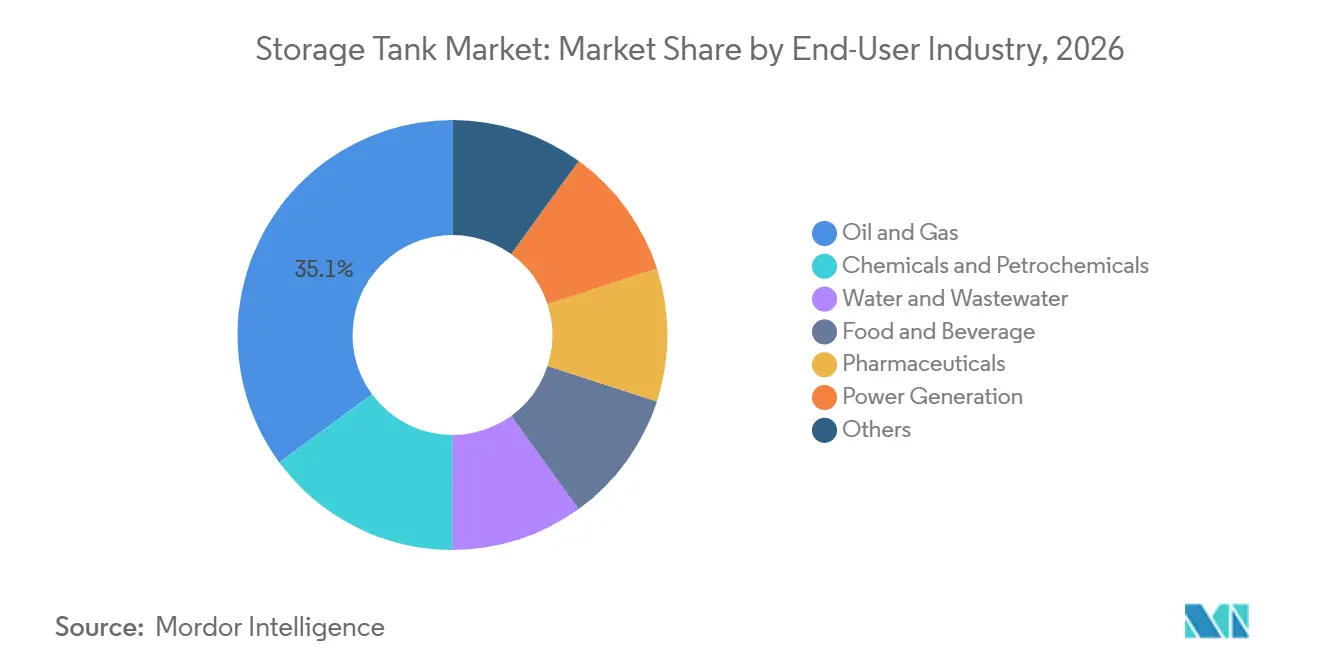
Energy Leads While Water Adds DemandOil and gas held 35.1% of global value in 2026. Crude storage, LNG terminals, and refined-products networks sustain this position. The segment requires large assets and experienced engineering contractors. It remains a core source of revenue for the storage tank market. Energy security and export infrastructure continue to support demand for these systems. Chemicals and petrochemicals provide additional requirements for feedstock and finished product storage.
Water and wastewater is forecast to grow at a 6.4% CAGR through 2032. Reuse systems, municipal treatment plants, and industrial water management are expanding the segment. STEAG Iqony commissioned a EUR 30 million, equal to USD 33 million, district-heating storage tank in Gelsenkirchen in July 2026. The 57-meter tank stores 31 million liters of hot water at temperatures up to 115°C. Food, beverage, and pharmaceutical customers also need compliant tanks as processing capacity expands. The storage tank market is thus supported by a broader set of end users than oil and gas alone.
Geography Analysis
APAC Storage Tank Market
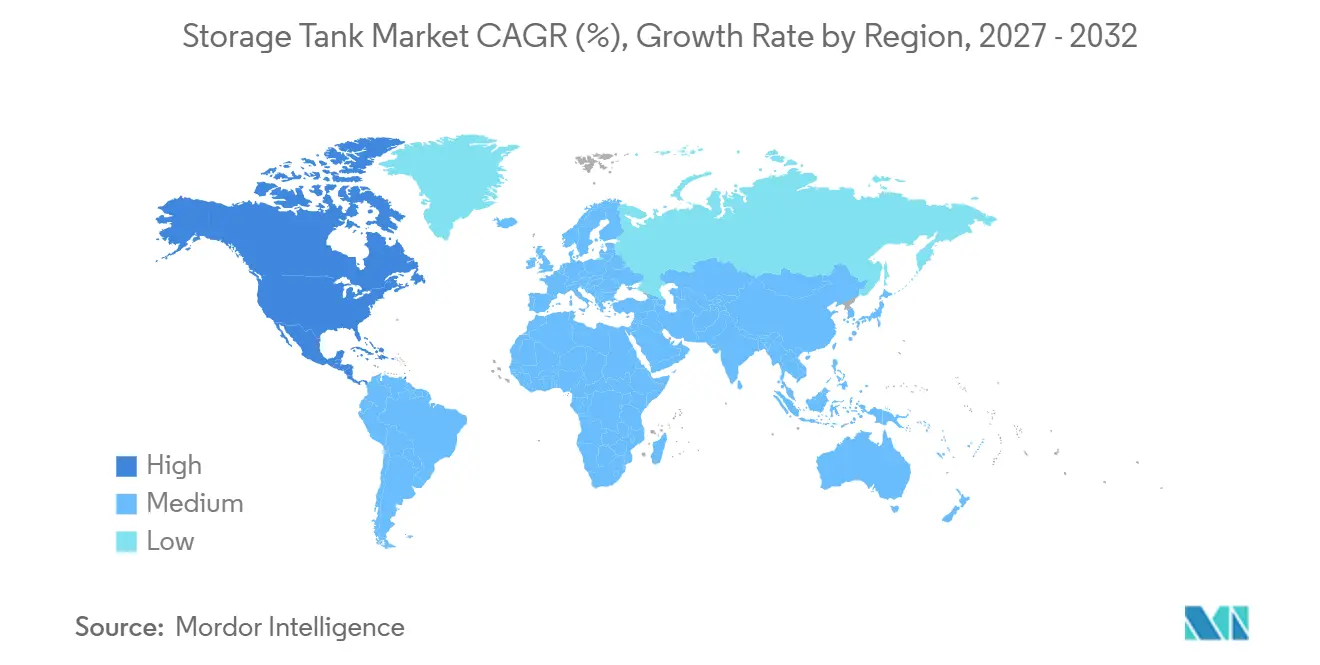
Asia-Pacific held 36.4% of the global storage tank market in 2026. The region benefits from strategic petroleum reserve programs, LNG import development, and industrial expansion. China, India, and Japan have demand across oil and gas, chemicals, water, and food processing. Japan is developing the Kawasaki Liquid Hydrogen (LH2) Terminal, which includes a 50,000 m³ commercial-scale liquid hydrogen tank. Kawasaki Heavy Industries began factory manufacturing for the tank in 2025. The project shows the region's role in cryogenic storage development. Asia-Pacific also has broad demand for conventional storage infrastructure.
North America Storage Tank Market
North America is forecast to grow at a 7.5% CAGR through 2032. LNG export investment along the U.S. Gulf Coast is concentrating demand for large storage systems. CB&I's Commonwealth LNG contract shows the scale of current construction activity in Louisiana. Replacement of aging assets and regulatory upgrades also support demand in the storage tank market. Water infrastructure spending adds a separate source of project activity.
EMEA and South America Storage Tank Market
Europe has demand from energy terminals, industrial heat projects, and specialized manufacturing. The Middle East and Africa need storage for petroleum, industrial water, and port operations. Veolia's Vitória reclamation station demonstrates the role of water reuse in South American industrial corridors. Europe also has a growing role in hydrogen and thermal storage projects. These distinct regional needs reduce reliance on any single geography in the storage tank market.
Competitive Landscape
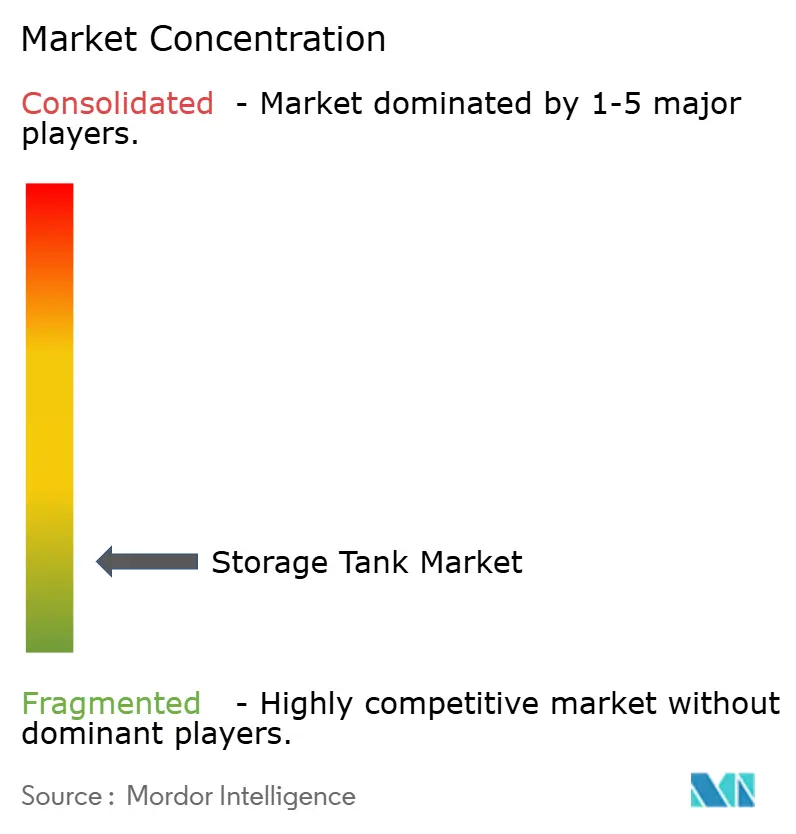
The storage tank market is fragmented and has a group of large Engineering, Procurement, and Construction (EPC) contractors in Liquefied Natural Gas (LNG) and petroleum projects. A broader group of regional fabricators serves bolted, shop-welded, and specialized tank applications. CB&I has designed and built more than 250 LNG tanks worldwide. Its 2026 projects in North America and Asia-Pacific demonstrate its position in large cryogenic storage. CST Industries operates across bolted, glass-fused-to-steel, and Fiber Reinforced Polymer (FRP) tanks in 125 countries. The market structure therefore differs by project scale, material, and end use.
CST Industries acquired Snyder Industries in March 2025 to add fiberglass aboveground storage tanks to its portfolio. The company also acquired Ostsee Tank Solutions GmbH to expand manufacturing and service capability in Europe. These moves support a multi-material supply model for customers. Kawasaki Heavy Industries is pursuing commercial-scale liquid hydrogen storage at its Kawasaki Liquid Hydrogen (LH2) Terminal. Toyo Kanetsu is developing large-scale liquid hydrogen tank technology with New Energy and Industrial Technology Development Organization (NEDO) support. These programs place cryogenic engineering at the center of competitive differentiation.
Digital services are becoming a further area of competition. Zhongneng Huajian launched its Tank Health Guardian platform in January 2026 for predictive corrosion analysis, leak detection, and maintenance scheduling. Fabricators that combine vessels with monitoring and compliance support can build recurring service revenue. Companies without these capabilities may face pressure in lifecycle service contracts. The storage tank market remains fragmented outside of large EPC projects. No combined market share for the leading companies was provided, so a score based on the prescribed market-share thresholds cannot be substantiated.
Storage Tank Industry Leaders
-
CST Industries, Inc.
-
McDermott International, Ltd.
-
PermianLide
-
Highland Tank & Manufacturing Company, Inc.
-
Fox Tank Company
- *Disclaimer: Major Players sorted in no particular order
Storage Tank Market Companies Covered in this Report
- Caldwell Tanks, Inc.
- Containment Solutions, Inc.
- CST Industries, Inc.
- DN Tanks, Inc.
- Fox Tank Company
- Highland Tank & Manufacturing Company, Inc.
- ISHII IRON WORKS CO., LTD.
- McDermott International, Ltd
- MEKRO Sp. z o.o.
- Modern Welding Company, Inc.
- Motherwell Bridge Industries Limited
- PermianLide
- Pfaudler, Inc.
- Snyder Industries, Inc.
- Superior Tank Co., Inc.
- Synalloy Corporation
- Tank Connection, LLC
- Tarsco, Inc.
- Toyo Kanetsu K.K.
- ZCL Composites Inc.
Recent Industry Developments in Storage Tank Market
- September 2026: CB&I and AG&P Industrial commissioned two 60,000 m³ all-steel full-containment LNG tanks at the LNGPH Ilijan LNG Facility in the Philippines. The facility was the first large-scale onshore LNG storage facility in the country and the first globally to use 9% nickel steel for both inner and outer containment walls. The project was completed with zero lost-time incidents over more than 1 million work hours.
- September 2026: EWE awarded Bilfinger a contract for hydrogen treatment infrastructure at the Huntorf facility in Germany. The project is part of EWE's Clean Hydrogen Coastline initiative, which has received funding under the European Union's Important Projects of Common European Interest (IPCEI) program. The facility is scheduled to connect to the German hydrogen core network and commence operations in 2028.
- August 2026: ABB Japan Bailey confirmed the supply of control systems for Kawasaki Heavy Industries' Kawasaki Liquid Hydrogen (LH2) Terminal in Kawasaki City. The terminal includes a 50,000 m³ liquid hydrogen storage tank and is described as the world's first commercial-scale liquid hydrogen base. Demonstration operations are planned from fiscal year 2028, funded by the New Energy and Industrial Technology Development Organization (NEDO).
- June 2026: GTT received an order from China Chengda Engineering to design three 240,000 m³ onshore LNG storage tanks for PipeChina Group's Yuedong LNG Terminal in Guangdong. The tanks use GTT's GST membrane full-containment technology and are identified as the largest onshore LNG tanks using this technology. Delivery is scheduled for the fourth quarter of 2028.
Global Storage Tank Market Report Scope
The storage tank market encompasses the global commercial and industrial activities involved in the design, engineering, manufacturing, installation, and maintenance of stationary or mobile containment vessels used to hold fluids, gases, or bulk solids. This market supports modern industrial infrastructure by facilitating resource availability, supply chain logistics, and environmental protection across public and private domains.
The global storage tank market is segmented by type, which includes aboveground and underground storage tanks. In terms of hazard class, the market is divided into Hazardous Storage Tanks, and Non-Hazardous Storage Tanks. The material segment consists of Steel Tanks, Concrete Tanks, Polyethylene Tanks, Fiberglass-Reinforced Plastic Tanks, and Other Materials. Based on capacity, the market is categorized into small, medium, and large storage tank. The end-use segment covers industry applications across Oil and Gas, Chemicals and Petrochemicals, Water and Wastewater, Food and Beverage, Pharmaceuticals, Power Generation, and Others. The report also covers the market size and forecasts for the global storage tank market across 26 countries in key regions. For each segment, the market sizing and forecasts have been provided on the basis of value (USD).
Segmentation Overview
| Aboveground Storage Tanks |
| Underground Storage Tanks |
| Hazardous Storage Tanks |
| Non-Hazardous Storage Tanks |
| Steel Tanks |
| Concrete Tanks |
| Polyethylene Tanks |
| Fiberglass-Reinforced Plastic Tanks |
| Other Materials |
| Small Tanks |
| Medium Tanks |
| Large Tanks |
| Oil and Gas |
| Chemicals and Petrochemicals |
| Water and Wastewater |
| Food and Beverage |
| Pharmaceuticals |
| Power Generation |
| Others |
| North America | United States |
| Canada | |
| Mexico | |
| Europe | Germany |
| France | |
| Italy | |
| Spain | |
| United Kingdom | |
| Poland | |
| Russia | |
| Rest of Europe | |
| Asia-Pacific | China |
| India | |
| Japan | |
| South Korea | |
| Australia | |
| Indonesia | |
| Vietnam | |
| Thailand | |
| Rest of Asia-Pacific | |
| South America | Brazil |
| Argentina | |
| Chile | |
| Rest of South America | |
| Middle East and Africa | Saudi Arabia |
| United Arab Emirates | |
| Egypt | |
| South Africa | |
| Morocco | |
| Rest of Middle East and Africa |
| By Type | Aboveground Storage Tanks | |
| Underground Storage Tanks | ||
| By Product Hazard Class | Hazardous Storage Tanks | |
| Non-Hazardous Storage Tanks | ||
| By Material | Steel Tanks | |
| Concrete Tanks | ||
| Polyethylene Tanks | ||
| Fiberglass-Reinforced Plastic Tanks | ||
| Other Materials | ||
| By Capacity | Small Tanks | |
| Medium Tanks | ||
| Large Tanks | ||
| By End-Use Industry | Oil and Gas | |
| Chemicals and Petrochemicals | ||
| Water and Wastewater | ||
| Food and Beverage | ||
| Pharmaceuticals | ||
| Power Generation | ||
| Others | ||
| By Geography | North America | United States |
| Canada | ||
| Mexico | ||
| Europe | Germany | |
| France | ||
| Italy | ||
| Spain | ||
| United Kingdom | ||
| Poland | ||
| Russia | ||
| Rest of Europe | ||
| Asia-Pacific | China | |
| India | ||
| Japan | ||
| South Korea | ||
| Australia | ||
| Indonesia | ||
| Vietnam | ||
| Thailand | ||
| Rest of Asia-Pacific | ||
| South America | Brazil | |
| Argentina | ||
| Chile | ||
| Rest of South America | ||
| Middle East and Africa | Saudi Arabia | |
| United Arab Emirates | ||
| Egypt | ||
| South Africa | ||
| Morocco | ||
| Rest of Middle East and Africa | ||
Key Questions Answered in the Report
What is the projected value of the global storage tank market by 2032?
The global storage tank market is forecast to reach USD 38.44 billion by 2032. It is projected to grow from USD 27.27 billion in 2026 at a 5.89% CAGR through the forecast period.
Which storage tank type held the largest share in 2026?
Aboveground tanks led with 66.3% of global value in 2026. Their use in oil terminals, LNG infrastructure, and large chemical and water projects supports their current position.
Which material is expected to grow fastest through 2032?
Polyethylene tanks are forecast to grow at a 7.1% CAGR. Their corrosion resistance and lower ownership cost support applications in water treatment, agricultural chemicals, and pharmaceutical facilities.
Which end use is expanding fastest through 2032?
Water and wastewater is forecast to grow at a 6.4% CAGR. Industrial reuse systems, municipal treatment plants, and water management projects are increasing the need for related storage assets.
Which region is expected to grow fastest through 2032?
North America is forecast to grow at a 7.5% CAGR. LNG export construction, water infrastructure projects, and replacement of aging systems support the region's demand.
What factors constrain new storage tank projects?
Resin and steel cost changes can weaken project economics. Foundation work, containment requirements, compliance costs, trade requirements, and approval timelines can also delay project delivery.